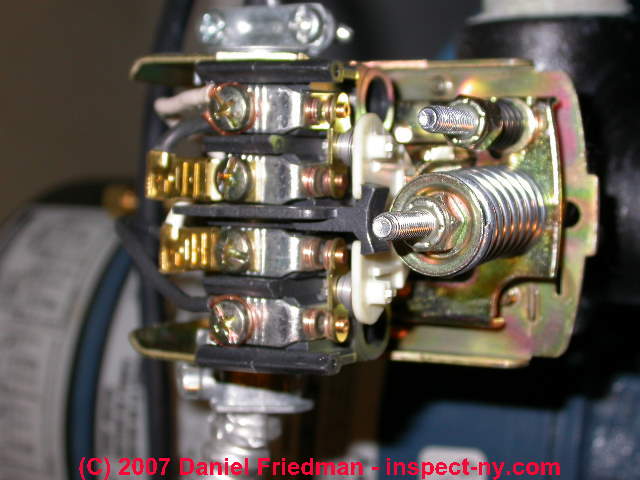
 Water Pump Pressure Control Switch Adjustment FAQs

- POST a QUESTION or COMMENT about how to adjust or set the Water Pump Pressure Switch - how set the water pump cut in and cut out pressures
More water or well pump pressure control switch FAQs:
Second set of questions and answers on how to adjust the pressure control switch for a water or well pump.
This article series answers commonly-asked questions about how to adjust a well pump or water pump pressure control switch. We provide pump pressure setting advice, procedures & questions & answers about adjusting the pump switch.
InspectAPedia tolerates no conflicts of interest. We have no relationship with advertisers, products, or services discussed at this website.
- Daniel Friedman, Publisher/Editor/Author - See WHO ARE WE?
FAQs on how to set the water pump pressure switch cut-in and cut-out pressures
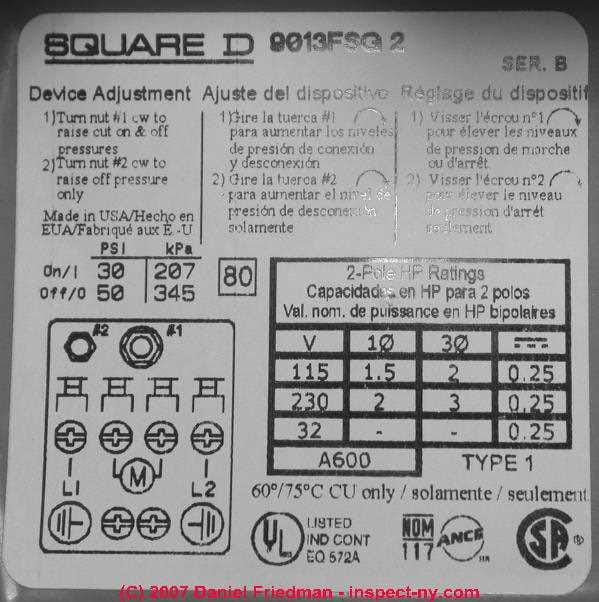
These questions were posted originally at WATER PRESSURE CONTROL SWITCH ADJUSTMENTS - be sure to see that article if you need to adjust the settings on your pressure control switch for your water pump or well pump.
Also see our index to all water pump control switch FAQs at WATER PUMP PRESSURE SWITCH REPAIR FAQs
Watch out: SAFETY WARNING OF FATAL SHOCK HAZARD: if you remove the cover of the pump pressure control switch you can get access to the two nuts that adjust the operating pressures of the water pump.
But watch out! There are also live electrical contacts exposed in this area. If you touch them, especially being near water piping, there is a serious risk of death by electrocution.
Watch what you touch, or have a professional plumber or electrician do this job for you.
The individual well pump control switch repair article links below explain exactly how to set the water pump pressure switch, where the adjustments are located (the large and small nut found under the switch cover), which way to turn the nuts to increase or decrease the pump cut-in and cut-out pressures, and other pressure switch troubleshooting and repair procedures
The individual well pump control switch repair article links below explain exactly how to set the water pump pressure switch, where the adjustments are located (the large and small nut found under the switch cover), which way to turn the nuts to increase or decrease the pump cut-in and cut-out pressures, and other pressure switch troubleshooting and repair procedures
Article Index
- IRRIGATION PUMP SWITCH PROBLEMS
- LOW WATER PRESSURE
- PRESSURE ADJUSTMENT RANGE
- PRESSURE EXCEEDS SWITCH SETTING
- PRESSURE SWITCH NUT ADJUSTMENT - which way do you turn the larger or smaller adjustment nut?
- PRESSURE SWITCH DIFFERENTIAL NUT ADJUSTMENT - adjusting the gap between CUT-IN and CUT-OUT
- WATER PRESSURE TOO HIGH - may be unsafe or cause leaks
- WEAK WATER PRESSURE
...
Water Pressure Control Switch Adjustment Range
How can I get a pressure switch that shuts off at a pressure above 50 psi?
I have an artiesan well 600 ft deep and would like to increase my water pressurs. I have a 1hp submersable pump with a 30 gal bladder tank.
Someone told me that they mfg a swith with a higher on/off pressure paramiter, is this true.
I currently have a swith that is a 30/50 on/off. Can I increase my pressure with a higher swith, thanks Ron. On 2014-07-16 by Ron Brown -
by (mod) - A 30/50 switch can be set higher but watch out for burst pipes or leaks
Ron,
Most water pressure control switches can be adjusted within a range, allowing you to up your cut-out and cut-in pressures above the factory 30/50 cut-in / cut-out pressures.We explain how to do this
at WATER PRESSURE REGULATOR ADJUSTMENT
Watch out: However you need to watch out: setting the pressure too high may
1. cause the pump to run indefinitely if the pump can't reach the new high pressure
2. cause plumbing leaks
Be sure that your water pressure tank has an appropriate pressure-relief valve installed.Dan
I need help getting my water pressure right.
I got the air pressure in the tank at 28 PSI and I need help and getting my water pressure at 30 cut in or cut on.
Right now my water pressure is reading 52 PSI is it supposed to be at 30? I need some help clarifying that thank you On 2018-01-17 by Ruben
Suggestions by (mod) - your pressure switch normal range: 30-50 psi is not precise
Ruben
With a 30/50 CUT-IN / CUT-OUT water pressure switch, when you run water and power is on to the pump you should see and hear the pump turn ON when the water pressure drops to approximately 30 psi. Watch the pressure gauge on your tank.
When you then turn OFF water in the home the pump will continue to run up to the CUT OFF pressure of approximately 50 psi.
If you're within a couple of PSI of those numbers your system should be fine. This is not absolutely precise lab grade equipment.
...
Pump used for lawn irrigation shuts down after a minute but I can force it to run.
I use my pump for irrigation for my lawn. Lately, The pump engages and provides enough pressure for the sprinkler heads to start.
After about 1 minute, the pressure switch cuts out and turns the pump off. If I go to the switch and hold up the lever on the left side, the pump engages again and holds pressure 30-40 psi for the remainder of the cycle. Bad switch? Any help is appreciated, thanks. - Dean G 8/20/11
Additionally, no adjustments have been made since the system was installed 4 years ago. It has been working fine until recently.
Reply:
Check for an overheating water pump and check for a clogged pressure sensor
Irrigation system pump short cycling on and off
After reading through all the info here, I am reasonably sure I could make whatever adjustment is necessary, assuming it is only an adjustment. I am just not sure of which adjustment to make. I do not know the size of my tank but it is 41" tall and 49" diameter.
The well runs only my irrigation system and a couple outside spigots. It is short cycling, assuming the guage is correct, in cuts in at 65 and out at 85. It does this as soon as I turn on a spigot or the sprinklers come on and keeps doing it every 3-5 seconds.
What I have done so far is: Check the cut in and cut out as mentioned above, made sure tank is not waterlogged(water level sounds as if it is about 1/3 or so up tank), checked the pressure in tank via valve on top at 37.5.
When I checked the pressure in tank, I did not drain anything, just simply checked with tire guage when pump was idle and water not running. Any advice what to do next would be very much appreciated. Thank you. (Jan 24, 2014)Ron
Reply:
Hi Ron.
Take a look at the detailed instructions at
PUMP PRESSURE SWITCH STANDARD (PSI) SETTINGS
Basically you want the pressure tank (internal bladder type) pre-charge to be just a few psi below the cut-in pressure.
A pump that uses a cut-in and out of 68/85 psi is higher than we normally see in a residential application - one would worry about faucet drips and toilet leaks.
Factory pressure settings on a pump pressure control switch are typically 20/40 or 30/50 psi.
But for an irrigation system of unknown specs the pressures you cite may be fine.
The fact that your pump comes on immediately when you open a faucet and that it is short cycling - that is turning on and off rapidly means that the pressure tank is not doing its job. I'm guessing that if the tank is really not waterlogged then water entry into the tank may be blocked (e.g. by a collapsed tank bladder).
I suppose it's also possible that there is large diameter water piping and an under-sized pressure tank.
Short cycling is a different problem.
see WATER PUMP SHORT CYCLING : How to Diagnose "Water Pump Short Cycling" & Restore Air in a Building Water Tank" to read how to troubleshoot and fix that problem.
(Jan 24, 2014) rd36mnm
Thanks. What if I bump up the tank pressure to 60? Is that too much for the tank?
Reply:
Normally not. Check the specs on your tank, and be sure you have the required pressure relief valve installed too. A burst water tank can injure or even kill someone.
...
Pressure Control Switch Differential Adjustment
Question: where is the differential adjustment nut
I do see the cut in big spring and nut, but i couldnt find the differential cut off nut, is this indicating that my pump is a very old one? - Old Pump 5/9/12
Reply:
Old Pump: sounds more as if you are describing a different type of pressure control switch that does not give all of the adjustments we describe - the switch may or may not be the same age as the pump itself.
Improper differential nut on pressure switch can cause short cycling of the water pump
In adjusting the pressure control switch differential nut#2, if you completely loosened the smaller nut #2 (differential adjustment) so that the pump differential between cut-in pressure and cut-out pressure is very small the water pump may short cycle on and off rapidly when water is being run in the building.
Re-adjust the pressure control switch.
SeeWATER PRESSURE CONTROL SWITCH ADJUSTMENTS
Improper differential nut setting on pressure control switch might also cause water pump to fail to shut off
Pump runs forever if the cut-out pressure is raised above 38 & differential set too low
I have a Goulds 1/2 hp J5 deep well pump with a 20 gal pressure tank. I am operating with a differential of 14 psi (20/34 cut-in/out).
Due to well limitations, the maximum pressure generated by the pump is 38 psi (pump runs forever if the cut-out pressure is raised above 38).
At this setting, the small nut is completely loosened.
I would like to operate at 24/34, but if I increase the cut-in pressure to 24 (large nut), then the cut-out pressure is also increased, and the pump runs forever (small nut still completely loose).
It seems that I am limited by the Goulds pressure control switch (which is attached to the pump and monitors the pressure by a plastic tube from the pump housing).
Any solution to this? It is a fairly new pump, so simply replacing the Goulds pressure conrol switch does not guarantee a solution, since the specs of the Goulds switch apparently do not allow one to operate with a cut-in/out differential of 10 psi. - Antony 9/14/12
Reply:
Anthony
You're right that the "range nut" (see article above) shifts the whole water pressure cut-in/cut-out range up or down, while the "differential nut" widens or narrows the cut-in to cut-out pressure gap.I SPECULATE that Goulds and other water pump pressure control manufacturers don't allow the range width to be less than 10 psi because you'd find that when running water in the building the pump would be cycling on and off too rapidly.
You'd be better off to set the range so that the cut-in is at 20 psi, and then you can set the cut-out up to 34 psi
...
Low Water Pressure vs Pressure Control Switch Problems
Clean faucet strainers, shower heads, washer hose screens if water pressure and flow are poor
We recently had a slight freeze which caused a lack of water from the well. After the thaw out water pressure was horrible.
I found removing any faucet or incoming water lines to check for sediment build up. This (fortunately) solved almost all of our issues? Hope this is useful? On 2017-03-18 16:19:47.430151 by Missqueenie71
Answer by (mod) -
Smart tip, Queenie.
Good tip for other readers: check those clogged faucet strainers and shower heads first. Another clog point is a small strainer found in the hose connector or at the hose connector fitting on both hot and cold water at washing machines.
Indeed anything that disturbs the well or plumbing system can send a shot of fresh debris that can clog faucets and strainers.Once you've experienced the embarrassment of calling a plumber who just unscrews the faucet strainer and shakes out the dirt to show great water flow rate after that step, you won't forget it. At least that's my case.
We have low water pressure after replacing a pressure control switch
Replaced the pressure control switch on a 30/50 unit as well as pressure gauge. Water pressure has been very low since. Turns on at 30 and shuts off at 50 so its working. Had no water pressure problem before replacing. Replaced once we found a leak that tied back to the pressure switch. Do I need to adjust pressure on/off or is it the pump? - Eric Det 10/9/12
Reply:
Eric, if the pump turns on at 30 and off at 50 psi, then your pump, control, and waterpressure are normal. I suspect that we're mixing up water pressure - something you measure with a guage when no water is running - and water flow rate - how fast and hard does water come out of the tap.
Bad water flow rate (that people may indeed loosely call call "water pressure") can be caused by lots of different problems ranging from a poor well flow rate or clogged building piping to simply clogged strainers and shower heads.
Take a look at WATER PRESSURE DIAGNOSIS for WELLS for a procedure that should get to the bottom of this problem.
We have Low water pressure in just some areas
The pressure in the kitchen is good (usually), but in the two bathrooms it is very low. I want it to be higher. Currently it seems the pressure cuts out around 60. Can I just increase it to 70 to help this problem, realizing it won't fix the problem entirely, or will that risk possibly doing some kind of damage to something else?
Thank you for any help! (Aug 16, 2014) Greg
Reply: look for a clogged strainer, partly closed or blocked valve, or a blockage in the piping to the low pressure area
Greg
When pressure is good in some locations and bad at others, the best approach is to find and remove the blockage in the supply piping. Pushing the pressure to 70 psi may reduce the complaint, it won't address the cause, and it slightly increases the risk of fixture leaks.
(Aug 17, 2014) Anonymous
Thank you for the reply/help! I'll try to figure out the blockage, although not sure I'm going to be successful there.
...
Water Pressure Too High: unsafe pressure switch or control settings
Do well pumps have safeguards for excessive head pressure?
If someone turns off the water supply line which feeds the supply tank, does the pump cut off or got into a bypass mode? On 2016-10-10 by David
by (mod) - warning about excessive well or water pump pressures & mis-placed control valves
David,
Conventional residential water pumps themselves don't have a built-in pressure limiter; the pump pressures are controlled by an external pressure control switch like those described
at WATER PUMP CONTROLS & SWITCHES - home
Watch out: Water pressure on a typical residential pump and well and pressure tank system should not be much over 70 psi. Higher pressures than that invite plumbing system leaks, and pressures that exceed the pressure tank's rated pressure level (typicallty 100 to 150 psi) risk bursting the tank - flooding the building and injuring anyone nearby.
Watch out: if some fool installs a shutoff valve between the pump outlet and the mounting point of the pressure control switch, closing that valve can cause the pump to continue to run until it is damaged, destsroyed, or worse, until high presusre blows a water line or water tank. A plumber in New Paltz, NY was killed by just this problem many years ago.
Residential pump controls include a pump CUT OUT setting that turns off the pump at a specified pressure measured typically at the water tank. In a proper installation the tank or water piping near the tank also include a pressure relief valve designed to open at a pressure below the tank's rated or burst pressure limit.
Head pressure inside the pump is not protected in a residential water pump.
If the outlet of a water pump is closed off there can be no trouble or big trouble: it depends on where the pressure switch pressure conducting tube is connected (to the pump housing vs. on water piping or at the pressure tank or at a tank tee) and where the shutoff valve is located.
The type of pump matters too: submersible in the well vs. above ground jet pump.
A submersible pump that is turned "on" and is isoltated from its pressure control switch and whose output is blocked by a control valve will probably blow a pipe, or more dangerous, it could blow the pressure tank. I know of a fatality involving just such a situation. Plumber working on pressure tank, pump in well is left on, valve is closed, tank bursts, plumber is killed by shrapnel.
...
Weak Water Pressure vs Pump Control Switch
Examples of reader questions about this distinction:
My jet pump builds pressure it just takes a long time to build it up. what might cause this? On 2017-01-25 by Steve
Pump runs but will not hold pressure..what can I do. ? On 2016-12-19 by Lorraine
Last night I lost water pressure. Everything was fine while showering then it slowly lost pressure until it was basically just not coming out at all. However, if you go and reset the pump at the breaker box... you get the pressure back but it will happen again...
After about 3 or 4 minutes the pressure dissipates until practically gone. Any idea what could be causing this and how to fix/troubleshoot?? We can verify that the well pump has electricity running to it and we can watch the gauge go down as you use water, then watch it return after we reset the breaker.. any help would be appreciated! - 2016-11-11 by Jody Davis (jody.davis57@gmail.com)
Reply by (mod) - Water pressure takes too long to build-up or pump can't hold pressure
Steve and Lorraine, & Jody Look for:
- Low pump voltage
- Damaged pump motor or impeller assembly
- Leaks in well piping
- Low water in the well combined with a well tailpiece or other pump protection device
...
Continue reading at WATER PRESSURE CONTROL SWITCH ADJUSTMENTS - topic home, or select a topic from the closely-related articles below, or see the complete ARTICLE INDEX.
Or see these
Recommended Articles
- WATER PUMP PRESSURE CONTROL REPAIR - home
- WATER PRESSURE CONTROL SWITCH ADJUSTMENTS - home for water pump pressure control switch
- WATER PUMP PRESSURE SWITCH NUT ADJUSTMENTS
- WATER PUMP PRESSURE SWITCH INSTALL / REPLACE
- WATER PUMP PRESSURE SWITCH INSTALLATION MANUALS
- WATER PUMP PRESSURE SWITCH STANDARD (PSI) SETTINGS - get your pressure switch back to the original factory settings
- WATER PUMP SHORT CYCLING - home
- WATER PRESSURE TABLE 1: PUMP WON'T RUN, WON'T STOP, or CYCLES
- WATER PRESSURE TABLE 2: PUMP RUNS, WEAK or NO WATER PRESSURE
- WATER PRESSURE TABLE 3: PUMP RUNS, NO WATER or INSUFFICIENT WATER
Suggested citation for this web page
WATER PUMP PRESSURE CONTROL ADJUST FAQs at Ins pectApedia.com - online encyclopedia of building & environmental inspection, testing, diagnosis, repair, & problem prevention advice.
INDEX to RELATED ARTICLES: ARTICLE INDEX to WATER SUPPLY, PUMPS TANKS WELLS
Or use the SEARCH BOX found below to Ask a Question or Search InspectApedia
Ask a Question or Search InspectApedia
Share this article:Search the InspectApedia website
Need to make a private comment? Email editor@inspectApedia.com. We welcome email with your website content critique, corrections, suggestions or questions. Email is monitored daily but our workload may prevent an immediate reply. For immediate results, we hope you'll first try asking your question using the search box just above.
Citations & References
In addition to any citations in the article above, a full list is available on request.
- In addition to citations & references found in this article, see the research citations given at the end of the related articles found at our suggested
CONTINUE READING or RECOMMENDED ARTICLES.
- Carson, Dunlop & Associates Ltd., 120 Carlton Street Suite 407, Toronto ON M5A 4K2. Tel: (416) 964-9415 1-800-268-7070 Email: info@carsondunlop.com. Alan Carson is a past president of ASHI, the American Society of Home Inspectors.
Thanks to Alan Carson and Bob Dunlop, for permission for InspectAPedia to use text excerpts from The HOME REFERENCE BOOK - the Encyclopedia of Homes and to use illustrations from The ILLUSTRATED HOME .
Carson Dunlop Associates provides extensive home inspection education and report writing material. In gratitude we provide links to tsome Carson Dunlop Associates products and services.
 |
HOME | ABOUT | ASK a QUESTION | CONTACT | CONTENT USE POLICY | DESCRIPTION | POLICIES | PRIVACY | |
| © 2026 - 1985 Publisher InspectApedia.com - Daniel Friedman | |||||||||