
InspectAPedia®FREE Encyclopedia of Building & Environmental Construction, Diagnosis, Maintenance & Repair |
Question? Just ask us! InspectAPedia
|
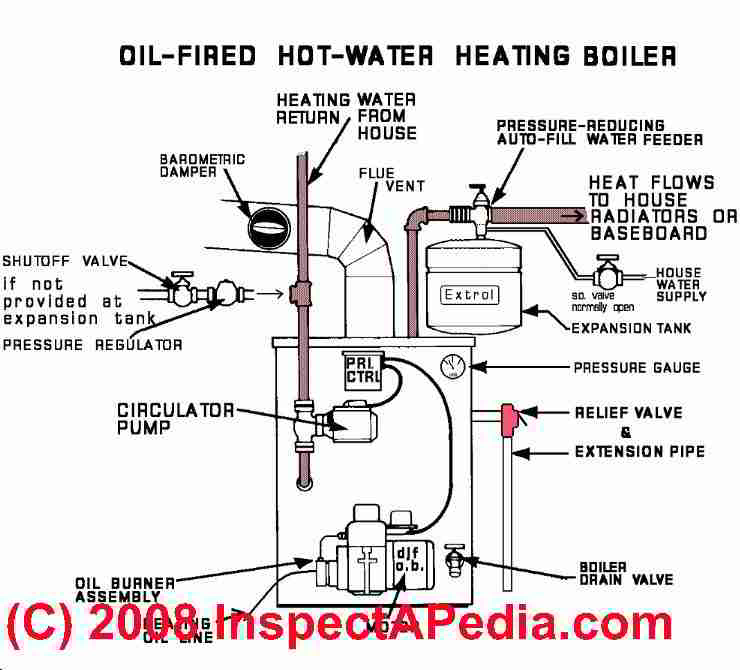 Heating Boiler Guide
Inspect, Install, Troubleshoot & Fix problems hot water boilers
Hydronic heat (hot water heat) boilers

- POST a QUESTION or COMMENT about heating boilers: inspection, diagnosis, repair, efficiency, tuning & maintenance
Residential heating boiler inspection, installation, diagnosis, &repairs:
This article series explains how to inspect & troubleshoot all types of residential heating systems and we describe just about every common heating system defect or operating problem.
We include articles describing all of the components of a home heating system, how to find the rated heating capacity of an heating system by examining various data tags and components, how to recognize common heating system operating or safety defects, and how to save money on home heating costs.
We include product safety recall and other heating system hazards. The limitations of visual inspection of heating systems are described.
InspectAPedia tolerates no conflicts of interest. We have no relationship with advertisers, products, or services discussed at this website.
- Daniel Friedman, Publisher/Editor/Author - See WHO ARE WE?
Hot water or Steam Boiler Heating System Diagnosis & Repair - where to start?
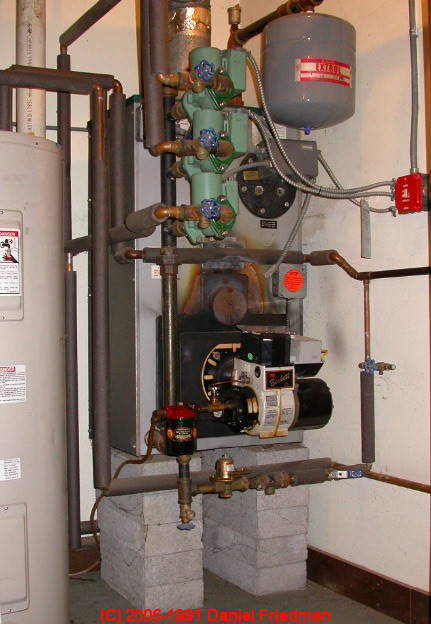 Article Series Contents
First, determine what type of heating system is installed
Hot Water or Steam Heating Systems - Boilers:
If the heat in your building is provided by warm or hot metal radiators, heating baseboards containing finned copper tubing, or wall convectors that look like a radiator but contain finned copper tubing, or if heat is provided by flexible rubber, plastic, or metal tubing run in building floors or ceilings, then the warm or hot water circulating in those devices is probably being delivered by piping circulating water heated by a heating boiler, or possibly by a steam boiler or a heat pump or geothermal system.
What's the difference between a hydronic (hot water) boiler and a steam boiler?
This page is the home of our detailed guide to inspecting and maintaining hydronic or hot water heating systems.
A "steam boiler" delivers heat to the occupied space in the form of steam: the boiler literally "boils" water and sends steam rising up through steam riser pipes and through steam radiators in the occupied space.
If your heating radiators have valves which hiss and let air escape as heat is coming on your heat is probably being delivered in pipes which circulate steam from the steam boiler up through radiators in the occupied space.
For a detailed guide to inspecting and maintaining steam heat systems
see STEAM HEATING SYSTEMS & CONTROLS - home for our information on steam boilers.
If you don't know what kind of heat your building uses, we explain how to figure out the answer
What's the difference between a heating boiler and a furnace?
In general, a "heating boiler" heats the building using hot water.
A "furnace" heats a building using hot air or "warm air" delivered through air ducts to the heated space.
Don't confuse the two since their means of making and distributing heat, their controls, and their equipment are mostly different. (
For a detailed guide to inspecting and maintaining warm air heating systems or furnaces,
see FURNACES, HEATING.
How is heating boiler efficiency or economy measured? What does boiler AFUE mean?
Each model of heating boiler is assigned an AFUE number. AFUE is an abbreviation for Annual Fuel Utilization Efficiency. In short, the AFUE tells you, for each dollar you spend on energy for heating by gas, oil, or another fuel, just how much of your dollar shows up inside the occupied space of your building as heat.
Details are at AFUE DEFINITION, RATINGS
What is a Hydronic or "hot water" Heating System?
What are we looking at when we're talking about oil-fired hot water heat? It's helpful to form a simple working definition that helps understand the system.
An oil-fired forced hot water or "hydronic" heating system is a collection of components which heats a building by heating and then circulating hot water through heat-radiating devices located in the occupied space.
A "heating boiler" is a steel, copper, or cast iron "box" of hot water, connected to a loop of pipe (and radiators or baseboards) which runs around through the living area.
The same physical water stays in the boiler and is circulated by a pump so that heat is delivered to the living area.
Burning oil makes hot gases which are used to heat the water before being exhausted outside. Pumps move fluids through the system. Safety controls of various types are installed at various points protect against a number of potential hazards.
A variation on forced hot water heat that we just described is HYDRONIC HEAT LOOPS on STEAM HEATING SYSTEMS - a steam heating system may include a loop of hot water circulated out of the steam boiler and used to heat a lower building floor or an indirect water heater.
How does a Heating Boiler Work?
We discuss how heating boilers work in step-by-step detail
at BOILER OPERATION DETAILS
How to Inspect a Heating System using Physical Location of Components
This approach broadens the scope of the heating system inspection and it may aid in heating system defect recognition or problem diagnosis, for example by observing that a heating boiler is located in a small, air-tight room (possible combustion air problems), or that the furnace is quite close to the oil storage tank.
Below we give the basics of heating system inspection using the physical location "map" of components to assure completeness. See full details of heating system inspection procedures provided
at HEATING SYSTEM INSPECT DIAGNOSE REPAIR
- Heating components: Identify the heating system components in each building area.
- Heating fuel & fuel delivery: At the heating boiler or furnace, identify the fuel source and follow fuel supply piping to its source (an oil tank, LP gas tank, or gas meter, for example).
- Heat distribution: At the boiler or furnace, identify the heat distribution method and follow the delivery of heat (warm air or hot water) leaving the furnace or boiler, and returning to it.
Failure to consider this whole path logically risks failing to notice potential problems such as return air taken at a furnace itself or the absence of adequate return air. - Heating controls: At the boiler or furnace identify each of the controls and safety devices and observe their condition.
Those devices that are intended for normal operation by the home owner are usually also operated and tested by the inspector. Other devices such as temperature/pressure relief valves are not normally operated but are visually inspected for evidence of a problem.
Is Heating by Hot Water Boiler a Good Approach?
The choice of heating system type involves choices of heat distribution (such as by hot water or steam (boilers), or by air (furnaces), or by using electric heat), or by more hybrid methods such as hot water or electric radiant heat in floors or ceilings, or other approaches.
There is no single "right answer" or "best" approach since we need to match the type of heat distribution, heat production, heat fuel to climate, construction, site conditions, fuel availability and other factors.
Reader question: Are we crazy to consider buying a house that uses hot water boiler heat?
COMMENT: I just looked at a home to buy that has hot water boiler heat. Don't know age but owners say they have always had it maintained since he is a plumber. Are we crazy to consider a house with this type of heating system. How energy efficient are they? 4/16/14 Diane Logsdon
Reply:
Diane I must be totally confused. Why would using a hot water heating system be less efficient than forced warm air? The heat loss rate of the house in which you are interested is the first determinant of heating cost. Look at the home's insulation, age, quality of construction, and for signs of air leakage such as thermal tracking.
Perhaps you meant to ask something else and I just don't get it.
Efficiency of Different Heating Methods
The efficiency of hot water heating systems (boilers, or hydronic heat) varies depending on the age and type of equipment, the fuel source (oil or gas for example), and very importantly, the state of tune of the system. An old clunky slow-speed oil fired hot water boiler that has not been cleaned or tuned-up might chug along reliably at 65 % efficiency.
I could clean and tune the system and get it up to perhaps 75% efficiency - meaning that if we ignore the very important heating efficiency factors of house insulation, heat loss, drafts, how heat is distributed, and if we just look at the boiler itself, 25 cents on the dollar is going up the chimney.
A new high-efficiency oil fired heater might run at the high 80's of efficiency or close to 90%, sending ten cents up the chimney for every dollar spent on fuel.
Those exact same efficiency ranges can be found in forced warm air heating systems (furnaces) and depending on how heat is made, on radiant heat systems.
Electricity is one of the most efficient heat producers once it's at the home, but once we factor in differences in fuel costs, in many areas of the world electricity is one of the more expensive ways to heat a home.
Efficiency and costs of different heating fuel sources are compared
at HEATING COST FUEL & BTU COST TABLES\
Reader follow-up: people around here say "stay away from a house with a heating boiler"
It is just the idea that it is a boiler.
When I tell people this they say stay away from it! I don't think there are many left in our Bloomington-Normal area. I have a friend who had one at her house and she said it was wonderful even heat but everyone who came to the house said that would have to be replaced right away.
She finally sold her house but it was tough. I'm thinking that if we wanted to resale the house later on it could be a problem.
It is the age of the house which has been very well maintained over 60 years by one couple and he was a plumber. Thanks for your answer and I think the house is well insulated and of quality construction. I am not sure what air leakage such as thermal tracking means. Diane
Reply: millions of homes heated by hot water (hydronic) heating systems
Gee Diane, there are literally millions of homes heated by hot water.
Sometimes when a type of heating system falls into disuse in an area it is because the contractors who knew how to install and service it have retired or died.
Indeed for a given community or area of use it can make sense to prefer buying a product (house or car) that many people in that area know how to fix
. In the U.S. in the 1970's it was very easy to find someone who knew how to fix a VW Beetle and very tough to find a mechanic who knew how to repair the triple-throat-Solex carburetors on a Porsche.
But for the area you are discussing, I fear you may be hearing from people with strong opinions that, at least in your comments, they have not backed up with information.
Thermal tracking means stains that can tell us something about building heat loss.
You can help me out in managing InspectAPedia by telling me why you didn't try our page top or page bottom search function to search for that term to read about it.
Take a look
at THERMAL TRACKING BRIDGING GHOSTING for details.
Should I buy this house?
Finally, having inspected thousands of homes, I've found very few that were in such bad shape that one would think buying the home is a mistake. Once you choose a house because you like the neighborhood and like the house and the price seems reasonable, most repairs, even a new heating system, make up a rather small percentage of the value of the property so in my OPINION are not reasons to refuse to go ahead with the purchase.
 The purpose of a home inspection is not to kill the deal nor to tell you to buy or not buy the house, but rather to tell you what to expect to need to repair and in what priority order - to protect against expensive surprises or dangerous conditions.
How do you add antifreeze to a boiler? What kind of antifreeze do we use in a boiler? How much do you add?
How do you add anti freeze to you boiler and what kind do you use? - Don Rose 9/26/2012
Reply:
Don, some help on winterizing a boiler as well as a whole building is
at WINTERIZE HEAST OFF PROCEDURE.
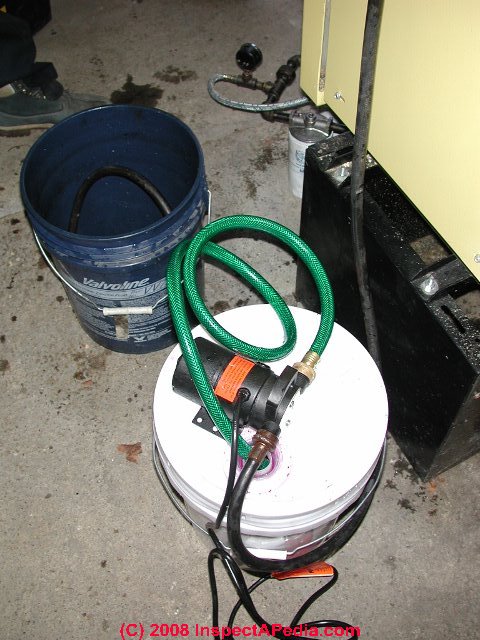
The basic procedure is to use a pony pump to add antifreeze (buy at your local heating supplier) to the water mix in the boiler until our test gauge shows that we've got enough antifreeze in the system to protect down to at least a bit below the lowest expected temperature.
The service tech uses a pony pump connected to a boiler drain or zone drain valve, typically using a pair of washing machine hoses to form a loop between a boiler drain, a bucked of antifreeze & water mix, and a zone drain.
The pump pushes antifreeze into the system from the bucket; keeping the drain end of the second hose below the level of antifreeze in the bucket avoids introducing air into the system and thus avoids having to bleed that air out.
Complete details about how to add anti-freeze to a hot water heating boiler and system are found
at ANTIFREEZE for BOILERS where we explain what kind of anti-freeze to use, how much to add, how to get it into the system, and what are the effects of antifreeze on heat transfer and heating system operation and costs.
Also see transfer pumps - PUMPS, PONY PUMPS
...
Reader Comments, Questions & Answers About The Article Above
Below you will find questions and answers previously posted on this page at its page bottom reader comment box.
Reader Q&A - also see RECOMMENDED ARTICLES & FAQs
We have to hit the oil burner transformer to make the burner run
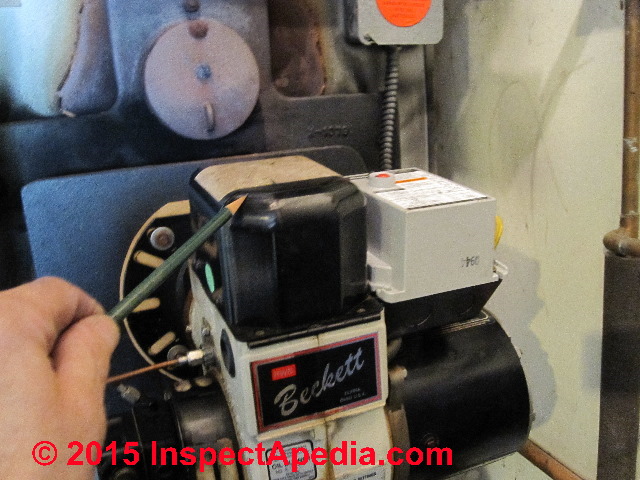 I have the Hydrotherm unit . There is a thing that looks like a transformer or relay up in the rafters . We have to hit it to make the heat come on . What is that part called ? On 2021-03-16
by Nancy
I have the Hydrotherm unit . There is a thing that looks like a transformer or relay up in the rafters . We have to hit it to make the heat come on . What is that part called ? On 2021-03-16
by Nancy
by Mod: that's the ignition transformer on your oil burner
@Nancy, from your brief description I'm afraid to guess but if it looks like a Transformer it probably is.
Low voltage Transformers are often used to provide Power to thermostats and other heating controls
In my photo above my pencil is pointing to the oil burner transformer - an electrical component that converts your household 120VAC current to high voltage to in turn produce the spark that ignites the oil burner flame.
See details
Is a gas water heater boiler connected to the home water supply?
Is a gas-water heater boiler connected to a home water pipe? On 2021-02-25 by Maria Silva
by (mod) - yes
@Maria Silva,
First, Let's be sure we're talking about the same device.
A water heater that heats your domestic hot water for washing and bathing might be gas fired and of course would be supplied with cold water from the building and it's inlet pipe and would supply hot water to the building at his outlet pipe.
A heating boiler that provides heat to the occupied space in your building through hot water radiators, baseboards, etc. will also be fed with a cold water supply from the building but that device does not normally use water nor have new water constantly fit into it.
The article above on this page describes heating boilers used to warm the occupied space not domestic hot water heaters.
Water heaters used to warm domestic hot water for washing and bathing are discussed starting at
WATER HEATERS - home
Depending on the country where you (and your domestic water heater) live (and the heater is installed) a "domestic hot water heater" for washing and bathing might be called a hot water cylinder, a calorifier, a geyser, or by other names.
How can I wire two thermostats so that we get heat when our tenant doesn't want or need it?
I have two family house, and only have one heating water boiler for whole house and one zone ( no zone valve), each unit has own thermostat and thermostat wire available at boiler.
Now I can use either one unit's thermostat to control whole house and disable another one.
Now the problem is that if the tenant who is living in the unit with working thermostat cook their meal for long time or use portable electric heater, the temperature in that unit will rise to setpoint to shut off the boiler, or the boiler never run, but at the same time the other unit is cold.
My question is anyway to wire two thermostats to control one heating boiler, so only way to shut off the boiler is both thermostats reach setpoint, and once one of the thermostat drop below the setpoint the boiler will run. On 2021-01-19
by Vincent
by (mod) - wire the thermostats in parallel
Vincent
Sure; both thermostats can be wired in parallel so that either or both can call for heat; or you can use any number of thermostats to turn on a relay that in turn operates the heater.
With that wiring even if the tenant's thermostat is not calling for heat, if your side of the home has a thermostat that calls for heat the heater will run.
Your heating tech can make those simple connections.
Of course your tenant is going to be opening her windows when it's too hot: an expensive way to heat a home;
As you've got hot water heat, you might ask your service tech to map the routing of the heating piping to see if you can split into two heating zones, or if radiators are in use, if they can be controlled with individual valves.
Salesman told me that a high efficiency heating boiler is wasteful
I am looking to replace my gas boiler and possibly get rid of my hot water tank. We have baseboard heat. I have had conflicting information regarding replacing my boiler to an >90% efficiency or to an 80% efficiency. My boiler is original to the house (about 55 years old).
I was told by one company that it would be a waiste o get a high efficiency (above 90%) and that I should get a mid efficiency (around 80%) because I have baseboard heat and something to do with the 180 degree temperature of the water being sent out. On 2020-11-03 by Rebecca
by (mod) - Nonsense!
Rebecca
What you were told escapes my ability to make sense of the remark.
At any water temperature setting higher efficiency means lower fuel cost.
Why is my heating boiler always needing more water?
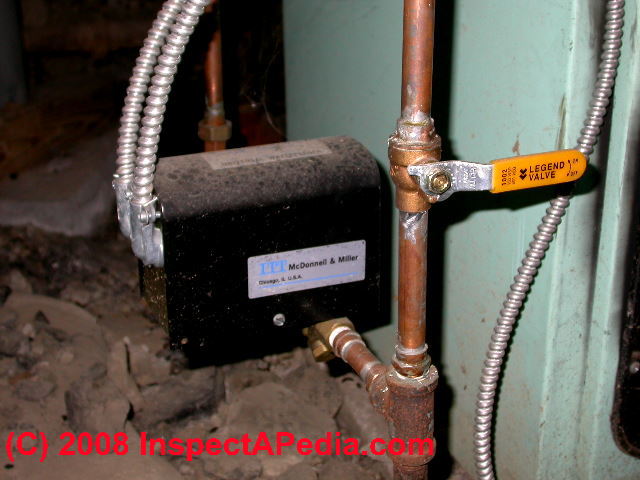 What seems to be a problem when my hot water boiler always needs water to refill . It seems my automatic Water feeder always work and costing too much water bill? Please help !!! On 2020-10-15 by Jess
by (mod) - don't confuse steam heat (uses water) with hydronic or hot water heat (should not be using water)
If you have a steam boiler some water usage is normal at every heating cycle.
And your automatic water feeder may look like the McDonnell & Miller unit I show in my photo above.
See details at WATER FEEDER VALVE, STEAM
Watch out: If you are heat is actually hot water and not steam then there's probably a leak somewhere that needs to be foundand you need to read
We keep getting black goo in our heating circulator pump
Older (late 90's weil mclain) gas fired boiler. Keep getting black "goo" in the circulator pump, which is on the return after the two zone valves.
Would adding a y-strainer into the system be overkill, or a good idea? Any other ideas? On 2020-09-25 by Jim
by (mod) - Try draining and flushing out the sediment & debris from your boiler
Jim:
Black oily goo found at the circulator of a hydronic boiler heating system:
You say this oily goo is IN the circulator pump? I take that to mean it's in the boiler water, not an obvious leak out of lubricant.
In that case, I'm not sure if the black goo is bacteria, rust and sludge, or oil or something else. What does it smell and feel like? That may be diagnostic.
I would consider flushing the system with a boiler cleaner;
Also take a detailed look at your circulators; some old circulator pumps might leak their lubricating oil into the water thorugh a failing sleeve bearing, though it's not a common complaint.
I prefer to find and fix the cause rather than treat the symptom.
by Jim - circulator pump is noisy and may be burning out
Thanks dan - I agree. I would prefer to fix, which is why I thought a Y-strainer was not appropriate.
The pump has been replaced within the last year - Taco 007 - so I figured that this is something in the boiler itself. Is cleaning a boiler something one can do themselves?
The system works - except lighting problem - another topic - but the pump is noisy and afraid may burn out.
by (mod) -
Regarding oily sludge crud in the hot water heating system boiler/pipes, etc:
You might try a complete flush-out of the boiler and pipes and badeboards or radiators to remove sediment and crud from the system. I'm concerned that if we don't clean out the system you risk loss of heat just when it's most needed, when weather is very cold.
Watch out: While draining a boiler to flush out the system is pretty straight forward, you'll want to see our boiler drain procedure warning
at BOILER DRAIN DAMAGES EXPANSION TANK
At ANTIFREEZE for BOILERS we describe removing scale from boilers and adding treatments to avoid scale build up as well as a freezing hazard.
Also consider CHEMICAL TREATMENTS, BOILER where we also discuss flushing out a hot water heating boiler.
Regarding your observation of a noisy circulator pump
A noisy circulator pump can be due to several reasons,
- most common: a failing pump bearing, often made worse if the pump motor and actual pumping mechanism are not perfectly aligned, or if lubrication for the pump wasn't maintained; look for leaks around the pump drive shaft at the impeller assembly
- common: blockage or debris such as scale inside the impeller assembly, or a damaged impeller
- less common: loose mounting of pump or impeller assembly
- somewhat common: air or debris in the heating system waterSee these diagnosis and repair details
Should the pressure gauge on my Dunkirk boiler show pressure?
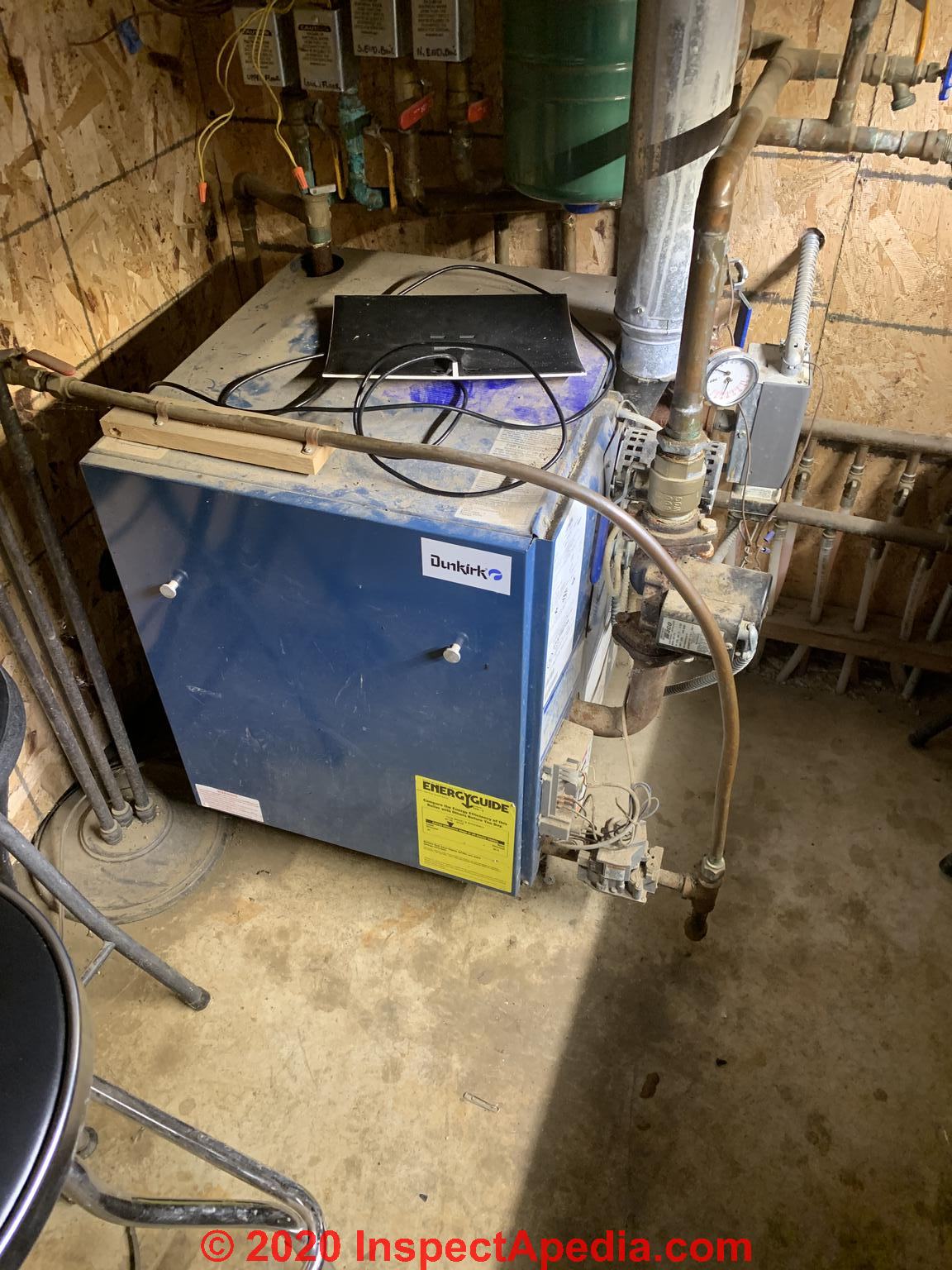 Boiler system: on the PSI gauge, should it show any PSI in the system ? On 2020-01-21 by Dave
by (mod) - Yes, here's the proper pressure fdor a Dunkirk gas fired heating boiler
If the system is filled properly and cold the gauge would read 12 psi - unless the gauge is stuck or defective.
When the boiler is hot the gauge will read somewhere under 30 psi for a hydronic (hot water) heating boiler like your Dunkirk model.
You can try tapping on the gauge to see if it frees up, but most likely it'll need to be replaced.
See details
Our boiler keeps losing pressure but we can't find the water leak
We keep losing presser and need to keep adding water to the boiler
Can not find any water leak. Burner flame is clear . Does have copperpipe running under floor in doorways on lower level of house.
If there is a leak, how do we find it. ? - On 2020-01-05 by Jerry
Reply by (mod) -
Jerry
That sounds as if there's a leak in the boiler hot water piping that you haven't yet found.Try using an IR scanner or a thermographic camera to look for a heat bloom where the piping dips into the slab under doors. That could indicate a leak.
Detailed help is
Our boiler works but heat doesn't get to pipes in one room
We have a boiler system hooked up to a hot water tank which usual has worked in the past but the hot water does not seem to make it through the pipes in our Florida room.
The top outlet pipes on the tank are hot but it does not circulate beyond a few feet? On 2019-10-31 by John
by (mod) -
John
What you are describing sounds like a classic case of air in the pipes blocking circulation of hot water through that one zone. Of course the problem could be a stuck or closed zone valve or a bad circulator - as we don't know exactly what equipment you have installed.
Best bet: I'd start by checking out our diagnosis and repair advice for airbound heating systemsthat begins at AIRBOUND HEAT SYSTEM REPAIR by WATER FEED VALVE
Other possiblities: If the problem might be a bad circulator pump or relay
see CIRCULATOR PUMPS & RELAYS for articles that help diagnose a circulator pump that won't start
Or if your system uses one circulator and multiple zone valves, also see
e ZONE VALVES, HEATING for diagnosis of zone valves that don't open or don't close when they should
Keep me posted on how that works for you and don't hesitate to ask follow-up questions
...
Continue reading at BOILER CONTROLS & SWITCHES or select a topic from the closely-related articles below, or see the complete ARTICLE INDEX.
Or see BOILER REPAIR DIAGNOSTIC FAQs - questions and answers posted originally on this page.
Or see this
Article Series Contents
- BOILER CONTROLS & SWITCHES - home
- BOILER DRAIN & FLUSH PROCEDURE
- BOILERS, HEATING - home
- BOILER OPERATING PROBLEMS
- DIAGNOSE & FIX HEATING PROBLEMS-BOILER
- HEATING SYSTEM TYPES if you don't know whether your heat is provided by a furnace (hot air) or boiler (hot water), or steam boiler (steam heat) or whether your fuel is oil, gas, or electric, and whether your heat is hot water, steam, or warm air
- OIL BURNER INSPECTION.
- GAS BURNER FLAME & NOISE DEFECTS
- GAS BURNER SOOT CAUSE & CURE
- GAS BURNER PILOT LIGHT PROCEDURE
- MANUALS & PARTS GUIDES - HVAC - home - Master Index to All Brand Names & HVAC manuals, wiring diagrams, installation and repair guides
- STEAM HEATING BOILERS & SYSTEMS & CONTROLS - home
- RADIATORS for ROOM HEAT - topic home, for cold radiator or baseboard diagnosis and repair
- WATER HEATERS - hot water tanks, sources of hot water in buildings, equipment installation, troubleshooting, repair.
Suggested citation for this web page
BOILERS, HEATING at InspectApedia.com - online encyclopedia of building & environmental inspection, testing, diagnosis, repair, & problem prevention advice.
Or see this
INDEX to RELATED ARTICLES: ARTICLE INDEX to HEATING BOILERS
Or use the SEARCH BOX found below to Ask a Question or Search InspectApedia
Ask a Question or Search InspectApedia
Try the search box just below, or if you prefer, post a question or comment in the Comments box below and we will respond promptly.
Search the InspectApedia website
Comments & Questions are Welcome Here
If you posted comments here and no longer see what you wrote, please check for your comment in the Reader Q&A found above on this page.
Citations & References
In addition to any citations in the article above, a full list is available on request.
- Fuel Oil & Oil Heating Magazine, 3621 Hill Rd., Parsippany, NJ 07054, 973-331-9545
- Domestic and Commercial Oil Burners, Charles H. Burkhardt, McGraw Hill Book Company, New York 3rd Ed 1969.
- National Fuel Gas Code (Z223.1) $16.00 and National Fuel Gas Code Handbook (Z223.2) $47.00 American Gas Association (A.G.A.), 1515 Wilson Boulevard, Arlington, VA 22209 also available from National Fire Protection Association, Batterymarch Park, Quincy, MA 02269. Fundamentals of Gas Appliance Venting and Ventilation, 1985, American Gas Association Laboratories, Engineering Services Department. American Gas Association, 1515 Wilson Boulevard, Arlington, VA 22209. Catalog #XHO585. Reprinted 1989.
- The Steam Book, 1984, Training and Education Department, Fluid Handling Division, ITT [probably out of print, possibly available from several home inspection supply companies] Fuel Oil and Oil Heat Magazine, October 1990, offers an update,
- Principles of Steam Heating, $13.25 includes postage. Fuel oil & Oil Heat Magazine, 389 Passaic Ave., Fairfield, NJ 07004.
- "Residential Hydronic (circulating hot water) Heating Systems", Instructional Technologies Institute, Inc., 145 "D" Grassy Plain St., Bethel, CT 06801 800/227-1663 [home inspection training material] 1987
- Boilers, Boiler Conversions, James E. Brumbaugh, ISBN 0-672-23389-4 (v. 1) Volume II, Oil, Gas, and Coal Burners, Controls, Ducts, Piping, Valves, James E. Brumbaugh, ISBN 0-672-23390-7 (v. 2) Volume III, Radiant Heating, Water Heaters, Ventilation, Air Conditioning, Heat Pumps, Air Cleaners, James E. Brumbaugh, ISBN 0-672-23383-5 (v. 3) or ISBN 0-672-23380-0 (set) Special Sales Director, Macmillan Publishing Co., 866 Third Ave., New York, NY 10022. Macmillan Publishing Co., NY
- Installation Guide #200 for Residential Hydronic Heating Systems, The Hydronics Institute, 35 Russo Place, Berkeley Heights, NJ 07922
- In addition to citations & references found in this article, see the research citations given at the end of the related articles found at our suggested
CONTINUE READING or RECOMMENDED ARTICLES.
- Carson, Dunlop & Associates Ltd., 120 Carlton Street Suite 407, Toronto ON M5A 4K2. Tel: (416) 964-9415 1-800-268-7070 Email: info@carsondunlop.com. Alan Carson is a past president of ASHI, the American Society of Home Inspectors.
Thanks to Alan Carson and Bob Dunlop, for permission for InspectAPedia to use text excerpts from The HOME REFERENCE BOOK - the Encyclopedia of Homes and to use illustrations from The ILLUSTRATED HOME .
Carson Dunlop Associates provides extensive home inspection education and report writing material. In gratitude we provide links to tsome Carson Dunlop Associates products and services.
 |
HOME | ABOUT | ASK a QUESTION | CONTACT | CONTENT USE POLICY | DESCRIPTION | POLICIES | PRIVACY | |
| © 2026 - 1985 Publisher InspectApedia.com - Daniel Friedman | |||||||||