
 Water Pump Pressure Control Switch
Adjustment Nuts
Water Pump Pressure Control Switch
Adjustment Nuts
Directions to turn the large & small adjustment nuts
- POST a QUESTION or COMMENT about Setting the Water Pump Pressure Switch and Improving Water Pressure
How to adjust the pump pressure control switch using the Square-D Pumptrol™ as an example:
This article describes how to adjust building water pressure by setting the water pump cut-in and cut-out pressure on the well water pump pressure control switch. We explain which adjustment nuts to turn and in which direction to change pump cut-in pressure or cut-our pressure settings.
This article series also includes information on how to adjust building municipal or community water pressure at a building.
InspectAPedia tolerates no conflicts of interest. We have no relationship with advertisers, products, or services discussed at this website.
- Daniel Friedman, Publisher/Editor/Author - See WHO ARE WE?
Water Well Pump Pressure Control Switch Adjustment: how to set the water pump cut-in and cut-out pressures
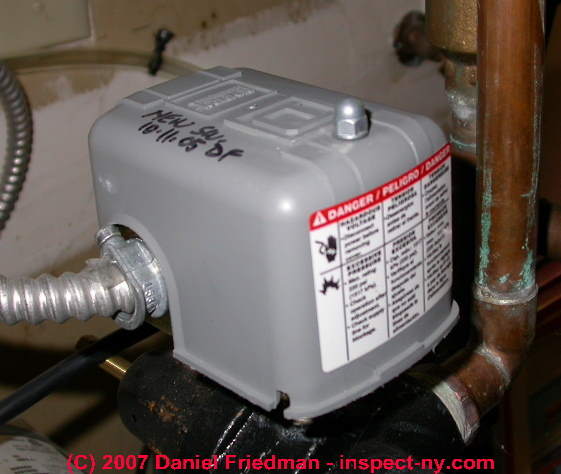
Water pumps use a pressure control that specifies the pump cut-in (turn on) and cut-out (turn off) water pressures.
Here we explain how to first make a correct diagnosis of your water pressure or pump control switch issue before trying to change any settings - to avoid simply making matters worse.
Then we explain what the one or two adjustments in the pressure switch do (Differential Nut and Range Nut) and how to adjust them to the proper pressure settings.
Article Contents
- DIAGNOSE TROUBLE CORRECTLY BEFORE ADJUSTING THE PRESSURE CONTROL
- WHAT DOES EACH PRESSURE CONTROL AJUSTMENT NUT DO? - how to identify the function of the larger and smaller adjustment nuts in the switch
- PRESSURE CONTROL NUT ADJUSTMENT SEQUENCE - which control nut to adjust first - Watch out: it makes a difference
- LARGER (RANGE) NUT ADJUSTMENT PROCEDURE
- SMALLER (DIFFERENTIAL) NUT ADJUSTMENT PROCEDURE
- WHICH WAY TO TURN THE PRESSURE CONTROL ADJUSTMENT NUT - effect of tightening (to the right) or loosening (to the left) the adjustment nuts
- SINGLE NUT PRESSURE CONTROL ADJUSTMENT - what if the pressure switch only has one single adjustment nut?
- HOW to SET THE CUT-IN PRESSURE UP WITHOUT MAKING THE CUT-OUT TOO HIGH
- IS IT OK TO MODIFY THE PRESSURE CONTROL SWITCH - for example to eliminate one of the adjustment nuts or functions
- EXAMPLES of PRESSURE CONTROL SWITCH ADJUSTMENTS - for specific pressure ranges or levels
Watch out: SAFETY WARNING OF FATAL SHOCK HAZARD: turn off power before working on the pump pressure switch.
If you remove the cover of the pump pressure control switch you can get access to the two nuts that adjust the operating pressures of the water pump.
But there are also live electrical contacts exposed in this area. If you touch them, especially being near water piping, there is a serious risk of death by electrocution.
Watch what you touch, or have a professional plumber or electrician do this job for you.
...
Diagnose the Water Pump Problem Correctly Before Messing With the Pressure Switch Control Nut Settings
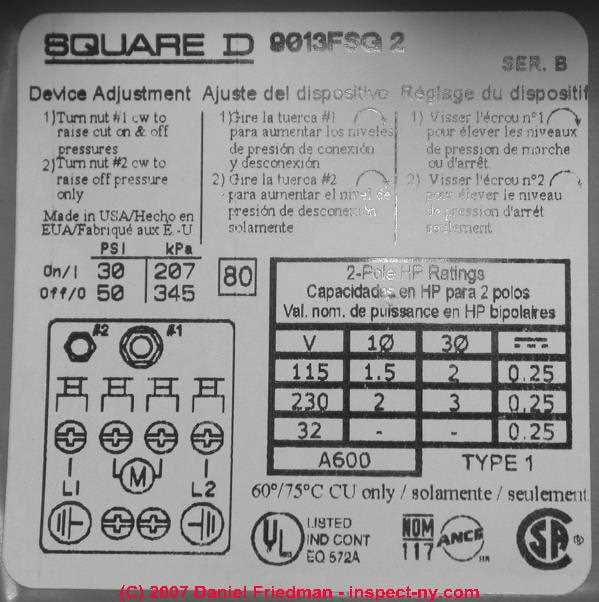
Pump pressure control switch adjustments are summarized inside the cover of many pressure switches, as shown in our photo.
But before messing with the pressure control switch an accurate diagnosis of what's wrong might be useful.
If the water pump apparent "short cycle" is say 1-3 minutes
this may be all your system can provide. If however something has changed, and the pump used to run longer, say 2-5 minutes, I suspect loss of air in the pressure tank or an internal problem in the tank (like a hole in the bladder if it's a "captive air" pressure tank).
The problem of lost air in the water pressure tank along with how to correct that condition are discussed beginning
If the "short cycle" is very short, clicking on and off,
there could be a different problem with the pump control pressure switch or with a dirty, clogged water filter if one is installed on the system.
Dirty water filters as a source of rapid pump on-off cycling are discussed
If you want to set up the cut-out pressure on your pump control, while leaving the "cut-in" down
where it is, you'll also get a longer "off" cycle, but if you set the cut-out pressure too high, the pump will just run forever since it can't reach that high pressure. This is easy to figure out since if you set it too high the pump will just keep running.
(Then turn it off electrically and set the cutout pressure a bit lower.) [This adjustment is only available on pressure control switches that have two adjustment nuts: Range and Differential]. Details are
at WATER PRESSURE CONTROL SWITCH ADJUSTMENTS
In sum, it might be possible to improve this condition by adjusting the pump control
which sets the cut-in water pressure (to start the water pump) and the cut-out water pressure (to stop the pump).
Usually this isn't going to help with pump short cycling but adjusting the water pump can give a longer on-cycle for the pump and it can increase the water system pressure up to a point.
If you ask the pump for more pressure than it can deliver it will simply keep running without ever reaching the cut-out pressure you've specified.
If your pump short-cycling behavior has recently gotten worse, don't try to fix it by adjusting the pump pressures, go on to look at other problems like loss of the air charge in the water tank or a defective or clogged pump control or water filter.
The article links below explain exactly how to set the water pump pressure switch, where the adjustments are located (the large and small nut found under the switch cover), which way to turn the nuts to increase or decrease the pump cut-in and cut-out pressures, and other pressure switch troubleshooting and repair procedures.
...
Which Nut in the Pressure Control Switch Does What?
How to Identify the Range & Differential Adjustment Nuts on a Water Pressure Control Switch
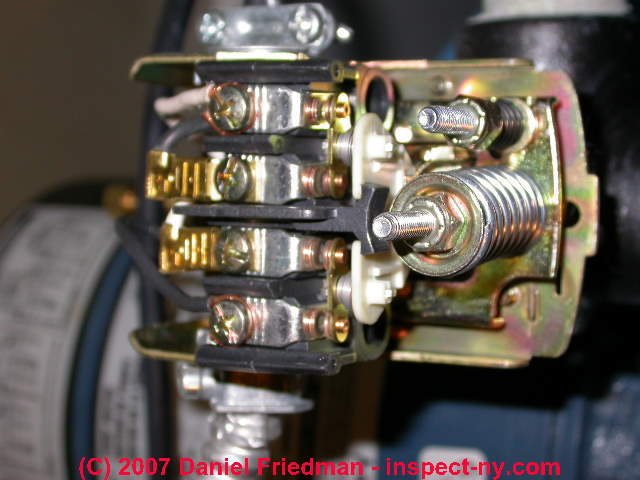
- The Range Nut
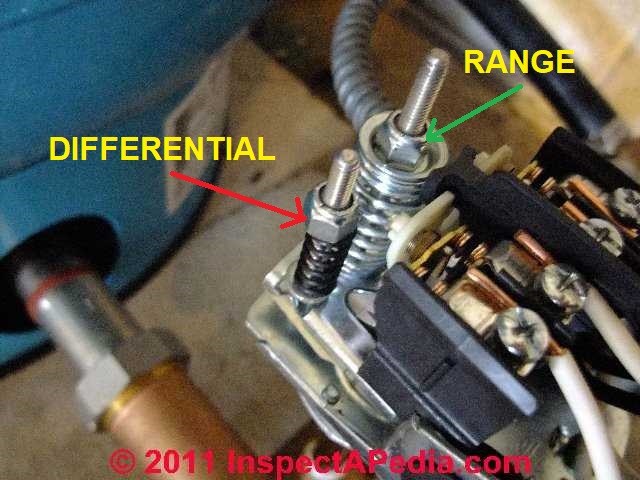
has a larger diameter spring - this shifts the whole operating pressure, CUT-IN / CUT-OU, up or down - The Differential Adjustment Nut
is on the smaller diameter spring - this increases or decreases the difference between CUT-IN and CUT-OUT pressures - The differential setting nut is usually on a shorter spring - it will be "lower" or further down in the pressure control switch. You will see this in our photo above.
- Some pressure control switches have only the range adjustment nut and no differential nut.
- In modern pressure control switches both nuts are typically sized to be turned with a 3/8" nut driver or socket
...
Pump Pressure Switch Pumptrol™ Nut Adjustment Sequence
 Watch out: Schneider Electric, the manufacturer of the Square-D Pumptrol pressure control switch warns that
when adjusting the pressure control settings it is important to make the adjustment in the proper sequence:
- Adjust the RANGE nut FIRST,
- Then adjust the DIFFERENTIAL nut SECOND.
- Pumptrol Pressure Switch Installation & Wiring Instructions (2010), retrieved 1 April 2015, Schneider Electric USA 8001 Knightdale Blvd. Knightdale, NC 27545 1-888-SquareD (1-888-778-2733) www.us.SquareD.com
Example Pump Pressure Switch Adjustment Instructions from Square-D Pressure Control
Understanding how pump pressure control switches work and which way to turn which of the two nuts in the control can be confusing.
On a Square-D Pumptrol™ 9013FSF-2 pump pressure switch, for example, Square D tells us that we
- Turn the Large Range Nut #1
(green arrow at right in our photo, the larger spring and nut) clockwise (to the right or "down") to raise [both] cut-on and cut-off pressures. This is "tightening the nut down" against the spring. ("Rightie-tightie, leftie-loosie" as Mara Gieseke says to her kids). Thanks to reader Rise for this clarification.
In other words, adjusting the pressure on this spring shifts the whole operating range of the switch up or down, but keeps the difference between cut-in and cut-out the same, whatever it happens to be (typically it's about 20 psi from the factory.)
Which Way do I turn the Larger Range Nut on the Pressure Control Switch
- If you want the pump to turn ON (cut-in) sooner,
that is, at a higher water pressure, turn the nut clockwise or "tighter". This shifts the whole operating pressure range of the pump control (and thus the water pump) up to higher cut-in and cut-out pressures.
If you want the water pump to turn ON (cut-in) later,
that is, at a lower water pressure, turn the nut counterclockwise or "looser". This shifts the operating range to lower cut-in and cut-out pressures.
The gap between cut-in and cut-out pressures remains the same when you adjust the range nut. It is the smaller differential nut that can change that gap as we explain in this article.
Remember to adjust the larger RANGE nut first, then adjust the smaller DIFFERNTIAL nut.
Watch out: be sure to check the adjustment instructions for your particular pressure control switch and to follow the manufacturer's instructions. Shown below are the instructions for a Type 9013-series Square D Pumptrol. This particular switch was the Square-D Pumptrol 9013FSG ( for which a contact replacement kit is available: Catalog No. 9998PC241). The switch label instructions say:
- Turn Nut #1 CW (clockwise or "down" or tighter) to raise cut on & off pressures.
- Turn Nut #2 CW (clockwise or "down" or tighter) to raise off pressure only. - Op. Cit.
...
Adjusting the (LARGER) RANGE Adjustment nut
Range Nut: The larger nut (green arrow) on the larger spring in the pump pressure switch: changes both the cut-in AND cut-out pressure simultaneously moving them both up (higher pressure) or down (lower pressure).
This is the range adjustment nut.
It has the practical effect of raising or lowering the operating pressure range of the switch.
So if your switch was running at 20/40 (on at 20 psi off at 40 psi), and you tighten this nut 3 1/2 turns, you'll increase both numbers so that the switch will now operate at 30/50 (on at 30 psi and off at 50 psi).
Usually the larger nut in the pump pressure control switch (green arrow in our photo at left) adjusts the pump cut-on ("cut-in") AND pump cut-off pressures simultaneously.
This is the left-hand spring (and nut) in our photo and is pointed-to by the green arrow.
That means that whatever the gap is between the cut-on pressure and the cut-off pressure, that gap is maintained, but the entire operating range of the pump is raised or lowered.
Turning the large nut clockwise RAISES BOTH the cut-on and cut-off pressures.
So turning the large nut clockwise shifts the whole operating pressure range of the pump UP to HIGHER pressures.
Conversely, turning the large nut counter-clockwise will lower the whole pump operating range. This is the simplest adjustment to make.
Effect of Turns on the Larger Pressure Range Adjustment Nut
Here is an example of Range Nut Adjustment Settings & the Number of Turns Required, using the Square-D Pumptrol Class 9013F and G Pressure Switches as an example:
Pressure Switch Range Nut Adjustments: Range Changes vs Number of Turns of the Nut |
||
| Original Range Nut Pressure Setting Cut-in / Cut-Out Pressure in PSI |
Number of Range Nut Clockwise Turns |
New Range Nut Pressure Setting Cut-in / Cut-Out Pressure in PSI |
| 20 / 40 psi | 3 1/2 turns | 30 / 50 psi |
| 20 / 40 psi | 8 to 8 1/2 turns | 40 / 60 psi |
| 30 / 50 psi | 3 1/2 turns | 40 / 60 psi |
Notes to the table above
Adapted from : "Preventive Maintenance and Troubleshooting Guidelines for Class 9013F and 9013G Pressure Switches" (2007), Original source: Schneider Electric USA 8001 Knightdale Boulevard Knightdale, NC 27545 USA 1-888-SquareD (1-888-778-2733) www.us.SquareD.com
Schneider Electric offers technical assistance for their Pumptrol product line: Schneider Electric Pumptrol Product Line 8001 Knightdale Boulevard Knightdale, NC 27545-9023 e-mail: control.support@us.schneider-electric.com Telephone: 1-888-SquareD (1-888-778-2733)
Watch out: Electrical equipment should be serviced only by qualified electrical maintenance personnel.
No responsibility is assumed by Square D [ nor by InspectApedia.com ] for any consequences arising out of the use of this material. - Pumptrol Pressure Switch Installation & Wiring Instructions (2010), retrieved 1 April 2015, Schneider Electric USA 8001 Knightdale Blvd. Knightdale, NC 27545 1-888-SquareD (1-888-778-2733) www.us.SquareD.com
PUMP PRESSURE SWITCH STANDARD (PSI) SETTINGS contains instructions for restoring a typical pressure control switch to factory settings
Watch out: Do NOT set the Nut #1, the larger adjustment, cut-out pressure too high. That's a common mistake that some folks make in trying to get the highest water pressure possible in their building. The result could indeed be a pump that never shuts off and that burns up.
Watch out: If the water pressure in your system exceeds 70 psi there's an increased risk of plumbing leaks.
Watch out: If the water pressure in your system exceeds the pressure tank's maximum working pressure specified by the manufacturer (typically 100 to 150 psi) there is a serious risk that the water pressure tank will burst, not only flooding the building, but injuring anyone nearby.
Our friend and associate ASHI member Steve Vermilye from New Paltz New York reported that a local plumber was killed while working on a water pressure tank that burst when over pressurized. (Oral communication, SV to DJF 1988, also cited at WATER TANK BLADDER REPLACEMENT ).
...
Turning The (Smaller) Differential Adjustment Nut
The smaller nut ( red arrow ) atop the smaller spring in the pump pressure switch: changes the differential between cut-in and cut-out pressure.
The larger nut is the pressure differential adjustment nut (and spring) in our photos - and sketches is pointed to by the green arrow.
The differential adjustment nut has the practical effect of raising or lowering the cut OFF pressure only. This in effect, widens the gap or pressure differential between cut-in and cut-off pressures. Or as the manufacturer puts it:
Adjusting the differential changes the cut-out setting. The cut-in does not change. - Op. Cit.
Which nut to turn in the pump pressure switch control, and which direction to turn it, are usually visible on a label inside the pressure switch cover.
Above we show photos of a common Square D water pump pressure control switch (Schneider Electric)
and
below is an example of the label with pump control adjustment details.
...
Which Way do I turn the Control Adjustment Nuts on the Pressure Control Switch?
 ...
...
Watch out: we have found some other web articles whose authors are confused about this switch and who did not identify the Range Nut (the larger of the two) and the Differential adjustment nut (the smaller) correctly.
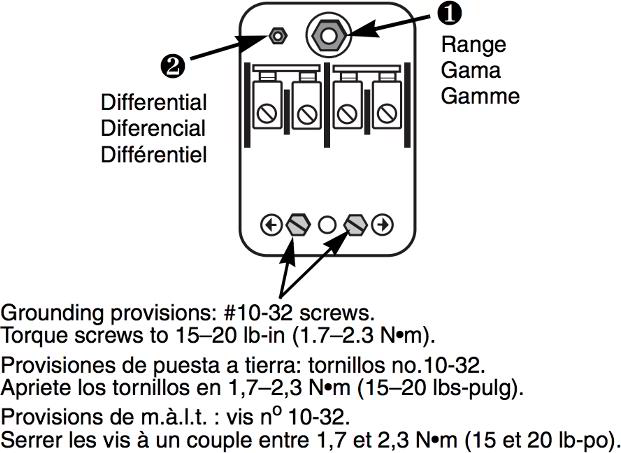
Here we follow the pressure control switch manufacturer's instructions and parts identification and adjustment procedures.
- Turn the Small Differential Nut #2 (red arrow in our photos & schematics above, the smaller spring and nut) clockwise to raise the cut-out pressure.
If you want the water pump to turn OFF (cut out or cut-off) at a higher water pressure, turn this nut clockwise or "tighter".
If you want the water pump to turn OFF (cut out or cut-off) at a lower water pressure, turn this nut counter clockwise or "looser"
Here is why the small nut is called the "Differential"
Adjusting the pressure on this spring shifts just the pump cut-out pressure up (clockwise) or down (counter-clockwise).
But as readers Don Travis has pointed out, it's a bit more complicated than this.
On at least some pressure control switch models, the small nut on the pressure control switch increases (turn down or tighten) or decreases (turn up or loosen) the differential between the cut-off and cut-on points on the switch.
In other words, If you leave the large nut alone and change the smaller one, you increase the gap between pump cut-in and pump cut-out pressures. A larger gap between cut-in (cut on pressure) and cut-out (cut off pressure) means you will run water longer in the building before the water pump is turned on.
Watch out: After adjusting nut #2 you may need to check the actual operating water pressures in your system and adjust nut #1 to be sure that you are not pushing the cut-out (upper pressure) so high that the water pump never turns off (dangerous).
Watch out: don't set the differential between cut-in and cut-out too close or the pump will short-cycle. A typical pressure range between CUT-IN and CUT-OUT is 15-20 psi.
Smaller (Differential) Nut on Pressure Switch Completely Loose
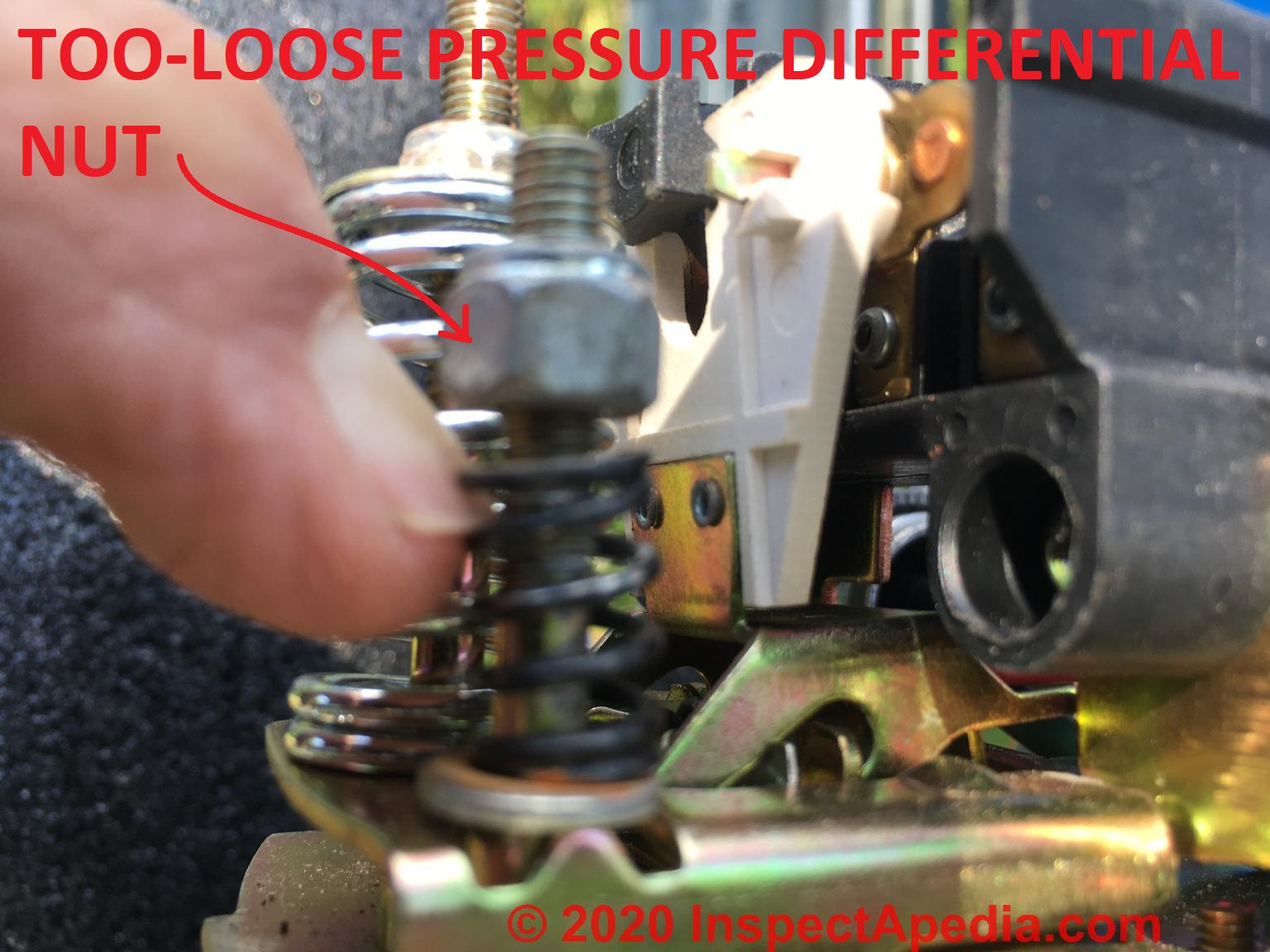
Photo above: a completely-loosened differential adjustment nut on a pressure control switch, courtesy of reader Moby.
Or in a contrary case if you completely loosen the smaller nut #2 (differential adjustment) - as we see in Moby's photo above, the pump differential between cut-in pressure and cut-out pressure is very small the water pump may short cycle on and off rapidly when water is being run in the building.
Especially if the well pump is a submersible (hidden and silent down inside the actual well) you may not realize that the pump motor is not shutting off.
Watch out: This can burst a pipe, burst a water tank, cause in-building leaks (especially at pressures over 70 psi), or burn up the well pump. You may be best to leave this adjustment screw alone.
In sum, the "Range" nut shifts the whole operating range of the pressure control up or down, but keeps the gap between cut-in and cut-out the same.
The "Differential" nut widens or narrows the gap between the cut-in and cut-out pressures.
But messing with the gap also shifts the operating pressure of the control so you may have to re-visit the range - or leave this nut alone.
Watch out: also, as the manufacturer (Schneider Electric for Square D Pumptrol wiring connections) warns:
Electrical equipment
should be serviced only
by qualified electrical
maintenance personnel.
No responsibility is assumed by Square D [ nor by InspectApedia.com ] for any consequences arising out of the use of this material. - Pumptrol Pressure Switch Installation & Wiring Instructions (2010) - retrieved 1 April 2015, Schneider Electric USA, 8001 Knightdale Blvd., Knightdale, NC 27545, 1-888-SquareD (1-888-778-2733) www.us.SquareD.com
...
What if my Pressure Control Switch has Only One Adjustment Nut?
Range-Only Adjustment on Some Pressure Switches
Yes. Some pump pressure control switches such as Schneider Electric's Square D Pumptrol™ Types FTG and FHG have only a range adjustment nut.
There is no differential adjustment.
Just follow the adjustment instructions for the large Nut 1 marked in green and described as RANGE nut in the article above.
...
How to increase the well pump cut-in pressure without setting the cut-out pressure too high
 Our reader asked: We have a well and have been experiencing intermittent low water pressure.
I checked the pump and it cuts in at 25 PSI and cuts off at 65 PSI. But the diagram on the inside of the pump switch cover indicates that it should be cutting in at 40 PSI and out at 60 PSI. It has a maximum PSI of 80.
How do I get the well pump to cut in at 40 PSI instead of 25 PSI? I believe this would give us adequate water pressure at all times.
According to the information on your website adjusting the mainspring will change both the cut in and cut off pressures and adjusting the differential will adjust only the cut off pressure. Apparently, there is no way to adjust only the cut in pressure? Thanks for your help. - L.W.
Reply: Here is how to change the cut-in pressure without pushing the cut-out pressure too high
A competent onsite inspection by an expert usually finds additional clues that help accurately diagnose a water pressure or pump problem.
And your cause of inadequate water pressure might be due to more than just the static pressure capability of the pump. For example, the pump's maximum flow rate in gpm could be inadequate, or you could have a partly closed water valve or clogged water pipe.
Put another way, many homes that operate between 30 and 50 psi have very good water pressure and flow rate at the fixtures.
So if you don't there may be another problem besides the pressure switch settings.
That said, here are some things to consider:
Most pump pressure controls are tricky to adjust in the way you mentioned, but you should be able to set the cut-in to a higher number and then adjust the cut-in - cut-out pressure differential to keep the cut-out pressure from being too high. That will cause your well pump to turn sooner when you start running water (and will cycle it more often, a factor in pump wear).
At PUMP PRESSURE CONTROL ADJUSTMENT we explain that the smaller nut on the pump control switch adjusts the differential or gap between cut in and cut out and the larger nut raises the cut-in pressure (as well as cut off).
In other words you can set the cut in pressure higher and then narrow the differential so that the cut-off pressure is not dangerously high or above what the pump can reach.
Watch out: don't run the water pressure control with too narrow a differential between the cut-in and cut-out or the pump may just sit there short-cycling until you burn up the motor. If your pump is staying on for less than 30 seconds (I prefer longer), you may be heading for trouble.
Watch out: setting the cut-out water pressure too high can cause the pump to never turn off or at high pressures you may find leaks at fixtures. And high water pressure that exceeds the rated water tank pressure can burst the tank - a very dangerous event. Also make sure your pressure tank has a relief valve installed.
Finally, I suspect that after you have increased the pump cut-in or cut-on pressure to a higher number, say 30 psi, if you will find that this does not fix your water pressure problem.
The fact that your low water pressure is intermittent might in fact point to a problem with the well flow rate itself.
See WELL YIELD DEFINITION.
Once the well pump turns on and presuming you are running water continuously, especially if more than one fixture is running, you may see that your pump runs continuously until you turn the water off. If this is the case, it's not the starting water pressure setting that is at fault, it's the pump or piping or well that is limiting the water flow rate.
If I'm right that means that the water flow rate through the system, from well through pump and pipes, elbows, valves, etc. is just not enough, and further diagnosis is in order.
Follow-up and Water Pressure Problem Solved:
Looks like I will call a plumber. I adjusted the mainspring to raise the cut-in/cut-out range but there was no change.
The water pump switch was faulty and had to be replaced. Also the line going into the water tank was clogged and had to be rodded out. Working fine now.
The homeowner attempted to adjust the pressure control switch for the water pump. When he turned the adjusting nut the water pump behavior and water pressure did not change. That observation led to calling a plumber who replaced the pressure control switch - which solved the water pressure problem.
...
Is it Ever OK to Modify a Pump Pressure Control Switch? [No]
My pressure control safety switch trips off at low pressure; Can I eliminate the low pressure cut-in?
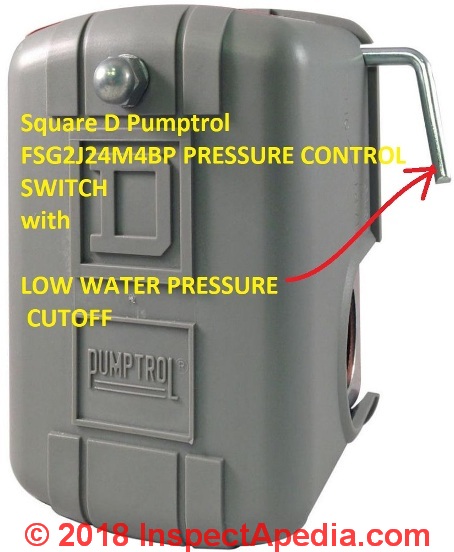 I Have Square D switch 30-50 lbs with a low water pressure shut off.
It causes me a lot of trouble when I fill large livestock tanks.
Can I modify the switch to eliminate the low pressure shut off feature or must I replace the switch. thanks - Mike Jones 8/22/11
Reply: no; that switch is protecting your pump.
Mike,
I'm not sure what trouble you're having with the pressure control switch, and that those details might be diagnostic.
If the pump is short cycling that's usually a pressure tank problem not a switch problem.
If the switch is burning up while staying "on" you might need to go to a two-switch system in which the Square-D switch switches on a heavy duty relay that turns on and off the pump.Watch out: But I am GUESSING from your comment that your pressure control has a low pressure "switch" (that's a pump protection device", that the underlying problem is that when you fill large livestock watering tanks you are exceeding your well's ability to deliver the quantity of water you want - your well is running dry.
If that's the case then the protection switch is important to keep from burning up your well pump.
So instead, take a look at WELL YIELD IMPROVEMENT
...
Examples of Water Pressure Control Switch Adjustments or Range Changes
How to increase the water pump pressure control from 20/40 to 30/50 CUT-IN/CUT-Out
I have a Square D water pressure control. It cuts off at 40 psi and goes down to 20 psi before it comes back on which is to low when I am using one sprinkler
I want it to come on at 30 psi. I can't understand how to do that looking your directions. Pls help - John 5/19/11
Reply:
How to increase the water pump pressure control cut-in and cut-out pressure:
Take a look again at the instructions above that indicate which nut to turn in which direction to increase the well pump cut-in pressure (that's your 20 psi number) and cut-out pressure (that's your 40 psi number).You should be able to raise the cut-in pressure to 30 psi and you will probably want to raise the cut out pressure to 50 psi, provided that your pump can actually reach that number.
Watch out: If the pump keeps running forever even AFTER you have turned off the water at the faucet or fixture, then it is not capable of reaching 50 psi and you'll have to lower that setting to avoid burning up the water pump.
Complete details of what these adjustment nuts do and which way to turn them are found in our separate, more-detailed article
at WATER PRESSURE CONTROL SWITCH ADJUSTMENTS
If the instructions are still too complicated to follow then you would be best off asking a plumber to change the settings for you. Just be sure the person you hire is familiar with well pump pressure control switches.
I'd like to get the cut-on at 60 and cut-off at 70.
I just rebuilt a Sta-Rite water pump (JBMG-41S)(2hp).
It had never been serviced and had a lot of iron build-up. The shaft had seized. After cleaning it out and putting new seals, it was still able to run OK so I reinstalled it. Then it seemed there was a problem with the pressure switch.
I cleaned out the pipes connecting to it and cleaned the switch itself but I wasn't able to get to a setting that wasn't cycling too quickly. I then looked at the air pressure in the pressure tank.
This system is installed in an old 6 floor apartment building. The city supply is about 45psi I wanted to get a cut-on pressure of about 55psi and a cut-off at about 75. The pressure tank (Challenger pc266r - 85 gallon) turned out to be over-charged.
I'm not sure what the pressure was at but it was over 60psi. I let out the air until it got to around 51. Now, cut-on pressure was around 55 and the pump was staying on for around 10 minutes before it reached 70psi but even with the differential nut unscrewed all the way I couldn't get the pump to turn off at 75psi.
I finally unscrewed the main nut and the pump went off but now the cut-on pressure was slightly lower.
I'd like to get the cut-on at 60 and cut-off at 70.
Help appreciated. - Ben 4/9/12
Reply:
Ben, please take another look at the details in the article above about adjusting the pump pressure control switch. You'll see that the two adjustments (on switches that have two) do not operate independently, so changing one can require fine tuning the other.
The larger nut shifts the whole cut-in/cut-out pressure range up or down, while the smaller nut changes the width of that range - the differential between cut in and cut out.
After I increased the pressure at the control switch the pump won't turn off
I raised my well pumps water pressure but now the pump won’t shut off. Help. On 2022-02-28 by Christopher Beitel
Solution by InspectApedia Com Moderator
@Christopher Beitel,
You may have set the pressure CUT OUT to a higher level than the pump can achieve.
You should try restoring your pressure control switch to the factory settings.
WATER PUMP PRESSURE SWITCH STANDARD (PSI) SETTINGS
Also see
WATER PUMP WONT STOP RUNNING
Set the pump switch pressure Range: I'd like to get the cut-on at 60 and cut-off at 70.
I just rebuilt a Sta-Rite water pump (JBMG-41S)(2hp).
It had never been serviced and had A lot of iron build-up. The shaft had seized. After cleaning it out and putting new seals, it was still able to run OK so I reinstalled it. Then it seemed there was a problem with the pressure switch
I cleaned out the pipes connecting to it and cleaned the switch itself but I wasn't able to get to a setting that wasn't cycling too quickly. I then looked at the air pressure in the pressure tank.
This system is installed in an old 6 floor apartment building. The city supply is about 45psi I wanted to get a cut-on pressure of about 55psi and a cut-off at about 75. The pressure tank (Challenger pc266r - 85 gallon) turned out to be over-charged.
I'm not sure what the pressure was at but it was over 60psi. I let out the air until it got to around 51. Now, cut-on pressure was around 55 and the pump was staying on for around 10 minutes before it reached 70psi but even with the differential nut unscrewed all the way I couldn't get the pump to turn off at 75psi.
I finally unscrewed the main nut and the pump went off but now the cut-on pressure was slightly lower.
I'd like to get the cut-on at 60 and cut-off at 70.
Help appreciated. - Ben 4/9/12
Reply:
Ben, please take another look at the details in the article above about adjusting the pump pressure control switch.
You'll see that the two adjustments (on switches that have two) do not operate independently, so changing one can require fine tuning the other.
The larger nut shifts the whole cut-in/cut-out pressure range up or down, while the smaller nut changes the width of that range - the differential between cut in and cut out.
...
Reader Comments, Questions & Answers About The Article Above
Below you will find questions and answers previously posted on this page at its page bottom reader comment box.
Reader Q&A - also see RECOMMENDED ARTICLES & FAQs
...
I keep having to let air out of the pressure tank to get the pump to turn on
As of yesterday after I turned off irrigation that the well would run-on, not pressurizing the pressure tank to 60psi and then cutting out.
I have a 250' deep well, I do not know which brand pump is below, it is a 3 wire 240vac type pump though.
When I have the AC breaker closed for the well, and take power readings within the well pump controller, the primary voltage coming from the pressure switch is 248vac, however, when I take a voltage reading at Red & Black of the well pump motor, the voltage is 320vac?!
At this point, I have made sure there are no house side leaks.
Each time I restore power to the well, I have to depress the Schrader valve (on the check valve on the pump inlet side of the check valve) until air ceases and water begins squirting.
When I have the AC breaker opened (no power to well) and place my ear to the 1.25" pipe coming up from the well head, I hear a hiss, and likewise during this scenario, the pressure at the pressure tank slowly drops down ... would this be the check valve just up=line from the point I am listening to the pipe? -On 2020-09-30 by Pat
by (mod) - voltage at the pump pressure switch contacts? Unwanted additional air in the pressure tank
Pat:
Some submersible pumps run on higher voltage powered by a separate control relay. The pressure control switch turns the relay on and off, and the relay operates the pump.
Obviously I don't know what you've got installed. Is there a second relay box?
Watch out: if you're not experienced with electrical testing you could be shocked or killed - take care.
About having to bleed air out of the tank to get the pump to turn on:The air bleeding procedure you describe tells me that new additional air is being injected into your pressure tank. This can happen if an air volume control on the tank isn't working properly OR if a snifter and drain-back valve system on your well and pump piping is not working right (suck open) or should have been removed when an old pressure tank was replaced.
Less likely and more extreme: it could mean that the pump itself is air bound or has low water in the well or that there is a snifter valve assembly that's not working properly on your well.
See details at SNIFTER & DRAIN BACK VALVES
On my water pump control the DIFF nut does not have any effect: Why?
What does it mean if the differential nut does not raise or lower the high pressure cut off and the gap stays the same?
In my case I noticed decreased pressure in the shower, and saw that the difference between the two readings was about thirty instead of twenty, so I attempted to turn the small nut to the left to bring the gap near 20, and then was going to raise the over all pressure with the big nut if it still was not adequate, but the small nut does not change the cut out pressure no matter how far I turn it.
The big nut, however, does do exactly what it is supposed to, raises both at the same time. This however did not solve my problem. I checked and adjusted the pressure tank pressure, and nothing has changed. On 2021-10-30 by philip hannem
by inspectapedia.com.moderator
@philip hannem,
It probably means that at least one of the two adjustment nuts on the pressure control switch has been loosened or tightened so far that the other nut has no effect on the switch behaviour. I'd return the switch to factory settings and start over.by philip hannem
thanks for your answer, but the factory setting is 40-60, but I am unable to achieve this. Can either get 20-50, or 30-60, cause the gap won't change with the differential nut setting.
by inspectapedia.com.moderator - how to restore pressure control switch to factory settings
@philip hannem,
Go to
PUMP PRESSURE SWITCH STANDARD (PSI) SETTINGS - contains instructions for restoring a typical pressure control switch to factory settings
Thank you to our readers for their generous comments
Thanks for the comments about safety in this article at inspectapedia. - Slater Pumps, Melbourne Australia.
This really could have turned out ugly if it were not for those safety comments. Honestly, safety is my number one priority and if I have to call a professional in because it is too dangerous for me, that is okay.
Thanks for all the advice -- much appreciated! - posted by Slater Pumps in Melbourne Australia On 2017-02-14 Yilliang Peng
Thanks for this article. Very useful. On 2018-01-11 by Eddie -
This information is awesome i learned A lot thank you . (July 10, 2014) louie brown
...
Continue reading at PUMP PRESSURE SWITCH STANDARD (PSI) SETTINGS or select a topic from the closely-related articles below, or see the complete ARTICLE INDEX.
Or see PRESSURE SWITCH NUT ADJUSTMENT FAQs - questions & answers about this article
Or see WATER PUMP PRESSURE CONTROL ADJUSTMENT FAQs - about the pressure control switch and its function
Or see these
Recommended Articles
- DIAGNOSE AND REPAIR POOR WATER PRESSURE
- WATER PRESSURE CONTROL SWITCH ADJUSTMENTS - home for water pump pressure control switch (you are on this page)
- WATER PUMP PRESSURE SWITCH DIFFERENTIAL NUT ADJUSTMENT
- WATER PUMP PRESSURE SWITCH RANGE NUT ADJUSTMENT
- WATER PUMP PRESSURE SWITCH SAFETY
- WATER PUMP PRESSURE SWITCH STANDARD (PSI) SETTINGS - how to get your pressure switch back to the original factory settings
- WATER PUMP PRESSURE SWITCH MAXIMUM PRESSURE SETTING
- WATER PUMP PRESSURE SWITCH SETTINGS TOO HIGH
- WATER PUMP PRESSURE SWITCH INSTALLATION MANUALS
- WATER PUMP PRESSURE SWITCH STANDARD (PSI) SETTINGS - get your pressure switch back to the original factory settings
- WATER PUMP SHORT CYCLING - home
- WATER PUMP WON'T START - no water pressure
- WATER PUMP WONT STOP RUNNING - pump just keeps running
- WATER TANK AIR PRESSURE ADJUSTMENT
Suggested citation for this web page
WATER PRESSURE CONTROL SWITCH ADJUSTMENTS at InspectApedia.com - online encyclopedia of building & environmental inspection, testing, diagnosis, repair, & problem prevention advice.
Or see this
INDEX to RELATED ARTICLES: ARTICLE INDEX to WATER SUPPLY, PUMPS TANKS WELLS
Or use the SEARCH BOX found below to Ask a Question or Search InspectApedia
Ask a Question or Search InspectApedia
Share this article:Try the search box just below, or if you prefer, post a question or comment in the Comments box below and we will respond promptly.
Search the InspectApedia website
Note: appearance of your Comment below may be delayed: if your comment contains an image, photograph, web link, or text that looks to the software as if it might be a web link, your posting will appear after it has been approved by a moderator. Apologies for the delay.
Only one image can be added per comment but you can post as many comments, and therefore images, as you like.
You will not receive a notification when a response to your question has been posted.
Please bookmark this page to make it easy for you to check back for our response.
IF above you see "Comment Form is loading comments..." then COMMENT BOX - countable.ca / bawkbox.com IS NOT WORKING.
In any case you are welcome to send an email directly to us at InspectApedia.com at editor@inspectApedia.com
We'll reply to you directly. Please help us help you by noting, in your email, the URL of the InspectApedia page where you wanted to comment.
Citations & Reviewers
In addition to any citations in the article above, a full list is available on request.
- Thank you to Jason Gapco at Education Solutions for careful editing and text suggestions, 12/2008
- Thank you to Steven Prior, a reader, for questions leading to our clarification of the function of the large and small pump pressure control switch springs, and for his photograph of the pump switch springs, 3/23/2009
- Thanks to reader Rise for pointing out that turning a nut clockwise means "to the right" or to the "more tight" position in the convention of how most threaded devices work. Nov 2009.
- Thanks to reader Don Travis for discussing water pump adjustment details - July 2010
- Pumptrol™ Pressure Switch Adjustment [PDF] Square D, Schneider Electric Corporation, 8001 Knightdale Blvd., Knightdale< NC 27545 1-888-778-2733 - Square D Technical Library, web search 07/24/2010 original source: http://ecatalog.squared.com/techlib/docdetail.cfm?oid=09008926800a93be
- In addition to citations & references found in this article, see the research citations given at the end of the related articles found at our suggested
CONTINUE READING or RECOMMENDED ARTICLES.
- Carson, Dunlop & Associates Ltd., 120 Carlton Street Suite 407, Toronto ON M5A 4K2. Tel: (416) 964-9415 1-800-268-7070 Email: info@carsondunlop.com. Alan Carson is a past president of ASHI, the American Society of Home Inspectors.
Thanks to Alan Carson and Bob Dunlop, for permission for InspectAPedia to use text excerpts from The HOME REFERENCE BOOK - the Encyclopedia of Homes and to use illustrations from The ILLUSTRATED HOME .
Carson Dunlop Associates provides extensive home inspection education and report writing material. In gratitude we provide links to tsome Carson Dunlop Associates products and services.
 |
HOME | ABOUT | ASK a QUESTION | CONTACT | CONTENT USE POLICY | DESCRIPTION | POLICIES | PRIVACY | |
| © 2026 - 1985 Publisher InspectApedia.com - Daniel Friedman | |||||||||