 Ceiling Tiles that do NOT Contain Asbestos
- POST a QUESTION or COMMENT about how to identify ceiling tiles that contain asbestos
Asbestos-free ceiling tiles:
How to recognize ceiling tiles by visual inspection to note clear evidence of non-asbestos materials such as fiberglass, and how to confirm that other ceiling tiles or suspended ceiling panels are asbestos free by a simple lab test.
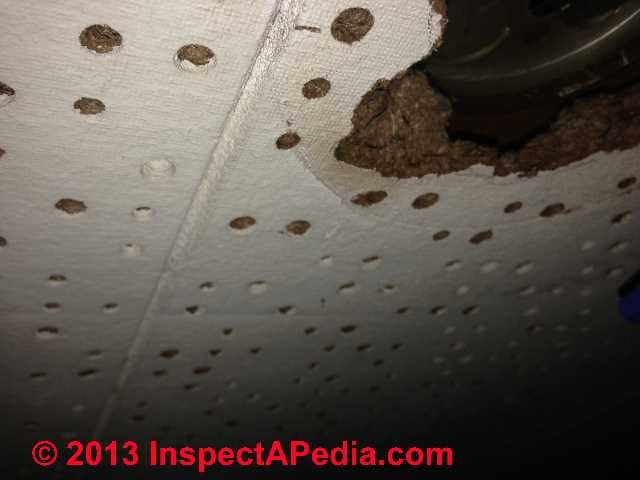
Our page top photo shows an old acoustic ceiling tile that tests showed did not contain asbestos. Below on this page we include photographs of other ceiling tiles whose properties may tell us that there is or is not a risk that the tile contains asbestos.
For example, ceiling tiles made obviously of fiberglass are not an asbestos product.
This article series assists building buyers, owners or inspectors who need to identify asbestos materials (or probable asbestos) in buildings by simple visual inspection.
We provide photographs and descriptive text of asbestos insulation and other asbestos-containing products to permit identification of definite, probable, or possible asbestos materials in buildings.
InspectAPedia tolerates no conflicts of interest. We have no relationship with advertisers, products, or services discussed at this website.
- Daniel Friedman, Publisher/Editor/Author - See WHO ARE WE?
How to Recognize or Test Ceiling Tiles or Suspended Ceiling Panels that DO NOT contain Asbestos
Article Contents
- ASBESTOS FREE FIBERGLASS CEILING TILES
- ASBESTOS FREE JOHNS MANVILLE CEILING TILES TEST RESULT
- ASBESTOS TEST RESULTS for OTHER CEILING TILES
- HOW TO RULE IN OR OUT ASBESTOS in CEILING TILES - How to make a reasonable guess by noting contextual clues such as building age.
...
Fiberglass Ceiling Tile Asbestos Risk?
Are These Yellow Fibrous Ceiling Tiles an Asbestos Product?
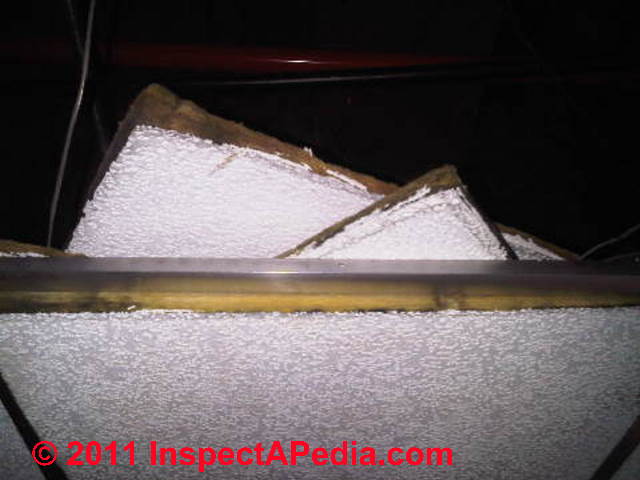 I hope you could help us identify if this ceiling material used contains asbestos. Kindly validate. Thank you. [unsigned, sent from Blackberry]
Reply: Fiberglass based suspended ceiling tiles do not contain asbestos
A competent onsite inspection by an expert usually finds additional clues that help accurately diagnose a problem or might find asbestos containing materials that you have not noticed.
That said, - no the material shown in your photo looks like fiberglass panels used in a suspended ceiling; the panels include a white plastic surface that faces down into the room, sometimes the surfaces may have been painted to cover stains.
Do not assume, based on a single item that has caught your eye, that there are no asbestos materials in the building, and of course there could be other environmental or even indoor air quality in the building.
The presence of what looks like thermal tracking stains present on the edges of the fiberglass suspended ceiling panels in your photo and the fact that it looks as if the panels may have been painted could be clues about unwanted air leakage and possible water leaks from above.
Watch out: normally asbestos-containing materials are not validated nor in-validated based on free emails sent to a stranger. But in this case the contents of the photo above are rather apparent.
Look at the yellow fibrous edge of this ceiling tile where you can see both the fiberglass base and the very thin plastic or vinyl top layer that forms the ceiling tile color and pattern.
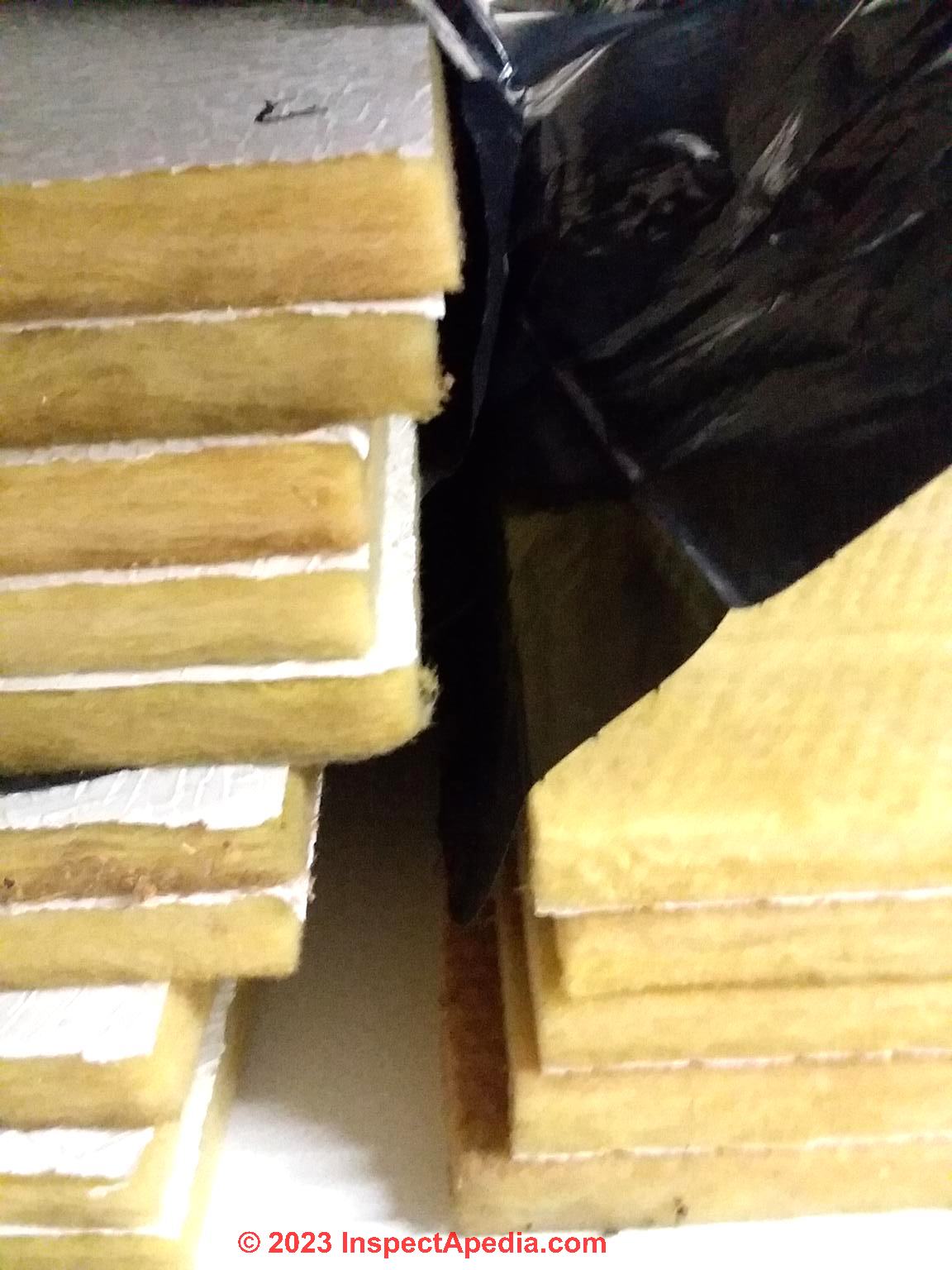
Below we include another contemporary example of fiberglass ceiling tiles. This an Armstrong Ceilings 4-ft x 2-ft SHASTA (Perforated) White Fiberglass Drop Ceiling Tile (Item #4358361 | Model #2906) sold at building suppliers such as Lowes, Menards, and Home Depot stores.
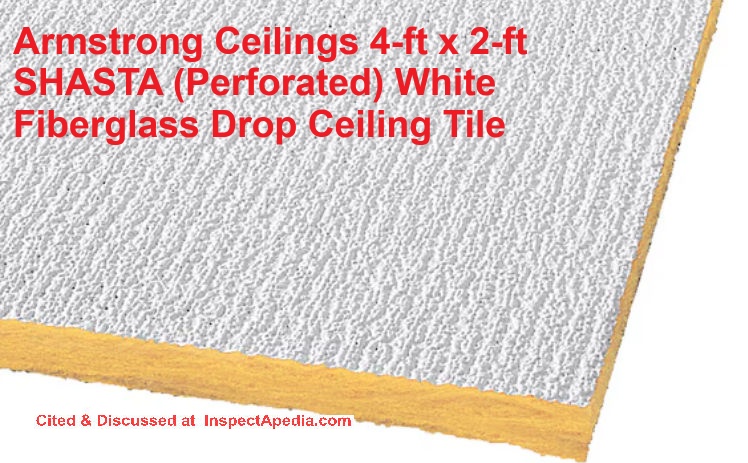
This is not an asbestos-containing product.
Watch out: however, IF above a suspended ceiling there happens to be asbestos material (such as spray on building insulation or asbestos-insulated piping) that is shedding material, that could fall onto the fiberglass ceiling tiles below, thus contaminating them with a material that may contain asbestos.
And the fact that we find fiberglass (asbestos-free) ceiling tiles in a building does not mean that there could not be other asbestos containing materials present. That risk is more or less likely depending on the age and location of the building.
Just below we show a cache of older 9-inch ceiling tiles found in the attic of an older home.

These ceiling tiles might be an asbestos containing material. We expected to find multiple layers of ceilings in this pre-1900 home, some of which were likely to make use of 1960's era acoustic ceiling tiles like the ones in our photo.
...
Johns Manville Ceiling Tiles - tested as asbestos free
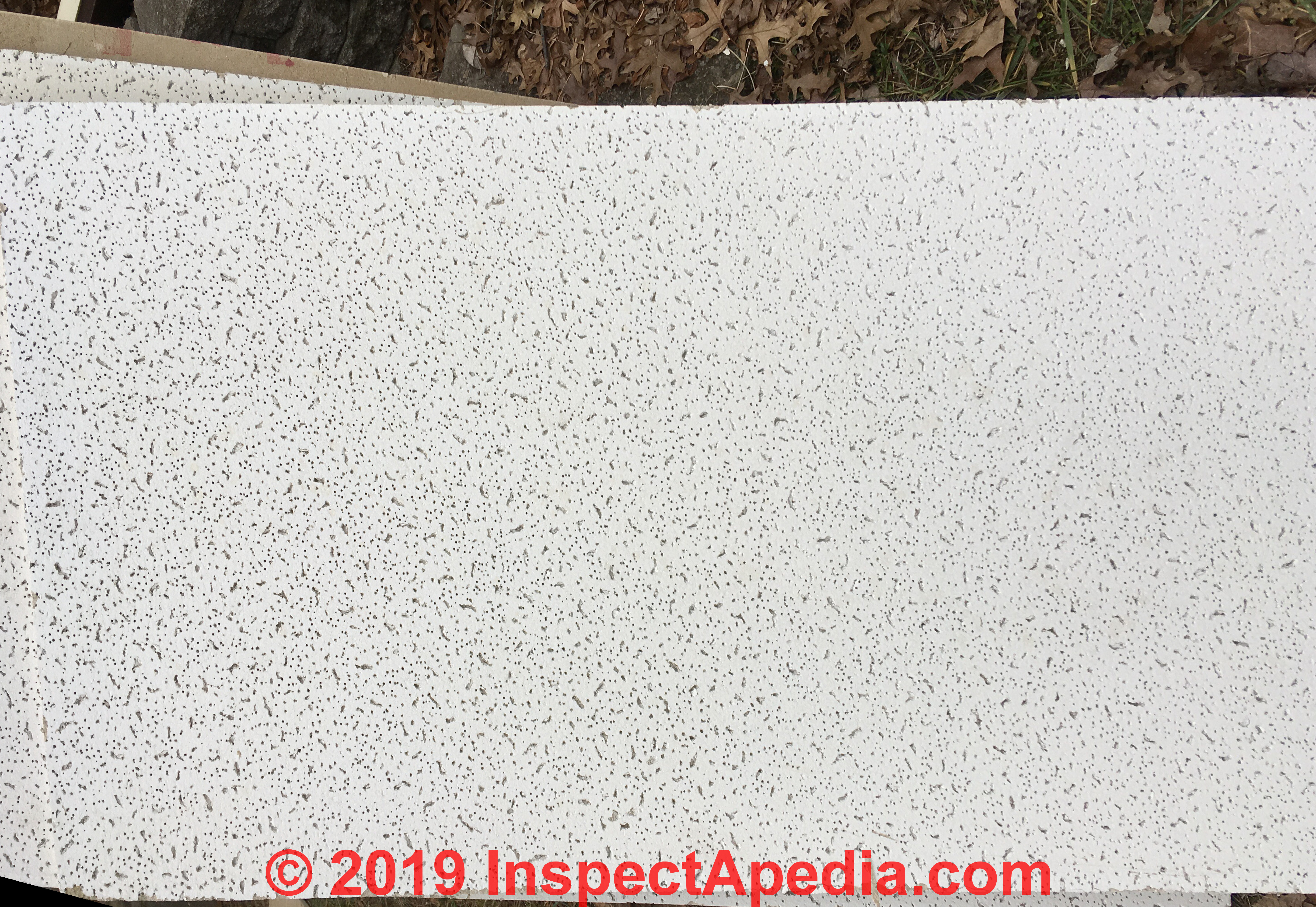 2020/01/13 by private email
I recently removed all of the drop ceiling tiles in my home that was built in 1967.
I don’t know when the ceiling was put in, I’ve only owned the house for a year. I didn’t even think about asbestos as I associate that more with floor tiles.
Can you please tell me if you know of these tiles containing asbestos? I can’t find any info online when I search for the patent number.
They are 2x4. I was wearing a respirator but now I’m paranoid as all hell exposing my family to this crap.
I plan on getting it tested at a lab but want to know if you have any input.
Thanks for any help, - Anonymous
Reply: don't panic, don't make dusty mess
First try not to panic us that's bad for your health too. If you didn't make a Dusty mess the risks are probably quite low. I'm traveling and working in Mexico where I'm not at my computer until tomorrow.
But you could try this: a Google Patent Search or Google Scholar search on the patent numbers and see if the patents describe an asbestos containing material. Let me know what you find.
Reader follow-up:
Wow, thank you for taking the time to reply. I searched the patent and found it was issued in February of 1969 but found no information regarding composition of material, just design.
It does describe the panels width as a “fragmentary” view. I’ve attached screen shots.

I was careful as to minimize the creation of dust (and there was a lot of mouse poop on top of panels, however the edges of the panels were very crumbly and a couple panels did break coming down. I took about 80 panels down in total.
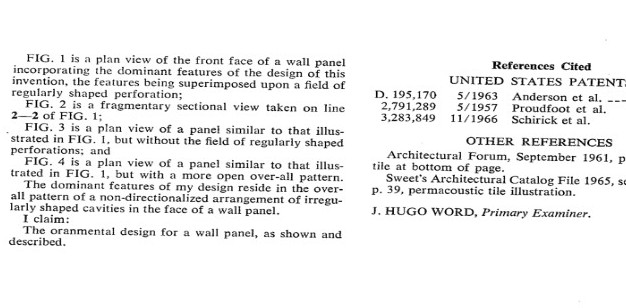
Unfortunately the basement is a mess now, as all work stopped after my revelation. Jan 13, 2020 -
Reply:
Okay so you want to damp wipe or HEPA vacuum the dusty areas and of course take care not to track dust elsewhere or you'll need to clean that area too.
Reader follow-up: tried calling Johns Manville - they wouldn't tell me
I found this attorney website (unknown credibility and obviously cant be all inclusive) asbestos-attorney.com/ asbestos_product_brands .htm that doesn't list any ceiling tiles for Johns Manville.
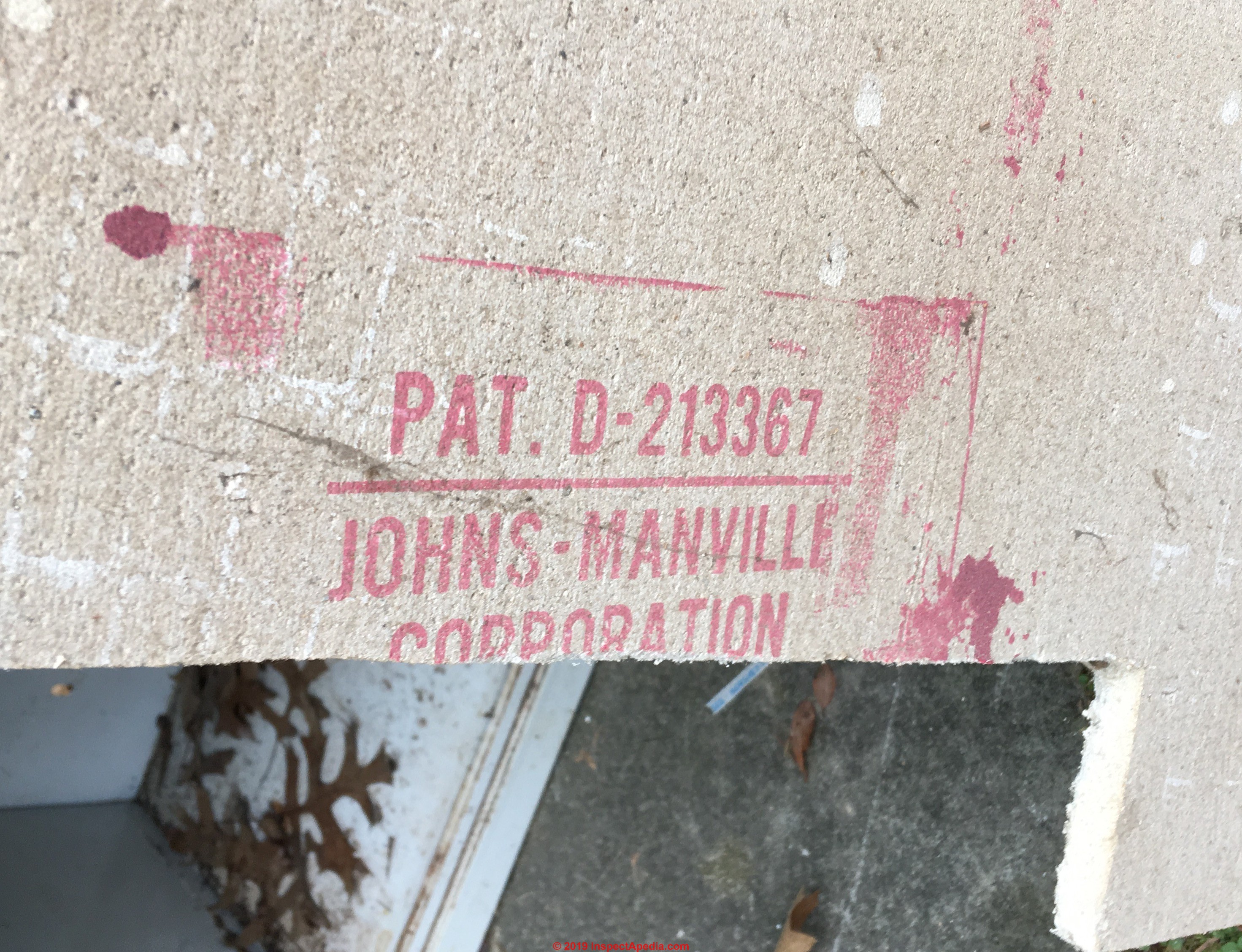 I did try calling Johns Manville direct but they wouldn't tell me either way.
The guy on the phone said the patent number was of no use for ID ing the product to him and recommended that I get it tested.
I noticed someone did post the exact same patent number and very similar description (although they were 2x2 and not 2x4) on your website but I never saw a followup by the poster if they were tested for asbestos or not.
I'll be dropping off a sample at a lab tomorrow and will keep you posted.
Thanks for your help. Safe travels, 21 Jan 2020
Moderator reply
Thank you for the update Danny and do keep me posted it will certainly be helpful to others as well. You wouldn't be surprised if there was a Mansville product that used asbestos since they used asbestos in quite a few things.
I agree that the patent number won't necessarily identify the specific ceiling tile product made by Johns Manville, but the person you spoke with may not have considered carefully just what patent numbers on products can tell us.
First, the most-recent patent date for patent numbers on a product tell us the oldest that the product could possibly be. That in turn can tell us if the product was made after asbestos was no longer used in consumer products of that type.
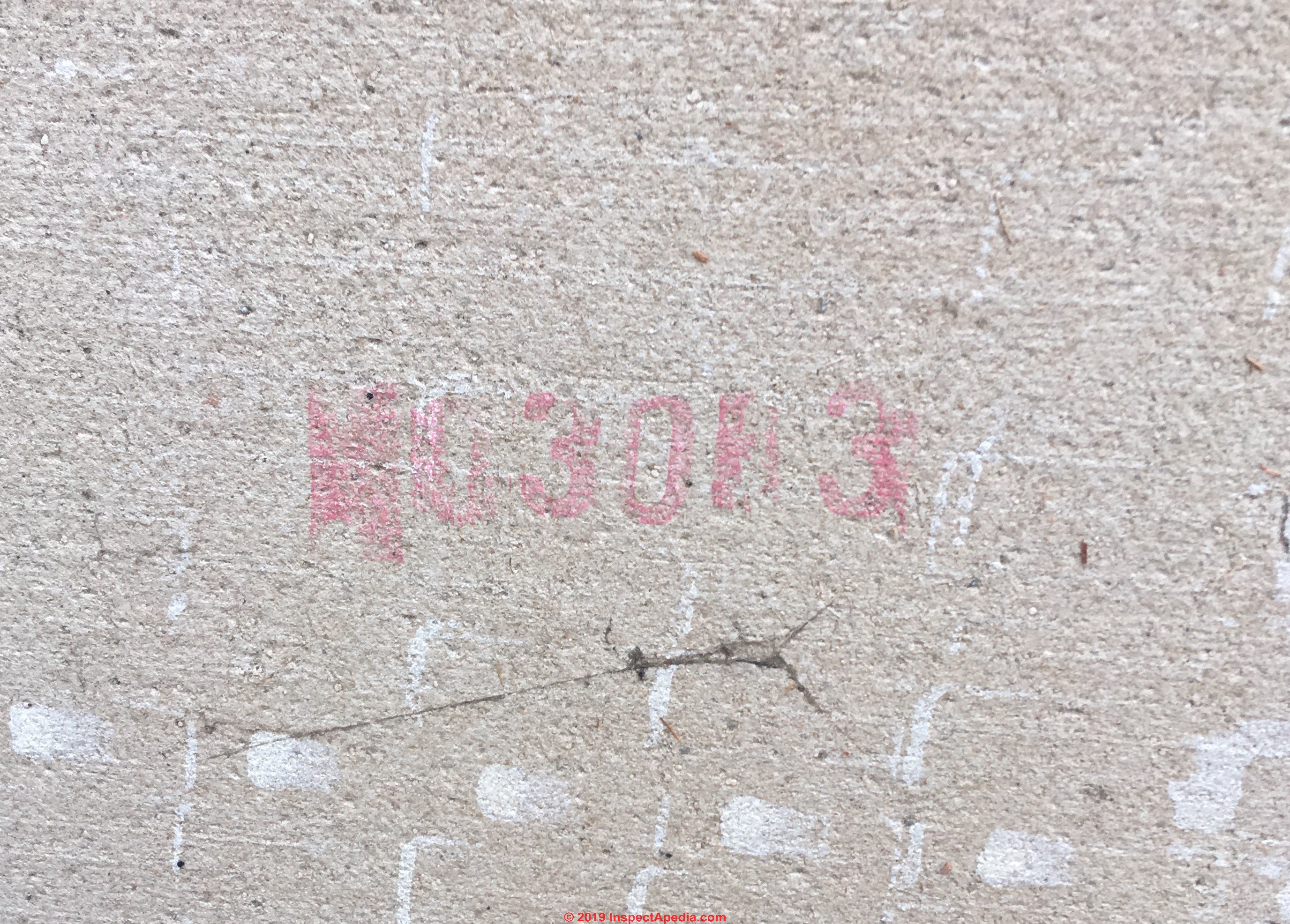 Second the patent numbers can, by reading the actual patent disclosure, tell us if asbestos is even mentioned in the patent description - often a useful clue about the possibility of asbestos content in a product that was patented.
For example some building material patents may specifically claim that asbestos was an ingredient in the product.
Of course none of this is an assertion that your specific ceiling tiles contain asbestos as many do not.
I'm looking at your photo of the edge of the product you could at least rule out fiberglass and I don't think that I saw what looks like cellulose but I will be interested in what the lab has to say. - 21 Jan 2020
Reader follow-up: these Johns Manville ceiling tiles were tested and found "negative" for asbestos
The ceiling tile/panel was negative for asbestos. Feel free to use the pictures and share results on your website.
I also had 4 other samples done. I can share those pictures and results with you, if you’d like.
The only positive result was a floor tile that is under carpet. I’m relieved to say the least. 21 Jan 2020
Moderator reply:
When you have energy to send along the other photos and if you can, the test reports that'd be great. When published our default is to keep you anonymous, editing or blanking out report ID info as appropriate if those appear online. 21 Jan 2020
...
How to Identify Non-Asbestos Acoustic Ceiling Tiles by Lab Test
Photos & Lab Test Results for Acoustic Ceiling Tiles Found NOT to Contain Asbestos
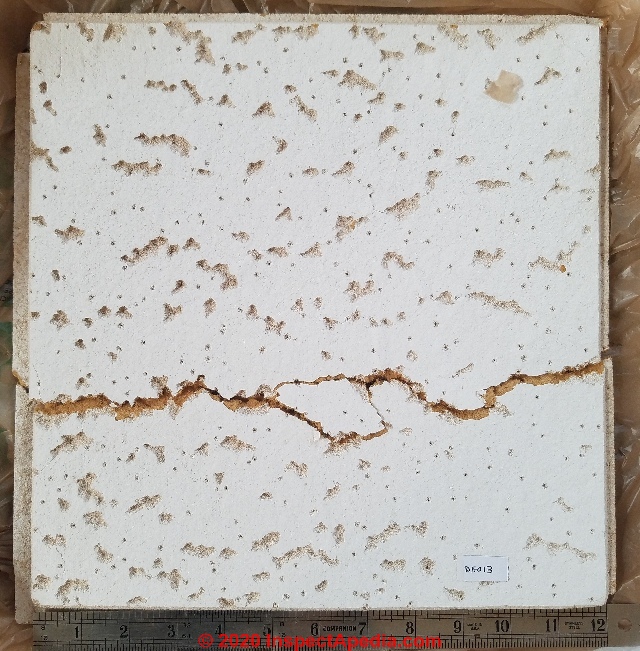
Acoustic Ceiling Tile Sample No. 12:
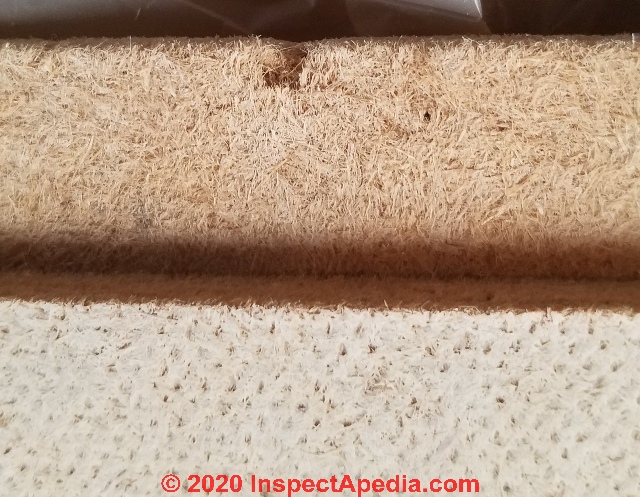
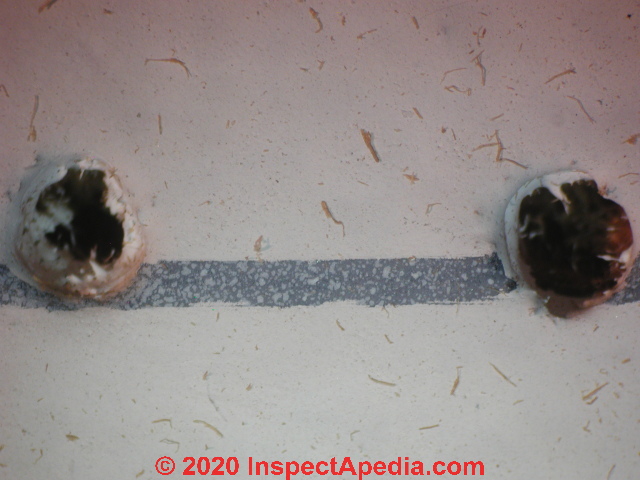
12-inch acoustic ceiling tile, Location: Two Harbors MN, acoustic ceiling tile from a home constructed in 1960, collected ca. 2019/12/01 (by L.C.) and shown above is the full tile and just and below a closer-look at the tile edge from the back surface.
Below are photographs of this same ceiling tile under the stereo microscope in our laboratory, showing a wood-fibre like construction coated with paint on the ceiling tile's exposed surface.
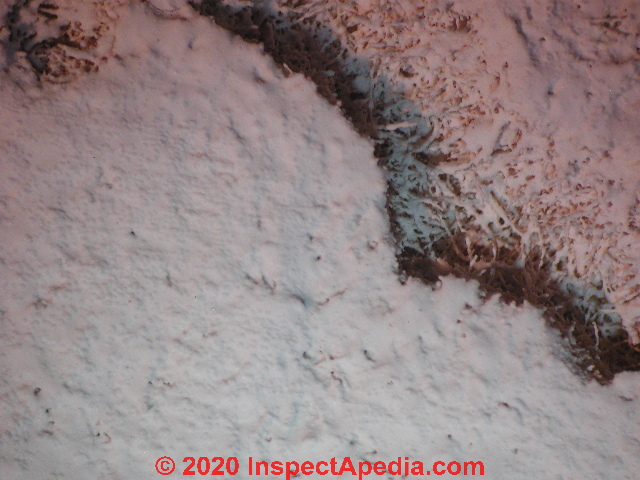
and
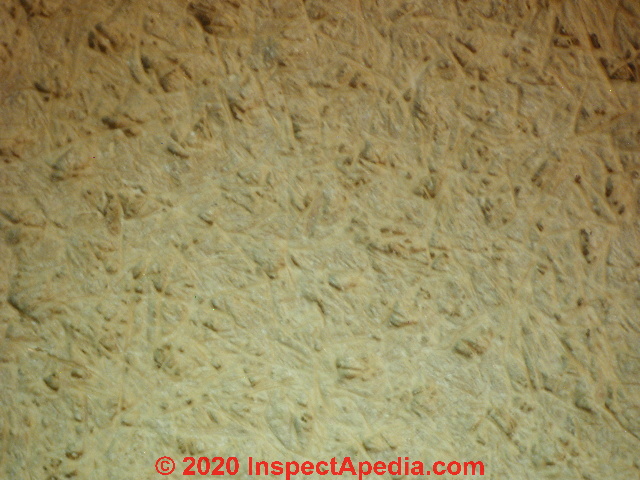
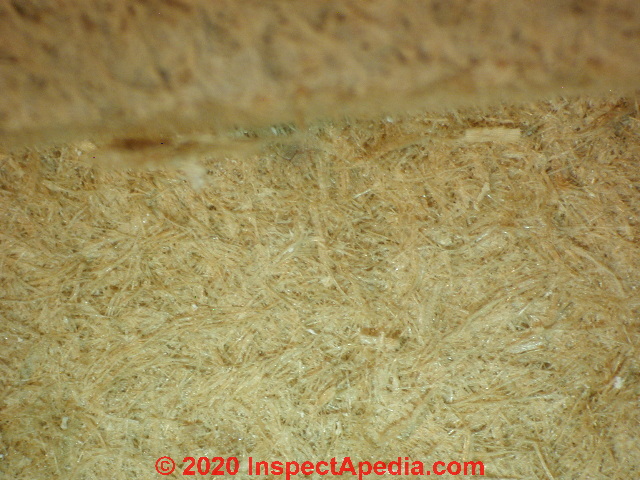
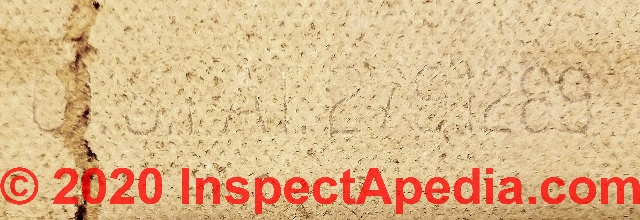
Below is a closer look at the cellulose-like fibres visible on the tile back surface, suggesting that this may be a straight cellulose product, followed by a photo of the partly legible manufacturer's number stamp, probably a ceiling tile model number.
...
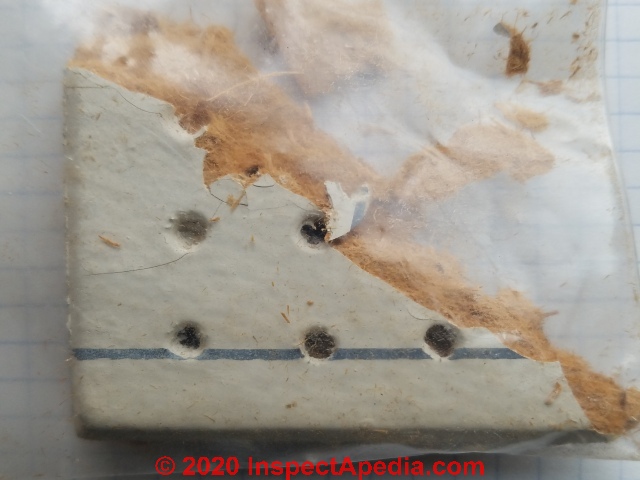
Acoustic Ceiling Tile Sample No. 13: 9-inch acoustic ceiling tile, Location: Two Harbors MN, acoustic ceiling tile from a home constructed in 1960, collected 2006/03/23 (by the author) and shown just below.
...

Below: Sample 12 ceiling tiles under the stereo microscope in our laboratory.
...
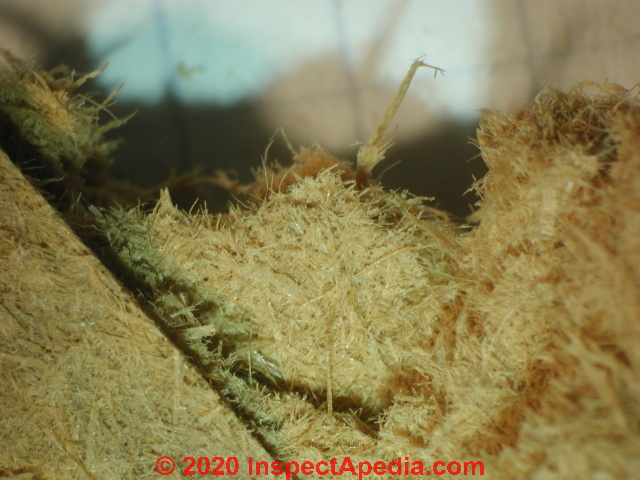
The brown wood-fibres visible even under the stereo microscope, before higher-resolution microscopy or PLM, suggest that this is a cellulose - wood-based - product.
Below: we sent both of these samples to a certified asbestos test lab for characterization and to screen for asbestos.
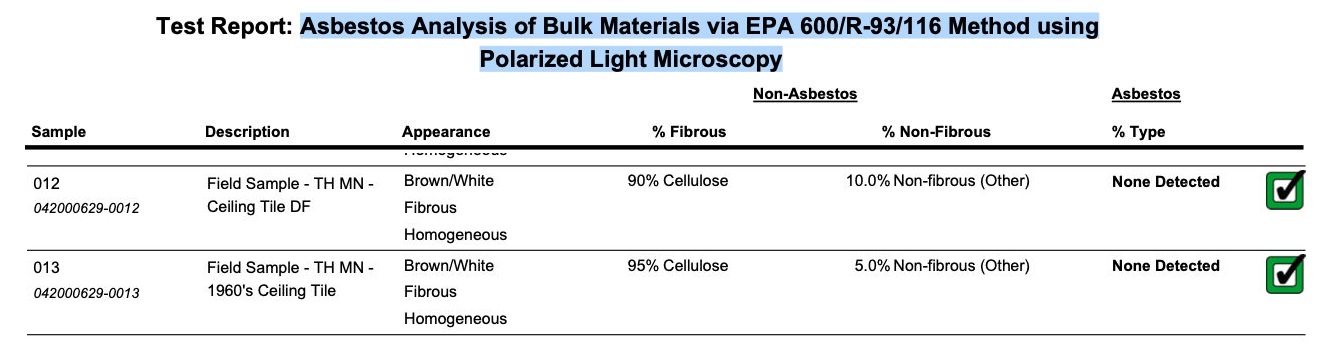
Report below: EMSL report on the same sample No. 012 using Asbestos Analysis of Bulk Materials via EPA 600/R-93/116 Method using Polarized Light Microscopy
The lab found for acoustic ceiling tile sample 12:
- Brown/White fibrous homogeneous material
- 90% cellulose
- 10% non-fibrous (other)
- Asbestos not detected
The lab found for our acoustic ceiling tile sample 13:
- Brown/white fibrous homogeneous material
- 95% cellulose
- 5 % non-fibrous (other)
- Asbestos not detected
- ASBESTOS TEST DESCRIPTION: PLM and TEM EPA 600/R-93/116) [PDF] 2020-01-23, used for InspectApedia.com asbestos test analysis via two methods, polarized light microscopy (low magnification stereo microscopy) and transmission electron microscopy (at about 20,000x) PLM EPA 600/R-93/116 (< 1%) & TEM EPA 600/R-93/116 (<0.01%).
for samples No. 001-005 and 008-014. - ASBESTOS TEST RESULTS SUMMARY [PDF] 2020/01-18-20, Test Report: Asbestos Analysis of Bulk Materials via EPA 600/R-93/116 Method using Polarized Light Microscopy EMSL Ord No. 042000629 2019-12-26 for samples No. 001-005 and 008-015.
For samples 001-005, and 008-014
- Contact: EMSL Analytical, Inc., 200 Route 130 North, Cinnaminson, NJ 08077 USA, Tel: 856-303-2500 - Fax: 856-786-5974 - Toll Free: 800-220-3675
Lab Hours: Mon-Friday 7AM-10PM, Saturday 8AM-5PM, Sunday On-Call. - ASBESTOS TEST LABS in the USA - EXAMPLE REPORTS - provides fourteen example asbestos test results from EMSL
Sample No. 12: see details at CEILING TILE ASBESTOS IDENTIFICATION - 12-13 - 1960 acoustic ceiling tile, TH MN
Sample No. 13: see details at CEILING TILE ASBESTOS IDENTIFICATION - 12-13 - 1960 acoustic ceiling tile, TH MN
Other Asbestos-Free Acoustic & Suspended Ceiling Tile Examples, Lab Test Results, Photos
Reader comment: Lab test confirms no asbestos in a representative ceiling tile
 I posted to the asbestos page 2 days ago about helping me understand my lab report.
From what I can make out it’s safe for me to work around these tiles. I started to replace light fixtures in my basement and these tiles came down while I was working.
I’ve attached the CEILING TILE ASBESTOS TEST REPORT [PDF] and appreciate the help. - Anonymous by private email 2020/09/10
This discussion was posted originally by HS at
Moderator reply:
Your report says that no asbestos was detected and notes that the basement ceiling material you submitted was homogeneous, tan and white, with 7.4% mineral wool.
Of course in any environmental test, EVERYTHING depends on where, when, how, under what conditions such a test was performed. For example if someone tested areas of the building outside the area that concerns you then the test would not be helpful.
Reader follow-up:
Thanks for the reply, it’s appreciated. I had the lab test just one ceiling tile and no other samples. I’m guessing it’s safe for me to work on the light fixture.
Reader comment: I live in a house built in 1954. I am worried that some of the materials in one room may contain asbestos.
The room in question appears to have been a garage carport that was enclosed a number of years after the home was built.
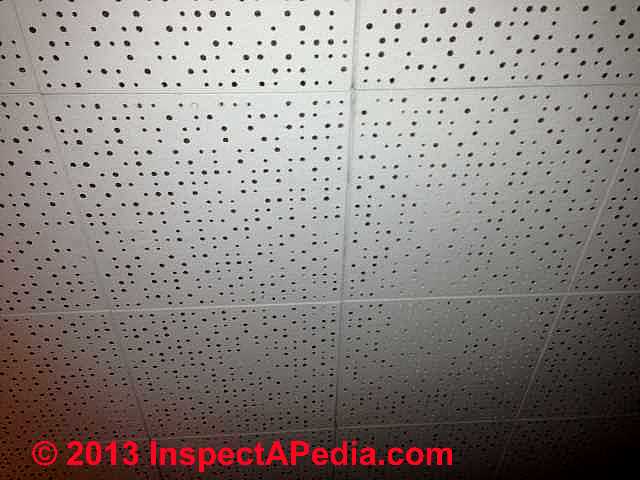
The ceiling in that room has acoustic tiles that resemble some of the tiles that have been known to have asbestos. I have taken a sample using the wetting methods I found on your site and elsewhere, but I wanted to check with you before I send them off to be tested.
The 12x12 floor tiles in the same room were recently covered with carpet and I never had a chance to take a sample.
The carpet was damaged by an clothing iron and I'm concerned that replacing the section of carpeting may disturb the tiles in question.
However, I'd probably just take a sample once that work was done so I guess I don't actually have a question concerning that.
I've included pictures of the ceiling. I understand that you are a paid consultant but I'm not sure if this question requires a fee. Thanks for your help! - R.N. 10 Feb 2013
Reply:
Often ceiling tiles that look like the ones in your photos do contain asbestos so your choices are to treat them assuming that they are asbestos containing or if you want to send a sample to a laboratory then you just want to select a certified asbestos testing laboratory.
Most of your ceiling, at least from the two photos, looked as if it were in good condition.
If there were a concern with fiber or dust release from the ceiling I might have suggested a coating or sealant - giving up some of the acoustic properties by painting is not such a big loss on this ceiling; or it may have already been painted. One could tell by looking for paint deposits in some of the acoustic holes in the tiles.
Certainly if you plan any demolition it makes sense to use appropriate dust control as if the material contained asbestos, not only to be safe (if you've not had testing done), but because high levels of dust can be a respiratory irritant or hazard whether or not there is asbestos present.
Reader Follow-up:
Thank you Mr. Friedman, I'll send my sample to one of those labs on Monday. I appreciate your help.
I just wanted to let you know that I had my ceiling tested and no asbestos was found. The lab was an accredited one so I trust I can assume there test to be accurate.. Thanks for your previous help!Reply:
Thanks for the follow-up and the photos. As long as your asbestos testing lab was a certified one we can be confident in these interesting results: an indication that not all old acoustic ceiling tiles contained asbestos. Indeed some manufacturers assert that their ceiling products never did.
How do I test Ceiling Tiles for Asbestos?
Our InspectApedia reader asked:
A hardware store employee told me to use the lead paint test kit on one of the acoustic ceiling tiles. He said that, after all these years (since 1965) it would show positive for lead, if in fact the tiles contain asbestos. Is this true? - Deb.
Moderator Reply: visual inspection plus sample collection to send to a certified asbestos testing laboratory
Deb, a lead paint test has nothing to do with and is not capable of detecting asbestos in building products. The hardware store guy who told you to use a lead paint test to screen for asbestos was mistaken.
- First make a visual inspection of the ceiling tile or panel. Some products can be positively identified as fiberglass or compact fiberglass - not an asbestos material, as you'll see illustrated in our photos in the next Q&A just below. Also
see ASBESTOS-FREE INSULATION MATERIALS. - Next, contact a local certified asbestos testing lab in your area or use one of the national labs that confirms that they are certified for asbestos testing. The lab can give you specific sample collection instructions. Also
see ASBESTOS REMOVAL, WETTING GUIDELINES.
Typically the asbestos test makes use of polarized light microscopy, is quick, and is not expensive. The result will tell you if your ceiling product contains asbestos and if so what type of asbestos (hazard levels vary) and at what level. - Watch out: dust from demolition of many building products can be irritating and even harmful regardless of whether or not the material contains asbestos fibers or particles.
Good dust control measures can avoid spreading dust throughout the building during material removal or remodeling, and proper personal protection can protect workers as well.
Coarse Fiber Ceiling Tiles Tested for Asbestos - None Found
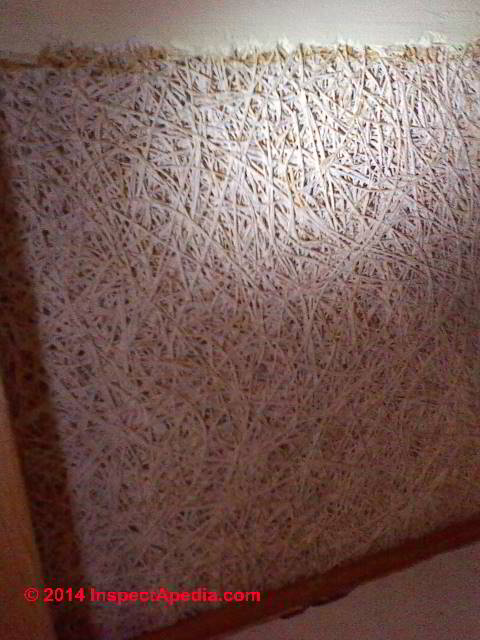
Our reader said:
We just bought a home. It was updated extensively/an addition put on sometime in the 60's-70's we think.
And then again in the late 80's-early nineties. We are finding these "tiles" for lack of a better term EVERYWHERE.
From what I am finding online it looks like "wood cement acoustic tile?" We haven't disturbed it significantly yet, although we did begin to remove some wallpaper it is attached to, but then stopped when we found it.
Should this be cause for concern? Our home inspection did not cover asbestos. And we didn't realize this material could be hazardous. We are feeling a little foolish and a lot concerned, as we have two young children also.
Any info you have, or direction you could point us in would be greatly appreciated.
Thanks so much in advance, - A.M. 21 Oct 2014
We commented:
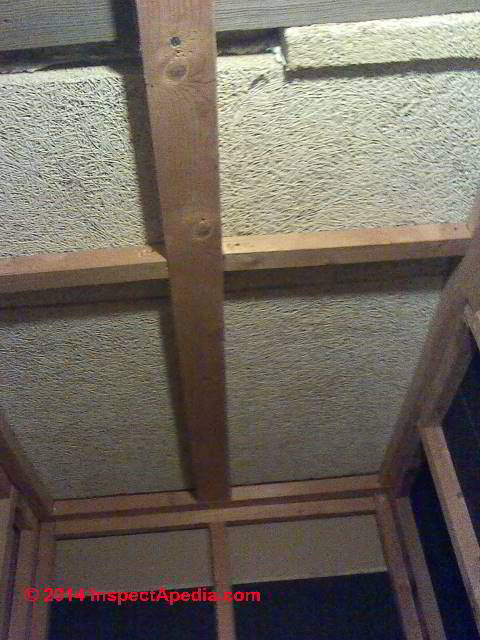
The brown colour looks to me as if this is a wood or cellulose insulating board product. Don't feel too foolish - unless you made a significant dusty mess the chances are that the dust exposure from what you've done so far is below measurement.

If you can remove the material without disturbing it do so. If it needs to be disturbed risking dust, I'd have a sample tested to be sure of its safety: the cost is around $50. U.S.
See ASBESTOS TESTING LAB LIST [Link given below] and do keep me posted on results if you have this tested.
Reader Follow-Up:
I am calling a lab in Cincinnati tomorrow morning. I will certainly let you know!
... It was NOT asbestos. - A.M. 11/11/2014
Suspended Ceiling Tile Asbestos: are these apartment ceiling tiles an asbestos hazard?
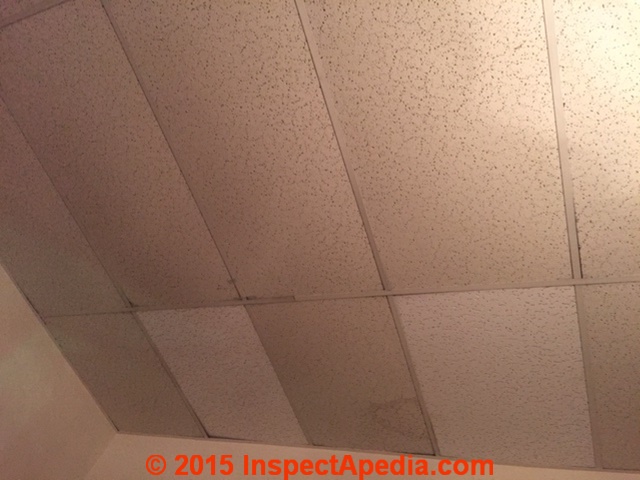
I just moved into a apartment in CA.. My lease did say that the building may have asbestos in it and it said not to mess with the ceiling tiles at all! My father says I have nothing to worry about but I'm still uneasy about the whole thing. Can you tell me if these tiles have asbestos in it? Or appear to? 2016/03/31 Edwin asked
Reply:
Some ceiling tiles contain asbestos and others don't. From your e-text and even with the photo, one cannot say for sure what's in your ceiling. But you've been warned by the building to leave the ceiling alone. Asbestos is not like a radioactive material. If it is intact, surface-sealed, and not disturbed, it's not likely to be a measurable hazard.
I do see signs of a leak in the ceiling above, as well as signs that some ceiling tiles have been replaced. From my experience it is almost impossible to remove and replace fibre-type ceiling tiles without causing at least a little fiber shedding. That's probably why the apartment management asked you to leave the ceilings alone.
To know for sure what the ceiling tiles contain you'd need to collect a small sample for analysis by an asbestos test lab. That cost is typically under $50
See ASBESTOS TESTING LAB LIST if you decide to have a test performed, and do keep me informed as what you find will surely assist other readers. You might also ask to see a copy of asbestos inspection & test reports pertaining to your apartment or building. Not all ceiling tiles contain asbestos.
Watch out: Also, I'd take care to keep an eye on workers who might do work in your apartment if that requires disturbing the ceiling. If tiles are damaged and a dusty mess is made, it needs to be cleaned up properly. Running a vacuum -cleaner that's not HEPA rated, for example, increases the level of small airborne particles.
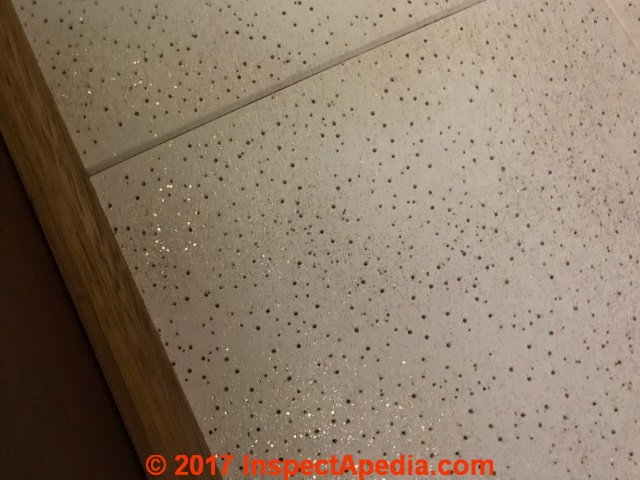
Do metallic-flaked white perforated 12x12 ceiling tiles contain asbestos?
Do you think these 12x12 ceiling tiles with metallic sparkly flakes contain asbestos?
The house was built in 1955; we see no identifying markings on the ceiling tiles. - anonymous by private email 2017/04/12
Reply:
My advice has to be the same as we posted in the online discussion for this ceiling: from a photograph, no date, no markings, no product name or ID, we're left having to suggest that you have a sample tested.
However very faintly I see what looks like a tile edge in your photo. Take a look, if you can see the edges of the material. If you see fiberglass, that's not an asbestos product.
If the edges are a yellow paper-like material that's probably a cellulose-based material.
Anon Said:
[Because I'm worried about this ceiling] we're taking a ceiling tile sample to micro air, inc. an NVLAP registered asbestos test lab 2 hours away in Indianapolis for same-day testing ($120. U.S.).
It seems as if you are pretty confident this is NOT an asbestos tile. Is that fair to say?
Reply: probably not asbestos
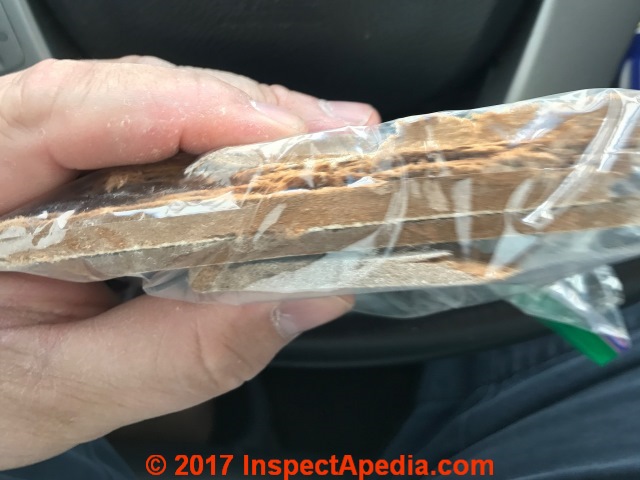
Unless there are known product brand and model markings that identify a material known already to be asbestos free, (such as fiberglass or such as specific product brand labels) one cannot be absolutely confident about the asbestos content in a material from photographs of the ceiling tile.
But usually the yellow papery like material such as shown in your photo of the ceiling tile edge is cellulose - a wood product.
Making trouble for that assumption is the fact that there were some similar-looking ceiling tiles that did include asbestos, as we describe separately
at ASBESTOS CEILING TILE IDENTIFICATION.
If you have not created a dusty mess by demolition then even where a ceiling tile contains asbestos, the amount of asbestos in building air and dust from the intact, undisturbed asbestos-containing ceiling tiles would be usually between extremely-low and below the limits of detection.
Generally the best course is to leave intact asbestos-suspect ceiling, wall, or floor material alone, covering it with drywall (or flooring) to form a new surface.
When the material has already made a dusty mess or if it must be demolished, then lab testing to confirm the presence or absence of asbestos is justified.
Asbestos isn't "radioactive" - it doesn't emit harmful particles into building air when covered-over or otherwise sealed, and as the US EPA recommends, the risk of asbestos-exposure from that approach is far less than the asbestos exposure hazard caused by demolition.
Fight that panic - lest opportunists gouge you. Pretend to be calm, even if you're not.
Reader follow-up: these ceiling tiles were found to contain 98% cellulose, 2% binder.
Just got the report back. 98% cellulose, 2% binder.
the asbestos test lab report (not reproduced here) included the following data:
Polarized Light Microscopy (PLM) Bulk Sample ResultsLocation, ... |
||||||||
| Sample ID | Client Sample ID | Date Collected | Date Analyzed | Asbestos Present? | Color | Homogeneous | Sample Composition Asbestos - Non-Asbestos |
|
| 001 | 1 | 4/13/2017 | 4/12/2017 | NO | O-W | YES | N/A | Cellulose 98%, Binder 2% |
Notes to the table above
Notes: Concentration of greater than one (1) percent of any type of asbestos means a sample meets the EPA definition of an asbestos-containing material.
... [other report explanatory contents deleted]
... Analyst name & reviewer names deleted - Ed.
Analytical Method: EPA Method 600-M4-82-020 & EPA Method 600-R93-116 (1993)
...
Rule In or Out the Possibility that Ceiling Tiles Contain Asbestos
When we know absolutely nothing about a ceiling tile but someone's worried that it may contain asbestos, there are several questions that can be asked (and answered) that permit a reasonable guess that can rule out a concern the ceiling product contains asbestos.
Detailed Steps to Rule Out Asbestos in Ceiling Tiles
are found in these two articles
- ASBESTOS CEILING TILE IDENTIFICATION - 5 Easy Steps to tell if CEILING TILES are likely to contain asbestos
- DOES THIS MATERIAL CONTAIN ASBESTOS?
...
...
Continue reading at ASBESTOS CEILING TILE IDENTIFICATION - 5 Easy Steps to tell if CEILING TILES are likely to contain asbestos, or select a topic from the closely-related articles below, or see the complete ARTICLE INDEX.
Or see ASBESTOS FREE CEILING TILE FAQs - questions & answers posted originally on this page
Or see these
Recommended Articles
- ASBESTOS CEILING TILE IDENTIFICATION - 5 Easy Steps to tell if CEILING TILES are likely to contain asbestos
- ASBESTOS TESTING LAB LIST - certified asbestos testing labs
- ASBESTOS-FREE CEILING TILES
- ASBESTOS-SUSPECT CEILING COVEROVER
- CELOTEX ASBESTOS PRODUCTS
- CEILING TILE MATERIALS
- DOES THIS MATERIAL CONTAIN ASBESTOS?
- TEST KIT for DUST, MOLD, PARTICLES: INSTRUCTIONS
Suggested citation for this web page
ASBESTOS-FREE CEILING TILES at InspectApedia.com - online encyclopedia of building & environmental inspection, testing, diagnosis, repair, & problem prevention advice.
Or see this
INDEX to RELATED ARTICLES: ARTICLE INDEX to ASBESTOS HAZARDS
Or use the SEARCH BOX found below to Ask a Question or Search InspectApedia
Ask a Question or Search InspectApedia
Share this article:Search the InspectApedia website
One image per comment; please Bookmark this page to find our response. Comments with an Image or a web link appear after moderator approval.
Private comment? Email editor@inspectApedia.com
Citations & Reviewers
In addition to any citations in the article above, a full list is available on request.
- 3/07: thanks to Gary Randolph, Ounce of Prevention Home Inspection, LLC Buffalo, NY, for attentive reading and editing suggestions. Mr. Randolph can be reached in Buffalo, NY, at (716) 636-3865 or email: gary@ouncehome.com
- 06/07: thanks for photographs of transite asbestos heating ducts, courtesy of Thomas Hauswirth, Managing Member of Beacon Fine Home Inspections, LLC and (in 2007) Vice President, Connecticut Association of Home Inspectors Ph. 860-526-3355 Fax 860-526-2942 beaconinspections@sbcglobal.net
- [1] Celotex 1973 Celotex Acoustical Systems catalog, January 1973
- [2] Celotex Home Building Materials, 1947 catalog, lists: Cane fiber products: Celotex sheathing, Celotex insulating lath (board), Celotex interior finish, Celo-Siding, Celo-Rok Gypsum products [may contain asbestos]: Celo-Rok anchor lath, Celo-Rock wallboards, Celo-Rok plasters, and Other Products: Celotex rock wool, Celotex roofing, Celotex hard boards, Celotex Cemesta, Celotex Corporation, Chicago IL
- [3] Celotex Insulating Cane Board, product catalog
- [4] Celotex Building Insulating Materials, 1948 Catalog, listing: Cemesto insulation, Cemesto roof decks, Cemesto exterior wall coverings, Cemesto interior wall coverings [we believe the Cemesto lines refer to cement-asbestos products - ed. ]
- [5] Celotex Sound Conditioning, 1948 Catalog, including perforated asbestos board sheets
- Celotex ceiling products division was purchased by Ceiling Products & Gypsum Wallboard (BPB) of the U.K. beginning in 1999
- Celotex roofing products division was purchased by Certainteed Corporation (Valley Forge PA) beginning in 1999
- [6] Certainteed Ceilings, Adagio fiberglass/mineral fiber composite acoustical ceiling product MSDS, web search 11/22/2011, original source: certainteed.com/resources/Adagio_MSDS_2010.pdf
- [7] "Board of Education for the School District of the City of Detroit v. Celotex, et al., Circuit Court of Wayne County, Michigan, No. 84-429634-ND"
- [8] Armstrong Corporation, web search 6/22/12, original source: http://www.armstrong.rs/commclgeu/eu1/uk/rs/FAQ_other.html, [Copy on file as Armstrong_Ceil_Asbestos.pdf]
- [9] Lipsitz & Ponterio, LLC, "Carpenters and Mesothelioma", Lipsitz & Ponterio, LLC, 135 Delaware Ave, 5th Floor, Buffalo, NY 14202-2415 (716) 849-0701. Web search 6/22/12, original source: http://www.mesotheliomacarpenter.com/carpenters-asbestos-exposure/ceiling-tile/ [Copy on file as LiIpsitz_Asbestos.pdf]
- [10] INACHI forum discussion about asbestos ceiling tiles, web search 6/22/12, original source: http://www.nachi.org/forum/f18/asbestos-ceiling-tiles-14709/ [Copy on file as Inach_Ceil_Asbestos.pdf]
- [11] Celotex [UK] History, Celotex Insulation Specialists, web search 6/30/12, original source: http://www.celotex.co.uk/celotex-history [Copy on file as Celotex_History_UK.pdf ]
- [14] Armstrong Corporation, "Corporate History: a Historical Summary", web search 6/30/12, original source: https://www.armstrongflooring.com/corporate/corporate-history.html
- [15] "Ceilings Pressed in Time", Old House Journal, web search 6/30/12, original source: http://www.oldhousejournal.com/ceillings_pressed_in_time/magazine/1070
- [16] Steven Mlynarek, Morton Corn, Charles Blake, "Asbestos Exposure of Building Maintenance Personnel", Regulatory Toxicology and Pharmacology, 23, 213–224 (1996) ARTICLE NO. 0045, http://library.certh.gr/libfiles/PDF/GEN-PAPYR-4810-ASBESTOS-by-MLYNAREK
-in-RTAP-VOL-23-ISS-3-PP-213-224-Y-1996.pdf - [23] BPB America Inc., 5301 West Cypress St., Suite 300, Tampa, FL 33607, Tel: 866-427-2872 E-mail: crc@bpb-na.com Web: www.bpb-na.com. Acoustic ceiling tile & accessories.
- [24] Affa Tile Company No. 1116/8, Poonamalee High Road, Opposite Hotel Shan Royal, Koyambedu Chennai, Tamil Nadu - 600 107, India, E-Mail: affatiles@gmail.com website: http://www.affatiles.com Tel:044-24757498, 044 - 24757497
- [25] Made-in-China.com, online sevice to connect buyers with product suppliers in China, web search 6/30/12
- "Handling Asbestos-Containing roofing material - an update", Carl Good, NRCA Associate Executive Director, Professional Roofing, February 1992, p. 38-43
- EPA Guidance for Controlling Asbestos-Containing Materials in buildings, NIAST, National Institute on Abatement Sciences & Technology, [republishing EPA public documents] 1985 ed., Exposure Evaluation Division, Office of Toxic Substances, Office of Pesticides and Toxic Substances, U.S. Environmental Protection Agency, Washington,D.C. 20460
- In addition to citations & references found in this article, see the research citations given at the end of the related articles found at our suggested
CONTINUE READING or RECOMMENDED ARTICLES.
- Carson, Dunlop & Associates Ltd., 120 Carlton Street Suite 407, Toronto ON M5A 4K2. Tel: (416) 964-9415 1-800-268-7070 Email: info@carsondunlop.com. Alan Carson is a past president of ASHI, the American Society of Home Inspectors.
Thanks to Alan Carson and Bob Dunlop, for permission for InspectAPedia to use text excerpts from The HOME REFERENCE BOOK - the Encyclopedia of Homes and to use illustrations from The ILLUSTRATED HOME .
Carson Dunlop Associates provides extensive home inspection education and report writing material. In gratitude we provide links to tsome Carson Dunlop Associates products and services.
 |
HOME | ABOUT | ASK a QUESTION | CONTACT | CONTENT USE POLICY | DESCRIPTION | POLICIES | PRIVACY | |
| © 2026 - 1985 Publisher InspectApedia.com - Daniel Friedman | |||||||||