
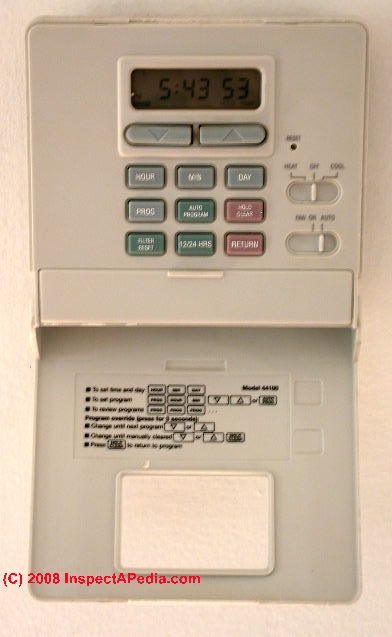
 Heat Won't Turn Off
How to turn off unwanted heat: radiators, baseboards
- POST a QUESTION or COMMENT about how to troubleshoot heat that doesn't seem to turn off when it should
Heat won't turn off:
Troubleshooting & repair when there is too much heat or when the heat won't turn off,
This article explains where and how to turn off the heat if simply turning down the thermostat does not stop unwanted heat coming from heating radiators or baseboards.
InspectAPedia tolerates no conflicts of interest. We have no relationship with advertisers, products, or services discussed at this website.
- Daniel Friedman, Publisher/Editor/Author - See WHO ARE WE?
How to Turn Off Un-Wanted Heat in buildings
How to fix the problem of too much heat or a furnace, heat pump, boiler, radiator or steam boiler that won't turn off.
How to stop unwanted heat from radiators and baseboards. Guide to Thermostats for Heating and Air Conditioning Systems - how to Find, Adjust, or Repair Thermostats - Troubleshooting & Repair Guide.
What are the Other Little Switches For on a Room Thermostat: Heat, Air Conditioning, Off, & Fan ON OFF MAN positions.
Article Contents
- HEAT ANTICIPATOR ADJUSTMENT if HEAT WON'T TURN OFF?
- HOW TO TURN OFF HEAT IF ROOM THERMOSTAT HAS NO ON-OFF SWITCH
- LOCKING THERMOSTAT COVER PREVENTS TAMPERING - how to keep other people from turning heat or A/C on or off
- MAIN ELECTRICAL POWER SWITCH use to FORCE HEAT OFF
- COOL-ON-OFF-HEAT SWITCH on THERMOSTATS - can turn heating or cooling off manually
- UNWANTED HEAT DUE to GRAVITY CIRCULATION - a flow control valve or check valve may be open
- UNWANTED HEAT at RADIANT-HEATED FLOOR - heat won't turn off not the same as missing or bad mixing valve
- UNWANTED HEAT DUE TO STUCK ZONE VALVE - on hot water heat zone won't shut off
...
If I can't get the heat to go off, will adjusting the heat anticipator help?
Our reader asked:
I live in a rental property. It is a three floor house, which old school round honeywell thermostats on each floor.
All three of these thermostats are turned down as low as they can go. It's nice out now, but our heaters still leak heat.
The landlords have told us we need to turn the heat off, that there is a "slidey switch" on each of the three thermostats to turn them off.
I live in New York, they live in colorado and don't specifically remember how to do it, even when I sent them cell phone pictures of the unit with the lid off.
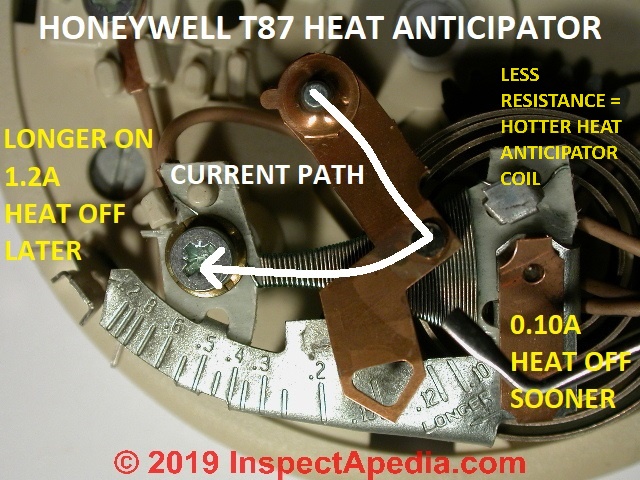
The only "slidey thing" I see is beneath the thermostat cover (I removed it to look) - it is what you describe
at HEAT ANTICIPATOR ADJUSTMENT (Photo shown above).
The arrow is in the dead center of the scale. Should we adjust it?
If not, do you perhaps have some idea how we may succeed in no longer wasting money on heating bills while we have three fans blazing per room? -- Johan J. Sheridan
Reply: NO. See this Guide to Turning off the Heat in a Building - When the Radiators or Baseboards "won't turn off"
DO NOT try to turn the heat on or off by changing the adjustment shown in our photo and described by the question above
That's the heat anticipator not an on-off control for heat. The heat anticipator is a fine-tuning adjustment inside the thermostat and not something that a homeowner should change.
The heat anticipator is explained
at HEAT ANTICIPATOR ADJUSTMENT
Just below we discuss several considerations in turning off un-wanted heat in a building. This article addresses problems with thermostat settings, non-working check valves or flo-control valves, and how to force the heat to "turn off".
Separately at RADIATORS for ROOM HEAT we discuss the problem of individual radiator valves that don't operate to allow turning a hot water or steam radiator on or off.
Also see ENERGY SAVINGS in BUILDINGS.
...
Turning Off Heat at Thermostats that Set Temperature Only - Lack an "on-off" Switch
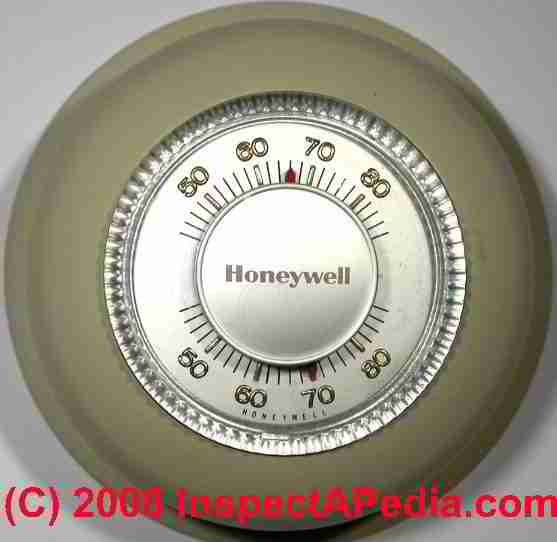
Thermostats contain an internal temperature sensor which compares the air temperature at the thermostat to the temperature called-for by the user, turning the cooling (or heating) equipment on or off as appropriate.
If with the cover on your thermostat (TT) looks like the Honeywell round thermostat shown at left, then there is no "HEAT OFF" control on the thermostat itself.
See THERMOSTATS for more detail.
This thermostat is adjusted by turning the clear plastic dial by grasping its outer ring.
The upper temperature dial is the "set" temperature - the temperature you are asking to be maintained.
The lower temperature indicator dial is the "current room temperature" sensed by the thermostat. In our photo the room temperature is at 70 °F and the "set" temperature is below that, at 66 °F.
In this condition the heating system should not be running to warm the building.
If this thermostat is set to a temperature above room temp the boiler (or furnace or steam boiler) will run until the thermostat is satisfied (and the room reaches or passes the "set" temperature on the thermostat.
So if you set the thermostat to a temperature below the room temperature, heat should be "off" and heat should soon stop coming out of radiators, baseboards, or air registers.
If the heating system keeps on warming radiators or baseboards in this condition, we explain what to do about it in this article - below in several sections, with more repair options at
- CONTINUOUS BLOWER FAN OPERATION - switch in the warm air furnace air handler may be "on"
- CONVECTION or GRAVITY CIRCULATION of HOT WATER - may keep heat on when you don't want it
- FAN WONT STOP - LIMIT SWITCH - failed furnace control
- FAN WONT STOP - THERMOSTAT SWITCH
- THERMOSTAT WON'T TURN OFF
- WARNING: DON'T TURN OFF BOILER that ALSO MAKES DOMESTIC HOT WATER
- ZONE VALVES, HEATING - a stuck zone valve can keep heat "on"
...
Locking Thermostat Cover Protects Against Thermostat Tampering
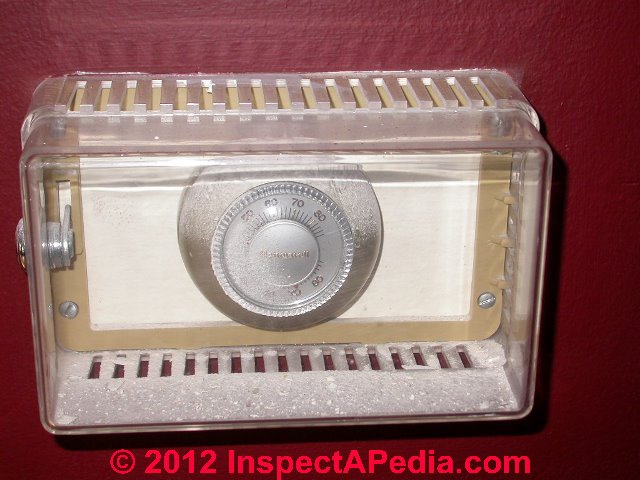 How can I keep my frisky kid from turning up the thermostat?

Our InspectApedia reader asked:
I have a daughter. she is 45. she is a toddler mentally. i need to stop her from turning on the heat all the time. It runs the bill sky high. there are political problems that make certain known solutions not possible.
Too late for spanking, no known way to stop her from turning on the heat all the time, cannot shut the heat off with switches, cannot pay the bill, cannot shut off electricity to the heat, its definately an interesting concept.
I basically mentally in your mind picture this: i have a 4 year old toddler who can reach the heat, and like a deviant keeps turning the heat on, but it's not deviant behavior it's incorrect behavior, its happening because of her medical situation related to thyroid, because of politics there is no known way to stop my 4 year old from turning on the heat and stopping the bill from being sky high.
I must stop the heat and the bill from happening from my point of view.
Also, I refuse to believe there is No way to stop this from happening; theres gotta be a way, but danged if i know or can think of it or a way to stop her or the heat. Is this crazy?
I refuse to believe there is no way to stop her or the heat. theres gotta be a way.
Help me on this fellas what am I missing here. - Anonymous 10/24/2012
Maybe a password protected digital thermometer?
Reply: how to prevent thermostat tampering: install a locking thermostat cover
Anon,
There is an easy fix for this problem of anyone messing with the thermostat as you can see in our photograph I've posted just above.
You can install a locking wall thermostat cover that prevents tampering.
Check with your heating supplier and almost certainly they can provide you with an inexpensive clear plastic cover that screws to the wall, has vents toilet the thermostat sense room air temperature, and can be opened to adjust the thermostat by using a lock and key.
You see these locking thermostat cover set ups often in offices and commercial buildings. It's an easy add-on feature to prevent thermostat adjustments by people who should keep their mitts off.
For more about wall thermostats, take a look
...
Turning Off Heat at the Electrical Power Switch or Service Switch
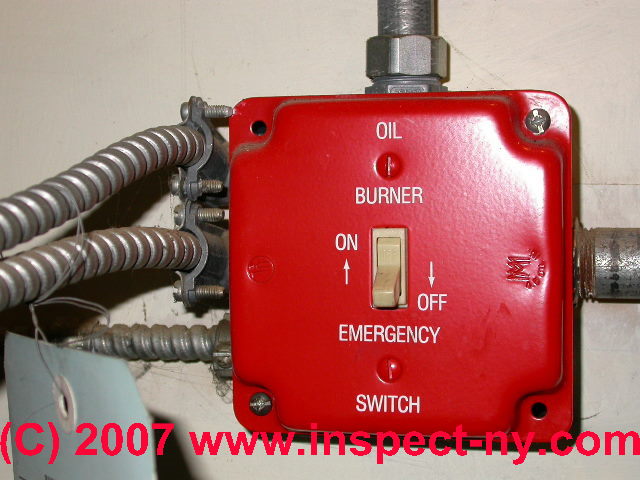
If you want to turn off your heating system regardless of the temperature setting at the thermostat, and if the thermostat itself does not include an "off" switch (see the next description below) you can turn off the heat by switching off electrical power to the heating boiler or furnace.
To completely turn off the heating system, regardless of thermostat setting, you'd need to find the boiler or furnace "off" or "service" switch - an electrical power switch.
Usually there are two electrical switches controlling power to a boiler, steam boiler, or warm air furnace, one at the heater itself (for service people) and one at the entry to the utility room or basement where the heater is located, or somewhere in the living area near a stairwell or hall that goes to the heater.
Sometimes, but not always, these switches have a red cover.
See ELECTRICAL POWER SWITCH FOR HEAT for a description of the heat master on-off control.
...
Turning Off Heat at Thermostats that Include a Cool-Off-Heat Switch on the Thermostat
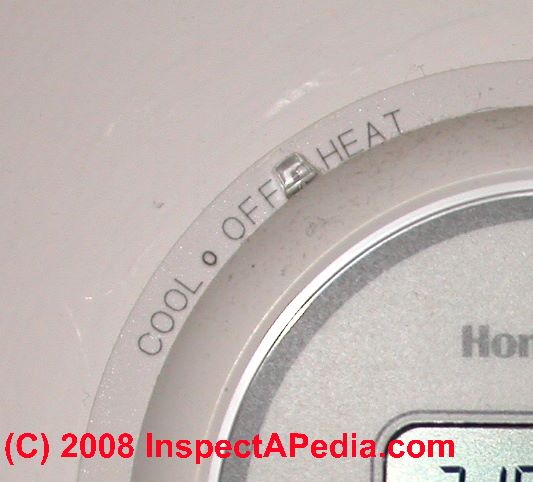
If your thermostat has a "Cool-Off-Heat" switch, such as those shown
at SWITCH FUNCTIONS on a ROOM THERMOSTSAT then just slide that little lever to "OFF" or "COOL" if you have A/C and want the air conditioning to kick in.
If your home does not have central air conditioning it might still have a thermostat with these three settings.
To simply turn off the heat regardless of the thermostat's temperature setting, just set the slide switch to the "off" position (in the middle in our photo at left).
Incidentally, wrong temperature settings can also foul up delivery of cool air from an air conditioning system: for the thermostat to actually turn on the air conditioning system (if central air is installed) the thermostat switch must be in the "cool" position and the temperature set to a level below the ambient room air temperature at the thermostat location.
...
Why Are the Baseboards or Radiators Hot Even Though the Room Temperature is Higher than the Thermostat Setting?
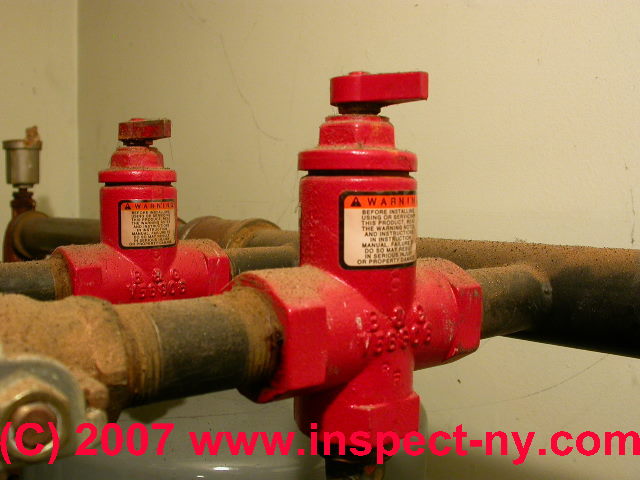 Un-wanted Gravity or Convection Circulation of Hot Water
If electrical power switch to a hot water heating boiler is in the on position and if the room temperature is higher than the Set Temperature on the thermostat, then , the heating system (hot water or steam) boiler or (warm air) furnace should not run.
See ELECTRICAL POWER SWITCH FOR HEAT for details if you can't find the switch.
Example: thermostat set to 65 °F and room temperature is at 68°F.
But for hot water heating systems (baseboards, radiators), other defects could cause or permit hot water to circulate through the heating system by "gravity" (convection, warm water rising on its own through the heating piping) even though the thermostat is not calling for heat.
The problem, if this is occurring, is usually that a check valve (photo above-left) (found internal to some circulator pumps, or external as a physical device) intended to prevent hot water from circulating on its own - when the circulator pump is off - is either set to a "forced open" position, or it has become defective.
If that's the problem (diagnosed by a heating and service technician) then the valve or circulator needs to be replaced.
While waiting for that repair to be made, you can still turn off the heat, by turning off electrical power to the boiler.
See CHECK VALVES, HEATING SYSTEM for more about these devices.
Reader Q&A on Stuck Hot Water Heat Flow Control Valves
Heat won't turn off in one of our rooms even though one thermostat controls all of our heating zones
We have a Thermostat that controls all of the heat upstairs (4BR’s and a bathroom) It controls the heat in all rooms except one just fine.
In our BR, even if the thermostat is clicked off our heat stays on.
The baseboards are always hot! (We heat our home with oil if that helps) Please help! Any suggestions would be greatly appreciated! On 2018-10-27 by Jenni
Answer by (mod) -
Jenni
In this article take a look at the discussion of hot water heat circulating by convection from the boiler because a flow control check valve at the boiler is not working.
How do I replace my flow check valve to a low voltage one?
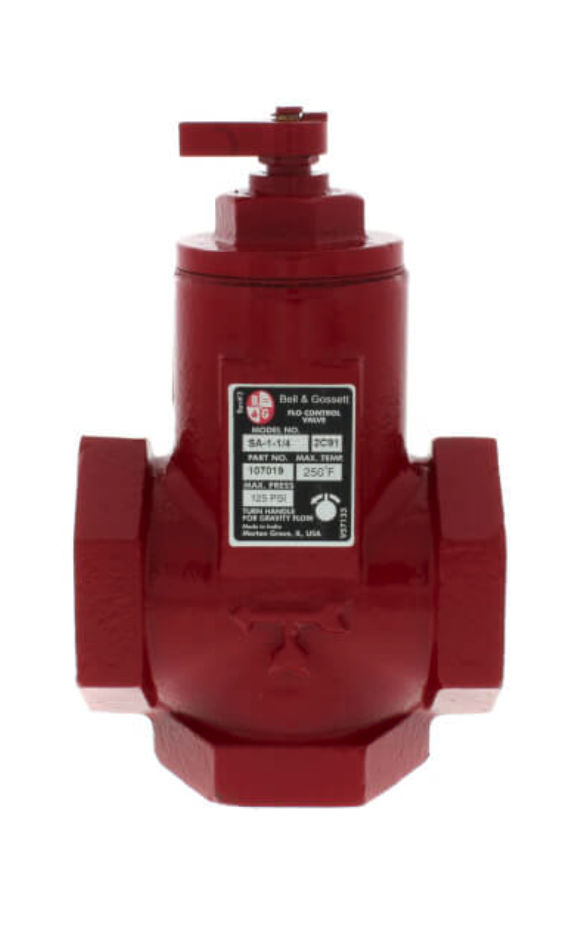
I want to know how to replace my flow check valve to a low voltage one - On 2021-11-12 by frank
by Inspectapedia Com Moderator - Don't confuse flow check valves with electrical controls on hot water heating systems
@frank,
You'll need to give us more details about just what flow check valve you're replacing.
A usual hydronic heating system flow check valve like the one we show below, the Bell & Gossett check valve does not use any electricity whatsoever.
Here is how the company describes the product:
The Bell & Gossett straight angle flow control valve accomplishes two things. First the Flo-Control valve acts as a check valve, keeping the system flow from short-circuiting into places where it doesn't belong.Second, and just as important, the Bell and Gossett Flo-Control valve stops hot water from migrating into a zone that's not calling for heat. - B&G IO Manual
see this B&G FLOW CHECK VALVE INSTALLATION MANUAL [PDF]
...
Hot Water Heat Zone Valves Stuck Open - Unwanted Heat
One of our hot water heat zones is heating to way above the thermostat setting!
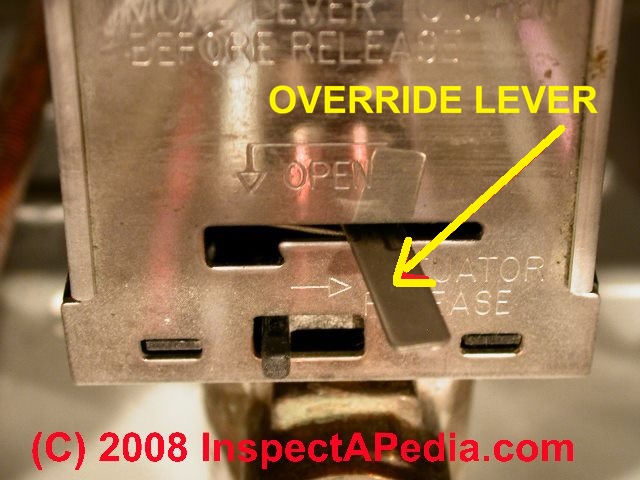
Photo above: a zone valve with its actuaor in the automatic position. If you push that lever to the left and down, you can see that it will remain latched into the "open" and "heat-on" position.
Our hydronic radiant floor heating system is malfunctioning.
We keep our thermostats at 70 and have had no problems for years.
Today, one of the zones (divided by floors) heated up to 82 even though the thermostat was at 70.
Tried switching thermostat control with one from a different floor but the temperature continued to hover around 80.
Not too familiar with the system but we have the water heater, expander, and it looks like each zone has its own Grundfos pump
Any thoughts about what is going on? Where to start troubleshooting? Thanks in advance - On 2020-12-13 by Nina
Reply by (mod) -
When you rule out the thermostat itself at the wall, we still have a risk that the thermostat wires are shorted together somewhere between the wall thermostat and the relay or device that the thermostat is controlling.
Try disconnecting the thermostat wires at their other end - at the heating boiler rather than at the thermostat itself.
When you have heat that won't shut off at just one hot water heating zone and you have disconnected the thermostat for that heating zone, I suspect a bad zone valve or a zone valve that has been latched manually into the "open" position.
See ZONE VALVES, HEATING for zone valve repair steps.
If you still have un-wanted heat everywhere then that points to a controller or control board or relay problem.
...
Radiant Heated Floor Heat Is Too Hot
How do we avoid too-hot temperatures in a radiant heat floor system ?
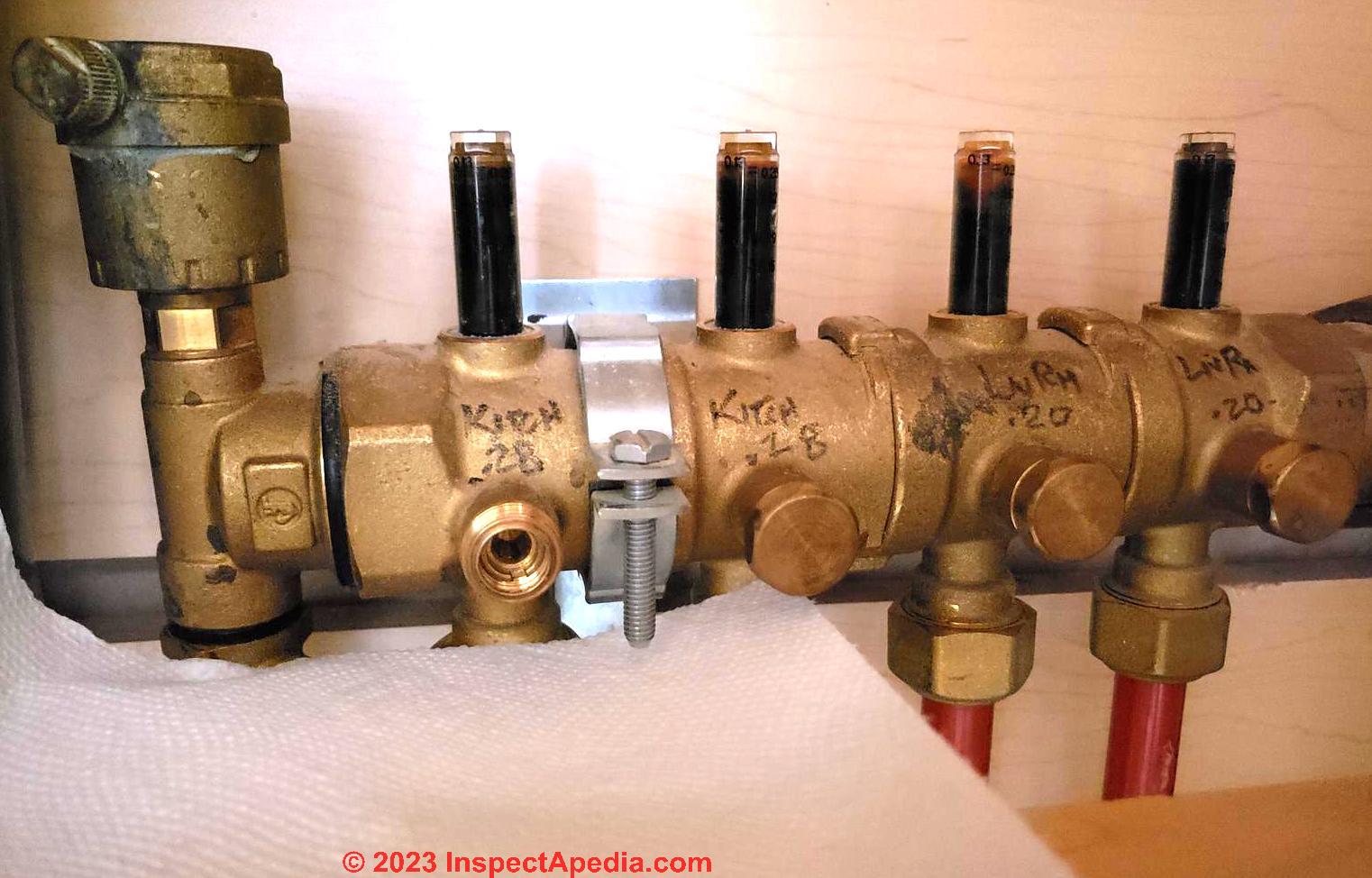
After roughing in an additional manifold on a Tekmar 370 Controller, I am having problems with overheating. Even with thermostats set to 50, I still have very hot water at every zone manifold and can't get things to cool down without dropping power.
But last night (after shutting off the controller for hours (to try and cool off the house) we flipped the switch on. Immediately, even with all thermostats set well below the room temp, the heat began to pour into the lines.
The Rinnai boiler was firing, all zone pumps were flowing (I could feel the vibration/heat) and everything started to heat up again.
Then all of a sudden, as I'm looking at the controller, feeling the Taco brass zone pumps, I hear a "click" and the controller lights now show "WWSD" and all the zone pumps are no longer operating.
I go to bed and wake up to cool manifolds...nice but not very hopeful when considering the temperature outside is 26 degrees.
We need help getting this system working right again.
I wrote to one heating forum asking for help when I noticed all my flow regulator caps at the manifold lines were so obstructed with a blackish coating that the measurements on the vial for flow rate couldn't be seen at all.
In removing one of them (cap just unscrewed) I found I could not remove this blackened material using Qtips, soap, rubbing alcohol...so I screwed the cap back onto the flow regulator.
Our water in the radiant heat system appears gray.
From 2002-2017 we ran glycol mix through a heat exchanger used with a Polaris HE water heater. In 2020 we switched to a Rinnai On Demand hot water heater and a Rinnai Boiler for the radiant heat in our concrete floors.
We also switched from the glycol mix to water in our floor lines (could this be causing the black/gray situation in the lines and maybe creating a problem?
Thermostats are nearly 20 years old...but this is a new problem.
I'm thinking I need to try and set each thermostat to a reasonable temperature above 50...so as to see if the system might function...things are so stressful right now let alone with this happening.
Please help. Thank you. - On 2020-12-15 by Cricket
Reply by (mod) -
Forgive such a basic question Cricket,
But does your system not have a mixing valve that recycles water through zones and meters hot from the heater into that loop? Without that control it can be difficult to avoid overheating in a radiant heat floor system.by Cricket - we don't have a mixing valve - and need to add one
In answer to your inquiry about the presence of a "mixing valve"...no we don't have one in the system. Sounds like we need to add this.
Can you shed a little light on these so I can develop an understanding? Thanks.
We worked with Supply House in 2017 (2020 was an error in my previous documentation) for the change over to the on-demand hot water and the boiler and will call them to order materials for the addition of the mixing valve.
In speaking with Fergeson about replacing/cleaning the flow rate vial covers.
John asked for pics and said he was unfamiliar with hydronic cleaners but they're available online. Is this cleaner something that should be normal yearly maintenance? Have you heard of it?
BTW, we set thermostats the next morning after the Tekmar 370 Controller went to WWSD the night before...and now we have heat and I'm doing small temp adjustments at the thermostats and we're pretty comfortable in the house again.
Reply by Mod - where to find radiant heat system mixing valve information
Cricket,
see RADIANT HEAT TEMPERATURE CONTROLS & SAFETY DEVICES
where you'll fine examples of automatic, temperature-controlled mixing valves for radiant heat systems.
...
What if Our Heating Boiler Also Makes Hot Water for Washing?
Watch out: if your heating boiler is also used to make domestic hot water for washing and bathing, through a tankless coil or through an indirect water heater then turning off the boiler will mean you'll also lose hot water for bathing.
See details at INDIRECT-FIRED WATER HEATERS
If that's the case, but you're getting heat when you're not asking for it, then the check valve, flo-control valve, or similar problem (or a faulty thermostat itself) needs to be diagnosed and repaired.
Also, before turning off your heating system completely in freezing weather,
...
Reader Comments, Questions & Answers About The Article Above
Below you will find questions and answers previously posted on this page at its page bottom reader comment box.
Reader Q&A - also see RECOMMENDED ARTICLES & FAQs
My hot water heat won't turn off, how do I find the problem?
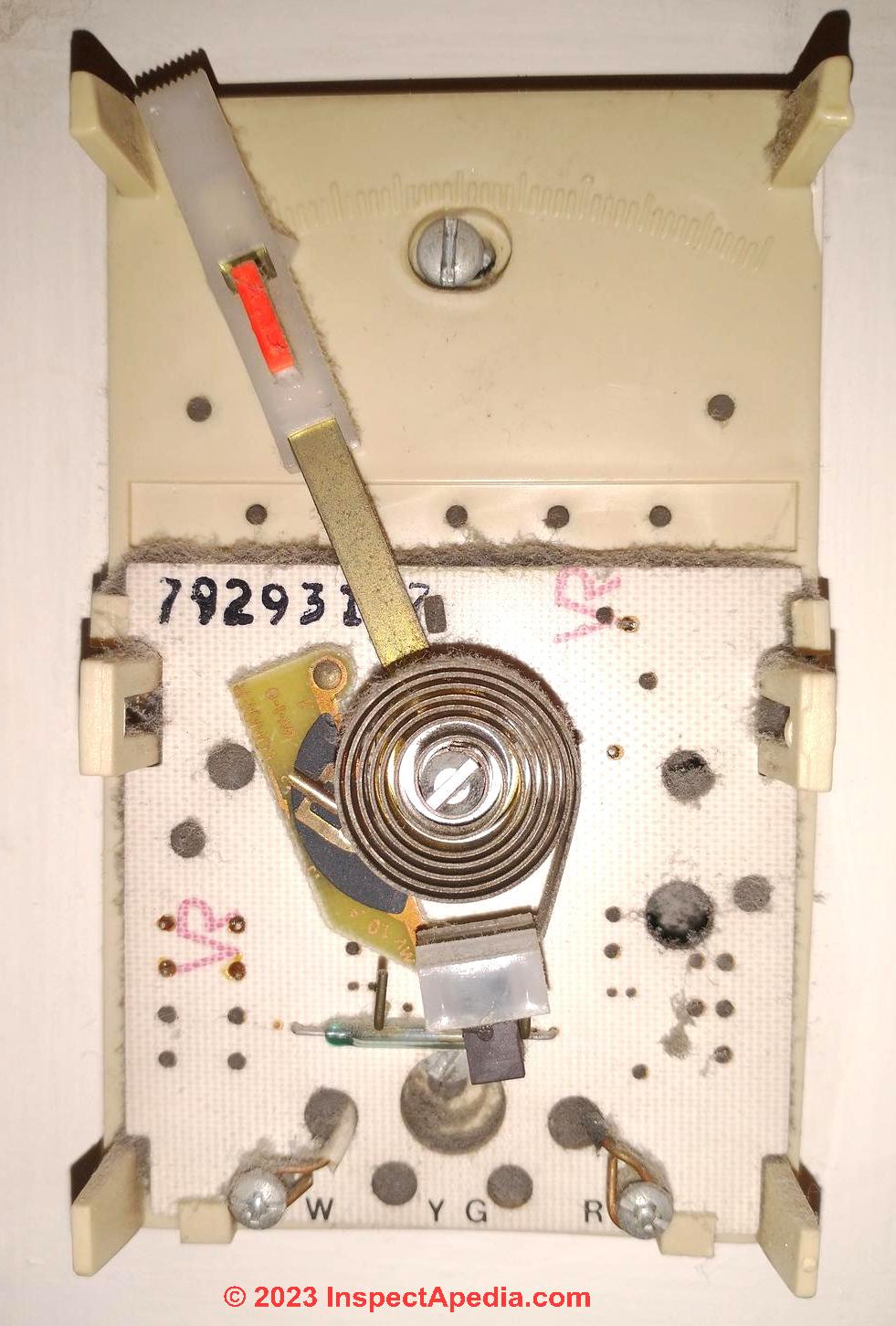
Heat won't turn off even at lowest setting. This is a 2 wire mercury thermostat. How do I trouble shoot? It is only heating, non central air, it is hot water heated. On 2021-03-27 by Lily
by danjoefriedman (mod) - easy to tell if thermostat is cause of heat staying on or not
@Lily,
I don't see a mercury bulb in your thermostat.
It's trivially easy to eliminate the thermostat as a possible cause for heat that stays on no matter what:just disconnect the thermostat wires from the thermostat and be sure that their bare ends are not touching. If the heat stays on, the problem is one of those above on this page.
If heat turns off the problem may indeed be the thermostat itself, or its setting.
Inany event, when your heat won't turn off, the cause is most-likely one of those you will see listed in the article above on this page.
Tke a look at the article above, then don't hesitate to ask if you're left with any questions.
After I installed a new thermostat my hot water baseboard heat never stops
My HWBB heat was running constantly after I installed a new thermostat.
I unhooked all wires ( 3 wires connected to nothing at this point) and the heat continued to run and I cannot figure out how or why? please help On 2021-02-21 by Anonymous
Honeywell T3 two wire app.
Wires installed on R and W terminals.
Heat immediately went on by no matter how low I set temp, the heat remains on! I do not see anything else to do! - On 2020-11-01 by Richard L. Gallagher
Answer by danjoefriedman (mod) - what to check if after disconnecting thermostat wires heat still won't stop running
@Anonymous,
IF your heating boiler runs constantly or hot water circulates constantly when the thermostat is set well below the current room temperature I'd look for
- a mis-wired thermostat
- thermostat wires shorted together anywhere between the thermostat and the boiler
IF the boiler runs constantly even when the thermostat wires are disconnected AT THE BOILER then we know the problem is not the thermostat nor the thermostat wires.
In that case, check the suggestions above on this page, for example to find- a circulator that's not shutting off
- a primary control at the boiler that's not shutting off
and for safety look at the boiler temperature and at the pressure relief valve.
IF a boiler runs without stopping AND no circulators are runningTHEN it should heat up to the HI limit set on the aquastat and turn off
IF it does not turn off then it will overheat *(Temperatures above 200F) and the Temperature-pressure relief valve will begin to spill hot water.
IF that occurs, turn off power to the boiler as it's unsafe.
Our furnace won't turn off after we turned it off, then back on.
We have temp on thermostat for gas heat set at 65. Heat just keeps running and running, never clicks off.
When we shut the heat down from the thermostat, heat clicked off fine. When we turn the heat back on from thermostat and set to our desired temp, it just runs and runs and never clicks off. - Anon 12/25/11
Reply:
Usually when a furnace won't turn off unless you turn down the thermostat that's a pretty good clue that the system is unable to warm the room enough to satisfy the thermostat.
This can happen with an undersized system, in very cold weather, with windows open in the room, but it can also happen if something (a dirty air filter, constricted or damaged heating supply ducts) is restricting the delivery of warm air into the room.
Our electric baseboard heat won't turn off
The heat won’t shut off in the living/dining area. I live in a 700 sq. ft 2-bedroom condo apartment built in 1972. The heating system is electrical baseboard with a relay/transformer + 2-wire low voltage thermostat.
The problem area has its own 2 pole breaker (120/240 VAC) and baseboard is 10’ long.
I replaced the thermostat with the same Aube TH-HC-28 + same relay/transformer Aube RC840T-240.
The problem remains the same.
I can feel the heat from the baseboards and it never stops on the desired temperature.
The only way to stop the heat is to shut off the breaker each time!
I’ve hired 3 electricians who all said the wiring is good.
I’ve spent $1,000 on service calls + parts and no one is able to find the cause. It’s a bit of a mystery, or is - On 2023-03-08 by Pierrette
by InspectApedia Editor - wiring error could risk a shock or fire
@Pierrette,
Watch out: This sure sounds like a wiring error to me, and worse, I worry that a wiring error could risk a shock or fire.
Your electricians all say the wiring is "good" but did they actually open electrical junction boxes, controls, and the panel to inspect and test electrical connections?
If you turn off heat at a thermostat and heat stays on, then either the thermostat is defective or its wires calling for heat are shorted together.
The simplest electric heat systems use a line-voltage thermostat that switches heat on or off directly by turning power on or off to the electric baseboards.
Your system is a little more complex: by using a low-voltage thermostat, that thermostat has to, in turn, switch a separate relay (your "relay transformer") on or off to turn line voltage on or off to the baseboards.
So there are a few more components to check.
First, if we remove the low voltage thermostat from the wall and make sure that the two low voltage wire ends are not touching, then heat should turn off.
If it does, then the problem is in the thermostat itself or its wiring connections.
If heat does not turn off then the problem is at the relay (not working or mis-wired).
When you bring in an electrician again, be sure, ahead of time, just what level of inspection and testing is going to be done for the money. Just saying "it looks good to me" without actually investigating isn't worth much.
Why do we have to turn our electric heat on and off manually?
Ok why do we have to turn on and off to get heat when the stat should be doing it
Ok why do we have to turn the thermostat on or off to get heat the thermostat should work by shutting off when reaching temp. Why?
Hi I live in a electric baseboard heating,why does my thermostat when we set it at low setting the heat stay hot and not shut off this happens on all 4 thermostat s do you have an answer.
We have replaced a couple of stats. @Richard L. Gallagher, On 2020-12-05 by Ralph
Answer by (mod) - safety warnings
Ralph
It's unusual for electric baseboard heat to stay on at lowest setting unless either
-the room temperature is actually below the thermostat's setting
or- the thermostat is being "fooled" about the actual room temperature, thinking the room is cooler than it is; this can happen, for example, if a thermostat is mounted in an area of draft or on a cold wall surface
or- the thermostat itself is improperly wired or is actually defective. For example the thermostat's temperature sensor could be damaged.
Tell me:
Has this electric-heat-won't-shut-off problem always been the case or is it a new or recent malfunction?
Is this problem true only in one room with one thermostat? Adding:
Watch out: if you are not trained in safe, proper electrical work don't fool with the electric baseboard heater thermostat nor its wiring, as you could be shocked or killed.
A trained tech might test the electric heater thermostat, with power to the heater off at the electrical panel, by checking for a short between the two hot leads and for voltage between each hot lead and ground; if the tech finds any of these shorted then either the thermostat itself is defective or the wiring is shorted, damaged, or connected improperly.In that case the heater wiring is unsafe and should be left shut off pending proper repair by a licensed electrician.
Bottom line:
If this is a new problem I suspect that the thermostat is defective and needs replacement.
I moved the mercury bulb on my T87F Thermostat and now the heat won't shut off
It's Honeywell t87f thermostat
My old round wall honeywell with mercury bulb. The cover broke off and is exposing coil and mercury bulb. At first moving bulb up or down made full heat or no heat. It's a townhouse with hot water baseboard heat. Guessing boiler system.
Now moving bulb does nothing full heat all the time.
Worried about fire and it's too hot in the place. How do I turn off completely. Nothing on breaker panel because it's free heat here. Any suggestions On 2020-10-29 by Geoff
by (mod) - bending the T87 Bimetallic spring puts the thermostat out of order
Watch out: first, to turn off the heat manually, there will be an emergency heat off switch at the entrance to the utility room or boiler room or furnace and most buildings as well as a service which right at the heater that will turn off its electrical power
Now: I suspect that by manually pushing that mercury bulb manually without using the original thermostat dial you may have bent the bimetallic spring assembly. That's easily done, and not repairable.
You should replace your T87 Theermostat with a new one.
Daniel Friedman
My thermostat button won't let me change from "heat" to "cool" or "off"
The button on my thermostat on the wall works and presses just fine but it wont let me select any other setting such as, cool or off.
The system is not running either, while its stuck in this mode. - On 2020-03-10 by Reesecup
Reply by (mod) -
Reese
Let's start by identifying the thermostat brand and model so that we can understand what's installed and then take a look at its IO manual.
Diagnostic questions:
has this problem been the case always or has it just recently occurred?
Does this thermostat use batteries? Have you tried replacing them?
All of my heating zone valves keep calling for heat
Hello I just bought three Honeywell non programmable thermostats heat only and installed them on my system which is 3 zones but I have no control I'm shutting the heat off keeps running on all of the zone valves.
Have to shut power off at heater to let house cool down. Is there anything somebody can help me with. Thank you On 2019-12-25 by Bill
Reply by (mod) -
Bill
Check first for improper wire connections, then with the thermostat removed completely, if the heat keeps running we know that either the wires are shorted together between the thermostat mount point on the wall and the heater (at their other end) or there is a failed control or relay in the heater itself.
After electrical work was done on my house my heat won't shut off
I had some electrical work done today in my mid-50s house, ahead of a plumbing re-pipe this week.
Since I am having galvanized pipes replaced with PEX, an electrician had to work on grounding the system differently.
Since then, my furnace won’t shut off-I’ve tried adjusting the thermostat- even when it’s turned off completely, the heat just keeps coming unless I turn off the switch in the basement at the furnace.
I don’t know what else to try.
I called the electrician, who told me even though he had to turn off the electrical to the furnace briefly, it wouldn’t have caused the problem I’m having now. This just started today coincidentally. Any suggestions? On 2019-12-10 by Mo
by (mod) -
How frustrating.
The cause is most likely one of the problems listed on the page above where we cycle through the various reasons that heat will not turn off.It's possible that someone bumped a wire and that the thermostat wires are shorted together. A nice diagnostic step would be to Simply disconnect the thermostat wires at the heater.
If the heater still won't shut off and you know it's not the thermostat or the thermostat wiring but rather a problem in the heater control itself.
Thank you to our readers for their generous comments
@danjoefriedman, thanks so much for the help - much appreciated - On 2021-02-21 by Anonymous
Great advice and thank you so much! - On 2023-03-11 by Pierrette
Reply by InspectApedia Editor
@Pierrette,
You're welcome.
We've worked hard on this material for decades, so are really grateful when a reader finds it useful and trustworthy.
...
Continue reading at THERMOSTAT WON'T TURN OFF or select a topic from the closely-related articles below, or see the complete ARTICLE INDEX.
Or see HEAT WON'T TURN OFF - FAQs - questions & answers posted originally at the end of this page.
Or see these
Recommended Articles
- BOILER CONTROLS & SWITCHES - hot water heating boiler controls
- COOL OFF HEAT, THERMOSTAT SWITCH - switches on the thermostat
- FAN ON AUTO MAN THERMOSTAT SWITCH - switches on the thermostat
- FAN WONT STOP - LIMIT SWITCH - forced on at the limit control in the air handler
- FAN WONT STOP - THERMOSTAT SWITCH - forced on by a thermostat switch
- FURNACE CONTROLS & SWITCHES - forced warm air heat
- STEAM HEATING SYSTEMS - steam radiators
- THERMOSTAT WON'T TURN OFF - heat won't turn off because of a problem at the room thermostat
Suggested citation for this web page
HEAT WON'T TURN OFF at InspectApedia.com - online encyclopedia of building & environmental inspection, testing, diagnosis, repair, & problem prevention advice.
Or see this
INDEX to RELATED ARTICLES: ARTICLE INDEX to HEATING SYSTEMS
Or use the SEARCH BOX found below to Ask a Question or Search InspectApedia
Ask a Question or Search InspectApedia
Share this article:Questions & answers or comments about troubleshooting too much heat or heat that won't turnoff in a building.
Try the search box just below, or if you prefer, post a question or comment in the Comments box below and we will respond promptly.
Search the InspectApedia website
Note: appearance of your Comment below may be delayed: if your comment contains an image, photograph, web link, or text that looks to the software as if it might be a web link, your posting will appear after it has been approved by a moderator. Apologies for the delay.
Only one image can be added per comment but you can post as many comments, and therefore images, as you like.
You will not receive a notification when a response to your question has been posted.
Please bookmark this page to make it easy for you to check back for our response.
IF above you see "Comment Form is loading comments..." then COMMENT BOX - countable.ca / bawkbox.com IS NOT WORKING.
In any case you are welcome to send an email directly to us at InspectApedia.com at editor@inspectApedia.com
We'll reply to you directly. Please help us help you by noting, in your email, the URL of the InspectApedia page where you wanted to comment.
Citations & References
In addition to any citations in the article above, a full list is available on request.
- Thanks to reader Johan J. Sheridan for discussing thermostat control difficulties and heat that kept coming out of baseboards - 08/03/2010
- Proliphix Corporate Headquarters, 3 LAN Drive Suite #100 Westford, MA 01886 Phone: +1.978.692.3375 Toll Free (U.S.): 866-IP-LIVING (866.475.4846) Fax: +1.978.692.3378 - Sales: sales@proliphix.com Customer support: support@proliphix.com http://www.proliphix.com/ - quoting from the company's website:
- Honeywell Controls, the company wants you to use their contact form at this web page: http://www51.honeywell.com/honeywell/contact-support/contact-us.html
Honeywell Consumer Products, 39 Old Ridgebury Road Danbury, CT 06810-5110 - (203) 830-7800
World Headquarters, Honeywell International Inc., 101 Columbia Road, Morristown, NJ 07962, Phone: (973) 455-2000, Fax: (973) 455-4807 1-800-328-5111 - White Rodgers Thermostats and HVAC controls,
Homeowner information: http://www.emersonclimate.com/en-US/brands/white_rodgers/Pages/wr-homeowner-info.aspx
Contractor information: http://www.emersonclimate.com/en-US/brands/white_rodgers/wr_contractor_info/Pages/white-rodgers-contractor-info.aspx
White Rodgers Product Catalog (don't misspell the company's name as White Rogers Thermostats) -
http://www.emersonclimate.com/Documents/thermostats.pdf - Thermostat Catalog - Domestic and Commercial Oil Burners, Charles H. Burkhardt, McGraw Hill Book Company, New York 3rd Ed 1969.
- National Fuel Gas Code (Z223.1) $16.00 and National Fuel Gas Code Handbook (Z223.2) $47.00 American Gas Association (A.G.A.), 1515 Wilson Boulevard, Arlington, VA 22209 also available from National Fire Protection Association, Batterymarch Park, Quincy, MA 02269. Fundamentals of Gas Appliance Venting and Ventilation, 1985, American Gas Association Laboratories, Engineering Services Department. American Gas Association, 1515 Wilson Boulevard, Arlington, VA 22209. Catalog #XHO585. Reprinted 1989.
- The Steam Book, 1984, Training and Education Department, Fluid Handling Division, ITT [probably out of print, possibly available from several home inspection supply companies] Fuel Oil and Oil Heat Magazine, October 1990, offers an update,
- The Lost Art of Steam Heating, Dan Holohan, 516-579-3046 FAX
- Principles of Steam Heating, Dan Holohan, technical editor of Fuel Oil and Oil Heat magazine, 389 Passaic Ave., Fairfield, NJ 07004 ($12.+1.25 postage/handling).
- "Residential Steam Heating Systems", Instructional Technologies Institute, Inc., 145 "D" Grassy Plain St., Bethel, CT 06801 800/227-1663 [home inspection training material] 1987
- "Residential Hydronic (circulating hot water) Heating Systems", Instructional Technologies Institute, Inc., 145 "D" Grassy Plain St., Bethel, CT 06801 800/227-1663 [home inspection training material] 1987
- "Warm Air Heating Systems". Instructional Technologies Institute, Inc., 145 "D" Grassy Plain St., Bethel, CT 06801 800/227-1663 [home inspection training material] 1987
- Heating, Ventilating, and Air Conditioning Volume I, Heating Fundamentals,
- Boilers, Boiler Conversions, James E. Brumbaugh, ISBN 0-672-23389-4 (v. 1) Volume II, Oil, Gas, and Coal Burners, Controls, Ducts, Piping, Valves, James E. Brumbaugh, ISBN 0-672-23390-7 (v. 2) Volume III, Radiant Heating, Water Heaters, Ventilation, Air Conditioning, Heat Pumps, Air Cleaners, James E. Brumbaugh, ISBN 0-672-23383-5 (v. 3) or ISBN 0-672-23380-0 (set) Special Sales Director, Macmillan Publishing Co., 866 Third Ave., New York, NY 10022. Macmillan Publishing Co., NY
- Installation Guide #200 for Residential Hydronic Heating Systems, The Hydronics Institute, 35 Russo Place, Berkeley Heights, NJ 07922
- The ABC's of Retention Head Oil Burners, National Association of Oil Heat Service Managers, TM 115, National Old Timers' Association of the Energy Industry, PO Box 168, Mineola, NY 11501. (Excellent tips on spotting problems on oil-fired heating equipment. Booklet.)
- Our recommended books about building & mechanical systems design, inspection, problem diagnosis, and repair, and about indoor environment and IAQ testing, diagnosis, and cleanup are at the InspectAPedia Bookstore. Also see our Book Reviews - InspectAPedia.
- In addition to citations & references found in this article, see the research citations given at the end of the related articles found at our suggested
CONTINUE READING or RECOMMENDED ARTICLES.
- Carson, Dunlop & Associates Ltd., 120 Carlton Street Suite 407, Toronto ON M5A 4K2. Tel: (416) 964-9415 1-800-268-7070 Email: info@carsondunlop.com. Alan Carson is a past president of ASHI, the American Society of Home Inspectors.
Thanks to Alan Carson and Bob Dunlop, for permission for InspectAPedia to use text excerpts from The HOME REFERENCE BOOK - the Encyclopedia of Homes and to use illustrations from The ILLUSTRATED HOME .
Carson Dunlop Associates provides extensive home inspection education and report writing material. In gratitude we provide links to tsome Carson Dunlop Associates products and services.
 |
HOME | ABOUT | ASK a QUESTION | CONTACT | CONTENT USE POLICY | DESCRIPTION | POLICIES | PRIVACY | |
| © 2026 - 1985 Publisher InspectApedia.com - Daniel Friedman | |||||||||