 Radiant Slab Tubing Clog or Leak FAQs

- POST a QUESTION or COMMENT about the different types of tubing & fluids used with radiant heating systems
Radiant heat tubing leak location, access, & repair questions & answers.
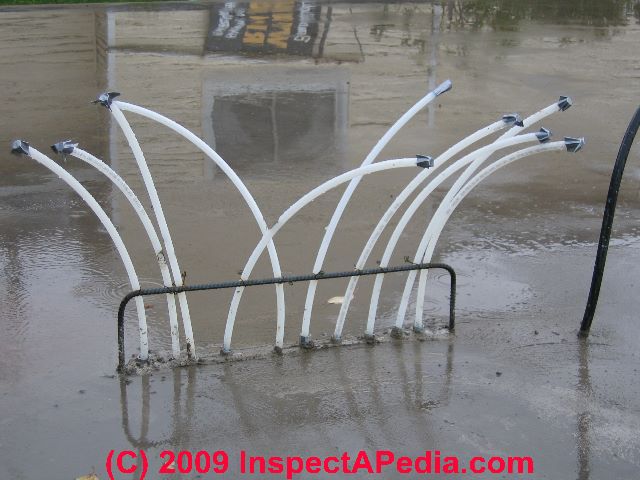
This article series discusses causes of and cures for leaks in tubing or piping used for radiant heat in floor slabs.Our page top photograph shows polyethylene tubing being installed in a new concrete floor slab for radiant heat in a Two Harbors Minnesota building.
InspectAPedia tolerates no conflicts of interest. We have no relationship with advertisers, products, or services discussed at this website.
- Daniel Friedman, Publisher/Editor/Author - See WHO ARE WE?
Radiant Floor Slab Tubing Leak Cause & Remedy FAQs
 These questions & answers about finding and fixing leaks in tubing in radiant heat floors were posted originally
be sure to review the detailed advice and cases discussed there.
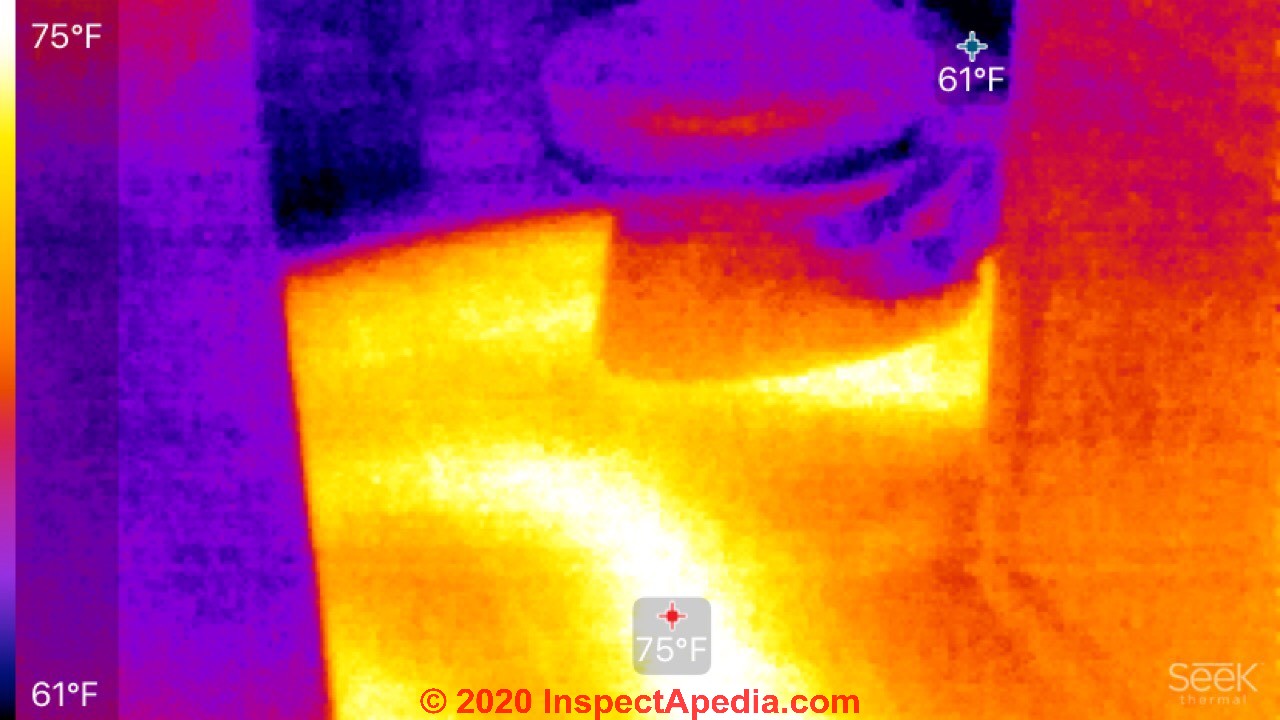
Photo: thermal imaging can help find leaks in radiant heat floor tubing as well as showing just where the tubing was routed.
For scanning and making thermal images to pinpoint the location of the PEX tubing that provides heat in your radiant slab
see THERMAL IMAGING, THERMOGRAPHY
How do I find the leak in radiant slab tubing ?
How do you FIND the leak in radiant slab tubing? On 2019-12-20 by Jay -
by Mod - How do you FIND the leak in radiant slab tubing?
An easy way to spot leaks in radiant slab tubing IF your heat source is working, is to heat up the tubing (and its fluid) and then use a thermal or IR scanner across the building's floors.
At RADIANT HEAT SLAB TUBING LOCATION & REPAIR you can read details of the steps involved in finding, exposing, and then repairing or moving a section of radiant heat tubing in a concrete floor slab.
We have a radiant heated floor tubing leak - how can we seal it?
 We may have a leak in the plastic lines in the basement floor. Not sure what material the lines are, but they're grey and the house is 30 years old. Is there a "stop leak" type of product that might work for this application? - anonymous by private email
follow-up email:
I was hoping not to open the floor up. I did find a product from C-Tec called CT1 that claims to seal plastic pipe. Even has a video, but anything can claim to work. Ever hear of them? On 2018-02-28 by Possible
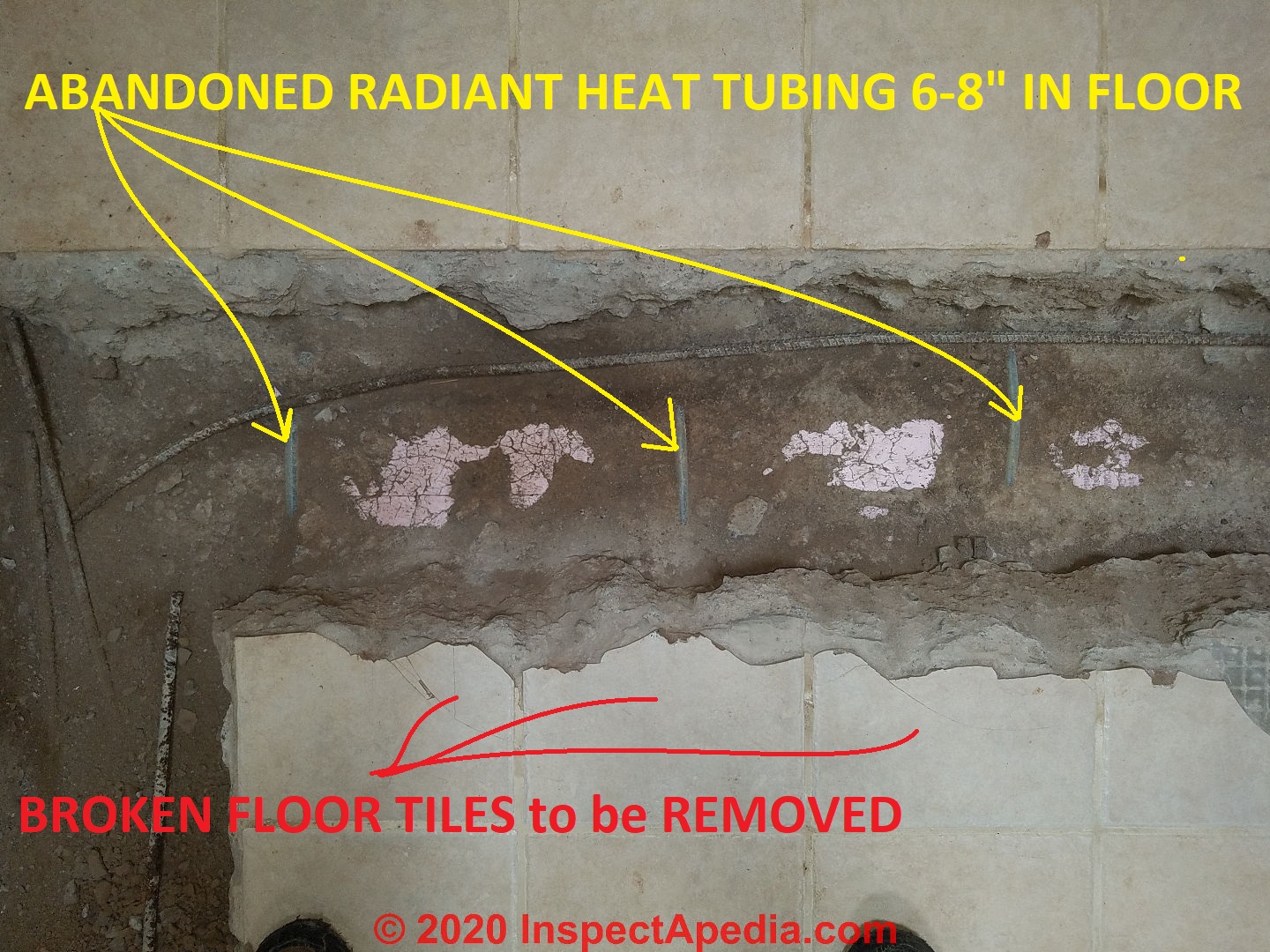
Photo: by the author (DF) demonstrates that it is possible to carefully cut open a slab to expose sections of radiant heat tubing giving enough working space to cut and replace the damaged tube section.
by (mod) - No product that could run through PEX type plastic tubing or water pipes to seal a leak.
I looked at www.ct1ltd.com - I don't see a product that would be successfully run through PEX type plastic tubing or water pipes to seal it;
If your plastic lines are a heating system you'd also be worried that the sealant goops up control valves or other components.
Keep me posted, I'll also look further, and perhaps other readers will have a suggestion.I would use a thermal scan, find the leak, and carefully expose enough of the PEX tubing to replace the section with a leak.
Earthquake protection for radiant heated floor slabs?
What suggestions do you have for limiting earthquake issues with Pex in a slab? I haven't poured it yet. 16' x 24' On 2018-07-27 by Daryl Prindle
Reply by (mod) - How to avoid earthquake damage & leaks in radiant heat tubing in a concrete slab
Great question. I'm uncertain that it's possible with tubing itself to avoid earthquake damage in a concrete slab, since even a flexible tubing, once set in concrete, is likely to be damaged if the concrete heaves and cracks.
BUT if you use the level of reinforcement that you see in New Zealand new floor slabs after their recent earthquakes you will minimize damage.
In NZ the builders use a larger size re-bar at a closer spacing and with plenty of wire ties, compared to what we see in -- well you didn't give your country and city.
This is an article on beams but it'll give some idea and resources
- Brooke, Nicholas James, and J. M. Ingham. THE EFFECT OF REINFORCEMENT STRENGTH ON THE OVERSTRENGTH FACTOR FOR REINFORCED CONCRETE BEAMS [PDF] In Proceedings of the 9th Pacific Conference on Earthquake Engineering, Building an Earthquake-Resilient Society, Auckland, New Zealand. 2011.
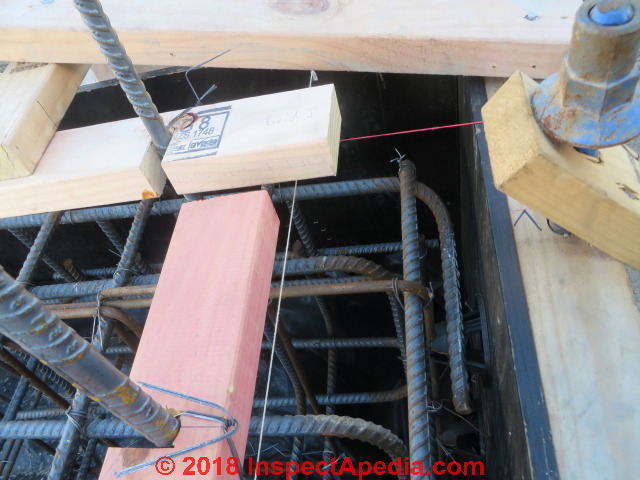
In some images I'll post here you will see the use of heavy re-bar and extensive tying during foundation and slab construction in Christchurch when I took these photos in September 2014.
Here is a closer detail. This was of course the foundation at the perimeter of the slab;

Will tubing close to the top of a radiant heated slab cause it to be damaged by heavy machinery
In a commercial building with heavy machines and 6” slab with radiant heat, would insulating under it compromise the concrete . On 2022-07-02 by Zack
by InspectApedia-911 (mod) - properly-constructed concrete slab can carry considerable weight
@Zack,
Fair question but as you put it, not possible to answer for all possible cases when we have no objective data.A normal, properly-constructed concrete slab can carry considerable weight but "heavy machines" is undefined.
For sure there are industrial installations where an engineered slab to carry much greater weight could be required.
But
Bottom line: in my OPINION radiant heat under an industrial slab should not cause any structural issue provided the slab is properly constructed. Consider that while tubing runs through the slab, it is spaced apart and the tubing is surely less than 1-inch in diameter and is buried two inches down, surrounded by solid concrete to which load is transferred.
Our floor heats unevenly. Can radiant heat pipes clog?
The floor heats unevenly. Some spots are cold even though other spots are toasty warm. This just started last winter. Can the pipes plug up? (Oct 16, 2015) Sue
Reply: yes
Yes individual circuits or loops can clog, particularly if they were run as separate loops off of a main.
If there is a leak in radiant heat floor tubing the boiler may automatically take on make-up water through a water feeder valve so you may not recognize the leak, particularly if the leaking heating tubing leaks down into soils rather than up into the occupied space.
But a thermal scan of the floor can often find where leaks are occurring by noticing the spread of heat pattern.
Other causes of uneven heating depend on the pattern of unevenness; don't confuse uneven heat between two zones ( a controller, mixing valve or clogging or circulator problem) with uneven radiant heat across a floor that you think is a single heating zone.
Find a boiler and pump etc that eliminate the worry about iron and permit use of non-oxygen barrier PEX
Is it possible to obtain pumps, boilers and other fittings and equipment that do not contain iron so non oxygen barrier pex can be used? Are non iron equipment more expensive On 2021-11-01 by Roger Shields
by inspectapedia.com.moderator - Pex with or without an oxygen barrier used in radiant heating systems
@Roger Shields,
Radiant slab heating sytsem texts that we've reviewed, classes attended, installation workshops, etc. pretty much all cite using a heat exchanger and a corrosion inhibiter (Fernox or equivalent) where non-oxygen barrier PEX is being used.I'd prefer to use Pex type A tubing.
Most designers seem to agree that it's a better plan to use a corrosion inhibitor than to fool ourselves into thinking that we won't have oxygen entering the system.
See these
Expert sources for Information using non oxygen-barrier PEX in radiant heating systems
- Siegenthaler, John. "Hydronic Radiant-Floor Heating." FINE HOMEBUILDING (1996): 58-60.
- Hackleman, Michael. "Radiant floor heating." Backwoods Home Magazine 64 [PDF] (2000): 42-49. - local copy saved as Radiant-Floor-Heating-Heckeroth.pdf
- IVAR Hydronics, 3-layers pipe PE-Xa 3 with EVOH barrier, IVAR PE-Xa 3
3-layers cross-linked polyethylene pipe PE-Xa with EVOH oxygen barrier. [PDF] Ivar Hydronics Components & systems - local copy saved as Ivar-PE-Xa3-Tubing.pdf
Excerpt: IVAR PE- Xa 3 is the cross- linked polyethylene pipe PE- Xa suitable for the transport of drinking water and for the implementation of heating and cooling systems. It is used in residential buildings, hospitals, schools, hotels, offices, shopping centers and industries, both new and under renovation. - Talami, Riccardo. "Recent trends in hydronic radiant system technology for heating and cooling." Available at SSRN 5053907 (2019).
Rusty water coming out of PEX radiant heat floor
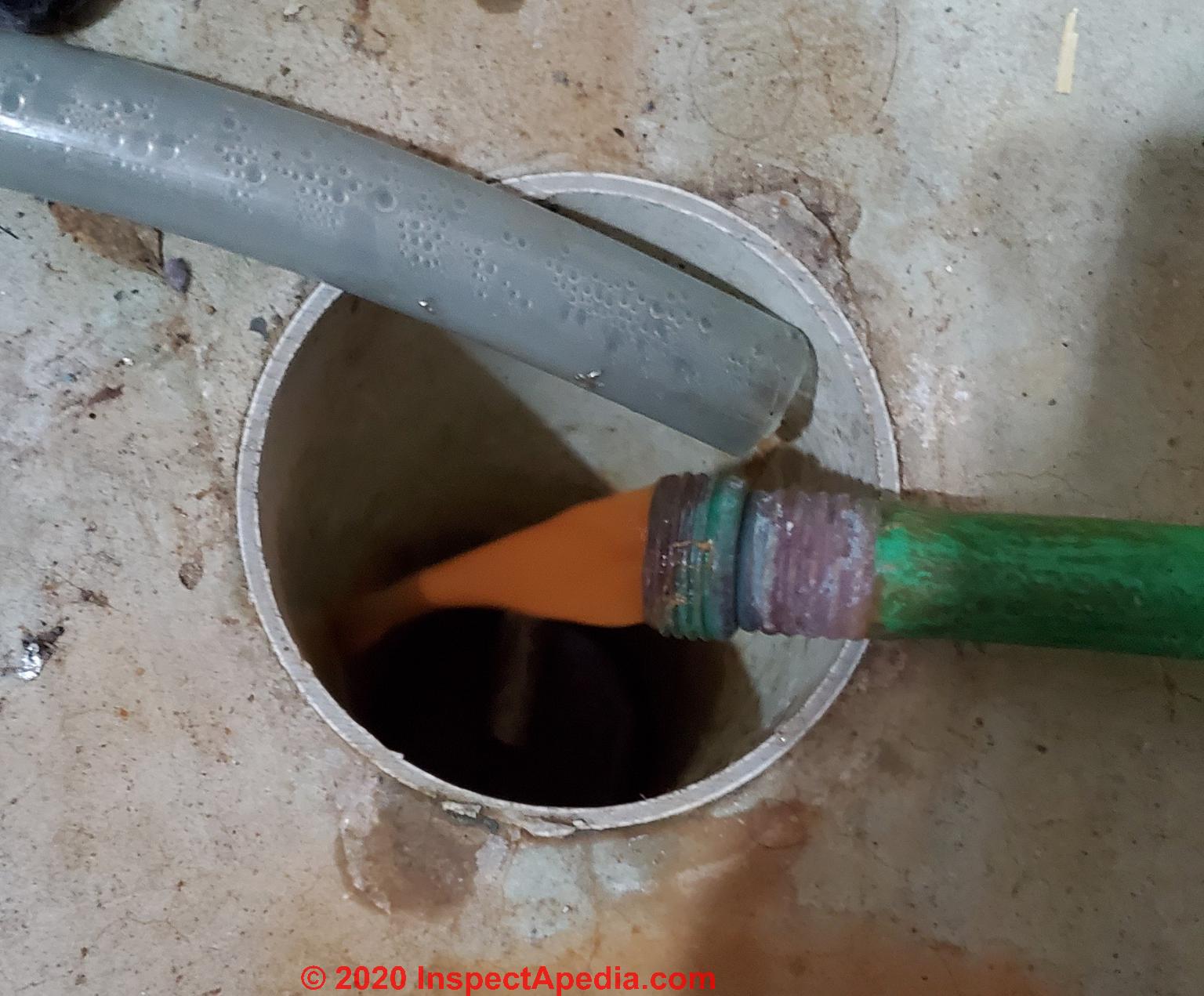 I was purging air from my radiant in-floor heating as per your excellent AIR BOUND HEAT SYSTEM REPAIR and on some of the loops, the water coming out was quite orange (image attached), even after running it for 2-3 minutes.
On other loops of the same zone it was clear. Is this normal? Is it indicative of a problem?
Lines are all PEX, each zone has a Grundfos circulator, fed from a modern boiler. - Thanks! On 2020-12-18 by Mark
by danjoefriedman (mod) -
Rusty water coming out of PEX is odd indeed - unless the rust is being produced by a steel or cast iron boiler.
- have any additives been used in the system?
- is there a potential rust source?
- is flow blocked?
- is there a leak in the system such that your water feeder keeps adding water?by Mark
We had the system flushed last year, they used some additives in that process, not sure what, though the orange water existed before then, so probably not the source.
Not sure what the rust source could be, nor why it would be on some loops but not others. Fittings going bad?
But they should all be brass. Assuming if a nail went through the PEX we'd have noticed a leak by now.Flow doesn't appear to be blocked on any of the loops, insofar as when i flush the lines, the water flows. There could be some kind of partial blockage though, the system doesn't keep up when it's below freezing outside.
Reply by (mod) -
What's puzzling is that ultimately all of your PEX Loops are being served by the same boiler so you would think that if there was something turning the heating water particularly red, that it would be uniform in the whole system.
But if I understand you only one line was producing colored water.
So let's see if we can think about what's different with that Loopby Mark
I was thinking the same thing. There are 5 loops on that particular manifold, so in theory, the water could mix among all the loops.
They are all part of one zone in the master bedroom, but several other zones have loops with orange water as well.
If there was a random nail or something poking into one of the lines, I would have thought the other lines would all be clear. But most of the lines have orange water now.
Reply by (mod) -
IMO a nail could not possibly cause so much water coloration. We don't quite yet know for sure it's rust. It may be an additive or treatment to your boiler water.
by Mark - Probably unrelated
Would the water smell rusty/metallic if it were rust? Probably unrelated, I was doing the air purge as part of overall troubleshooting efforts to get the house warmer.
It currently can't keep up. I've just determined that the boiler isn't getting close to its CH target, and appears to be short cycling. CH Target is 145F, it's getting to 112F right now, but won't fire for more than about 10 seconds at a time before turning off.
This is essentially a separate problem, but could the two (orange water and boiler not getting CH water to target) be related?
by danjoefriedman (mod) - troubleshooting red murky water in radiant heat system
Are we sure that there's no leak in the system anywhere?
by Mark
We are not sure there's no leak. There are no obvious leaks, no wet spots on walls or floors, no mold.
To be sure of no leak, would I shut off the make-up supply water and wait to see if the system pressure drops?
BTW, thanks for all the help!by (mod) - simple way to check for leak in radiant heat floor tubing
Right; good idea. I'd do that;
...
...
Continue reading at RADIANT SLAB TUBING LEAKS - topic home, or select a topic from the closely-related articles below, or see the complete ARTICLE INDEX.
Or see these other RADIANT HEAT MISTAKES FAQs questions & answers about installing or repairing radiant heat systems.
Or see these
Radiant Heating System Articles
- CIPP PIPE LINING REPAIRS
- PEX BRASS CONNECTOR LEAKS
- PLASTIC PIPE LEAK CAUSES
- RADIANT HEAT - home
- THERMAL IMAGING, THERMOGRAPHY
Suggested citation for this web page
RADIANT SLAB TUBING LEAK FAQs at InspectApedia.com - online encyclopedia of building & environmental inspection, testing, diagnosis, repair, & problem prevention advice.
Or see this
INDEX to RELATED ARTICLES: ARTICLE INDEX to RADIANT HEAT
Or use the SEARCH BOX found below to Ask a Question or Search InspectApedia
Ask a Question or Search InspectApedia
Share this article:Search the InspectApedia website
Need to make a private comment? Email editor@inspectApedia.com. We welcome email with your website content critique, corrections, suggestions or questions. Email is monitored daily but our workload may prevent an immediate reply. For immediate results, we hope you'll first try asking your question using the search box just above.
Citations & References
In addition to any citations in the article above, a full list is available on request.
- In addition to citations & references found in this article, see the research citations given at the end of the related articles found at our suggested
CONTINUE READING or RECOMMENDED ARTICLES.
- Carson, Dunlop & Associates Ltd., 120 Carlton Street Suite 407, Toronto ON M5A 4K2. Tel: (416) 964-9415 1-800-268-7070 Email: info@carsondunlop.com. Alan Carson is a past president of ASHI, the American Society of Home Inspectors.
Thanks to Alan Carson and Bob Dunlop, for permission for InspectAPedia to use text excerpts from The HOME REFERENCE BOOK - the Encyclopedia of Homes and to use illustrations from The ILLUSTRATED HOME .
Carson Dunlop Associates provides extensive home inspection education and report writing material. In gratitude we provide links to tsome Carson Dunlop Associates products and services.
 |
HOME | ABOUT | ASK a QUESTION | CONTACT | CONTENT USE POLICY | DESCRIPTION | POLICIES | PRIVACY | |
| © 2026 - 1985 Publisher InspectApedia.com - Daniel Friedman | |||||||||