 Water Pump Control & Switch Location FAQs
- POST a QUESTION or COMMENT how to troubleshoot problems with water pump controls
Questions and answers about exactly where you can mount the well or water pump pressure control switch.
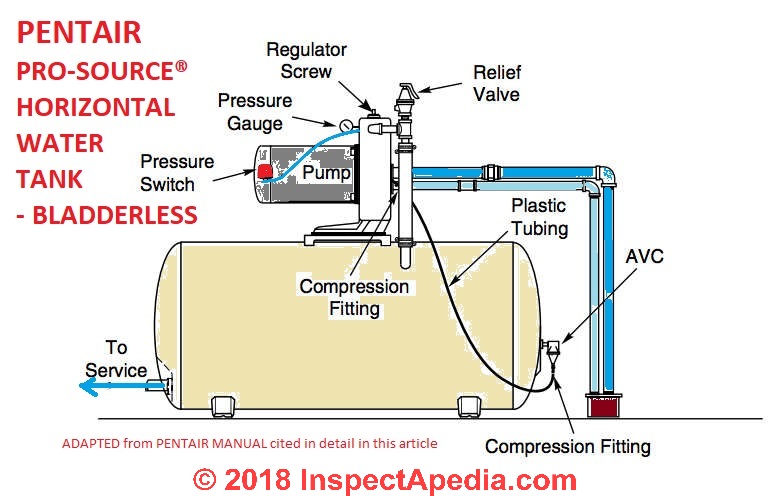
This article series describes and identifies the switches, controls, and safety devices used on water tanks and water pumps such as the pump pressure control switch, pump motor relays, water tank relief valve, water tank pressure gauge, water tank air volume control, and water tank air valve.
InspectAPedia tolerates no conflicts of interest. We have no relationship with advertisers, products, or services discussed at this website.
- Daniel Friedman, Publisher/Editor/Author - See WHO ARE WE?
Water Pressure Control Mounting Q&A
These questions & answers about water pump controls were posted originally
at WATER PUMP PRESSURE SWITCH LOCATION - be sure to read the pressure switch installation advice given there.
Also see our index to all water pump control switch FAQs at WATER PUMP PRESSURE SWITCH REPAIR FAQs
...
Can the pump control switch be mounted at the pressure tank inlet?
Can pressure switch be on tank inlet line? On 2020-04-19 by Raymond Teed
by (mod) - yes, that's a recommended location
Yes Raymond
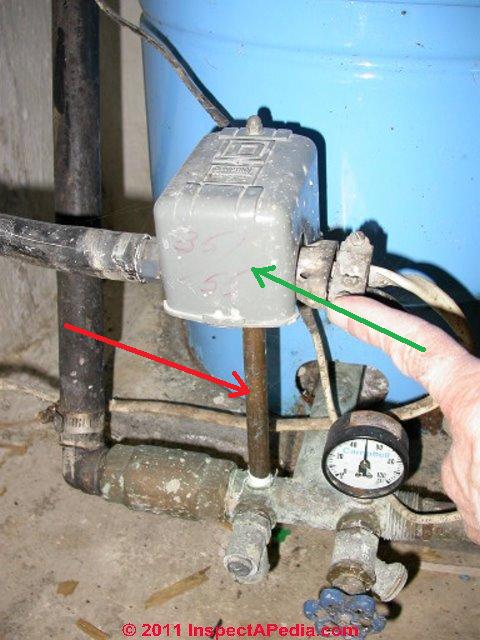
The pressure control switch can be on the inlet line to the tank - take a look at the photo I include below where there is a standard water tank inlet tee showing fittings for various devices including the switch.
Take care: there should be no shutoff valve between the pressure switch and the pump nor between the switch and the pressure tank.
Where to put the pressure control switch if I'm using a second Remote Pressure Tank?
I am on a well system, and have an 80 gallon pressure tank. Tank is located at well cap, about 100 feet from the house.
My question is - is it possible to have the pressure tank at the well fill a pressure tank installed in the house?
The tank in the house would only be connected by the actual water pipe that exits the pressure tank at the well, no pressure switch connection.
So basically it would be tank #1 being filled then water going from tank #1 to tank #2 about 100 feet away, and when tank #2 is full then the pressure switch at tank #1 would cut out the well pump.
Other than the initial filling of tank #2 would their be any issues to the well pump or tank #1 pressure switch? (Mar 20, 2014) Paul
Reply:
Paul, generally we want the pressure control switch to be close to the pressure tank.
That pair of components can be located wherever it is convenient. I'm unclear of why we're talking about two pressure tanks unless one of them is actually to function as a water storage device.
Paul said:
Thanks for the reply -
The primary idea for a second tank was not only for storage, but my thought was also that since the second tank would also be a pressure tank that the pressure inside the house would be better as the run from the well and present tank is over 100 feet from the house and also on a 10% grade lower than the house.
The original tank at the well head would retain the pressure switch and that tank in turn would feed the 2nd tank 100 feet away at the water pipes entry into the house.
I am thinking, and this is just a thought which may be incorrect, is that since another tank, in the house, is also holding water under a pressurized bladder that it would provide a bit better pressure in the house due to the current pressure tank being over 100 feet away and also "pushing" water uphill.
Reply:
If you float a second pressure tank on the supply piping at a 100 ft distance from the original pressure tank (and pressure control switch) it's about the same functionally as if you had simply put a larger pressure tank at the original location.
There are flow losses due to friction losses and bends and restrictions through a water supply system, but pressure sensing is consistent throughout.
That is, with the pressure switch remote, at the well, it's not going to change when the pump turns on and off to add a second pressure tank in the building.
However, a water storage tank high in a building that feeds building plumbing fixtures may give some improved performance by benefiting from gravity as it feeds the rest of the building.
In communities served by municipal water mains that operate at low pressures or intermittent pressures, many buildings take this approach: a rooftop or attic-located tank is filled slowly by pressure from the street (or using a booster pump in tall buildings), then that tank feeds the building by gravity (or by gravity and a second booster pump)
See examples at ROOFTOP WATER TANKS
Paul said:
Thanks for the information. My thought was that the second tank, having a pressurized bladder, would pick up some of the pressure loss due to the distance and uphill flow from the pressure tank at the well.
Appreciate your insights.
Reply:
Paul I may not have the correct understanding but in general, a second tank, pressurized by the first one, is never going to be able to "push" water harder into the building than the first one did unless it includes a higher location or a booster pump. You are chiefly adding water storage volume, not water pressure.
Damaged leaky well casing, installing new shallow well pump with its own pressure switch; can I mount the old pressure control & leave old pump in the well?
 My deep well casing split, and we can't afford to dig a new deep well for a couple of years. We have an old shallow well in our basement, and I've tested the water and it's good.
The well refill rate is about 21 hours from pretty much empty to full. My question, I have a shallow well jet pump that I'm installing, that has a pressure switch on the pump itself.
The pressure switch for the deep well pump is at my water tank. do I remove that one at the tank, or can I just leave it there, and wire up the pressure switch on the jet pump? On 2021-06-11 by Marc
by (mod)
In general, yes, but check the install instructions for your specific switch - that is, Your old pressure switch can run the new pump.
You might also look into having the well casing repaired by an insert instead of replacing the entire casing.If you leave the old pump in the well, you would leave power turned off to the pump that is in the well that is not working.
But
Watch out: there may be check valves or water intake constructions for the new above-ground pump if you leave the old pump in the well.
by Marc - can't repair the well casing
Ack, thanks...so I just bypass the pressure switch on my Burcam?
I've had 3 different people come drop a camera down the deep well, and they've all agreed that an insert in our case has a pretty low chance of success, and that we'd more than likely be spending like $3000 to find out that we need a new well dug anyway.by Marc - more details
Yeah I know I leave the deep well pump turned off. My explanations might be a bit confusing. I have a new Burcam shallow well jet pump that has a pressure switch on it that I have installed right beside my shallow well which is about 20 feet from my tank. The tank is still connected to the deep well pump but I'm going to disconnect that pump, and hook up the Burcam to my tank.
The problem is that the pressure switch for the deep well pump is on a tee right at the tank, so what I've trying to figure out is do I use the pressure switch that is part of my Burcam shallow well pump, or use the one on the tee at the water tank. If I use the one one on my shallow well, I assume I can just leave the switch at the tank installed, but just not connect it.
If I use the switch at the water tank, I assume I have to electrically bypass the one on my shallow well pump, but assume I don't have to actually remove it.
Thanks again for the info.by inspectapedia.com.moderator (mod) - switching to a shallow-well pump - what to do with old pressure-control & tank
Marc:
OK so options for that old, now "OFF" pressure switch for the deep well:
1. Leave it alone just turn off electrical power to it.
Use the switch that came with your Burcam shallow well pump to control that pump. It's new, already integrated with the pump, and should be in good working order.
I don't see any advantage to trying to use the old pressure control.
In any event your new pump is going to feed water to the existing pressure tank and to the building.
2. If you plan to abandon the deep well then you'll want to see
WELL ABANDONMENT PROCEDURE inspectapedia.com/water/Well_Abandonment_Procedure.php
and you could remove wiring to the old pressure control and then remove the control itself entirely, using a suitably-sized NPT pipe plug to close the pipe tee opening where it was mounted.
3. IF your Burcam pump is like the one shown below, (
Hover to zoom
Burcam Pumps 506227P - 18 GPM 3/4 HP Thermoplastic Shallow Well Jet Pump w/ 7 Gallon Tank (115/230V)) it includes its own water pressure tank; in that case you can still feed output into your existing water system - the existing tank will give a little bit more water storage.
But
Watch out: from your description I can't say that it sounds as if that shallow well is going to provide sufficient water quantity for a working occupied household.
You might still be able to live with it by installing a much larger water storage tank than what I am guessing is your present water pressure tank; that approach allows the system to pump and store water at a slow-enough rate and to pump water during times of no water use - avoiding exhausting the well but giving enough reserve to have a functional water system.
In that case the new large water storage system would replace that old pressure tank.by Marc - Burcam pump not protected from damage if well runs dry
@inspectapedia.com.moderator, Thanks, the help is much appreciated. In answer to a couple of the points made, my pump is the 506518SS which doesn't come with the attached tank, so the plan was to use my existing tank.
Our house was built in 1887, and according to the elderly people from across the street, the well was dug somewhere around 1900. It's about 4 feet in diameter and 18 feet deep.
Right now it has about a 2 foot head. After the snow melt, if my sump pump fails, my basement is under about 2 feet of water (found that out the hard way.) By end of August it's usually down to about a 3 or 4 foot head depending on how dry the year has been. I've drained it nearly completely dry, and it refilled in about 24 hours.
My one concern is that if the well does run dry or some reason, this pump doesn't have a safety to shut it down. Again, thanks for the help.
by (mod) - pump protection switch & dug well sanitation warnings
@Anonymous,
Certainly there are well pump protection controls of various types that can be added to a system to protect against "running dry" damage.
Examples are at WATER PUMP PROTECTION SWITCH
Watch out: There is absolutely no chance that your basement dug-well can provide safe, sanitary drinking water:
1. dug wells are not protected against surface water contaminants
2. your dug well is in a basement that floods seasonally
You can not drink that water safely without also providing a water treatment system that includes at the very least, disinfection.
When a well can be contaminated by surface waters, other surface contaminants such as pesticides, fertilizer, etc. also may be present.
It would make sense to have some very thorough testing done of that water and also to know the history of usage of the property to have an idea what contaminants should be monitored-for.
Take a look at
DUG WELL POTABILITY TEST
DUG WELL SANITATION PROTECTIONIncidentally the Burcam 506518SS - as shown in our photo from an online vendor (Lowes) looks as if it's using the standard Square-D pressure control switch that appears in many of our pressure control swith articles in this series.
Watch out: As the pump comes with a switch I'd expect to use that one; however it if the distance between pump and water pressure tank is more than a few feet we might want to re-consider that pressure switch location - as you'll read in the article above on this page - and which may be why your discussion appeared here in the first place.
Finally: to estimate the volume of water available in your dug well - before considering its slow recovery rate,
see VOLUME of WATER IN a CYLINDER - CALCULATION

...
...
Continue reading at WATER PUMP PRESSURE CONTROL SWITCH or select a topic from the closely-related articles below, or see the complete ARTICLE INDEX.
Or see these
Water Pump Control & Switch Articles
- WATER PUMP CONTROLS & SWITCHES - home
- WATER PUMP CONTROL STATUS INDICATORS
- WATER PUMP ELECTRICAL SWITCHES
- WATER PRESSURE CONTROL SWITCH ADJUSTMENTS
- WATER PUMP PRESSURE CONTROL SWITCH
- WATER PUMP VARIABLE FREQUENCY / VARIABLE SPEED DRIVE (VFDs)
- WATER PUMP SWITCH INSTALLATION MANUALS
- WATER PUMP & TANK I&O & REPAIR MANUALS
- WATER PUMP PROTECTION SWITCH
- WATER PUMP RELAY SWITCH
- WATER PUMP REPAIR GUIDE - home
Suggested citation for this web page
WATER PUMP CONTROL SWITCH LOCATION FAQs at InspectApedia.com - online encyclopedia of building & environmental inspection, testing, diagnosis, repair, & problem prevention advice.
Or see this
INDEX to RELATED ARTICLES: ARTICLE INDEX to WATER SUPPLY, PUMPS TANKS WELLS
Or use the SEARCH BOX found below to Ask a Question or Search InspectApedia
Ask a Question or Search InspectApedia
Share this article:Search the InspectApedia website
Need to make a private comment? Email editor@inspectApedia.com. We welcome email with your website content critique, corrections, suggestions or questions. Email is monitored daily but our workload may prevent an immediate reply. For immediate results, we hope you'll first try asking your question using the search box just above.
Citations & References
In addition to any citations in the article above, a full list is available on request.
- In addition to citations & references found in this article, see the research citations given at the end of the related articles found at our suggested
CONTINUE READING or RECOMMENDED ARTICLES.
- Carson, Dunlop & Associates Ltd., 120 Carlton Street Suite 407, Toronto ON M5A 4K2. Tel: (416) 964-9415 1-800-268-7070 Email: info@carsondunlop.com. Alan Carson is a past president of ASHI, the American Society of Home Inspectors.
Thanks to Alan Carson and Bob Dunlop, for permission for InspectAPedia to use text excerpts from The HOME REFERENCE BOOK - the Encyclopedia of Homes and to use illustrations from The ILLUSTRATED HOME .
Carson Dunlop Associates provides extensive home inspection education and report writing material. In gratitude we provide links to tsome Carson Dunlop Associates products and services.
 |
HOME | ABOUT | ASK a QUESTION | CONTACT | CONTENT USE POLICY | DESCRIPTION | POLICIES | PRIVACY | |
| © 2026 - 1985 Publisher InspectApedia.com - Daniel Friedman | |||||||||