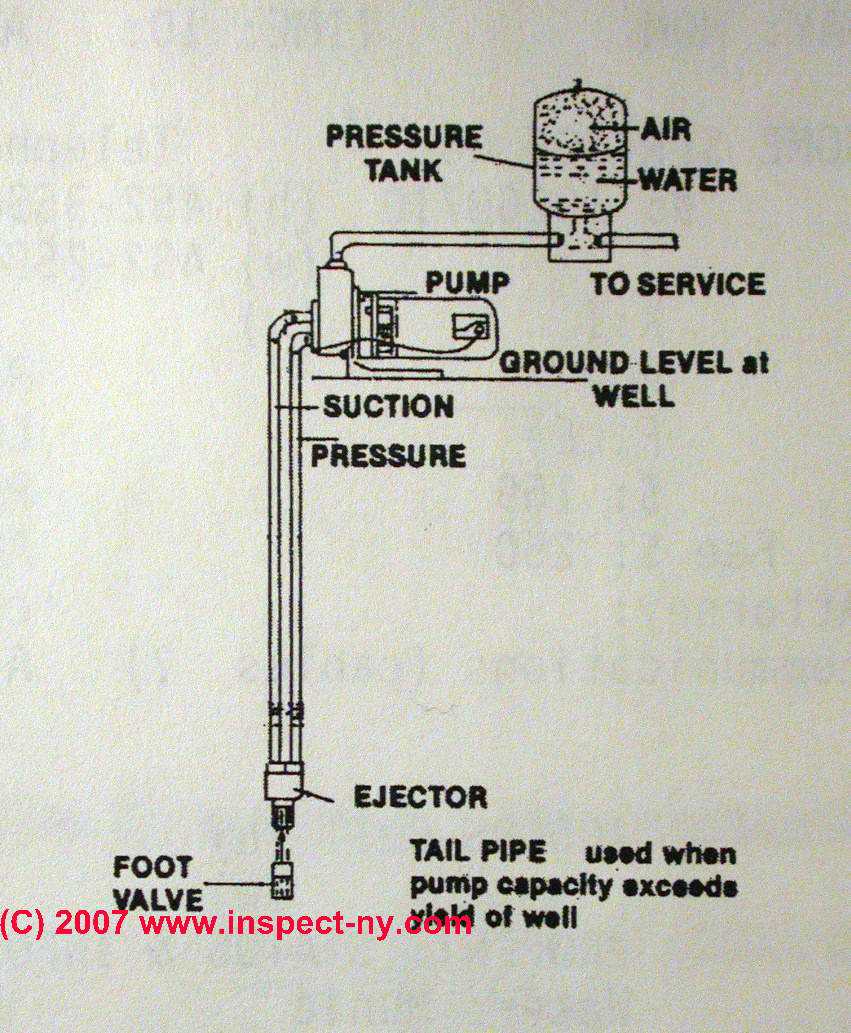
 Well Pipe Ejectors / Venturi
- ASK a QUESTION or POST a COMMENT about this well pipe ejectors
This article explains the well ejector or venturi types use on shallow or deep wells, mounted at the pump (shallow wells) or in the well (deep wells) at the bottom of a one or two line jet pump well pipe to pick up water from significant depths.
We describe the differences among the three principal types of ejector/venturi assemblies and note where and how each is used.
InspectAPedia tolerates no conflicts of interest. We have no relationship with advertisers, products, or services discussed at this website.
- Daniel Friedman, Publisher/Editor/Author - See WHO ARE WE?
Ejectors & Venturi Used in Water Wells
Illustrated at the top of this page and in more detail below, a well pipe ejector is a device containing a funnel-shaped "venturi" opening through which the smaller-diameter down pipe of a 2-line jet pump sends water down into the well and through the ejector.
Ejectors are used principally on two-pipe jet pump well installations, but may also be found on "convertible" one-line jet pump well systems just above the end of the down-pipe or suction line in the well.
Water squirting through the venturi inside the ejector causes more water to be picked up from the well and sent back to the pump through the larger of the two well lines.
Below, also from Flint and Walling's CPJ Series Jet Pump Installation Instructions [PDF] (F&W Website) we illustrate the three basic types of water well ejectors. (Local backup saved as Flint-Walling-CPJ-Jet-Pump-Instructions.pdf)
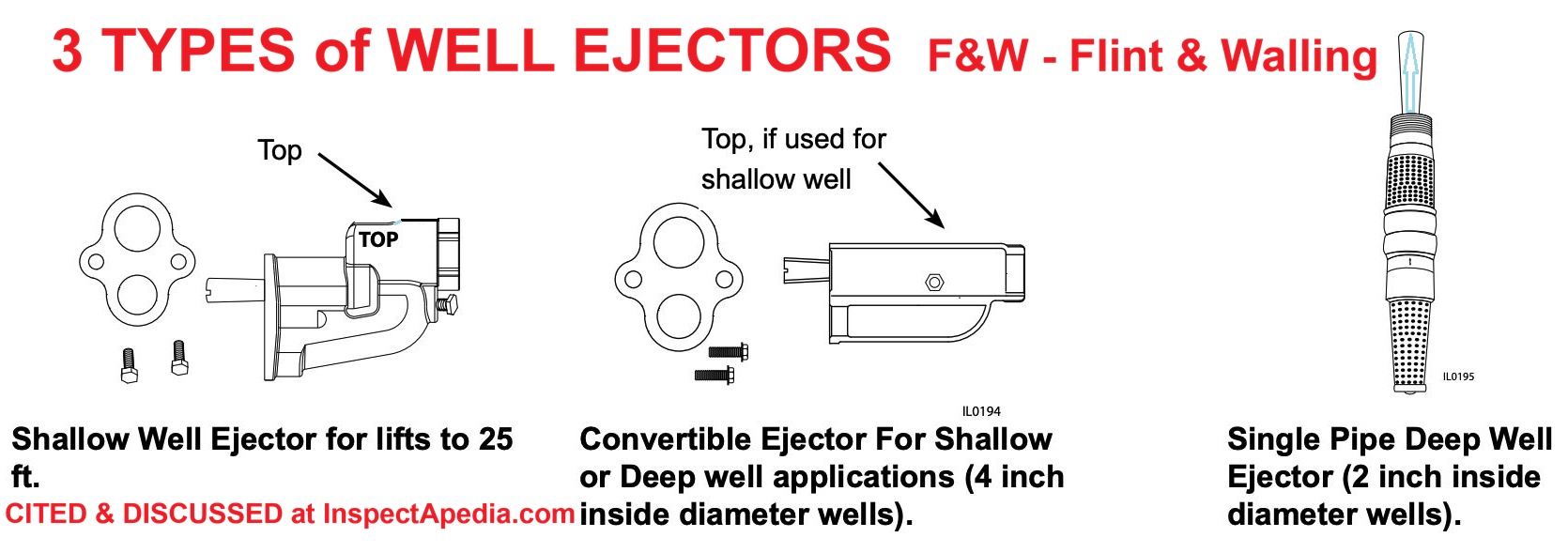
In the Flint & Walling's well ejector types drawing above, the leftmost shallow well ejector can lift water no more than 25 feet - shallow well depth.
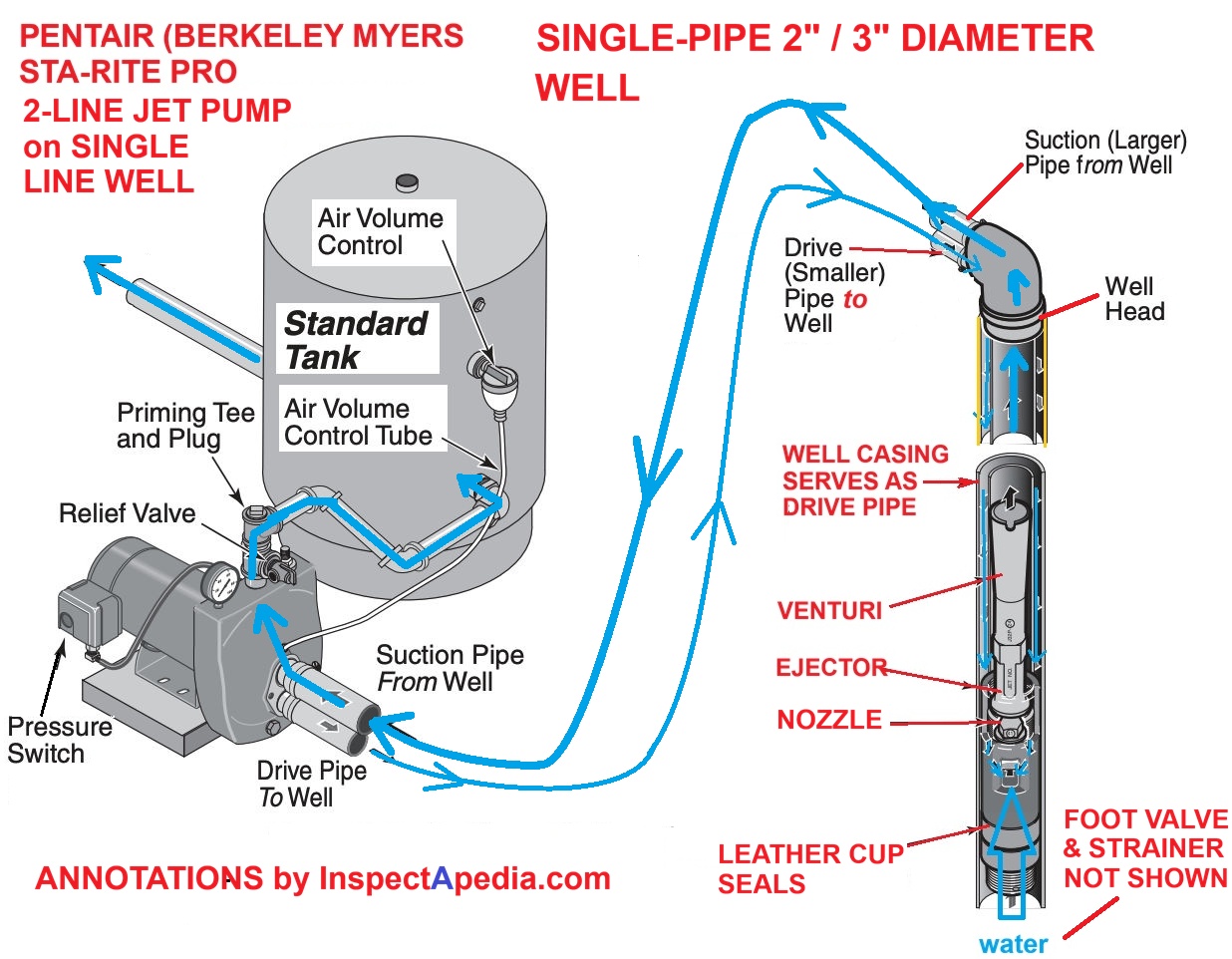
The center ejector may be used for either shallow and deep wells, while the third or rightmost ejector is used in a single well pipe deep well in which the well casing serves as the "down pipe" to send water from the two-line jet pump to the ejector to bring up more water from the well.
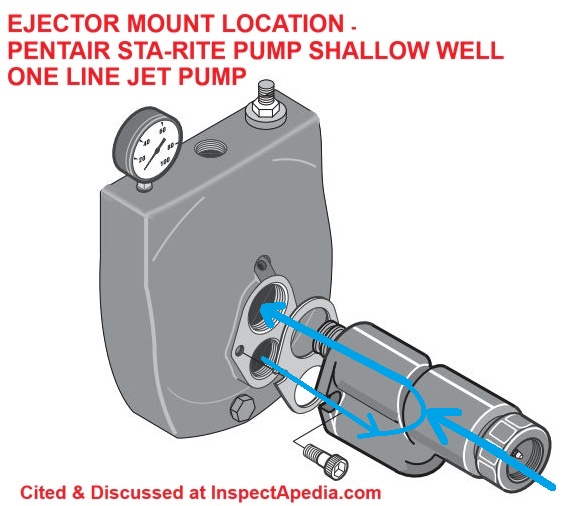
In a shallow-well application the ejector mounts right to the face of the jet pump, as we show in Pentair's illustration below - source: Pentair Jet Pump Manual [PDF] (Pentair website)
In contrast with the single pipe shallow well set up above, the center and right-hand ejectors in our earlier sketch are shown in this Pentair deep well installation schematic from the same manual we just cited.
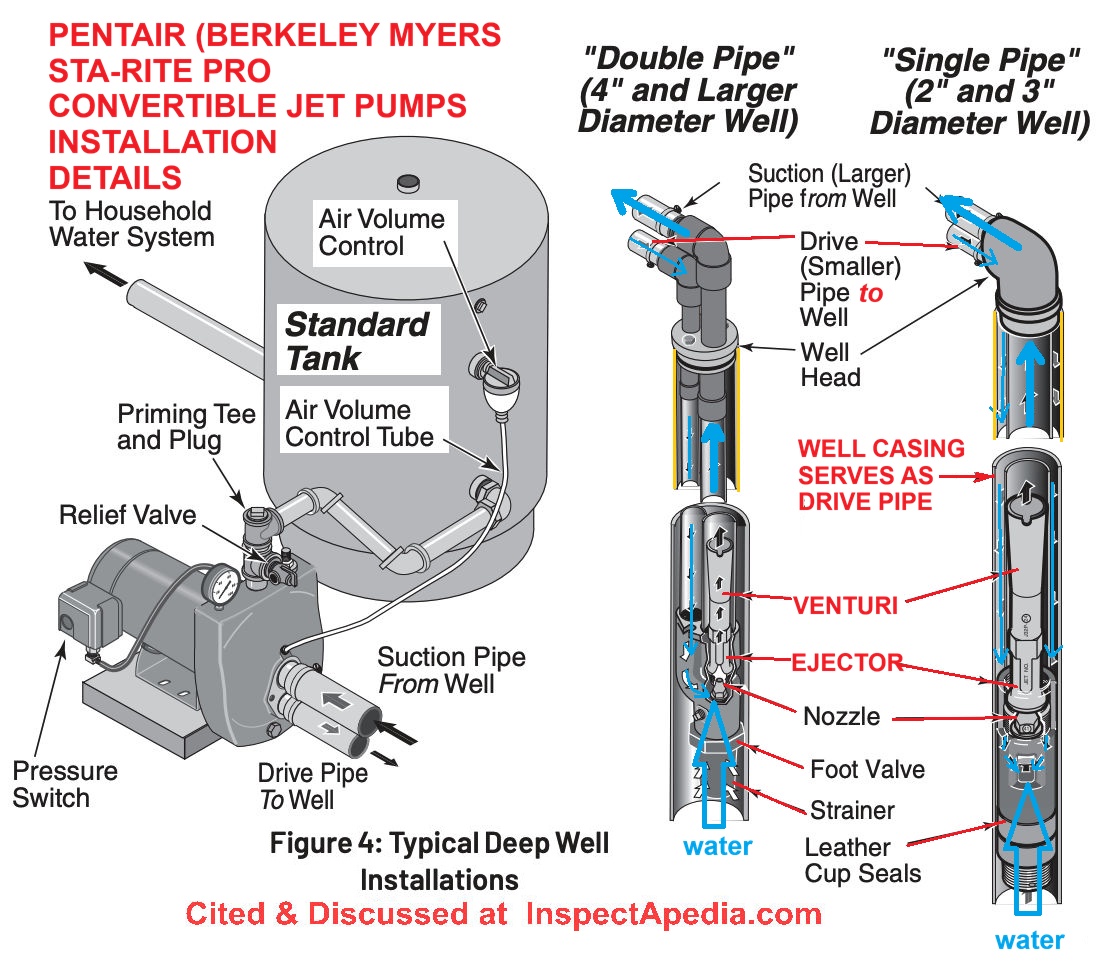
Below, with more edits to Pentair's illustration we show in more exact detail how a 2-line jet pump is used to draw water from a small diameter 2" or 3" well that uses a 1 pipe deep well ejector.
And below is a closer look at a 1-pipe deep well ejector/venturi assembly from A.Y. McDonald.
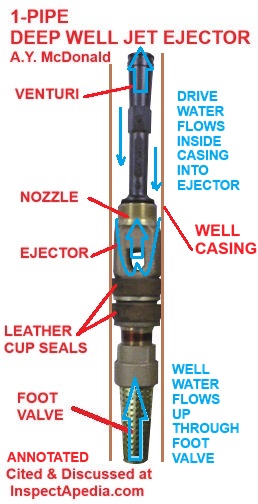
A Tailpiece and Foot Valve are Needed at the Bottom of the Well Pipe Ejector
Watch out: You'll notice that typically an ejector assembly can't fit into well bores or casings that are smaller than 4" in diameter. We show the tailpiece and the well pipe bottom foot valve in my drawing below.
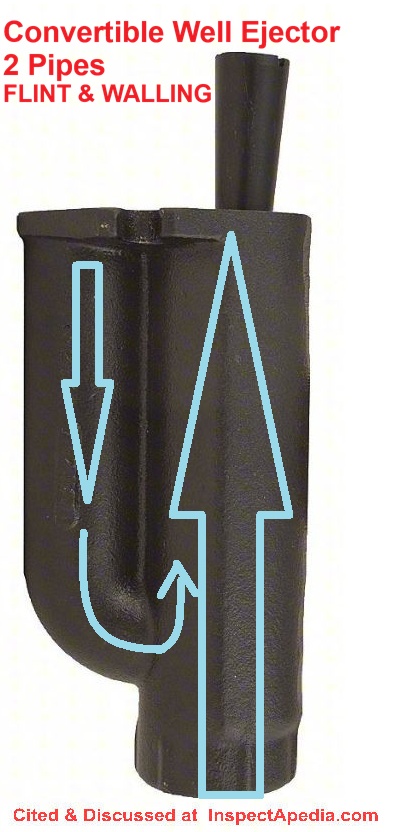
This 2-pipe well line ejector is a FLINT & WALLING Convertible Well Ejector: 2 Pipes, JHU05/JHU07/JHU10, JHU - as sold by plumbing suppliers and online vendors such as Grainger.
This particular ejector can be used with convertible well jet pumps for lifting water from shallow (up to 25 ft. deep) and deep (greater than 25 ft. deep) water wells.
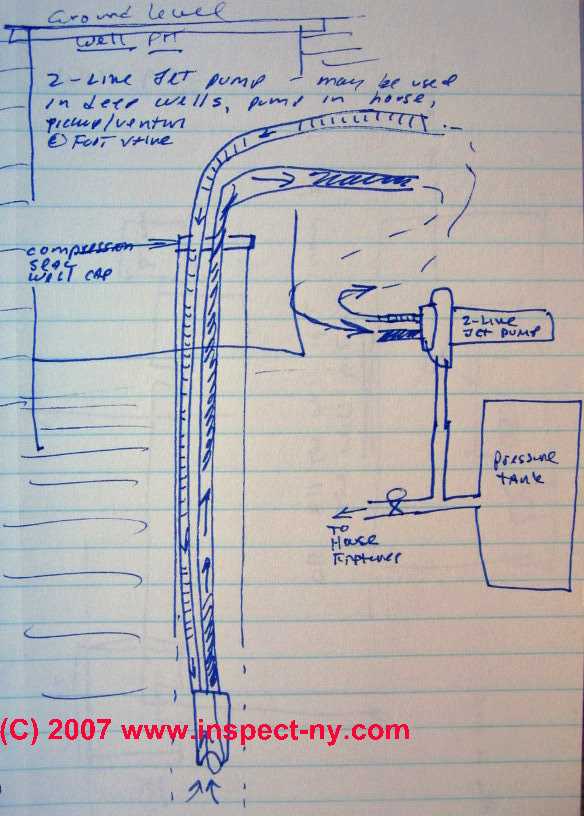
Above in my annotated sketch from plumbing school you can see the ejector, also described in red here as "VENTURI / JET" depicted as at the very bottom of a 2-pipe well line installation.
Actually that's not complete. A tailpiece and foot valve would extend below the ejector/venturi/jet and is necessary not just to improve water pick-up but also to protect loss of well prime in the vertical well pipes, as we illustrate below.
Shown below is a typical well ejector used on a two-pipe jet pump well system.
The lift capacity of various ejectors or venturi devices varies by design and by the capacity of the jet pump as well, so there are limits on the tailpiece extension length or depth.
You'll notice on most well ejectors that the bottom of the unit has either bolt fittings or a threaded opening to which a down-pipe or tailpiece can be attached and that can include the necessary foot valve, a special check valve at the bottom of well piping that prevents loss of well prime in the vertical well pipes.
We explain and illustrate foot valves in this separate article: FOOT VALVES
...
Reader Comments, Questions & Answers About The Article Above
Below you will find questions and answers previously posted on this page at its page bottom reader comment box.
Reader Q&A - also see RECOMMENDED ARTICLES & FAQs
For a 2-line jet pump, Can the ejector go closer to pump?
 Can the ejector go closer to pump ? On 2020-05-14 by Dennis
Answer by (mod) -
Dennis:
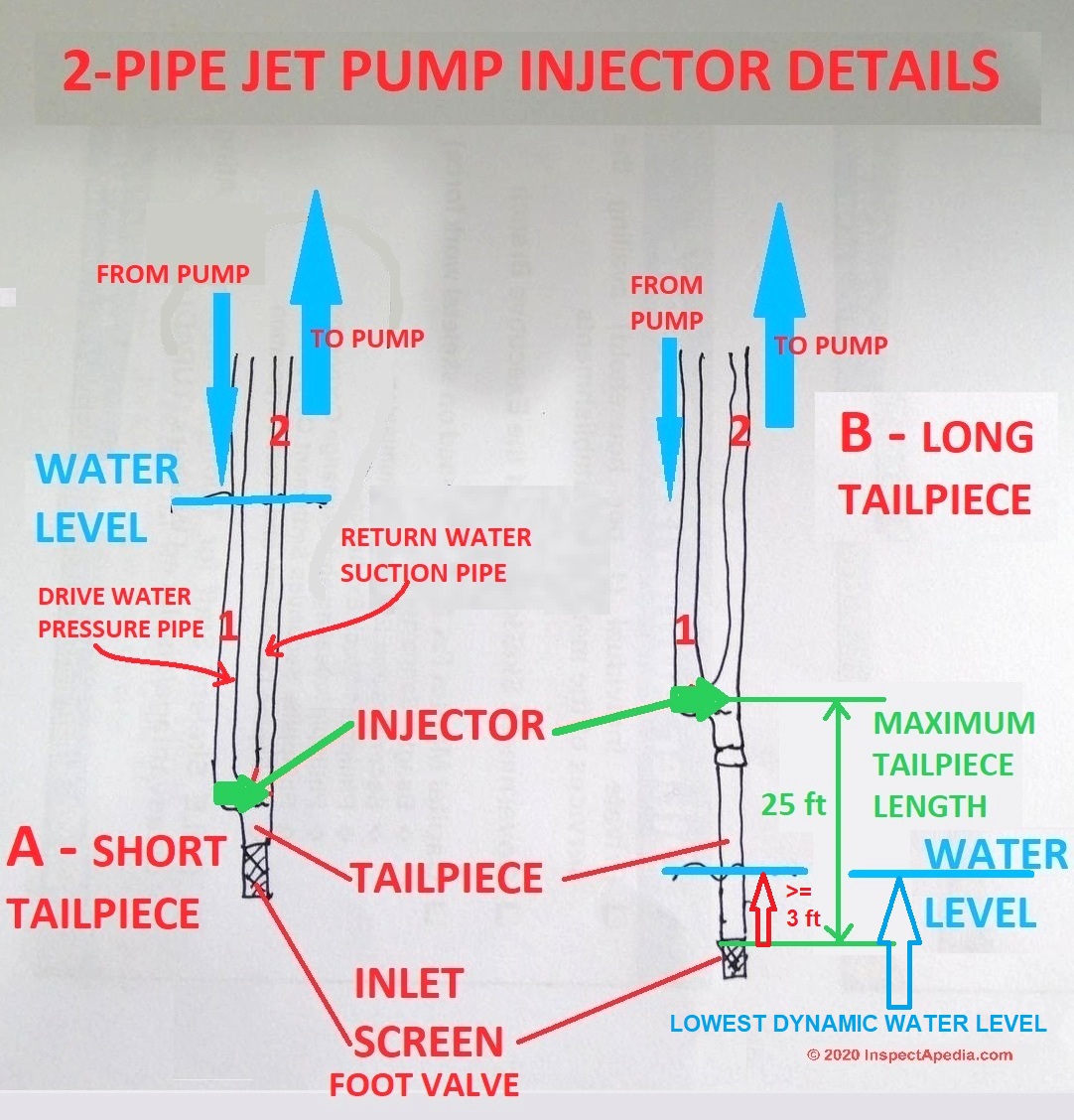
The ejector in a 2 line jet pump needs to quite close to or even below the surface of the water, in the well, though you'll see in our ejector tailpiece illustrations that it does not have to be at the very bottom of the well piping.
Otherwise it can't generate the required lift.To be clear about how your 2 line jet pump is working to deliver water to the building
in the building or somewhere above ground a 2 line jet pump includes an impeller that pushes water down the smaller-diameter well pipe and near the bottom of that pipe, in the well, water is pushed through a jet or venturi - an opening shaped like a funnel.
The venturi, by reducing the opening size in a funnel shape, increases the speed of water passing through the venturi - also called the "injector".
That increase in water creates a suction that draws additional water up through the tailpiece, into the injector, and the combined volume of water sent down the pipe plus additional water sent up the larger pipe back to the pump is what actually delivers water into the building.
The maximum length of the tailpiece is 25 feet.
Why 25 ft. for the maximum tailpiece length?
It's no coincidence. The lift force generated by a venturi is capable of drawing water up in any application is about 25 ft.
So the deep well 2 line jet pump tailpiece length limitation of 25 ft. derives from the same limitation that tells us that a shallow well 1 line jet pump can not lift water from a depth of more than 25 ft.
The difference is that a 1 line jet pump's venturi is above ground, while the 2 line jet pump's venturi or injector is down in the well.
The additional "lift" capacity of the 2 line jet pump comes from the added force or "push" generated by that smaller-diameter pipe that is pushing water down the well piping as well as pushing it back up the well piping to the surface.
It is necessary to extend the injector for a 2 line jet pump all the way to the bottom of the water?
It is necessary to extend the injector to the button of the water? 2020/04/09 Francis Carlo
Reply: the injector can be above water level with a sufficiently long tailpiece but ... watch out!
Francis
Injectors are used on two-pipe deep well systems in well casings that are 4" in diameter or larger. (An injector won't fit into a smaller diameter well but you may be able to use a packer-well assembly in those smaller casings.)
Both of the 2-line jet pump injectors in your drawing (shown here with my edits) can work as long as the length of the tailpiece does not require a greater water lift suction than the injector can provide.
We know that a 2-line jet pump works by sending water down smaller-diameter pipe #1, through the injector, and with help from additional well-water picked up by the injector, a larger volume of water returns to the pump through larger diameter pipe #2.
The injector's lift capability is determined by the venturi design, size, and the flow rate of water moving down through pipe A.
Watch out: unless your well has a very high water flow-rate, a short tailpiece and injector above the water level is going to give only a very limited volume of well water before the well water level drops below the well screen or foot valve - you will run out of water quickly.
Note that at least some of the pump manufacturer's installation recommendations we've reviewed recommend that the injector be located 10-20 feet below the lowest point to which water is expected to be drawn down in the well casing.
Below I'll include our annotated version of Carson Dunlop's Two Line Jet Pump installation to give a more-complete picture of the function of the ejector in a two line jet pump water well.
Thank you for asking - working together helps us both.

Can I use a 2-line jet ejector system on an existing 3 inch diameter PVC well casing?
Can I use a 2-line jet ejector system on an existing 3 inch diameter PVC well casing? Thanks and regards On 2020-04-10 by Jonathan
Reply by (mod) - it may not fit in the well casing
Jonathan
Watch out: most 2-line jet pump piping arrangements and ejectors require a 4-inch or larger diameter well casing.
It's also possible that you'll be reducing the flow capacity of the system.
You might want to try selecting the actual ejector venturi size to get the best flow from your well without exceeding the well's recovery or flow rate capacity.
Betta Flo and also Sta-Rite are examples of sources of jet / venturi / tailpiece components.Another solution is to install a powerful one-line jet pump that can serve small diameter well casings, as we describe at WATER PUMP, ONE LINE JET DEEP WELL - these pumps can lift from over 300 feet
...
Continue reading at WATER PUMP, TWO LINE JET PUMP OPERATION, or select a topic from the closely-related articles below, or see the complete ARTICLE INDEX.
Or see these
Recommended Articles
- EJECTORS in WELLS
- FOOT VALVES
- WATER PRESSURE INTERMITTENT LOSS - occasional loss of water pressure
- WATER PRESSURE LOSS DIAGNOSIS & REPAIR - home
- WATER PUMP CONTROLS & SWITCHES - home
- WATER PUMP DIAGNOSTIC TABLE
- WATER PUMP INTERMITTENT CYCLING - pump cycles on and off at odd times or for no apparent reason
- WATER PUMP, ONE LINE JET
- WATER PUMP PRESSURE SWITCH MANUALS
- WATER PUMP PRIMING PROCEDURE - prime the pump using a garden hose or by other means
- WATER PUMP PROTECTION SWITCH
- WATER PUMP REPAIR GUIDE - home
- WATER PUMP, SUBMERSIBLE
- WATER PUMP, TWO LINE JET
- WATER PUMP, TWO LINE JET PUMP OPERATION - read this next
- WATER PUMP WONT STOP RUNNING - pump runs continuously, never shuts off or can't reach shut-off pressure
- WATER PUMP & TANK I&O & REPAIR MANUALS - manuals for water pump controls, pumps, tanks
- WATER TANK: USES, TROUBLESHOOTING
- WELL PIPING CHECK VALVES
- WELL PUMP PRIMING PROCEDURE if you need to re-prime your jet pump.
- WELL CAPS & COVERS - requirements for sealed well caps & covers, requirements for vents & exclusion of vent requirements for some jet pump installations.
- WELL PIPING TAIL PIECE
- WELL WATER PRESSURE DIAGNOSIS
Suggested citation for this web page
EJECTORS in WELLS at InspectApedia.com - online encyclopedia of building & environmental inspection, testing, diagnosis, repair, & problem prevention advice.
Or see this
INDEX to RELATED ARTICLES: ARTICLE INDEX to WATER SUPPLY, PUMPS TANKS WELLS
Or use the SEARCH BOX found below to Ask a Question or Search InspectApedia
Ask a Question or Search InspectApedia
Share this article:Search the InspectApedia website
Need to make a private comment? Email editor@inspectApedia.com. We welcome email with your website content critique, corrections, suggestions or questions. Email is monitored daily but our workload may prevent an immediate reply. For immediate results, we hope you'll first try asking your question using the search box just above.
Citations & Reviewers
In addition to any citations in the article above, a full list is available on request.
- AY McDonald, EJECTOR for SHALLOW WELL DATA SHEET [PDF] (at a pump vendor website, not found at McDonald's website, local backup copy saved as Jet-Ejectors-AYMcDonald.pdf) A.Y. McDonald Mfg. Co., 4800 Chavenelle Rd., Dubuque, IA 52002 USA Toll Free: 1-800-292-2737 sales@aymcdonald.com aymcdonald.com
This catalog illustrates jet pump ejectors (for the company's 8630 or 8631 series well pumps) for convertible (1-line to 2-line) and shallow well pumps including the following .
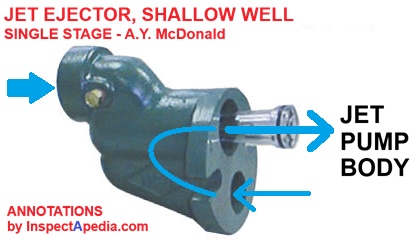
Above: A.Y. McDonald Single Stage Shallow Well Jet Ejector venturi assembly for wells up to about 25 ft. in depth.
Below: A.Y. McDonald 's Deep well single pipe deep well ejector, handling water depths to 110 ft. depending on jet ejector model. For a single pipe deep well ejector/venturi assembly like this one water is pumped down from the 2-line jet pump using the well casing as the "down pipe" and is returned to the pump through the single riser pipe in the well.
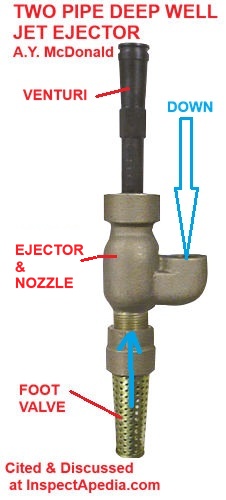
And third, shown below is McDonald's two pipe deep well jet ejector with lift capacities about the same as the single pipe ejector. This ejector uses a 1" drive pipe and a 1 1/4" return pipe but the company notes that you can improve the pump efficiency by using increasing fittings to fit a 1 1/4" drive pipe as well.
- Flint & Wallling, CPJ SERIES JET PUMPS INSTALLATION & PARTS MANUAL [PDF] (Flint & Walling website) F&W, Flint & Walling, 95 N Oak Street, Kendallville, IN 46755 USA Tel: 800-345-9422, Website: https://flintandwalling.com/ Email: Technical questions: tech@flintandwalling.com - local backup copy saved as Flint-Walling-CPJ-Pump_manual.pdf
- PENTAIR BERKELEY MYERS STA-RITE PRO CONVERTIBLE JET PUMPS MANUAL [PDF] (Pentair website) Pentair, 293 Wright St., Delavan, WI 53115 USA Teléfono: 888.987.8677 - Pentair Canada, 90 Pinebush Rd., Unit 4 Cambridge, Ontario Canada N1t 0a5 Teléfono: 800.363.7867 pentair.com - local copy saved as Pentair-Jet-Pump-Manual.pdf
- In addition to citations & references found in this article, see the research citations given at the end of the related articles found at our suggested
CONTINUE READING or RECOMMENDED ARTICLES.
- Carson, Dunlop & Associates Ltd., 120 Carlton Street Suite 407, Toronto ON M5A 4K2. Tel: (416) 964-9415 1-800-268-7070 Email: info@carsondunlop.com. Alan Carson is a past president of ASHI, the American Society of Home Inspectors.
Thanks to Alan Carson and Bob Dunlop, for permission for InspectAPedia to use text excerpts from The HOME REFERENCE BOOK - the Encyclopedia of Homes and to use illustrations from The ILLUSTRATED HOME .
Carson Dunlop Associates provides extensive home inspection education and report writing material. In gratitude we provide links to tsome Carson Dunlop Associates products and services.
 |
HOME | ABOUT | ASK a QUESTION | CONTACT | CONTENT USE POLICY | DESCRIPTION | POLICIES | PRIVACY | |
| © 2026 - 1985 Publisher InspectApedia.com - Daniel Friedman | |||||||||