 Radiator Air Bleeder Valve Test FAQs
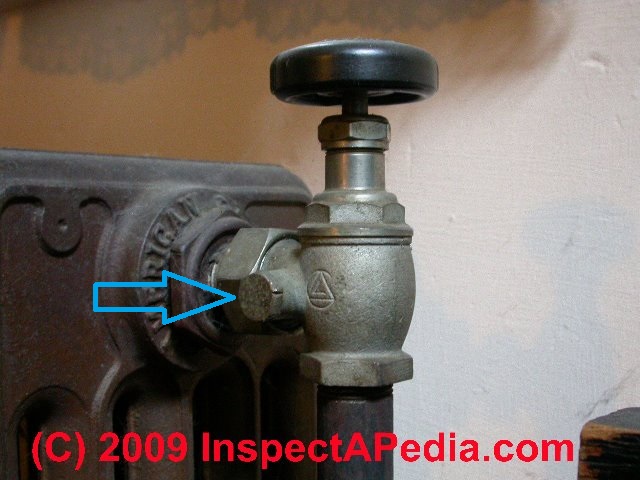
- POST a QUESTION or COMMENT about troubleshooting problems bleeding the air out of hot water heating system radiators, baseboards, convectors etc.
Answers to reader questions on how to use or fix air bleeder valves & automatic air purging valves on hot water heating systems including boilers, radiators, & baseboards.
This article series explains how to diagnose and repair problems with air bleed valves and we describe methods used to remove un-wanted, air from noisy or air-bound hot water heating system pipes, radiators, convectors, and baseboards.
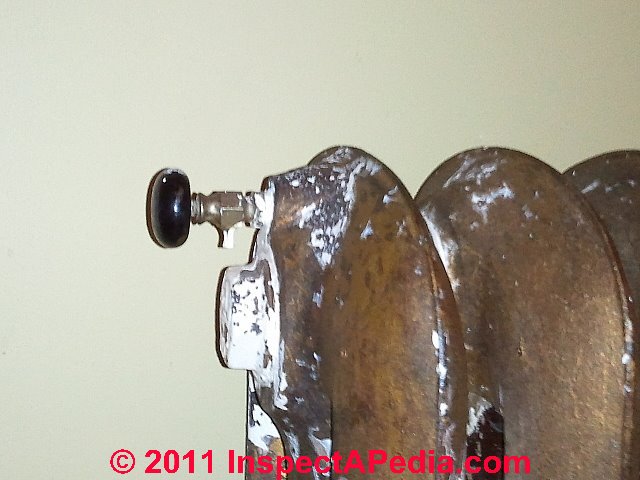
Page top photo: an antique manually-operated air bleeder valve at the top of a hot water heating radiator.
InspectAPedia tolerates no conflicts of interest. We have no relationship with advertisers, products, or services discussed at this website.
- Daniel Friedman, Publisher/Editor/Author - See WHO ARE WE?
Air Bleeder & Vent Test & Repair FAQs-3
 These questions & answers about heating system air bleeder valve installation, troubleshooting & repair were posted originally
at AIR BLEEDER VALVES - be sure to see the repair advice given there.
Also see this AIRBOUND HEAT REPAIR FAQs INDEX - to all questions & answers about fixing airbound hot water heating systems including air bleeder valves, air vents, and air removal methods.
Article Contents
- AIR BLEEDER VALVE TEST PROCEDURE FAQs - how to test an air vent or air bleeder
- AIR BLEEDER VALVE USE PROCEDURE FAQs - how to use & set up an air vent or air bleeder on hot water heat
- AIR BLEEDER NOT WORKING - NO AIR COMES OUT, ONLY WATER, FAQs - we open the vent and just get water, no air
...
Hot Water Heating System Air Vent Test FAQs
Tip: more help is at
- AIR BLEEDERS NOT WORKING - NO WATER COMES OUT - we open the vent and nothing happens
- AIR BLEEDERS NOT WORKING - NO AIR COMES OUT, ONLY WATER - we open the vent and just get water, no air
How can I tell if the air bleeder at the boiler is working?
I have a hotwater baseboard gas fired heating system (installed in the 1990's new). It has a automatic bleeder valve that was replaced in October 2018, I believe.
After the repair I noticed more and more "air bubble" "gurgling" sounds for the upstairs zones pipes when the heat turned on.
I just manually flushed all the lines this morning, and I did flush a lot of air pockets out, now things sound right.
My concern is since my furnace has an automatic airbleeder valve (installed on top of some kind of cast iron piece, looks like some of the pictures on this website) I shouldn't have to be manually flushing the heat zones to get air bubbles.
How can I check / test / tell if my automatic air bleeder is working right or if the problem is something else (like the circulator is so weak the bubbles from the upstairs lines never make it back down to the furnace).
I have not indications the circulator is weak, the heat upstairs is good and kicks on quickly (hear fins on pipes creaking) when the thermostat kicks on. On 2019-02-16 by Timotheus
by (mod) - how to check if the main air bleeder at the boiler is working
Tim
1. Check that the little screw cap on the air bleeder is loose - it should not be screwed all the way tight or the bleeder can't vent
2. To test the air bleeder remove the cap and with a small screwdriver, pencil or the like, press the center pin - that opens the valve.
If water squirts out the bleeder is working and there was no air to vent - at least no air right in the float vent itself.
Watch out: Doing this test can result in a bleeder that starts to leak and won't stop.
If jiggling the pin up and down doesn't stop the leaking then the valve needs to be replaced. Meanwhile you can stop the leaking by screwing the cap down tightly - it'll stop leaking but it also can no longer vent air.
The air bleeder at the boiler cannot remove all air from the system - if there is air trapped in upper floor piping, radiators or baseboards it may need to be removed by using bleeder valves at those higher locations.
I"m doubtful that your boiler flushing operation at the boiler would get rid of all air in the system though this article series does describe how a heating service tech might successfully do that by using those drains plus a bucket and a pony pump - not something a normal homeowner is equipped to handle.
If you want to see those details they're
in AIR BOUND HEAT SYSTEM REPAIR by PUMP
I don't think my hot water heating piping air-bleeder vents are working
I have this type of radiator inspectapedia.com/heat/Heat_Convector173-DFes.jpg. For someone reason the one closest to the boiler needs to be bled every day. I do not see any leaks. All other radiators function fine. It is a one floor house with one zone. Any thoughts? - Chris 1/3/13
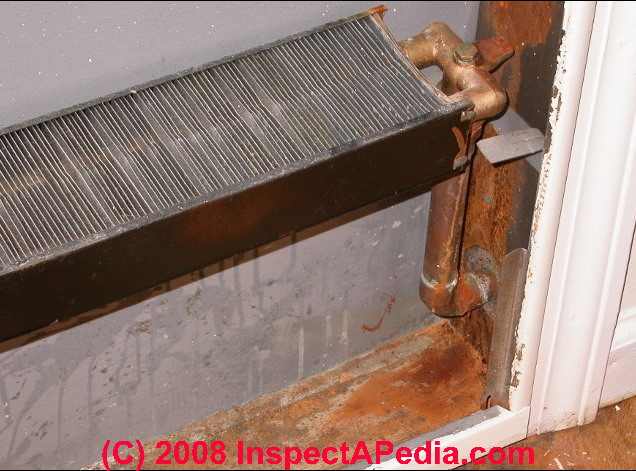
I have three automatic air vents - one Spirovent and two Hy-Vents for three paralleled heating needs off oil-fired boiler. Former is on main whole-house distribution loop for Infloor radiant heating and one of latter is for DHW storage tank distribution loop. The last is on the far-side distribution loop of heat exchanger for sunporch with Infloor radiant heating. This loop has 50:50 mix with antifreeze because the temperature control is set for 50 degrees in Gypcrete slab temp and not air temp in glass/extruded aluminum sunporch.
This automatic air vent seems not to be working automatically anymore because this heating season I'm hearing entrained air 'tinkling' and 'squirting' through the circulator pump.
Even with pressure checked at 20 PSI.
This vent sits atop Taco air scoop with expansion tank under scoop and these three are downstream of pump which is piped in very soon after boiler outflow manifold.
I have checked that screw cap cover is backed off and have now depressed Schrader valve to release a 'highly carbonated' bubbly froth three times today and still haven't gotten all air out.
Other Hy-Vent on piping to DHW tank delivers only water when I depress Schrader valve. Can I clean this [faulty] unit without depressuring that loop? If so, how do I take it apart. Taco manuals I've found show nothing. Just replace it? Is the antifreeze to blame? Specifications said I could use it. Suggestions welcome. - Christopher D'Amico 1/14/2013
Reply: How do I Know if the Air Eliminator or Air Purger is Working on my Heating System?
Christopher I think you might first take a look at our air bleed valve diagnostics beginning
at AIR BLEEDER VALVE DIAGNOSTIC FAQs to be sure we're on the same page.
As you are continuing to have trouble you will want to
see AIRBOUND HEAT SYSTEM REPAIR by WATER FEED VALVE where we describe methods to be sure you've gotten all the excess air out of all of the system components and piping.
How to Know if the Air Eliminator or Air Purger is Working on a Heating System
As we explain beginning at AIR BLEEDER VALVES , virtually every hot water heating system has one or more air bleed valves installed.
On most hot water heating systems there is at least one automatic air bleed valve, usually located on the heating boiler itself, or close to the heating boiler on a nearby check valve or flow controller.
If the automatic air bleed valves are installed in the proper locations on the heating system, typically at high points such as at or near the heating boiler and at one or more high points in the radiator or baseboard piping system, then small amounts of air in the heating piping will be purged automatically.
First, is there evidence that the heating system is not working due to air trapped in the hot water heat piping, baseboards, or radiators?
Check hot water baseboards, radiators, or heating convectors: if some of these heating devices are hot and others cold, are they all on the same heating zone? Feel the hot water piping leaving the heating boiler - it should be hot when the boiler is running and the thermostat is calling for heat.
If the building has multiple heating zones each zone will be controlled by its own thermostat and each heating zone will either have its own hot water circulator pump (controlled by a thermostat and pump relay switch), or each hot water heating zone will have its own thermostat and a zone valve that opens to let a common circulator pump send hot water through that individual heating zone.
Are all of the thermostats turned up high enough to call for heat in each heating zone?
If some heating baseboards or radiators are hot and others cold and we're sure that they're on the same heating zone, then the system is probably air-blocked.
Second: even if heat is working throughout the building and the heating system is not air-bound, there may still be air purge or air bleed valve repairs needed. Sounds of air gurgling in the heating piping is a sign that trouble is brewing, and leaks anywhere in the syste are also leading to trouble.
But a variety of problems can cause the automatic air purging valves to fail to do their job. The effort to fix these problems ranges from trivial to a bit of work. Failure to fix the air purge system can ultimately lead to loss of heat in all or parts of a building.
- Cap on the air purge valve: the cap on automatic air purge valves is left loose to permit the valve to vent air. If someone closes this cap, as we might do if the valve is leaking, it will no longer function automatically. The simple repair is ususally to replace the valve.
- Corrosion at the air purge valve: an air purge valve that has been leaking may become blocked with corrosion debris, for both automatic and manual air purge valves. Clean or replace the valve.
- Leaks at the air purge valve: if an automatic air purge valve is leaking, an easy emergency repair is to close the valve cap. But the leaky valve should be replaced or repaired so that it can continue to do its job.
I get no air but water leaks out from the air elimination valve
Wateris leaking from self elimination air valve. I opened the screw, no air but water leaks out of the screw when I tightened the screw and half turn to open, some times it leaks and sometimes it doesn't
I thought once air is out the valve closes ... thanks for any response. On 2017-05-06 by John
Reply by (mod) -
John,
If the air valve is an automatic one, there will be no screw that you turn to open or close it. If your air valve uses a screw to open or close it it is a manual valve.If you open that valve and only water emerges, then there's no air to be bled from that point, and you should leave the valve closed.
My Heating system has an American Air Purger but no air bleeder valves and I hear gurgling pipes
I'm trying to findout how to bleed air from my baseboard hot water heating system. There are no bleed valves on the baseboard units or by the zone valves in the basement.
There is an American Air Purger installed, but everytime I try to find how to bleed there, or if I can/should, the pages I was looking at initially come up with "error, problem loading page". Frustrating as I know there were instructions there.
I have excessive noise in the system (gurgling, bubbling, banging) and know my system is not being efficient and that this can pose further problems as well as being potentially dangerous. Help, please. On 2015-02-02 1 0 by GorRiv
Reply by (mod) -
GorRiv
If your system has no air bleeder valves the choices are to install some at strategic points or to try the other air bound heat repair methods describe by these articles listed in the ARTICLE INDEX or in the Continue Reading links at the end of many of the pages in this article series.AIR BOUND HEAT SYSTEM REPAIR by PUMP
AIRBOUND HEAT SYSTEM REPAIR by WATER FEED VALVE
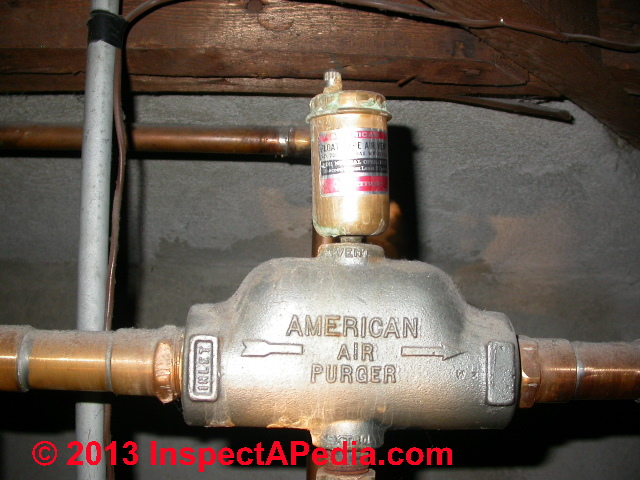
American Air Purger as illustrated in this article, which is automatic? I have excessive gurgling, bubbling, and banging
I have an American Air Purger as illustrated in this article, which is automatic? I have excessive gurgling, bubbling, and banging in my baseboard system though.
Can/should I crack the valve at the top to bleed off air? Should I make sure the water intake for the boiler is open, and how much/when? Everytime I try to access other pages about Air bleeding they come up with "error, problem loading page". Help, please. (Feb 2, 2015) GorRiv
Reply:
GorRiv -
Check that the valve cap is loose and that the valve is not leaky or clogged with mineral salts from prior leaks - or just replace it.
Then see BANGING HEATING PIPES RADIATORS
I bled air but still get gurgling sounds - where will I find secondary air bleeders
I have an under 10 year old baseboard hot water radiator system. I bled the main tank at the furnace but am still getting gurgling and water flowing sounds in some of the radiators. I assume there are secondary bleeder valves. Where are the likely places these might be located. Thanks - Jim 1/30/12
Reply:
AIRBOUND HEAT SYSTEM REPAIR by WATER FEED VALVE has more thorough and aggressive means to get unwanted air out of a hot water heating system.
...
Air Bleeder Valve Use Procedure
Tip: see the step by step detailed procedure for using an air bleeder valve to fix cold heating pipes, radiators, or baseboards, given
at AIR BLEEDER VALVE USE PROCEDURE - how to use air bleeders on baseboard heaters or radiators
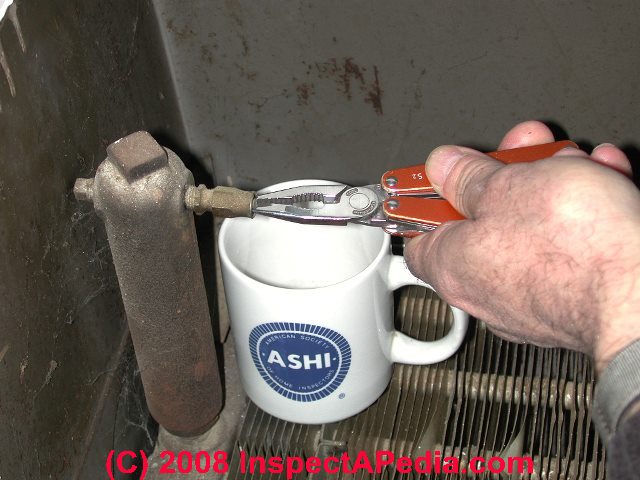 If I was going to bleed my own heating pipes would I start at the top floor or the bottom floor?
If I was going to bleed my own heating pipes would I start at the top floor or the bottom floor? On 2018-11-11 by Mary -
Reply by Mod: Best to start low at the first cold pipe or radiator - or use a pony pump
Mary,
When using air bleeders at the radiators or baseboards, I start bleeding air at the air bleeder valve nearest to or just after the first place where pipes or radiators are cold.
My OPINION (not all heating service techs will agree with me), is that I worry about starting at the highest point in the building because if the air blockage is much lower, closer to the boiler, I have to get it to move all the way upstairs to get it out - which means bleeding a heck of a lot of water bfore the air shows up to be bled at that high location.
If on the other hand I'm using a pump as described at AIR BOUND HEAT SYSTEM REPAIR by PUMP then my work starts right at the boiler.
How much water do I let out of the air bleeder valve before I close it?
How much water do I let out before I close the valve? On 2016-11-22 19:48:17.396120 by Louise
by (mod) - whe no more air comes out of the air bleeder, close the valve
Louise:
AS SOON AS YOU SEE WATER coming out of the air bleeder valve, close it - you're finished there. DO NOT bleed any extra volume of water out of the system; that won't help anything and it just requires more makeup water at the boiler.(The only time I might try bleeding out more water would be if I am still hearing air gurgling in that run of heating pipe.)
Only air or a slight bit of water should come out of the air bleeder valve, right?
Only Air comes out but no water or very slight? On 2016-10-09 by Anonymous -
Reply by mod
Only air or air with a very small amount of "spitting" water might come out during air bleeding at a radiator or baseboard or hot water heating pipe.
If the valve begins leaking water on its own, that is when you're not fooling with it, it needs to be replaced.
If water comes out of an air vent that has been manually opened then it should be closed, and we can infer that there is no air present in that part of the heating system piping.
I hear air release when I open the air bleeder, and then I hear water gurgling - have I successfully bled air from the system?
The bleeder valve is a finned unit in the center of two water valves about 12" apart. A flat stamped metal lever moves from the normally up position to a fully down position.
An opening in the front of the baseboard unit allows an easy release and upward push up of the lever.
I've moved the lever twice and heard air release and then water gurgling. The piping on either side of the bleeder valve is now warm. Have I successfully bled the system? On 2017-03-15 by Allen
by (mod) What to do if there's still some air in the heating pipes after I try bleeding it out
Allen
If you still hear water gurgling then there is probably still some air in the heating system piping.
It's possible that if the hot water is now circulating, but still contains some air, that air might be released by one or more float type automatic air vents if those are also installed on your heating system, perhaps at the boiler and elsewhere.
If there's no more air released at an air bleeder valve, and if water comes out of the valve when you open it, then either the system is not air-bound ,or it's air-bound in a section or piping not serviced by the bleeder valve or the air is much further ahead (before) the point where you're doing the bleeding; you can try bleeding out more water or try looking for other air bleeder points to try between the boiler and your first cold radiator or baseboard.
If the heating pipes don't get hot I'd start by seeing if the boiler is running in response to a call for heat (or at least check temperatures at the boiler) and I'd see if the circulator is working or zone valve is opening.
by Allen
I guess I was wrong. After checking back to the pipes on either side of the valve, although now just room temperature, the piping remains the same temp. I tried the lever 2 more times, waited, but no more gurgling or air sounds. What do I do now?
...
Air Vent or Bleeder Only Bleeds Water, Never Air - FAQs
Tip: See our detailed advice on this condition at AIR BLEEDERS NOT WORKING - NO AIR COMES OUT, ONLY WATER - we open the vent and just get water, no air
Also see WATER LEAKS at AIR BLEEDER or AIR VENT
The air bleeder near the circulator pump just bleeds water
The first bleeder valve off the circulation pump is venting fluid, and the system pressure is at 0. The boiler still seems to be heating up the baseboard pipes OK though.
Do you think cleaning or replacing the bleeder valve will fix our problem? Seems like the pressure reading might indicate a different or larger problem? On 2017-11-09 by Mike
by (mod) - what to do if the air bleeder valve is venting fluid
Mike if water comes out at an air bleeder valve when you open it then there is no air at that location to be vented.
There are two cases:
- If the air eliminator is an automatic air bleeder valve then it should not be leaking water. If it is, replace the valve.
- If the air vent is a manual air bleeder and water comes out when you open it, close the valve and try other vents in other locations where piping or radiators are cool or cold.
...
...
...
Continue reading at AIR BLEEDER VALVE FUNCTIONS or select a topic from the closely-related articles below, or see the complete ARTICLE INDEX.
Or see these
Recommended Articles
- AIR-BOUND HEATING SYSTEMS - home
- AIR BLEEDER VALVES
- AIR BLEEDER VALVE FUNCTIONS
- AIR BLEED VALVE INSTALLATION
- AIR BLEED VALVE LEAK REPAIR
- AIR BLEED VALVE SOURCES
- AIR ELIMINATOR / FLOAT VENT REPLACEMENT
- AIRBOUND RADIANT HEAT
- AIRBOUND HEAT SYSTEM REPAIR by PUMP
- AIRBOUND HEAT SYSTEM REPAIR by WATER FEED VALVE
- AIR SCOOPS PURGERS SEPARATORS
Suggested citation for this web page
AIR BLEEDER VALVE DIAGNOSTIC FAQs-3 at InspectApedia.com - online encyclopedia of building & environmental inspection, testing, diagnosis, repair, & problem prevention advice.
Or see this
INDEX to RELATED ARTICLES: ARTICLE INDEX to HEATING BOILERS
Or use the SEARCH BOX found below to Ask a Question or Search InspectApedia
Ask a Question or Search InspectApedia
Share this article:Search the InspectApedia website
Need to make a private comment? Email editor@inspectApedia.com. We welcome email with your website content critique, corrections, suggestions or questions. Email is monitored daily but our workload may prevent an immediate reply. For immediate results, we hope you'll first try asking your question using the search box just above.
Citations & References
In addition to any citations in the article above, a full list is available on request.
- In addition to citations & references found in this article, see the research citations given at the end of the related articles found at our suggested
CONTINUE READING or RECOMMENDED ARTICLES.
- Carson, Dunlop & Associates Ltd., 120 Carlton Street Suite 407, Toronto ON M5A 4K2. Tel: (416) 964-9415 1-800-268-7070 Email: info@carsondunlop.com. Alan Carson is a past president of ASHI, the American Society of Home Inspectors.
Thanks to Alan Carson and Bob Dunlop, for permission for InspectAPedia to use text excerpts from The HOME REFERENCE BOOK - the Encyclopedia of Homes and to use illustrations from The ILLUSTRATED HOME .
Carson Dunlop Associates provides extensive home inspection education and report writing material. In gratitude we provide links to tsome Carson Dunlop Associates products and services.
 |
HOME | ABOUT | ASK a QUESTION | CONTACT | CONTENT USE POLICY | DESCRIPTION | POLICIES | PRIVACY | |
| © 2026 - 1985 Publisher InspectApedia.com - Daniel Friedman | |||||||||