 Boiler Relief Valve Leak Caused by Expansion Tank
Waterlogged expansion tank may cause PRV Leak
Zilmet expansion tank diagnosis
- POST a QUESTION or COMMENT about the causes & cures of leaks and discharges from pressure relief valves or TP valves
Temperature & pressure relief valve leaks on a hydronic heating boiler (hot water heat) may be caused by a waterlogged expansion tank serving the boiler.
This article series describes the causes of leaks, drips, or discharges from pressure relief valves, temperature/pressure relief valves, or TP valves found on heating boilers, water heaters, or the simpler pressure relief valves found on water pressure tanks.
Watch out: a dripping or frequently spilling T&P valve is dangerous because those very leaks can eventually cause the valve to clog and then to fail to open when it should.
InspectAPedia tolerates no conflicts of interest. We have no relationship with advertisers, products, or services discussed at this website.
- Daniel Friedman, Publisher/Editor/Author - See WHO ARE WE?
Expansion Tank Role in Boiler Relief Valve Leaks
An inspectApedia reader asked for help troubleshooting a leaky pressure relief valve.
Here we describe in step by step detail how we determined that the boiler's expansion tank was the root cause of the leak.
Tell me How to Diagnose a TPR valve on tankless gas boiler that spills on a regular basis
I have a tankless gas boiler and after maybe 6 years in use, it has started relying on the pressure relief valve on a regular basis, such that it fills a 5 gallon bucket about once a week.
During a heating cycle, the boiler steadily climbs from about 15 psi to 45, at which point the pressure relief valve bleeds off a little water into the bucket.
Is this a symptom of something I can fix?
There's no floor drain in the proximity of the boiler, so it's kind of annoying, but otherwise it works fine.
I'm also having a problem with one of my Taco ZVC403 Zone Controller zones that stays on just a few seconds
- discussed separately at ZONE CONTROLLER TACO ZVC403 - Karl Peterson by private email 2017/12/09
This discussion is explained
as RELIEF VALVE LEAK DUE TO ZILMET EXPANSION TANK
Reply:
By tankless gas boiler, is that boiler used for heating your home or is it supplying domestic hot water?
Guessing it's for heating your home, a frequent spillage at the temperature/pressure relief valve is unsafe, although we are of course glad that the valve is doing its job.
- Start by taking a look at the data tag on the relief valve.
If it is intended to open at 45psi AND if your system pressure gauge is reading around 45 when the valve spills, then it's working correctly and we need to find the problem elsewhere.
The danger is that after repeated spillage at the relief valve, mineral deposits or debris can accumulate that ultimately block the valve, rendering the system unsafe and risking a BLEVE explosion.
Tell me the brand and model of your heater and we can look for its manual to see what the manufacturer says about proper operating temperature,
- Next let's check the water pressures involved & pressure regulation.
(Most residential heating boilers in a typical 2 story home operate at 12 psi cold and a bit under 30 psi hot. A taller house might need 15 psi cold incoming pressure but would still remain under 30 psi.
If your relief valve is original equipment chosen by the manufacturer and is designed to open at 45 not 30 psi, then your system is designed to operate at a bit higher pressure.
The usual underlying causes of a temperature/pressure relief valve to open (high temp or high pressure or both) are
at RELIEF VALVE LEAKS
 If you haven't seen that article, its diagnostics are a good place to start.
- Is the incoming water pressure set higher than it should be?
That could be a problem at a pressure regulator valve on your water supply system or at a water feeder valve at the heating boiler. - Is the mixing valve,
intended to let the boiler run at hot and thus high efficiency, failing to operate properly, causing over temperature in the system and perhaps overpressure? - Are there water hammer noises?
Are the zone valves on the return side of the heating loop? Is the circulator pumping "away" from the zone valves and towards the boiler? If there is water hammer, that can cause relief valve leaks.
Closed hot water heating systems can also leak due to thermal expansion.
- Next let's consider that thermal expansion:
Another direction of investigation, particularly where a tankless boiler is in use for heating, is
at THERMAL EXPANSION TPR VALVE LEAKS - Does your boiler include an expansion tank
to accommodate thermal expansion?
Is that tank waterlogged or if it's one that uses an internal bladder, perhaps its bladder has developed a leak?
Reader follow-up: water pressure controls on my Cosmogas Boiler vs Relief Valve Leaks
[The Cosmogas boiler manual for this heater/water heater gas fired combo boiler as well as company contact information is
at COSMOGAS® boiler / water heater combo manuals - thanks to Karl for providing this document - Ed.]
Below is a photo of the front panel. It is supposed to have a minimum of 12 psi, and a max of 30psi according to the manual, but the relief valve is at 50psi (another photo below.)
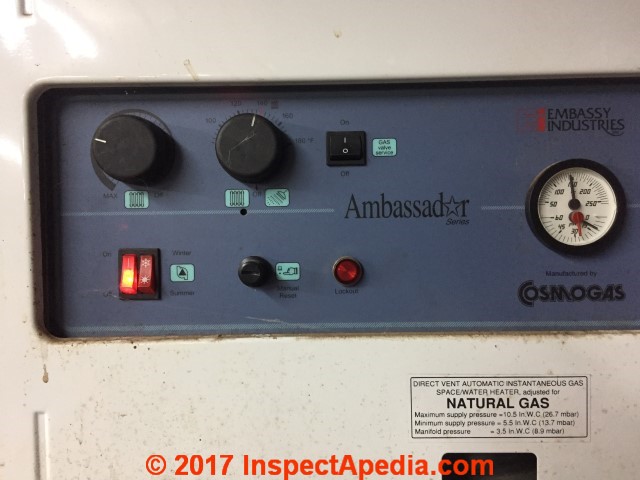
At rest, the pressure is indeed about 12-15 psi generally, but after 2 or three cycles of the heater heating up water for the radiant heat, the pressure climbs to about 45psi, and the valve starts to bleed off pressure.
Its done this all last heating season, and possibly the previous season as well. it never does this in the summer time (or when the heat is off) and as I mentioned previously, it didn't do this at all for the first 6 or 7 years it was installed. There is no banging or hammer noises.
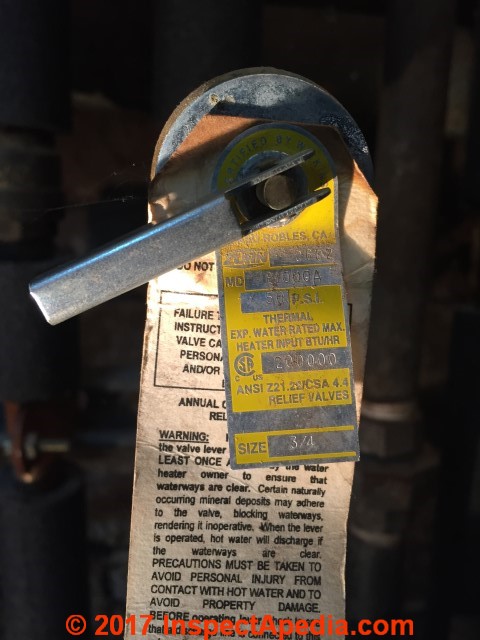
Above: Zurn Model P1000A temperature/pressure relief valve rated for 200,000 input BTUH and opening at 50 psi.
This TPR is rated to handle thermal expansion of hot water and complies with ANSI Z21.22 / CSA 4.4 relief valve specifications.
Cosmogas® Boiler Relief Valve Leak Diagnosis & Warnings
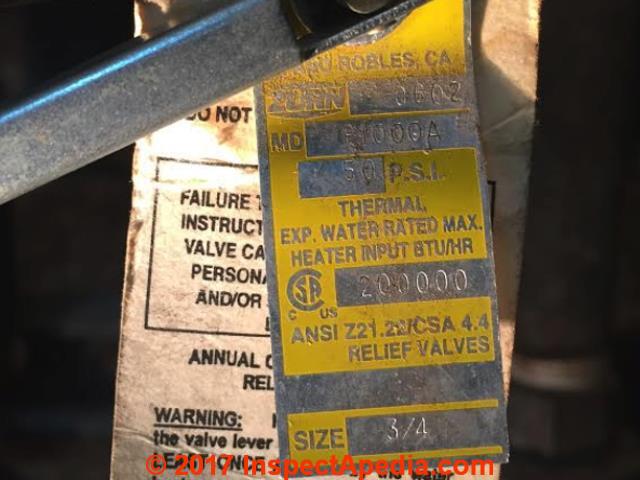
Watch out: I note on p. 13 that the Cosmogas boiler manual for your heater specifies a 30 psi TPR valve.
I had some trouble making out the details in your photo but it looks to me as if you've got a 50 psi TPR valve installed. That might indicate someone was already having pressure problems with this system, or it might be that the higher psi is appropriate for a radiant floor system.
In any event one should never substitute a higher-pressure-rated TPR valve than specified by the manufacturer without their explicit approval.
A too-high pressure could cause the boiler to explode, causing a BLEVE
BLEVE EXPLOSIONS discusses this.
Watch out: The manufacturer also warns about TPR discharge due to thermal expansion
HOT WATER PRESSURE EXPANSION RATE discusses that issue.
That's why your system would probably have a hot water thermal expansion tank installed (HOT WATER EXPANSION TANKS ) , and as we said earlier a failure of that tank (such as a rupture of an internal bladder) could then cause TPR valve leaks.
There should be a water pressure feeder/reducer for your boiler keeping the cold pressure to 12 psi - maybe a bit higher if yours is a tall home. That will prevent your booster pump or your supply water pressure from overpressurizing the boiler.
See COSMOGAS® BOILER MANUAL Models BMS & BTS [PDF] (2002)
Watch out: A tankless coil type hot water supply can also drive up system water pressure if the coil develops a leak. The coil leaks water at house system water pressure into the heating boiler's own water system. Normally the house water supply will be above 30 psi while starting cold water pressure in a boiler is at 12 psi.
TANKLESS COIL INTERNAL LEAKS INTO the BOILER
Watch out: another possible cause of leaks at your boiler's TPR valve is one we mentioned earlier, water hammer - discussed beginning
at WATER HAMMER NOISE DIAGNOSE & CURE
Reader follow-up:
Yes I noticed that as I was rereading the manual the other day (about the 30psi TPR valve) and yes, the one installed currently is a 50psi model. I can't remember if that was changed or not, but I don't believe so. In any case, if it were a 30psi model, this problem of the water being released would be that much worse.
I understand that water coming out of the valve is preferable to an explosion, but I only say this to indicate that there is clearly an issue here. I had this system put in, so, there is no history that I shouldn't know about (if I can remember it)
Anyway, the line about domestic water pressure is something that changed a few years ago. Yes, this unit provides both hot water for the floors and for domestic use. We recently had an extra pump installed to provide greater water pressure to the building, as the top floors were suffering from reduced pressure from an RPZ(?) that we had to have installed. (We're a 4 floor building, one unit to each floor, and each floor has its own heating and hot water equipment.)
I will look again at the boiler tonight to see if I can find any evidence of a coil leak inside the boiler.
There is a small expansion tank inside the boiler - I will look that over tonight as well.
Reply:
There should be a water pressure feeder/reducer for your boiler keeping the cold pressure to 12 psi - maybe a bit higher if yours is a tall home. That will prevent your booster pump or your supply water pressure from overpressurizing the boiler.
As you describe each floor having its own heating boiler for both heat and hot water, 12 psi would be the normal input water feed pressure when the boiler is cold. When the boiler is at full operating temperature, typically somewhere under 200°F the system pressure should be under 30 psi.
You won't "see" a cold water supply leak into the boiler through a corroded coil since that's hidden inside the boiler.
But you can spot it by noticing the boiler pressure going up when the feed to the boiler is closed completely.
This analysis is made more difficult by the fact that pressure goes up when the boiler heats up as well.
TANKLESS COIL INTERNAL LEAKS INTO the BOILER is intended to help sort that out.
Reader follow-up:
Attached is the manual for my boiler - I have the BMS 15/29. I can find no information about regulating pressures inside the boiler.
The COSMOGAS® BOILER MANUAL Models BMS & BTS [PDF] (2002) for this heater/water heater gas fired combo boiler as well as company contact information is also found at at COSMOGAS® boiler / water heater combo manuals.
Reply:
Something might be mistaken here but I note on p. 13 that the company specifies a 30 psi TPR valve. I had some trouble making out the details in your photo but it looks to me as if you've got a 50 psi TPR valve installed. That might indicate someone was already having pressure problems with this system, or it might be that the higher psi is appropriate for a radiant floor system.
In any event one should never substitute a higher-pressure-rated TPR valve than specified by the manufacturer without their explicit approval. (A too-high pressure could cause the boiler to explode, causing
The manufacturer also warns about TPR discharge due to thermal expansion
HOT WATER PRESSURE EXPANSION RATE discusses that issue. That's why your system would probably have a hot water thermal expansion tank installed
and as we said earlier a failure of that tank (such as a rupture of an internal bladder) could then cause TPR valve leaks.
…
[Besides a failed hot water thermal expansion tank,] a tankless coil type hot water supply can also drive up system water pressure if the coil develops a leak. The coil leaks water at house system water pressure into the heating boiler's own water system.
Normally the house water supply will be above 30 psi while starting cold water pressure in a boiler is at 12 psi.
See TANKLESS COIL INTERNAL LEAKS INTO the BOILER
Reader follow-up - check for abnormal boiler water feed pressure, check for tankless coil leaks
Yes I noticed that as I was rereading the manual the other day (about the 30psi TPR valve) and yes, the one installed currently is a 50psi model. I can't remember if that was changed or not, but I don't believe so. In any case, if it were a 30psi model, this problem of the water being released would be that much worse.
I understand that water coming out of the valve is preferable to an explosion, but I only say this to indicate that there is clearly an issue here. I had this system put in, so, there is no history that I shouldn't know about (if I can remember it...)
Anyway, the line about domestic water pressure is something that changed a few years ago. Yes, this unit provides both hot water for the floors and for domestic use. We recently had an extra pump installed to provide greater water pressure to the building, as the top floors were suffering from reduced pressure from an RPZ(?) that we had to have installed.
(We're a 4 floor building, one unit to each floor, and each floor has its own heating and hot water equipment.)
I will look again at the boiler tonight to see if I can find any evidence of a coil leak inside the boiler.
There is a small expansion tank inside the boiler - I will look that over tonight as well.
Reply: homing in on a problem with the boiler's expansion tank
Yes you want the TPR to spill.
Yes more will spill at 30 psi.
But you don't want to over-pressurisze the system.
There should be a water pressure feeder/reducer for your boiler keeping the cold pressure to 12 psi - maybe a bit higher if yours is a tall home. That will prevent your booster pump or your supply water pressure from overpressurizing the boiler.
You won't "see" a cold water supply leak into the boiler through a corroded coil since that's hidden inside the boiler.
But you can spot it by noticing the boiler pressure going up when the feed to the boiler is closed completely. The study is made more difficult by the fact that pressure goes up when the boiler heats up as well.
TANKLESS COIL INTERNAL LEAKS INTO the BOILER is intended to help sort that out.
also,
As you describe each floor having its own heating boiler for both heat and hot water, 12 psi would be the normal input water feed pressure when the boiler is cold. When the boiler is at full operating temperature, typically somewhere under 200°F the system pressure should be under 30 psi.
…
Reader Follow-up: cold system pressure is in normal range & boiler temperature limit is well below 200F, no water hammer
Yes, when the system is cold, the pressure is at about 12-15 psi according to the meter on the front of the boiler, and there is a pressure reducing valve on the line into the boiler. The boiler is set to 150 degrees.
There are no hammering noises with this boiler.
Reply:
I think this is in my article on leaky coils but I want to suggest: if you can stand having no hot water for a time you can try turning off the cold water supply into the coil, dropping the boiler pressure down to normal, then leaving the cold off (to the coil) to see if the boiler pressure creeps back up or not.
(Presuming we're confident that the stop valve really closes fully - you can test that by seeing that hot water pressure at the tap falls to zero). Or you can do that when leaving home for a time or when nobody needs hot water.
Reader Followup: check pressure on the heating loop side ?
we do this to limit the heaters function to heating water to the radiant heat flooring?
Reply: no, check the domestic hot water system - tankless coil
We're closing water into the domestic hot water heating coil - shutting off the hot water for your shower.
The radiant heat part of the system will continue to work.
By closing off water into the tankless coil (stopping hot water flow in the home) and seeing that pressure doesn't rise (you dropped boiler pressure down to normal at the start of this test by draining off a bit of water from the boiler drain), we will confirm that the problem is a leaky coil.
Remember water inside the coil enters cold, gets heated by the physically separate boiler water, and flows out hot onwards to your plumbing fixtures. Details of how this works are
If boiler pressure continues to rise when the coil is (for sure) isolated from the system then we will suspect a bad water feeder / pressure-reducer valve feeding more water into the boiler itself.
Reader Followup:
Anyway, here's a video of the situation.
See this VIDEO of COSMOGAS BOILER OPERATION [85MB .mov file] - temporarily offline as /heat/Cosmogas-Boiler-Overpressure.mov or @ Offline Cosmogas-Boiler-Overpressure.mp4 - available on request.
https://drive.google.com/open?id=1fbzRJV7SIGBV7xqZ2wAijHMdQ_X4CRfa
Shutting off the cold water in doesn't seem to change anything.
Looking inside the boiler, I can see some corrosion around the bottom of the red expansion tank. I can also see that the expansion tank is only connected to the radiant heat side of the boiler.
Also, there doesn't seem to be another shut off for the cold water closer to the boiler - the one I show in the movie is the closest one.
Reply:
Watch out: your movie shows the heating system going up to nearly 45 psi, well over the 30 psi maximum pressure specified by the Cosmogas boiler manufacturer and to a level at which it would be normal for the TPR valve to open and spill to relieve pressure.
This is an unsafe heating system, particularly should the TPR valve become clogged by repeated passage of heating system water (and mineral deposits.)
Right, the expansion tank only needs to be connected such that it responds to pressure in the closed-system boiler and piping. IT has nothing to do with the tankless coil making domestic hot water.
But if the coil leaks into the boiler then that pressure increase will be continuous up to the point at which boiler pressure is about the same as house water system pressure. That will overwhelm an expansion tank even if the tank is otherwise in fine shape.
There is bound to be a shutoff somewhere on the cold water entering the hot water producing coil. Follow the piping back from the boiler's connection of cold water to coil - this is separate from the cold supply that feeds the boiler itself.
…
To look for a tankless coil leak into the boiler, shutting off the cold water into the coil will not immediately show a result.
To watch for the effects of a leaky tankless coil overpresssurising the boiler you will need to
- turn off cold into the tankless coil (not into the boiler itself)
- drop the boiler pressure to 12 psi when the boiler is cold
- wait and watch - since the rate at which boiler pressure would be pushed up from a coil leak depends on the size of the coil leak and on the pressure difference across the leak (house water system pressure and boiler pressure)
- turn the cold water supply to the coil back on and again watch for a pressure increase on the boiler side
Really? Keep in mind that if the expansion tank has failed the system pressure will increase when the boiler heats up and the relief valve may spill when the tankless coil is out of the picture.
We need to investigate that thermal expansion tank on your heating system.
 Reader follow-up - investigating the expansion tank

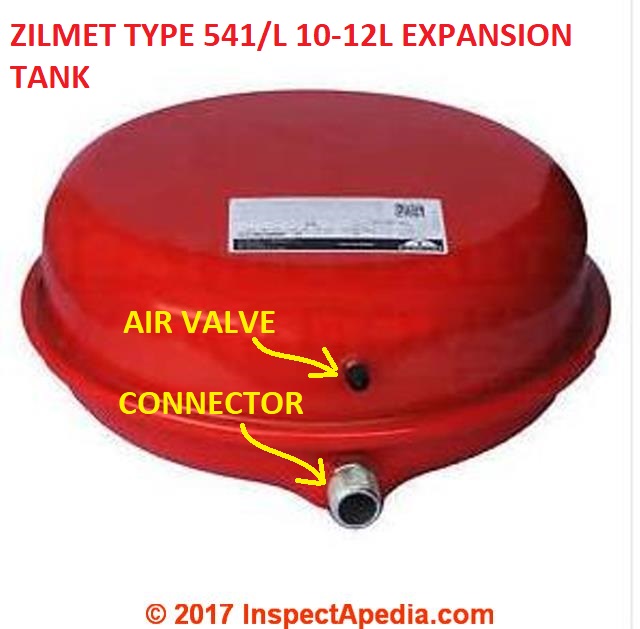
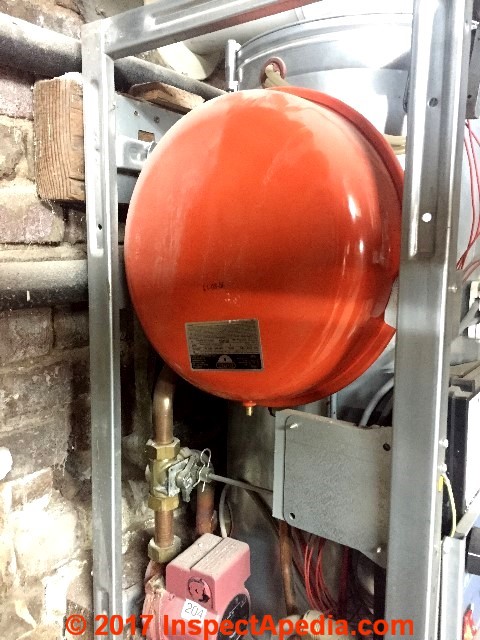
I'm looking more closely at the expansion tank - it is a Zilmet 10L tank, and according to this page, it should have an internal bladder.
(Fhere's no information about the type of tank it is in the manual)
I thought I'd check the pressure via the bicycle style air valve, but a bunch of water came out instead - perhaps the internal bladder has been punctured, and it's completely full of water?
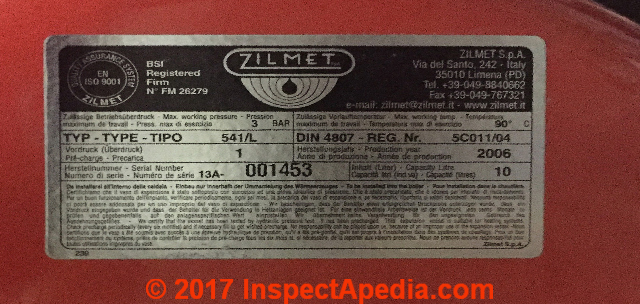
Photos: Zilmet Type 541/L OEM type expansion tank or expansion vessel (in the U.K.) and below, its data tag.
I also found some installation manuals for the complete line of Zilmet expansion tanks(although mine isn't listed), which says their tanks have a life span of about 5 years, and mine is closing on 10.
Reply: Evidence of Bladder Failure in a Zilmet OEM Type 541/L flat heating boiler expansion tank
If you can get me a photo of your actual tank as well as its label I'd like to research it.
If the tank uses an internal bladder
and if water came out of the air (adjustment) valve
then the bladder has burst and you've diagnosed what's probably the trouble with the TPR valve leaking.
Still there may be a second problem and a source of abnormal system pressures -
IF you see that when cold your boiler pressure is abnormally high
- say over 12-14 psi or if when the system is hot the pressure is at or over 30 psi.
 Watch out: Having confirmed that the tank uses an internal (butyl) bladder to keep water and air separated, that it uses an air valve to check tank pressure, and that you had water squirting out of your tank's air valve it's a reasonable conclusion that the tank's bladder has failed.
You will want to replace this tank.
The OEM description I found was from a UK vendor but they're sold also in the US. I found listings by searching for "Zilmet Type 541/L pressure tank"
I would fix this first, but you should also continue to investigate whether or not there are other defects causing abnormally high water pressure in your system by making simple observations of the system's pressure as I described.
Paraphrasing from the company's information and other sources:
This Zilmet Type 541/L (made in 2006, 5-year warranty) "flat" expansion tank tank has a maximum working pressure of 3 bar (about 43 psi) so if it has been exposed to higher pressures that could have contributed to a failure.
This Zilmet product is specifically made as an OEM used by heater manufacturers. I'll include the manual for your tank [PDF attached] and an image of the currently-sold version of your OEM tank
Tanks in this shape are selected for space-saving, perhaps here to fit into the boiler chassis for a wall-hung condensing boiler.
The Zilmet expansion tank models for which I reviewed information all use a butyl or synthetic SBR rubber internal bladder or membrane (replaceable in some models).
Your Zilmet 541/L is a 10L (or perhaps 12L) model is rated for a maximum pressure of 3 bar (14.5 psi) maximum pressure and comes with a1-bar factory air pre-charge.
Some Zilmet expansion vessel models handle up to 150psi and 210F, and have a factory air pre-charge of 40 psi but your tank is a different model not described exactly in that literature. One can find some literature about the Zilmet 541/L from UK vendors.
- ZILMET USA Corp. , 400 Frenchtown Rd. | East Greenwich, RI 02818 USA Tel. 401-884-4943 | Fax 401-287-4951 (p) 401 884 4943 Website: http://zilmetusa.com/ Email: info@zilmetusa.com
- ZILMET TYPE 541/L EXPANSION VESSEL SPECIFICATIONS [image file]
- ZILMET OEM PRO INSTALLATION & OPERATION MANUAL [PDF] (2012) covers the flat red expansion tank discussed in this article
- ZILMET USA EXPANSION TANK INSTALLATION & OPERATION MANUAL [PDF] (2016)
- ZILMET FLAT HYDRONIC WALL HUNG EXPANSION TANKS PRODUCT LITERATURE [PDF] (2015)

Watch out: notice that the factory air pre-charge is 1 bar - or 14.5 psi.
So on your system the tank will start accepting water (from the closed hydronic system) when that system pressure exceeds 14.5 psi and will work correctly up to about 45 psi. which is above where the TPR valve should dump.
...
...
...
Continue reading at RELIEF VALVE LEAKS or select a topic from the closely-related articles below, or see the complete ARTICLE INDEX.
Or see RELIEF VALVE LEAK FAQs questions & answers posted on this topic.
Or see these
Recommended Articles
- EXPANSION TANK WATERLOGGED, RELIEF VALVE LEAKS
- HOT WATER EXPANSION TANKS
- RELIEF VALVES - TP VALVES - home
- RELIEF VALVE DISCHARGE TUBE
- RELIEF VALVE LEAKS
- RELIEF VALVE LEAK DUE TO EXPANSION TANK
- RELIEF VALVE, TP VALVE, BOILER
- RELIEF VALVE, TP VALVE, STEAM BOILER
- RELIEF VALVE, TP VALVE TEST
- RELIEF VALVE, WATER HEATER
- RELIEF VALVE, WATER TANK
- TUNDISH used in PLUMBING
- WATER HEATER PRESSURE-ONLY RELIEF VALVES
- THERMAL EXPANSION of HOT WATER
- WATER HEATER LEAK REPAIR
Suggested citation for this web page
RELIEF VALVE LEAK DUE TO EXPANSION TANK at InspectApedia.com - online encyclopedia of building & environmental inspection, testing, diagnosis, repair, & problem prevention advice.
Or see this
INDEX to RELATED ARTICLES: ARTICLE INDEX to T&P RELIEF VALVES
Or use the SEARCH BOX found below to Ask a Question or Search InspectApedia
Or see
INDEX to RELATED ARTICLES: ARTICLE INDEX to PLUMBING SYSTEMS
Or use the SEARCH BOX found below to Ask a Question or Search InspectApedia
Ask a Question or Search InspectApedia
Share this article:Try the search box just below, or if you prefer, post a question or comment in the Comments box below and we will respond promptly.
Search the InspectApedia website
Note: appearance of your Comment below may be delayed: if your comment contains an image, photograph, web link, or text that looks to the software as if it might be a web link, your posting will appear after it has been approved by a moderator. Apologies for the delay.
Only one image can be added per comment but you can post as many comments, and therefore images, as you like.
You will not receive a notification when a response to your question has been posted.
Please bookmark this page to make it easy for you to check back for our response.
IF above you see "Comment Form is loading comments..." then COMMENT BOX - countable.ca / bawkbox.com IS NOT WORKING.
In any case you are welcome to send an email directly to us at InspectApedia.com at editor@inspectApedia.com
We'll reply to you directly. Please help us help you by noting, in your email, the URL of the InspectApedia page where you wanted to comment.
Citations & References
In addition to any citations in the article above, a full list is available on request.
- In addition to citations & references found in this article, see the research citations given at the end of the related articles found at our suggested
CONTINUE READING or RECOMMENDED ARTICLES.
- Carson, Dunlop & Associates Ltd., 120 Carlton Street Suite 407, Toronto ON M5A 4K2. Tel: (416) 964-9415 1-800-268-7070 Email: info@carsondunlop.com. Alan Carson is a past president of ASHI, the American Society of Home Inspectors.
Thanks to Alan Carson and Bob Dunlop, for permission for InspectAPedia to use text excerpts from The HOME REFERENCE BOOK - the Encyclopedia of Homes and to use illustrations from The ILLUSTRATED HOME .
Carson Dunlop Associates provides extensive home inspection education and report writing material. In gratitude we provide links to tsome Carson Dunlop Associates products and services.
 |
HOME | ABOUT | ASK a QUESTION | CONTACT | CONTENT USE POLICY | DESCRIPTION | POLICIES | PRIVACY | |
| © 2026 - 1985 Publisher InspectApedia.com - Daniel Friedman | |||||||||