 Hydronic Loop on Steam Heat Boilers
What is a hydronic loop on a steam boiler
Hydronic loop to heat a separate hot water heating zone
Hydronic loop to heat domestic hot water - indirect water heater
Hydronic loop to add hot water radiator to steam heat system
- POST a QUESTION or COMMENT about this article topic
This article discusses hydronic heating loops (forced hot water) on steam boilers.
While steam boilers normally heat a building by sending steam up through steam pipes to steam radiators that emit heat into the occupied space.
Condensate returns from those radiators to the steam boiler. But a steam boiler can also be used to circulate hot boiler water through a loop of pipe that in turn may be used to heat a lower building heating zone or to heat domestic hot water in an indirect water heater.
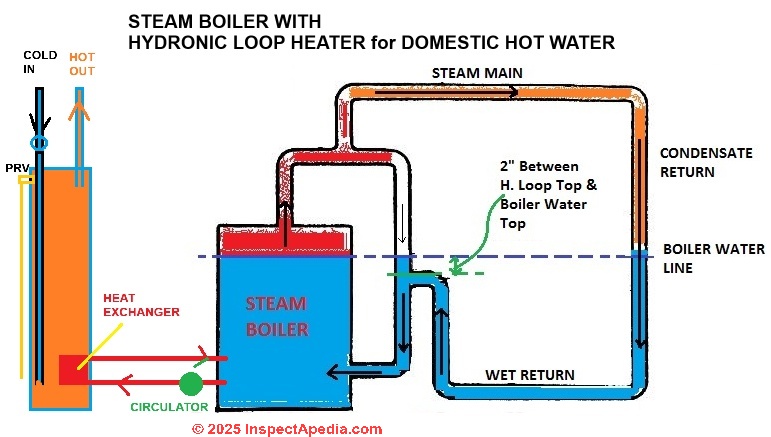
Page top sketch is our adaptation of an old ITT drawing to which we added color and an indirect water heater and a hydronic loop used to produce domestic hot water (for washing and bathing).
InspectAPedia tolerates no conflicts of interest. We have no relationship with advertisers, products, or services discussed at this website.
- Daniel Friedman, Publisher/Editor/Author - See WHO ARE WE?
Steam Boiler Hydronic Loop Uses & Troubleshooting
Where a hydronic loop (hot water loop) is included in a steam heating system, a seperate or secondary loop of pipe is run from the steam boiler to provide either hot water heat, usually in a lower or basement level area of the building, or to provide heat to an indirect water heater to produce domestic hot water for washing and bathing.
The primary piping loop provides heat to most of the building. The secondary or hydronic loop is connected to the steam boiler below the water level in the boiler and is circulated by a circulator pump or (rarely) by convection or "gravity". Where the hydronic loop is used to make domestic hot water, the boiler water is circulated through a heat exchanging coil inside the indirect water heater tank.
Responding to reader questions we discuss applications of a hydronic or forced hot water piping loops on a steam heat system and and we describe troubleshooting hydronic heating loop troubles.
Article Contents
- HOT WATER HEAT ZONE LOOP on STEAM BOILER, ATTIC EXPANSION TANK - why is there a hot water expansion tank in the attic of a home served by steam heat?
- HOT WATER HEATER via HYDRONIC LOOP on STEAM BOILER - troubleshooting
- HOT WATER RADIATOR via HYDRONIC LOOP on STEAM HEAT SYSTEM
- WATER HAMMER on HYDRONIC HEATING LOOP SYSTEM - noise complaint
Watch out: when piping hot water off of a steam boiler for any purpose, proper provision of temperature control and relief valves is critical as a steam boiler is producing water at its boiling point or 212°F at sea level!
Piping a hydronic or "hot water" zone off of a steam boiler will require, in addition to the piping loop, a circulator pump, possibly a heat exchanger, possibly one or more zone circulators or zone valves, a flow control valve, possibly one or more air bleeder controls on the hot water system, an expansion tank, and possibly system drains or purge valves.
...
Hydronic (hot water) Heating Loops on Steam Heating Systems
Boiler Expansion Tank or "Header Tank" + Sight Glass on a Steam Heating System?
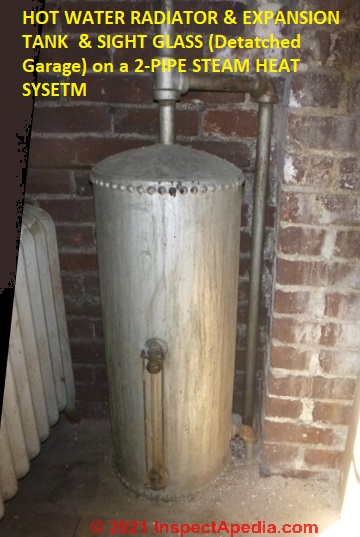
Why do we find this expansion tank and sight glass connected to a steam heating system?
The galvanized steel expansion tank, complete with sight glass, appeared in the 1920 National Boilers & Radiators catalog that we cite below.
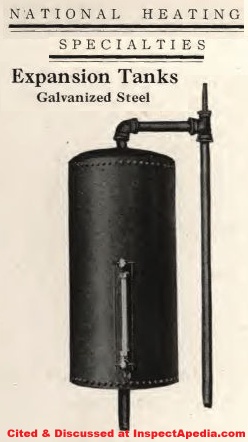
Excerpt from the catalog p. 76: These tanks are made of refined boiler steel, double-riveted, caulked and galvanized, and tested to 150 pounds pressure.
They are tapped top and bottom for 1-inch overflow and expansion pipe, and on the side near the top; 1 inch for filling attachment. They are also tapped on side for 1/2-inch water gauge brasses.
The expansion tank was sold in capacities ranging from 8 to 100 gallons at a cost (in 1920) of $7.50 to $51.00.
NATIONAL BOILERS & RADIATORS CATALOG [PDF] (1920) (Archived copy at the Internet Archive, free PDF download) - National Radiator Company Catalog No. 26 - local backup copy saved as National-Radiator-Co-Catalog-26.pdf (1920) and we also have a backup of a later National-Radiator-Co-Catalog-35.pdf (1926).
The mystery is easily explained by noting that some steam heating systems, including the Weil McLain gas fired steam boiler below, are also used to provide hot water or hydronic heat to some building areas or even to a separate outbuilding where it is easier to circulate hot water than to route and control steam piping.
Why the sight glass on this expansion tank?
Because it's not just handling expansion; the tank's water level assures occupants that there is sufficient water reservoir in the system for the hydronic loop off of the steam boiler to actually provide heat.
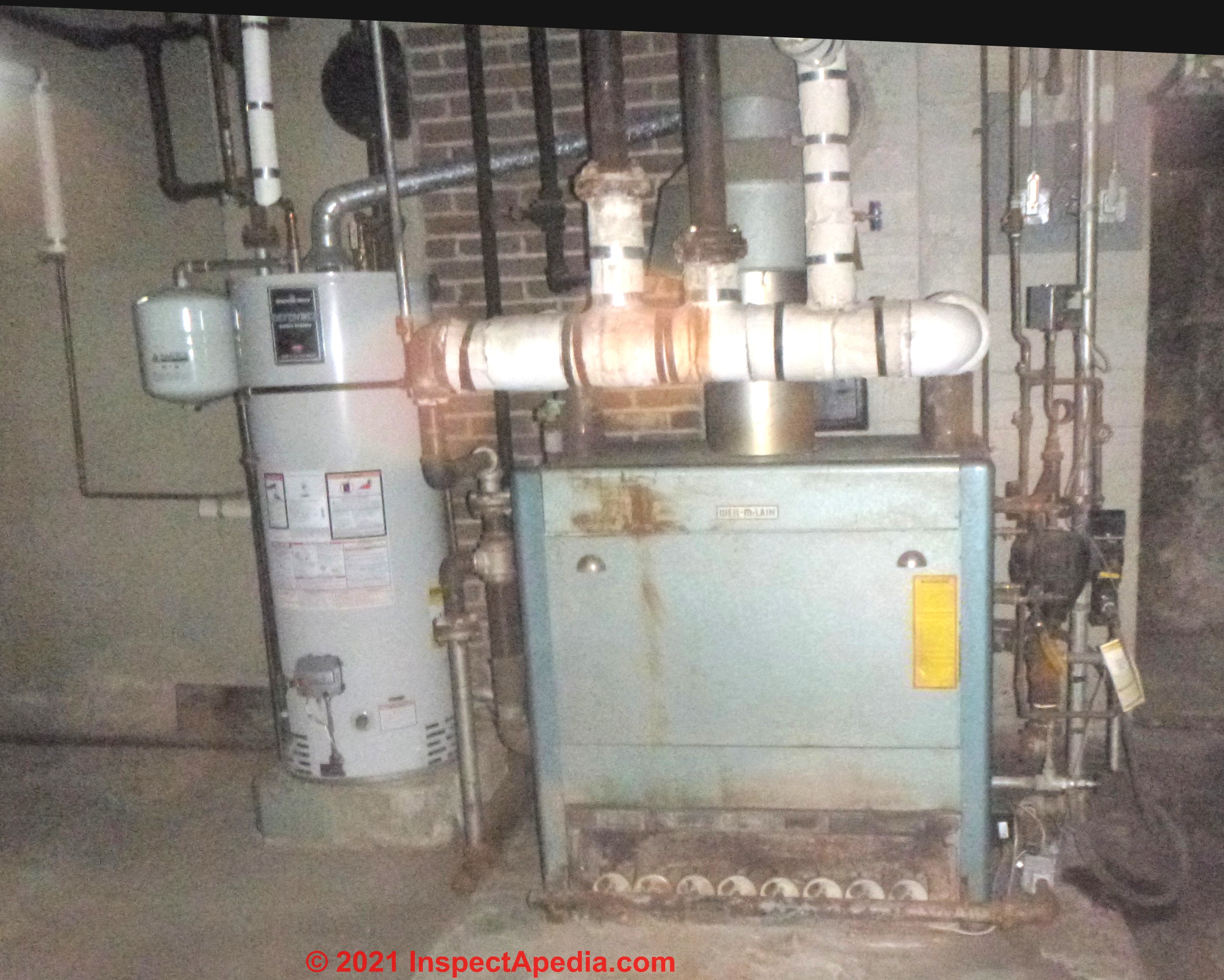
Typically a separate circuator pump and hot water piping loop are connected to the lower, wet portion of the steam boiler and are used to supply hot water to one or more hot water radiators or convectors elsewhere in the building or property.
Above is the Weil McLain gas fired two pipe steam heating system boiler whose hot water feeds a separate hot water radiator and expansion tank with sight glass located in a separate garage on the same property.
More about attic or open heating boiler expansion tanks is
at ATTIC & ANTIQUE EXPANSION or HEADER TANKS
More about steam heating systems can be found
at STEAM HEATING SYSTEMS & CONTROLS - home
- Lawrence Transue is a Pennsylvania building scientist and consultant, a certified ASHI home inspector, a Licensed Pesticide Applicator, a
BPI Building Analyst & Envelope Professional, with
18 Years of Home Inspection Experience. He can be reached by Telephone: 610.417.0763, by Email: lawrence@lawrencetransue.com as well as at his WEBSITE and at FACEBOOK.
Mr. Transue is a frequent contributor to InspectAPedia.com.
...
Hot Water Radiators Added to Steam Heating System
Can I add a radiator on the steam condensate return line?
I have a one pipe steam system. I would like to know if I can hookup a radiator to a return line. It’s in the laundry room. The main steam line runs just below the ceiling of the laundry room and runs to another room one level higher than the laundry room. The laundry room is next to the garage.
Located in the wall between the laundry room and garage is a pipe which connects the ceiling steam line with the return line that runs in the floor of the laundry room which then heads to the basement.
I had the floor of the laundry room open so I replaced the return line in the floor put in a tee so I could put in a short piece of black pipe and a valve which would connect to a radiator.
The return would continue on under the laundry room floor and reach the basement. when the return reaches the basement there is a ninety degree elbow and a drop of about two feet and then the return line runs along the perimeter of the basement dropping about another two feet until it enters the boiler.
I placed a varivent on the side opposite the valve, about midlevel.
The radiator is sloped back to the valve. When I ran the heat after a few minutes, water started pouring out of the varivent air valve. I thought that steam also runs in the returns in addition to condensate and I would be able to get some steam out of the return line into the radiator.
Is the problem that the radiator is filling up with condensate water from the return. Or is there a problem with the varivent air vent.
Could i just put a 1/8 plug instead of the varivent and get some heat out of the radiator from the hot condensate or would the air in the radiator prevent this as the air would have no place to go. Is there a work around to this so I could get some heat in the laundry room from the return line in the floor On 2018-08-21 by david
by (mod) - yes if properly-piped
There are also steam boiler heating systems that also provide hydronic heat to a lower floor by adding a circulator pump and separately piped hot water zone loop. You'll also need tne necessary controls.
Why not ask your heating company to make an estimate of both methods?...
...
Troubleshoot a Weil McLain Steam Boiler with Hydronic Heating Loop
Why does my steam boiler refuse to turn on when there's a call for steam heat or for the hydronic loop to make hot water?
I am a handy residential homeowner with mixed heating system, part steam, part recirculating hot water.
I have a Weil McLean boiler which provides the steam and heats the recirculating hot water via a heat exchanger.
A few weeks ago the system was serviced because the water temperature in the recirculating system was quite tepid.
They found an expansion tank had failed (full of water) and they replaced the expansion tank, 2 air vents, pressure/temperature gauge (on the hot water system), hot water relief valve, and our horizontal heat exchanger.
Recirculating hot water heat was dramatically improved. To my knowledge all their changes were in the hot water section, not the boiler itself.
But at least twice since, the furnace refused to fire up when calling for steam or recirculating hot water and the house began cooling down.
The venting blower was operating and normally and water cut off light was illuminated green as normal. I have a relatively new thermocoupler and the pilot was on, and the water was not low.
I tried turning the system off and on, but nothing worked. I did notice one odd thing.
Our smart thermostat which controls the steam heat indicated it was disconnected from the internet, which Almost certainly means it was not getting power from the system and was operating on battery.
The house cooled considerably (outside temp in the 20s) in the evening, but sometime during the night the furnace came back on.
And this morning I noticed the thermostat was connected to the internet again. Looking at the wiring diagram and reading your very helpful site, I suspected I might have a steam pressure/pressure switch problem.
To my amazement the pressure valve on the boiler was registered between 7 and 10 psi when the system was heating, and the shutoff seemed to be set to 7.5 psi.
This seemed crazy high, but it was still operating when the pressure was reading 10 psi level.
When I turned down the thermostats, the pressure settled back down to less than 1 psi. Any advice would be most welcome. On 2022-03-14 by David Ellwood
by Inspectapedia Com Moderator - Weil McLean boiler controls
@David Ellwood,
Thanks that's an interesting, helpful and also confusing steam boiler controls question.
Occam's razor advice says we ought to choose the one simplest explanation and not look for multiple causes or coincidences.
But I hear at least two odd snafus.
1. your thermostat not connected to wiFi would mean it needs to be attended: re-connected, re-initialized, or a similar procedure,
and while at it, if it's really not getting power then the low voltage transformer that supplies the thermostat (and often also some boiler controls) may be disconnected or have failed.
So start by confirming that the thermostat is getting 24VAC and if not work backwards to find and fix the transformer or wiring to it.
2. A residential steam boiler, as you know, operates at very low pressure, often around 0.5 psi. IF we see pressure has been pushed to a higher number that usually means a service tech is not a steam expert and has tried to solve a steam flow problem by increasing pressure.
Usually the hydronic loop simply circulates actual hot water out of the boiler's lower section that will always have hot water therein.
3. Or there is some arrangement of your hydronic heating system and a heat exchanger whose design and operation is unclear to me sitting so far away and with just a shred of information about your set-up.by David Ellwood
@Inspectapedia Com Moderator,
Thanks so much for your quick reply! I agree it seems like pressure is the problem.How is pressure adjusted on a boiler? Is it simply by adjusting the setting on the pressure switch?
The current maximum is shown as 7.5 psi. I could easily reduce that setting.
Do I really need to call a technician for that? Or is it likely the switch and or gauge are defective?
BTW: Smart thermostats require a c wire and are run off the power to the furnace. If the power fails for any reason, they stay on battery power and disconnect from WiFi. When the power returns, they reconnect automatically.Since the thermostat went off line at the same time as the furnace, and it was back on line when the furnace was back, I would say the most likely explanation is that whatever tripped the furnace (my theory is the pressure switch) also cut power to the thermostat.
Since the thermostat is shown on most wiring diagrams as connected directly into the pressure switch, that led me to suspect the pressure switch was tripped. And then I saw the high pressure reading and sent you the note.
Thanks again,
David
It sounds like the problem is likely to be excess pressure so I will seek out someone to fix the problem. Thanks again for your help.by Inspectapedia Com Moderator - checking the setting on the pressure switch
@David Ellwood,
Start by checking the setting on the pressure switch itself - and compare that with the pressure setting specified in the manual for your specific steam boiler brand and model.
If you don't have the IO manual we may have a copy.
...
Noise Complaint - Steam Heat with Hydronic Heating Loop
We get hot water hammer when hot water runs through our upstairs extension baseboards - hydronic loop on steam heat system
I have a steam/hot water heating system. Originally the system was all steam, than added upstairs extension to house that is running gravity feed water from the boiler. So I'm running steam in one section and water in the other section from the same boiler.
When hot water starts to run through the extension, it hammers through most of the pipes, but I do get heat. Question; is it air or cold water sitting in the pipes and how do I fix it? (Feb 19, 2015) Bill
Reply:
I'm not sure, Bill, but typically banging pipes in a steam system is traces to a condensate return blockage or a clogged steam trap.
See BANGING HEATING PIPES RADIATORS for more detailed help.
Research & References for Hydronic & Steam Boilers
Hydronic loop applications on steam systems
- Arena, L., and Omari Faakye. Optimizing hydronic system performance in residential applications. [PDF] (at US DOE) No. DOE/GO-102013-4108. National Renewable Energy Lab.(NREL), Golden, CO (United States), 2013. - local copy saved as Hydronic-Heat-Performance-Arena.pdf
Even though new homes constructed with hydronic heat comprise only 3% of the market (US Census Bureau 2009), of the 115 million existing homes in the United States, almost 14 million of those homes (11%) are heated with steam or hot water systems according to 2009 US Census data.
Therefore, improvements in hydronic system performance could result in significant energy savings in the US. When operating properly, the combination of a gas-fired condensing boiler with baseboard convectors and an indirect water heater is a viable option for high-efficiency residential space heating in cold climates.
Based on previous research efforts, however, it is apparent that these types of systems are typically not designed and installed to achieve maximum efficiency.
Furthermore, guidance on proper design and commissioning for heating contractors and energy consultants is hard to find and is not comprehensive.
Through modeling and monitoring, CARB sought to determine the optimal combination(s) of components - pumps, high efficiency heat sources, plumbing configurations and controls - that result in the highest overall efficiency for a hydronic system when baseboard convectors are used as the heat emitter.
The impact of variable-speed pumps on energy use and system performance was also investigated along with the effects of various control strategies and the introduction of thermal mass. - Butcher, Thomas A. Performance of Integrated Hydronic Heating Systems [PDF] (at NORA), No. BNL-79814-2008-IR. Brookhaven National Lab.(BNL), Upton, NY (United States), 2007. - local backup copy saved as Integrated-Hydronic-Heat-Performance-Butcher.pdf
Abstract:
A variety of system configurations are used in North America to meet the heating and domestic hot water needs of single-family homes.
This includes, for example: warm air furnaces with electric water heaters; boilers with integrated hot water coils; and boilers with “indirect” hot water storage tanks. Integrated hydronic systems which provide both heat and hot water are more popular only in the Northeast and mid-Atlantic regions.
For those making decisions about configurations of these integrated hydronic systems, including control options, little information is available concerning the annual energy cost implications of these decisions.
This report presents results of a project to use a direct load emulation approach to measure the performance of hydronic systems, develop performance curves, and to provide decision tools to consumers. This is a laboratory measurement system involving direct energy input and output measurements under different load patterns.
These results are then used to develop performance correlations for specific systems that can be used to predict energy use in specific applications.
A wide range of system types have been tested under this project including conventional boilers with “tankless” internal coils for domestic hot water production, boilers with indirect external storage tanks, tank type water heaters which may also be used for space heating, condensing oil- and gas-fired systems, and systems with custom control features.
It is shown that low load and idle energy losses can have a very large impact on the total annual energy use and that the potential energy savings associated with replacing old equipment with newer, high efficiency equipment with low losses at idle or low load can be in the 25% range.
These savings are larger than simple combustion efficiency measurements would indicate. - BC, Skilled Trades. "B-4.1 Hydronic Distribution System Components." Block B: Heating & Cooling Systems (2025).
- Deghal Cheridi, Amina Lyria, Ahcene Loubar, Amel Dadda, and Abdallah Bouam. "Modeling and simulation of a natural circulation water-tube steam boiler [PDF] (at Springer Nature Link) SN Applied Sciences 1, no. 11 (2019): 1405. - local backup copy saved as Steam-Boiler-Study-Deghal.pdf
Abstract excerpt:
In the present work, the overall behavior of a steam boiler is investigated using RELAP5/MOD3.2 system code at three different operating loads. Main thermal–hydraulic parameters are analyzed at steady-states corresponding to 60%, 100% and 110% of the boiler nominal load.
RELAP5 system code is widely used in the design and safety analysis of nuclear reactor installations as well as for conventional facilities in recent years.
The steam boiler studied herein is a water-tube natural circulation type used in a natural gas liquefaction complex for superheated steam production purposes. - Harris, Warren Skinner. MODERNIZATION of HYDRONIC [HEATING] SYSTEMS [PDF] (1976) Technical Note. no. 13, Small Homes Council-Building Research Council, University of Illinois at Urbana Champaign
This publication offers a clear explanation of types of steam and hot water heating systems, including gravity vs. forced hot water circulation, one pipe vs two pipe steam heating systems, dry return vs wet return steam systems, and for hot water heat, single loop vs. series-loop two circuit systems. The writers also discuss replacing radiators with heating baseboard and the plumbing changes required.
Excerpt: The seasonal energy consumption of most old land 2-pipe residential steam heating systems can be reduced by as much as 10% by converting the system to a modem forced-circulation, hot-water system.
In this publication, guidelines will be presented for modernization of hydronic heating systems. The conversion of old steam and gravity hot-water systems to a modem two-pipe forced-circulation system requires an understanding of the originally installed system. - Holohan, Dan, How to run a Hot-Water Zone Off a Steam Boiler [Website] (2014). Dan Holohan is a widely-recognized expert on steam heating systems. - local backup copy saved as Hydronic-Loop-off-Steam-Boiler-Holohan.pdf
- Holohan, Dan, The Lost Art of Steam Heating, [Book for sale at Amazon], Dan Holohan, 516-579-3046 FAX
- Julia Keen, P. H. D. "Hydronics 101." ASHRAE Journal 57, no. 5 (2015): 62.
- Krajewski, Richard F., and John W. Andrews. Hydronic distribution systems for use with condensing boilers. No. BNL-51731. [PDF] (1983) (at OSTI) Brookhaven National Lab.(BNL), Upton, NY (United States). - Local backup copy saved as Hydronic-Distribution-Condensing-Boilers-Krajewski.pdf
Abstract: A survey of available hydronic distribution equipment was carried out with the objective of determining how such systems might best be mated to condensing boilers for building space heating.
The major problem is that to support condensing of water vapor in the flue gases and thereby maximize efficiency, the return water temperatufe must be in the vicinity of 100°F, whereas conventional hydronic systems are designed for return water temperatures above 150°F.
Six generic system configurations were analyzed and compared with three noncondensing options. Means for saving additional energy through zoning played a significiant part in the analysis.
Excerpt: In the area of new construction and the refit of certain single-loop systems there appears to be an opportunity to take advantage of the thermal properties of a hydronic baseboard system operating under low-flow conditions, because such a system releases about 67% of its heat in its first half.
With careful isolation of two parts of a building, a zoning effect can be achieved with a single-loop system.
Additional flexibility can be incorporated into the system by using a flow reversal valving system.
The analysis of this type of system indicates that in buildings with a moderate heat loss of about 600 Btu/°F-hr this kind of system could achieve about 70% of the savings effect that a two loop zoned system could achieve. - Patterson Kelly, Commercial Boiler Piping Diagrams [PDF] Patterson-Kelley, LLC 155 Burson St, East Stroudsburg, PA 18301 -USA - includes piping diagrams for steam heat combined with local hot water or hydronic loops for hydronic heating or for heating or pre-heating domestic hot water - local copy saved as Boiler-Piping-Diagram-PattersonKelly.pdf
- Peerless Boiler Company, The Color of Water: Piping & Designing Hydronic systems [PDF] (2008) (at Peerless) Peerless Boilers (PH Heat), 131 S. Church St., Bally PA 19503, USA. Peerless is owned by Burnham Holdings. - local backup copy saved as Hydronic-Piping-Peerless.pdf
...
...
Continue reading at STEAM HEATING SYSTEMS & CONTROLS - home, or select a topic from the closely-related articles below, or see the complete ARTICLE INDEX.
Or see these
Recommended Articles
- AIRBOUND HEAT SYSTEM REPAIR by WATER FEED VALVE
- BANGING HEATING PIPES RADIATORS
- CONVECTOR HEATERS - HYDRONIC COILS
- HOT WATER EXPANSION TANKS - for water heaters, domestic hot water supply
- EXPANSION TANKS, BOILERS - home
- HARTFORD LOOP
- HYDRONIC HEATING RADIATOR REPAIR - cold hot water heat radiator
- HYDRONIC HEATING SYSTEMS - home hot water / hydronic heating boilers & systems
- INDIRECT FIRED WATER HEATERS - hot water tank heated by the building heating boiler
- NO HEAT - BOILER
- RADIANT HEAT - home - also use hydronic heating loops
- STEAM BOILER PRESSURE - home steam heating boilers & systems
- STEAM BOILER FLOODING / SURGING REPAIR
- STEAM HEAT RADIATOR REPAIR
- STEAM HEATING SYSTEMS & CONTROLS - home
- WATER HAMMER NOISE DIAGNOSE & CURE
- WATER HEATERS - hot water tanks, sources of hot water in buildings, equipment installation, troubleshooting, repair.
Suggested citation for this web page
HYDRONIC HEAT LOOPS on STEAM HEATING SYSTEMS at InspectApedia.com - online encyclopedia of building & environmental inspection, testing, diagnosis, repair, & problem prevention advice.
Or see this
INDEX to RELATED ARTICLES: ARTICLE INDEX to STEAM BOILERS
Or use the SEARCH BOX found below to Ask a Question or Search InspectApedia
Ask a Question or Search InspectApedia
Share this article:Try the search box just below, or if you prefer, post a question or comment in the Comments box below and we will respond promptly.
Search the InspectApedia website
Note: appearance of your Comment below may be delayed: if your comment contains an image, photograph, web link, or text that looks to the software as if it might be a web link, your posting will appear after it has been approved by a moderator. Apologies for the delay.
Only one image can be added per comment but you can post as many comments, and therefore images, as you like.
You will not receive a notification when a response to your question has been posted.
Please bookmark this page to make it easy for you to check back for our response.
IF above you see "Comment Form is loading comments..." then COMMENT BOX - countable.ca / bawkbox.com IS NOT WORKING.
In any case you are welcome to send an email directly to us at InspectApedia.com at editor@inspectApedia.com
We'll reply to you directly. Please help us help you by noting, in your email, the URL of the InspectApedia page where you wanted to comment.
Citations & References
In addition to any citations in the article above, a full list is available on request.
- In addition to citations & references found in this article, see the research citations given at the end of the related articles found at our suggested
CONTINUE READING or RECOMMENDED ARTICLES.
- Carson, Dunlop & Associates Ltd., 120 Carlton Street Suite 407, Toronto ON M5A 4K2. Tel: (416) 964-9415 1-800-268-7070 Email: info@carsondunlop.com. Alan Carson is a past president of ASHI, the American Society of Home Inspectors.
Thanks to Alan Carson and Bob Dunlop, for permission for InspectAPedia to use text excerpts from The HOME REFERENCE BOOK - the Encyclopedia of Homes and to use illustrations from The ILLUSTRATED HOME .
Carson Dunlop Associates provides extensive home inspection education and report writing material. In gratitude we provide links to tsome Carson Dunlop Associates products and services.
 |
HOME | ABOUT | ASK a QUESTION | CONTACT | CONTENT USE POLICY | DESCRIPTION | POLICIES | PRIVACY | |
| © 2026 - 1985 Publisher InspectApedia.com - Daniel Friedman | |||||||||