 Oil Burner Nozzle FAQs
- POST a QUESTION or COMMENT about this article topic
This article answers selection or troubleshooting questions about oil burner nozzles.
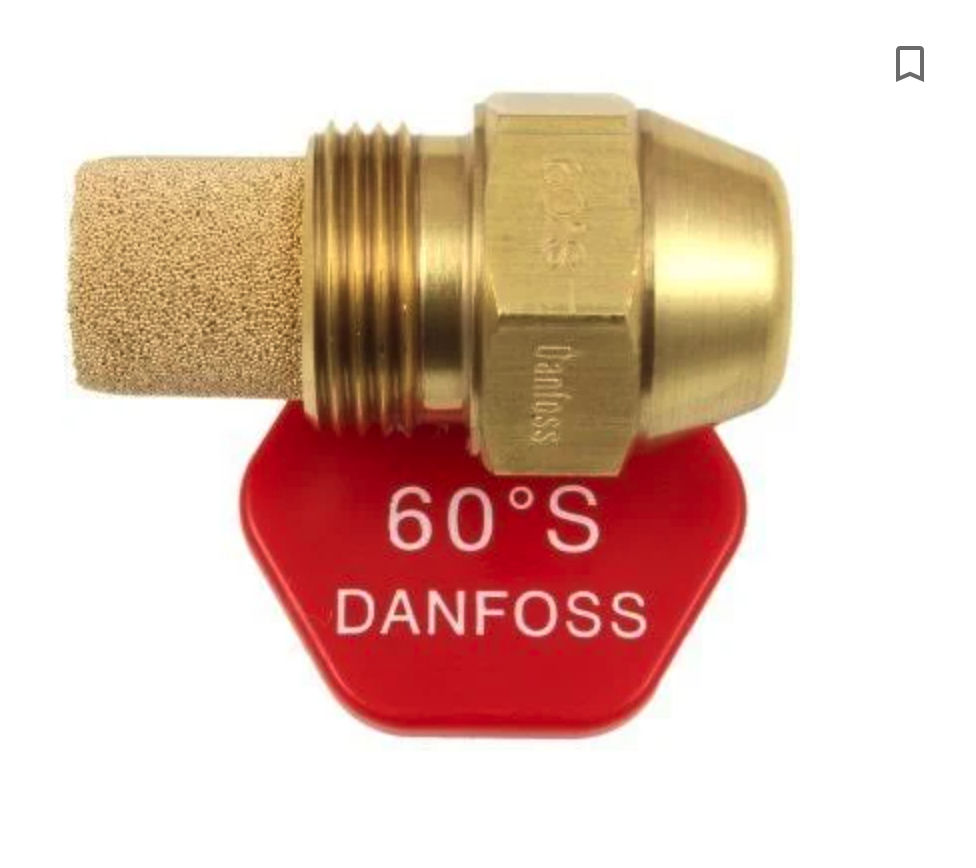
Page top photo: a Danfoss oil burner nozzle whose container cap shows that this is a 60 degree angle solid cone nozzle. The nozzle's firing rate in GPH isn't shown in the photo but will also be embossed on the brass nozzle head.
InspectAPedia tolerates no conflicts of interest. We have no relationship with advertisers, products, or services discussed at this website.
- Daniel Friedman, Publisher/Editor/Author - See WHO ARE WE?
Oil Burner Nozzle Selection, Troubleshooting, Installation Q&A
 These questions & answers about oil burner nozzles were poste originally at OIL BURNER NOZZLE GUIDE - topic home, - be sure to review the guidance given on that page.
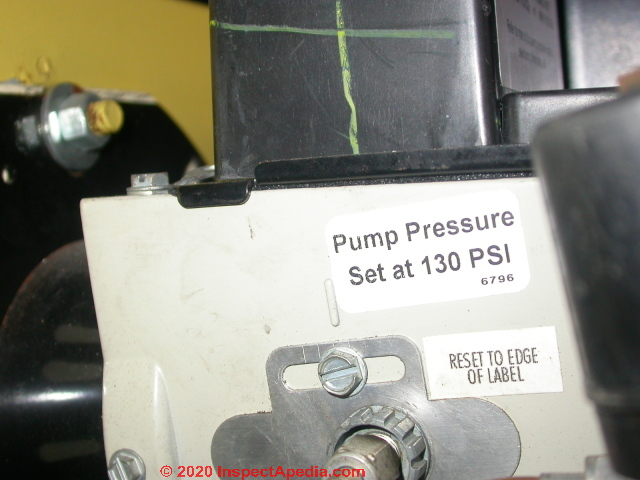
Photo: note that on this oil burner the manufacturer has included a sticker indicating that the oil burner's fuel unit should be adjusted to deliver 130 psi to the nozzle. If the pressure is not close to the recommended setting the oil burner may not work properly.
Below is our index to questions & answers about oil burner nozzle selection, installation, troubleshooting & replacement.
Article Contents
- OIL BURNER DIAGNOSTIC FAQs - index to all oil burner diagnosis and repair Q&A
- OIL BURNER FLAME DEFECTS - askew, impinging, too far off nozzle, etc.
- OIL BURNER NOZZLE CODE FAQs - what do the letters & numbers mean on the oil burner nozzle?
- OIL BURNER NOZZLE LEAK FAQs - bad flame & may flood the combustion chamber
- OIL BURNER NOZZLE PATTERN FAQs
- OIL BURNER NOZZLE SIZE FAQs
- OIL BURNER NOZZLE SPRAY ANGLE FAQs
- OIL BURNER OIL LEAKS - Other oil leaks at or near the oil burner
- OIL BURNER SOOTING FAQs - burner is producing soot or has a smoky, sooty flame
We're sorting out these reader Q&A and will re-post all of these pages soon.
Meanwhile use the on page search feature of your browser if you don't want to wade through the page. - DF
...
Oil Burner Nozzle Leak FAQs
Tip: See OIL BURNER RUMBLING AFTER WORKING ON THE SYSTEM - changed a nozzle, adjusted the burner, new parts? Or is it a new high speed burner?
After I "Fixed" my oil burner there's an oil leak and a flame around the nozzle
I have a Weil-Mclain's furnace with a Beckett gun on it. I changed the tip and filter on it.
There is a strong oil smell coming from the furnace it. When it is done from a firing cycle there is a small flame around the nozzle.
Plus there is excess oil coming out the bottom of the chamber door.
I have been doing the service work on my furnace for years an never had this problem before. Any help would be appreciated On 2015-03-29 by Tony
by (mod) - turn the furnace off right away!
Watch out: Tony you need to shut the system off now. What you describe sounds like an oil leak, maybe at the nozzle adapter. The risk includes a puffback explosion.
As a novice service tech on oil heat I once over-tightened the nozzle into the brass nozzle adapter, stripping threads and causing just the problem you describe.
Other oil line piping leaks are discussed at
and at OIL LINE PIPING LEAK CAUSES
Be sure to see the heating oil leak diagnostic and repair tips given in those articles.
Oil leaks at my oil burner nozzle and I think the flame is incomplete
Oil leaks back when running as if not getting total burn. On 2022-09-12 by Rod sassic
by InspectApedia-911 (mod) - over-tightened nozzle can strip threads on the nozzle adapter
@Rod sassic,
Leaks back where, from where? We need to inspect and find the leak point before we know which fittings to replace.
Watch out: an over-tightened nozzle can strip threads on the nozzle adapter or on the nozzle tube, causing oil leaks.Repeated nozzle changes followed by persistent oil burner flame problems point to a damaged nozzle adapter.
I've made that mistake - it's the sort of error that's painful enough that you remember not to do it again.
...
Other Oil Leaks at the Oil Burner
 Tip: See these diagnosis and repair articles for common oil leak points at the oil burner
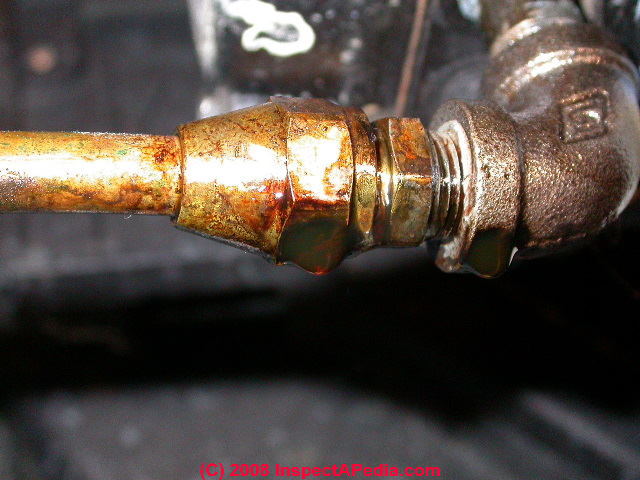
Photo: drips at the flare fitting on this oil line mean more than oil leaks out: it also means air leaks into the oil line when the oil burner is running, leading to improper oil burner operation and risking a puffback explosion.
Oil leak puddle at burner found after a service call
I had my oil burner cleaned by a professional company and oil supplier and afterwards I noticed oil piddling around my boiler, burner on floor.
I called the oil burner service company.
They returned and claim to fix it but to no avail hours later oil puddles due to leaking oil and heavy oil odor in hourse. What is causing this? This was not a problem before when I've had my system cleaned. On 2018-09-07 by Debbie
by (mod) - find source of oil puddles near oil burner
Debbie
Sorry but I can't diagnose the source of an oil leak from just your text.It could be that there was a spill during service or if the leak is continuing then there's probably a leaky or cross-threaded or damaged fitting in the oil piping, filter, or oil burner connections.
It should be easy to find by wiping everything clean and then seeing what gets wet with heating oil.
Watch out: in addition to the odor and need for oil spill cleanup, depending on the nature of the oil leak - if there is one at all - you risk loss of heat.
Call your heating service company and ask the service manager to send someone to clean up the spill and to check for leaks.
To be conversant with the issue,
see our OIL TANK LEAK & ODOR ADVICE
Some common oil leak examples around oil heating equipment include
Cause of oil in the oil burner tube
What causes oil to be in the burner tube . I ran the burner for 10 min. shut it down ,open up the transformer looked into the tube & its wet with oil.Wiped the tube dry repeated the run ,Wet again. (Jan 30, 2014) Anonymous
Reply:
Oil burner adjustment, nozzle adapter thread damage, dirty nozzle, incomplete combustion, sloppy oil burner start up or shut down, air leaks in or oil leaks out of the oil line are examples.
Oil puddles or leaks around the oil burner
I always find a puddle of oil around my oil burner.
What could be the problem? (Feb 8, 2014) Anonymous
Reply: Here's a list of common leak points that can leave a drip or puddle of oil near the oil burner
Anon, sounds like an oil leak. Leaks can occur inside the burner tube and drip out as well as anywhere in the fuel system .
- A leak at the oil nozzle poorly connected to the oil nozzle adapter,
- a dirty clogged oil burner nozzle making an improper spray of oil,
- a leaky nozzle adapter,
- leaks at either end of the oil burner nozzle feed tube inside the oil burner and
- leaks outside the oil burner tube at the high pressure line into the burner and,
- when the oil burner is not running (not creating suction on the oil supply piping) a loose fitting on the suction line at the fuel unit,
- at the oil filter, or
- at the oil safety valve
all can lead to oil drips found at or near the oil burner.
Watch out, a leak out can also Involve air leaks in, leading to poor operation, loss of heat, or even a puffback explosion. Other than the petty crime of shouting in all CAPS, there is probably an oil leak at a fitting on or near the oil burner.
Watch out: oil leaks cause improper and unsafe oil burner operation as air can be drawn into the piping system leading to sooting, clogs, and a dangerous puffback. Ask your oil heating service company to inspect, find and fix the leaks.
...
Oil Burner Nozzle Flame Defects
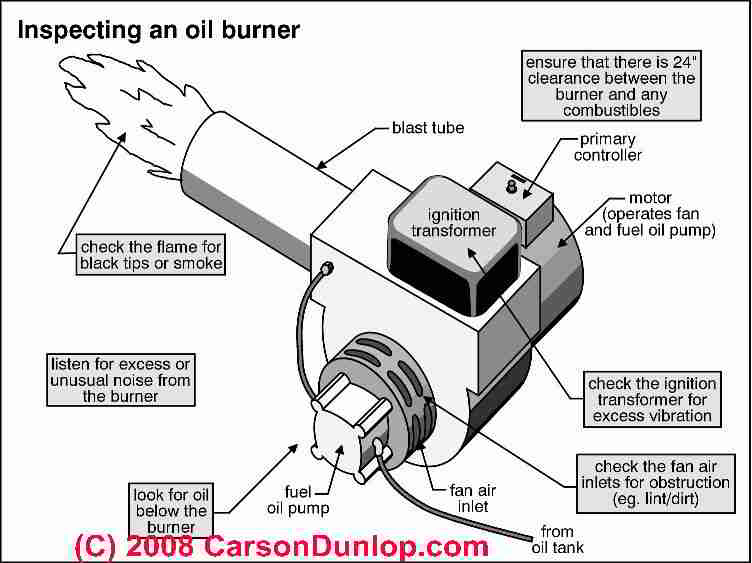 Tip: See OIL BURNER OPERATING TROUBLE - visual inspection of the oil burner flame is diagnostic
Also see OIL BURNER RUMBLING AFTER WORKING ON THE SYSTEM - changed a nozzle, adjusted the burner, new parts? Or is it a new high speed burner?
Oil burner nozzle sprays fuel and flame is far in front of the nozzle
The jet is still spraying fuel and the flame ignites a long distance in from the nozzle. The problem is that the flame does not stay going it pulses on and off and then trips out completely.
What could be the cause of this? On 2017-11-29 by Peter
by (mod) - oil burner is spraying fuel - turn it off immediately
Peter
Watch out: you describe a dangerously improper operating oil burner. Turn it OFF and leave it OFF while calling your oil company for service/repair.
Typical causes of the oil burner flame lifting too far off of the nozzle face:
- Dirty oil burner nozzle
- Displaced flame head turbulator
...
Oil Burner Nozzle Size FAQs
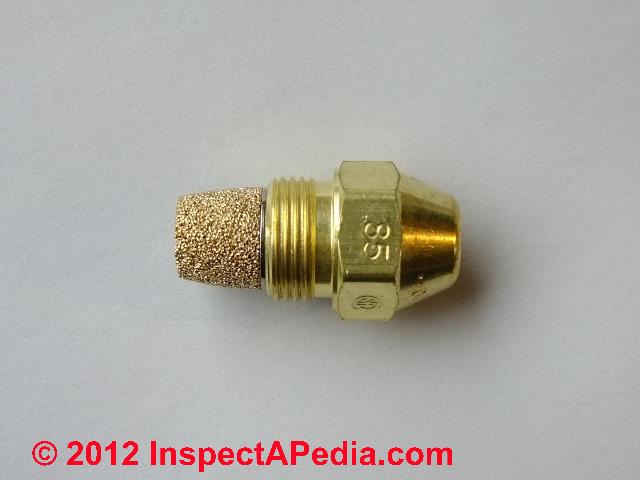 Tip: See CALCULATE THE PROPER NOZZLE FIRING RATE (SIZE) - four methods
Also see OIL BURNER NOZZLE FIRING RATE GPH
Photo: the firing rate of this nozzle is clearly stamped into one fo the facets of the nozzle head. This one is rated at 0.85 GPH. Note that usually the GPH rating assumes that the oil burner output high pressure is set to 100 psi.
If your oil burner is set to a higher output pressure the firing rate of the nozzle has to be recalculated - which we explain in the two articles cited just above.
Is it OK to drop my oil burner nozzle size from .75 to .65?
Can a 75 × 70A nozzle be replace with a 65 × 70A nozzle. What are pros/ cons? On 2020-11-11 by Claude
by (mod) - Yes, usually it's ok to downsize the oil burner nozzle - be sure you're getting enough heat
Claude,
I am assuming that the first number in your data 75 x 70A means 0.75 GPH firing rate, 70 degree angle, A-type (hollow cone pattern) nozzle.
Keep the nozzle type (A) and angle (70 Deg) in any case but you can change the nozzle firing rate or GPH.
Generally, yes. And your change is fairly modest so probably it'll be ok. Best would be to check the sticker or IO manual for your oil burner to see what firing range is recommended.
Going to a smaller nozzle, as long as you can keep up with the heat demand, will give a longer oil burner "on" cycle - which can help oil burner efficiency and so cut your oil bills a bit.
Going to a larger oil burner nozzle can be needed if the oil burner cannot keep up with the heating or hot water demand, again, provided you don't exceed the recommended size range in gph.
Watch out: but you want to stay within the manufacturer's recommended firing rate for both the oil burner and the combustion chamber design for your heater.
See OK TO CHANGE THE FIRING RATE - NOZZLE SIZE? for details, and
also take a look at OIL BURNER NOZZLE FIRING RATE GPH
Can I Calculate the BTU output of an oil burner from the nozzle size?
The BTU output of an oil burner at X psi is found by multiplying the nominal GPH output (140k btu/gal) by the square root of the actual burner psi, then dividing by 10. On 2024-01-09 by SAH
by InspectApedia DF (mod) - Not quite: what is the increase in BTUH when we increase the oil burner fuel unit pressure?
@SAH,
How interesting, thank you. Unfortunately your formula cannot be sued to get the BTU output from an oil burner.For example, simply changing the delivery pressure on the fuel unit will make enormous changes in the burner flame and heat or BTU output.
See OIL BURNER NOZZLE FIRING RATE GPH
where you will find a table titled: Oil Nozzle GPH Rate vs Oil Pressure Setting
that includes our data sources - from experts.
As an example, that table says that if we increase the fuel unit pressure from 100 psi to 120 psi, a 1 gph nozzle will increase its delivery rate to 1.10 gph.
That's the change in flow rate in gph. One would think that the BTU delivery would change proportionally, though a more sophisticated look at oil burner performance might suggest that that's not exactly the case. That's because for the same oil burner nozzle size, spray angle, spray pattern etc., upping the pressure tends to deliver oil in finer droplets.
Those smaller droplets might be expected to ignite more readily and possibly burn more completely, perhaps delivering a bit more BTUH.
So let's try your formula to sophisticate the answer to the question of what is the increase in BTUH when we increase the oil burner fuel unit pressure?
We don't get 100% of the btus out of no. 2 heating oil we get maybe 80% or more depending on burner tune and operating efficiency.
But let's look at your formula:
At 100 psi and 1 gph output we're getting 140K BTUh nominal output (before adjusting for burner efficiency or inefficiency).
If we change the "actual psi" from 100 to 120 and use your formula:
[Sqrt (120) ] / 10 = 10.95 gph
10.95 x 10 = 109.5 gph
This corresponds exactly to the table that we include above in this article - rounding up to 110 gph.
Now if you want to convert the firing rate in gph to BTUh, yes you can multiply the new gph number x 140 (kbtus per gallon)
but as I warned above, that's theoretical, nowhere near actual.
If you want to know what the oil burner is actually delivering in BTUh or btus per hour you must know the burner's efficiency rate - how many BTUs are being delivered into the building as heat vs how many are going up the chimney as exhaust.
And as I've noted, at higher pressure the burner's efficiency improves. So it's not exactly linear and our calculation is theoretical, not actual.
Thank you for the discussion.Also read CALCULATE THE PROPER NOZZLE FIRING RATE (SIZE) - four methods
Oil nozzle 3.5 gph 45 H for Carlin burner on a maple syrup evaporator is too hot
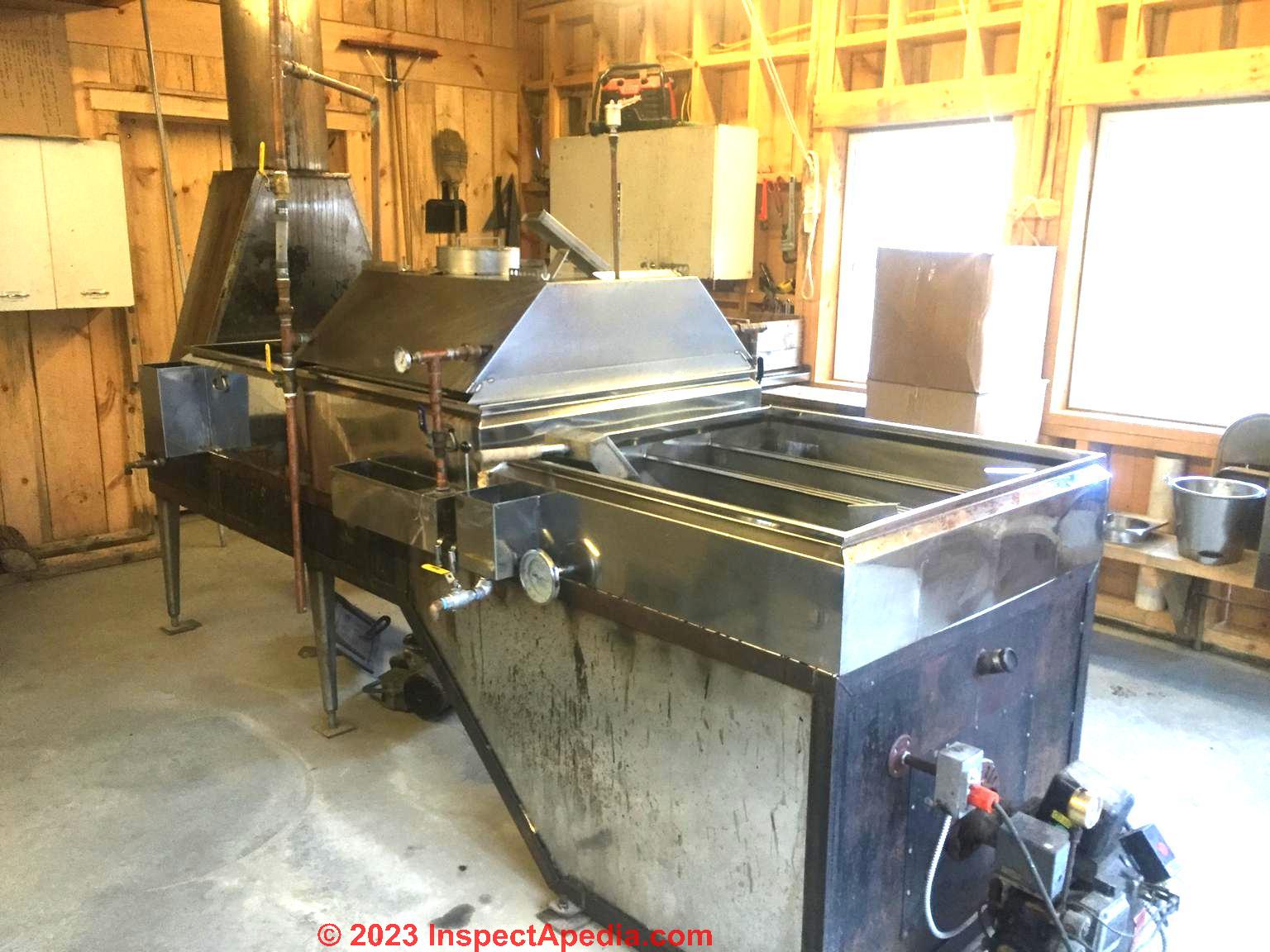
Hi, I have a Carlin 701CR that I use on my 3.5’ X 10’ maple evaporator. I now use the following nozzles; low fire -
3.5 gph 45 H
High fire- 3.25 gph 80 B.
My burner is running at 150 psi. The combustion chamber inside demensions are 38” wide X 54” deep and 24” high.
My problem is, the syrup is carmilizing to much before it reaches the correct densityI would like to change my nozzles to cut back on heat, not sure if I should step down GPH or angle of fire or possibly both? On 2023-01-09 by Brian
by InspectApedia Publisher - what size nozzle should I use on my Carlin 701CR to cut back on heat to my maple evaporator?
@Brian,
On a conventional heating furnace or boiler, the manufacturer has matched the properties of the combustion chamber size and shape, the heat exchanger, the heater's venting capacity and other features when they include a data tag, usually right on the oil burner or on the heater, that gives an acceptable firing range in gph as well as the specific nozzle pattern (angle and spray type).
We don't know who made your maple evaporator - brand and model. If it's not a home-made system you would call the manufacturer to check with their engineers about the acceptable nozzle firing rate.
Normally you can step down the firing rate but I'm not sure that you can drop it by a whole gph or enough to stop caramelizing the maple syrup without a too-small flame.
Our options are to ask the manufacturer's engineers or to do some experimenting with smaller firing rates, say dropping to 3 gph and 2.75 gph and have a trained oil heat service tech monitor the stack temperature, CO2 and smoke level so that we're sure that the system runs clean-enough and safely.
Watch out: The angle of fire should be matched to the combustion chamber size and shape and isn 't something you'd vary by much at all.For example going to a too-wide or too-long flame can cause flame impingement on the combustion chamber liner that in turn causes incomplete sooting, clogging up of the system or worse, a puffback explosion.
Can I drop my Riello oil burner nozzle to a smaller GPH?
I just changed a Riello nozzle from .50/70w to a .80/85 could I use a lower .40 gph On 2020-09-11 by Jason squirrel
by (mod) - avoid very big changes in nozzle flow rates
Depending on your oil depending on your oil burner that might be a pretty big change in gallons per hour depending on your oil burner that might be a pretty big change in gallons per hour depending on your oil burner that might be a pretty big change in gallons per hour.
Going from 0.5 gph up to 0.8 is a pretty big increase. Going from 0.5 gph down to 0.4 gph is much more conservative.
Changing from a 70 angle nozzle to an 85 could be a problem in some combustion chambers but might work.
An experienced servicve tech would first try to match what the oil burner manufacturer specifies as the proper operating range for the specific oil burner model and the heating appliance that it is firing.
Watch out: Bottom line: start by looking at your oil burner for a tag or sticker that gives the allowed range of nozzle sizes and also be sure you're using the proper angle or width of spray
OK to replace a .75 80 A with a .75 80 H oil burner nozzle?
Can I replace a .75 80 A with a .75 80 H On 2020-08-09 by Matt Collins
by (mod) - keep the original spray angle (80°) and you can try other nozzle patterns
Matt,
See OIL BURNER NOZZLE SPRAY PATTERN
you'll see that as long as you keep the nozzle spray angle the same, going to a hollow cone might work ok on your burner but you'll want to check what the manufacturer permits for your burner and boiler or furnace.
What is the right nozzle substitution for a a 120 60 W
What crosses with 120 60 W - On 2020-06-16 by (mod)
Reply by (mod)
Vince, Apologies but I don't recognize your oil burner nozzle specifications. You need to clearly give firing rate GPH, spray angle, and spray pattern or type (solid, hollow, etc). Then
see OIL BURNER NOZZLE SUBSTITUTIONS for a complete step by step guide along with nozzle substitution charts.
How do I convert oil burner nozzle rates in GPH to litres per hour LPH?
What is the conversion factor to litres per hour? Are they using British Gallons (4.5l) if they are using British thermal units?
Or US gallon (3.78 L) (Nov 2, 2014) tking
Reply:
Many of our InspectApedia articles are using U.S. oil burner nozzle ratings in U.S. gallons per hour.
1 U.S. Gallons (or for oil burner nozzles gallons per hour or GPH) = 3.79 Litres
1 British Gallon = 4.5 Litres
1 British Gallon = 1.6 U.S. Gallons
So if a US-made or US-specified oil burner nozzle is rated at 1.0 gph (at say 100 psi) then it will burn 3.79 litres per hour or LPH.
Also see HEATING OIL USAGE RATE for more details.
Que es el tamaño corecto por aceite combustible No 2. ? - What's the proper oil burner atomization droplet size?
He leído que el tamaño de la partícula pulverizada del aceite combustible N.2. para que exista una buena combustión debe ser entre 10 y 50 micras, me podrían indicar si es correcto, y cual es el tamaño de las partículas pulverizadas a una presión de 100 psig. de las boquillas marca Delavan o de otras marcas. Mi correo ssatiar@hotmail.com. Gracias. On 2022-05-24 by Á Ramírez A.
by InspectApedia-911 (mod)
@Á Ramírez A.,
Favor de encontrar su pregunta y nuestra repuesta, in ingles y tambien en espan~ol, los detailes se encuentran a
OIL BURNER NOZZLE DROPLET SIZE RANGE
Mil gracias por la pregunta - digme si hay mas preguntas.
Daniel
...
Oil Burner Nozzle Pattern Selection FAQs
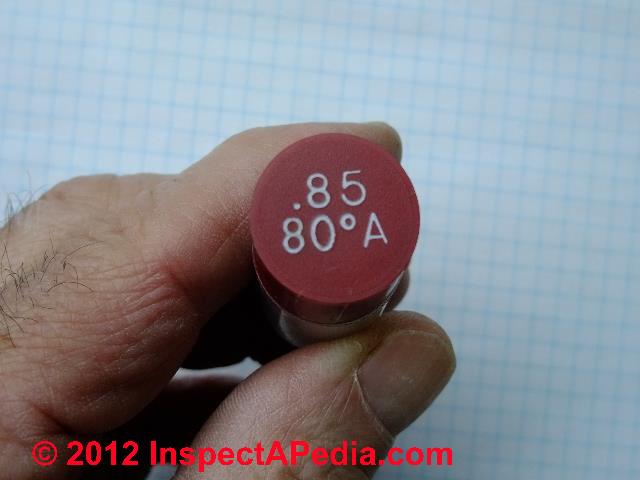 Tip: see OIL BURNER NOZZLE SPRAY PATTERN - hollow, solid, other
Preferred oil burner nozzle for my Miller Mobile home Furnace
Is there any advantage or disadvantage to using a Delovan .579MH nozzle in an older Miller mobile home furnace (model MF80P ? with a Beckett burner) On 2023-12-24 by Greg
by InspectApedia Publisher - need to know the proper nozzle for your particular mobile home heater
@Greg,
Can you tell me the original, manufacturer's oil burner nozzle specified for your burner and heater?That is to say no one can give a "safe" answer to your question without knowing what is the proper nozzle for your particular mobile home heater.
Often the recommended nozzle size, pattern, angle are given on a sticker right on the oil burner that came with your furnace.
You can also contact the manufacturer, Nortek, at 8000 Phoenix Parkway, O'Fallon, MO 63368 Tel: 1-800-422-4328
You'll see above on this page that we give some guidelines for substituting among oil burner nozzles; you need to stay pretty close to the original specified nozzle, though the firing rate in gph of the nozzle is of course not a fixed number - depending on the oil pressure to which the fuel unit (oil pump) on the burner has been set.
If you don't have the manual for your furnace you can down load this copy
https://inspectapedia.com/heat/CMF-Furnace-Manual.pdf
OK to substitute a B- for an A- oil burner nozzle?
I have a WBV-04 I have the nozzle at .75 80A can I put a .75 80B in side
Sorry wayne eagle one model meg-1
I need a cad relay dont know part number a Beckett heater at least 30 to 35 years old - does anyone know which one I would need On 2020-03-06 by Anonymous
by (mod) - A=hollow cone, B=solid cone - might work but ...
Anon
Take a look at the oil burner selection nozzle guidance givenat OIL BURNER NOZZLE GUIDE
I don't know what oil burner nozzle brand you're using, but A- nozzles are typically a hollow cone while B is solid. Either nozzle might "work" in the same oil burner but usually we stick with the manufacturer's recommendation as a starting point as the nozzle pattern is matched to the combustion chamber and burner properties.
I add that if you're keeping the firing rate 0.75 gph and the spray angle (80 degrees) un-changed, then it's reasonable to experiment with the two patterns.
Watch out: if you're not trained and equipped with the full set of measuring and test tools you cannot, by eye alone, know that your substitute oil burner nozzle is working properly in your oil burner and heater set-up. An expert needs to measure draft, temperature, smoke, and CO or CO2.
...
Oil Burner Nozzle Code FAQs
Tip: see all of the oil burner nozzle codes and what they mean at OIL BURNER NOZZLE GUIDE - home
What does the AS stand for on my oil furnace nozzle?
I have a hot air oil furnace. I typically change the filter and the Nozzle every year. The nozzle type and brand is Danfoss 0.85 70 degree AS.
I cannot find this nozzle. I know the the 0.85 is the gallons, the 70 degree is the spray pattern.
What does the AS stand for. I went to a plumbing supply and they have a Steinen 0.85 70 degree S nozzle. Will this work?
email: dbarone@nycap.rr.com On 2023-12-18 by Dominick C Barone
by InspectApedia Publisher -
@Dominick C Barone,
For most brands the letter A on an oil burner nozzle refers to a hollow cone spray pattern
And the letter S refers to a solid cone spray pattern
If you have a nozzle that is stamped both A and S I'm guessing that it was a universal substitute nozzle that claimed it would work equally well for either requirement.
Take a look on the oil burner itself as well as in the manual for your heater where often the manufacturer will give you the preferred pattern.
What does "NS" mean on my oil burner nozzle?
What does NS mean on a oil burner nozzle question On 2022-08-03 by Brian
by InspectApedia-911 (mod) - NS = hollow cone; see our complete table of oil burner nozzle codes
@Brian,
At OIL BURNER NOZZLE GUIDE you'll find a complete table of oil burner nozzle codes and a translation of those codes into nozzle spray pattern properties,and at OIL BURNER NOZZLE SPRAY PATTERN you'll see that NS is a type of hollow-cone spray pattern.
Any idea what a Delavan J20 nozzle means?
I have a Delevan .75 .70A nozzle, but unlike others I have, it also has a J20 stamped on it.
I can't find anywhere online that says what this means. it did not perform well in my furnace.
Flame sounded "rough' or like there was air in the fuel and the furnace would shut down every few days. Once I noticed, while troubleshooting, the J20 I changed it out with one that didn't have J20 on it and so far the furnace seems to be running fine.
Any idea what J20 means?On 2022-12-01 by Gerry
by InspectApedia (Editor) -
@Gerry,
OIL BURNER NOZZLE SUBSTITUTIONS
Lists all of the oil burner nozzle codes we've been able to find but J-20 is not among them.I don't think it's a size in gph nor spray angle.
I have seen a J20 nozzle block (nozzle adapter) made of steel and used in marine oil burner applcations. I think. When I searched for J20 oil burner nozzle I found references to the Delavan 33517 Nozzle Body used in steam generator applications.
I'll do some further research but it would help if you could post photos of the nozzle, one per comment, showing the markings on its various facets.
...
Oil Burner Nozzle Spray Angle FAQs
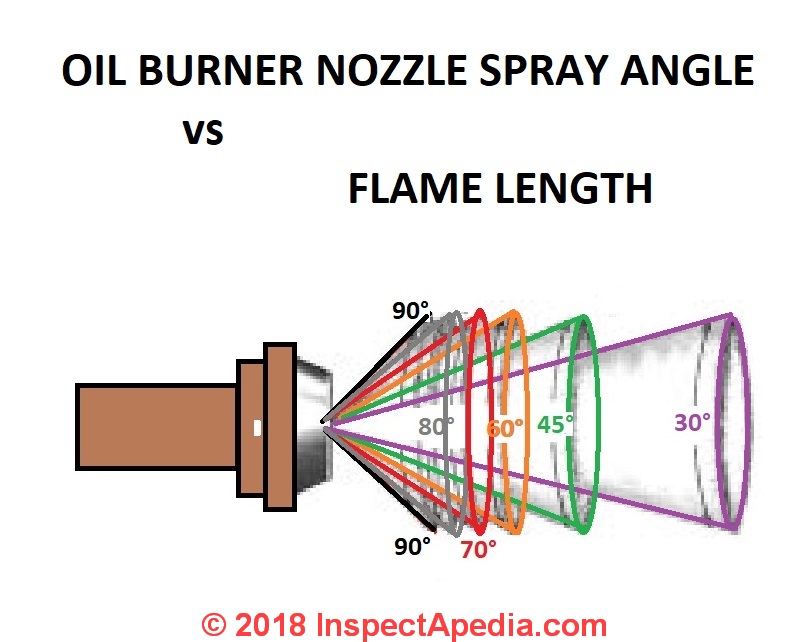 Tip: see OIL BURNER NOZZLE SPRAY ANGLE - 45° to 80° - wider angle in shorter combustion chambers
What would changing the oil burner nozzle flame angle by 10 degrees affect?
What would happen if I changed from a 1.5 GPH 70 degree A to a 1.5 GPH 80 degree A. What would changing the angle at 10 degree effect. On 2021-02-26 by Sam Wise
by danjoefriedman (mod) -
@Sam Wise,
A 10 degree wider spray angle with the otherwise same oil burner nozzle GPH and flame type (A) means that the flame produced will be a bit shorter (extending less far from the tip of the oil burner nozzle into the combustion chamber) and a bit wider across.
That might be a small-enough change as to be OK.
What a technician would watch for would include watching for too much flame impingement on the combustion chamber sides, resulting in less than complete combustion of the heating oil being sprayed, and, though probably less likely, incomplete combustion of a small volume of droplets that might otherwise hit the hot back of the combustion chamber and thus be assisted in burning by the hot surface of the chamber liner.
In other words, too little impact on the chamber liner or too much on the liner might both result in less-perfect combustion of the sprayed fuel.
You'd probably detect these with a combination of observation (smoky flame, noises), and measurement of smoke and CO2 or O2 and temperatures in the breech.
Before changing the oil burner nozzle spray angle width, check the sticker on the oil burner or boiler or furnace where you find the manufacturer's recommended nozzle type and pattern.
...
Oil Burner Sooting FAQs
Tip: See the diagnosis and repair steps ghiven at OIL BURNER NOISE SMOKE ODORS - that includes oil burner soot production.
Oil burner soots up and clogs the whole burner body
My oil burner soots up alot and it looks like there is un burned oil on the flue and it also clogs up the entire burner body.
At least once a year i have to take the whole burner apart and vacuum it could my nozzle be to big spraying to much oil thats not igniting? On 2020-09-22 by Dean
by (mod) - oil burner soots up alot
If the burner is sooting abnormally AND has a nozzle that's within the range permitted by the manufacturer for your oil burner, the tech will look for any of quite few other causes of oil burner sooting like air leaks, dirty oil, wrong pressure, poor combustion air, wrong draft settings, bad electrodes.
See SOOT on OIL FIRED HEATING EQUIPMENTWatch out: if you are not trained in proper oil burner service and repair you may not be adjusting or maintaining your oil burner properly. That's dangerous.
Watch out: you risk a puffback explosion too.
See OIL BURNER SOOT & PUFFBACKS
Soot is blowing out of out of oil fired Brock Engineer furnace damper - is that a problem?
I have an old Brock engineer oil furnace and black soot comes out of the damper on the floor. Is that normal? (Sept 21, 2014) Anonymous
Reply: yes
Richard,
A trivial amount of soot, a few grains here and there, isn't usually a significant worry but if you see soot increasing, or if there is a lot of it in and around the boiler room, then
It sounds like an oil burner clean out and tuneup are needed along with a chimney and combustion air check.
Watch out: be sure to read OIL BURNER SOOT & PUFFBACKS
...
Oil Burner Nozzles: Solid versus Hollow Cone FAQs
Riello RG 1 oil burner nozzle pattern: works with solid cone, clogs when I install a hollow cone
 Hello ,
I have a Riello RG 1 oil burner . While It works fine with a nozzle with a solid cone when I put a nozzlewith hollow cone as the service manual says, it doesn't start or it does after 4-5 times that is blocked.
Do I have to make some other adjustments like air damper setting or different position of the electrodes?
Thanks a lot On 2020-01-17 by Nick Livanios -
by (mod) - hollow cone vs solid cone operating problems on a Riello RG 1 oil burner
Nick
Even when changing from solid to hollow cone nozzle while keeping the same spray angle and GPH rating it would make sense to check and adjust the air shutter.
You would not change the electrodes. The electrode gap, height, and forward-space from nozzle face would remain the same. However when changing a nozzle, if the nozzle dimensions moved the face of the nozzle forward or backward from the previous one the electrodes might need fine tuning.Also, of course, its possible to foul up the nozzle electrode position during nozzle change as often the electrodes have to be loosened and moved to replace the nozzle.
A blocked oil burner nozzle can occur for a range of reasons, of which the most-obvious is debris in the oil supply, perhaps made worse by failing to change the oil filter and fuel unit screen; but an improper adjustment of electrodes or combustion air supply or draft can result in a smoky flame that fouls the nozzle end.
You might see that by inspection: a build-up of oily soot on the nozzle face and on the electrode tips.
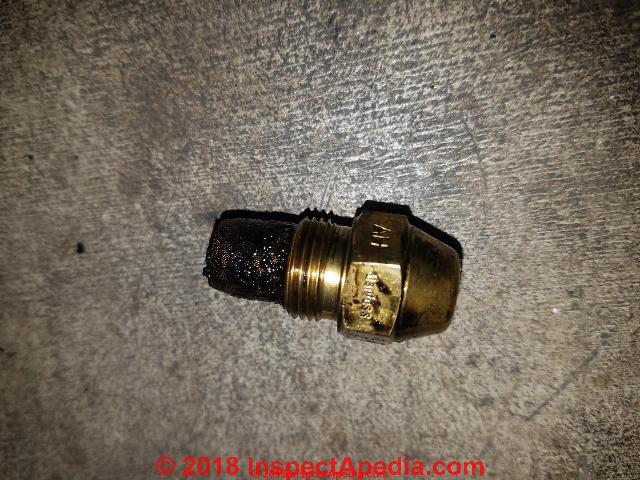
On the other hand changing nozzle spray pattern would not explain nozzle clogging at the nozzle's inlet filter -that sintered bronze filter shown in our photo below.That clogging comes from debris in the oil supply combined with failure to change the oil filter or the screen in the fuel unit.
Watch out: for nicking or stripping the threads in the nozzle adapter when fooling with oil burner nozzles.If you've made that mistake no nozzle will work properly as air or oil leaks will foul up the burner at the nozzle.
Watch out: unless you're trained and equipped to tune an oil burner, unfortunately you can't get it right just by eye alone.It's necessary to measure the smoke level, stack temperature, and CO2 or O2 level as well as draft over the fire and in the breech.
Substituted an 80x85B for an 80x85A oil burner nozzle - was that OK?
I cleaned my buner and replaced the nozzle. The specs label called for 80x85 B, when I removed the old nozzle it was 80x85A.
I see the difference between the spray patterns. Was is appropriate for the service company to change the nozzle type? On 2020-01-10 by Anonymous
by (mod) - are A- and B- oil burner nozzles interchangeable?
Anon
Thanks for asking about nozzle pattern substitutions.
A look through our data and tables such as in the article above we see that at least for some burner brands and models the manufacturer will say, quite explicitly, that you can use either an A- (hollow cone) or B- (solid cone) nozzle.
By staying with the same spray angle 80 deg and gph 0.85 you should be ok.
There are a couple of reasons a tech might go from A to B or B to A spray patterns.
1. she thinks she's getting better burner flame and thus better burner operation
2. she (or he) didn't have the other version (has A but not B or vice-versa) in the right angle and gph rating on the truck.
I used to think that I preferred hollow as burning more efficiently but that's opinion, not fact.
...
...
Continue reading at OIL BURNER NOZZLE GUIDE - topic home, or select a topic from the closely-related articles below, or see the complete ARTICLE INDEX.
Or see these
Recommended Articles
- OIL BURNER ELECTRODES - how to set the electrodes on the oil burner once you've got the right nozzle
- OIL BURNER RUMBLING NOISE
- OIL BURNER NOZZLE GUIDE
- OIL BURNER NOZZLE REPLACEMENT: MATCH THE OLD ONE
- OIL BURNER NOZZLE FIRING RATE GPH
- OIL BURNER NOZZLE SPRAY ANGLE
- OIL BURNER NOZZLE SPRAY PATTERN
- OIL BURNER NOZZLE DROPLET SIZE RANGE - separate article
- OIL BURNER NOZZLE SELECTION TABLE
- OTHER OIL BURNER NOZZLE FEATURES
- OIL BURNER NOZZLE SUBSTITUTIONS - separate article
- OIL BURNER NOZZLE GUIDE BOOKS
- OIL BURNER INSPECTION - home
- OIL BURNER WONT RUN - diagnose and fix oil burner problems
Suggested citation for this web page
OIL BURNER NOZZLE FAQs at InspectApedia.com - online encyclopedia of building & environmental inspection, testing, diagnosis, repair, & problem prevention advice.
Or see this
INDEX to RELATED ARTICLES: ARTICLE INDEX to HEATING OIL, OIL BURNERS, OIL FIRED HEATERS, OIL TANKS
Or use the SEARCH BOX found below to Ask a Question or Search InspectApedia
Ask a Question or Search InspectApedia
Share this article:Search the InspectApedia website
Need to make a private comment? Email editor@inspectApedia.com. We welcome email with your website content critique, corrections, suggestions or questions. Email is monitored daily but our workload may prevent an immediate reply. For immediate results, we hope you'll first try asking your question using the search box just above.
Citations & References
In addition to any citations in the article above, a full list is available on request.
- In addition to citations & references found in this article, see the research citations given at the end of the related articles found at our suggested
CONTINUE READING or RECOMMENDED ARTICLES.
- Carson, Dunlop & Associates Ltd., 120 Carlton Street Suite 407, Toronto ON M5A 4K2. Tel: (416) 964-9415 1-800-268-7070 Email: info@carsondunlop.com. Alan Carson is a past president of ASHI, the American Society of Home Inspectors.
Thanks to Alan Carson and Bob Dunlop, for permission for InspectAPedia to use text excerpts from The HOME REFERENCE BOOK - the Encyclopedia of Homes and to use illustrations from The ILLUSTRATED HOME .
Carson Dunlop Associates provides extensive home inspection education and report writing material. In gratitude we provide links to tsome Carson Dunlop Associates products and services.
 |
HOME | ABOUT | ASK a QUESTION | CONTACT | CONTENT USE POLICY | DESCRIPTION | POLICIES | PRIVACY | |
| © 2026 - 1985 Publisher InspectApedia.com - Daniel Friedman | |||||||||