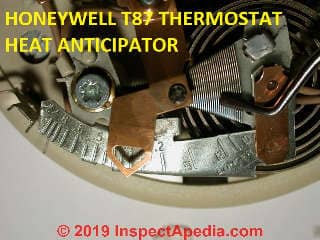
 Q&A on How & Why to Adjust the Thermostat Heat Anticipator
- POST a QUESTION or COMMENT about heating thermostat heat anticipators
Thermostat heat anticipator function & adjustment questions & answers.
What Should Be the Heat Anticipator Settings on a Room Thermostat?
This article series explains what a heat anticipator is on a wall thermostat, where to find it, what it looks like, how & why we adjust the heat anticipator, & what settings to use.
InspectAPedia tolerates no conflicts of interest. We have no relationship with advertisers, products, or services discussed at this website.
- Daniel Friedman, Publisher/Editor/Author - See WHO ARE WE?
Q&A on How & Why to Adjust the Heat Anticipator on a Room Thermostat
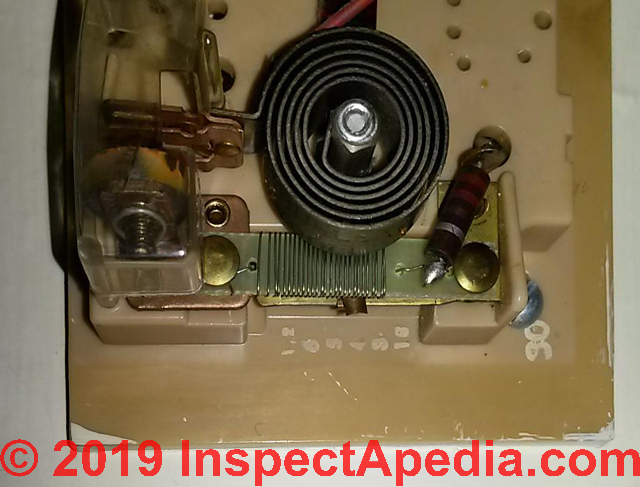 These questions & answers on settings for the thermostat heat anticipator were posted originally
at HEAT ANTICIPATOR ADJUSTMENT - be sure to review the guidance found there.
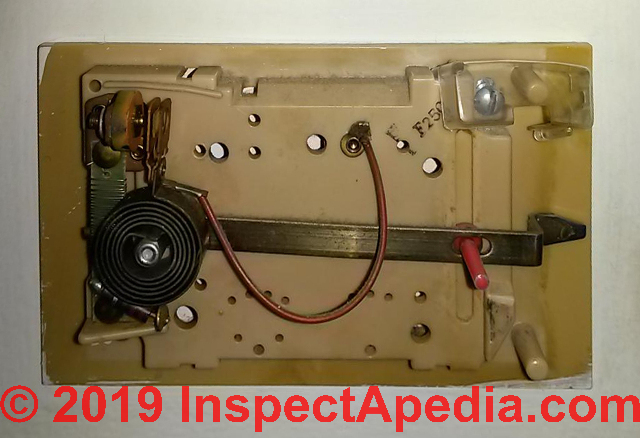
Photo: heat anticipator in a Dayton 2E156 room thermostat cited by Tom below.
Below is our index to questions and answers about heating thermostat heat anticipators, how they work and how to adjust the heat anticipator.
Article Contents
- HOW HEAT ANTICIPATORS WORK FAQs
- HEAT ANTICIPATOR ADJUSTMENT for BOILERs FAQ
- HEAT ANTICIPATOR ADJUSTMENT STARTING POINT FAQs
- HEAT ANTICIAPTOR DAMAGE or FAILULRE FAQs
- HEAT ANTICIPATOR EXPLANATION by an ENGINEER
- HEAT ANTICIPATOR SCALE MARKINGS & POINTER FAQs
- HEAT ANTICIPATOR EFFECT on ROOM TEMPERATURE FAQs
- HEAT ANTICIPATOR vs COMPENSATOR FAQ
- HEAT ANTICIPATOR vs ROOM TEMPERATURE OVERSHOOT FAQ
- HEAT ANTICIPATOR vs SHORT CYCLING HEATER FAQ
- HEAT ANTICIPATOR vs THERMOSTAT SENSTIVITY FAQs
- WHICH WAY to MOVE THE HEAT ANTICIPATOR POINTER FAQs
- WHERE are HEAT ANTICIPATORS NOT USED?
...
Starting Heat Anticipator Setting FAQs
Where to set the heat anticipator on a White Rodgers Thermostat
Where should I set the heat anticipater on a white rodger thermostat? On 2017-07-08 by Jorge Acosta
Reply by (mod) - match the primary control amps rating or use Honeywell's table of settings
Jorge,
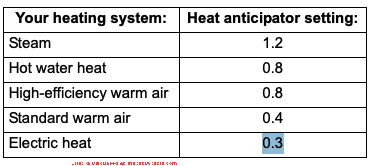
Adjust anticipator to match current rating of primary control. Rating is usually stamped on the control name- plate.If you can't find that data, use the table below, recommended by Honeywell,
Or you can consult the complete and detailed heat anticipator setting tables given in our article
HEAT ANTICIPATOR ADJUSTMENT - Daniel
Here's an alternative to using a mini-Ammeter to check a thermostat heat anticipator circuit setting
An alternative to using a Mini-Ammeter is using a loop of wire with 10 wraps of wire; such as 10 wraps of 16 or 18 gauge wire around 4 fingers. Hook this up in series with the thermostat just as you would the mini-ammeter.
Put the jaw clamps of any journeyman's type ammeter through the loop and divide the reading by 10 for the systems' current draw. This way you won't need an extra, sensitive low reading ammeter. You can also use any number of wraps for sensitivity or ease of division.
Most good DMM's also now have a current scale for measurements up to 10 amps. The point is, as you make it, is to MATCH the thermostat to the system. Then, any fine tweaking is easier from there. Thanks for a great article. Greg- On 2016-12-15 by greg riutzel
Heat anticipator adjustment to match the gas valve amps rating?
Thank you for incorporating my comments.
The thermostat heat anticipator needs to be adjusted at installation to match the furnace gas valve. Doing that will make the thermostat behave the same way for any furnace.
For example, my furnace gas valve is rated at 0.6 amperes. So the anticipator should be set at 0.6.
Another furnace gas valve might be rated at 1.0. So the anticipator should be set at 1.0.
The 0.6 setting for my gas valve will give the same thermostat behavior as the 1.0 setting for the other furnace. - On 2015-04-13 by Qprew7U
Reply by (mod) -
Thanks QP
What I mean is that as shipped from the factory the typical wall thermostat - among those that had a heat anticipator adjustment such as the famous Honeywell T87, will work well with most heating systems.Unless the installer reads the data tag giving different heat anticipator adjustment recommendations (we show this tag in the article) and matches it to the heater then she or he should leave it alone.
Your point about matching the gas valve is helpful and certainly applies to gas fired heating equipment.Keep in mind that this thermostat is very widely used on furnaces, but also on hot water and steam heating systems and with both oil and gas fired equipment. So there is not a single "right" number
Recommends not using the heat anticipator for steam heat systems
Good article - but in steam systems, you should tell people to cut out the anticipator entirely.
Because the steam systems take so many minutes between the time the thermostat detects a need for heat and the time the boiler boils water, delivers it to the radiators, then heat up and finally warm the room, the anticipator function isn't really needed.
I didn't see any instructions for how to cut it out entirely, using the other lug or a drop of solder on the coil. - Bob On 2017-03-11 by bob
by (mod) -
Bob
Thanks for the interesting and important comment about heat anticipators on thermostats controlling steam heating systems.The total amount of anticipation time effected by those thermostats that include a heat anticipator is not that great that in my opinion there is any need to try to remove the feature.
One could simply set it to the recommended generic setting for the type of heat in use. For steam heat for a typical Honeywell setting that's at 1.2A.
Remember that the anticipator is functioning by basically turning the call for heat off slightly early - that's all.The heat anticipator in a room thermostat has little to do with when the heat turns ON, only when it turns OFF.
...
Heat Anticipator vs Thermostat Sensitivity to Room Temperature FAQs
How can I make my room thermostat more temperature sensitive
Our furnace comes on at a 4 degrees difference I want 2 what can I do to change it - On 2019-03-22 by Anonymous
Moderator reply: How to improve the temperature sensitivity of your room thermostat
Most room thermostats do not themselves have a temperature sensitivity adjustment. And if you made the thermostat too sensitive to room temperature, it might try to switch your boiler or furnace on and off too frequently, leading to oscillating and heating equipment damage.
I infer that you feel that rooms are too chilly - getting too cold before your heat cycles back on.
If I'm right, you can take these additional steps to improve your room comfort and the performance of your heating thermostat:
- Choose a good thermostat mounting location:
not in a draft, not in direct sunlight, not on an abnormally warm wall such as the wall behind which your boiler or furnace is located - Set the appropriate thermostat turning OFF point
for your thermostat with its heat anticipator (if your thermostat has one) - that will keep the thermostsat from turning your heat off too early before the thermostat is satisfied.For adjusting the point at which your thermostat turns OFF, take a look at your thermostat and see if it includes an adjustable heat anticipator such as we discuss
at HEAT ANTICIPATOR ADJUSTMENTOR post photos of the thermostat front cover and interior and we can comment further.
- Review our Building Heating Cost Energy Saving Steps and Priorities
Found at ENERGY SAVINGS PRIORITIES - Check your home for excessive heat loss points & drafts
as we explain at INSULATION INSPECTION & IMPROVEMENT - home
and at ENERGY SAVINGS in BUILDINGS - home
Line Voltage Thermostats vs Dayton Low Voltage Thermostat temperature swing
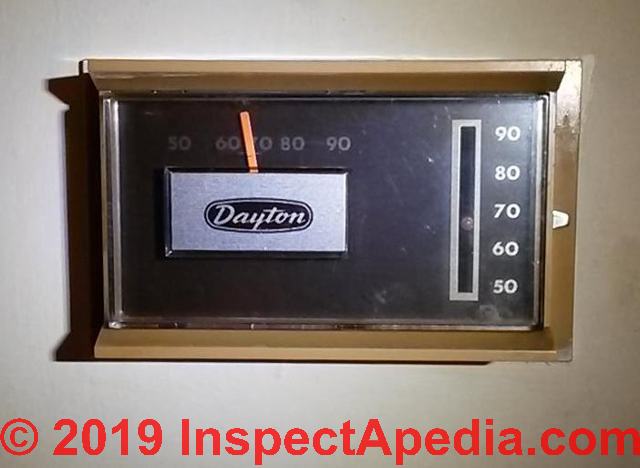 Thank you for sharing your expertise regarding thermostat setup. I live in a 1970's ranch house equipped with electric baseboard throughout.
Line voltage thermostats in the bedrooms provide consistent temperature but a large part of the house is controlled by an old Dayton low voltage thermostat that would allow a 5-6 degree temperature swing.
Ive managed to adjust that down to 1.5-2 degrees.
Much better! On 2019-02-24 by Tom from Bethlehem Pa
Reply by (mod) -
Tom
Nice going, and thanks for the feedback. It would be helpful to know the brand and model of the thermostats involved.by Tom from Bethlehem Pa
The thermostat in question is a Dayton 2E156.
I did not find any direct info online about this model. Perhaps as old as the house, mid 70's.
I had touched it up with a bit of deoxit this fall. Ill be interested to see how sungle digit outside temps change the indoor temp swing but right now its less than 2 degrees. Ill post a couple and let you decide whats helpful.
Thanks again for the wisdom!
by - (mod) - Dayton Room Thermostat Information & sources
Thanks for those excellent photos. More about Dayton thermostats is
at THERMOSTAT WIRING DAYTON where you can download the IO manual for your Dayton thermostat as a free PDF.
...
Heat Anticipator Settings for Hydronic Boilers
What's the right heat anticipator setting for a hot water boiler?
What do you set the heat anticipater on a low pressure boiler? I think the brand is a Hydro On 2019-01-31 by Larry
by (mod) - at or above 0.6A
Larry
please check out the three approaches to deciding on the thermostat heat anticipator settings given in the article HEAT ANTICIPATOR ADJUSTMENT - T8
One of those three is a useful
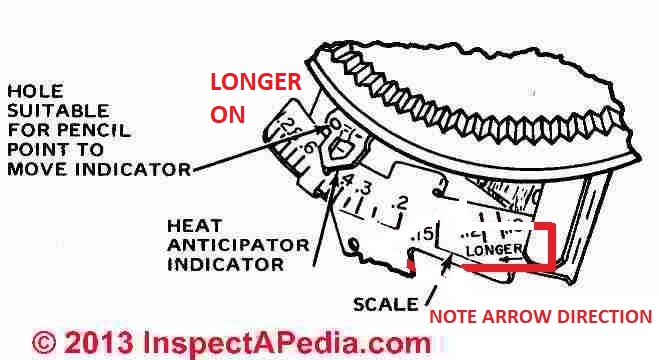
Table of General Heat Anticipator SettingsHere's a drawing giving similar guidance
That you could follow if you have no other information.So start by setting your T87 thermostat heat anticipator somewhere between 0.6A and 1.25A.
...
Heat Anticipator Setting vs Room Temperature Overshoot FAQ
How to Fix a Honeywell T822D Thermostat Temperature Overshoot Problem
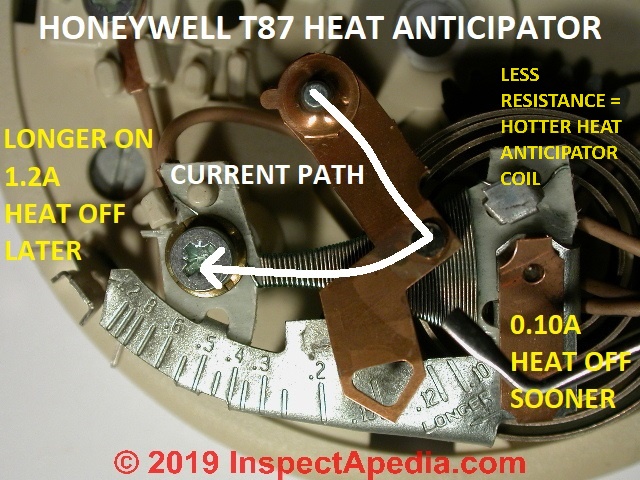 Our house thermostat is a Honeywell T822D, and we recently added a Beckett Genysys 7505 as primary.
The product has draw of .1amp, the lowest setting on thermostat is .18, which I now use as setting, yet there is overshoot, which has been the case even before new primary. Any suggestions. On 2018-12-07 by Pat A
Reply by (mod) -
If you changed your thermostat to the T87 shown here, that scale goes as low as 0.1 A. But Honeywell warns not to set the anticipator beow 0.3A.
I would expect the overshoot problem to be most serious if you have large cast iron hot water heating radiators.
Is that the case? If so you might consider some thermostatically operated radiator valves as a better solution.
by Pat A
Not really. A few, but the boiler is a WM SGO3, with heating capacity of 354 SF of steam, and radiation sf is 218.
Reply by (mod) -
I'm talking a bit beyond my expertise here so you should consider this an opinion only.
Considering that we're discussing steam heating and not hot water heating if there is an overshoot problem I would have dress that by installing the proper steam vents on the radiators.I might need an adjustable vent.
That's because it may be but events are taking so long to vent air but the whole heating cycle is being extended. I also would look carefully at the thermostat location.
See STEAM VENTS
or better, to make each radiator into a controlled heating zone
see AUTOMATIC RADIATOR VALVES - Automatic or Thermostatically Controlled Radiator Valves
- Daniel Friedman
My service tech said set the heat anticipator to 0.2Amps - room temperature overshoots
I am reading your section on " How & why to adjust the heat anticipator on a room thermostat" and my oil burner service man installed a new control on my baseboard oil/hot water burner lately.
It has a L7224/L7248 Electronic Aquastat next to it. When I take the cover off ther is a piece of cardboard that tells you to set the Thermostat anticipator to 0.1 amps.
The oil burner serviceman had it set to 0.2 amps and the burner seemed to be overshooting the thermostat reading.
I just turned it down to 0.1 amps. I question your article that says you should never turn down below 0.3 amps.
Can you help me there? I have copper tubing/finned baseboard heat in a small apartment so NO mass (cast iron radiators).
Your article also says the recommended setting to be 0.8? Can you help me out with these contradictions? Thank you, Thomas Spero On 2018-04-09 by Thomas Spero
Reply by (mod) -
Thomas,
Thank you for posting your question and opinion.My 0.3A quote is excerpted from Honeywell's "general" guidance for the heat anticipator setting.
But I agree that it makes perfect sense to follow the instructions on the specific heating equipment you've installed.
Another approach that's beyond the scope of most service techs is to actually *measure* the current draw on the heating thermostat control circuit. That requires using a special low-range ammeter or a digital VOM/DMM with a suitable range sensitivity. Most techs wing-it.
The apparent contradictions in heat anticipator setting advice aren't as ugly as they may seem.
In the article above on this page you'll find a summary table titled
Table of Heat Anticipator Setting Recommendations for the Honeywell CT87A,B,J Round® Thermostat
there you'll see a range of recommended heat anticipator settings that depend on the type of heat being controlled. Those numbers range from 0.3A (electric heat) to 1.2A (steam heat). And yeah, you'll see Honeywell's recommendation for forced hot water heat as 0.8A at the heat anticipator.
Keep in mind that Honeywell recommended these settings as a general number - the company (and I) can not possibly know the specific performance or behaviour of every installed heating system and I think Honeywell's engineers would agree that further adjustment could be needed.
Certainly you can try lower settings down to 0.1 if your particular heating system is continuing to overheat or over-shoot.
Compare the actual room temperature - measured independently but AT THE THERMOSTAT with the thermostat's set-temperature.
For example if the thermostat set temp is 68F and you see that after your boiler turns OFF your heat continues to rise to say 70F or more, then you might try setting the heat anticipator to a lower number.
Finally, don't forget to look for other reasons for heat overshoot, such as a zone valve that's not closing or a check valve at the boiler that's stuck open when it should be closing.
...
...
Continue reading at HEAT ANTICIPATOR ADJUSTMENT - T87 or select a topic from the closely-related articles below, or see the complete ARTICLE INDEX.
Or see these
Recommended Articles
- AMPS MEASUREMENT AUTOMOTIVE DC
- AMPS MEASUREMENT METHODS
- BOILER CONTROLS & SWITCHES
- DEFINITION OF AMPS, ELECTRICAL CURRENT
- DEFINITION OF OHMS, ELECTRICAL RESISTANCE
- ELECTRICAL RESISTANCE vs HEAT GENERATED
- FURNACE CONTROLS & SWITCHES
- HEAT ANTICIPATOR ADJUSTMENT
- HEAT ANTICIPATOR ADJUSTMENT - T87
- HEAT ANTICIPATOR EFFECTS on ROOM TEMPERATURE
- HEAT ANTICIPATOR OPERATION
- HEAT ANTICIPATOR SET & TEST by AMMETER
- HEAT ANTICIPATOR THERMOSTAT SOURCES
- HEAT WON'T TURN OFF
- STEAM HEATING SYSTEMS
- TEMPERATURE RESPONSE of ROOM THERMOSTATS
- THERMOSTAT INSTALLATION & WIRING MANUALS
- THERMOSTAT WIRE CONNECTIONS
- VOLTS / AMPS MEASUREMENT EQUIP
Suggested citation for this web page
HEAT ANTICIPATOR ADJUSTMENT FAQs at InspectApedia.com - online encyclopedia of building & environmental inspection, testing, diagnosis, repair, & problem prevention advice.
Or see this
INDEX to RELATED ARTICLES: ARTICLE INDEX to HVAC THERMOSTATS
Or use the SEARCH BOX found below to Ask a Question or Search InspectApedia
Ask a Question or Search InspectApedia
Share this article:Search the InspectApedia website
Need to make a private comment? Email editor@inspectApedia.com. We welcome email with your website content critique, corrections, suggestions or questions. Email is monitored daily but our workload may prevent an immediate reply. For immediate results, we hope you'll first try asking your question using the search box just above.
Citations & References
In addition to any citations in the article above, a full list is available on request.
- [1] Proliphix Corporate Headquarters [Website: proliphix.com] , 3 LAN Drive Suite #100, Westford, MA 01886 Phone: +1.978.692.3375 Toll Free (U.S.): 866-IP-LIVING (866.475.4846) Fax: +1.978.692.3378 - Sales: sales@proliphix.com Marketing: marketing@proliphix.com Customer support: support@proliphix.com http://www.proliphix.com/
- [2] "The Nest Learning Thermostat", Nest Thermostat, 900 Hansen Way Palo Alto, CA 94304, Tel: 855-4MY-NEST, Email: info@nest.com, website http://www.nest.com/, retrieved 1/24/2013.
- [3] Honeywell Controls, the company wants you to use their contact form at this web page: http://www51.honeywell.com/honeywell/contact-support/contact-us.html
Honeywell Consumer Products, 39 Old Ridgebury Road Danbury, CT 06810-5110 - (203) 830-7800
World Headquarters, Honeywell International Inc., 101 Columbia Road, Morristown, NJ 07962, Phone: (973) 455-2000, Fax: (973) 455-4807 1-800-328-5111 - [3a] Honeywell Tradeline T87T Universal Thermostat Installation Instructions for the Trained Service Technician", Honeywell International Inc. Honeywell Limited—Honeywell Limitée 1985 Douglas Drive North 35 Dynamic Drive Golden Valley, MN 55422 Scarborough, Ontario M1V 4Z9, 60-0830—4 G.H. Rev. 8-02, retrieved 12/1/2013 Website: www.honeywell.com
- [3b] Honeywell CT87A,B,J Round® Themostat Low Voltage (15 to 30 VAC) Thermostat and Mounting Hardware Installation Instructions, Honeywell International Inc. Honeywell Limited—Honeywell Limitée 1985 Douglas Drive North 35 Dynamic Drive Golden Valley, MN 55422 Scarborough, Ontario M1V 4Z9, 60-0830—4 G.H. Rev. 8-02, retrieved 12/1/2013 Website: www.honeywell.com
- [5] Domestic Central Heating Wiring Systems and Controls, 2d Ed., Raymond Ward, Newnes, ISBN-10: 0750664363, ISBN-13: 978-0750664363
- Our recommended books about building & mechanical systems design, inspection, problem diagnosis, and repair, and about indoor environment and IAQ testing, diagnosis, and cleanup are at the InspectAPedia Bookstore. Also see our Book Reviews - InspectAPedia.
- In addition to citations & references found in this article, see the research citations given at the end of the related articles found at our suggested
CONTINUE READING or RECOMMENDED ARTICLES.
- Carson, Dunlop & Associates Ltd., 120 Carlton Street Suite 407, Toronto ON M5A 4K2. Tel: (416) 964-9415 1-800-268-7070 Email: info@carsondunlop.com. Alan Carson is a past president of ASHI, the American Society of Home Inspectors.
Thanks to Alan Carson and Bob Dunlop, for permission for InspectAPedia to use text excerpts from The HOME REFERENCE BOOK - the Encyclopedia of Homes and to use illustrations from The ILLUSTRATED HOME .
Carson Dunlop Associates provides extensive home inspection education and report writing material. In gratitude we provide links to tsome Carson Dunlop Associates products and services.
 |
HOME | ABOUT | ASK a QUESTION | CONTACT | CONTENT USE POLICY | DESCRIPTION | POLICIES | PRIVACY | |
| © 2026 - 1985 Publisher InspectApedia.com - Daniel Friedman | |||||||||