 Driven Point Well FAQs
- POST a QUESTION or COMMENT about driven point wells and jetted wells: diagnosis and repair
Driven point well construction, capacity, troubleshooting & repair questions & answers.
In this article series we define driven point wells & describe how a driven point water well is constructed. We discuss why water flow and pressure are ultimately lost from a driven point well and we explain how to restore water flow (sometimes) without having to construct a new well.
InspectAPedia tolerates no conflicts of interest. We have no relationship with advertisers, products, or services discussed at this website.
- Daniel Friedman, Publisher/Editor/Author - See WHO ARE WE?
Small Diameter Driven Point Well FAQs
Article Index
- AIR IN WATER from POINT WELL
- CHECK VALVES on DRIVEN POINT WELLS
- DRIVEN POINT WELL HAS GONE DRY
- FLOODING AROUND DRIVEN POINT WELL
- HOW TO GET MORE WATER FROM A DRIVEN or SAND POINT WELL
- HOW TO UN-CLOG THE SAND POINT in a WELL
- WATER QUALITY ISSUES FROM A DRIVEN or SAND POINT WELL - dirt, sand, contaminants
...
Point Well Check Valve Q&A
Does a driven point well use a foot valve?
Do point wells have foot valves ? I'm losing prime in point well continually after installing a new pump and pipe on pressure side.
I have three options left, a bad foot valve if there is one, leak in piping from well to pump or check valve on suction side is malfunctioning.
FYI I had to replace the pump because it froze in sub zero temps and cracked. The tank seems fine On 2018-01-19 by Jay
by (mod) - no but look for a check valve at the pump
Jay
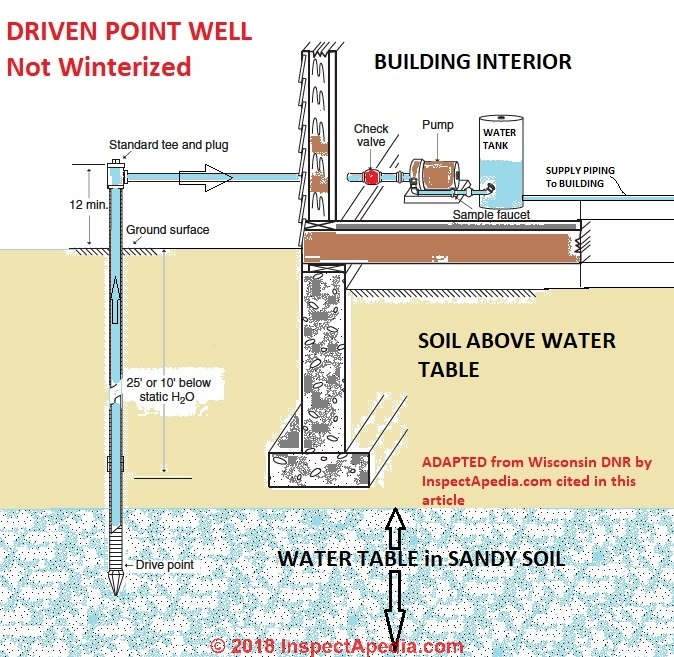
Usually a driven point well does not incorporate a foot valve.Rather, since such wells are by definition always shallow, there will be a check valve at or on the pump.
I would look for a leaky check valve first.Then look for a leaky piping connection.
To understand the types of check valves found on wells and well piping or well pumps
see CHECK VALVES, WATER SUPPLY, DRAINS, PUMPS - Daniel
...
Driven Point Well Has Gone Dry
We have a BIG water problem: no water from our driven point well.
We have a BIG water problem. According to the county, we have no water. The house was built in 1950, and they just drove a 1.25" galvanized pipe into the ground, poured some cement around it, and called it a well, no permit.
Unfortunately, over time that pipe started to rust inside, and some idiot put a thin walled pvc pipe inside it, and then thought they fixed the problem.
Well the rust continued, and it cracked the pvc pipe, and to hook on to city water, it will cost us about $20-25 thousand. I was also told that a new well to be drilled would cost us about $3,000.
We had the money for a new well, by my father-in-law passed away and the money went toward his funeral expenses, so we are trying to get by for as cheap as possible till we save up for a new well again, but we keep having to dip into our savings to try to keep water running.
Currently we have a 1hp shallow pump jet pump sucking up water upto 40 ft though a half inch hose (the largest diameter we can fit down that stupid pvc pipe and using a small nut on a string, the bottom of the well is 40 feet down).
We can only have one thing using water at a time, or we have no pressure, and if we run water to long, we lose our prime on the pump, even though we have a sediment filter before a back flow valve, that are before the pump.
We also have a another sediment filter that will also remove clorine smell (works for sulfur smell too) and a back flow valve between the pump and pressure tank, and another back flow valve after the pressure tank.
I completely replumbed the house with 3/4" pex supply line and 1/2" to each fixture and repaced the pump 2 years ago, and pressure tank last summer.
The tank is almost 100 gallons, and set at 28 psi, the pump pressure switch was replaced 2 days ago and is a 30/50 switch.
We are currently now 48 hrs without water, because our pump, after priming, will overheat and shut down and the pressure is not going over 25 psi. Any advice would be GREATLY appreciated. On 2018-06-14 by mollja
by (mod) - here are your choices to get more water:
Molla
Our sympathies on your well and water problems.Your choices, from your note, are clear:
Start by talking with local well drillers about their experience and success (or not) in finding water in your neighborhood: at what depth, what flow rates, what costs. That will help you decide among these options:
- Try to clean or clear the existing driven well point - see more information at DRIVEN POINT WELL RESTORATION
- Pull out or abandon the existing driven point well and install a new driven point well close to the original location - see DRIVEN POINT WELLS
- Drill a new well: if there is water at 25 ft. or less you'd look at SHALLOW WELL with ONE LINE JET PUMP - or if you have to go deeper, look at DRILLED WELL with SUBMERSIBLE PUMP or with a WATER PUMP, TWO LINE JET
- Connect to municipal water and if the municipal water supply itself is weak or modest see MUNICIPAL WATER PRESSURE IMPROVEMENTS
Bottom line: I would want a more clear explanation of the costs involved in connecting to city water (why so high?) and of your water bill rates using municipal water, and also more information on the probability of a functional well, at what depth and what cost, before making a choice among these options.
...
Need to get more Water from my Sand Point or Driven Point Well
Diagnosis needed: why can't we get enough water out of our driven point well?
I have a 2 inch sand point well that has been running my house for 20 years or more. But it now need the point pulled and a new one put in,
But i now am having trouble finding water . I have tried different things like going deeper, and we put a new pump on .
We pulled the 2 inch pipe 3 times at 24 feet. The only way we got any water was to put a 1 inch pipe in the 2 inch with a foot valve at the bottom.
We would get good and lots of water for a few minutes but then it would stop for a few minutes and start again.
I can hear noises coming from the the down by the 2 inch pipe. I have done driven water wells man y times but never had this problem.
I now there just do not seem to be enough water , but is it true water wells can dry up. hope you can give me some ideas. Rich On 2016-06-05 by Richard Peterson
by (mod) - signs that the aquifer has fallen or dried up: you are not hitting a good water area
This sounds as if there is still not good water flow to the well point; often your neighbors and local well drillers can update you on the success in finding water in your immediate area at the depth you are driving.
It is certainly true that water wells can "dry up" - the water table falls with heavy use, nearby wells drawing water that weren't there previously, geological changes (in some areas) and climate change, reduced rainfall, higher temperatures (depending on where you live)
Flow rate from our driven point well fell from 13 to just 2 gpm
I just bought a house. My well is 36 feet deep and 2 inch well. I have water pressure for 45 seconds them my pump kicks on and pumps forever to 60 lbs then shuts off, no maintenance has been don to the well it's self,
When drilled 28 years ago it had 13.2 gpm.
Now it's 2.5 gpm.
What can I do to help the water pressure? On 2011-11-13 by Mike J
Advice from (mod)
Mike, at DRIVEN POINT WELL RESTORATION you'll find expert advice on getting more water out of your point well - if water is present. - DF
How long should my well pump run to fill the holding tank
How long should my well pump run to fill the holding tank On 2017-03-04 by Anonymous
Answer by (mod) -
Excellent question, Anon.
The answer is, ... it depends. On the water holding tank size, its air-charge, how much water remains in the tank when the pump turns on, the pump and well's delivery rate in gallons per minute (or equivalent in liters).
Typically a home water pressure tank in the 20-40 gallon size will take less than 5 minutes for a typical well pump to re-charge the tank IF no water is being run in the building at the same time.
If water is also running in the building the time to re-charge the water tank will be longer, and if water is running in the building at a rate that exceeds the pump's capacity, then the tank won't be re-filled until users stop running other water.
...
Using Chemicals or Solvents to Unclog the Well Point
Can't I just use a solvent along with air pressure to clear the point and screen?
Why not try a solvent along with air pressure to clear the point and screen? Its likely that the clog is mineral deposits. Why not use CLR? On 2011-04-28 by Tedd
by (mod) - warning by mod
Using a solvent sounds appealing if the clog were minerals around a well point screen, but often the culprits are sand and silt.
Watch out: More important, one would not want to pump any potentially harmful solvent down into a well where it would contaminate the water source.
And you'll find it very difficult to flush that chemical out unless you've got a generous aquifer feeding your well.
Some CLR's (Calcium Lime Removers) use toxic caustics. And unfortunately with a driven point well it's a bit of trouble to pull up the well and re-drive it just to try soaking the well point in a lime or calcium solvent - at that point you'd just put on a new point.Take a look at the suggestions at DRIVEN POINT WELL RESTORATION
If I'm missing something, please elaborate as it may help other readers.
I use sulfamic acid crystals to unclog my point well
Sulfamic acid crystals (10-12 oz.) poured down pipe, then fill pipe with water.
Let sit 1-2 days, then pump out with a hand pump. It will break down the iron/manganese in the water. On 2011-08-31 by Joe -
by (mod) - Watch out: warning by mod: clear a clogged driven well point using sulfamic acid?
Joe,
Nice idea for trying to clear a clogged driven well point using sulfamic acid.Watch out: But if you read any MSDS for Sulfamic acid you'll see that it is "Extremely hazardous in case of skin contact (corrosive, irritant), of eye contact (irritant), of ingestion, of inhalation. Very hazardous in case of skin contact (sensitizer)."
Dangers of handling sulfamic acid set aside for a moment, you'd want to know just how much well flushing is required to safely remove all traces of the chemical from the building water supply and perhaps you'd want to purchase a chemical test that can absolutely assure you that the sulfamic acid has been flushed to below the limits of detection before permitting anyone to run the water from the treated well into the building plumbing system.
...
Driven Point Well Water Quality Problems Q&A
75 year old driven point well went dry; drilled deeper, got water but poor water quality
We have a Driven well point. we painstakingly replaced it a couple years ago as our water level has decreased. The point had been in place for 75 yrs, so there was no point in driving it in deeper so it was totally replaced.
Our water use to be very clear. Since the well went "dry" we drilled deeper until we got water again. Now although we have water and great pressure, the quality is not the same.
Would you advise that we drill deeper?
It use to be 15' now its 20' Since the well is "inside" our porch, we can only add 5' at a time. On 2012-09-1 by Karen K
by (mod) - hard to assure that a shallow driven point well will remain sanitary.
Karen
It's hard to assure that a shallow driven point well will remain sanitary.And it's a guess whether or not another few feet of depth will improve quality, or even change quantity for the better.
I'd ask neighbors, local well drillers, and test labs or health department what they know about the aquifer in your area. You may need a treatment system or a drilled, sanitary well.
Also it sounds as if your well is too close to the house by current standards.
I'd start at DRIVEN POINT SANDPOINT WELL CHLORINATION
Problem getting dirty water from my sand point well
i have a sand point well not sure how deep but I've been getting dirty water not sand but blackish one day it will be clear the next its dirty ,any ideas about this problem would be appreciated On 2012-07-18 7 by troy b
by (mod) - suggestions include water treatment & filtration
Troy B
Honestly I don't know - perhaps some other driven point well owners or installers can comment.I speculate that some sources of variation in sediment level in water from a well can be variations in the water table level, or draw-down levels that do or do not draw from or stir up nearby sediments; even surging at a pump can impact or disturb water around a well point.
If the problem persists and water quantity is not an issue you may need to consider a separate in-house filtration and disinfection system to be sure that your water is safe to drink. - DF
Fine sand from our sand point well on Lake Erie gets into our water
We are putting a point along the sandy beach of lake Erie. The sand is so fine that it gets into the water. Is there a way to put fresh coarse sand around the point end? On 2012-05-14 by Keith
Suggestion by (mod)
I'd worry that a much finer mesh screen at your driven point well will simply clog. Would you consider adding a filtration system along with disinfection?
...
Air Discharge in Sand Point Well Water Supply
We're getting air spitting out of our driven point well
My point well is 28ft. deep and 1 1/4" well diameter. But it keeps on spitting air. How do I get this to stop? On 2012-05-29 by j Anderson
Suggestion by (mod) -
Anderson, we offer diagnostics for a well that keeps spitting air at the article AIR DISCHARGE at FAUCETS, FIXTURES
...
Flooding or Standing Water Around Point Well
We have a driven well point and it is leaking. We have a lake on our front lawn.
We just moved into our house, less than 30 days ago. We have a driven well point and it is leaking. We have a lake on our front lawn.
The well is original to the home built in the 40's. Would something like this be repairable? Or are we probably looking at drilling a new well? On 2013-02-17 by Danyell
Reply by (mod): some diagnostic suggestions
Darrell:
Driven point wells don't usually send water up to the ground surface, but it's possible depending on weather conditions and terrain shape. We need to do some diagnosis:
- Is your point well down-slope from a large hill? Has there been a lot of wet weather? If so it's possible that the water aquifer feeding your well has enlarged and is causing your well to act like an artesian well. If so take a look at what artesian well installers do
at ARTESIAN WELLS, WELL SPOOLS
If that's not the case then we should be looking further for
- a leak in well piping
- another water source
Watch out: surface flooding around your well could be contaminating your water supply. See our advice
at FLOOD CONTAMINATED WELL RESTORE & PROTECTby Darrell
Your article was very helpful to me ,and may save me a great deal of money, so thank you. On 2013-04-07
...
Continue reading at DRIVEN POINT WELLS - topic home, or select a topic from the closely-related articles below, or see the complete ARTICLE INDEX.
Or see these
Recommended Articles
- DRIVEN POINT WELLS - home
- DRIVEN POINT WELL RESTORATION
- DRIVEN POINT SANDPOINT WELL CHLORINATION
- IRON & SEDIMENT REMOVAL
- JETTED WELLS
- OLD WELL - RETURN TO SERVICE
- WASH WELLS
- WATER TREATMENT EQUIPMENT CHOICES
- WELL FLOW RATE
- WELL LIFE EXPECTANCY
- WELL WATER VOLUME CALCULATION
Suggested citation for this web page
DRIVEN POINT WELL FAQs at InspectApedia.com - online encyclopedia of building & environmental inspection, testing, diagnosis, repair, & problem prevention advice.
Or see this
INDEX to RELATED ARTICLES: ARTICLE INDEX to WATER SUPPLY, PUMPS TANKS WELLS & SPRINGS
Or use the SEARCH BOX found below to Ask a Question or Search InspectApedia
Ask a Question or Search InspectApedia
Share this article:Search the InspectApedia website
Need to make a private comment? Email editor@inspectApedia.com. We welcome email with your website content critique, corrections, suggestions or questions. Email is monitored daily but our workload may prevent an immediate reply. For immediate results, we hope you'll first try asking your question using the search box just above.
Citations & References
In addition to any citations in the article above, a full list is available on request.
- In addition to citations & references found in this article, see the research citations given at the end of the related articles found at our suggested
CONTINUE READING or RECOMMENDED ARTICLES.
- Carson, Dunlop & Associates Ltd., 120 Carlton Street Suite 407, Toronto ON M5A 4K2. Tel: (416) 964-9415 1-800-268-7070 Email: info@carsondunlop.com. Alan Carson is a past president of ASHI, the American Society of Home Inspectors.
Thanks to Alan Carson and Bob Dunlop, for permission for InspectAPedia to use text excerpts from The HOME REFERENCE BOOK - the Encyclopedia of Homes and to use illustrations from The ILLUSTRATED HOME .
Carson Dunlop Associates provides extensive home inspection education and report writing material. In gratitude we provide links to tsome Carson Dunlop Associates products and services.
 |
HOME | ABOUT | ASK a QUESTION | CONTACT | CONTENT USE POLICY | DESCRIPTION | POLICIES | PRIVACY | |
| © 2026 - 1985 Publisher InspectApedia.com - Daniel Friedman | |||||||||