 Sewer or Septic Main Drain Line Replacement Procedure

- POST a QUESTION or COMMENT about mains Septic or Sewer Line Replacement
Sewer or Septic drain line replacement procedure: beginning here, this article series describes in detail all of the steps in diagnosing & repairing or replacing a broken or damaged main drain between building and public sewer or building and septic tank, including when, where, how, and why a sewer pipe or "drain line" is replaced.
- How to determine that a sewer or septic system drain pipe needs replacement
- Step by step main drain piping repair or replacement, between the house and septic tank or sewer connectionHow to document the location of buried plumbing & septic components
- Final site restoration guide after sewer or septic pipe replacement
InspectAPedia tolerates no conflicts of interest. We have no relationship with advertisers, products, or services discussed at this website.
- Daniel Friedman, Publisher/Editor/Author - See WHO ARE WE?
Diagnosing the Cause of a Blocked Building Drain or Sewer Line
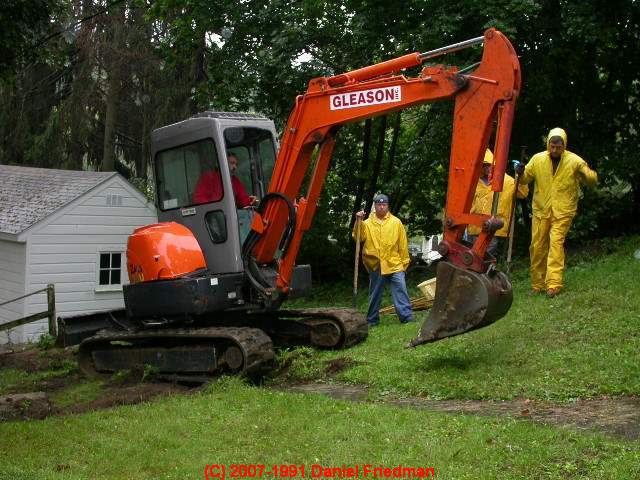
Replacing a house to septic or sewer system with piping that runs from the building exterior to a septic tank located downhill from the home.
We present an actual case study, illustrated with photos of each step in the diagnosis and replacement of a blocked sewer line.
The waste line in this case was found to be blocked, damaged, old, and needing replacement in the course of an attempt to clear a blocked drain between the house and septic tank. Technical reviewers are welcome and are listed at "References."
Also see CLOGGED DRAIN DIAGNOSIS & REPAIR
and see diagnosing septic backups and septic system failures versus clogged drains.
The first signs of a main building drain clog or breakage & leak problem
How to diagnose slow drains & toilet backups:
The first signs of a drain problem was the report by our tenant that the toilet was
slow to flush in the home.
Is the slow drain problem at a fixture, the whole building, or main drain?
Following our own advice on diagnosing clogged drains
and how to distinguish a clogged drain from a failed septic system
(online at CLOGGED DRAIN DIAGNOSIS & REPAIR we asked if all the drains in the home were slow or just the toilet.
The answer: all of the building plumbing fixture drains were slow. That tells us that the blockage is somewhere in the main building drain.
The toilet would show the most dramatic blockage
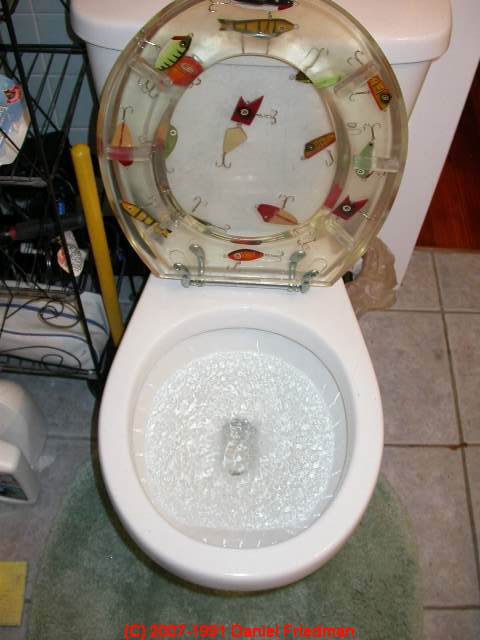
because it sends a large sudden discharge volume of water and waste into the sewer line. We flushed the toilet and watched the water rise right up to the bowl brim.
(If the toilet had begun to overflow we'd have reached inside the tank to manually close the tank flapper valve to stop the flush.)
Though not optimistic that it would make any difference, we tried plunging the toilet aggressively with a manual toilet plunger. It didn't help. Plunging the toilet made no difference. W
e already suspected a main drain or system problem (all drains were slow). So we needed a plumber to help with further diagnosis of the drain blockage.
[Continue this article using the links shown below.]
The details of this sewer line replacement article series are divided as shown at RECOMMENDED ARTICLES at the end of this page.
...
Reader Comments, Questions & Answers About The Article Above
Below you will find questions and answers previously posted on this page at its page bottom reader comment box.
Reader Q&A - also see RECOMMENDED ARTICLES & FAQs
How long will my new sewer line last?
How long should a replacement last? On 2016-05-16 by Camille J
Answer by (mod) -
Properly installed perhaps 30 to 50 years.
Thank you to our readers for their generous comments
I'm working as a sort of handyman I never done anything like this so all this information is very helpful to me. On 2016-07-21 by Jose Tinoco
...
Continue reading at WHEN to CALL a PLUMBER or select a topic from the closely-related articles below, or see the complete ARTICLE INDEX.
Or see these
Recommended Articles
- CLOGGED DRAIN DIAGNOSIS & REPAIR
- SEPTIC SYSTEM INSPECTION & MAINTENANCE COURSE - free online book on septic systems.
- SEWER LINE REPLACEMENT
- DIAGNOSE a BLOCKED DRAIN
- WHEN to CALL a PLUMBER
- FIND the MAIN BUILDING DRAIN
- USE a POWER SNAKE to CLEAR a BLOCKED DRAIN
- FIND DISTANCE to DRAIN BLOCKAGE
- DETERMINE NEED for DRAIN LINE REPLACEMENT
- REPLACE SEWER LINE, STEP BY STEP
- MAKE OTHER SEPTIC REPAIRS
- INSTALLING the NEW SEWER LINE
- BED the SEWER LINE in SAND
- FINAL BACKFILL SEWER LINE TRENCH
- DOCUMENT BURIED COMPONENT LOCATION
- FINAL SEEDING & RESTORATION
- SEWER / SEPTIC LINES at STEEP SITES
- SEWER / SEPTIC PIPE CAMERAS - find the point where digging is needed to repair a specific blockage or broken sewer line
- TRENCHLESS SEPTIC / SEWER LINE REPLACEMENT
Suggested citation for this web page
SEWER LINE REPLACEMENT at InspectApedia.com - online encyclopedia of building & environmental inspection, testing, diagnosis, repair, & problem prevention advice.
Or see this
INDEX to RELATED ARTICLES: ARTICLE INDEX to DRAIN SEPTIC SEWER PIPES
Or use the SEARCH BOX found below to Ask a Question or Search InspectApedia
Ask a Question or Search InspectApedia
Share this article:Search the InspectApedia website
Need to make a private comment? Email editor@inspectApedia.com. We welcome email with your website content critique, corrections, suggestions or questions. Email is monitored daily but our workload may prevent an immediate reply. For immediate results, we hope you'll first try asking your question using the search box just above.
Citations & Reviewers
In addition to any citations in the article above, a full list is available on request.
- New York State Department of Health, APPENDIX 75-A WASTEWATER TREATMENT STANDARDS - INDIVIDUAL HOUSEHOLD SYSTEMS , [PDF] New York State Department of Health, 3 February 2010, retrieved 3/1/2010, original source: https://www.health.ny.gov/regulations/nycrr/title_10/part_75/appendix_75-a.htm
- Thanks to Thomas Gleason, excavators, Poughkeepsie, NY 845-454-3730, for the excavating work at the project photo documented here in September 2006
- Thanks to Cleveland Plumbing, the prime plumbing contractor, Staatsburgh, NY 845-485-7700 for the plumbing work and drain clog diagnosis work documented here in September 2006
- Septic Tank/Soil-Absorption Systems: How to Operate & Maintain [PDF ] - , Equipment Tips, U.S. Department of Agriculture, 8271 1302, 7100 Engineering, 2300 Recreation, September 1982, web search 08/28/2010, original source: http://www.fs.fed.us/t-d/pubs/pdfimage/82711302.pdf.
- [3] "How to Maintain Your Septic System", Alaska Department of Environmental Conservation, Division of Water, retrieved 8/8/12, original source: http://dec.alaska.gov/water/wwdp/onsite/maintain_septic.htm [copy on file as Alaska_Septic_Care.pdf]
- [4] Installers Manual for Conventional Onsite Domestic Wastewater Treatment and Disposal Systems", Alaska Department of Environmental Conservation, Division of Water, retrieved 1/15/2001, original source: [copy on file as Alaska_Certified_Installer's_Manual.pdf]
- Tyler, E. T., R. Laak, E. McCoy, and S. S. Sandhu. 1977. "The Soil as a Treatment System." in Home Sewage Treatment. ASAE publication 5-77
- Septic Tank Maintenance - Guide M-113, R. Craig Runyan, Extension Water Quality Specialist, New Mexico septic tank size table , scheduled for update 11/07 (pending), Cooperative Extension Service, College of Agriculture and Home Economics, New Mexico State University (Las Cruces)
- "Manual of Policy, Procedures, and Guidelines for Onsite Sewage Systems," Ontario Reg. 374/81, Part VII of the Environmental Protection Act (Canada), ISBN 0-7743-7303-2, Ministry of the Environment,135 St. Clair Ave. West, Toronto Ontario M4V 1P5 Canada $24. CDN.
- In addition to citations & references found in this article, see the research citations given at the end of the related articles found at our suggested
CONTINUE READING or RECOMMENDED ARTICLES.
- Carson, Dunlop & Associates Ltd., 120 Carlton Street Suite 407, Toronto ON M5A 4K2. Tel: (416) 964-9415 1-800-268-7070 Email: info@carsondunlop.com. Alan Carson is a past president of ASHI, the American Society of Home Inspectors.
Thanks to Alan Carson and Bob Dunlop, for permission for InspectAPedia to use text excerpts from The HOME REFERENCE BOOK - the Encyclopedia of Homes and to use illustrations from The ILLUSTRATED HOME .
Carson Dunlop Associates provides extensive home inspection education and report writing material. In gratitude we provide links to tsome Carson Dunlop Associates products and services.
 |
HOME | ABOUT | ASK a QUESTION | CONTACT | CONTENT USE POLICY | DESCRIPTION | POLICIES | PRIVACY | |
| © 2026 - 1985 Publisher InspectApedia.com - Daniel Friedman | |||||||||