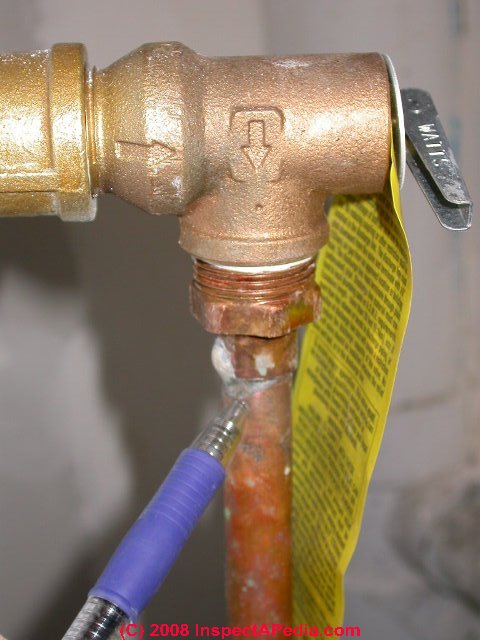
 Relief Valve Discharge Tube FAQs
- POST a QUESTION or COMMENT about TPR valve or temperature/pressure relief valve drain line piping
T&P valve discharge tube extension questions and an swers.
This article series describes the requirements for a discharge tube or drain line on temperature & pressure relief valves used on any appliance that heats water. These include hydronic heating boilers (hot water boilers), steam boilers, and all types of water heaters, both those that use a water storage tank or cylinder and those that heat water on demand such as tankless water heaters.
InspectAPedia tolerates no conflicts of interest. We have no relationship with advertisers, products, or services discussed at this website.
- Daniel Friedman, Publisher/Editor/Author - See WHO ARE WE?
Temperature/Pressure Relief Valve Discharge Tube Q&A
These questions and answers about proper piping of the extension tube or discharge tube connected to a temperature/pressure relief valve were posted originally at RELIEF VALVE DISCHARGE TUBE - topic home, be sure to read the proper installation details and codes found at that page.
Article Contents
- TPR VALVE DISCHARGE TUBE CORRUGATED or FLEXIBLE COPPER FAQs - is it ok to use flexible / corrugated tubing?
- TPR VALVE DISCHARGE TUBE MATERIAL: PLASTIC FAQs
- TPR VALVE DISCHARGE TUBE MISSING FAQs - no relief valve discharge tube installed - unsafe
- TPR VALVE DISCHARGE TUBE PIPED "UP" FAQs
- TPR VALVE DISCHARGE TUBE PLUMBING CONNECTIONS FAQs
- TPR VALVE DISCHARGE TUBE TERMINATION LOCATION FAQs
Also see our index to all water heater pressure/relief valve questions and answers at RELIEF VALVE, WATER HEATER DIAGNOSE & REPAIR FAQs
...
Relief Valve Discharge Tube Piped Upwards or Horizontal FAQs
 Tip: See TPR DISCHARGE DRAIN PIPED UP - usually unsafe
Is the relief valve suppose to be horizontal or vertical
Is the relief valve suppose to be horizontal or vertical? 2017/01/01 Anonymous said:
Reply: relief valve mouth should always point downb
The relief valve discharge opening or "mouth" must point DOWN
Up and down pressure relief valve piping
Can you run a pipe down then back up off a pressure relief valve - (Feb 18, 2015) Kev
Reply: NO
Kevin,
No that's dangerous and prohibited. Up-piped TPR discharge piping can hold water in the line causing the valve operating mechanism to clog with minerals or debris. The risk is a BLEVE EXPLOSION.
Can I route my tankless water heater relief valve discharge up through my foundation wall top to the ourdoors?
My new tankless water heater is in a place in my basement (finished) where there is no floor drain. A sump pit and pump exist in the area. Obviously if my relief valve activates, if it were to just be allowed to dump onto the floor, the water would travel through a finished part of my basement before reaching the drain.
Right now I have a piece of plastic tubing attached to the bottom of the 3/4" relief valve pipe.
This is probably not the best or legal solution but it would keep my basement from flooding (so long as sump pump operates.)
Is there a legal option of looping the relief valve discharge tube up through the band board of my house so it can drain to the outside? (Nov 12, 2012) W Fisher
Reply: NO, Do not pipe the TP valve discharge tube UP
Watch out: Do not pipe the TP valve discharge tube UP - the result (because dripping or leaks can remain in the piping and valve opening) can be a clogged, failed TP valve and a fatal BLEVE explosion.
You can pipe a tp valve down and to a floor drain provided the end of the extension remains visible.
...
Relief Valve Discharge Tube Termination Location FAQs
TPR Valve Discharge Tube Termination Location: into drain overflow pan?
Re: "TPR Valve Discharge Tube Termination Location: The water that may be discharged from a T&P valve must be conducted to a safe place of disposal. This may be a floor drain (recommended by Watts) or in some jurisdictions another location may be permitted."
Is it acceptable to use the drain pan as the TPR Valve Discharge Tube Termination Location when the drain pan has drain tube that terminates in a floor drain? On 2023-01-23 by Anonymous
by InspectApedia Publisher - proper relief valve drain system makes it possible for you to see if the valve is dripping or discharging
@Anonymous,
Unless I'm missing something in your question that's a perfectly acceptable solution.
As a side note, it's important that the Relief valve drain system make it possible for you to see if the valve is dripping or discharging.
Is it OK to discharge relief valve into the plumbing? or into a bucket?
Prior installation routes TPR discharge line, via copper, into hole cut in sub-floor.
I need to examine closer once I remove water heater to be replaced, but since this same hole also provides routing for a copper supply line elsewhere in the home, I am concerned that the discharge is routed into the active plumbing system.
1. Is it acceptable to route discharge into the plumbing system?
2. Assuming it is NOT, is it acceptable for me to cap the prior connection at the plumb line, NOT the discharge line, and route the new discharge properly down only, into a plastic 5 gallon bucket? There is no floor drain in this location.
Wouldn't tapping into a pressurized line violate the gravity requirement for discharge? - On 2022-01-02 by Mattenzie
by Inspectapedia Com Moderator - not acceptable to route discharge into the plumbing system
@Mattenzie,
It would not be possible to discharge a TPR valve into a water supply line - you'd simply have backpressure on the safety valve and it could never work
That would be very dangerous, risking a BLEVE explosion.
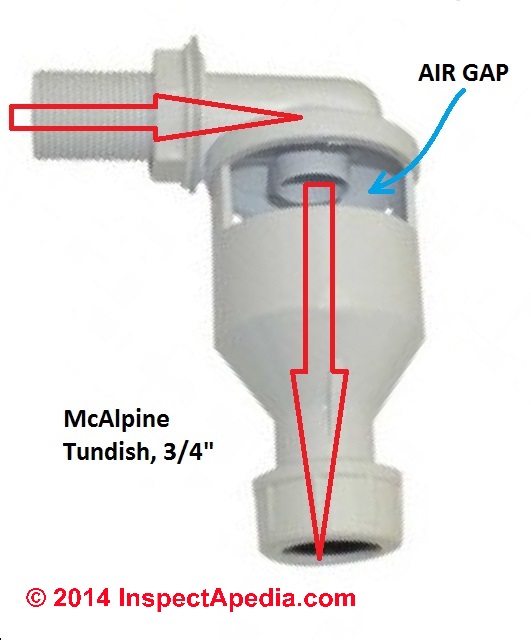
Also a TPR valve discharge end MUST be VISIBLE so that occupants can see that it's leaking - a dangerous condition - OR a special device like a "tundish" - search InspectApedia.com for details - must be installed.
The problem with discharging into a bucket - other than during service - is that you can't see if there is active leaking from the valve - unless the bucket is normally empty.by Mattenzie
@Inspectapedia Com Moderator, thank you very much for the feedback.
Hopefully the discharge disappearing into the subfloor does so to a hidden drain and not into the plumbing system.Though I will need to correct for visibility if a drain is there. Perhaps I could do a proper TPR run to a drain pan which could then route to the possible hidden drain, which would also allow for drainage in the case of a full heater failure and drainage (separate from TPR drainage).
If it does tap into the plumbing system, I'll disconnect and cap that line to keep the TPR discharge free and visible.
I will still be caught with no drainage though due to initial construction.by Inspectapedia Com Moderator
@Mattenzie,
Use the on Page search box or look in the index to related articles to read about the
TUNDISH used in PLUMBING
for an alternative approachby Mattenzie
@Inspectapedia Com Moderator, thank you, I was just looking at that as well and am going to check it against our local codes. I really appreciate your help!
My water heater T&P valve goes through a corrugated extension and out through a wall and under a slab
I have a cold water line coming from the bottom of the cold water shut for water heater to the discharge line of the T&P valve.
I just replaced the valve because it was leaking or so I thought.
Now I think that the cold water line is what is constantly draining out.
The discharge line goes into the wall and under the slab to the outside. Can I just remove that line?
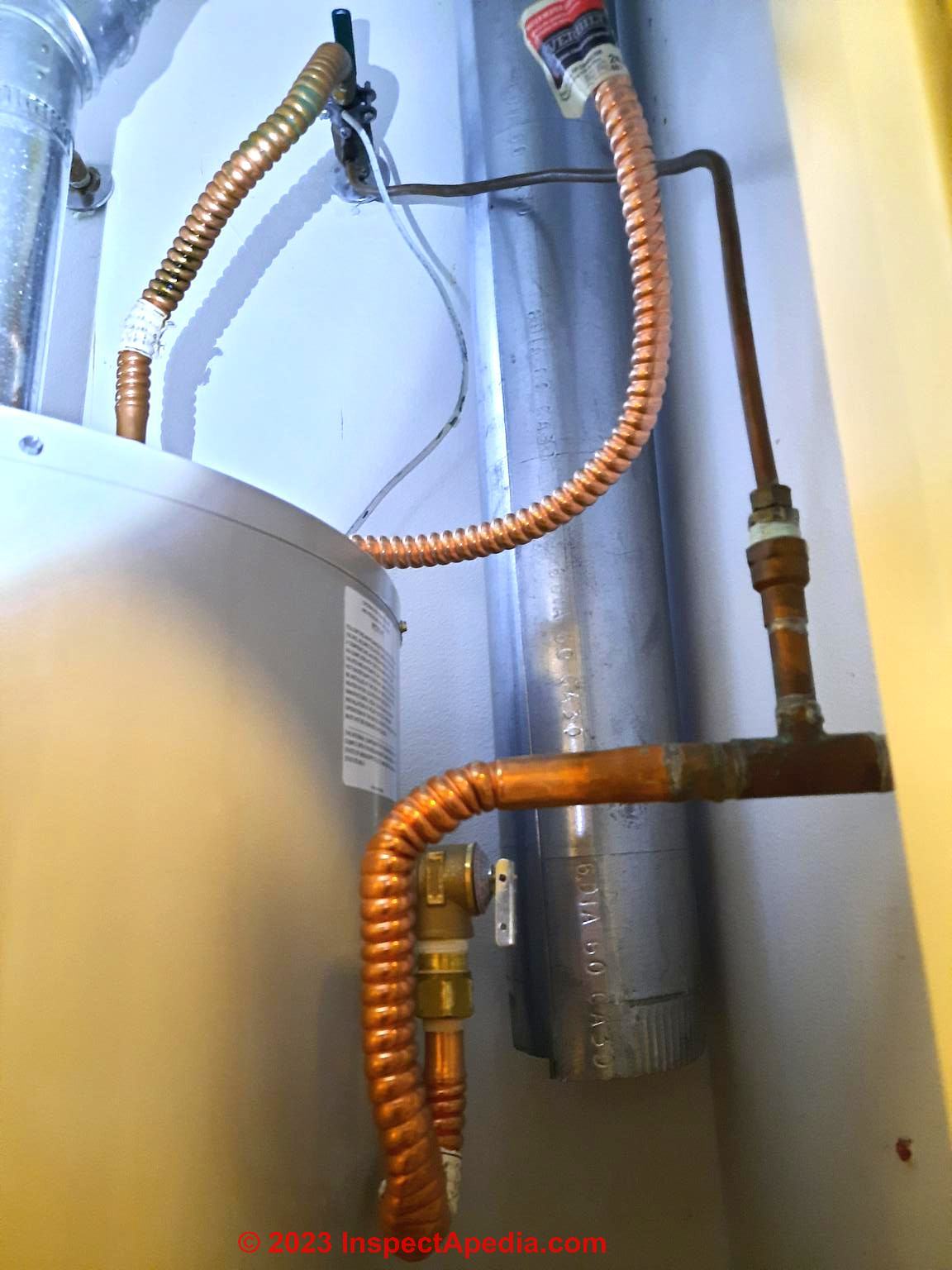
On 2021-07-10 by H Brown
by inspectapedia.com.moderator - Watch out: improper, illegal, and dangerous water heater relief valve piping arrangement
@H Brown,
We don't know what the heck is going on with that piping in your photo, in that we don't know the sources or destinations of the extensions and connections to that relief valve extension pipe.
But for sure I can say
Watch out: this is an improper, illegal, and dangerous piping arrangement - in all events - because it the relief valve discharge has been piped down into a "U" and then UP and then horizontally out to - who-knows-where.
Piping a relief valve "up" means that if/when it drips or leaks the water held against the valve outlet by that up-piping invites corrosion, debris, blockage of the valve outlet that can result in a dangerous BLEVE EXPLOSIONThere is also a concern that the use of corrugated tubing for a relief discharge tube may reduce the flow capacity of the extension, causing an unsafe condition if the relief valve is in effect constricted.
See TPR DISCHARGE TUBE CORRUGATED / FLEXIBLE ?I speculate that someone routed the discharge tube to a drain or to the outdoors but it's dangerous at the outset because of that up-piping, and possibly also dangerous if its ending cannot be observed (as no one will know that it's leaking so won't know of unsafe conditions at the water heater)
I speculate that that small diameter tubing connected by Tee to the improper relief valve discharge tube along its horizontal run may be draining A/C condensate - if so then we have additional unsafe, unsanitary, dangerous plumbing:
- algae, sediment, debris can add to clogging of the relief valve itself - again adding to the BLEVE danger
- wastewater discharged in that smaller tube can contain pathogens that as piped form a cross connection between wastewater and potable water in the building - also an improper plumbing detail that risks contaminating the building's water supply.
See details at CROSS CONNECTIONS, PLUMBING
Watch out: finally when we see plumbing like this in a building we know for sure that plumbing work has been done by someone who has, frankly, no idea of proper, safe, sanitary plumbing - so you should be alert for and have an inspection for other unsafe, improper, unsanitary plumbing work
Correct this immediately lest your water heater turn into a catastrophe. The cost should be minor, especially compared with the risks.
Just removing that "cold water line" into the TPR valve extension tee is nowhere near-enough.by H Brown
@inspectapedia.com.moderator, Thank you. That cold water pipe comes out of the bottom of the shut off. Someone wondered if it was to cool the hot water when being discharged...
or is it something that was added when the last homeowner put a recirc pump on and used one of those connections at the faurthest faucet. That was removed though. I see that for sure I'll have to get the discharge pipe lower.
My T&P valve is inserted down into a drain line that goes outdoors - does it have to be mechanically attached?
I have a T&P that is just inserted into a PVC drain line that goes to the outdoors. I looked through the code book (IRC) and can't find any where that states it must be mechanically attached. Should I have the plumber attach it or let it ride? Or where can I find it in writing? On 2016-06-14 by Michael
And
Hi I would appreciate if you could advise where I should direct the relief valve pipe to. The 45 litre electric hot water unit is installed under the kitchen bench inside the cupboard in a unit.
The kitchen under sink outlet pipes are higher than the relief valve pipe. On 2016-05-18 by Alfred
by (mod) -
Michael: the end of the relief valve discharge tube does not have to be mechanically attached to the drain and in fact there should be an air gap between the two.
Alfred: you can NOT pipe a relief valve drain pipe "upwards" as doing so is unsafe, risking valve clogging and a BLEVE explosion of the water heater. Your heater's relief valve can terminate above a drain pan.
Watch out: for safety, in all cases, either the end of the drain needs to be visible or if your local codes permit, you can install a Tundish -
See details at
Unsafe relief valve on old Rheem water heater: extension undersized, routed out of sight
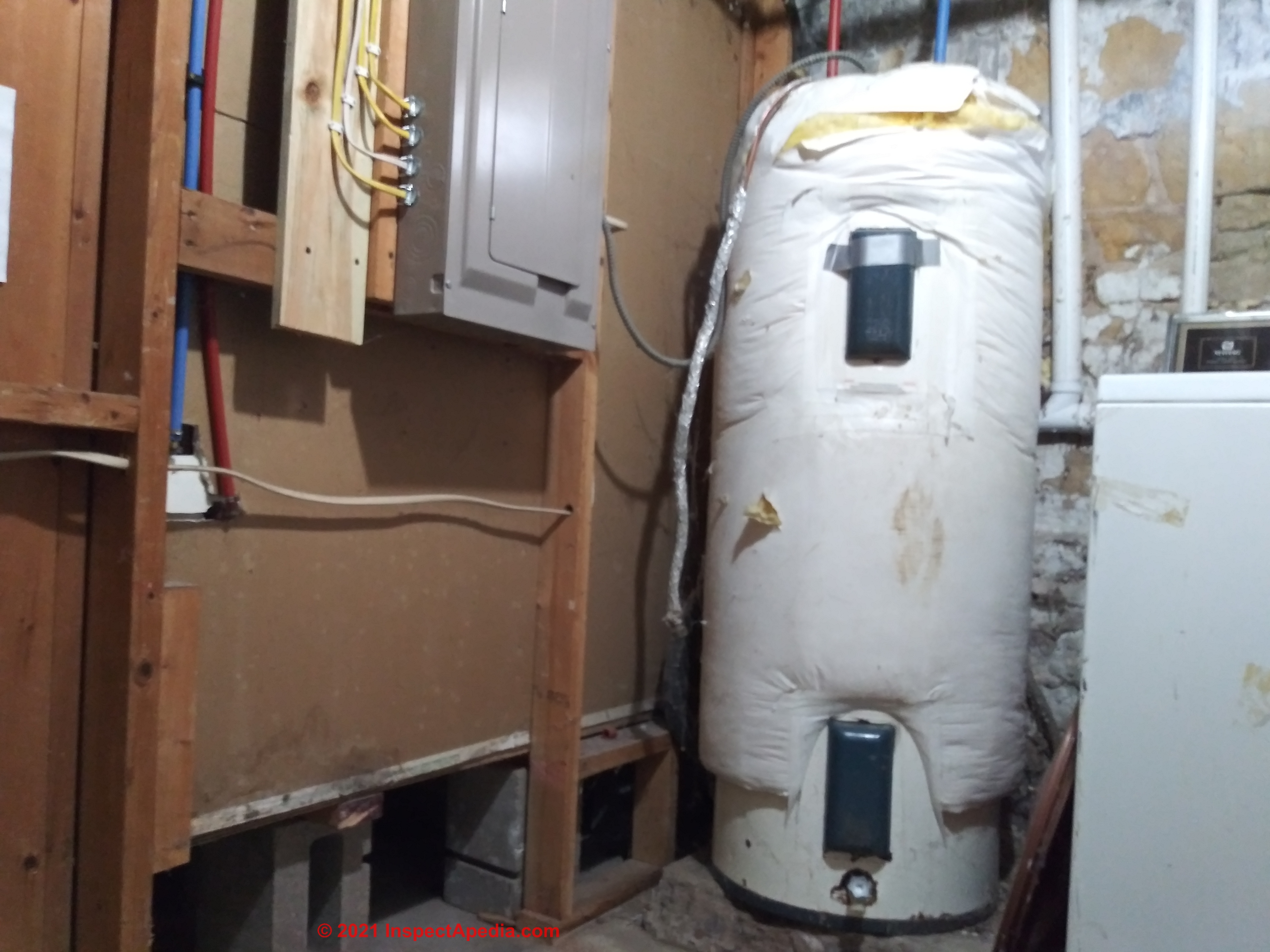
I am a tenant who found this the other day on a 35 year old water heater: (see pics)
Then this and another pressure relief valve on a furnace boiler were overlooked for code violations in an official inspection--which I arranged--which took all of five minutes.
There are other things I might mention. I wish the water heater were red-tagged, but you know, I'm only a tenant.
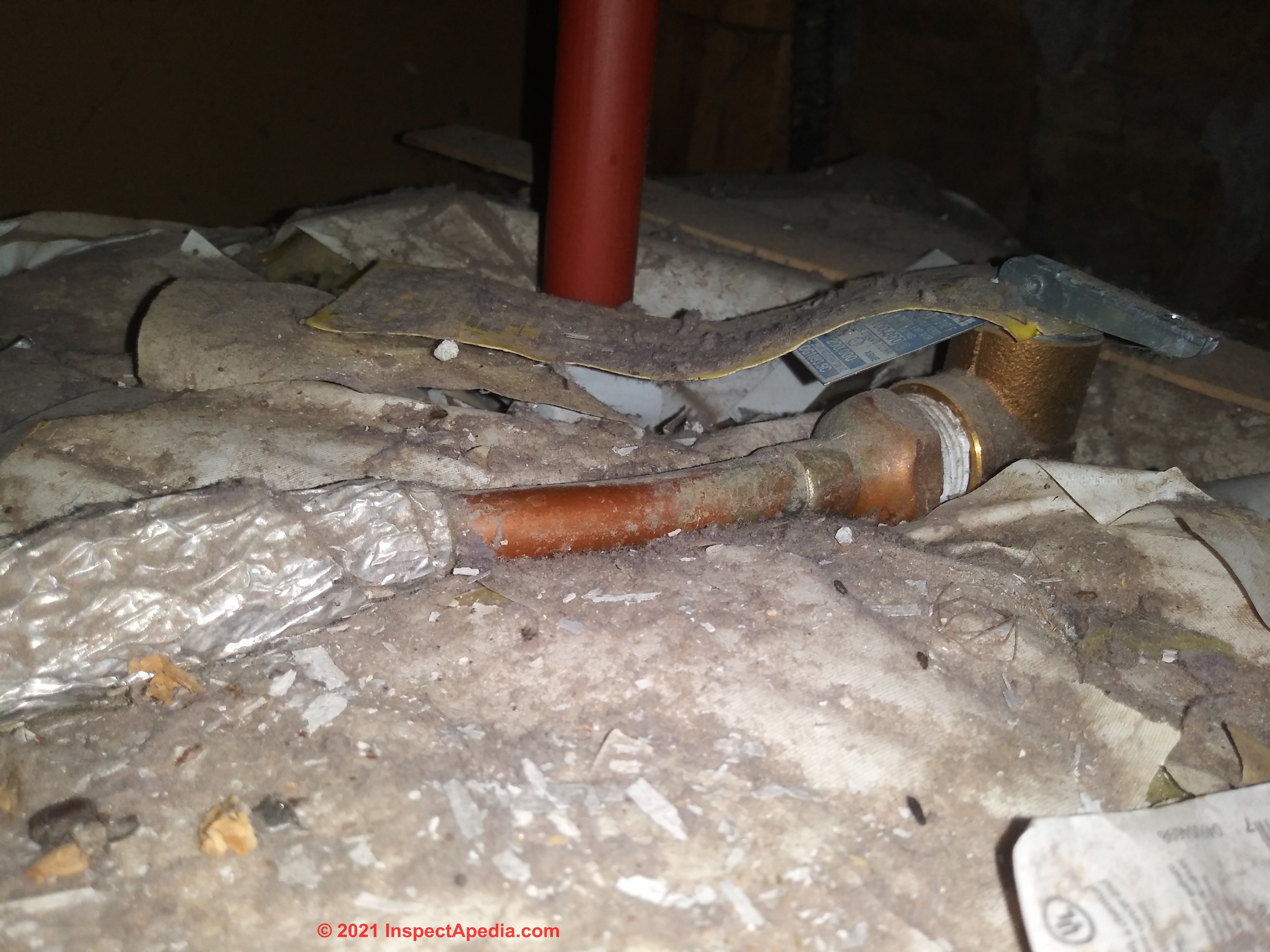
Who, besides a willing contractor/plumber (which tenants don't hire in this state) can (red tag)?

From what I understand, if it's still functioning, an ordinary inspector will give an appliance a passing grade and therefore the official "okay". (happened already).
They don't seem to care to look as closely at things like temperature and pressure relief valves as your inspection website does--but I wish.
Where could I have found such care and expertise in an inspector the first time? - Anonymous by private email 2021/05/04
Moderator reply: building landlord is responsible for safety of mechanical equipment
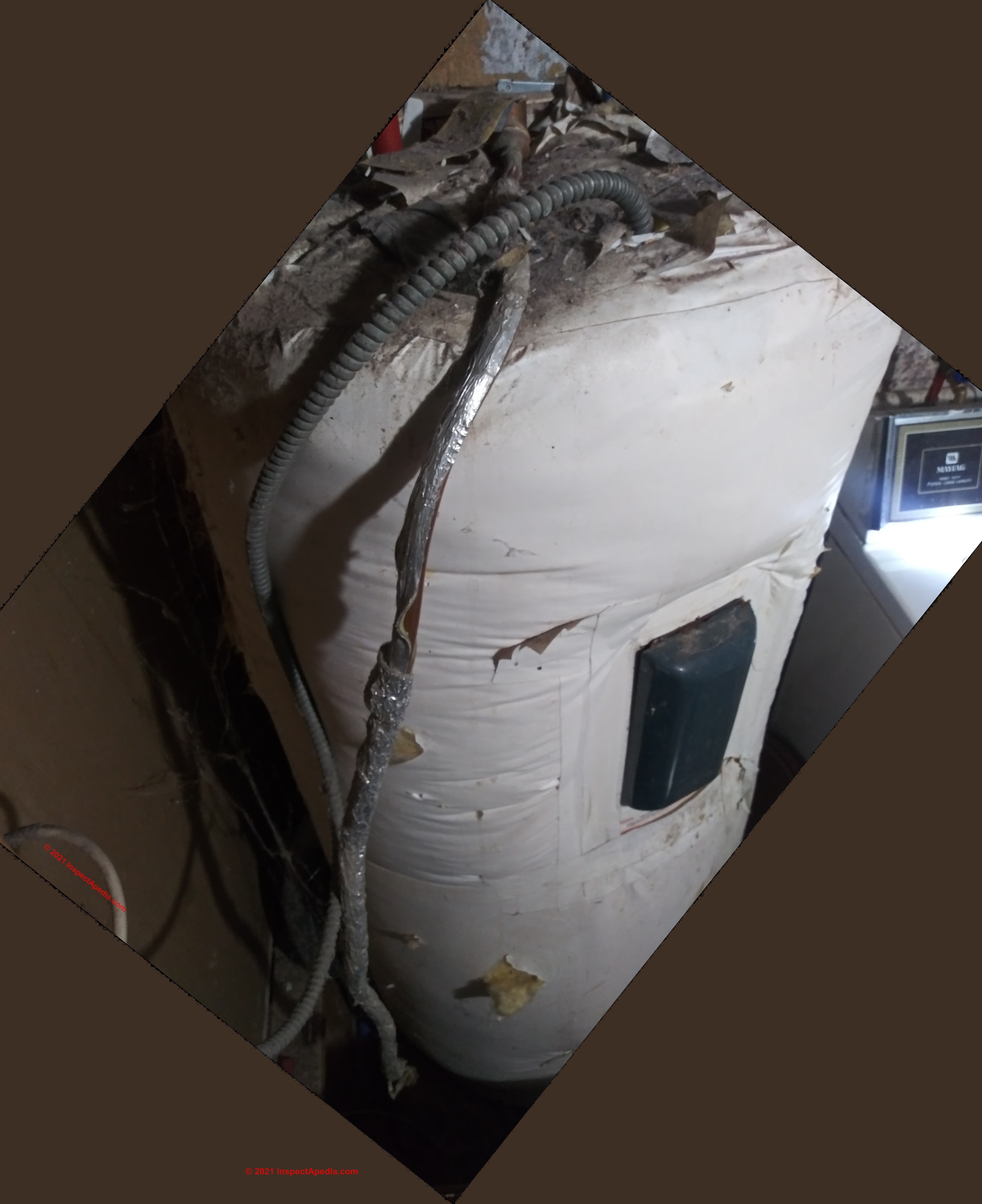 Watch out: as you already know this water heater is unsafe, risking a very dangerous
as your photos shows improper and dangerous modifications:
- The relief valve discharge tube is down-sized, smaller than the opening of the relief valve itself, reducing the valve's ability to release heat, pressure, energy, should the heater over-heat
- There is a drop of water at the discharge tube mouth that may be telling us that this valve leaks - which risks valve clogging by mineral scale and again risking that it cannot work safely if called-on to do so.
- I think your photo of the water heater shows rust at its bottom; an old water heater and especially a rusty one that has suffered leaks over its life is at greater risk of bursting - a BLEVE explosion risk.
- Some of the discharge tube is wrapped in foil and isn't visible so there may be other hazards.
- Incidentally, that water heater insulation is not required and in some installations can be itself unsafe, e.g. if it blocks view of or draining of a relief valve.
"Red tagging" is most-often done by a service technician. Others (building code inspector or home inspector) should write up the issue, and because it's a life-safety concern, ought to notify all parties concerned, including owners and occupants of the building - in writing and orally.
The cost to cure is trivial: a few dollars in plumbing parts and, of course, the plumbers labor charge.
It's worth noting to your landlord both orally and in writing immediately that
- There are immediate life-safety hazards at the property
- The cost to correct them might be trivial
More information is at RELIEF VALVE, WATER HEATER
Reader follow-up:
Thank you. You said: "the cost to cure is trivial..." Yes, but I'm thinking it might/should be a little more--based on the opinion of a couple of plumbers I've spoken with--and the tank's age
(you're right, though, still trivial--compared to the risk mentioned)--Neither one would be willing to touch it, but instead recommended replacement due to age.
concerning the heating element, it was suggested that it might be impossible to get a replacement part for that as well.
Moderator reply:
Thanks for the discussion;
By "trivial" I mean that the cost of the correct-sized relief valve discharge tube in 3/4" copper (or even PVC) probably less than $10. U.S.
The plastic Reliance -brand T&P discharge pipe I show here is sold by plumbing suppliers locally and on-line for about $12. U.S.
An hour of plumber's time to install the tube costs $50. to $150 depending on where the building is located. (many handyman people could also do this job)
I've already cited the safety concern.
Details are at BLEVE EXPLOSIONS
None of this addresses a separate question of an old water heater that's shot.
by no means do I want to sound glib; and I know it's FAR too easy to sit in some distant spot and tell someone else to just spend money.
Maybe the water heater needs to be replaced: if it's leaking or badly-corroded, for example. No one can see that from your original question.
In fact you might want to check out the opinion at
OTHER PEOPLE's MONEY
Can I just dump the T&P valve into a crawl space under a slab?
This electric heat pump water heater is installed in a crawlspace (6" ceiling). The water heater is sitting on a reinforced 4" concrete slab.
Would it be acceptable to allow the T&P valve to simply dump into the crushed rock in the crawl space? Could the same be done with the condensate line?
Two alternatives:
1. Pipe the T&P and condensate lines to a sump with a float to pump outside. (Probably the appropriate approach but rather difficult given rocky soil condition and distance.)
2. The house's main sewer line is right next to the water heater but about 28" above the base of the water heater (ie not a floor drain). A "P" Trap could be installed about 10" under the T&P. (Probably not permitted because it is above floor height?) - On 2020-07-15 by Doug H
Reply by (mod) - Discharge from a T&P valve discharge tube must be visible, and dumping water into a crawlspace is a bad idea
Doug.
Even though the discharge of water into an area may not, in your opinion, cause damage to the building, the point of discharge must be visible so that someone can spot trouble (leaks) before a catastrophe occurs
OR
Your local building code inspector might indeed approve routing the relief valve discharge to a hidden and harmless location provided a Tundish is installed so that leaks can be detected.
See details at
...
Corrugated or Flexible Tubing for Relief Valve Discharge Tube FAQs
Use of Flexible Copper Tubing as Water Heater TPR Valve Discharge Tube ?
Can 3/4-inch flexible copper tubing sections (with FIP ends) be legally used in any part of a water heater's T&P discharge line? 13 March 2015 Stan Stan the Inspector Man
Reply:
Thanks for the excellent question, Stan.
In a photo included here on RELIEF VALVE, WATER HEATER you can see a flexible 3/4" copper tube used in the routing of the discharge of a TP valve from the top of a water heater.
No one called out the use of that piping material itself as a hazard, but there can be hazards nonetheless depending on how that tube is routed - such as to a hidden location without a Tundish or routed "up" from the TP valve itself.
So ... it depends. If for example someone installed a flexible line to replace a straight downtube running down the side of a water heater from the TP valve, I'd be worried that some fool would come along and bend the tubing "up" - as nothing prevents them from doing so.
Maybe to get it out of the way of a basketball or something. The result is a dangerous blockage of the TP valve and the risk of a BLEVE explosion.
SO if I I were a building inspector given final authority I'd object to that installation. But I might not object to use of the same tubing connecting properly beween a valve's discharge opening and a proper destination.
Quoting from Watts:
Discharge line must always be installed to avoid water damage and scalding injury, when valve operates.
Discharge line must be same size as valve outlet, be pitched down for free draining, and have no shut-off valve or obstructions throughout its entire length.
Discharge line termination point should be visible to observe any discharge.
Nothing in their installation instructions prohibit use of flexible lines per-se but in summary, it is certainly possible to find two violations:
1. the flexible line, if not connected at both ends, could be bent "up" causing an unsafe condition
2. it is not permissible to terminate a TPR valve discharge line with a threaded fitting - the reasoning is that it's too easy for someone to screw a cap onto a dripping line, leading ultimately to a BLEVE explosion.
See details at RELIEF VALVE DISCHARGE TUBE
including TPR DISCHARGE TUBE CORRUGATED / FLEXIBLE ? - restricts flow, may be unsafe
Can 3/4-inch flexible copper tubing sections (with FIP ends) be legally used in any part of a water heater's T&P discharge line?
Can 3/4-inch flexible copper tubing sections (with FIP ends) be legally used in any part of a water heater's T&P discharge line? - 13 March 2015 Stan Stan the Inspector Man
Reply: yes but not as termination and not piped up and not where the line can be bent "up"
Thanks for the excellent question, Stan.
In a photo above on this page you can see a flexible 3/4" copper tube used in the routing of the discharge of a TP valve from the top of a water heater. No one called out the use of that piping material itself as a hazard, but there can be hazards nonetheless depending on how that tube is routed - such as to a hidden location without a Tundish or routed "up" from the TP valve itself.
So ... it depends.
If for example someone installed a flexible line to replace a straight downtube running down the side of a water heater from the TP valve, I'd be worried that some fool would come along and bend the tubing "up" - as nothing prevents them from doing so.
Maybe to get it out of the way of a basketball or something. The result is a dangerous blockage of the TP valve and the risk of a BLEVE explosion. SO if I I were a building inspector given final authority I'd object to that installation. But I might not object to use of the same tubing connecting properly between a valve's discharge opening and a proper destination.
Quoting from Watts:
Discharge line must always be installed to avoid water damage and scalding injury, when valve operates.
Discharge line must be same size as valve outlet, be pitched down for free draining, and have no shut-off valve or obstructions throughout its entire length. Discharge line termination point should be visible to observe any discharge.
Nothing in their installation instructions prohibit use of flexible lines per-se but in summary, it is certainly possible to find two violations:
1. The flexible line, if not connected at both ends, could be bent "up" causing an unsafe condition
2. It is not permissible to terminate a TPR valve discharge line with a threaded fitting - the reasoning is that it's too easy for someone to screw a cap onto a dripping line, leading ultimately to a BLEVE explosion.
...
Relief Valve Discharge Tube Material FAQs - Plastic OK?
Is our boiler relief valve white plastic discharge tube not to code? Is Copper required by code?
Recently we replaced our 14 year old Ultra 310 Boiler with a new Evergreen 399 Boiler. Our Ultra 310 boiler was professionally installed with a plastic PT valve a white plastic discharge tube.
During a routine maintenance, we
were told that the white plastic was not to code and should be replaced with copper.
At the time, we immediately requested the heating company to replace the plastic and paid a substantial amount of money to do this. |
We now have a new Evergreen Boiler and the copper was removed and replaced with a blue plastic discharge tube. So, which should it be? We are puzzled. On 2020-02-21 by Eleni
by (mod) - plastic plumbing pipe discharge tube is permitted in most jurisdictions
Eleni
I'd like to see photos of the relief valves that you mention and of their discharge tubes.
I am not aware of any temperature/pressure valve that itself is made of plastic.
It is common to see plastic discharge tubes on some PT valves and that's an accepted practice provided the tubing is properly rated for the temperatures involved.
"A substantial amount of money" worries me.
As you can see from the example I give below, a typical residential boiler relief valve costs less than $100. U.S. and a typical discharge tube of 3 or 4 feet or less costs less than $10. U.S.
Even if a plumber charged a minimum of an hour's labor to unscrew the old valve and screw in the new one and its discharge tube that ought not amount to a substantial total (where I read "substantial" as hundreds of dollars) unless there was something rather unusual and costly going on in your home.
Does the relief valve discharge tube have to be of copper? Is PVC ok?
Thanks for the information. Is there any requirement that the fitting and pipe extension is required to be made from copper? I came across a boiler where the fitting off the T&P and the extension to the floor is made of PVC. - Kevin 7/26/2011
Reply by (mod) - most code officials accept PVC.
Kevin the relief valve would itself tap into a metal fitting on the boiler or on older installations on metal heating piping. But the discharge tube on many new installations is plastic; it's a pipe that rarely sees service and whose job is to divert hot water to the floor rather than onto a bystander.
In that application most code officials accept PVC.
Is a PVC Extension on my water heater relief valve OK?
Have Hot water heater in garage mounted on stand approximately 3 feet off ground.
Relief Valve has a PVC pipe which goes to floor but not to drain nor outside. Is this sufficient?
And what is probability of valve releasing in typical operations? On 2017-04-18 by Jeff R
by (mod) - yes
What you describe is commonly-permitted but the legal answer rests with your local plumbing inspector.
TPR valves do not spill water in normal daily operation of the water heater. THey open when unsafe conditions are present - over pressure or over temperature.
OK to connect a garden hose to the pressure relief valve?
Is it safe to connect a hose to the pressure relief valve if it drains into a floor drain? On 2017-10-22 by Sarah
by (mod) - NO
Sarah
No, garden hose material is not an approved nor safe material to use for a temperature/pressure relief valve discharge tube.Not only is the hose not rated to safely carry very hot water, it's inner diameter may constrict the valve's discharge flow rate (dangerous), and further, a flexible drain extension on the pressure/temperature relief valve might for various reasons end up spraying hot water on someone nearby.
...
No Relief Valve Discharge Tube Installed FAQs
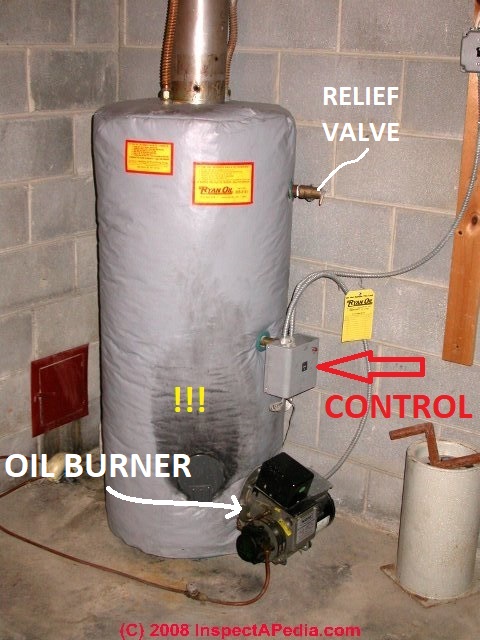 There's no discharge tube on TP valve, steam is coming out; Is it a Wrong TP valve rating?
I have a relief valve right on top of my steam boiler, it doesn't have a discharge outlet but it has openings right on top of it where I see some, if not too much steam coming out, it should be replaced or it is normal? (Oct 8, 2012) Filipe Bernardino
If the installation for my boiler said use 50psi and the tech put in 30psi relief valve. do you think that's the reason it keeps leaking. - (Oct 8, 2012) raul
Reply by (mod)
Fillip,
The valve should not be leaking, but before replacing it you need to know why it's leaky, as the problem may not be the valve. Call your service company as this is va safety concern
Watch out: a discharge tube is required on TP valves to direct discharge from the valve dowwards and away from anyonewho may be nearby in order avoid scalding burn hazards.
Raul
Compare the actual boiler pressure when leaks are seen with the valve rating. Normally a hydronic heating boiler doesn't run over 30 psi
...
Relief Valve Discharge Tube Plumbing Connections FAQs
Can I use a plumbing Tee and elbow to connect the relief valve combined with an air eliminator?
My T&P valve on my gas boiler was installed horizontally so they could place an air eliminator valve in the vertical position. Is it safe to use a brass tee out of the boiler, place the T&P valve correctly (vertical) and apply a brass elbow off the tee so I can use a vertical air eliminator valve also? - On 2021-09-13 by Sam
by inspectapedia.com.moderator - No, You can NOT install a pressure relief valve into a tee
@Sam,
You can NOT install a pressure relief valve into a tee for several reasons including
increasing its distance from the device it's supposed to protect,
affecting its ability to sense temperature correctly,
and possibly interfering with a temperature sensor probe
If the correct pressure relief valve is installed it can be mounted in either a vertical or horizontal position, of course with the mouth or opening facing out or down
Should TP Valve Discharge Lines be Trapped?
Does TP valve on residential water heater use a p-trap - Xavier
Reply:
No Xavier, the discharge from a TP valve should not be trapped it's discharge end should be visible
...
Continue reading at RELIEF VALVE DISCHARGE TUBE - topic home, or select a topic from the closely-related articles below, or see the complete ARTICLE INDEX.
Or see these
Recommended Articles
- RELIEF VALVE LEAKS
- RELIEF VALVE DISCHARGE TUBE
- RELIEF VALVES, BOILERS
- RELIEF VALVES - TP VALVES - home
- TUNDISH used in PLUMBING
- WATER HEATER SAFETY
Suggested citation for this web page
RELIEF VALVE DISCHARGE TUBE FAQs at InspectApedia.com - online encyclopedia of building & environmental inspection, testing, diagnosis, repair, & problem prevention advice.
Or see this
INDEX to RELATED ARTICLES: ARTICLE INDEX to T&P RELIEF VALVES
Or use the SEARCH BOX found below to Ask a Question or Search InspectApedia
Or see
INDEX to RELATED ARTICLES: ARTICLE INDEX to PLUMBING SYSTEMS
Or use the SEARCH BOX found below to Ask a Question or Search InspectApedia
Ask a Question or Search InspectApedia
Share this article:Search the InspectApedia website
Need to make a private comment? Email editor@inspectApedia.com. We welcome email with your website content critique, corrections, suggestions or questions. Email is monitored daily but our workload may prevent an immediate reply. For immediate results, we hope you'll first try asking your question using the search box just above.
Citations & References
In addition to any citations in the article above, a full list is available on request.
- In addition to citations & references found in this article, see the research citations given at the end of the related articles found at our suggested
CONTINUE READING or RECOMMENDED ARTICLES.
- Carson, Dunlop & Associates Ltd., 120 Carlton Street Suite 407, Toronto ON M5A 4K2. Tel: (416) 964-9415 1-800-268-7070 Email: info@carsondunlop.com. Alan Carson is a past president of ASHI, the American Society of Home Inspectors.
Thanks to Alan Carson and Bob Dunlop, for permission for InspectAPedia to use text excerpts from The HOME REFERENCE BOOK - the Encyclopedia of Homes and to use illustrations from The ILLUSTRATED HOME .
Carson Dunlop Associates provides extensive home inspection education and report writing material. In gratitude we provide links to tsome Carson Dunlop Associates products and services.
 |
HOME | ABOUT | ASK a QUESTION | CONTACT | CONTENT USE POLICY | DESCRIPTION | POLICIES | PRIVACY | |
| © 2026 - 1985 Publisher InspectApedia.com - Daniel Friedman | |||||||||