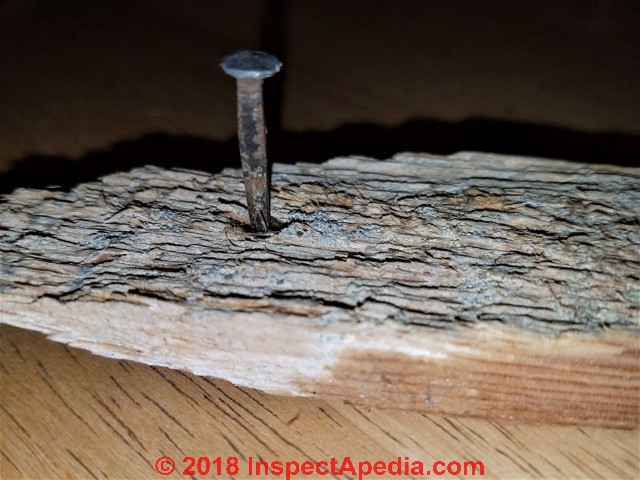
 Cut Nail Nail Age, History, Identification FAQs
- POST a QUESTION or COMMENT about hand-cut or machine-cut nail age, properties, uses, types, useful also in determining building age by examining its hardware
Questions & answers about how to identify antique & modern reproductions of cut nails.
This article series includes an identification key to specific types & dimensions of cut nails, followed with examples and description of hand-wrought heads.
InspectAPedia tolerates no conflicts of interest. We have no relationship with advertisers, products, or services discussed at this website.
- Daniel Friedman, Publisher/Editor/Author - See WHO ARE WE?
Antique & Reproduction Nail Identification Q&A
These questions and answers about using our key to determine the age and type of cut nails were posted originally
at NAIL ID & AGE: CUT NAILS - be sure to check out the diagnostic suggestions on that page.
Age & purpose of nail found on island off of Aruba
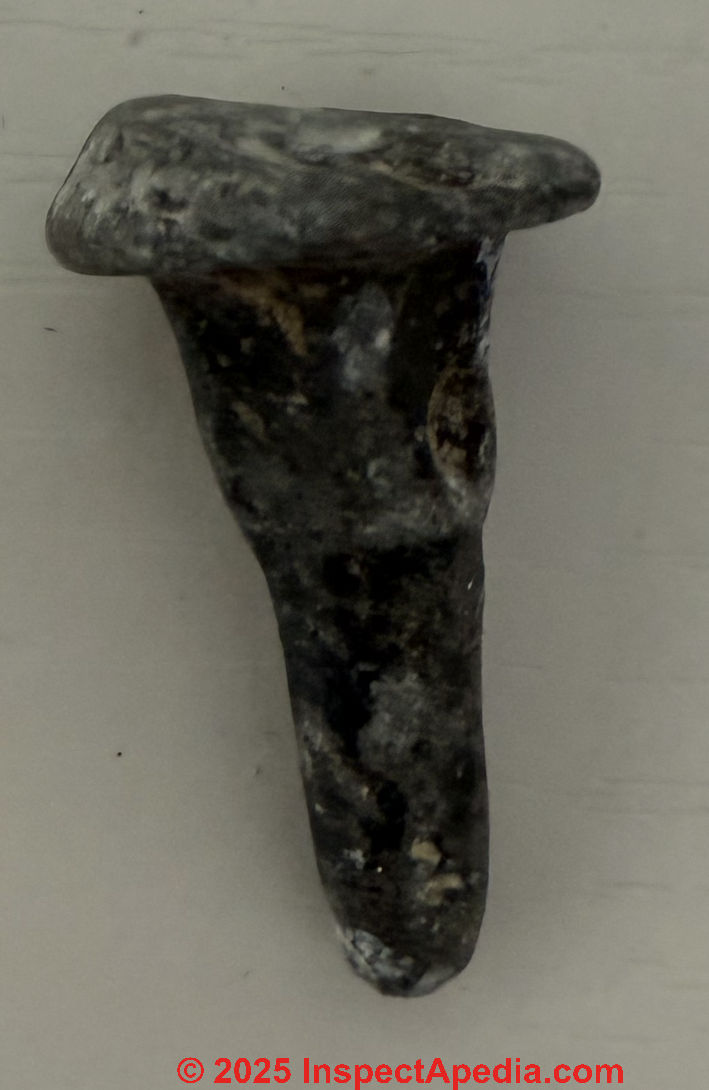
I found this nail on a small island off the coast of Aruba. It’s about an inch and a half in length and the head is about 3/4 of an inch. Any help/guidance/knowledge would be greatly appreciated. Thank you. On 2025-04-02 by Mary
by InspectApedia Publisher (mod)
@Mary, here's another of the photos of your nail - rec'd by private email.
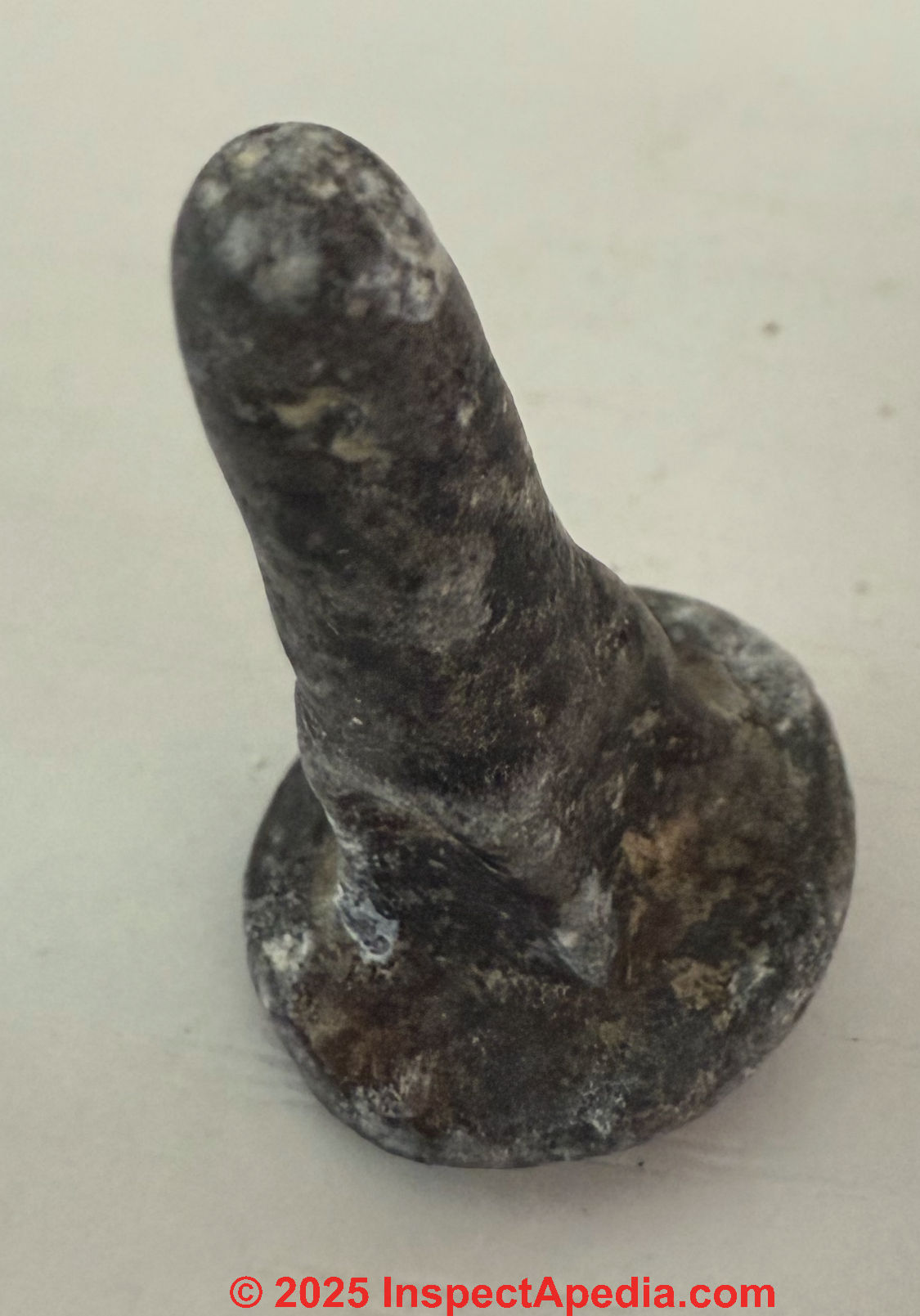
My initial guess, based on this photo alone, was that we were seeing the head of a hand wrought nail, The shank of which has rusted away.
But now I think that guess was completely wrong.
Additional photos that you sent by private email show what looks like a perfectly round head and round shank.
Notice the round shank and the square shape just under the very round head.
Usually that square under-head shank form appears on bolts that are set into a square hole in an iron plate - designed to prevent rotation of the bolt during tightening.
Is your "nail" iron (magnetic) or another metal such as brass?
This is a great example of how a single nail photo from a particular angle can be tricky to interpret. - Daniel
Age of 6" & 10" Iron Spikes found in the Thames River
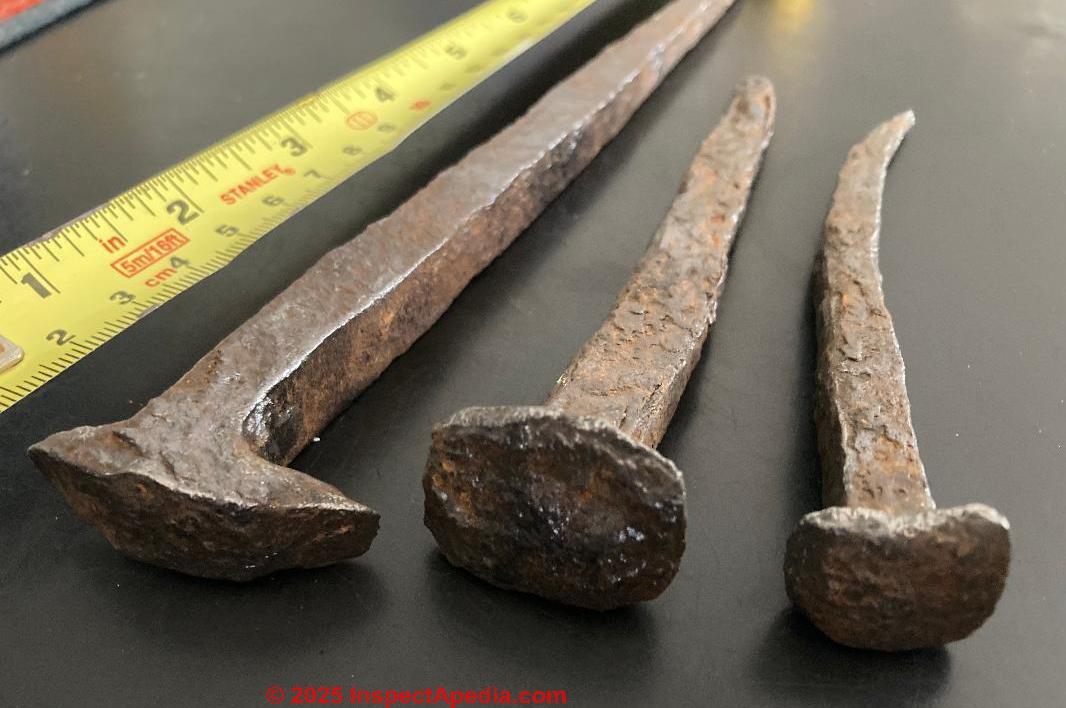
Hi, I pulled these out of the river Thames, UK. the longest is 10" the others are 6". Any info much appreciated.
- On 2024-07-24 by Angus carr
Reply by InspectApedia Publisher (mod)
@Angus carr,
Those are really nice, and are three different spikes, from head shape and length in particular.
On the leftmost spike we see hammer marks - hand tooling. It looks like it wasn't cut from a blank.From the shape and tooling marks it seems to me that those are hand-wrought spikes.
It's been a while since we were in Oxfordshire but from what I recall from my own walks along the Thames, I would expect spikes like those to have been used on docks.
You might want to take a look at the additional details that can help set an age by comparing those spikes with the criteria at
NAIL AGE DETERMINATION KEY - use this key to guess at the age of your nail or spike
Date the age of Cross-Headed 2-inch cut nails found in an oak fence in the UK
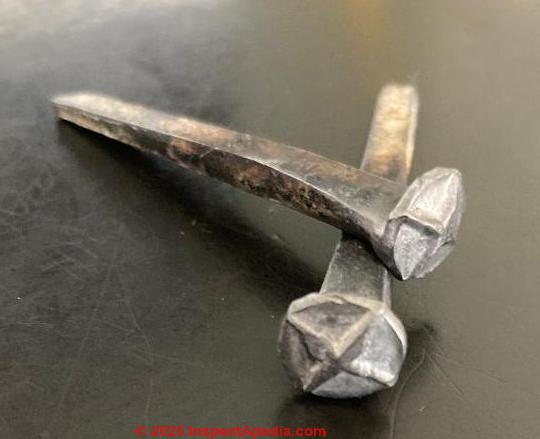
Hi, I am trying to date these 2 inch cut nails. Does anyone have an idea? they came from an oak fence, and the house is about 100 years old. I kept alot of them as the fence was being renewed as I liked the head! I never thought I would end up on a nail forum! - Angus.
I'm guessing Victiorian era. 1890 ish.
I live in Wallingford, Oxfordshire, UK, OX10 8DL. It was my neighbours oak fence with oak panels. pic attached. I think I have salvaged a couple of kg's. I buffed these on a wire wheel.
On 2024-06-03 by Angus Carr
by InspectApedia Publisher (mod)
@Angus Carr,
Nice photo. I like that cross stamped nail head too.
Look closely at the shanks on those nails to note where there is a burr running along the cut edge. The use your browser search function to search this page for "burr" (CTRL-F) and you'll see our discussion of that nail age clue.
If you see that the two cutting/stamping burrs are on the same side of the nail then it was probably made after 1840. Earlier nails had burrs on diagonally opposite edges of the nail shank.
Can you tell us the location of the home, or better, of the fence where these nails were found?Thank you for the added photo of the oak board fence.
While someone might indeed re-use old nails, in this case I think that yours are a modern product - hence take a look at the edge burrs that I mentioned previously.
It's not likely that the fence in your photo is more than 50-75 years old.
Nice nails, though.
Daniel
Identify offset-head cut nails from a pub in Victoria, Australia
Hi could please help me identify these nails found at on old Pub in Victoria Australia?
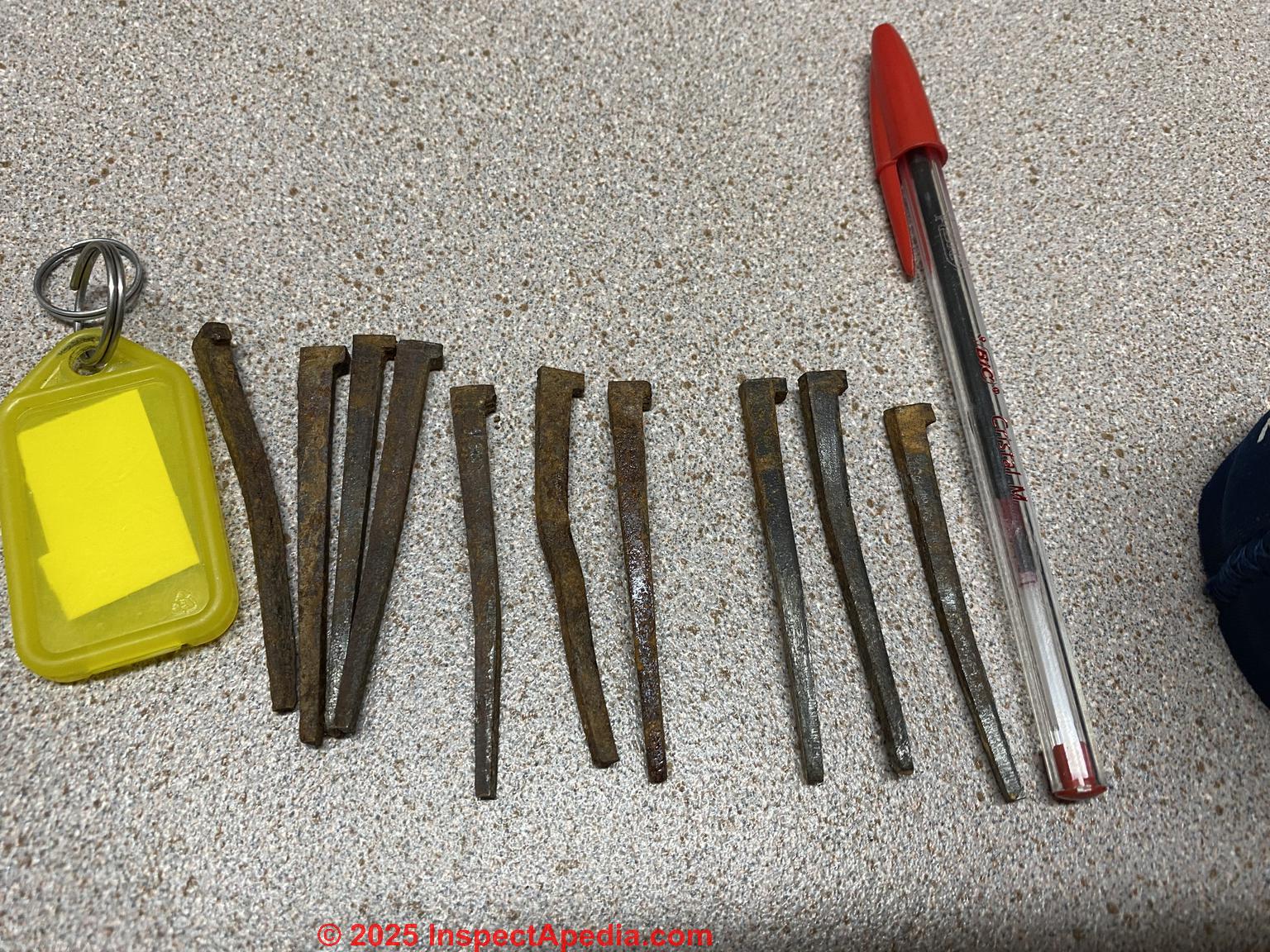
On 2024-03-20 by Scott
Reply by InspectApedia Publisher (mod) - Offset head, straight tapered shank cut nails.
@Scott,
The fact that that offset head on the nail was made as an integral part of the cutting of the nail from a blank suggests that these are not the oldest and forged sort of nail.
What can you tell me about the age of the building?
Do you have any photos of the timbers of the building such that we can look at tool marks?
How do I figure out the age of these 4" to 5" rectangular-shank old nails?
Would you know what age these nails are please
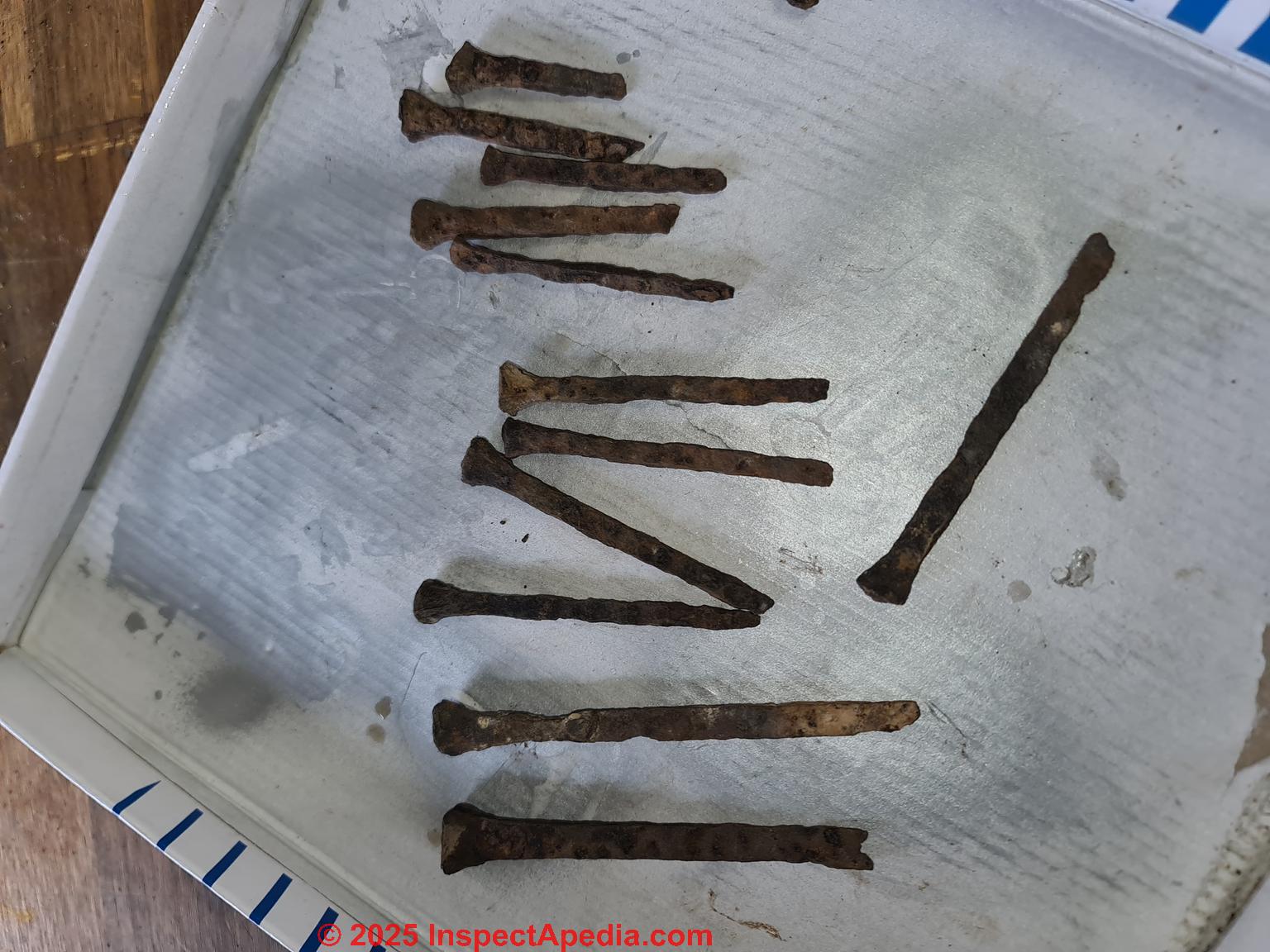
On 2022-05-29 by LEONIE WALTON -
Reply by InspectApedia-911 (mod)
@LEONIE WALTON,
I can't really see much there. Did you try using the steps and easy questions suggested at
NAIL AGE DETERMINATION KEY - use this key to guess at the age of your nail or spike
https://inspectapedia.com/interiors/Determine-age-of-old-nails.php
Please give that a try and let me know what you think
Brass spikes found in the surf at Jekyll Island
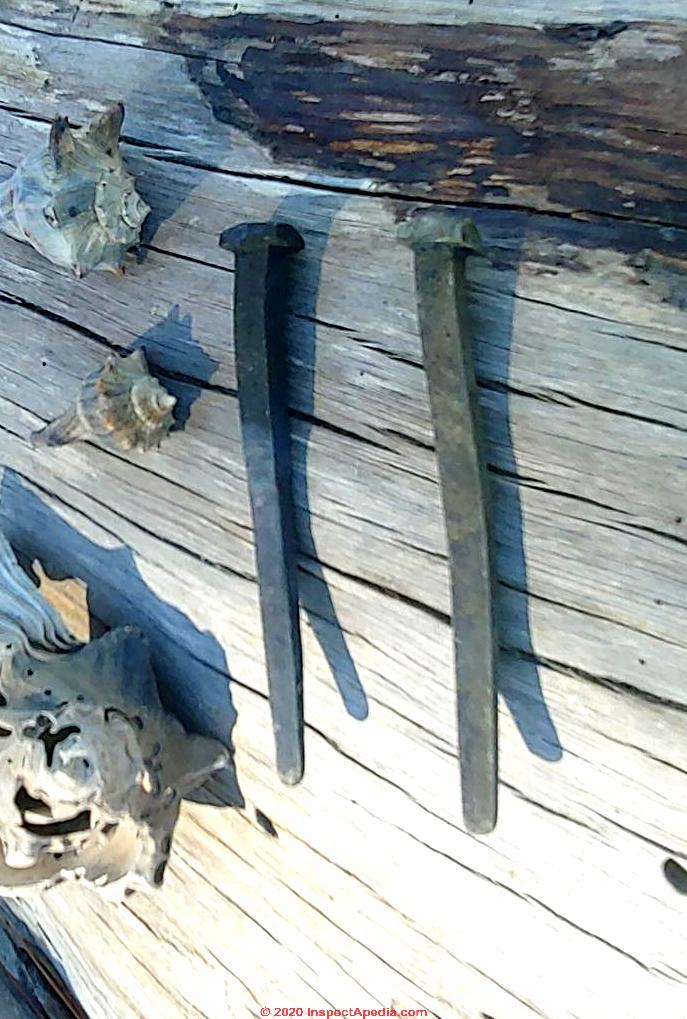
I found these brass spikes in the surf line on Jekyll Island. They are approximately 6" long. After finding one by itself, I found this board with some of them protruding. Thanks, Ben On 2020-07-31 by Ben BURCHFIELD
by (mod) - after 1733
Ben, Georgia's Jekyll Island has had European settlers on it, as I bet you know, since 1733,
and according to https://www.jekyllisland.com/history/island-history/, the island has had human occupants since 1500 B.C.:
The earliest known archaeological sites on Jekyll Island suggest that this island has been a destination for more than 3,500 years.
Finding those nice brass spikes in a board gives us a chance to guess at their use if you can describe more about the board itself - or attach some photos (one per comment); It'd be useful to look at the saw or tool marks on the lumber.
The spikes are uniform-tapered and may be hand-cut, probably from the early 1800s.
What can you tell me about this 5-inch nail with a square head with uneven surrounding iron?
I am curious about this nail, which was given to me. Thank you. It is five inches long.
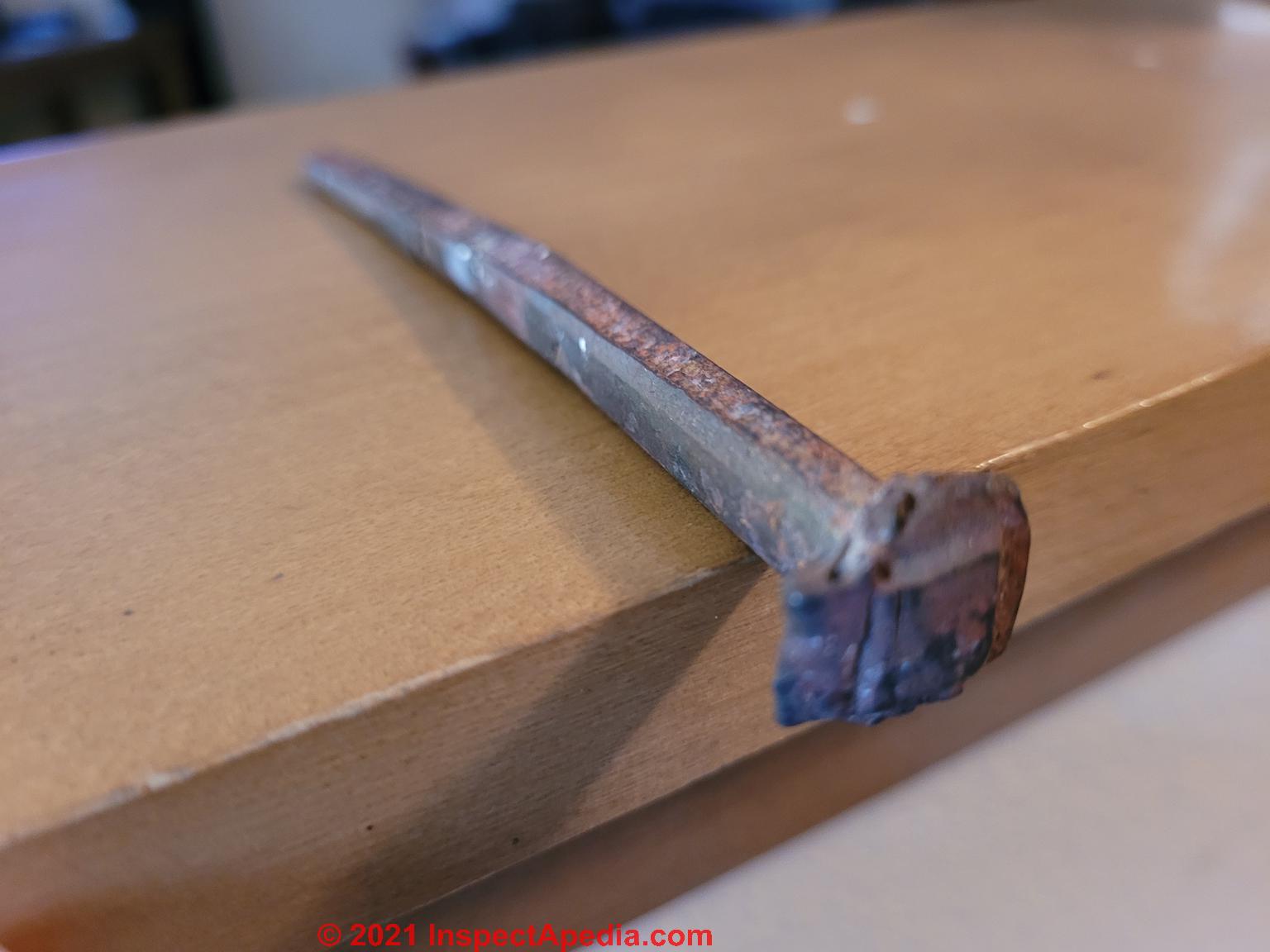
On 2021-07-13 by J Norris
by mak.church (mod)
@J Norris,
In addition to all the information about old nails above on this page, you may enjoy learning more at the following articles:
AGE AND HISTORY OF ANTIQUE NAILS - https://inspectapedia.com/interiors/Determine-age-of-old-nails.php
ANTIQUE NAIL AGE AND HISTORY FAQs - inspectapedia.com/interiors/Age-of-Nails-FAQs.php
Antique cut nail age in Texas - or is it a bolt?
Any idea how old this nail is? I found it in my backyard in San Antonio TX.|
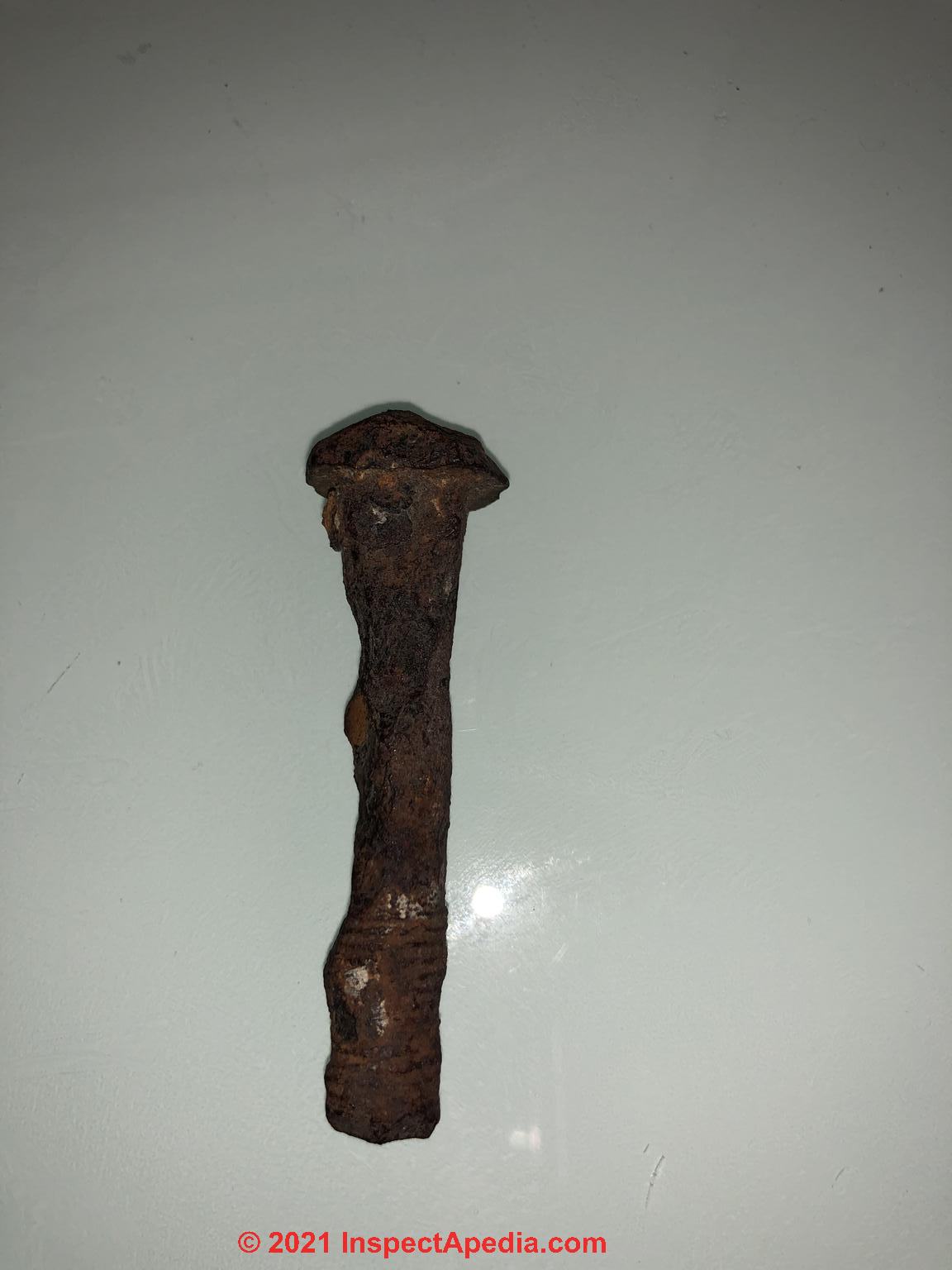
On 2020-06-30 by linda
Reply by (mod) -
Linda
From the regular machine-cut threads at the right end I think you've found a modern iron bolt, most likely made after 1940.
Age of nails found in an old bureau
I found an old dresser and this was one of the nails I pulled out of it, just curious on the age based on the nails.. hopefully
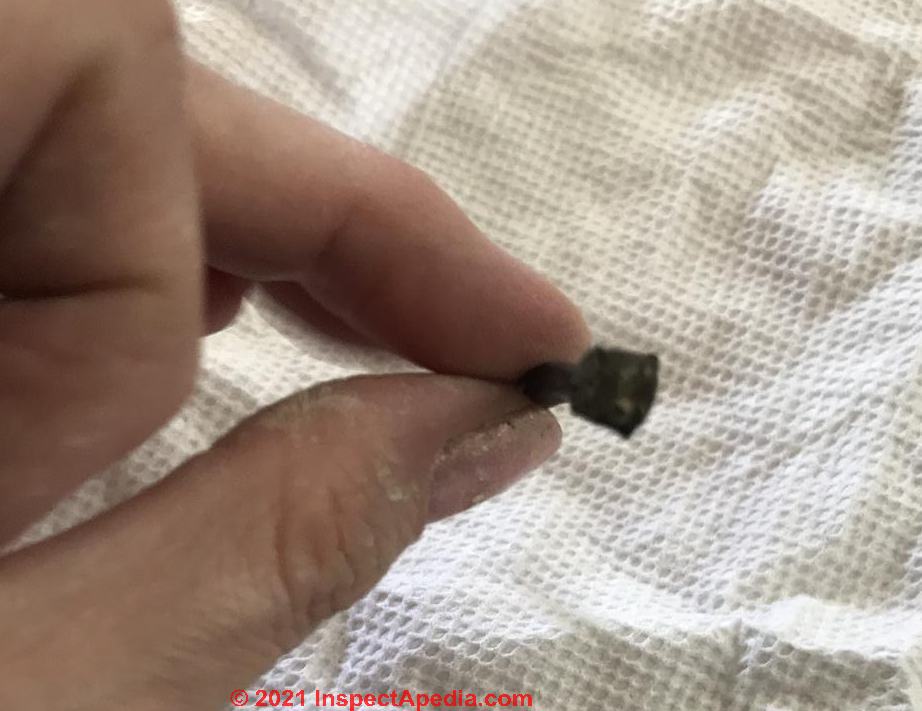
On 2020-06-28 by Atheana
How old is this nail from my 1970's home, and what info do you have?
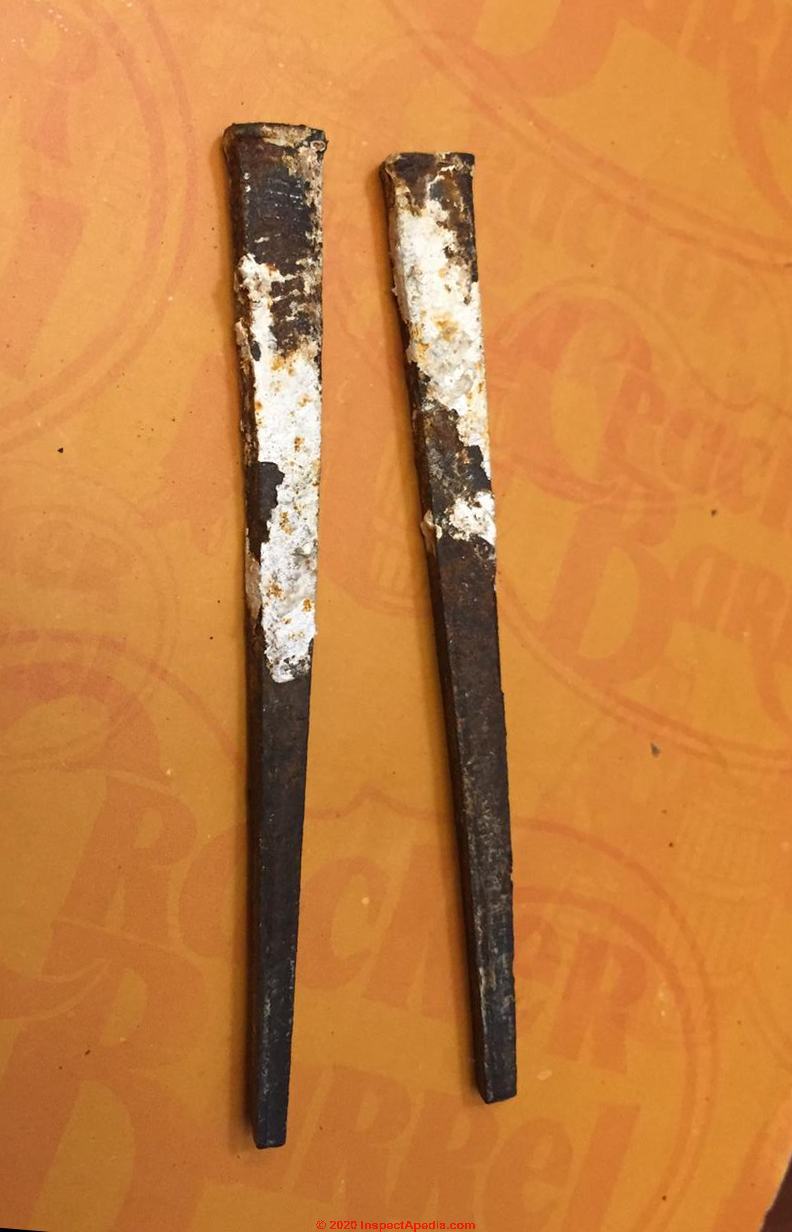 How old are these nails and where would they have been created?
They were randomly holding up flower baskets in the ceiling of the outside porch of my 1970s house.
I can see a little bit of a dip on one long side and one short side but they are consistent all the way down,
And there are some other smaller consistent scuff marks maybe all the way around the top of the nail?
So my guess is it’s from a machine?
On 2019-10-04 by Athena:
by (mod) - how to recognize modern machine cut nails - 1970
Those look like modern machine-made cut-nails;
I note that the nail sides are straight-tapered, not rounded, and absent any marks of hand tooling.
If you look closely, under magnification, at a cut nail you can sometimes observe which sides of the nail bear a burr showing the direction of machine cutting.
That in turn will match up with the two different generations of machine-made cut nails
described in NAIL AGE DETERMINATION KEY
The "scuff marks" under the head of a nail are usually left by the clamping device that holds the cut nail in place for a second machine step that presses a head onto the nail top.
We see that detail more-clearly on round shanked "wire" nails.
Thanks for asking and for the photo.
Age of Nails from Czech Republic Embassy in Paris - are these nails more than 400 years old?
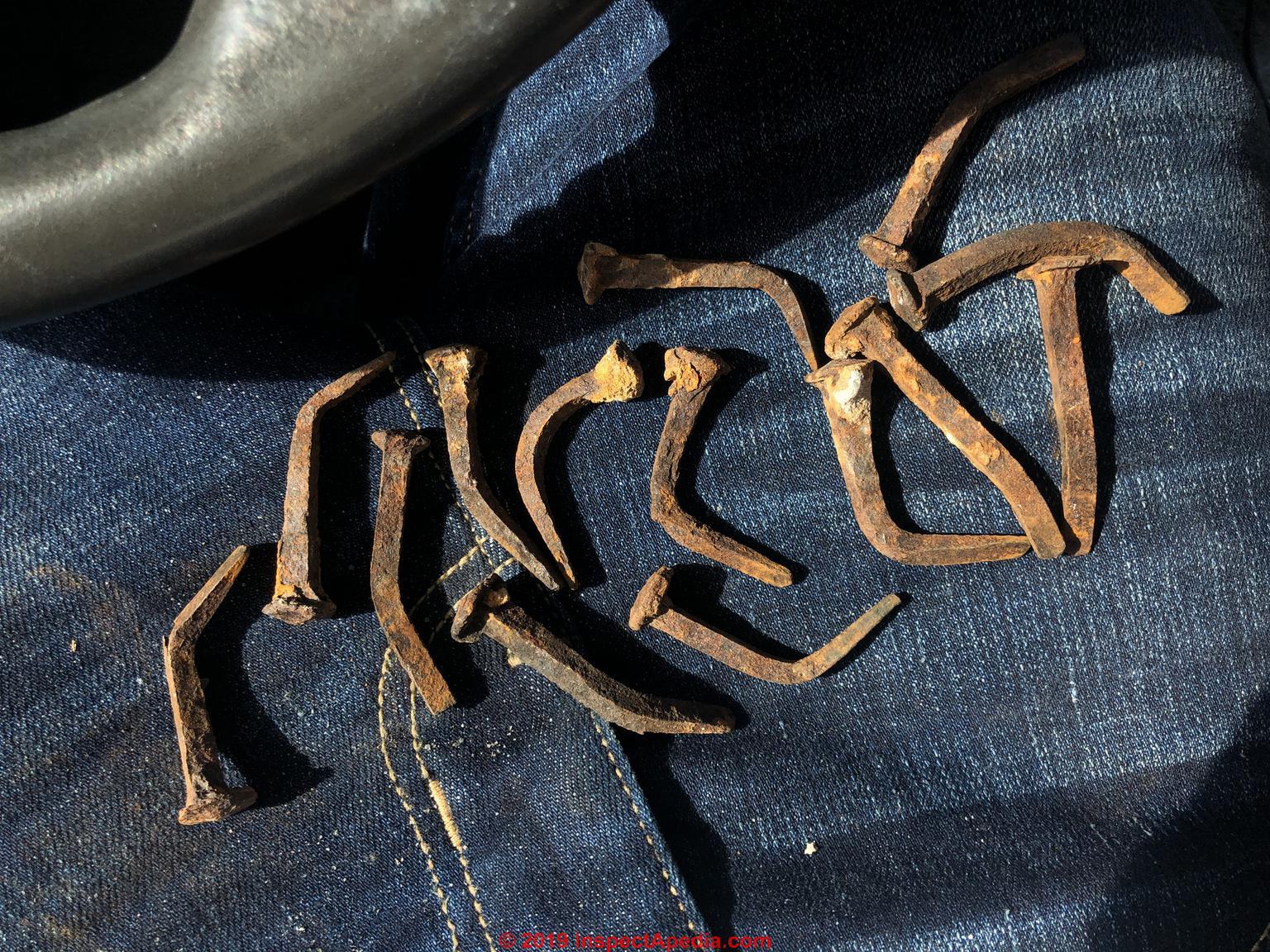
I work at a reclaimed lumber yard in Montana and we some lumber torn down from supposedly the Czech Republic embassy in Paris France (which I know the lumber is from) and I denailed carefully these nails from some of the lumber
but I’m curious as to how dangerous touching these could be due to the rust or whatever and I’m curious if anyone believes they’re 403 years old which is how old I was told the product was? On 2019-03-17 by taylorjordan1993.tj
by (mod): No those clinched nails are not 400 years old: antique clinched cut nails
Taylor
There is no chance that your bent-over clinched nails are 400+ years old.
The nail shank is regular and smooth, not hand wrought - these are cut nails.
The nails are bent-over suggesting that they were originally clinched - driven through wood and their ends bent over.
Clinched nails are chosen with a length longer than the thickness of the target wood: the clinched-nails are driven-through wood and then the exposed nail shank is hammered over flat against the other side of the wood surface.
Clinched nails were used both for decorative purposes and for great withdrawal strength.
But a clinched-nail that is also a cut nail will be older than about 1830-1840. So your nails are less than 200 years old, probably newer.
At NAILS, AGE & HISTORY and
again in at NAIL AGE DETERMINATION KEY you'll read that because older iron, before the early 1800's nails that were to be clinched would have been hand-wrought since otherwise the cross-diretion of iron fibers (in early cut nails) caused the bent nail end to break off.
Age of this nail found in Jamaica
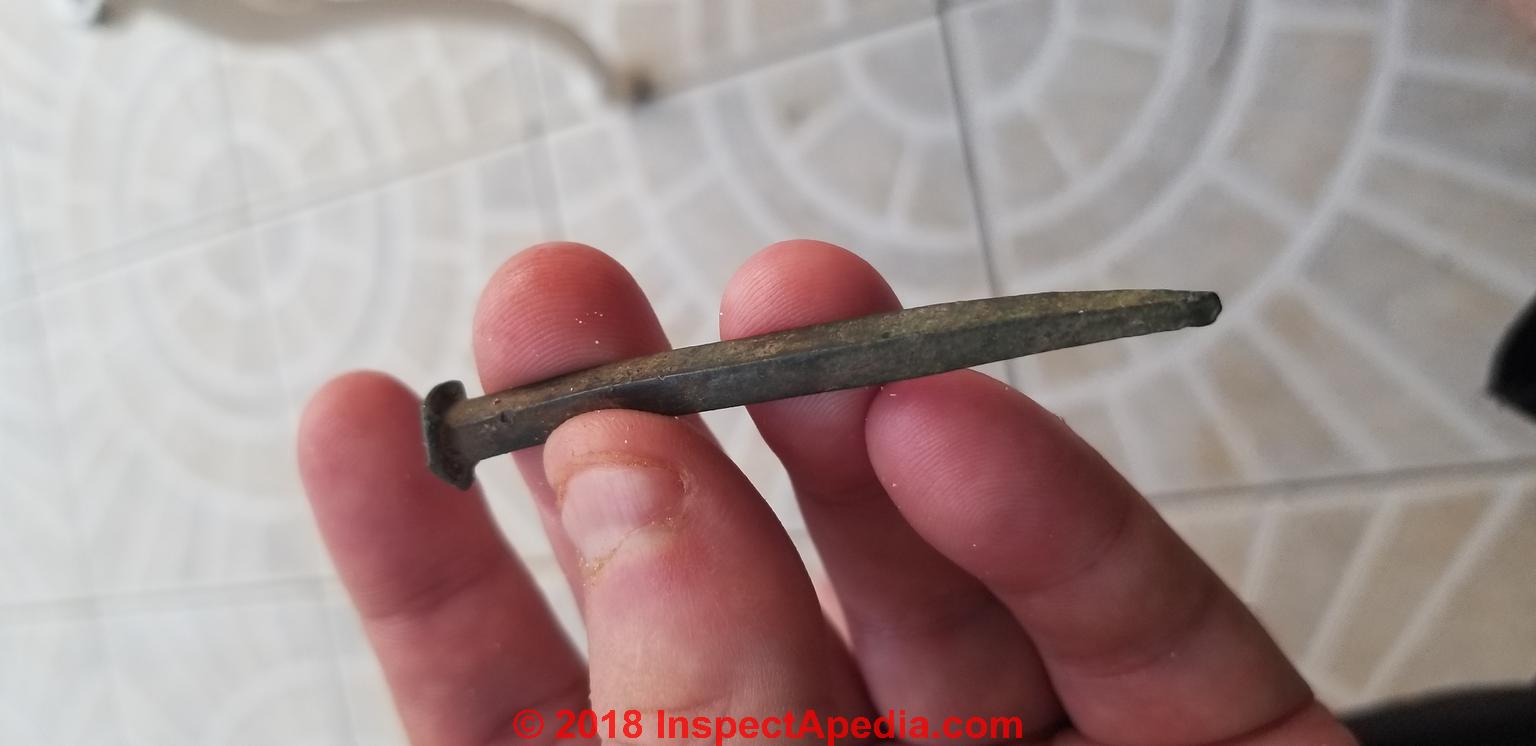
Jamaica found today? Any info. 1800s On 2018-11-17 by David and madison
by (mod) - probably a machine made nail
David
I enlarged (by clicking on the image above) your photo to see that its sides are so dead flat and edges so straight that I could not see a single hammer mark on the nail shank - making me think this is a machine made nail.
What's the age of these long rusty nails?
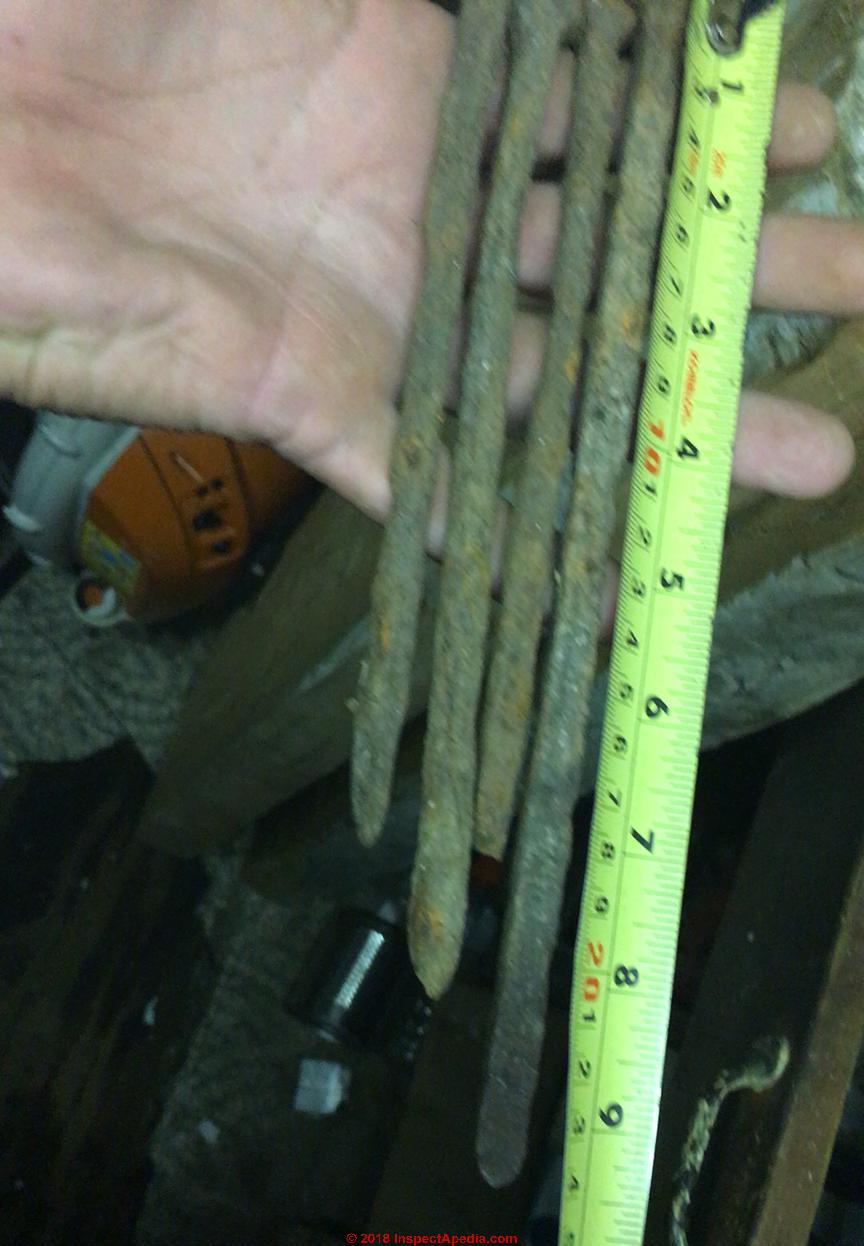
Would you know the age of these nails?
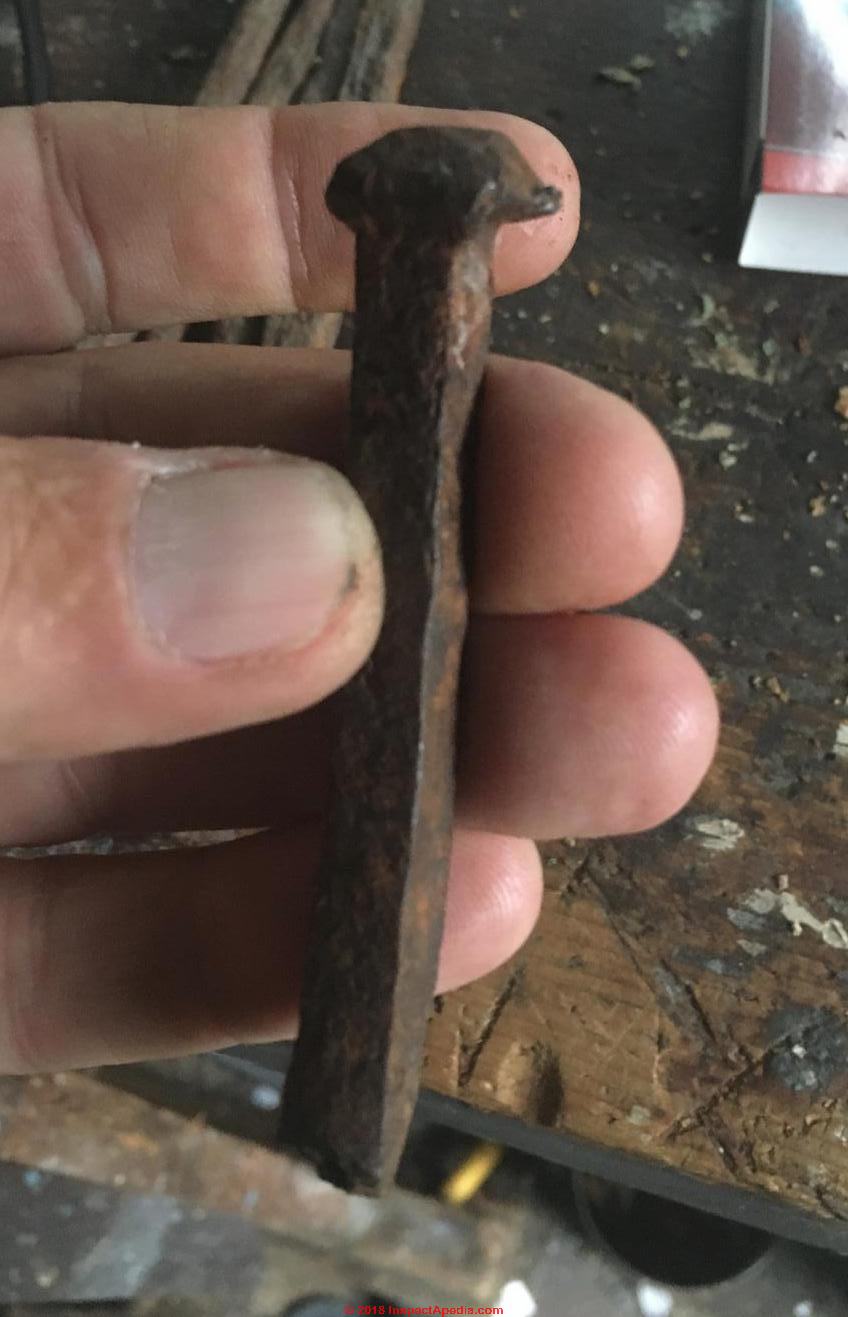
On 2018-09-11 by Peter
by (mod) - signs of a modern cut nail? Rusted-off head.
Some of those nails, especially in the second photo look round - that would be a modern nail.
On the nails that are rectangular in cross section, look for hammer marks (hand wrought) or cut or ground edges (machine made)
I think this is a Tremont Cut Spike - can you confirm that?

Here is one more reference photo as well.
Between your website, and Tremont's, I believe this is a Tremont Cut Spike.
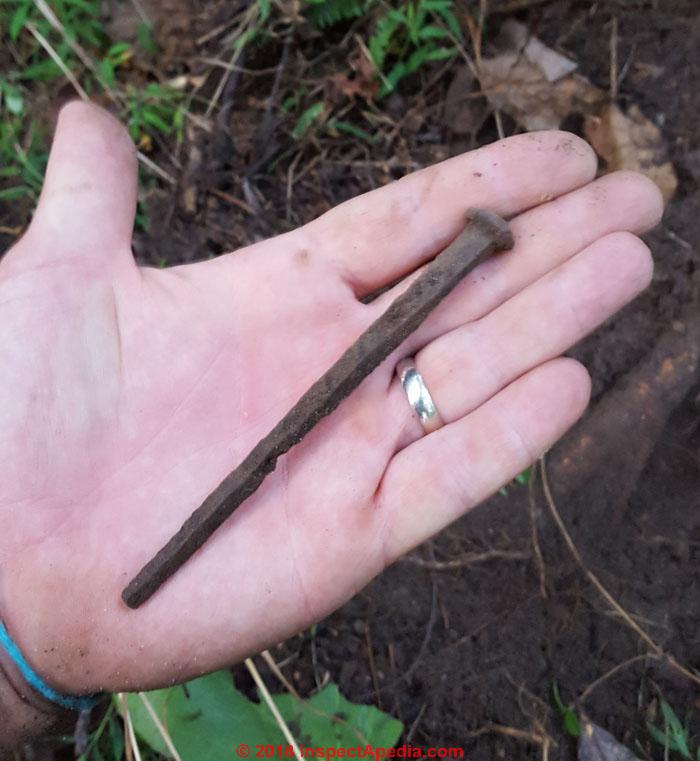
Any help you can give with confirming this and dating would be appreciated. Thank you! On 2018-09-06 by Chris
by (mod) - cut nails, spikes, identification tips
Chris
The photo of the nail is not quite sharp enough to look for stamping or grinding marks found on newer nails such as Tremont's reproductions of antique cut nails.
But near the nail head in your first photo I see what could be the remains of a modern nail stamping machine mark.
Take a close look along the sharp edges of the sides of the nail for irregularities or hammer marks. Those would typically mark an older nail.
Of course when if a nail or spike is badly rusted some of those details can be hard to see.
How to research age of nails found at the Justin Morgan historic location
I have been doing some research and digging at what I believe to be a historical location.
For the past ten years I have been looking for and at last found a location where Justin Morgan (1747 - 1798, Springfield MA) (founder of the Morgan Horse see ... settled when he came to Vermont.
The general location had always been known however the exact spot was never known.
According to all of my documentation the spot that I have found is the location however in order for me to get the State of Vermont to acknowledge this location with a historical marker they wanted more proof such as some type of physical proof.
In digging at the location we have found nails in three of the four corners of what we believe to be the small log cabin structure that Morgan and his family lived in.
Vermont claims that the nails are not good enough proof because we cannot prove that the nails were from the 1788 time period when Morgan moved to Vermont.
History records show that the small log cabin structure was already there when Morgan arrived.
Morgan himself never owned any land that he settled in Vermont and the cabin that he lived in was on land owned by Joseph Griswold. Griswold was one of the original settlers in Randolph Vermont in which he was given land as long as he settle it.
The connection between Griswold and Morgan comes from Massachusetts ties.
The reason I am emailing you is because I have the nails that we found at the Morgan location and I am wondering if those nails can be dated in some way to establish their age?
Would you be able to confirm the age of a nail? Is there any way? Please email me at denlore3@denlore.com if you think you can help. On 2018-08-27 by Dennis -
by (mod) - age of nails from Justin Morgan possible site
Having visited and studed that site myself, I'd be glad to look at the nails or at sharp photos of them, Dennis.
Age of cut nails in antique coffee table
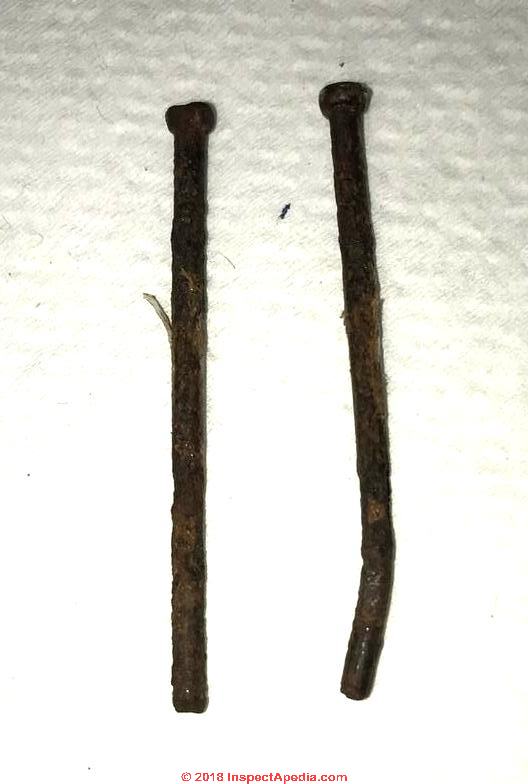
I just bought an old unique rustic coffee table fastened with these nails.
Just curious if knowing a little about the nails could give me some indication of how old the table is. I’m guessing these are finishing nails? On 2018-07-15 by Anonymous
Reply by (mod) -
The photo is a little blurry in the nails quite rusted so it's hard to see details but in one of your pictures I can see enough of a very straightedge to think that that's a machine made cut nail.
You can see the history of those in the article NAIL AGE DETERINATION KEY (live link at end of this page)
Remember that when you're guessing at the age of a nail and therefore perhaps the wood item in which it was used, you have to consider the location geographically since in some areas such as North America nail making machines were available on the East Coast much sooner than farther west.
Age of spike in fence post in Litchfield California?
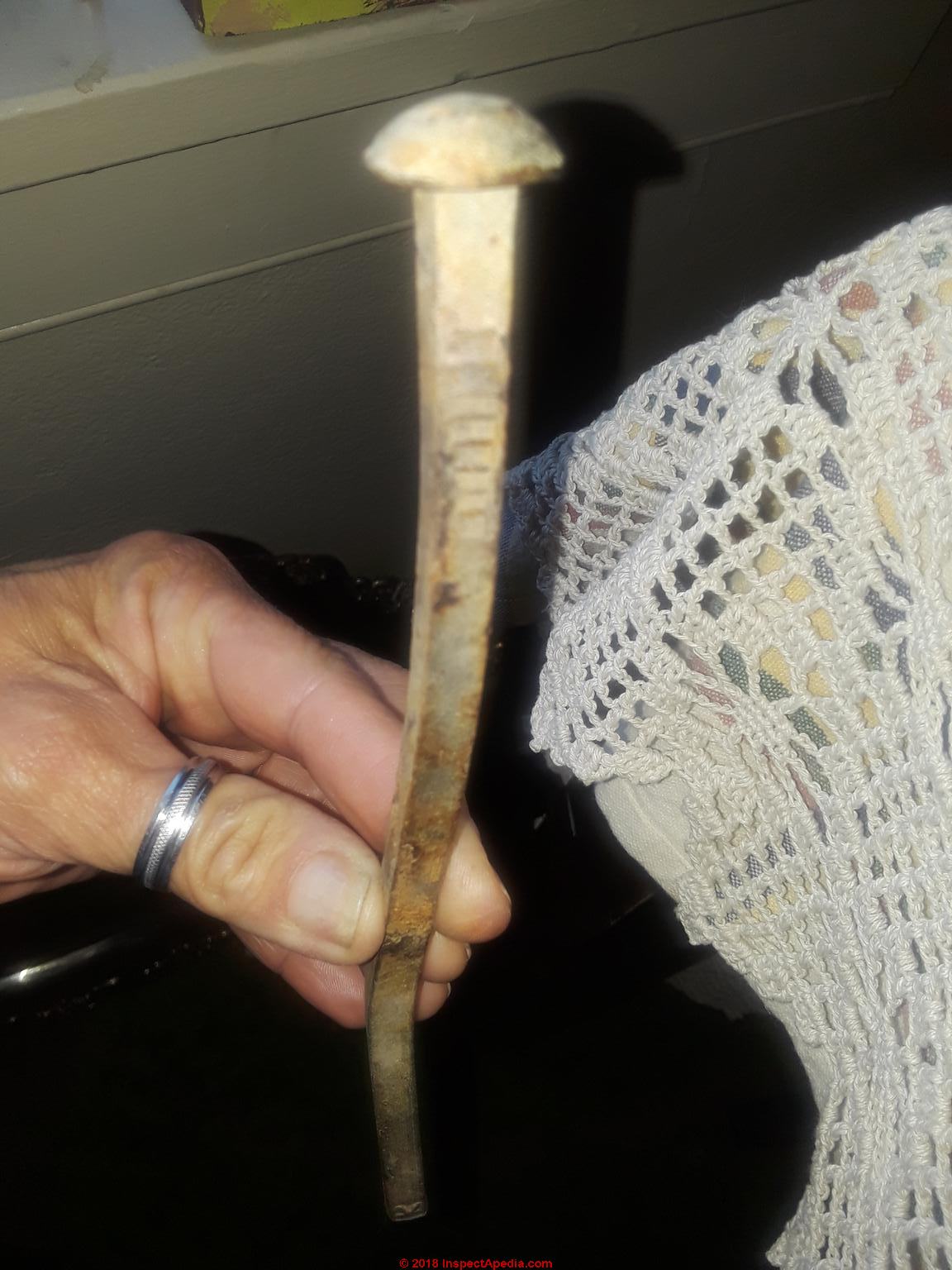 What is the age of this Nail? I found it in an old fence post. On 2018-06-15 by Sydney
On 2018-06-15 by (mod) - indications of a factory-made spike or nail
Sydney
I have to beg the question by asking the country and city where the nail was found since the use of cut nails or machine made nails and their history is not uniform around the world.
Your nail looks like it is machine made - the top is very round with no hammer marks, and the sides show a ridging characteristic of stamped out cut nails rather than hand wrought (and older) nails.
In the U.K. such nails were used between about 1830 and 1900.
In the U.S. the use of machine nails spread from earliest on the east coast, westward over a later period.
On 2018-06-15 by Sydney
It was found in Northern California in the high desert. Black rock desert.
Litchfield Ca. Old logging towns.
On 2018-06-15 by (mod) - age of spike from northern California high desert, Litchfield
I would guess 1890 to 1930
...
...
Continue reading at NAIL ID & AGE: CUT NAILS - topic home, or select a topic from the closely-related articles below, or see the complete ARTICLE INDEX.
Or see these
Recommended Articles
- AGE of a BUILDING, HOW to DETERMINE - home
- DOOR HARDWARE AGE
- NAILS, AGE & HISTORY - home
- HORSESHOE & HORSESHOE NAIL AGE
- NAIL & HARDWARE, AGE RESEARCH
- NAIL & HARDWARE CLEAN-UP
- NAIL AGE DETERMINATION KEY - use this key to guess at the age of your nail or spike
- NAIL ID & AGE: CUT NAILS
- NAIL ID & AGE: HAND FORGED NAILS
- NAILS in BARTER & TRADE
- NAIL SPLITS & CRACKS vs AGE
- NAIL TYPE, ANTIQUE, IDENTIFICATION KEY
- RAILROAD SPIKES
- RAILROAD SPIKE AGE - CONTEXTUAL CLUES
- SAW & AXE CUTS, TOOL MARKS, AGE
- WINDOW HARDWARE AGE
Suggested citation for this web page
NAIL ID & AGE: CUT NAILS-FAQs at InspectApedia.com - online encyclopedia of building & environmental inspection, testing, diagnosis, repair, & problem prevention advice.
Or see this
INDEX to RELATED ARTICLES: ARTICLE INDEX to BUILDING AGE
Or use the SEARCH BOX found below to Ask a Question or Search InspectApedia
Ask a Question or Search InspectApedia
Share this article:Search the InspectApedia website
Need to make a private comment? Email editor@inspectApedia.com. We welcome email with your website content critique, corrections, suggestions or questions. Email is monitored daily but our workload may prevent an immediate reply. For immediate results, we hope you'll first try asking your question using the search box just above.
Citations & References
In addition to any citations in the article above, a full list is available on request.
- In addition to citations & references found in this article, see the research citations given at the end of the related articles found at our suggested
CONTINUE READING or RECOMMENDED ARTICLES.
- Carson, Dunlop & Associates Ltd., 120 Carlton Street Suite 407, Toronto ON M5A 4K2. Tel: (416) 964-9415 1-800-268-7070 Email: info@carsondunlop.com. Alan Carson is a past president of ASHI, the American Society of Home Inspectors.
Thanks to Alan Carson and Bob Dunlop, for permission for InspectAPedia to use text excerpts from The HOME REFERENCE BOOK - the Encyclopedia of Homes and to use illustrations from The ILLUSTRATED HOME .
Carson Dunlop Associates provides extensive home inspection education and report writing material. In gratitude we provide links to tsome Carson Dunlop Associates products and services.
 |
HOME | ABOUT | ASK a QUESTION | CONTACT | CONTENT USE POLICY | DESCRIPTION | POLICIES | PRIVACY | |
| © 2026 - 1985 Publisher InspectApedia.com - Daniel Friedman | |||||||||