 Furnace Blower Fan Blows Cold Air or Alternates Blowing Warm then Cold Air

- POST a QUESTION or COMMENT about diagnosing furnace fan operating problems
Furnace blows cold air:
This article describes what to check if the warm air heating blower fan delivers intermittent cold air into the occupied space, or if the furnace cycles between blowing warm air & cool or even cold air into the building.
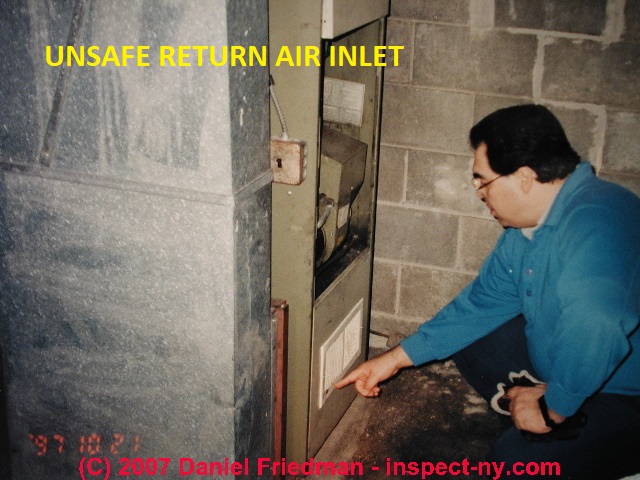
Page top photo: Watch out: a return air inlet close to a gas heating furnace may be unsafe - see UNSAFE DUCT OPENINGS for details.
InspectAPedia tolerates no conflicts of interest. We have no relationship with advertisers, products, or services discussed at this website.
- Daniel Friedman, Publisher/Editor/Author - See WHO ARE WE?
How to Diagnose & Fix a Blower Fan that Blows Alternating Hot then Cold Air

Discussed here: what to check if the forced warm air furnace blows cold air out of the supply registers, or cycles between blowing warm air & cold air.
Forced air heating furnace blows COLD, HOT, COLD, then OFF - what's up with its fan limit control?
Fan Limit Switch Problem History
Two story 75 year old classic cape cod home. Gas forced air furnace is Lennox G16 24 years old, in good condition. With Honeywell fan limit switch, outside fresh air intake and draft motor.
We have owned home 12 years. (has AC). Owner not a technician but understands mechanical/heating concepts.
Furnace operating problem
When heat called for and fan comes on it blows cold air, then heat, then cold, then off. It has always done this. Limit switch is at off 100, on 125 off 150.
Recent information
Changing set points on limit switch does not seem to change pattern. I do not dare force it. This winter local utility provider replaced burned out fan motor with same HP, number of speeds, etc.
Since the draft motor was noisy we replaced that as well. Upon dissection of draft motor is was covered with white crusty minerals probably from the water from the humidifier mounted on the nearby cold air return. When we first owned this house we have removed the humidifier (and installed a whole house water filter).
My Theory
The fan limit switch sensor which protrudes into the burn area is crusted and therefore "locked" into a former position and now un adjustable. What do you think? - J.C. 4/15/2013
Reply: stuff to check when the fan is not turning on and off at reasonable temperatures
Thanks for the interesting question and the excellent photo. Unfortunately the photo you sent had a virus - we had to clean it up so what we display here is a bit different and at at lower resolution that your version. I don't know what's happening with your heating system but I can, from your note make a few diagnostic suggestions:
Watch out: you are quite right not to force the set point adjustments on a fan limit switch. Doing so can make the heating system unsafe, even risking overheating, heat exchanger damage, and fatal carbon monoxide poisoning of building occupants.
The furnace fan limit switch assembly is intended to be adjusted within a safe range by the heating service tech by moving the stops, but if you bend something the switch is damaged and unsafe, and if you set the switch incorrectly (for example fan coming on too late or turning off too early, or setting the upper limit too high) there is risk of overheating the heat exchanger, cracking it, risking fatal carbon monoxide poisoning at worst, or perhaps a costly heat exchanger or furnace replacement job.
I like Dan Holohan's expression "Keep your hands in your pockets" - my mom used to make me sitOn my own hands. (No not recently.)
Take a look at the duct system itself for things that can make it cool down quickly blowing cold air sooner than one might expect, such as a long uninsulated run, missing insulation, air leaks at the return side.
Check that the air filter is clean and that the ductwork is not obstructed. (This is just on general principle).
Now about that pesky fan limit control, you could
- Test the operation of the fan limit switch
following the instructions in the article above. Start reading
at FAN LIMIT SWITCH TROUBLESHOOTING.
A very simple "test" that most fellows do in the field before touching anything is to just watch the dial as the plenum heats up when the furnace is running. If the dial doesn't turn it's jammed.
The installation instructions warn about installation mistakes (like a too-long or improperly-located sheet metal screw) or sensor in contact with ductwork etc. - stuff that can bind the switch operation. - Inspect the limit switch temperature sensor
for obstruction or clogging (as you suggest) - to do this you have to turn power off and completely remove the switch - carefully again so as not to get cut nor bend anything. If the helix and heat sensor look clean, then you can jump to step 3 which is probably where a less curious tech might start - Replace the switch
with a new unit, at its factory settings.
Keep us posted - what you learn will help other readers diagnosing a fan limit switch problem with their own furnace.
Other Causes for a Heating Furnace to Blow Cool or Cold Air into the Occupied Spaces
Check for air duct leaks
Check for an air duct leak, particularly, leaks from cold areas such as an un-heated crawl space or basement into the return air duct system. Such leaks not only increase heating costs unnecessarily, they also are unsafe.
Check for deliberate introduction of cold air into the HVAC system
In some buildings we like to run the blower fan continuously for more even heat distribution and improved air filtration - improvements to building indoor air quality.
But in some buildings where heating ducts run through cold spaces and are not well insulated, or in installations in which the heating system is inducing cold outdoor air into the duct system, when the furnace burners are off the system will indeed blow cold air onto building occupants.
Check the following two switches to make sure that the furnace blower fan is not simply set to run continuously:
If you need to introduce outdoor air into a building for air quality reasons, consider an air to air heat exchange system to save on heating costs. Check out
...
...
Continue reading at FAN LIMIT SWITCH TROUBLESHOOTING or select a topic from the closely-related articles below, or see the complete ARTICLE INDEX.
Or see FURNACE BLOWS COLD AIR FAQs - Q&A posted originally on this page
Or see these
Recommended Articles
- AIR HANDLER / BLOWER UNITS - home
- BLOWER FAN CONTINUOUS OPERATION
- BLOWER FAN CYCLES ON INTERMITTENTLY
- BLOWER FAN OPERATION & TESTING - home
- BLOWER FAN SPEED SETTINGS - how to set the air handler fan speed
- BLOWER FAN WONT START
- BLOWER FAN WON'T START, BUZZING
- BLOWER FAN WONT STOP - LIMIT SWITCH
- BLOWER FAN WONT STOP - THERMOSTAT SWITCH
- AIR HANDLER BLOWER LEAKS, RUST & MOLD
- CAD CELL RELAY SWITCH
- FURNACE BLOWS COLD AIR
- FURNACE FAN CYCLES AFTER HEAT
- FURNACE FAN CYCLES DURING HEAT
- FURNACE FAN STOPS EARLY
- FURNACE FAN WONT START
- FURNACE or A/C BLOWER FAN WONT STOP
- WOOD FURNACE FAN LIMIT CONTROL
- FAN, AIR HANDLER BLOWER UNIT
- FAN LIMIT SWITCH TROUBLESHOOTING
- FAN ON AUTO MAN THERMOSTAT SWITCH
- FAN WONT STOP - LIMIT SWITCH - switch in the air handler is set to manual fan ON
- FAN WONT STOP - THERMOSTAT SWITCH - switch on the thermostat is set to manuall fan ON
- UNDERSIZED RETURN DUCTS - not enough return air
Suggested citation for this web page
FURNACE BLOWS COLD AIR at InspectApedia.com - online encyclopedia of building & environmental inspection, testing, diagnosis, repair, & problem prevention advice.
Or see this
INDEX to RELATED ARTICLES: ARTICLE INDEX to HEATING FURNACES
Or use the SEARCH BOX found below to Ask a Question or Search InspectApedia
Ask a Question or Search InspectApedia
Share this article:Search the InspectApedia website
Need to make a private comment? Email editor@inspectApedia.com. We welcome email with your website content critique, corrections, suggestions or questions. Email is monitored daily but our workload may prevent an immediate reply. For immediate results, we hope you'll first try asking your question using the search box just above.
Citations & References
In addition to any citations in the article above, a full list is available on request.
- In addition to citations & references found in this article, see the research citations given at the end of the related articles found at our suggested
CONTINUE READING or RECOMMENDED ARTICLES.
- Carson, Dunlop & Associates Ltd., 120 Carlton Street Suite 407, Toronto ON M5A 4K2. Tel: (416) 964-9415 1-800-268-7070 Email: info@carsondunlop.com. Alan Carson is a past president of ASHI, the American Society of Home Inspectors.
Thanks to Alan Carson and Bob Dunlop, for permission for InspectAPedia to use text excerpts from The HOME REFERENCE BOOK - the Encyclopedia of Homes and to use illustrations from The ILLUSTRATED HOME .
Carson Dunlop Associates provides extensive home inspection education and report writing material. In gratitude we provide links to tsome Carson Dunlop Associates products and services.
 |
HOME | ABOUT | ASK a QUESTION | CONTACT | CONTENT USE POLICY | DESCRIPTION | POLICIES | PRIVACY | |
| © 2026 - 1985 Publisher InspectApedia.com - Daniel Friedman | |||||||||