 Boiler Drain Procedure
- POST a QUESTION or COMMENT about heating system expansion tanks: their function, size, location, maintenance, and need for draining (on some models)
On occasion its necessary to drain and even flush a hot water heating boiler to remove sediment or sludge from the boiler, often as a preparatory step to adding a boiler chemical treatment or antifreeze.
Here we describe the steps in a safe and effective hot water heating boiler drain-out for cleaning, maintenance, or water treatment.
InspectAPedia tolerates no conflicts of interest. We have no relationship with advertisers, products, or services discussed at this website.
- Daniel Friedman, Publisher/Editor/Author - See WHO ARE WE?
Heating Boiler Drain Procedure
Do you really need to drain the boiler?
For conventional hydronic heating boilers, before setting out to drain the whole system you might want to first draw a water sample to examine it for sludge and rust.
Often a traditional residential heating boiler and the heating system that uses hot water circulated from the heating boiler through radiating devices such as radiators, convectors, or heating baseboard, are left working for years without a complete system drain, cleaning, and re-fill.
In fact, some boiler manufacturers (Patriot 2026) go so fare as to advise that you should not drain a hydronic (hot-water) boiler except if needed for maintenance or for power-off freeze protection.
That's in part because in hydronic (hot water) heating systems the same physical charge of water remains in the heating system and is constantly reused and cycled through the system boiler, pipes, and radiating devices, limiting the degree of corrosion and boiler damage that can be caused by sediment and corrosion.
For steam heating boilers: the comments above are in contrast with steam heating systems that constantly introduce new water and so face a bigger problem of internal corrosion, rust, or scale formation.
We'll provide details at step 7 in the boiler flush and drain procedure steps below.
For tankless heating boilers such as a Carrier tankless heating boiler and hot water maker described in our references below, the company recommends draining and cleaning that boiler every 6-12 months!
Steps to Drain a Hot Water Heating Boiler or a Steam Boiler
If your heating system needs to flush out sediment or if it has to be drained for heat-off winterizing, or for repairs requiring draining the system, it is important that the boiler drain procedure be done safely and following steps to prevent damage to the equipment. Here are some simple residential heating boiler drain steps that your heating service technician will probably follow.
- Watch out: Avoid starting to drain a heating boiler and hot water heating system if
weather conditions are so cold that there is risk of building or building plumbing system freeze damage. Unless absolutely necessary it's best to conduct a boiler drain and re-fill procedure when the heating system is not in great demand.
Watch out: if you are not trained in heating boiler service and repair and you try to follow this procedure yourself you risk being burned or damaging your heating equipment.
- Turn off the heating system and allow the boiler to cool down
to a low-enough temperature (below 100 degF) that there is no risk of scalding burn injury and no problem disposing of otherwise hot heating system water.
This means turning off electrical power to the system. It's not usually necessary to also turn off the heater's fuel supply.
- Connect a drain hose to the boiler drain
and extend the hose to an acceptable boiler water disposal location such as a floor drain or to the building exterior.
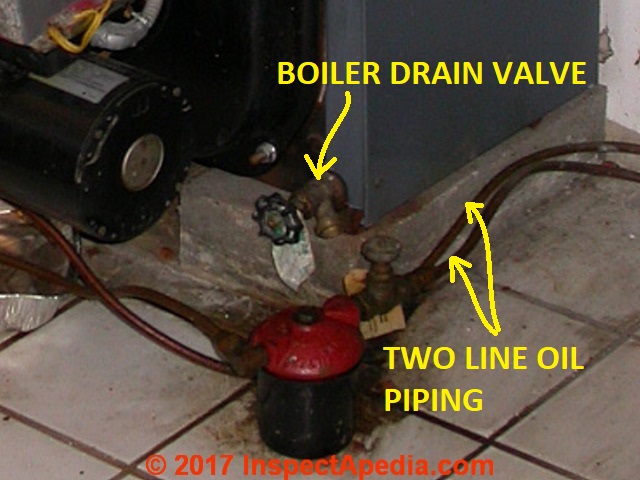
My photo above shows a typical heating boiler drain valve. You'll notice that the boiler drain is quite close to the floor and that there's not much space to connect your drain hose.
If necessary, use a pony pump to lift boiler drain water up to a bucket or a longer hose to send the boielr drainage to a sutitable disposal location.
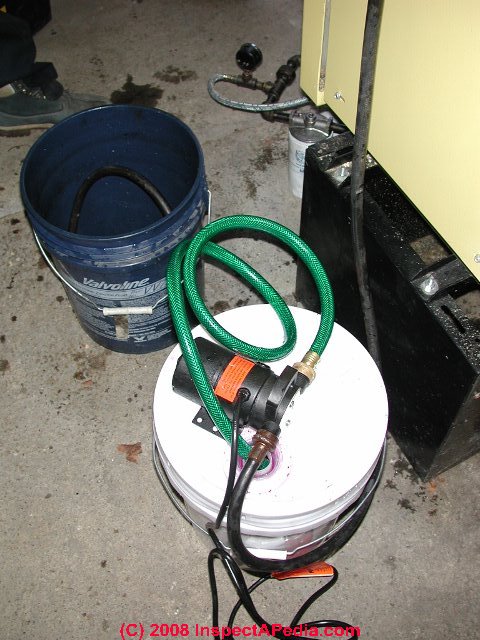
In my photo below I've connected a black washing machine hose between the boiler drain and the pony pump inlet, and my green hose is directed into a white bucket; it could have been run to another suitable boiler drainage location.
Watch out: Take care not to drain hot water nor boiler water nor chemically-treated boiler water onto plants that may be damaged nor onto a driveway or other locadtion where boiler sludge may cause a stain problem.
Watch out: typical building codes (and common sense) prohibit discharging water into a drain (such as that handy floor drain near your boiler) at a temperature over 140°F. You may need to temper your hot water for disposal by mixing it with cold, and if your boiler drainage is high in sludge you should consider whether or not you risk clogging a drain.
A more-costly service offered by some boiler companies and used more often at commercial installations is to collect boiler sludge and drainage in a tank for later disposal at an approved waste disposal site. - Turn off the water supply to the boiler.
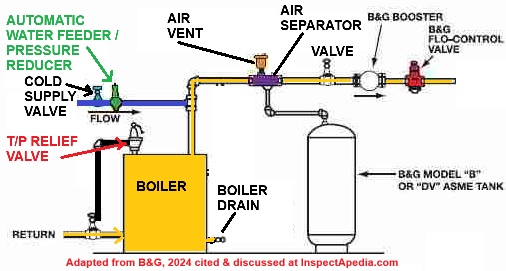
Find the boiler water supply line and look for its shut-off valve, usually ahead of the boiler's pressure-reducer water feeder.
Watch out: if you don't turn off water supply to the boiler, as you drain the boiler, it's likely that the pressure-reducer/water-feed valve will simply keep sending new water into the boiler before it has been fully emptied. - Open the boiler drain
to which you connected the drain hose.
Watch out: watch the drain outlet to be sure the water is flowing to an acceptable destination as we described earlier, and to note that there are no leaks or spills anywhere else. - Allow air to enter the boiler by opening one or more air bleeder valves (if yours is a hot water or hydronic heating boiler)
preferably high in the building at a high radiator or baseboard.
See AIR BLEEDER VALVE USE STEPS
Some service techs will lift the manual test lever on the pressure relief valve as a faster way both to dump water into a nearby floor drain and later to let air into the boiler as remaining water exits at the lower boiler drain. But
Watch out: it is possible that the pressure relief valve won't close fully at the end of that operation, so it may be necessary to replace that part. For that reason we don't open or "test" a pressure relief valve unless we're prepared to install a new one.
Watch out: check that air is entering at the bleeder and that you're not squirting messy boiler water out into the room

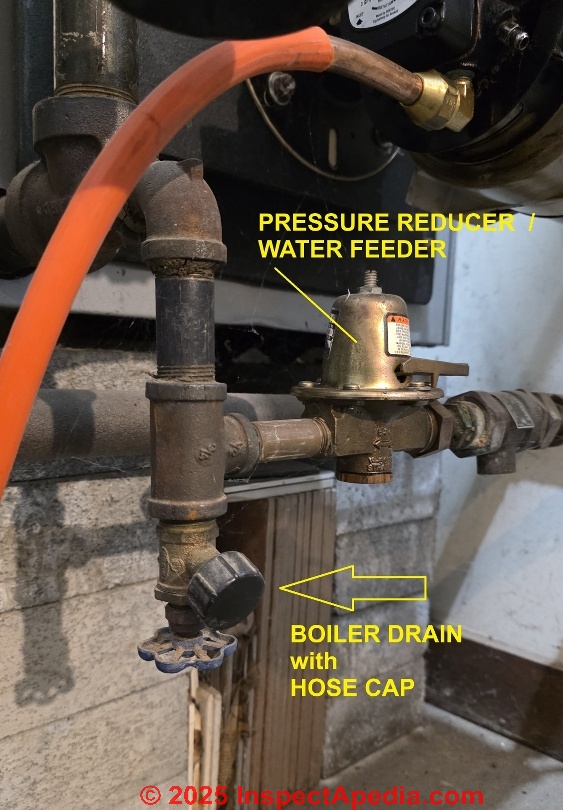
Photo above: we've put a heavy duty plastic hose cap on this boiler drain to guard against drips or leaks when no one is keeping an eye on the boiler.
- Flush the boiler with clean water
For a hydronic (hot water) boiler, flush the boiler with clean water until the outlet runs clean.
Now you can move on to step 8, refilling the boiler, pipes, radiators, basboards, etc. (We'll note at steps 9 & 10 that you may need extra steps to get all of the air out of your heating pipes and radiating devices.)
For steam boilers steam heating experts and companies producing boiler water treatment products recommend a more-detailed steam boiler water check, then flush and treatmenbt that we summarize here:
Oatey (in a detailed steam boiler flushing cleaning article provided at CITATIONS & REFERENCES found at the end of the this page) recommends removing a one gallon liquid sample of boiler water, reserving a quart of that water, and examining it for rust or sludge.If the water sample is shows high levels of rust or sludge, the company recommends removing a total of 1-2 gallons of water, and replacing that water with a mixture of a boiler water treatment product that is a system restorer and noise reducer.
Fllowing Oatey's procedure, the chemical treatment is added and the boiler is turned on and hot water is circulated through the heating system for two hours after which the system is drained completely, re-filled, and if appropriate, treated with an antifreeze or scale protection chemical.
Watch out: the company warns that leaving a boiler cleaner/restorer in the boiler for too long can damage or even ruin the boiler and heating pipes or baseboards.
Watch out: you've already been flushing the low water cutoff valve regularly, right? If not now's a good time to start.
See LWCO LOW WATER CUTOFF on STEAM BOILERS - flush the LWCO - When the boiler has finished draining close the boiler drain.
Do this once you see that there is no more water is flowing out of the drain valve/hose nor at the boiler drain. And of course remove the drain hose, pony pump etc. that you were using.
Tip: if the boiler drain drips because no one has used it for years and its internal washer is damaged, the drain valve will need to be replaced.
But you can make a quick and temporary repair by simply screwing a good quality hose cap over that dripping boiler drain.
- Re-fill the boiler
For hot water boilers: you'll need to refill the boiler itself as well as pipes and radiating devices if those were drained as well.
Watch out: keep an eyte on and close any air bleeders that you opened as soon as you see that water reached those points.
If any air bleeder continues to leak after you've turned it off (closed the valve)
see AIR BLEED VALVE LEAK REPAIR
For steam boilers: refill the boiler to the fill line indicated on the steam boiler sight glass.
See SIGHT GLASS, STEAM BOILER if you need more detail.
- Turn the heating boiler back on
And watch it go through a heating cycle, checking for leaks and confirming that all of your baseboards or radiators get hot when they should.
Really? Well yeah but if some of your radiators or baseboards don't get hot, you probably need to get more air out of the system piping.
See AIR-BOUND HEATING SYSTEMS - home for step by step solutions to that annoying problem.
...
...
Continue reading at BOILER DRAIN DAMAGES EXPANSION TANK or select a topic from the closely-related articles below, or see the complete ARTICLE INDEX.
Or see these
Recommended Articles
- AIR BLEEDER VALVES
- ANTIFREEZE for BOILERS - when, where, how & why to add antifreeze to a heating boiler
- BOILER AGE GUESSER
- BOILER CHEMICAL TREATMENTS
- BOILER DRAIN & FLUSH PROCEDURE
- BOILER DRAIN DAMAGES EXPANSION TANK - warning that using a pump or vacuum can damage the hydronic boiler expansion tank
- CHEMICAL TREATMENTS, BOILER
- EXPANSION TANKS, BOILERS - home
- LEAKS at BASEBOARD, CONVECTOR, RADIATOR - where use of additives to try to stop radiator or baseboard leaks is described
- LWCO LOW WATER CUTOFF on STEAM BOILERS - flush the LWCO
- PRESSURE REDUCER / WATER FEED VALVE, BOILER - how to get water into a heating boiler
- RELIEF VALVES, BOILERS
- WATER HEATER DRAIN PROCEDURE - draining a domestic hot water supply tank, calorifier, geyser, etc.
- WINTERIZE - HEAT OFF PROCEDURE - may require draining the heating boiler & pipes
Suggested citation for this web page
BOILER DRAIN & FLUSH PROCEDURE at InspectApedia.com - online encyclopedia of building & environmental inspection, testing, diagnosis, repair, & problem prevention advice.
Or see this
INDEX to RELATED ARTICLES: ARTICLE INDEX to HEATING BOILERS
Or use the SEARCH BOX found below to Ask a Question or Search InspectApedia
Ask a Question or Search InspectApedia
Share this article:Search the InspectApedia website
Need to make a private comment? Email editor@inspectApedia.com. We welcome email with your website content critique, corrections, suggestions or questions. Email is monitored daily but our workload may prevent an immediate reply. For immediate results, we hope you'll first try asking your question using the search box just above.
Citations & Reviewers
In addition to any citations in the article above, a full list is available on request.
- ASME Boiler and Pressure Vessel Code (BPVC) [Website], American Society of Mechanical Engineers - this site gives access to purchase a copy of the BPVC. Editors note: Regreattably buying a copy of these codes is so expensive($285 - $690 USD) that few homeowners will do so. Check with your boiler service company.
- Carrier Enterprise, WHY BOILERS NEED TO BE DRAINED & HOW TO DRAIN THEM [Website] - retrieved 2025/12/01, local backup saved as How-to-drain-a-boiler-safely-Carrier.pdf
Watch out: I (DF) think that here Carrier is talking about a tankless-coil type heating boiler that in newer hydronic heating systems can be used both to provide home heating and domestic hot water. The authors of this document did not appear to be considering a traditional residential heating boiler such as - NBBI, Suggested Maintenance Log Program for Boiler Systems [Website] (2025) National Board of Boiler and Pressure Vessel Inspectors, 1055 Crupper Avenue Columbus, OH 43229 Ph.614.888.8320, local copy saved as Boiler-Maintenance-NBBI.pdf
- Oatey, 4 TIPS to EXTEND THE LIFE OF A BOILER [PDF] (2017) Seasonal boiler maintenance can help your Residential customers improve efficiency and Performance, year-round. Oatey / Hercules Co., Cleveland OH 44135, Web: oatey.com
- Patriot Boiler Co, How to Drain a Boiler [Web article] (2025), 228 W. Lodge Drive,
Tempe, AZ 85283 USA 480-797-9349
Excerpt: Drain a hot-water boiler only for maintenance or in the event of a protracted power loss that might cause the pipes to freeze. To drain, cut off the power and water supply and allow the water to cool (the boiler has a temperature monitor).
Connect the drain valve with a hose. Drain the hose or collect the water in buckets. Open the air vents on top-floor radiators once the water is flowing. You may apply an antifreeze substance to the system to avoid freeze-ups. It may need adjustments to the boiler’s water supply, which your boiler serviceman should only perform. - Reimers Electra Steam, Inc., Maintaining a Small Steam Boiler [Website] (2021) 4407 Martinsburg Pike Clear Brook, Virginia 22624 Phone: 540-662-3811 Fax: 540-665-8101 Toll Free: 1-800-872-7562 Fax-Free: 1-800-726-4215 sales@reimersinc.com
- Holohan, Dan, "Why compression tanks waterlog", HeatingHelp.com (June 2014) - retrieved 19 March 2015, original source: https://heatinghelp.com/systems-help-center/why-compression-tanks-waterlog/
- HSB, HEATING BOILER LOG [PDF] (2020) The Hartford Steam Boiler Inspection and Insurance Company Attn: Inspection Services Hartford Steam Boiler PO Box 61509 King of Prussia, PA 19406 USA, Email: NSCINSP_hotline@hsb.com - local copy saved as Steam-boiler-Log-HSB.pdf
- Etherton, Mark (contractor), "Expansion Tanks 101: the facts and myths", Contractor Magazine, contractormag.com, (March 2000), retrieved 19 March 2015, original source: http://contractormag.com/hydronics/cm_column_75
- Extrol Corporation, "Installation & Operation Instructions, Extrol (R) Hydronic Diaphragm Expansion Tanks In-Line & SX-Series", Exrtrol Corporation, 1400 Division Road, West Warwick RI 02983, Tel: 401-884-6300, Website: www.amtrol.com, retrieved 3/3/2014, original source http://www.amtrol.com/media/documents/extrol/9015183_3_11_EXTROL_IO.pdf
- [5] Bell & Gossett Airtrol® System Installation, Operating and Service Instructions [PDF] Bell & Gossett, 8200 N. Austin Ave., Morton Grove IL 60053, USA - Tel 847 966-3700 Fax 847 965-8379. Retrieved 8/9/2012, original source B&G, [copy on file as Airtrol_Installation_Manual.pdf linked in this reference]
- "Residential Hydronic (circulating hot water) Heating Systems", Instructional Technologies Institute, Inc., 145 "D" Grassy Plain St., Bethel, CT 06801 800/227-1663 [home inspection training material] 1987
- Boilers, Boiler Conversions, James E. Brumbaugh, ISBN 0-672-23389-4 (v. 1) Volume II, Oil, Gas, and Coal Burners, Controls, Ducts, Piping, Valves, James E. Brumbaugh, ISBN 0-672-23390-7 (v. 2) Volume III, Radiant Heating, Water Heaters, Ventilation, Air Conditioning, Heat Pumps, Air Cleaners, James E. Brumbaugh, ISBN 0-672-23383-5 (v. 3) or ISBN 0-672-23380-0 (set) Special Sales Director, Macmillan Publishing Co., 866 Third Ave., New York, NY 10022. Macmillan Publishing Co., NY
- Installation Guide #200 for Residential Hydronic Heating Systems, The Hydronics Institute, 35 Russo Place, Berkeley Heights, NJ 07922
- In addition to citations & references found in this article, see the research citations given at the end of the related articles found at our suggested
CONTINUE READING or RECOMMENDED ARTICLES.
- Carson, Dunlop & Associates Ltd., 120 Carlton Street Suite 407, Toronto ON M5A 4K2. Tel: (416) 964-9415 1-800-268-7070 Email: info@carsondunlop.com. Alan Carson is a past president of ASHI, the American Society of Home Inspectors.
Thanks to Alan Carson and Bob Dunlop, for permission for InspectAPedia to use text excerpts from The HOME REFERENCE BOOK - the Encyclopedia of Homes and to use illustrations from The ILLUSTRATED HOME .
Carson Dunlop Associates provides extensive home inspection education and report writing material. In gratitude we provide links to tsome Carson Dunlop Associates products and services.
 |
HOME | ABOUT | ASK a QUESTION | CONTACT | CONTENT USE POLICY | DESCRIPTION | POLICIES | PRIVACY | |
| © 2026 - 1985 Publisher InspectApedia.com - Daniel Friedman | |||||||||