 Asbestos in Gas Fireplace Coals, Logs, etc.
- POST a QUESTION or COMMENT about how to recognize asbestos used in unusual applications in or on buildings
Asbestos was used in some gas logs or coals or used in gas fireplaces and similar heaters, world wide.
This article series provides examples of examples of unusual uses of asbestos insulation material in buildings, most likely also hazards that should be evaluated.
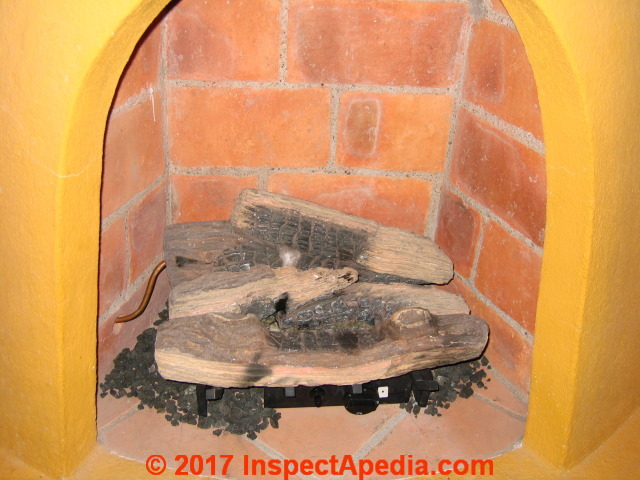
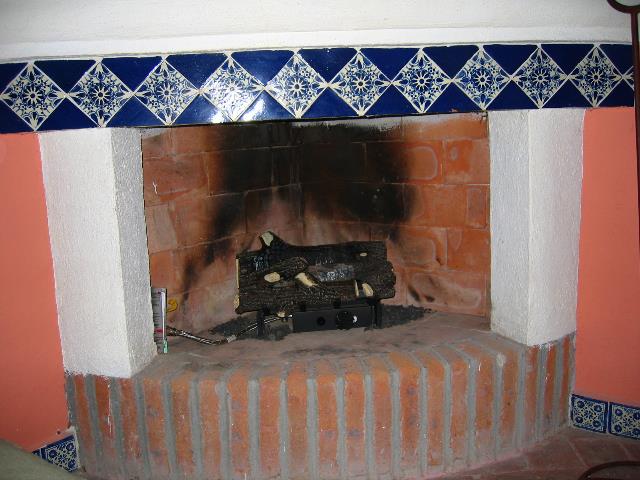
Page top photo: an asbestos-containing gas fireplace log in a home in San Miguel de Allende, Guanajuato, Mexico.
InspectAPedia tolerates no conflicts of interest. We have no relationship with advertisers, products, or services discussed at this website.
- Daniel Friedman, Publisher/Editor/Author - See WHO ARE WE?
Asbestos Use in Gas Coal or Log Fireplaces
Article Index
- ASBESTOS in ANTIQUE GAS FIREPLACES
- ASBESTOS in GAS FIREPLACE LOGS or COALS
- SUPPORTING RESEARCH on ASBESTOS in GAS FIREPLACES, LOGS, COALS
...
Asbestos Gas-Fireplace Materials in Old Houses
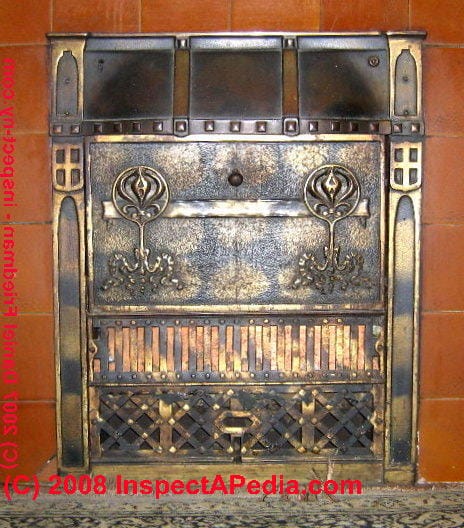
This pre-1900 gas fireplace found in a Minnesota home used tufts of asbestos fibers to support the heating flame. [
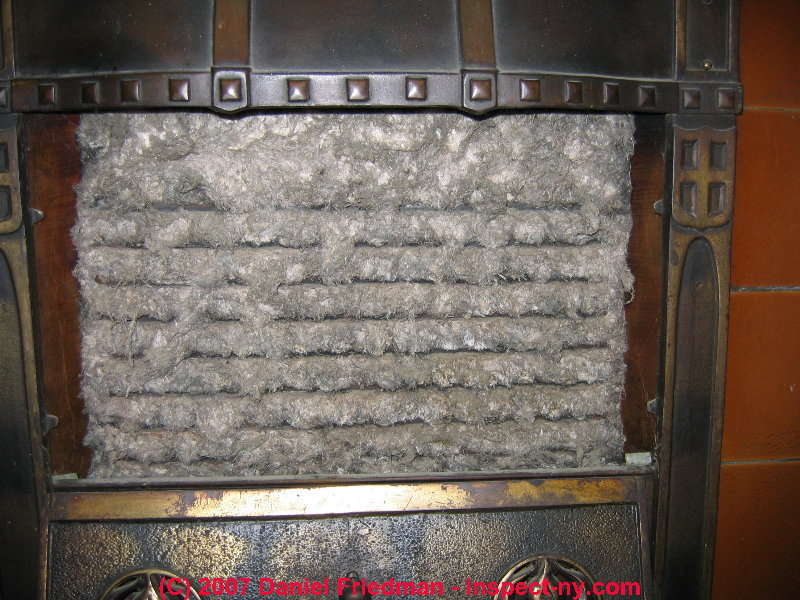
Photographs courtesy Roger Hankey.]
...
Asbestos use in Gas Fireplace Logs or Coals
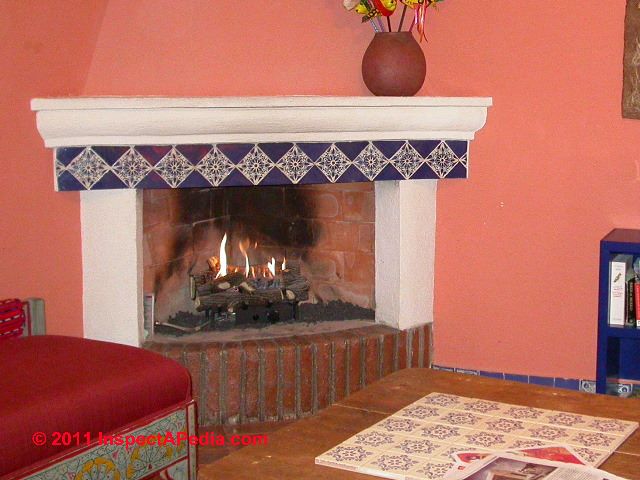
When did gas fireplaces use asbestos logs, rocks, ashes?
U.S. Title 16 › Chapter II › Subchapter B Consumer Product Safety Act › Part 1305 › Section 1305.5: asbestos in emberizing materials
This title contains U.S. Code of Federal Regulations (CFR) rules and proposed rules published in the U.S. Federal Register relating to Title 16
The answer depends largely on when and where the gas-logs were manufactured and sold. For example in the U.S. it would be highly unlikely to find asbestos gas-logs in 1991, but in some other countries such products may still have been marketed.
The U.S. CFR regulation I excerpt below had its first version published in the Congressional Record on 7 July 1983 - see the search I used given in citations below.
 In the CURRENT U.S. Title 16 › Chapter II › Subchapter B› Part 1305 › Section 1305.5 (Thanks to Cornell Law School, Legal Information Institute)
§ 1305.5 Findings.
(a) The degree and nature of the risk of injury. The Commission finds that the risk of injury which this regulation is designed to eliminate or reduce is from cancer, including lung cancer and mesothelioma.
Measurements are not available of the amounts of asbestos in the air from asbestos-containing emberizing materials in homes.
However, it appears that the amount of airborne asbestos in such homes would increase when air currents in the home are created by downdrafts from a fireplace chimney or other activities that stir air in any room.
Since emberizing materials may contain up to 50 percent asbestos, which if not permanently bound into artificial fireplace logs would be in respirable form, the risk associated with emberizing materials is considerable, especially since it continues to exist 24 hours a day.
(b) Products subject to the ban. Artificial emberizing materials are decorative simulated ashes or embers, used in certain gas-buring fireplace systems, which glow to give the appearance of real burning embers.
The material is sprinkled on or glued to gas logs, or sprinkled on fireplace floors.
(c) Need of the public for the products and effects of the rule on their utility, cost, and availability. Artificial fireplace emberizing material serves a strictly decorative purpose and does not materially affect the actual performance of the fireplace gas system in terms of its ability to provide heat.
A certain degree of aesthetic desirability exists, however, since the product “system” itself (the gas log, ashes, and embers) is intended to simulate burning wooden logs.
Gas logs may be sold with artificial emberizing material attached at the factory (the log commonly referred to as being “frosted”), or with the “embers” in a separate kit, often mixed with simulated “ashes.”
Virtually all gas logs are either frosted or packaged with an emberizing kit; however, the majority of gas logs produced in 1977 were packaged with non-asbestos-containing emberizing kits.
The Commission estimates annual sales of artificial gas logs at approximately 100,000 units. Some 25,000-30,000 of these would be subject to the ban.
Approximately 100,000 gas logs frosted or treated by consumers with asbestos are estimated to be in existence.
The Commission believes that the majority of gas logs are sold with emberizing kits; this gives the consumer a choice as to whether or not to use the artificial embers and ashes.
(1) Utility. Manufacturers of artificial gas log emberizing material are currently using four substitutes for asbestos in their products: vermiculite, rock wool, mica, and a synthetic fiber.
None of the four is claimed to be as aesthetically effective as asbestos. Thus, the utility derived by consumers from some gas-burning fireplace systems may be adversely affected.
...
Research on Use of Asbestos in Gas Fireplaces, Logs, Coals
- GAS FIREPLACE / LOG MANUALS provides resources including patent history of gas logs and gas fireplaces and the use of asbestos in those products in the U.S. beginning before 1900
- Original source for the 1983 regulation, see: https://www.govinfo.gov/content/pkg/FR-1983-07-07/pdf/FR-1983-07-07.pdf [be warned this is a huge document, the entie Federal Registger for 7 July 1983 - Ed.]
Current: Title 16 - Commercial Practices, Chapter II - CONSUMER PRODUCT SAFETY COMMISSION Subchapter B - CONSUMER PRODUCT SAFETY ACT REGULATIONS Part PART 1305—BAN OF ARTIFICIAL EMBERIZING MATERIALS (ASH AND EMBERS) CONTAINING RESPIRABLE FREE-FORM ASBESTOS [PDF] retrieved 2017/11/09, original source: https://www.gpo.gov/fdsys/pkg/CFR-2012-title16-vol2/pdf/CFR-2012-title16-vol2-part1305.pdf Date January 1, 2017 - Alleman, James E., and Brooke T. Mossman. "Asbestos revisited." Scientific American 277, no. 1 (1997): 70-75.
cites Asbestos in gas fireplace mantles. - Chemcare Environmental Cleanup Co., Gas Heaters and Asbestos (website), the company notes that though the U.S. and U.K. have lists of heater models and brands that contained asbestos, New Zealand does not have such a list.
- Fibre Safe, Gas & Electric Heating Appliances [In the UK] known to contain Asbestos [PDF] (at fibresafe.com website) Fibre Safe Ltd Contact 0800 458 4136 www.fibresafe.com = - local copy saved as Asbestos-in-Heaters-FibreSafe.pdf - Fibre Safe has offices in Wirral, Liverpool, Manchester, and Wales
- Kilburn, Kaye H. "Asbestos and other fibers." Public health and preventive medicine (1992): 343-364.
- Konzo, Seichi, James T. Lendrum, Keith Harry Hinchcliff, and Warren Skinner Harris. "Chimneys and Fireplaces." Circular Series Index No. F7. 0 (1945).
Another type [of chimney], approved only for use with gas as the fuel, has a single wall made of a cement-asbestos material. - Smith, S. "Fireplaces and flues." In Brickwork, pp. 51-64. London: Macmillan Education UK, 1972.
Cites use of asbestos in general fireplace construction; other sources commonly cite use of asbestos in fireplace or heater flue sealants and in fireplace mantles. - Storage Heaters OLD STORAGE HEATERS CONTAINING ASBESTOS (Website) - this website storageheaters.com does not identify its principals nor give a location or address; local copy saved as Storage-Heaetrs-W-Asbestos.pdf
Note that while we list here the names or brands of companies making storage heaters known to contain asbestos, in the original document specific model heaters are given:
ET Electrical Industries of Ireland, Activair, Allied, TI Ardun Ltd., Alexander Dunn, Balmforth, Belling, Berry Magicoal, Brush Electrical Co., Ltd. (Kenton Storage Radiators), Chidlow, Constor, Parkinson Cowan Heating Ltd., TI Creda, Creda, Dimplex, Dunlop / Westayr, Electrolux, EMA, English Electric, Enviwarm, Erskine / Westayr, Falks, Falks (Storawarm), Fletcher, GSW Activaire, GEC/EE, GEC of Ireland (AET), Harper, Heatovent, Heatstore, Heetrite, Husquvarna, Kenton, Magicoal, Berry Magicoal Ltd., Marsden New Home (Storage fan heater), Multitherm, Partridge, (Colston) Phillips Quilstore, Revo, Selex, Servis, Storad, Thermair, Tricity, Tyrad, Unidare, Thermadare, Westayr (Dunlop / Westayr, Erskine / Westayr, Evenstore)
- Teschke, Kay, Michael S. Morgan, Harvey Checkoway, Gary Franklin, John J. Spinelli, Gerald van Belle, and Noel S. Weiss. "Mesothelioma surveillance to locate sources of exposure to asbestos." Canadian journal of public health 88, no. 3 (1997): 163-168.
A weaker citation: in the bricklayers group, a next-of-kin thought the subject may have used asbestos when laying fireplace bricks. Two individuals from this group were bricklayers, - US CPSC, ASBESTOS BAN ANNOUNCED - Proposed Instructions for Removing Non-Burning Artificial Fireplace Logs, Gas-Burning Fireplace Logs and Ashes Containing Asbestos (1977) (Website) U.S. Consumer Products Safety Commission, local copy saved as CPSC-Asbestos-Ban-1977.pdf
Cites consumer patching compounds containing asbestos and artificial fireplace ash containing asbestos,
...
Artificial fireplace emberizing materials (ash and embers) are used in gas- burning or artificial fireplace systems for decorative purposes
...
artificial fireplace ash containing asbestos - EPA Guidance for Controlling Asbestos-Containing Materials in buildings, NIAST, National Institute on Abatement Sciences & Technology, [republishing EPA public documents] 1985 ed., Exposure Evaluation Division, Office of Toxic Substances, Office of Pesticides and Toxic Substances, U.S. Environmental Protection Agency, Washington,D.C. 20460
- US CPSC ASBESTOS IN THE HOME [PDF] (1990) - copy at this website; original no longer online.
- US CPSC, Asbestos in the Home [PDF] (1982) (EPA Website) - local copy saved as Asbestos-in-Your-Home-EPA-1982.pdf
- US CPSC, Asbestos in the Home (Website) U.S. Consumer Product Safety Commission, retrieved 2026/07/03, local copy saved as Asbestos-in-the-Home-CPSC.pdf
Excerpt: ARTIFICIAL ASHES AND EMBERS sold for use in gas-fired fireplaces. Also, other older household products such as FIREPROOF GLOVES, STOVE-TOP PADS, IRONING BOARD COVERS, and certain HAIRDRYERS. - U.S. Title 16 › Chapter II › Subchapter B › Part 1305 › Section 1305.5 [PDF, Cornell Law School, Legal Information Institute, retrieved 2017/09/19, original source: https://www.law.cornell.edu/cfr/text/16/1305.5
- To Search the U.S. CFR Federal Register such as the asbestos gas log research we cite earlier on this page, use this website: https://www.govinfo.gov/app/search/
...
Reader Comments, Questions & Answers About The Article Above
Below you will find questions and answers previously posted on this page at its page bottom reader comment box.
Reader Q&A - also see RECOMMENDED ARTICLES & FAQs
Asbestos in old 1937 gas fireplace with "mock coals"?
Will my fireplace which contains an old gas fire with mock coals have asbestos ? It was built in 1937 . On 2021-10-04 by Phil North
by inspectapedia.com.moderator (mod) - quite possibly
@Phil North,
It is true that at one time, some gas fire decorative components, such as ash, embers, or logs, were known to contain asbestos.
If you could post a photo, it would helpful in more accurately answering your question. Is there any label or marking of the brand of fireplace?
Some of the information on this page may be helpful if you know more information about your fireplace:
GAS LOG FIREPLACE MANUALS
Asbestos in this 2004 Napoleon gas fireplace ?
Is this asbestos in the Napoleon gas fireplace in my house? the house was built in 2004 in Canada
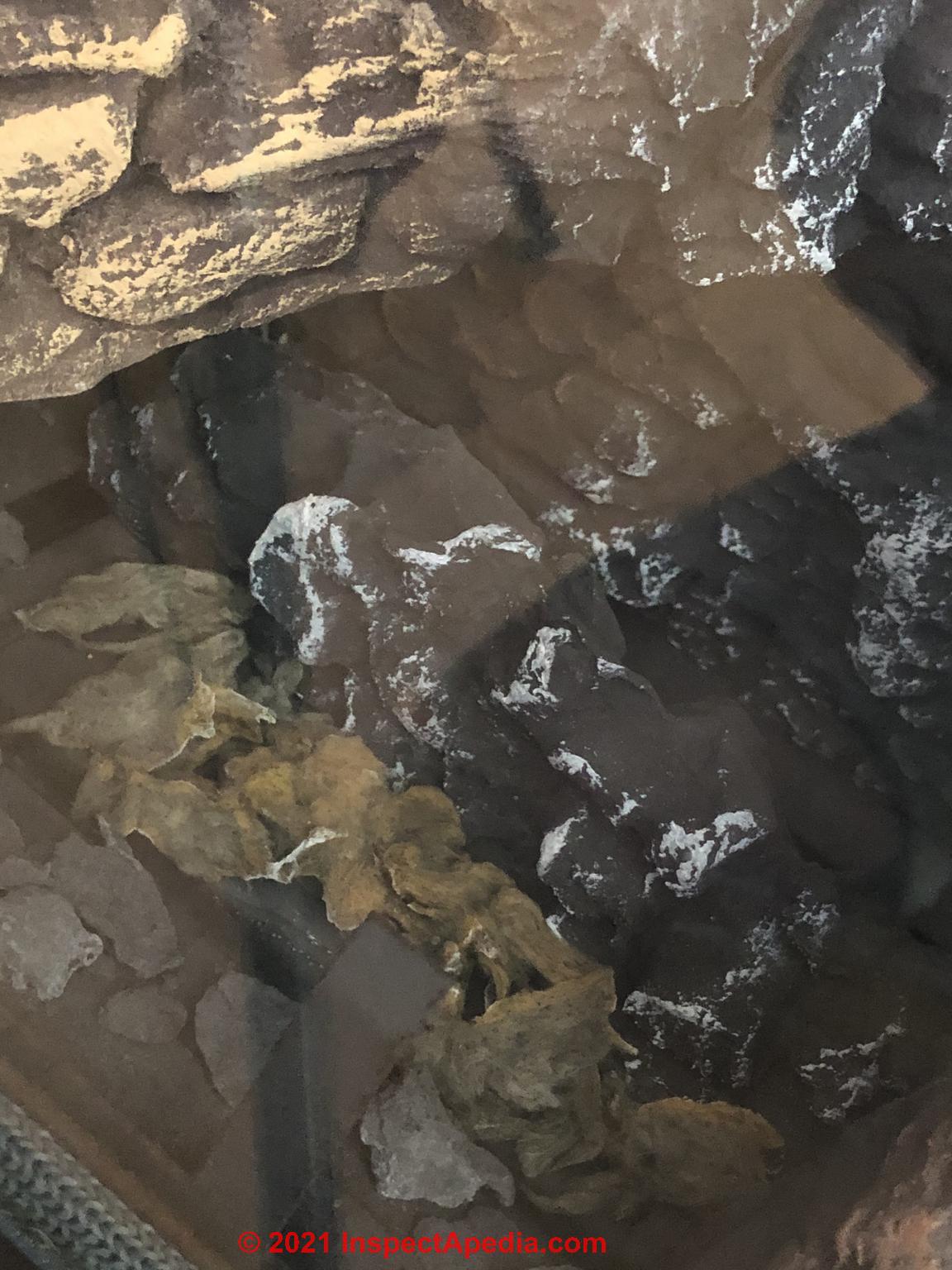
On 2020-08-26 by Nick
by (mod) - NO asbestos in a 2004 home gas fireplace in the U.S.
Nick,
One would not expect asbestos-containing products in a 2004-built home.
How to deal with pre-1900 fluffy asbestos fiber in the gas fireplaces
We just moved into an antique home with pre-1900 fluffy asbestos fiber in the gas fireplaces. What would be the best way to deal with this? Thanks so much On 2020-02-19 by AMY
by (mod) -
Amy I've not seen fluffy asbestos fiber in a gas fireplace but imagine it's possible that a mineral fiber was included along the gas burner orifices so as to break up the flame for added realism.
If the material in question is really asbestos (attach some sharp photos, 1 per comment so we can see what you see) then I'd figure that the fake logs may also contain asbestos.
In that case it'd be reasonable disconnect, bag, and remove the entire assembly intact.
ASBESTOS REMOVAL, WETTING GUIDE will be helpful as well as ASBESTOS DISPOSAL REGULATIONS that may apply depending on where you live.
Asbestos Hazard from Real Fyre Glowing Embers G4 Series Burner Split Oak SG4-24 gas logs ?
We have Real Fyre Glowing Embers G4 Series Burner Split Oak SG4-24 gas logs in our home. They were installed some time between 1984 and 1991.
The literature that came with the gas logs and was passed on to us when we bought the house says, "Real-Fyre®Glowing Embers (Item #10) are specially formulated and sized to create the most authentic,uniform "glow," and...are nonflammable and inert, containing no asbestos."
Also, based on the literature provided, it looks like sand was used with our natural gas system as opposed to vermiculite which would be used with a propane gas system. Do I need to have this tested for asbestos? If so, what specific components need to be sampled and tested?
When I called the Regional EPA office, they indicated that testing may be more hazardous because it would disturb the area. Maybe testing would make things worse? Please advise. Signed, A Worried Mom On 2017-11-09 by Linda -
Answer by (mod) - Real Fyre Glowing Embers G4 Series Burner Split Oak SG4-24 gas logs
Linda,
Nobody is likely to bet their retirement savings on making promises about hazards from materials described in a simple e-text and otherwise unknown, but certainly either you trust the literature as pertaining to your gas logs or you don't.
Or you could contact the manufacturer to ask for confirmation that your logs are asbestos free - you'll want the date of manufacture or at least the date of installation of the gas log.
RealFyre gas logs are produced by Robert H. Peterson Co. • 14724 East Proctor Avenue • City of Industry, CA 91746 USA Website: http://www.rhpeterson.com/, Tel: 800 332 3973
You can see a typical RealFyre gas log owners' manual here in PDF form
https://inspectapedia.com/chimneys/Real-Fyre-Gas-Log-Manual-RH-Peterson.pdf
If you are worrying, the health effects from that stress might be bad enough to justify the cost of a simple asbestos material test. Search InspectApedia for ASBESTOS TEST LAB LIST if you need that service. The lab will instruct you on safe sampling, typically you're simply wetting an area and pinching off an very tiny sample of material - a procedure that would not be expected to release a detectable indoor air particle hazard.by Linda
Thank you so much for your response, danjoefriedman. I did have someone come out who said they would need to test three "components" of the logs. I told him I needed to do some research before proceeding.
I am fine with trusting the company, I'm just concerned that there are additional components (other than the glowing embers) that would need to be tested. Any idea what other two components in a gas fireplace produced in the 1980s would need to be tested? I did contact RH Peterson. They have been very responsive. Thanks again for your help.
by (mod) -
Linda
What did RH Peterson tell you about the use of asbestos in their products? A search of their site for "asbestos" returned null.
Typically asbestos was used in some gas fire logs and on occasion it might have been used in place of mineral wool or mixed with mineral wool to produce glowing embers around the log base. In my OPINION that would be a greater potential hazard than undisturbed gas logs. If your fireplace uses sand or glass or mineral wool, those aren't asbestos materials.
At GAS LOG FIREPLACE MANUALS -
you'll find this helpful PDFCornell Law School, ASBESTOS in GAS LOGS 16 CFR 1305.5 - Findings. Injuries from asbestos in gas logs [PDF]
that describes the hazard sources.
What did RH Peterson tell you about the use of asbestos in their products? A search of their site for "asbestos" returned null.
Typically asbestos was used in some gas fire logs and on occasion it might have been used in place of mineral wool or mixed with mineral wool to produce glowing embers around the log base. In my OPINION that would be a greater potential hazard than undisturbed gas logs. If your fireplace uses sand or glass or mineral wool, those aren't asbestos materials.
At GAS LOG FIREPLACE MANUALS - inspectapedia.com/heat/HVAC-Manuals-Air-Conditioners-Boiler-Furnaces-F-I.php#GasLog
you'll find this helpful PDF
Cornell Law School, ASBESTOS in GAS LOGS 16 CFR 1305.5 - Findings. Injuries from asbestos in gas logs [PDF]
at inspectapedia.com/hazmat/Asbestos-Gas-Logs-US-16-CFR-1305.5.pdf
That source and the CPSC cited glue melting at high temperatures on the logs, releasing emberizing material that contained asbestos.
that describes the hazard sources. Those emberizing materials on gas logs were banned in the U.S.
Also in some older gas-log fireplaces vermiculite was used at the fire base. Some vermiculite, depending on where it was mined, contained asbestos. See VERMICULITE INSULATION -https://inspectapedia.com/insulation/Vermiculite_Insulation.phpby Linda
Thanks for the info. RH Peterson is working on tracking down info for me. They have been great. I have a child with a genetic condition that causes him to have lots of health problems.
Based on the info you provided, I'm still not sure if it's riskier to leave the fireplace alone and not use it or to have it tested and, as the EPA said, potentially risk disturbing asbestos. Do you happen to know, if we do test, would keeping my child out of the house for a couple of days after testing help to mitigate the risk?
Also, if I just leave it alone, don't use the fireplace, and keep the damper closed, can the asbestos fibers still get in to my home? I'm happy to pay to have a trained professional test, I am just trying to figure out how to minimize the risk to my son.
Is it likely that a 1991-93 gas fireplace has asbestos logs, rocks, or ashes?
Is it likely that a 1991-93 gas fireplace has asbestos logs, rocks, or ashes? On 2017-09-19 by Bill -
Answer by (mod) - actual health hazards of asbestos-containing gas fireplace logs - IF present.
Bill,
The answer depends largely on when and where the gas-logs were manufactured and sold. For example in the U.S. it would be highly unlikely to find asbestos gas-logs in 1991, but in some other countries such products may still have been marketed.The U.S. CFR regulation I excerpt below had its first version published in the Congressional Record on 7 July 1983 - see the search I used given in citations now found at
GAS FIREPLACE LOG ASBESTOS https://inspectapedia.com/hazmat/Asbestos_Unusual.phpIn the U.S. Title 16 › Chapter II › Subchapter B › Part 1305 › Section 1305.5
Thanks to Cornell Law School, Legal Information Institute)
§ 1305.5 Findings.(a)The degree and nature of the risk of injury.
The Commission finds that the risk of injury which this regulation is designed to eliminate or reduce is from cancer, including lung cancer and mesothelioma. Measurements are not available of the amounts of asbestos in the air from asbestos-containing emberizing materials in homes.
However, it appears that the amount of airborne asbestos in such homes would increase when air currents in the home are created by downdrafts from a fireplace chimney or other activities that stir air in any room.
Since emberizing materials may contain up to 50 percent asbestos, which if not permanently bound into artificial fireplace logs would be in respirable form, the risk associated with emberizing materials is considerable, especially since it continues to exist 24 hours a day.
(b)Products subject to the ban. Artificial emberizing materials are decorative simulated ashes or embers, used in certain gas-burning fireplace systems, which glow to give the appearance of real burning embers. The material is sprinkled on or glued to gas logs, or sprinkled on fireplace floors.
(c)Need of the public for the products and effects of the rule on their utility, cost, and availability. Artificial fireplace emberizing material serves a strictly decorative purpose and does not materially affect the actual performance of the fireplace gas system in terms of its ability to provide heat.A certain degree of aesthetic desirability exists, however, since the product “system” itself (the gas log, ashes, and embers) is intended to simulate burning wooden logs. Gas logs may be sold with artificial emberizing material attached at the factory (the log commonly referred to as being “frosted”), or with the “embers” in a separate kit, often mixed with simulated “ashes.”
Virtually all gas logs are either frosted or packaged with an emberizing kit; however, the majority of gas logs produced in 1977 were packaged with non-asbestos-containing emberizing kits.
The Commission estimates annual sales of artificial gas logs at approximately 100,000 units. Some 25,000-30,000 of these would be subject to the ban. Approximately 100,000 gas logs frosted or treated by consumers with asbestos are estimated to be in existence.
The Commission believes that the majority of gas logs are sold with emberizing kits; this gives the consumer a choice as to whether or not to use the artificial embers and ashes.
(1)Utility. Manufacturers of artificial gas log emberizing material are currently using four substitutes for asbestos in their products: vermiculite, rock wool, mica, and a synthetic fiber. None of the four is claimed to be as aesthetically effective as asbestos. Thus, the utility derived by consumers from some gas-burning fireplace systems may be adversely affected.
I appreciate the question and will post the full text of the cited law under Gas Logs found in ASBESTOS in UNUSUAL PLACES https://inspectapedia.com/hazmat/Asbestos_Unusual.phpby Bill
I live in the US, so I guess the chances are slim
Followup by Bill: Volcanic rock used in Superior Gas Fireplaces in California is not asbestos
MORE INFO: The fireplace I asked about earlier was manufactured by Superior Fireplaces in California between 1991-93. It have volcanic rock and no ash.
It satisfies all ANSI specifications. Is this likely to have asbestos logs. On 2017-09-20 by Bill -
by (mod) - Gas fireplace "coals" are unlikely to be an asbestos worry but there may be asbestiform minerals in some volcanic rock
Bill, volcanic rock is completely different from and looks nothing like a log.
Volcanic rock is a natural material, porous rock created by volcanic action. It looks like rocks not like a log.
You can see photos of typical gas fireplace logs at the top of the article on this page. You're also welcome to send me photos of your gas fireplace using the page top or bottom contact link.You'll see that in New Zealand and probably elsewhere there may, however, be asbestiform minerals in some volcanic rock.
Asbestos occurrence in volcanic rock would be rare, but according to the University of Auckland, some volcanic rocks may contain equally dangerous minerals that may occur or break into fibers similar to asbestos, citing erionite or amphibole (which in some of our sources is listed as an asbestiform mineral) - Daniel F.
Reference
- Salmonde, Jennifer and Martin Brook, What lies beneath: is this the new asbestos? (2020) (Website)
Authors are at : School of Environment, Faculty of Science, University of Auckland
Excerpt: A mineral linked to a form of lung cancer associated with asbestos has been found in Auckland. As the city enters a new phase of earthwork and construction activity, it is important to ensure erionite deposits are not disturbed.
...
Continue reading at ASBESTOS in GAS FIREPLACE BACKER, or select a topic from the closely-related articles below, or see the complete ARTICLE INDEX.
Or see these
Recommended Articles
- ASBESTOS IDENTIFICATION IN BUILDINGS - home
- ASBESTOS in GAS FIREPLACE BACKER
- ASBESTOS USE in ELECTRIC or GAS HEATERS
- ASBESTOS LIST of PRODUCTS - topic home
- ASBESTOS USE in APPLIANCES
Suggested citation for this web page
ASBESTOS in GAS FIREPLACES at InspectApedia.com - online encyclopedia of building & environmental inspection, testing, diagnosis, repair, & problem prevention advice.
Or see this
INDEX to RELATED ARTICLES: ARTICLE INDEX to ASBESTOS HAZARDS
Or use the SEARCH BOX found below to Ask a Question or Search InspectApedia
Ask a Question or Search InspectApedia
Share this article:Search the InspectApedia website
Need to make a private comment? Email editor@inspectApedia.com. We welcome email with your website content critique, corrections, suggestions or questions. Email is monitored daily but our workload may prevent an immediate reply. For immediate results, we hope you'll first try asking your question using the search box just above.
Citations & References
In addition to any citations in the article above, a full list is available on request.
- ASBESTOS IN YOUR HOME U.S. EPA, Exposure Evaluation Division, Office of Toxic Substances, Office of Pesticides and Toxic Substances, U.S. Environmental Protection Agency, Washington,D.C. 20460
- In addition to citations & references found in this article, see the research citations given at the end of the related articles found at our suggested
CONTINUE READING or RECOMMENDED ARTICLES.
- Carson, Dunlop & Associates Ltd., 120 Carlton Street Suite 407, Toronto ON M5A 4K2. Tel: (416) 964-9415 1-800-268-7070 Email: info@carsondunlop.com. Alan Carson is a past president of ASHI, the American Society of Home Inspectors.
Thanks to Alan Carson and Bob Dunlop, for permission for InspectAPedia to use text excerpts from The HOME REFERENCE BOOK - the Encyclopedia of Homes and to use illustrations from The ILLUSTRATED HOME .
Carson Dunlop Associates provides extensive home inspection education and report writing material. In gratitude we provide links to tsome Carson Dunlop Associates products and services.
 |
HOME | ABOUT | ASK a QUESTION | CONTACT | CONTENT USE POLICY | DESCRIPTION | POLICIES | PRIVACY | |
| © 2026 - 1985 Publisher InspectApedia.com - Daniel Friedman | |||||||||