 Mushrooms - Fungi - Growing on Building Surfaces
- POST a QUESTION or COMMENT about brown mold in buildings; should you buy a moldy house?
What does it mean if we find mushrooms growing out of building ceilings, walls, floors, carpets or on wood framing?
What about mushrooms growing in our dirt crawlspace?
Watch out: The mushrooms on your carpet or wall may not be harmful but at the very least their presenc means that conditions that are wet enough to grow mushrooms in or on your building. In turn that means that there is risk of hidden rot, insect damage, and possibly harmful mold spores.
What we call "mushrooms" are the fruiting body or spore-release mechanism of certain groups of fungi.
This article serices provides photos of mold on indoor building surfaces to help you recognize mold in buildings, recognize probably-cosmetic mold, and recognize stuff that is not mold and does not need to be tested.
InspectAPedia tolerates no conflicts of interest. We have no relationship with advertisers, products, or services discussed at this website.
- Daniel Friedman, Publisher/Editor/Author - See WHO ARE WE?
Mushrooms Growing On or In Buildings & Building Materials
Mushrooms Growing Indoors
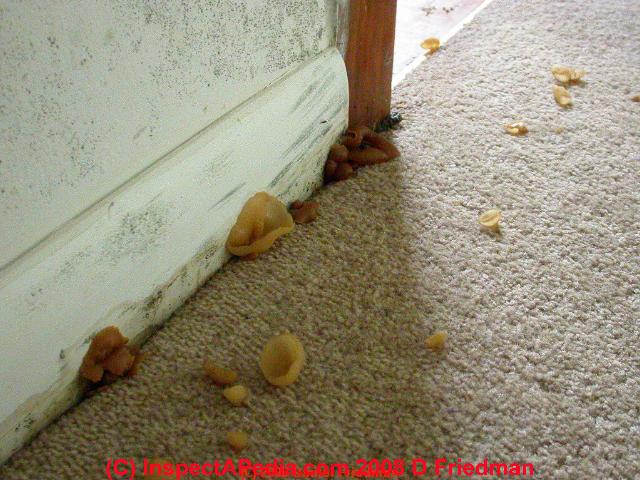
Brown fungus growing out of carpeting and floor trim combined with green mold on the exposed surface of drywall were conditions easily seen, and under which we assumed that the wall cavities were likely to be mold-contaminated in this area.
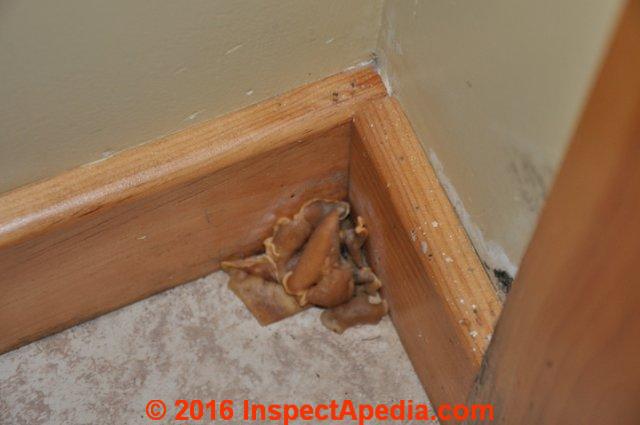
If you see mushrooms growing out of a building surface it's a safe bet that conditions have been quite wet and there is high probability of additional and substantial hidden mold growth and perhaps rot (and insect damage) in building cavities and in nearby wood structural members or subflooring.
Typically basidiomycetes or wood-rotting fungi grown on wet wood and can appear rather quickly even indoors in wet conditions
. These fungal fruiting bodies may appear in any of many colours, commonly brown, white, red, even blue or very dark, almost black.
Also see MUSHROOMS GROWING OUT OF BUILDING CEILINGS FLOORS or WALLS FAQs
More examples of mushrooms growing in or on buildings are
and
at MOLD on DIRT FLOORS - separate article, includes white mold on dirt in crawl spaces & basements
Examples of Mushrooms (mold) on Dirt Under Buildings

As we illustrate above and below, mushrooms of various shapes, sizes and colors are often found in damp or wet dirt crawlspaces under buildings
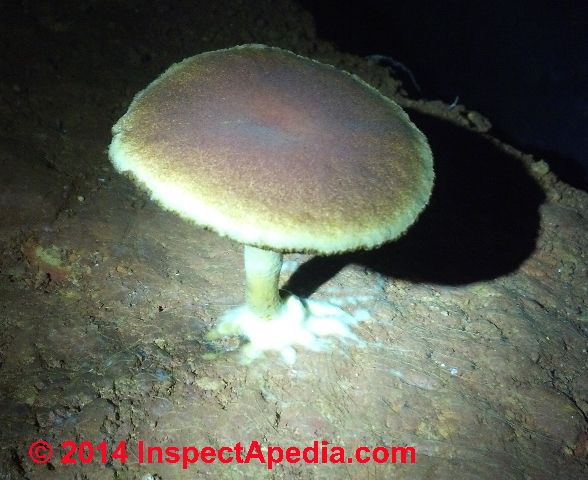
- discussed in detail
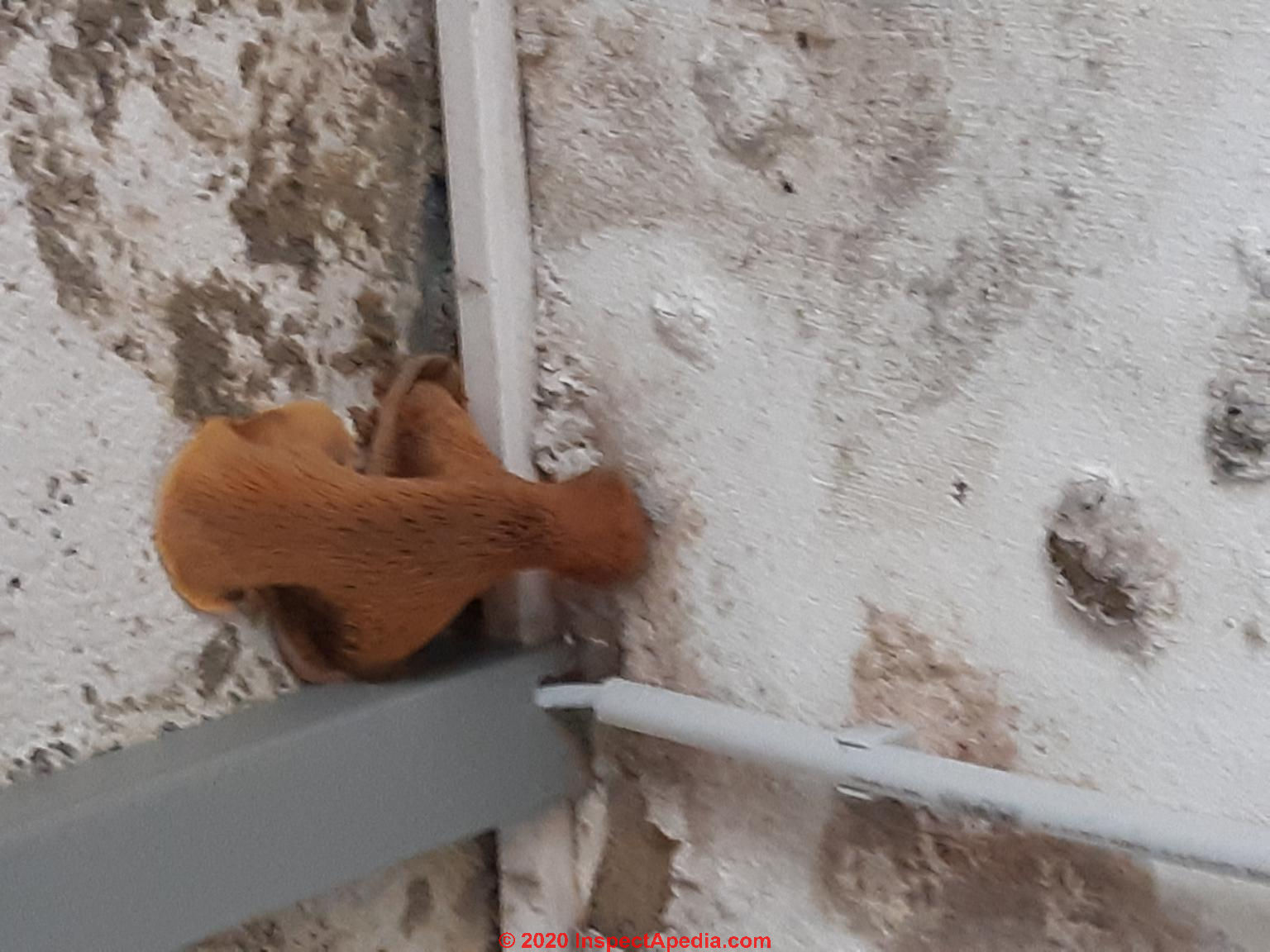
Are these mushrooms growing on the wall in our garage?
I found your informative site after an hour or so of trying to find similar pictures to a mold/mushroom/fungus that I discovered in my garage yesterday.
I only noticed it after it dropped a clear liquid next to me. They seem to be growing out of the darker patches of moist paint/plaster.
Would that interest you to feature the photo? If you did, it might help me know what I could do about it. [Photo shown above]
Thanks and regards, On 2019-10-31 by Michael -
by (mod) - mold (or fungi) producing mushrooms growing on indoor surfaces
Michael
Thanks for the photo and question.
Other examples of mold (or fungi) producing mushrooms growing on indoor surfaces are at
YELLOW MOLD PHOTOS
and separately at
MOLD APPEARANCE on VARIOUS SURFACES we provide a large catalog of photos of what mold looks like growing on all sorts of building materials and surfaces.
What is the material and what are we looking at in your garage photo: this looks to me like a concrete or other masonry wall skim coated with a moisture-resistant paint.Those blistered spots in the right side of the image look like paint being pushed off of the wall by moisture and probably by efflorescence - a mineral salt that forms as water moves through the wall and evaporates on the inner surface.
Some of the dark areas in the paint are likely to be one or more species of mold.
The "Mushroom" in your photo is simply confirmation that the area has been wet and that one of the mold species produced its fruiting body.
Am I right that this is a wall and that it's below ground level? If so your outside focus will be on getting water away from the building by addressing surface runoff and / or overflowing roof gutters.
Indoors, you can use any common cleaner to clean the surfaces and let them dry. But don't bother re-coating the wall before the water problem has been addressed.
Finally, knowing the genera/species of mold won't change the cleanup procedure; from the little we know here there's no justification for any further testing. Remove the mold and fix its cause.Also see MUSHROOMS IN or NEAR BUILDINGS
Also see MOLD on PLASTER CEILINGS, WALLS where we'll include your photo. Thanks again: working together makes us smarter.
by Michael
Many thanks for the detailed response. It definitely proves your competence, as every one of your predictions of further details were correct; very astute.
I had to check with the owner's son about the wall material etc, but it is indeed a concrete wall, and he believes the paint was moisture resistant.
I have removed the fungus, brushed down the wall and knocked off the darker patches (wore a mask, just to be sure). I've dried the wall using heaters and heat guns, but the underlying problem as you said was moisture insidr the wall.
It is un the garage which as you rightly deducted is underground, as the garden comes up a level around the house. Having investigated, the garden patio where it meets the problem wall has perforations all the way along; each large enough to accommodate a fat ant to pass through.Not sure how or why those holes have started, but it explains perfectly how the wall can get so wet. This is the thing that I'll need to fix.
Further, the garage used to be a chicken coup, 80 years ago.And there was a metal chimney of sorts, of which the stove pipe is still in place in the unused outhouse the level above...turns out, with the current cold weather, water had been condensing on the inside of this pipe and running down and out in the garage, exactly where the 2 mushrooms were.
Once I get the patio/wall holes filled, I can tackle the metal pipe then re-dry the wall and paint it.
Many thanks for your invaluable help.by (mod) - keep the water out from outside
Michael
Thanks for the compliments. Actually I'm just a 13 year old kid typing from my smartphone in Guanajuato, Mexico. It's dry here but we still see mold growth from time to time. (ok just kidding).
Comments:
It's always better to keep the water out from outside than to let it come in and then try to get rid of it; but beyond trying to seal the wall inside or out, at most homes the most-important step is to keep the roof drainage system working: clean gutters, unclogged downspouts, and downspouts take water 10' or more away from the building and dump it where it doesn't run back towards the foundation.
In-slope grade close to the foundation also sends un-wanted water in that direction.
Your detective work on noticing the abandoned metal chimney pipe as a source of moisture is great: I'd like to see some photos (one per comment is what works);
That too is best fixed from the roof-side (don't fall off the roof);
But the condensation also tells us there's a high indoor moisture level; In addition to stopping water entry as we've discussed, look for other moisture sources.
...
Reader Comments, Questions & Answers About The Article Above
Below you will find questions and answers previously posted on this page at its page bottom reader comment box.
Reader Q&A - also see RECOMMENDED ARTICLES & FAQs
Is this brown mold on our Floor / Baseboard Trim Dangerous?
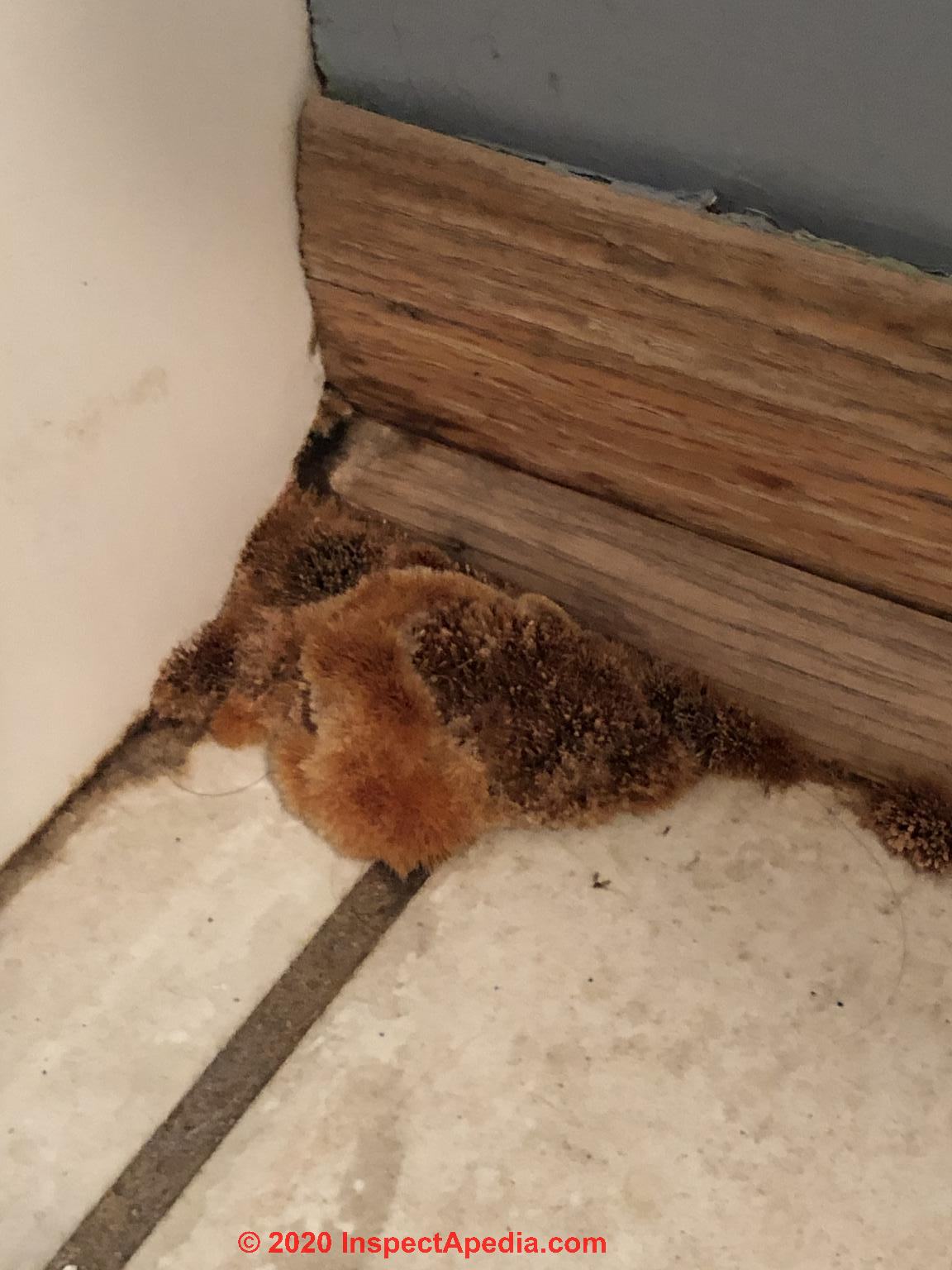
Is this Brown Mold and is it dangerous? On 2020-06-09 by Kristin Williams
by (mod) - trivial amount of mold visible but look further for a larger hidden reservoir
Kristin
The volume of mold in the photo, if that were all of the building mold, would be trivial.
Watch out: But of course the leak that caused that mold growth (we're seeing the fruiting body of the fungus) may have caused more extensive and thus hazardous hidden mold in the floor or wall. Investigate further.
Dark Brown Hairy mold growing on a window sash and sill
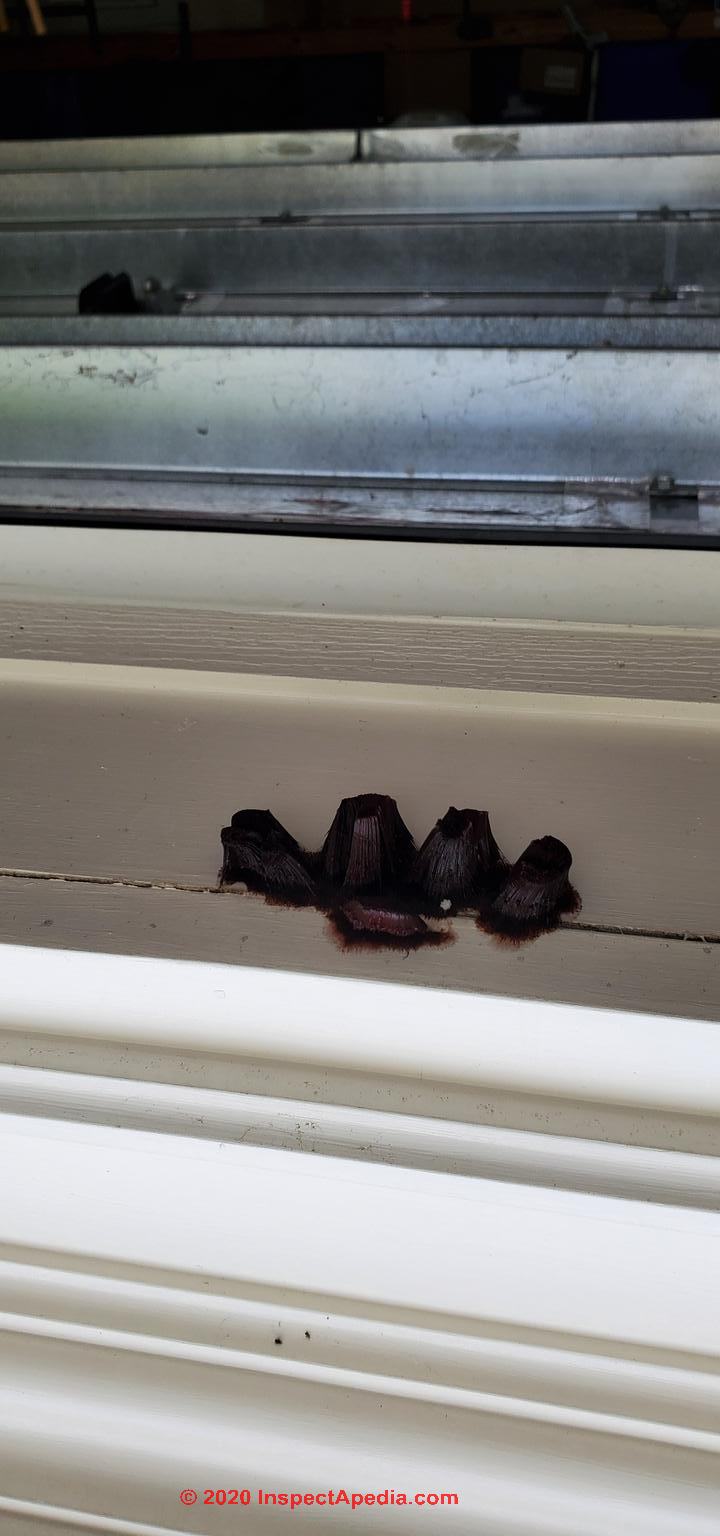
Any idea what this is?
This grew on the outside of my garage overnight. It is wet and a dark purple color. Any idea what it is? On 2020-06-07 by tdavis52 - Marie Smith D
by (mod) -
Marie,
That looks like a fungus, perhaps a Stemonitis mold, telling us that there's a leak into the wall trim and possibly the wall cavity - further investigation is warranted.
Fix the gutter leaks and look inside the building for leak stains or measure for moisture at the ceiling-wall intersection in this area.
It may be necessary to cut a small inspection opening in that area.
...
Continue reading at MOLD APPEARANCE - WHAT MOLD LOOKS LIKE or select a topic from the closely-related articles below, or see the complete ARTICLE INDEX.
Or see these
Recommended Articles
- BROWN MOLD PHOTOS
- BROWN HAIRY BATHROOM MOLD - topic home
- MOLD APPEARANCE - WHAT MOLD LOOKS LIKE - a Photo ID Library for detection and identification of mold allergens on indoor building surfaces.
- MOLD APPEARANCE - STUFF THAT IS NOT MOLD
- MOLD ATLAS & PARTICLES INDEX for an atlas of building molds and for more microphotographs of building mold samples observed in our laboratory.
- MOLD GROWTH on SURFACES, PHOTOS
- MOLD on DIRT FLOORS - more examples of fungi growing in or on buildings
- MOLD RELATED ILLNESS SYMPTOMS - details about specific mold genera/species and their health effects
- MOREL MUSHROOMS, IDENTIFICATION & DRYING
- MUSHROOMS IN or NEAR BUILDINGS
- OVERNIGHT MUSHROOM SPROUTS
- ROT TYPES, BROWN SOFT WHITE
- MOLD APPEARANCE - WHAT MOLD LOOKS LIKE
Suggested citation for this web page
MUSHROOMS GROWING on BUILDING SURFACES at InspectApedia.com - online encyclopedia of building & environmental inspection, testing, diagnosis, repair, & problem prevention advice.
Or see this
INDEX to RELATED ARTICLES: ARTICLE INDEX to MOLD CONTAMINATION & REMEDIATION
Or use the SEARCH BOX found below to Ask a Question or Search InspectApedia
Ask a Question or Search InspectApedia
Share this article:Search the InspectApedia website
Need to make a private comment? Email editor@inspectApedia.com. We welcome email with your website content critique, corrections, suggestions or questions. Email is monitored daily but our workload may prevent an immediate reply. For immediate results, we hope you'll first try asking your question using the search box just above.
Citations & Reviewers
In addition to any citations in the article above, a full list is available on request.
- [1] Field Guide to Mushrooms, Lincoff, Gary H., Carol Nehring, National Audobon Society, Alfred A. Knopf, 2000, ISBN 0-394-51992-2
- Kansas State University, department of plant pathology, extension plant pathology web page on wheat rust fungus: see http://www.oznet.ksu.edu/path-ext/factSheets/Wheat/Wheat%20Leaf%20Rust.asp
- Allergens: Testing for the level of exposure to animal allergens is discussed at http://www.animalhealthchannel.com/animalallergy/diagnosis.shtml (lab animal exposure study is interesting because it involves a higher exposure level in some cases
- Atlas of Clinical Fungi, 2nd Ed., GS deHoog, J Guarro, J Gene, & MJ Figueras, Centraalbureau voor Schimmelcultures, Universitat Rovira I Virgili, 2000, ISBN 90-70351-43-9rmildew.htm
- Fifth Kingdom, Bryce Kendrick, ISBN13: 9781585100224, - we recommend the CD-ROM version of this book.
- Fungi, Identifying Filamentous, A Clinical Laboratory Handbook, Guy St-Germain, Richard Summerbell, Star Publishing, 1996, ISBN 0-89863-177-7 (English)
- In addition to citations & references found in this article, see the research citations given at the end of the related articles found at our suggested
CONTINUE READING or RECOMMENDED ARTICLES.
- Carson, Dunlop & Associates Ltd., 120 Carlton Street Suite 407, Toronto ON M5A 4K2. Tel: (416) 964-9415 1-800-268-7070 Email: info@carsondunlop.com. Alan Carson is a past president of ASHI, the American Society of Home Inspectors.
Thanks to Alan Carson and Bob Dunlop, for permission for InspectAPedia to use text excerpts from The HOME REFERENCE BOOK - the Encyclopedia of Homes and to use illustrations from The ILLUSTRATED HOME .
Carson Dunlop Associates provides extensive home inspection education and report writing material. In gratitude we provide links to tsome Carson Dunlop Associates products and services.
 |
HOME | ABOUT | ASK a QUESTION | CONTACT | CONTENT USE POLICY | DESCRIPTION | POLICIES | PRIVACY | |
| © 2026 - 1985 Publisher InspectApedia.com - Daniel Friedman | |||||||||