 Water Leaks & Frost Damage to Chimneys & Flues
- POST a QUESTION or COMMENT about how to spot water or frost damage to chimneys & how that chimney damage may be repaired
Water damage to chimneys & flues:
This article describes water leaks and moisture that damage masonry and metal chimneys and the heating appliances that are connected to them.
We list the common sources of water and leaks and we include warnings for inspectors who need to examine equipment as well as the chimney itself when water or moisture leaks are detected.
InspectAPedia tolerates no conflicts of interest. We have no relationship with advertisers, products, or services discussed at this website.
- Daniel Friedman, Publisher/Editor/Author - See WHO ARE WE?
Moisture Problems that Damage Chimneys
Our photograph at the top of this page shows a stunning waterfall flowing out of a "sealed" chimney cleanout in a basement. Lots of roof spillage or surface runoff was entering the base of this chimney and also pouring out of the chimney cleanout during a heavy rainstorm.
Readers of this article should also see CHIMNEY COLLAPSE RISKS, REPAIRS.
Moisture is the major cause of chimney corrosion and disintegration in both masonry and metal chimneys. The flue gases are acidic in nature and if allowed to condense and saturate the masonry or joints in metal flues the destructive results will soon be apparent.
Mechanical problems in the construction or settlement after construction and over firing or flue fires will also contribute to the problems.
External moisture enters the chimney through cracked caps, porous masonry, poor mortar joints and improperly designed and installed roof flashings. Internal moisture (condensation) collects in cracked or separated flue tiles, blocked flues and chimney caps.
Masonry chimneys subjected to moisture damage can have efflorescent salt stains, spalled bricks, eroded mortar joints, flaked cracks in the ceramic flue liner and cracked caps.
Metal components of a vent system can have rust and white acid stains at joints, corrosion holes along the bottom of horizontal connectors and corroded chimney cleanout doors at the base of the flue.
Moisture enters a chimney structure from several locations:
- Missing chimney cap lets wind blown rain and snow enter the flue
- Damaged chimney crown lets water enter the chimney structure
- Leaks at the chimney sides let wind-blown rain enter the chimney structure
- Leaks at chimney flashing let water enter the chimney structure
- Ground and surface runoff or roof spillage by a building often enter the base of a chimney that extends below ground.
Water leaks into a Chimney can Damage the Chimney and the Appliances Connected to It
The result of leaks into a chimney can be unsafe heating equipment as well as costly damage to the chimney, the appliances connected to it, and to the building itself.
- Frost or water damage can crack or break a masonry clay chimney tile resulting in fire or flue gas hazards at the building
- Broken chimney flue liner parts can obstruct the chimney flue resulting in dangerous, potentially fatal carbon monoxide gas hazards
- Water entering the heating appliance such as a furnace, boiler, water heater or woodstove can cause rust damage to the heater components or can damage electrical controls on the appliance, leading to costly repairs
- Water entering a wood-framed chimney chase can also invite insects, rot, or mold problems in the building
- Water entering a metal chimney or flue can cause corrosion or rust which perforate the chimney or flue vent connector leading to equipment failure, improper operation, and dangerous flue gas leaks in the building.
Even a stainless steel manufactured chimney is not immune to rust and corrosion when it faces the combination of water in the flue interior (or between the layers of metal of a multi-wall chimney) and corrosive acids that form as soot and creosote are dissolved by the water in the flue.
Watch out: water leaks or high levels of condensation in a chimney are dangerous, risking damage to heating equipment, other metal chimney flue or vent connectors, and in-turn, improper and unsafe heating equipment operation that can include both the building damage ensuing if there is loss of heat during freezing weather, and most serious, a building fire or fatal carbon monoxide poisoning of building occupants.
Where do Most Leaks Occur at Chimneys?
We can't find the leak in our chimney
Our reader asked:
Our chimney leaks every time it rains heavy.
We have had a builder and roofer out over the last two years who have made various changes (or they told us they have), however its still dripping and letting rain water in. Any ideas?
This question and our reply were posted originally
at CHIMNEY CRACK DETECTION & DIAGNOSIS
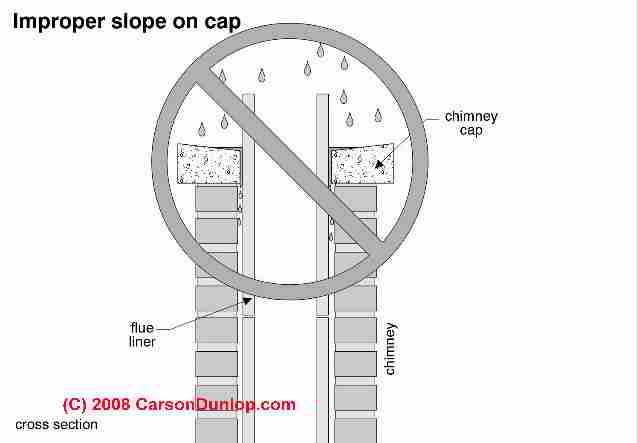
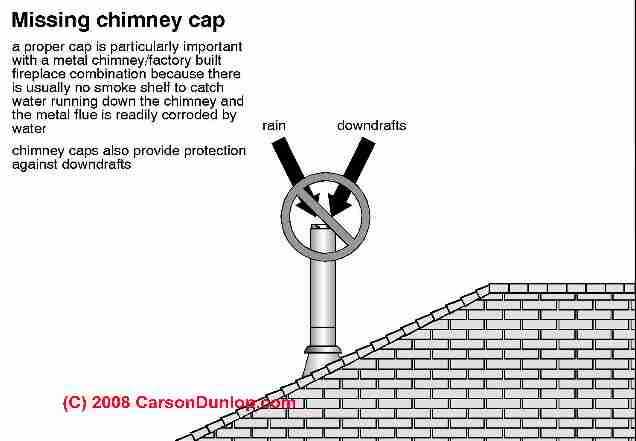
Sketch above / left showing improper slope on the masonry cap of a chimney and also the omission of a rain cap atop the chimney flue and our chimney drawing below were provided by Carson Dunlop Associates, a Toronto home inspection, report writing & education firm. 2017/09/10 Laura
Reply: where to look for leaks on or around chimneys
Laura,
It sounds as if the people working on the problem have tried solutions without finding the actual leak source.
 I'd start by trying to find, more accurately, just where water is coming in to the building:
- is it a roof flashing problem (leaks where a chimney passes through the roof) ,
- a chimney rain-cap or top seal problem (water enters at or near the top of the chimney),
- a chimney body problem (water enters somewhere along the route of the chimney parts that are exposed outside), or a
- groundwater problem - water enters at the chimney base or from ground level or below, or less common,
- an internal leak into a chimney (from a nearby leaky supply or drain pipe).
You might get a more clear understanding of the leak by asking for an inspection by a chimney sweep who's certified (National Chimney Sweeps Guild) and who can examine both the entire exterior and the entire flue interior of the chimney to see where water is originating.
I suggest preparing yourself by reading over some of the chimney leak diagnosis and repair articles I'll give below, to become familiar with the different types of leaks that occur in or on or around chimneys.
Note that some of these leak problems occur only on brick or other masonry chimneys while others like CHIMNEY CHASE CONSTRUCTION will discuss leak points that only occur around the top of a wood-framed and enclosed metal chimney.
A repair person deliberately routed rainwater into our chimney flue: is this normal?
 An InspectApedia reader asked:
I live in an apartment block which has 2 flats and I live on the ground floor.
I have lived in my apartment for 8 years with no problems with the chimney, recently a new couple moved in upstairs and he has had some work done on the chimney.
He told me that he had water coming in his roof (it is a shared chimney breast but has 2 separate flues), so he employed someone to come and fit a different chimney hood and also a pipe to divert any rainwater etc into the inspection flue.
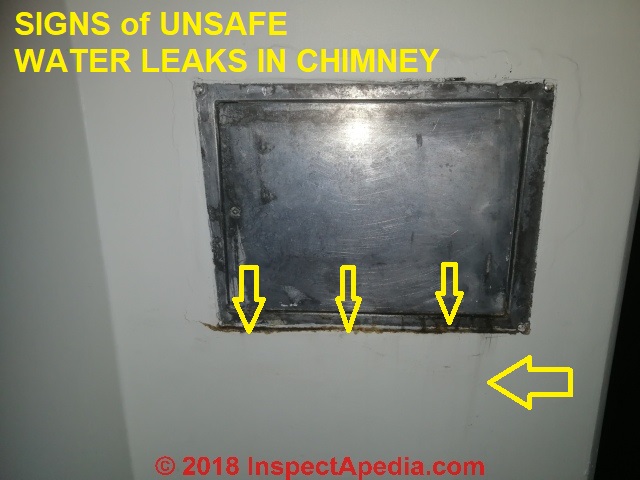
This has now caused an issue for me which is that now I have water running out of the inspection hatch and down my wall, he has said that it is normal to divert the water in the way he had it done, and the reason the water is running down the wall is because the bottom of the inspection hole is level and should be below the level of the hatch, the inspection port is angled
I have attached a couple of pictures, but could you tell me if this is normal? - 2018/10/02 Anonymous
Reply: deliberately sending water into a chimney flue is not normal and not safe
Opinion:
Forgive me but I don't know what is meant by an "inspection flue" - chimneys don't to my knowledge have an "inspection flue" and since each flue in a chimney has to be physically separate from all of the others, from point of use to rooftop, such a flue would not permit inspection of the in-use flues anyway.
I think that you meant the chimney cleanout door - which is what I see in your photo.
The cleanout door / opening is there to permit chimney cleaning and inspection of a chimney flue that is in turn used by a heating appliance.
All of the comments about blaming water leaks on the cleanout door in any way are incorrect.
 Water coming out of the cleanout or coming into and out of a chimney anywhere is improper and dangerous; in other words, nothing is normal nor proper about having water running into or out of a chimney. Chimneys are meant to safely conduct combustion gas products out of the building and above the roof line.
Chimney flues are not meant to receive nor conduct rainwater or any other water.
Diverting rainwater INTO a chimney anywhere makes not an iota of sense; unless we've misunderstood what was done, that would be a very serious error.
The potential hazards from sending water deliberately into a chimney are very serious, risking costly damage or destruction of heating equipment, building leaks, mold, rot, or insect damage, water damage, and most-seriously, flue damage that risks a building fire or fatal carbon monoxide poisoning.
Watch out: Because there are serious hazards and because if what you described is accurate, there is a high probability that work was done by someone incompetent and dangerous, all parties affected by or using any part of the chimney you describe should have the chimney inspected for safety and for proper function, using the services of a qualified chimney expert such as a chimney sweep who is certified.
In the U.S. chimney sweeps meeting at least minimum qualifications are certified (at more than one level of expertise) by the National Chimney Sweeps guild (http://www.csia.org/) . In Europe there are different associations such as
the
International Union of European Chimney Sweep Workers (ICU) Representing worker sweeps and apprentices (trade union) http://www.icu.li/
OR
the European Federation of Chimney Sweeps (ESCHFOE) http://www.eschfoe.com/
Our complete list of contacts for chimney cleaning professionals by country is found
...
Continue reading at CHIMNEY INSPECTION at ROOFTOP or select a topic from the closely-related articles below, or see the complete ARTICLE INDEX.
Or see these
Chimney Leak Articles
- CHIMNEY CAP & CROWN DEFINITIONS - difference between a chimney rain cap and a chimney top seal - two different possible leak problems.
- CHIMNEY CRACK DETECTION & DIAGNOSIS - leaks may occur in a masonry chimney that is damaged by frost, settlement, movement - such chimneys are probably unsafe
- CHIMNEY DAMAGE by LEAKS & FROST - How water and moisture leak into and damage chimneys and heating appliances.
- CHIMNEY INSPECTION from GROUND
- CHIMNEY INSPECTION at ROOFTOP
- CHIMNEY RAIN CAP / RAIN COVER INSPECTION
- CHIMNEY REPAIRS, TOP & CLAY FLUE TILE for leaks at the top seal or top of the chimney
- CHIMNEY SHOULDER LEAKS - if it's a brick chimney there may be leaks along the point where the chimney widens out as it nears its base
- CHIMNEY STAINS & LEAKS - stains can help track down where water is getting into a chimney - where I have posted your question and my reply
- CHIMNEY WET TIME & CORROSION - effects of moisture on metal chimneys & flues
- DRIPPING WATER SOUND SOURCES
- FLASHING, CHIMNEY MISTAKES & LEAKS - leaks where a chimney passes through a roof or eaves or soffit
Suggested citation for this web page
CHIMNEY DAMAGE by LEAKS & FROST at InspectApedia.com - online encyclopedia of building & environmental inspection, testing, diagnosis, repair, & problem prevention advice.
Or see this
INDEX to RELATED ARTICLES: ARTICLE INDEX to CHIMNEYS & FLUES
Or use the SEARCH BOX found below to Ask a Question or Search InspectApedia
Ask a Question or Search InspectApedia
Share this article:Questions & answers or comments about how to spot water or frost damage to chimneys & how that chimney damage may be repaired.
Search the InspectApedia website
Need to make a private comment? Email editor@inspectApedia.com. We welcome email with your website content critique, corrections, suggestions or questions. Email is monitored daily but our workload may prevent an immediate reply. For immediate results, we hope you'll first try asking your question using the search box just above.
Citations & Reviewers
In addition to any citations in the article above, a full list is available on request.
- Mark Cramer Inspection Services Mark Cramer, Tampa Florida, Mr. Cramer is a past president of ASHI, the American Society of Home Inspectors and is a Florida home inspector and home inspection educator. Mr. Cramer serves on the ASHI Home Inspection Standards. Contact Mark Cramer at: 727-595-4211 mark@BestTampaInspector.com
- John Cranor [Website: /www.house-whisperer.com ] is an ASHI member and a home inspector (The House Whisperer) is located in Glen Allen, VA 23060. He is also a contributor to InspectApedia.com in several technical areas such as plumbing and appliances (dryer vents). Contact Mr. Cranor at 804-873-8534 or by Email: johncranor@verizon.net
- Thanks to Luke Barnes for suggesting that we add text regarding the hazards of shared chimney flues. USMA - Sept. 2008.
- Roger Hankey is principal of Hankey and Brown home inspectors, Eden Prairie, MN, technical review by Roger Hankey, prior chairman, Standards Committee, American Society of Home Inspectors - ASHI. 952 829-0044 - hankeyandbrown.com
- NFPA 211: Standard for Chimneys, Fireplaces, Vents, and Solid Fuel-Burning Appliances, (2024) at the NFPA Bookstore, (Older NFPA editions and standards are found at the same bookstore)
- ICC, Fire Inspector Guide Based on the 2021 International Fire Code [ICC Digital Subscription] International Code Council
- Uniform Mechanical Code - UMC 1991, Sec 913 (a.) Masonry Chimneys, refers to Chapters 23, 29, and 37 of the Building Code.
- New York 1984 Uniform Fire Prevention and Building Code, Article 10, Heating, Ventilating, and Air Conditioning Requirements
- New York 1979 Uniform Fire Prevention & Building Code, The "requirement" for 8" of solid masonry OR for use of a flue liner was listed in the One and Two Family Dwelling Code for New York, in 1979, in Chapter 9, Chimneys and Fireplaces, New York 1979 Building and Fire Prevention Code:
- "Top Ten Chimney (and related) Problems Encountered by One Chimney Sweep," Hudson Valley ASHI education seminar, 3 January 2000, contributed by Bob Hansen, ASHI
- Chimney Inspection Checklist, Carson Dunlop, Associates, Toronto, Ontario
- Costello, Martine & Josh Kovner, "Rooftop View Turns to Darkness," New Haven Register, 12 May 1992 p. 11:
Excerpt:
Catherine Murphy was sunning on a building roof when a chimney collapsed; she fell into and was trapped inside the chimney until rescued by emergency workers. - "Chimneys and Vents," Mark J. Reinmiller, P.E., ASHI Technical Journal, Vol. 1 No. 2 July 1991 p. 34-38.
- "Chimney Inspection Procedures & Codes," Donald V. Cohen was to be published in the first volume of the 1994 ASHI Technical Journal by D. Friedman, then editor/publisher of that publication, but the production of the ASHI Technical Journal was cancelled by ASHI President Patrick Porzio.
Some of the content of Mr. Cohen's original submission has been included in this more complete chimney inspection article:
CHIMNEY INSPECTION DIAGNOSIS REPAIR - Natural Gas Weekly Update: http://tonto.eia.doe.gov/oog/info/ngw/ngupdate.asp Official Energy Statistics from the U.S. Government
- US Energy Administration: Electrical Energy Costs http://www.eia.doe.gov/fuelelectric.html
- Ceramic Roofware, Hans Van Lemmen, Shire Library, 2008, ISBN-13: 978-0747805694
- Chimney Inspection Checklist, Carson Dunlop, Associates, Toronto, Ontario
- Chimney & Stack Inspection Guidelines, American Society of Civil Engineers, [Book] 2003 ISBN: 9780784475423
These guidelines address the inspection of chimneys and stacks. Each guideline assists owners in determining what level of inspection is appropriate to a particular chimney and provides common criteria so that all parties involved have a clear understanding of the scope of the inspection and the end product required.
Each chimney or stack is a unique structure, subject to both aggressive operating and natural environments, and degradation over time.
Such degradation may be managed via a prudent inspection program followed by maintenance work on any equipment or structure determined to be in need of attention. Sample inspection report specifications, sample field inspection data forms, and an example of a developed plan of a concrete chimney are included in the guidelines.
This book provides a valuable guidance tool for chimney and stack inspections and also offers a set of references for these particular inspections. - Fireplaces, a Practical Design Guide, Jane Gitlin
- Fireplaces, Friend or Foe, Robert D. Mayo
- NFPA 211: Standard for Chimneys, Fireplaces, Vents, and Solid Fuel-Burning Appliances, (2024) at the NFPA Bookstore, (Older NFPA editions and standards are found at the same bookstore)
- Principles of Home Inspection: Chimneys & Wood Heating, in (Principles of Home Inspection), Carson Dunlop, Associates, Toronto, Ontario
- NFPA 211 - 3-1.10 - Relining guide for chimneys
- NFPA 211 - 3-2 - Construction of Masonry Chimneys
- NFPA 211 - 3-3 - Termination Height for chimneys
- NFPA 211 - 3-4 - Clearance from Combustible Material
- NFPA 54 - 7-1 - Venting of Equipment into chimneys
- Brick Institute of America - Flashing Chimneys
Brick Institute of America - Proper Chimney Crowns
Brick Institute of America - Moisture Resistance of Brick - American Gas Association - New Vent Sizing Tables
- Chimney Safety Institute of America - Chimney Fires: Causes, Effects, Evaluation
- National Chimney Sweep Guild [Website] 1255 SW Prairie Trail Pkwy Ankeny, Iowa 50023 USA, Tel: +1 (317) 837-1500 Email: office@ncsg.org NCSG certifies chimney sweep (cleaning) professionals.
- In addition to citations & references found in this article, see the research citations given at the end of the related articles found at our suggested
CONTINUE READING or RECOMMENDED ARTICLES.
- Carson, Dunlop & Associates Ltd., 120 Carlton Street Suite 407, Toronto ON M5A 4K2. Tel: (416) 964-9415 1-800-268-7070 Email: info@carsondunlop.com. Alan Carson is a past president of ASHI, the American Society of Home Inspectors.
Thanks to Alan Carson and Bob Dunlop, for permission for InspectAPedia to use text excerpts from The HOME REFERENCE BOOK - the Encyclopedia of Homes and to use illustrations from The ILLUSTRATED HOME .
Carson Dunlop Associates provides extensive home inspection education and report writing material. In gratitude we provide links to tsome Carson Dunlop Associates products and services.
 |
HOME | ABOUT | ASK a QUESTION | CONTACT | CONTENT USE POLICY | DESCRIPTION | POLICIES | PRIVACY | |
| © 2026 - 1985 Publisher InspectApedia.com - Daniel Friedman | |||||||||