 Septic Tank Leak FAQs
- POST a QUESTION or COMMENT about leaky septic tanks: detection, diagnosis, repair procedures
Questions & answers about the cause, effects, & repair of septic tank leaks.
This article series explains where and why septic tanks might leak, why surface water or runoff leaking into a septic tank is bad, and why septic effluent leaking out of a septic tank can also be a problem.
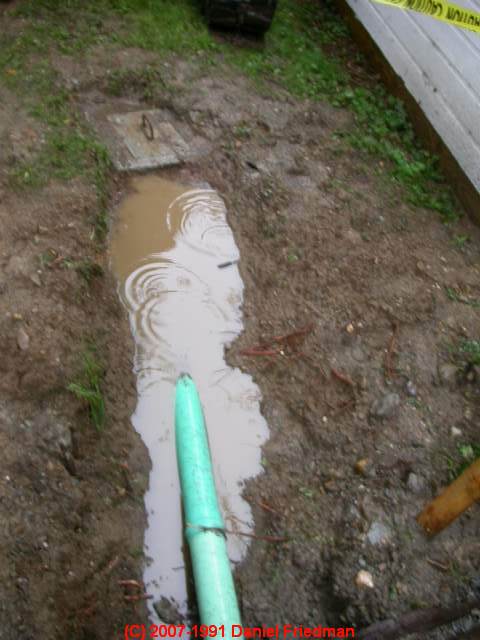
Page top photo: the trench excavated to install the building sewer line connection to the septic tank will slope down towards the septic tank, catching groundwater or rain and directing it towards the septic tank. This means that the seal of the sewer line at the septic tank is essential to avoid leaks into the septic tank itself.
InspectAPedia tolerates no conflicts of interest. We have no relationship with advertisers, products, or services discussed at this website.
- Daniel Friedman, Publisher/Editor/Author - See WHO ARE WE?
Q&A on Causes, Effects, & Repair of Septic Tank Leaks
 These questions & answers about leaks at septic tanks - leaks into and leaks out of the septic tank - were posted originally
at SEPTIC TANK LEAKS - please be sure to read that article.
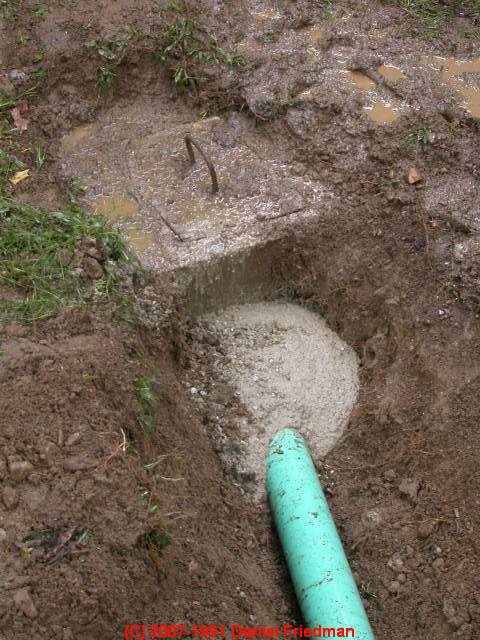
Photo: As a seal against ground-water entry into the septic tank through this downhill sewer line trench, the installer simply poured a bucket of concrete around the sewer line where it entered the septic tank.
Article Index
- INTERNAL SEPTIC TANK LEAKS Q&A - leaks between septic tank chambers or sections
- SEPTIC TANK LEAK CAUSES FAQs
- SEPTIC TANK LEAK DETECTION FAQs - tank is flooded, sewage leaks out of septic tank
- SEPTIC TANK LID or COVER or RISER LEAK FAQs - leaks at the septic tank top
- SEPTIC TANK PIPE or CONNECTION LEAKS - sewer line between tank and building or other connections
- WATER LEAKS INTO a SEPTIC TANK FAQS - groundwater, runoff, rain flooding the the septic tank / system
...
Septic Tank Leak Detection Q&A
Tip: While the only way to fully inspect the conditions inside of a septic tank is to open the tank, inspect conditions, then pump the tank for further information, but in some circumstances a camera can behelpful: see SEWER / SEPTIC PIPE CAMERAS
How do I confirm that the septic tank is leaking
The 1,000 gallon fiberglass tank was installed in 1977. It serves an A-frame cottage that, prior to 2008, was virtually unoccupied as it was being remodeled. Since 2008, it has been occupied on average no more than 2-3 days, no more than 10 times/years. The last use was around 6 months ago.
We're told that since a recent pumping produced nothing, the tank leaks. My questions are:
1. Is it reasonable to think that, due to extremely low usage and very cold temps, the material in the tank could be solidified or frozen and thereby unable to be pumped?
2. Is there a practical way to inspect the system to know if the tank is, in fact, leaking, or if there are other causes? 1 FEB 2015 Phil Scott
Reply:
Phil
Start by opening the tank inspection or service port and looking inside. If a septic tank is in use and is not filled to normal (near the top) levels then it's probably damaged or leaking - unless it was just pumped.
If the septic tank were frozen after long dis-use in very cold weather (unusual by not completely impossible) the pumper would have been able to tell you that by visual inspection.
Septic inspector said the septic tank is leaking: how do we test it for leaks?
I am trying to buy a house with a septic tank. When they did the septic inspection they said that the septic tank was leaking.
Well first they said they had to fill it with water to check if it had any leaks because there wasn't enough in it to check it.
So once they did this then they came back the next day to see if the level of water had gone down they said that it went down 3" which is not good...What is your take on it?
The company that is selling the house is willing to see two estimates for the septic repairs. Do you know what ballpark figure I'm looking at? (July 11, 2012) Eli
Reply:
Eli, if the tank was filled to just the level of the bottom of the outlet pipe and there was no use overnight and if when inspected the next day the level was below that point there is a leak.
Watch out: a septic tank is normally always "full" to the level of the bottom of the outlet pipe or tee. So the fact that a previously-in-use septic tank had much lower sewage level could indicate eiteher
- A serious leak that needs repair or possibly in worst case, tank replacement
- The property seller had the septic tank pumped before your inspection - in which case it may not be leaking at all, but such pumping might be hiding a costly drainfield failure.
The repair cost ranges from nothing to tens of thousands of dollars if the tank and drainfield need replacement.
You should have a proper septic inspection and loading and dye test performed now.
Be sure to read
- HOME BUYERS GUIDE to SEPTIC SYSTEMS - what to do when buying a home with a septic tank
- SEPTIC LOADING & DYE TEST PROCEDURE - home
...
Septic Tank Leak Causes FAQs
Tip: Also see SEPTIC TANK BACK FLOODING
Our Septic tank leaks because of bad concrete mix
Wall of septic tank leakage due to improper cement ratio. On 2018-08-24 by U. C. Boruah
by (mod) - defective septic tank may be beyond repair
UC
It makes sense to do some careful inspection of the septic tank top, sides, bottom, with the tank having been pumped and washed down, to get an idea if the defective concrete is a local problem or if the whole tank needs to be replaced.
Your contractor needs to inspect the tank exterior as well as interior.
Watch out: do not try to enter or even lean over a septic tank - you can be overcome by fumes, fall in, die. Special training and equipment are needed and the workers also should never work alone.
Smaller, limited area damage to a concrete septic tank can usually be repaired using a suitable sealant.
Watch out: while it's certainly possible to seal a few septic tank cracks orleaks, if the septic tank concrete mix or construction really was defective you should be seeing spalling, crumbling, or extensive cracking. If that's the case I am doubtful that repair is a reasonable approach and more likely you'll need to replace the tank
...
Leaks into a Septic Tank from Groundwater, Rain, Runoff FAQs
 Tip: see SEPTIC DRAINFIELD REPAIR BY CORRECTING SURFACE WATER RUNOFF OR DRAINAGE - if the drainfield floods in wet weather
Tip: see also SEPTIC TANK BACK FLOODING
How to stop rainwater getting into the septic tank
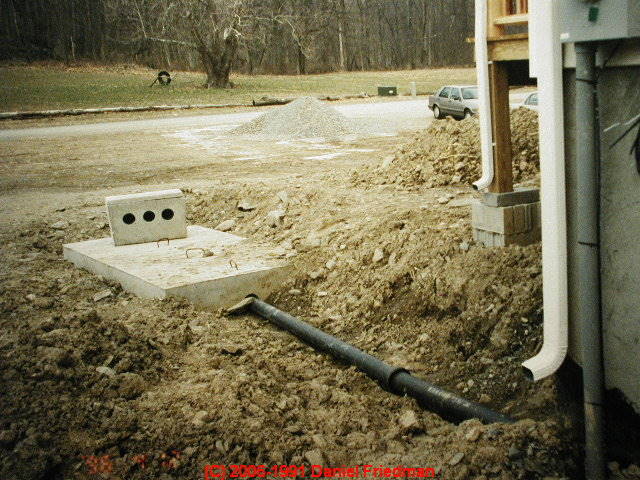
Watch out: notice in our photo (DJF at InspectApedia) that in this new septic tank installation notice these two septic tank leak sources: the drainline into the septic tank has not yet been sealed, and the trench dug to route dirct sownspout the drain, when backfilled, may still direct water from the downspout right towards the septic tank.
The owner should use a separate downspout drain or extension to rout that roof runoff well away from the septic system.
Our reader asked:
I know for sure I am replacing my drain field. The ground water that has saturated my drain field is from my pump tank. That what I meant by saying my drain field is saturated from ground water. I do have slope in my yard which lets rain water run off my field.
I got advice from a septic system owner/installer.
He did say get fill dirt and raise my yard up even higher than it is now and then install the new drain field. I plan on doing about a 12" lift of fill and top soil so I can raise my field. That's just part of the problem.
I do know that my system pumps several times afte rain r real bigstorms. I'm hoping by digging around the outside of the tanks that I can find where surface water could be entering tanks. I'm guessing the gasket on the top lids are not sealed anymore.
Or worse, the walls are cracked. I'm trying not to have to replace several thousands of dollars worth of tanks, by repairing what I have. Like I said, they are only 20 years old, young for a concrete tank I would think.
I kind of just wanted some reassurance of how I plan on repairing the tanks was acceptable or just plain old crazy.
Side note: you would think that the seasonal water table was taken in account for when the system was originally installed. Just saying. On 2016-03-22 by Joe P
by (mod) - seal pipe openings and septic tank top against ground water entry then direct surface runoff away
You're addressing the concerns that I'd worry about too, Joe. Your state may require a minimum distance, say 2 ft. between the bottom of the septic drainfield or trench and the seasonal high water table.
See what your health department wants and let me know. Do this before deciding how much fill to bring in to the site.
You will want to get ground water away from the septic tank and to keep surface runoff away from the fields regardless.If the terrain allows, the best solution is to construct an intercept swale or drain to keep water away from the septic tank.
See details of how to do that
at SEPTIC DRAINFIELD REPAIR BY CORRECTING SURFACE WATER RUNOFF OR DRAINAGE
About sealing leaks into the tank itself, it's easier to seal the pipe connections to the tank (against ground water) than the tank top.
But both are possible.
Install septic tank top risers, sealed to the tank top. That may solve that problem.
Our septic tank is flooding from groundwater; how do we fix it?
Water is running in to our septic tank from groundwater runoff and rain; tell me how to repair it? On 2014-02-01 by Joan davis
Answer by (mod) -
Joan, you need to
1. dig up enough of the septic tank to see where water is entering - if it's entering around the entry pipe (which is common) that's where a new rubber seal or other seal needs to be installed.
If water is entering the holding tank through a lid or cover then it may be possible to seal the cover - but don't glue it down as access is needed for cleaning and inspection; and see point 2 below.
If you don't see an obvious water leak-in point from a little exploration, when the tank is pumped and cleaned, your service company can inspect the tank interior for cracks or damage; it may be possible to repair cracks - you don't say what the tank is made-of.
but
WATCH OUT: NEVER enter a septic tank - it can mean almost instant death by asphyxiation by septic fumes; special equipment and procedures are needed if entry is necessary.
NEVER even LEAN OVER the tank to look inside directly - for the same reason; people are made unconscious and may fall into the tank and die.
An expert uses a combination of flashlight & mirror on a pole for safer and more remote inspection.
See our article titled
How & Why Septic Tank Leaks Cause Septic System Failures at SEPTIC TANK LEAKS
Finally, you want to determine where the problem water is coming from and to direct it away from the septic tank.
...
Septic Tank Internal Leaks - between sections or chambers - FAQs
How do we seal a leak between two septic tank sections?
Our septic tank (in North Carolina) is a two-part concrete tank with a seal between the two parts.
A leak has developed at the seal. A neighbor suggested digging around the outside of the tank and applying hydraulic cement to fix the leak. This would be difficult as we are in the mountains and the rocky ground makes it difficult to dig.
Can it be pumped out and fixed from the inside? If so how could it be done? On 2018-05-14 by Barbara
by (mod) - dangerous attempts to seal a septic tank interior
Watch out: It might be possible to seal a septic tank from the interior but it is an extremely dangerous tasks requiring special training and Equipment.
Entering a septic tank even one that has been pumped out and washed can quickly overcome in Kill and unprepared worker.
by Barbara
Thanks for replying. Is the best fix to dig around the outside and seal it? What do you use to seal it?
Answer by (mod) -
You will probably excavate around the tank top, clean the surfaces, and apply a flexible sealant such as a polyturethane caulk.
You'll also want to direct surface runoff away from the tank.
See SEAL CRACKS in CONCRETE
...
Leaks at Septic Tank Covers, Lids, Risers FAQs
Tip: See SEPTIC TANK COVERS and also SEPTIC TANK RISERS
Watch out: leaks of sewage or septic tank effluent coming out of the top of a septic tank or its access covers or risers mean that the septic tank is completely flooded, risking a sewage backup into the building and suggesting that the septic system is in failure.
What would cause water leaking out of septic tank lid
I just purchased a home in a rural setting. I currently have water seeping out the top of the tank from the lid of the tank. What would cause this and how would I go about fixing the problem (Nov 19, 2011) David
Reply: uh oh!
David:
Ah geez, the Greeks killed messengers who brought bad news (so I have to add that I'm writing from an undisclosed location out of the U.S.)
But it sure sounds as if your septic system is in trouble. Most likely the outlet from the septic tank is blocked. If you're lucky it's a damaged pipe or outlet baffle or tee. But equally often this problem shows up when the septic drainfield is saturated - and needs replacement - and is expensive.
Another common cause is a drainfield flooded by surface runoff or other water leaking into the drainfield or septic tank itself, such as from roof drainage or area flooding.
Some digging and looking can help diagnose the problem or search InspectApedia for "how to find the D-box" and open it up to see if effluent is backing up there too. If not the blockage is between the tank and the D-box (good news).
Septic tank leaks at the lid; water rises above the tank lid;
we Used Roebic K-57 a septic tank treatment product - our home made septic system is still in trouble
Hello. We have old, homemade septic system in house we've lived in for a bit over 5 years. Had tank pumped about 3 years ago.
Noticed water overflow above tank lid but drain field is dry. We just had the tank pumped again, about 2 weeks ago.
Used Roebic K-57 to treat right after. No issue for about 2 weeks then tank is overfilling again, baffle is submerged.
Water rises above the lid, after bath lets out but slowly drains, but tank remains overfilled. Doesn't seem to rise above lid if just flushing toilet or doing dishes. Only letting out the bath.
We know that previous homeowner replaced the drain field at some point but tank is original and homemade. House was built late 60's early 70's. Thank you! On 2020-05-01 by andrealb2010@gmail.com -
by (mod) - important safety warnings
Andrea,
That sounds like a failed drainfield.
No treatment, nor pumping will fix that.Watch out: home made or site-built septic systems are often under-sized, fail early, and if the septic tank is home-made or of concrete blocks, it may be unsafe, lacking a secure cover.
Keep people away from the septic system, especially the septic tank until it has been inspected for safety: falling into a collapsing septic tank means a quick, nasty death.
Some further investigation is needed.
How do I stop water from running out of the top of my septic tank?
What do I do when the water starts running out of the top of my septic tank? septic tank On 2017-05-06 by Nancy
by (mod) - Have the tank pumped and check for a blockage or a failed drainfield
Nancy:
1. Give a call to your septic pumping company to have the tank pumped: that will stop the immediate risk of a costly sewage backup into your home3 and will give you 1-3 days to find out what is the real problem. (After that the tank will be full again).
During pumping there is more information to be learned - the condition of the tank, tank baffles (bad baffles = clogged incoming lines or clogged drainfield), backflow into the tank from its outlet means the soakaway bed is flooded, failed.
Read with care the article above on this page about septic tank flooding: causes, implications.
2. Diagnose the cause of backup in the septic tank; a broken or clogged pipe can be repaired.Flooded or failed septic drain field will require replacement, or at the least, direction of surface runoff or groundwater away from the fields.
...
Leaks at Septic Tank Pipes & Connection FAQs
Waste flows out of pipe connecting septic tank and toilet and not going into the septic tank
The pipe that is coming from the toilet to the septic tank has a hole like someone put it there. But when we flush the water from.the toilet is coming out of that hole not going the septic tank. On 2019-07-10 by Tonya -
Reply by mod - Watch out: health hazard + failed septic system or blocked sewer pipe
Tonya: you're describing at least improper or damaged sewer piping and a health hazard. It's also possible that the septic system has failed, won't accept wastewater, so is backing up and flowing out of a broken sewer pipe.
You need an onsite septic contractor to diagnose and fix the trouble.
...
...
Continue reading at SEPTIC TANK LEAKS - topic home, or select a topic from the closely-related articles below, or see the complete ARTICLE INDEX.
Or see these
Septic Tank Articles
- CAULK & SEALANT CHOICES, products list for possible septic tank lid or pipe connection sealants to keep water out of the tank
- INSPECT the SEPTIC TANK BEFORE PUMPING
- INSPECT the SEPTIC TANK DURING PUMPING
- INSPECT the SEPTIC TANK AFTER PUMPING where we describe septic tank inspection mirrors, cameras & other tools
- MEASURE SEPTIC TANK SCUM & SLUDGE how we measure the thickness of septic tank floating scum and bottom sludge levels.
- SEAL CRACKS in CONCRETE
- SEPTIC TANK BACK FLOODING - a common source of flooded septic tanks: failed drainfield / soak bed
- SEPTIC TANK INSPECTION PROCEDURE
- SEPTIC TANK LEAKS
- SEPTIC TANK LEVELS of SEWAGE for a discussion of the normal levels of sewage found in a septic tank.
Suggested citation for this web page
SEPTIC TANK LEAK FAQs at InspectApedia.com - online encyclopedia of building & environmental inspection, testing, diagnosis, repair, & problem prevention advice.
Or see this
INDEX to RELATED ARTICLES: ARTICLE INDEX to SEPTIC SYSTEMS
Or use the SEARCH BOX found below to Ask a Question or Search InspectApedia
Ask a Question or Search InspectApedia
Share this article:Search the InspectApedia website
Need to make a private comment? Email editor@inspectApedia.com. We welcome email with your website content critique, corrections, suggestions or questions. Email is monitored daily but our workload may prevent an immediate reply. For immediate results, we hope you'll first try asking your question using the search box just above.
Citations & References
In addition to any citations in the article above, a full list is available on request.
- In addition to citations & references found in this article, see the research citations given at the end of the related articles found at our suggested
CONTINUE READING or RECOMMENDED ARTICLES.
- Carson, Dunlop & Associates Ltd., 120 Carlton Street Suite 407, Toronto ON M5A 4K2. Tel: (416) 964-9415 1-800-268-7070 Email: info@carsondunlop.com. Alan Carson is a past president of ASHI, the American Society of Home Inspectors.
Thanks to Alan Carson and Bob Dunlop, for permission for InspectAPedia to use text excerpts from The HOME REFERENCE BOOK - the Encyclopedia of Homes and to use illustrations from The ILLUSTRATED HOME .
Carson Dunlop Associates provides extensive home inspection education and report writing material. In gratitude we provide links to tsome Carson Dunlop Associates products and services.
 |
HOME | ABOUT | ASK a QUESTION | CONTACT | CONTENT USE POLICY | DESCRIPTION | POLICIES | PRIVACY | |
| © 2026 - 1985 Publisher InspectApedia.com - Daniel Friedman | |||||||||