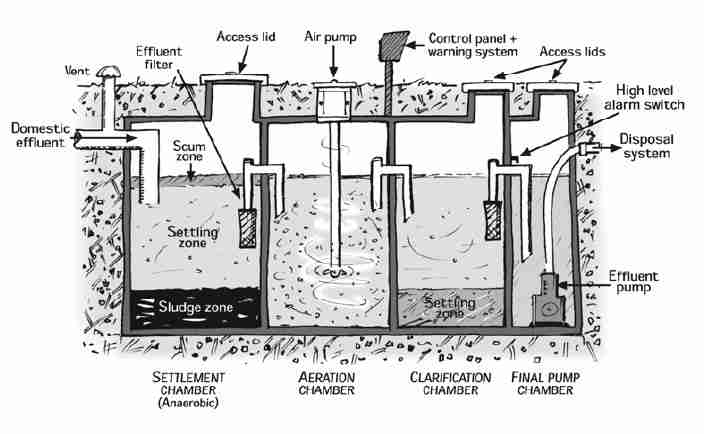
 AEROBIC Septic System Tanks
- POST a QUESTION or COMMENT about aerobic treatment unit ATU tank sizes
Aerobic Treatment Unit Septic Tank Sizes:
Here we provide the size and design requirements for aerobic septic tanks or ATUs.
Here are designs and products for aerobic septic treatment units (ATUs, or in the UK, Australia, New Zealand, Aerobic Wastewater Treatment Units or AWTs) for onsite waste disposal, also called fine bubble aeration systems.
We address aerobic septic system design, features, inspection, repair, and maintenance.
Aerobic septic system product sources are also listed. Qualified aerobic septic tank designers, producers, or service providers may be listed at this website at no fee. The page top illustration of a four-chamber aerobic wastewater treatment unit is adapted from the New Zealand Taranaki Regional Council's sewerage system guide.[5]
InspectAPedia tolerates no conflicts of interest. We have no relationship with advertisers, products, or services discussed at this website.
- Daniel Friedman, Publisher/Editor/Author - See WHO ARE WE?
Aerobic Treatment Unit Tank Size Requirements
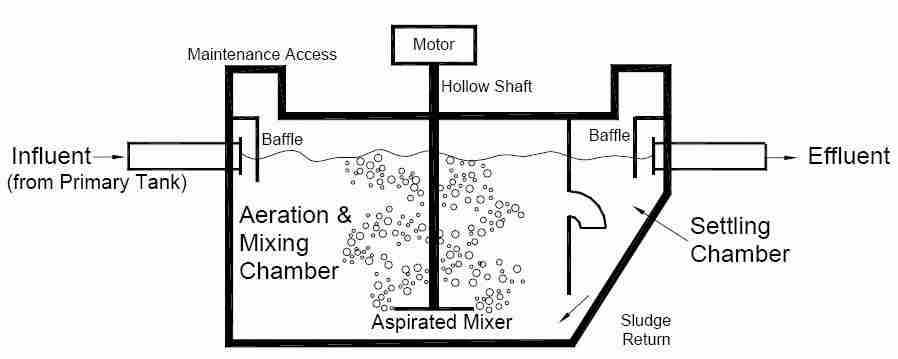
Typically a residential aerobic septic treatment unit does not run continuously, just as inflow to it is not continuous.
ATU size or capacity is determined as for a conventional septic system, by allowing 50 to 100 gallons of wastewater per day per building occupant.
Some jurisdictions require that the system minimum capacity accept 500 gallons of wastewater daily.
Safe aerobic treatment tank size advice
A "safe" design size for an aerobic treatment tank that allows for temporary power outage (and thus loss of the aeration pump) is an aerobic treatment tank at least as large as the conventional tank that would have been required for a given site.
Aerobic treatment tanks in cold climates
If your ATU tank is being installed in a cold climate, it may be necessary to insulate the treatment tank (use 2" solid foam panels) to keep the tank temperature high enough (above 54 degF) for the aerobic processing to continue in cold weather. (Some thermophilic microorganisms require temperatures as high as 131 to 149 degF.)
ATU Flow: Continuous or Intermittent Aerobic Pumping Systems
Design Alternatives for Aerobic Septic Systems
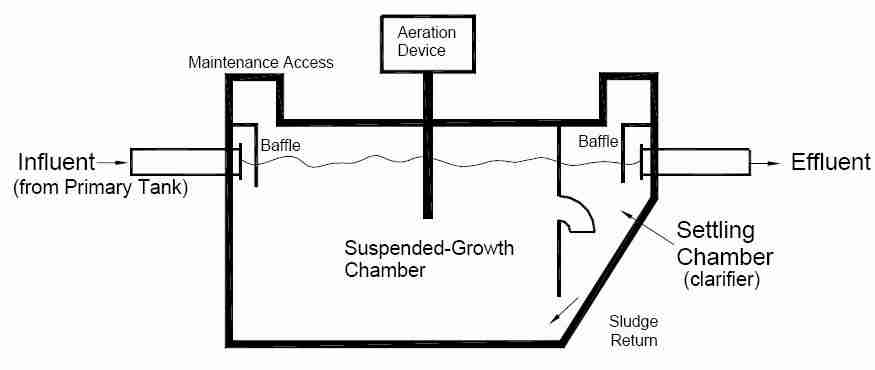
Two basic ATU designs provide for intermittent or continuous flow through the system.
Intermittent flow aerobic septic systems
Just as most residential septic systems do not receive wastewater continuously but rather intermittently, the ATU may be designed to turn the aerator and agitator on and off as needed. Intermittent flow septic systems, including aerobic or aeration treatment designs are also called a "batch system" septic design approach.
Continuous flow aerobic treatment system designs
Other aerobic or aeration septic treatment systems, particularly aerobic systems which have to serve a larger facility where wastewater inflow may be continuous, may themselves operate continuously. Obviously these designs are called "continuous flow" aerobic treatment systems.
How to Select & Where to Buy an Aerobic Septic Tank Aerator Pump
How do I size the correct aerator pump for my ATU ?
How do I size the correct aerator pump for my ATU ? My systems holds 600 gallons . There are 5 people in our house , with vistors sometimes 10 ?
Do I need a dual pump or can I run pumps alternately ? 11/5/2015 Josh
Reply:
Josh
In very general terms, the ATU size or capacity is determined as for a conventional septic system, by allowing 50 to 100 gallons of wastewater per day per building occupant.
Indeed a number of aerobic septic designers suggest dual aerator pumps that are run alternately to be sure that both are operational. That design helps assure that the ATU can keep operating even if one of the pumps fails and thus needs repair or replacement.
Please see detail on aerobic pump sizing
at AEROBIC SEPTIC AERATOR PUMPS - next in this article series.
...
Reader Comments, Questions & Answers About The Article Above
Below you will find questions and answers previously posted on this page at its page bottom reader comment box.
Reader Q&A - also see RECOMMENDED ARTICLES & FAQs
What are the design (size) reaquirements for the chamber size of an aerobic septic system tank (ATU) ?
I am trying to find design requirements for the chambers of a ATU.
I see you need 50-100 gpd per occupant, but if it seems that the basic designs show a continuous throughput. What is the residency time?
Or for 700 gpd, what capacity should the trash chamber have, the aeration chamber, the clarifier? Is there a rule of thumb that the capacity should be 3x the daily flow or something like that? Thank you. On 2021-10-05 by Mike
Reply by inspectapedia.com.moderator (mod)
@Mike,
A "safe" design size for an aerobic treatment tank that allows for temporary power outage (and thus loss of the aeration pump) is an aerobic treatment tank at least as large as the conventional tank that would have been required for a given site.
The gallon size of the tank will pertain to the entire tank capacity just the same as a conventional tank.
You can choose between 2, 3, or 4 chamber aerobic tanks as discussed here:
GUIDE TO AEROBIC SEPTIC SYSTEMS
Typically there isn’t a need to differentiate between the inner chamber sizes of the tank as they will be in proportion to the total tank size.
See more about conventional tank sizes here:
SEPTIC TANK SIZE REQUIREMENTSby Mike
@inspectapedia.com.moderator, thank you so much for this information and links. I have not had time to review it all, but it looks like it has the information that I need to move forward with planning and decisions. Blessings.
by inspectapedia.com.moderator (mod)
@Mike,
Thank you.
We've worked hard on this material for decades, so are really grateful when a reader finds it useful and trustworthy.
We also welcome your photos, questions, criticism or suggestions.
Advice for cold weather protection for anew Aerobic Septic System
Any advice and instruction on cold weather care for a new aerobic system?
We're in Oklahoma so it doesn't drop below zero for long.
However, we've got negative temps sticking around for longer than usual and I want to protect the new system. Also, our sprinkler heads are currently staying up, not spraying. On 2021-02-13 13:47:25.749801 by Mathew
Reply by danjoefriedman (mod)
Matthew:
Any brand new septic, but particularly mounds, raised-bed septics, and aerobic septics using an above-ground spray efffluent disposal system are at risk of freeze-damage and failures unless the system is protected from freezing by an adequate level of active use;Some installers add straw or hay in hope of a slight bit of extra frost protection until there is adequate layer of snow cover.
In addition I expect that the manufacturer of your specific system will have additional suggestions.
In your specific case I worry that your sprinkler system is already frozen. Could that be the case?
Our aerobic septic alarm is on but levels on the tank look correct
All levels are good but alarm is on On 2018-12-02 by David
by (mod) - All levels are good but alarm is on
David
It may be that you need to simply turn off the alarm or to check for a stuck float sensor switch in the septic tank.
SEPTIC ALARM TROUBLE SHOOTING
Should help.
Keep me posted
Are we required by code to upgrade any portion of the septic system when increasing occupancy?
We are currently in the planning stages of building a detached garage with an in law suite. We will be adding a shower,toilet and lav.
We have an aerobic drip system with a 750 gallon tank and aprox 2250 linear feet of drip line.
There would be a total of 6 people in home, would it be required by code to upgrade any portion of system and would our current system be sufficient enough to handle 6? On 2018-05-26 by Scott Sears
by (mod) - usually yes
In my experience and opinion that's not the best question to ask.
Watch out: If the usage level or number of occupants at your property increases beyond the design limits of your septic system and you don't do anything to increase the system capacity the result is likely to be an early and expensive septic system failure.
It's not likely that that the septic tank, nor the effluent dispersal system will be adequate.
Review your system capacity with the manufacturer of your specific aerobic system or a local septic engineer.
Surely you need a building permit.
Is it better to leave the aerobic septic effluent pump always turned on or just to turn it on occasionally?
Is it better to leave a septic tank pump on permanently or just switch it on for a little while periodically to empty excess water then switch off. - carol (no email) 2016/03/10
by (mod) - aerobic septic tank aerator pump should run full time; the effluent pump runs by a timer or by a float level control switch
Carol,
If you are asking about an aerobic septic tank aerator pump, check the owner's manual for your particular aerobic system as some designs vary, but generally the aerobic pump is on all the time. The pump is needed to aerate the system to keep it working.
If you are asking about a sewage pump or effluent pump, the pump should be operating based on a float not on a manual on-off switch.Watch out: don't simply turn off either of those pumps or you risk a sewage backup in your home or a failed aerobic treatment tank.
...
Continue reading at AEROBIC SEPTIC AERATOR PUMPS or select a topic from the closely-related articles below, or see the complete ARTICLE INDEX.
Or see these
Recommended Articles
- AEROBIC SEPTIC SYSTEMS, ATUs - home
Suggested citation for this web page
AEROBIC ATU SEPTIC TANK SIZES at InspectApedia.com - online encyclopedia of building & environmental inspection, testing, diagnosis, repair, & problem prevention advice.
Or see this
INDEX to RELATED ARTICLES: ARTICLE INDEX to SEPTIC SYSTEMS
Or use the SEARCH BOX found below to Ask a Question or Search InspectApedia
Ask a Question or Search InspectApedia
Share this article:Questions & answers or comments about septic effluent disinfection systems - chemicals to use and others to avoid using
Search the InspectApedia website
Need to make a private comment? Email editor@inspectApedia.com. We welcome email with your website content critique, corrections, suggestions or questions. Email is monitored daily but our workload may prevent an immediate reply. For immediate results, we hope you'll first try asking your question using the search box just above.
Citations & References
In addition to any citations in the article above, a full list is available on request.
- [5] "Looking after your household sewerage system," New Plymouth District Council, Taranaki NZ, newplymouthnz.com, retrieved 4/4/13, [copy on file as Septic_Maintenance_Taranaki_NZ.pdf]
- Advanced Onsite Wastewater Systems Technologies, Anish R. Jantrania, Mark A. Gross. Anish Jantrania, Ph.D., P.E., M.B.A., is a Consulting Engineer, in Mechanicsville VA, 804-550-0389 (2006). Outstanding technical reference especially on alternative septic system design alternatives. Written for designers and engineers, this book is not at all easy going for homeowners but is a text I recommend for professionals--DF.
- Septic Tank/Soil-Absorption Systems: How to Operate & Maintain, Equipment Tips, U.S. Department of Agriculture, 8271 1302, 7100 Engineering, 2300 Recreation, September 1982, web search 08/28/2010, original source: http://www.fs.fed.us/t-d/pubs/pdfimage/82711302.pdf
- US EPA ONSITE WASTEWATER TREATMENT SYSTEMS MANUAL Top Reference: US EPA's Design Manual for Onsite Wastewater Treatment and Disposal, 1980, available from the US EPA, the US GPO Superintendent of Documents (Pueblo CO), and from the National Small Flows Clearinghouse. Original source http://www.epa.gov/ORD/NRMRL/Pubs/625R00008/625R00008.htm
- In addition to citations & references found in this article, see the research citations given at the end of the related articles found at our suggested
CONTINUE READING or RECOMMENDED ARTICLES.
- Carson, Dunlop & Associates Ltd., 120 Carlton Street Suite 407, Toronto ON M5A 4K2. Tel: (416) 964-9415 1-800-268-7070 Email: info@carsondunlop.com. Alan Carson is a past president of ASHI, the American Society of Home Inspectors.
Thanks to Alan Carson and Bob Dunlop, for permission for InspectAPedia to use text excerpts from The HOME REFERENCE BOOK - the Encyclopedia of Homes and to use illustrations from The ILLUSTRATED HOME .
Carson Dunlop Associates provides extensive home inspection education and report writing material. In gratitude we provide links to tsome Carson Dunlop Associates products and services.
 |
HOME | ABOUT | ASK a QUESTION | CONTACT | CONTENT USE POLICY | DESCRIPTION | POLICIES | PRIVACY | |
| © 2026 - 1985 Publisher InspectApedia.com - Daniel Friedman | |||||||||