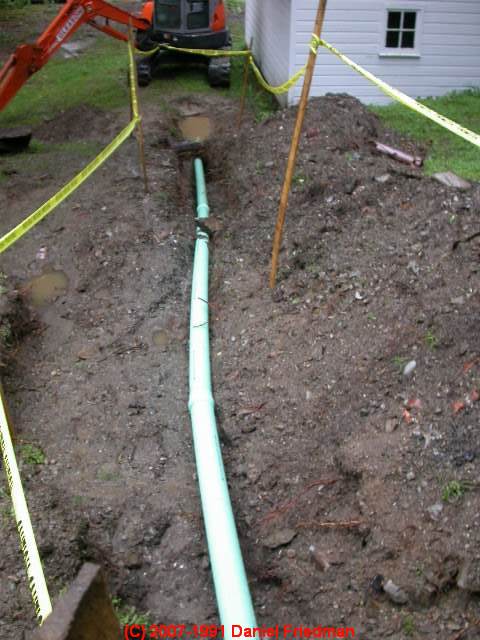
 Q&A Sewer Line Installations on Steep Slopes

- POST a QUESTION or COMMENT about sewer or septic piping lines on steeply sloped sites
Steep slope septic system piping FAQs.
This article sseries describes the installation of drain lines on steep slopes between a house and the septic tank.
InspectAPedia tolerates no conflicts of interest. We have no relationship with advertisers, products, or services discussed at this website.
- Daniel Friedman, Publisher/Editor/Author - See WHO ARE WE?
FAQs on installing or replaceing septic / sewer pipe at Steep Sites
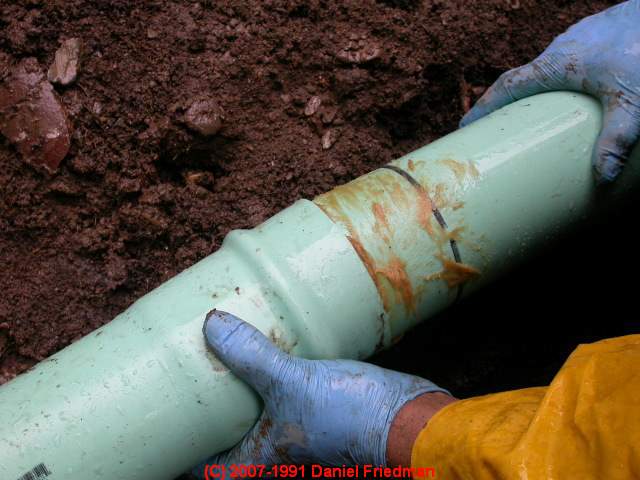
These questions & answers about how to route pipes for septic systems built on steep slopes were posted originally
at SEWER / SEPTIC LINES at STEEP SITES - be sure to see the advice given there.
Need tips for installing a drainfield on a hillside
I have 3.9 acres that I want to put a small ( 900 sq ft ) cabin on.
The property had a slight slope and the cabin will be at the bottom of the slope.
What is the best septic system to put here since we will only use it about once a month?
I have heard of a tank system that can be pumped every so often.
Not sure what that is or if code will allow it.
What do you think? -
Thanks On 2016-09-20 by rick
Reply by (mod) -
Rick, there are suggestions at STEEP SLOPE SEPTIC DESIGNS that may help you out, depending on how steep the slope actually is.
"Best septic" is not something one can specify by a brief e-text. The type of septic needed depends on the number of building occupants but also on the soil conditions (search InspectApedia for SOIL PERC TESTS), and the space available.On installing just a sewage holding tank, most jurisdictions will not permit a holding tank except as a temporary measure, or on occasion by special permit such as for a property abutting a river or stream.
Your planned temporary occupancy needs to be weighed by the local building department against the required building standards for a home that could be occupied full time. One owner's part time use might be followed by someone else's full time use;Furthermore, even in part time use, the septic system has to be sized sufficiently to handle the maximum or peak usage.
You might consider, and ask if your local authorities will approve, a waterless toilet system such as those discussed at TOILETS, WATERLESS ALTERNATIVES https://inspectapedia.com/septic/Toilets_Waterless.php
After drainfield failure I have to install a new fields on a 6% slope: how do we do that?
My old drain field failed. My contractor replaced the failed drain field with 4 trenches (supposedly) level with a step-down to a 5th trench.
The installation permit and inspection report call this a "Serial" drain field with "2" trenches. In less than 12 months after installation, effluent is surfacing to my yard at the step-down to the 5th trench.
The property has 6% slope.
The Health Dept and the contractor seem clueless as to the cause of this hydraulic overload. What is causing this problem and can it be corrected? On 2018-05-08 by Marvin
Answer by (mod) -
Marvin,
As I can't see anything about your drainfield from here- I'm left having to guess.
OPINION: Design of effluent disposal systems on a slope is difficult: the installation has to control the flow of effluent in the upper trenches, slowing its passage there. Otherwise, as is patently obvious, all of the effluent wants to rush down to the lowest point in the system, reaching it quickly and overloading it by saturating the soil just as you have described.
I think that a savvy septic design engineer would look very carefully at the slope of the upper lines, making sure they don't slope too much, maybe staying within 1/8" per foot.Since digging with a backhoe and placement of pipes is often not lab-grade precise, careful monitoring and adjustment during construction could be what was needed - and maybe lacking.
At this point I think the engineer would dig a few test cuts into the system to see how effluent is flowing, and she might be able to fix the system by adding some flow restrictors upstream from the lowest and flooding trench.
Another alternative might be to go to a dosing system design.
What's the maximum allowed sewer / septic line slope between building and septic tank?
What is the maximum pipe slope for sewer line from main building to septic tank? On 2018-02-21 by Elsa
by (mod) -
Elsa
The sewer line piping should slope between 1/8 inch and 1/4 inch per foot.
What's the right type of pipe connector to step down myh sewer or septic line across a slope?
I'm Looking to step my sewer pipe down a couple of times. What's the best thing to use to step it down - On 2017-10-09 by Jason youngman
Answer by (mod) -
Use 45s not 90s just as with any drain line
There is no limit on vertical drop AFTER a plumbing trap.
Maintain the required minimum slope, typically 2% or 1/8"/ft to 1/4"/ft in non-vertical lines
How do I get drains at proper slope when the drain route slopes too much?
 My septic tank is 16’ away from my home however the drop is about 40” is this an acceptable drop? If not how do I fix this? This is an old septic tank in which I was grandfathered use of. On 2020-04-02 by Eddie -
Reply by (mod) -
Eddie
A septic tank just 18-inches from a building foundation is a bit close; How did you construct the new building without either damaging the septic tank or having the tank compromise the foundation?
A 40 inch drop over 18" into a septic tank, once you add the necessary elbows, essentially vertical. The risk is that solids falling vertically can stick and clog the piping - though using 45's instead of 90 degree elbows can reduce the trouble.
Similarly the fast flow of waste into the septic tank risks clogging at the tank inlet baffle.
I would start by having the tank inspected to determine in this order of importance
- Safety: are the tank cover and access opening covers safe against a collapse and someone dying by falling-in?
- Septic tank condition and materials: is the tank sound or is it home made out of block or made of rusting steel; what are the condition of the baffles and protection from groundwater leaks
- Function: what are the tank size and how does that compare with the daily wastewater flow?
- What is the condition of and capacity of the drainfield?
What's the total septic drain pipe drop over 120 feet?
What is the pipe drop when septic tank is 120 feet away? On 2020-03-24 by Anonymous -
Answer by (mod) -
Anon:
at 1/8" slope per foot, .125 x (120 ft) = about 15 inches
at 1/4" slope per foot of run, 0.25 x 120 = about 30" of drop
What's the limit to steep sloping septic pipes?
My team wants to build a septic system, but we need to work out the details for the drop boxes we are including for the steep slope.
How steep can the pipes be from drop box to drop box? Is there a limit? Is there a limit for how long the pipe can be as well, besides how steep? Are there regulated dimensions for a drop box?
Please let us know! Thanks On 2020-03-10 by Shaun -
Reply by (mod) -
Shaun: the limits are basically set by how much space you have along with where along slope you're putting turns and other components.
If you have to drop down a steep slope run your pipes at proper slope and zig zag down the slope so that the slope is not excessive - otherwise your drain may leave solids behind as water rushes down the steep pipe - leading to sewer line clogs.
How to route lines from cabin to septic tank when part of the route slopes steeply?
Hello, I have a question about a toilet being installed in a cabin about 300 feet from the main house/septic tank and field. The cabin is gradually uphill from the septic tank, but at times the slope is quite a bit more than 1/4 inch per foot.
Given the long distance to get the effluent to the tank, is too much slope a problem in this situation? Or is it okay to have some stretches that are more than 1/4 inch per foot? Would installing a sewage pump help at all in this situation, given that the septic tank is downhill from the toilet? On 2019-08-01 by Verne -
Suggestions by (mod) - What to do when there is too much downslope on a septic or sewer line.
Thanks for a useful and interesting question, Verne, the problem of too much downslope on a septic or sewer line.
I've seen plenty of sewer lines that were way too steep (1/8" to 1/4" drop per foot of run is recommended) but that were short - just a few feet to a septic tank, and where any bends were kept gentle, and that don't seem to clog.
The problem with longer stretches of excessive slope sewer piping is that the liquid waste will sometimes run ahead of the solids in the line. Especially with a long 300 ft line that's asking for clogs in the sewer line and backups in the cabin.
One of the most useful aphorisms I offer, at least for the building construction and mechanicals field, is that it's rarely the case that you're going to run into a problem that no one has encountered before. What's left is to find what are the best known solutions.
One solution you'll read about on this page is that the sewer line gets even longer, zig-zagging across the steeper sloped sections.
Also be sure to use gentle turns, 45s at most, a sharp bend in a sewer line combined with high velocity waste is also likely to lead to clogs. I'll leave the graphic details to your imagination.
Finally, you could convert the whole thing to a "force main" with a sewage grinder pump and probably some check valves but that may be an unnecessary expense also adding complexity we'd prefer to avoid. Let's take the question to your septic installer to hear what she thinks.
See details at SEWAGE PUMPING STATIONS
Direct water away from septic components built onto sloped sites
Do you need any type of drainage system before your septic tank and leaching fields if its at the bottom of a steep hill? Also how deep should the sand or topsoil be when covering leaching. On 2021-09-24 by Eugene Casivant -
Reply by (mod) -
@Eugene Casivant,
Thank you for such a question about directing water away from septic components built onto sloped sites.
A proper design will will direct surface runoff and subsurface runoff away from the drainfield and it would be smart to keep it directed away from the septic tank and distribution box as well.
I can't propose a detailed solution is correct for a site about which I know nothing (you'll need a local design professional) but typically you would use either a surface cotiur swale or subsurface intercept drains, or both.
Those are good questions to ask your septic system design engineer during the site survey.
Can I run a lower slope drain line under my slab and then drop vertically to the needed depth?
I am going to build my own home , and do not choose to dig all of my trenches under my concrete pad at a depth of 4 feet , which is the required depth in my locality needed to legally exit from under the pad in my climate zone.
My question is can I trench shallower, and then drop vertically to the required 4 foot depth ?.This drop would be 30 -40 inches before exiting from under the concrete slab to a septic tank tank ,which will be about 10-15 feet from concrete pad. On 2021-03-05 by RENO -
Reply by danjoefriedman (mod)
@RENO,
I am guessing that by concrete pad you're referring to the floor slab of the home that you are building.It's certainly common for sewer or septic lines to leave a building quite shallow in the soil and above the frost line. Of course those lines need to slope at the appropriate pitch to the ultimate location of the septic tank. Otherwise the line will clog or freeze or both.
Watch out: that does NOT mean that you can run nearly-flat drain lines under your slab. If you do that you're asking for a very expensive repair job down the road as those inadequately-sloped drains under slab will be a constant clogged drain issue.
I recommend that you check with your local building authorities about exactly what is Required to be placed at a 4 foot depth.
What valve goes between septic tank pump and drainfield?
What kind of valve goes from the pump to the drain field ? On 2019-02-08 by Anonymous -
Answer by (mod) - normally none unless there's a pumping system that needs a check valve
Anon
I don't know as I don't know what sort of septic system we're discussing, nor where the pump and drainfield are, nor what slopes, distances, etc. are involved, but I SPECULATE that you're asking about a check valve that would be used to prevent up-sloping pipes from draining backwards into the septic pump or effluent pump system.
...
Continue reading at SEWER / SEPTIC LINES at STEEP SITES - topic home, or select a topic from the closely-related articles below, or see the complete ARTICLE INDEX.
Or see these
Steep Slope Septic System Articles
- SEPTIC CONSULTANTS, DESIGNERS, ENGINEERS
- SEPTIC SYSTEM DESIGN ALTERNATIVES - home
- SEPTIC SYSTEM DESIGN BASICS - home
- SEWER / SEPTIC LINES at STEEP SITES
- STEEP SLOPE SEPTIC DESIGNS
Suggested citation for this web page
SEWER / SEPTIC LINES for STEEP SITES FAQs at InspectApedia.com - online encyclopedia of building & environmental inspection, testing, diagnosis, repair, & problem prevention advice.
Or see this
INDEX to RELATED ARTICLES: ARTICLE INDEX to DRAIN SEPTIC SEWER PIPES
Or use the SEARCH BOX found below to Ask a Question or Search InspectApedia
Ask a Question or Search InspectApedia
Share this article:Search the InspectApedia website
Need to make a private comment? Email editor@inspectApedia.com. We welcome email with your website content critique, corrections, suggestions or questions. Email is monitored daily but our workload may prevent an immediate reply. For immediate results, we hope you'll first try asking your question using the search box just above.
Citations & References
In addition to any citations in the article above, a full list is available on request.
- In addition to citations & references found in this article, see the research citations given at the end of the related articles found at our suggested
CONTINUE READING or RECOMMENDED ARTICLES.
- Carson, Dunlop & Associates Ltd., 120 Carlton Street Suite 407, Toronto ON M5A 4K2. Tel: (416) 964-9415 1-800-268-7070 Email: info@carsondunlop.com. Alan Carson is a past president of ASHI, the American Society of Home Inspectors.
Thanks to Alan Carson and Bob Dunlop, for permission for InspectAPedia to use text excerpts from The HOME REFERENCE BOOK - the Encyclopedia of Homes and to use illustrations from The ILLUSTRATED HOME .
Carson Dunlop Associates provides extensive home inspection education and report writing material. In gratitude we provide links to tsome Carson Dunlop Associates products and services.
 |
HOME | ABOUT | ASK a QUESTION | CONTACT | CONTENT USE POLICY | DESCRIPTION | POLICIES | PRIVACY | |
| © 2026 - 1985 Publisher InspectApedia.com - Daniel Friedman | |||||||||