
InspectAPedia® FREE Encyclopedia of Building & Environmental Construction, Diagnosis, Maintenance & Repair |
Question? Just ask us! InspectAPedia
|
 Water Storage & Pressure Tanks - Home
Water tank
purpose, uses, diagnosis, repair, replacement
- POST a QUESTION or COMMENT about all types of water storage tanks & water pressure tanks
Water tanks:
This article describes the purpose of water storage and water pressure tanks, how water tanks work, what goes wrong with the water tank (such as water tank leaks, loss of air charge, corrosion, failure to admit water) and how to fix water tank troubles.
We explain the purpose of water storage or water pressure tanks on private well systems, or in pressure boosting systems on municipal water supplies. We discuss how to diagnose & correct short cycling "on-off" of the building water pump. What is the difference between a bladder type water tank and a glass lined no-bladder water tank? How are well water tanks recycled?
We explain the different types of water tanks such as tanks using an internal bladder or diaphragm, bladderless steel, fiberglass, or plastic water tanks, and water tank pressure and air controls and valves.
InspectAPedia tolerates no conflicts of interest. We have no relationship with advertisers, products, or services discussed at this website.
What is the purpose of the water tank on building water supply systems
 Water tanks in or at building water supplies serve one or both of these basic functions:
1. Prevent short cycling pump:
An air charge in the tank delivers water pressure out of the tank and into the building to avoid water pump rapid on-off cycling or "short cycling" that is annoying and that ultimately damages the equipment.
2. Provide water storage:
At some properties where the supply capacity of the water well is limited, a large water tank may also be used to store water for use by building occupants. That storage capacity assures that occupants always have water and permits the tank to be re-filled slowly during off-use periods.
Here we provide information on the purpose and function of water tanks and on water tank selection, installation, troubleshooting, and repair. Our complete list of water tank installation, diagnosis, & repair articles is at the end of this page.
Private well and pump systems include
a well (the water source), piping from the well to the building,
a water pump, and a water tank to which
building water supply plumbing is connected.
[Click to enlarge any image]
Building plumbing fixtures (sinks, toilets, showers, tubs) are supplied with water from the building water supply piping, and drain into the building drain-waste-vent (DWV) system.
How water pressure tanks work
- When water is turned on at a fixture in the building,
compressed air in the water tank acts like a spring: it pushes water out of the water tank and into the building water supply piping and thus water is sent on to the building plumbing fixtures.
If many fixtures are being run at once in the building, or if the water flow rate produced by the pump and piping and controls is a modest one, the pump may run continuously all while the fixture is being operated.
More typically, if only one fixture is running and if the pump and well can deliver a high water flow rate, the pump may come on and off several times while the fixture is being run.
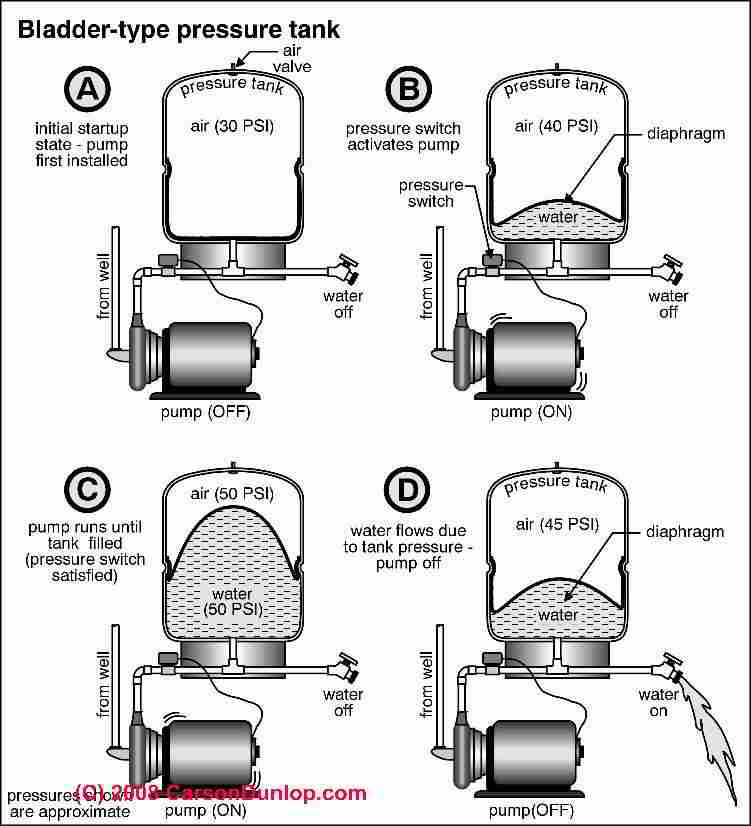
- As water leaves the water tank, water pressure in the water tank drops.
Since the water tank also contains air, the air pressure drops too. In the tank water pressure and air pressure will be at the same psi. Sketch courtesy of Carson Dunlop Associates, a Toronto home inspection, education & report writing tool company [ carsondunlop.com ]. - A pressure control switch,
usually mounted on or near the water tank, senses the pressure drop, and at a pre-set "pump cut-in pressure" (typically 20 or 30 psi) the pressure switch
turns on the water pump
See WATER PRESSURE CONTROL SWITCH ADJUSTMENTS for details of this control. - The water pump,
located at the tank or perhaps in the well, pumps water to the building from the well, simultaneously re-pressurizing the water tank and providing water to the building.
See WATER PUMP LIFE EXPECTANCY for types of water well pumps, how they work, how they are diagnosed and repaired.
Because the water pressure tank is connected to the water pump (water in from the well) and also to the building water supply piping (water out to the building) the water tank is said to be "floated on the water line" and when the water pump is running water is pushed simultaneously into the water pressure tank and into the building supply piping. - When the water pressure in the system reaches the pump control switch CUT OUT pressure
either because the pump pushes water into building water system piping and pressure tank faster than water is being used, OR because plumbing fixtures that were using water are now turned OFF,
The pressure control switch turns off the water pump
when water pressure in the pressure tank reaches the "pump cut-out pressure" (typically 40 or 50 psi) - pressure switch turns off the well pump.
Difference Between Bladder Type Captive Air Water Tanks & Conventional Bladderless Water Tanks
 Describe: Internal bladder type water pressure tanks
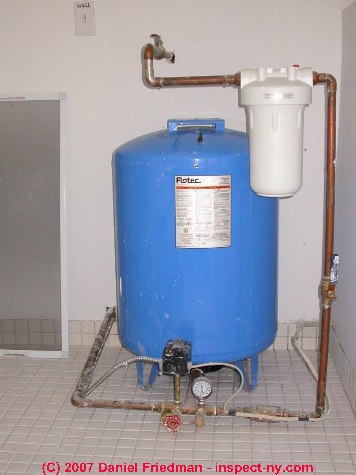
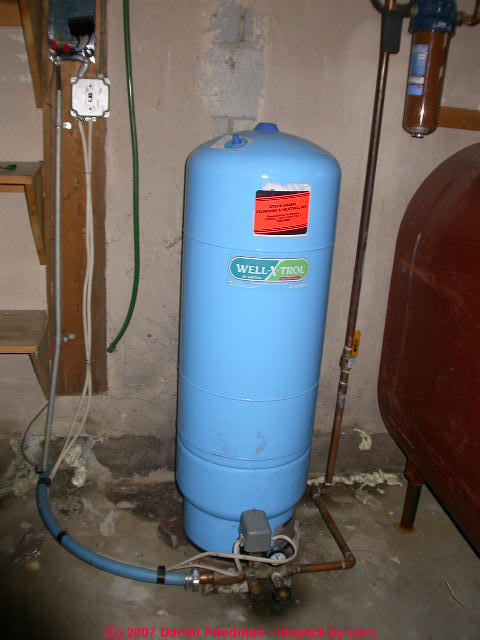
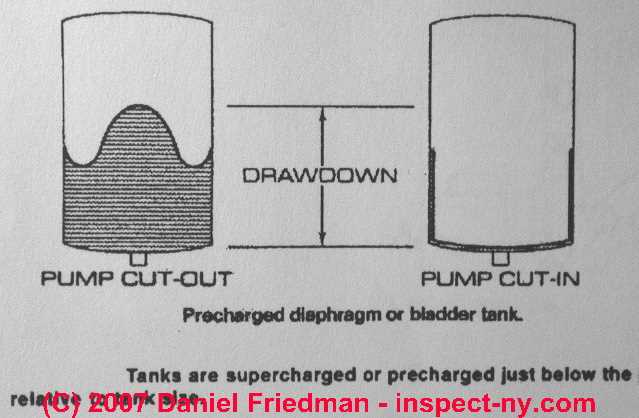
Bladder type or "captive air" water tanks (shown in our photo at left and in the sketch above) store the water tank's air charge in the upper portion of the steel water tank.
Water in the tank moves in and out of a rubber bladder in the tank bottom.
Because the air charge is kept separate from the water in the tank, air is not absorbed into the water and bladder type water tanks do not normally need to have makeup air added.
Water pressure or water pump short cycling problems with bladder-type water tanks are usually traced to a problem with the pump controls, with well and water piping leaks, or less often, to a failure of the internal tank bladder itself - a component that may be replaceable.
If the water-containing rubber bladder in a "captive air" water tank is defective (it can become stuck to itself and remain collapsed), the result can be a rapid on-off short cycling of the water pump.
We test water pressure tanks to see if they're empty or nearly empty of water by seeing if we can gently rock or move the tank.
If the water tank is heavy with water it does not move easily.
Watch out: Be careful not to jiggle the tank so hard that you cause a leak or break a pipe! Bladder type or captive-air water pressure tanks and their repairs are described just above and in more detail at WATER TANK TYPES where we describe all of the types of storage tanks found in, on, or around buildings.
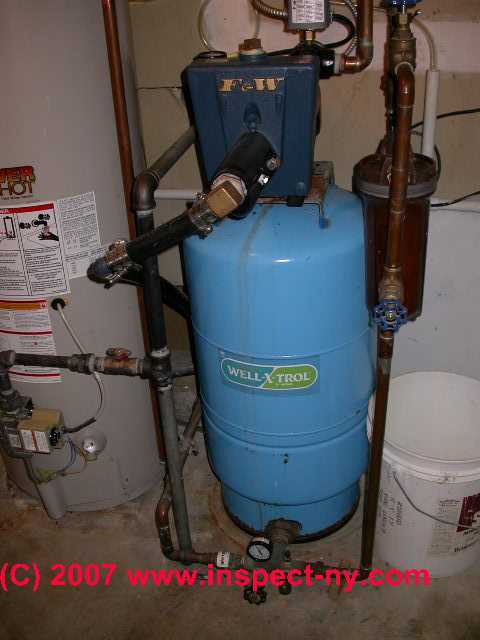
- as the name suggests, these tanks use an internal bladder to keep water and air separate;
usually water is inside the bladder and air outside it but there are a few models that work in the opposite fashion
see WATER TANK BLADDERS & CAPTIVE AIR - almost always are made with a visible seam around the body of the tank, usually at the center of the pressure tank, or the tank may have a removable bottom or top through which the internal bladder is assembled at the factory. Some models permit disassembly and bladder replacement;
- use an air valve only for initial tank pressure adjustment, usually located atop the pressure tank, capped, and surrounded by a "leave this alone" sign.
See details about water pressure tanks that use an internal bladder
at WATER TANK BLADDERS & CAPTIVE AIR
Describe: Bladderless (no internal bladder) water pressure tanks
 Bladderless Water Pressure Tanks (photo and sketch just below) use a single tank interior to hold both the air charge and the water supply.
Bladder-less or "non-bladder" or traditional water pressure tanks do not use an internal bladder to keep water and air separate.
Modern steel bladderless type water tanks may be coated internally to increase the water tank life by resisting corrosion.
That's what "glass lined" refers to on some water tanks.
A "glass lined" or "epoxy coated" water tank will not be a bladder type water tank like the types we we defined above.
See details about bladderless water pressure tanks
and
at FIBERGLASS WATER TANKS, BLADDERLESS
and
at MORRISON WELL SYSTEM FUNCTION & REPAIR
Describe: Open Steel Water Storage Tanks
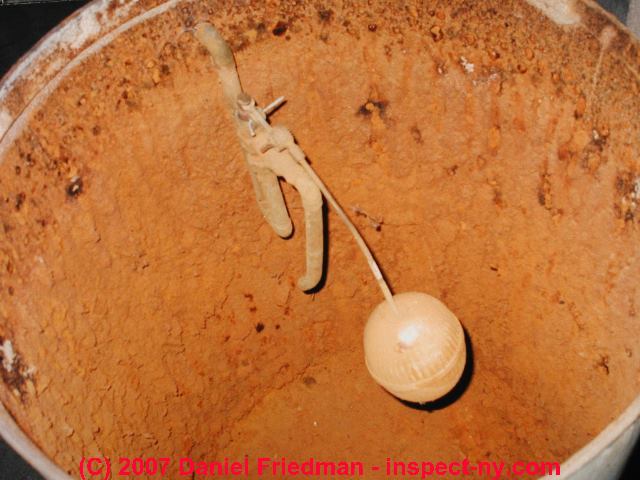
In some older buildings a steel cistern or open water tank was used to provide a building water supply. The tank shown, leaking badly and no longer functional, included a float-controlled water inlet valve in the top of the tank.
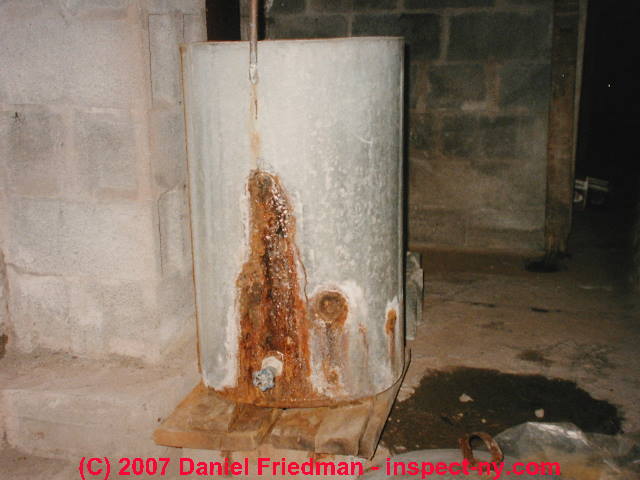
This water tank is discussed
Why Air is Needed in a Water Pressure Tank
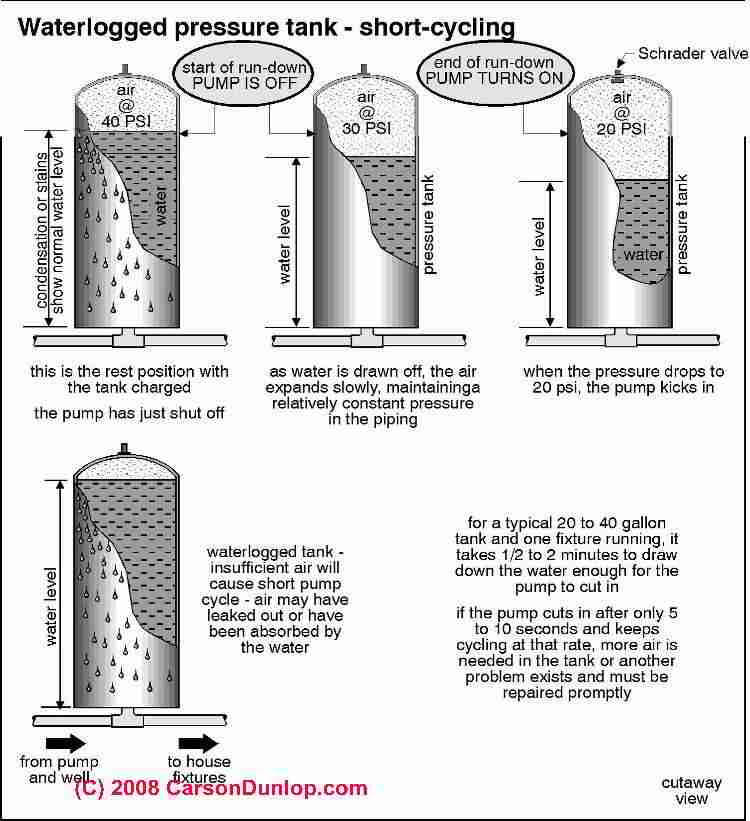
Air in the water tank acts like a spring or cushion which serves to smooth the delivery of water into the building as the pump cycles on and off. That's why we call this the water pressure tank rather than a water storage tank - though for most people these are the same device.
Sketch courtesy of Carson Dunlop Associates, a Toronto home inspection, report writing, & education company.
This air cushion effect prevents the water from surging (much) at the plumbing fixture as the pump turns on and off as water is running during use of the fixture (such as a sink or shower).
More important, this cushion effect prevents short-cycling of the pump on and off, which in turn prevents pump burnout or water pressure control switch damage which could occur if the system switches on and off too rapidly.
Why is a pressure tank with a buffer or spring or cushion of air needed? Water itself is not very compressible.
Since a pump can usually pump faster than the flow of water out of a single faucet, as soon as the pump switched on, water pressure would build way up and the pump would immediately switch off.
Water would not flow nicely from the tap. Instead it would come in a series of squirts. Worse, you'd burn up the water pump or pump control switch by this rapid cycling.
The air cushion in the tank acts like a big spring which is compressed by water pushed into the tank by the pump at the same time that water is also flowing out of the pump, tank, and piping system into the building to whatever faucet has been opened.
So while water is running in a building served by a private well, part of the time the water flow is being maintained only by air pressure in the water tank, and part of the time the water flow is being boosted by the pump during its on cycle. And during the pump's on cycle, it is both pushing water into the house and re-pressurizing (by compressing) air in the water tank.
Water Pressure Requirements for Flushometer Type Toilet & Urinal Valves
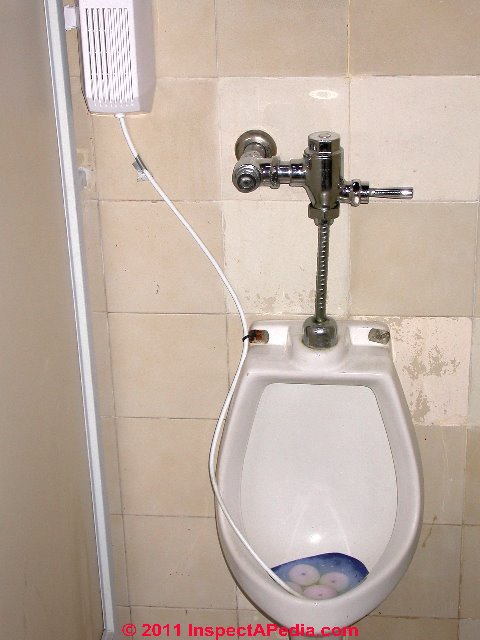
Reader question: Installing a pressurized system & Flushometer Valve Toilets & Urinals on a Well & Pump Water Supply System
I have a well system at a marina and would like to install commercial flushometer toilets and urinals. It is old and is currently served by a standard residential system.
I have space above the rest rooms and would like to install a stand alone pressurized system that is fed by the existing residential system, but would provide the gpm and pressure to function the commercial units. Likely to be a total of 3 toilets and two urinals.
Any ideas or plans available? Thanks, Bill
Reply: Be sure that your well water supply system, pressure tank, pressure, and water supply piping diameter & flow rate can support flushometer valves; consider waterless urinal fixtures.
Bill, we provide a detailed answer to this question
at FLUSHOMETER VALVES for TOILETS URINALS
While flushometer valves by various manufacturers can operate at a range of water pressures (10-100 psi) the typical operating pressure requirement is 25 psi. But the fixtures also need a high water flow rate at that pressure to operate the valve and flush the fixture properly.
That's why the standard water supply pipe diameter to the fixture is 1 1/4" rather than the common 1/2" or 3/4" water supply piping found in residential and light commercial buildings using conventional tank-type toilets.
When choosing fixtures and deciding on water storage volume, pressure, and plumbing specifications you'll need to be sure to check the specific requirements of the flush valves you are buying for the urinals and toilets.
Are well water tanks recyclable?
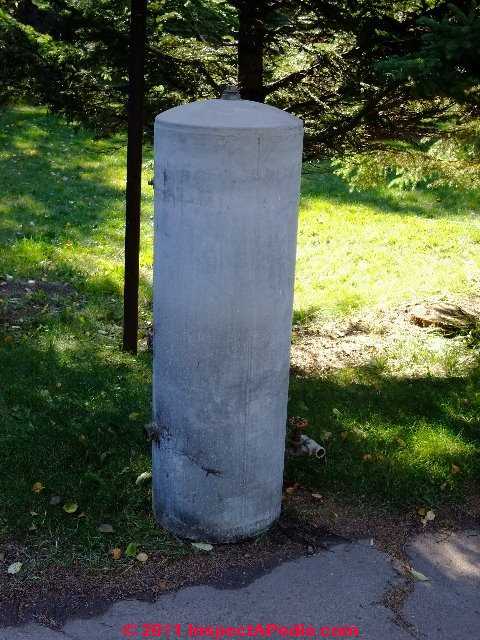
Reader Question: I'm replacing my well tank. The plumber says they recycle these tanks. Is that possible? - Anon
Reply: Yes well water tanks are often recycled
Well water tanks are often collected and recycled, especially by larger plumbing and well drilling companies. To recycle an internal-bladder well water pressure tank the tank is cut open and the bladder is removed.
The remaining steel is delivered to a recycler. This is a useful detail to know about not just because we recommend recycling whenever possible.
Our photo (left) of a bladderless steel water pressure tank illustrates a unit that was replaced by a newer internal bladder tank
. The steel tank will be taken away by the installer (avoiding leaving something difficult for the homeowner to dispose-of), and stored in the installer's junkyard until that company has accumulated enough tanks to have them hauled en-masse to the recycler.
The plumbing company that opens water pressure tanks has an inside view of problems that may have developed with the bladder or with the tank itself - useful water tank failure cause and effect data.
Reader Comments, Questions & Answers About The Article Above
Below you will find questions and answers previously posted on this page at its page bottom reader comment box.
Reader Q&A - also see RECOMMENDED ARTICLES & FAQs
On 2022-12-23 by InspectApedia (Editor) - can I use the pressure tank as a direct source of water
@Pat,
You can use that water, but typical pressure tank volume may well be much too small to water livestock. You'd want a much larger local storage tank.
On 2022-12-23 by Pat
Is there any reason I cannot use the pressure tank as a direct source of water? The one located in the heated portion of the barn could provide water for stock during freezing weather.
Question: issue with our water pressure changing
(May 11, 2016) Pat said:
We are having an issue with our water pressure changing (which changes the water temperature) while we're taking showers. We're on a hill. We use city water that feeds directly into a tank. From there our pump feeds it to the house. Our pressure tank is at the end of the line (water goes through the house before getting to the tank).
There is a sixty foot elevation change from our water tank, which is where the pump is, to the house. is this too much for the pump to try to push the water up 60 ft in elevation, plus another 120'(when it gets to the top before reaching the house), and keep a reasonably consistent pressure so the temperature doesn't change while taking a shower?
Reply:
Pat:
Have you considered installing a point-of-use anti-scald valve that will regulate water temperature regardless of pressure changes? That's what I'd do. Searching InspectApedia.com for "point of use anti scald valve" returns this article that may help:
inspectapedia.com/plumbing/Anti_Scald_Mixing_Valve_POU.php
An alternative would be to install a much larger pressure tank closer to the point of use of the water (in the house). I think the POU anti scald valve is a better idea.
(May 15, 2016) Pat said:
Thank you for your suggestion, but i don't think an anti scalding valve is what i need. I checked with an infrared thermometer and the hot water heater doesn't put out more that about 117 degrees. With cold water already mixing in it never feels like it gets to a scalding point. It's just the changing pressure and temp that is bothersome.
I would still like to know if putting another tank and pump combo at the top of the hill (house level) would help with the changing pressure.
(mod) said:
Right, Pat, but a valve that automatically regulates the temperature at the fixture should protect not just from scalding but from getting too cold as pressure between hot and cold vary. Or am I still missing something.
Another route is to add an independent pressure booster to your water system to try to keep pressure more uniform. We do that with a local tank and pressure booster pump - more or less what you're thinking.
Question:
(May 18, 2016) Anonymous said:
One of our future projects (sooner than later) is remodeling both bath/shower areas. We would then just purchase new valves with the temperature regulators built in. But, I'm thinking that the installation of a local tank and pressure booster pump would be helpful.
Any suggestions as to the size of the tank and size and type of booster pump?
(May 20, 2016) Jan said:
water come out from the air valve on top of the pressure tank, . Is need to replace or can be repaired that tank?
Reply:
If it's an internal bladder tank the bladder or tank needs replacement
Question:
(June 2, 2016) princess said:
what is my guide in buying a pressure tank? how big should it be in terms of the size of the tank and the size of the motor.
what is also my guide in buying an overhead water tank, what is the capacity?
Reply:
Princess I'm not familiar with "overhead" water tanks - nor just what you're asking about. Tank physical size requirements depend on the job it's doing; a simple typical north American water pressure tank, regulating pressure, not storing backup volumes of water, is small - 30-50 gallon rated capacity. Tanks in the hundreds or thousands of gallons are needed in some situation such as storing a water reserve when a well is limited.
Question: pin hole in tank
(June 7, 2016) Anonymous said:
pin hole in tank
Reply:
Hardware store or plumbing supplier tank repair metal screw + rubber washer. Short term fix.
Question: pump won't stop and water isn't entering the pressure tank
(June 7, 2016) Nancy said:
Hi there. I have an old bladderless pressure tank for my irrigation system. I recently had to fix a leak in a pipe running to/from the tank and had to drain all of the water out of the tank. I now have the irrigation system running but the pump will not stop and no water seems to be going into the pressure tank. I don't seem to have any other leaks in the system. How do I get water back into the pressure tank to stop the system from running on? Any ideas?
Reply:
I suspect your pump has lost prime. Search InspectApedia for HOW TO PRIME THE PUMP to read details. Don't let a pump keep running dry as it's likely to be damaged.
Question: wiring order for the pressure switch
(July 17, 2016) Jamie said:
What's the wiring order for the pressure switch on pressure tank
Reply:
Easy wiring instructions are usually given on a sticker right inside the pressure switch cover.
Question: air comes out of the T-bar drain plug
(July 19, 2016) Jason said:
How do I know if the bladder is bad in my pressure tank? When I put air in, it comes out through the T bar drain plug?
Reply:
Jason
If the T-bar drain plug is at the bottom of your pressure tank where water is normally going to be routed into the tank, and if air is coming out there (at an air valve), and if your tank uses an internal bladder, then I suspect the bladder is torn or burst.
Question: low pressure vs bad tank bladder
(Aug 14, 2016) t said:
low pressure how can i tell if bladder is bad
Reply:
Low water pressure would not directly be due to a defective tank bladder; more likely a bladder that's stuck and not allowing water into the pressure tank or that has a hole and is leaking, will result in water pump short cycling on and off too rapidly. Ultimately that short-cycling can damage the pump itself or its control switch. IF that happens more likely the pump just won't run.
Search InspectApedia.com for DIAGNOSE LOW WATER PRESSURE to see diagnostic and repair suggestions.
Question:
(Aug 21, 2016) f. castellanos said:
I have a 20 gallons pressure tank, and after bleeding or discharging a lot of water, a great deal of it remains. Can I open it in the bottom (it has 4 bolts) and get all the water out? It is a rubber bladder type.
Reply:
FC
I would NOT open the bolted-cover on the water pressure tank bottom to remove remaining water from the tank as I speculate that that's a port intended to permit replacement of the tank bladder; you may damage the bladder or have trouble getting a re-seal on the tank, and besides it's not necessary.
If your tank indeed uses an internal bladder as you and I think, simply opening the drain valve at the tank bottom while the pump is turned off will normally drain all of the water out of the tank; that's because the air pre-charge in the tank will push the water out. The air pre-charge is set to 2 psi below the pressure control switch CUT-IN pressure, say 28 psi. That's more than enough to empty the tank.
If your tank uses an internal bladder and no more water will drain out of the tank but the tank is still heavy with water I suspect a perforated or damaged tank bladder. Search InspectApedia.com for WATER TANK BLADDER REPAIR to see details.
...
Continue reading at CISTERNS, WATER STORAGE or select a topic from the closely-related articles below, or see the complete ARTICLE INDEX.
Or see WATER TANK FAQs - questions & answers posted originally at this article.
Or see these
Recommended Articles
- WATER PUMP CONTROLS & SWITCHES - home
- WATER PUMP & TANK I&O & REPAIR MANUALS - installation, operation & repair guides for all brands of water pump, pump controls, & water pressure or water storage tanks
- WATER TANK DIAGNOSIS & REPAIR - home
- WATER TANK: USES, TROUBLESHOOTING - home
- AIR VOLUME CONTROLS, WATER TANK
- CISTERNS, WATER STORAGE
- FIBERGLASS WATER TANKS, BLADDERLESS
- IDENTIFY WATER TANK USE
- LARGE CAPACITY WATER STORAGE TANKS
- ODORS IN WATER
- PLASTIC RECYCLING CODES, TANKS, TYPES
- ROOFTOP WATER TANKS
- WATER TANK AGE DECODER
- WATER TANK AIR, HOW TO ADD
- AIR DISCHARGE at FAUCETS, FIXTURES
- SNIFTER & DRAIN BACK VALVES
- WATER TANK AIR VOLUME CONTROLS
- WATER TANK AIR ADD AT AIR VALVE
- WATER TANK AIR ADD BY DRAINING
- WATER TANK AIR HOW MUCH TO ADD
- WATER TANK AIR HOW OFTEN TO ADD
- WATER TANK AIR INLET VALVE
- WATER TANK AIR INLET VALVE
- WATER TANK AIR LOSS FAQs
- WATER TANK AIR LOSS SIGNS
- WATER TANK AIR PRESSURE ADJUSTMENT
- WATER TANK AIR VALVE REPAIRS
- WATER TANK AIR VOLUME CONTROLS
- AIR VOLUME CONTROL ADJUSTMENT
- AIR VOLUME CONTROLS on DRAIN BACK SYSTEMS
- AIR VOLUME CONTROLS ROUND/Tube
- AIR VOLUME CONTROLS RECTANGULAR
- AIR VOLUME CONTROLS FLOAT TYPE
- AIR VOLUME CONTROLS, GET RID OF
- AIR VOLUME CONTROLS, HISSING
- AIR VOLUME CONTROL REPAIR
- AIR VOLUME CONTROLS, REPLACE
- AIR VOLUME CONTROL TEST
- MORRISON WELL SYSTEM FUNCTION & REPAIR
- SNIFTER & DRAIN BACK VALVES
- WATER TANK BLADDERS & CAPTIVE AIR
- WATER TANK BLADDER BURST or LEAKY
- WATER TANK BLADDER CONSTRUCTION
- WATER TANK BLADDER PRESSURE ADJUSTMENT
- WATER TANK BLADDER REPLACEMENT
- WATER TANK BLADDER STUCK to ITSELF
- WATER TANK CAPTIVE AIR vs TRADITIONAL WellMate
- WATER TANK CLEANING CODES STANDARDS
- WATER TANK CONTROLS & SWITCHES
- WATER TANK COSTS & PUMP PRICES
- WATER TANK DIAGNOSIS & REPAIR - home
- WATER TANK REPAIR PROCEDURES
- WATER TANK TYPES - what are the different kinds of water pressure tanks & water storage tanks & how are they used?
- SHAKE the WATER TANK
- WATER TANK & PUMP DRAIN & WINTERIZE - how to protect the water tank from freezing
- WATER TANK DRAIN VALVE
- WATER TANK, FIBERGLASS
- WATER TANK IDENTIFICATION & USE
- WATER TANK, LARGE CAPACITY
- WATER TANK LIFE EXPECTANCY
- WATER TANK MANUALS
Suggested citation for this web page
WATER TANK: USES, TROUBLESHOOTING at InspectApedia.com - online encyclopedia of building & environmental inspection, testing, diagnosis, repair, & problem prevention advice.
Or see this
INDEX to RELATED ARTICLES: ARTICLE INDEX to WATER SUPPLY, PUMPS TANKS WELLS & SPRINGS
Or use the SEARCH BOX found below to Ask a Question or Search InspectApedia
Ask a Question or Search InspectApedia
Try the search box just below, or if you prefer, post a question or comment in the Comments box below and we will respond promptly.
Search the InspectApedia website
Note: appearance of your Comment below may be delayed: if your comment contains an image, photograph, web link, or text that looks to the software as if it might be a web link, your posting will appear after it has been approved by a moderator. Apologies for the delay.
Only one image can be added per comment but you can post as many comments, and therefore images, as you like.
You will not receive a notification when a response to your question has been posted.
Please bookmark this page to make it easy for you to check back for our response.
Our Comment Box is provided by Countable Web Productions countable.ca
Citations & References
In addition to any citations in the article above, a full list is available on request.
- In addition to citations & references found in this article, see the research citations given at the end of the related articles found at our suggested
CONTINUE READING or RECOMMENDED ARTICLES.
- Access Water Energy, PO Box 2061, Moorabbin, VIC 3189, Australia, Tel: 1300 797 758, email: sales@accesswater.com.au Website: http://www.accesswater.com.au/
Moorabbin Office: Kingston Trade Centre, 100 Cochranes Rd, Moorabbin, VIC 3189
Australian supplier of: Greywater systems, Solar power to grid packages, Edwards solar systems, Vulcan compact solar systems, water & solar system pumps & controls, and a wide rage of above ground & under ground water storage tanks: concrete, steel, plastic, modular, and bladder storage tanks. - Life Expectancy of Water Pumps - Well Pumps: how long should a water pump last? What affects pump life?
- Life Expectancy of Wells & Water Tanks how long should a water well and its components last?
- Smart Tank, Installation Instructions, Flexcon Industries, 300 Pond St., Randolph MA 02368, www.flexconind.com, Tel: 800-527-0030 - web search 07/24/2010, original source: http://www.flexconind.com/pdf/st_install.pdf [Copy on file as /water/Smart_Tank_Flexcon.pdf ] -
- Typical Shallow Well One Line Jet Pump Installation, Grove Electric, G&G Electric & Plumbing, 1900 NE 78th St., Suite 101, Vancouver WA 98665 www.grovelectric.com - web search -7/15/2010 original source: http://www.groverelectric.com/howto/38_Typical%20Jet%20Pump%20Installation.pdf, [Copy on file as /water/Jet_Pump_Grove_Elect_Jet_Pumps.pdf ] -
- Typical Deep Well Two Line Jet Pump Installation, Grove Electric, G&G Electric & Plumbing, 1900 NE 78th St., Suite 101, Vancouver WA 98665 www.grovelectric.com - web search -7/15/2010 original source: http://www.groverelectric.com/howto/38_Typical%20Jet%20Pump%20Installation.pdf, [Copy on file as /water/Jet_Pump_Grove_Elect.pdf ] - Cooperative Extension, School of Forest Resources, web search 07/24/2010, original source: http://pubs.cas.psu.edu/FreePubs/pdfs/XH0002.pdf
- Water pressure tanks - how to diagnose the need for air, how to add air, stop water pump short cycling to avoid damage - water storage water pressure tank safety.
- WATER PUMP REPAIR GUIDE an specific case offers an example of diagnosis of loss of water pressure, loss of water, and analyzes the actual repair cost
- Water pressure tank failures & water pump short cycling diagnosis and repair
- Our recommended books about building & mechanical systems design, inspection, problem diagnosis, and repair, and about indoor environment and IAQ testing, diagnosis, and cleanup are at the InspectAPedia Bookstore. Also see our Book Reviews - InspectAPedia.
- In addition to citations & references found in this article, see the research citations given at the end of the related articles found at our suggested
CONTINUE READING or RECOMMENDED ARTICLES.
- Carson, Dunlop & Associates Ltd., 120 Carlton Street Suite 407, Toronto ON M5A 4K2. Tel: (416) 964-9415 1-800-268-7070 Email: info@carsondunlop.com. Alan Carson is a past president of ASHI, the American Society of Home Inspectors.
Thanks to Alan Carson and Bob Dunlop, for permission for InspectAPedia to use text excerpts from The HOME REFERENCE BOOK - the Encyclopedia of Homes and to use illustrations from The ILLUSTRATED HOME .
Carson Dunlop Associates provides extensive home inspection education and report writing material. In gratitude we provide links to tsome Carson Dunlop Associates products and services.
 | HOME | ABOUT | ASK a QUESTION | CONTACT | CONTENT USE POLICY | DESCRIPTION | POLICIES | PRIVACY | |
| © 2024 - 1985 Publisher InspectApedia.com - Daniel Friedman | |||||||||