
InspectAPedia® FREE Encyclopedia of Building & Environmental Construction, Diagnosis, Maintenance & Repair |
Question? Just ask us! InspectAPedia
|
 Building Safety Inspections & Standards
Home Page & Article Index
- POST a QUESTION or COMMENT about building safety, building mechanical system safety, and indoor environmental safety
Building safety hazards, standards, inspection procedures & article index.
Here we list major building & indoor environmental safety hazards, and we discuss how to detect and protect from safety & environmental hazards in homes and other buildings.
We include links to detailed safety articles on important building hazards facing home owners, property owners, tenants, office workers, and repair contractors as well as for building and home inspectors, contractors, and for building owners who need to inspect or test the condition of their building.
InspectAPedia tolerates no conflicts of interest. We have no relationship with advertisers, products, or services discussed at this website.
Home & Building Safety Hazards, Standards, Inspections
News: on 12 March 2018, ISO 45001, Occupational Health and Safety Management Systems Standard, was published for the first time. This safety standard, developed by experts from more than seventy countries and organizations began with the British safety standard OHSAS 18001, the U.S. ANSI Z10 safety standard, the Canadian CSA Z1000 standard, and ILO's OHSMS guidelines.
Reporting on the key elements in the new ISO 45001 safety standard, Vic Toy noted that according to the International Organization for Standardization had reported an annual 2.2 million work-related fatalities, of which 80% were ascribed to occupational disease. Toy also cited 374 million non-fatal work-related injuries and illnesses per year, pointing out that these staggering numbers surely merit improved health and safety management world wide. - Toy, Vic, "The Long Road to ISO 45001, Key Elements of the First Global Health and Safety Management Systems Standard", American Industrial Hygiene Association, The Synergist, 3141 Fairview Park Dr, Ste 777, Falls Church VA 22042 USA, June/July 2018 pp. 24-27, author email: vtoy@insystohs.com.
The article series given here focuses on home and small building safety standards that put owners, occupants, inspectors, and contractors at special risk.
- Daniel Friedman 03/26/2008 - 7/20/2018 orignal presentation to the Connecticut Association of Home Inspectors
Abstract - this brief paper is a summary of HOME INSPECTION SAFETY HAZARDS [web article] where we offer detailed safety advice for building & home inspectors who, as building professionals, are charged both with protecting themselves, their clients, and the occupants of buildings that they inspect. The purpose of this class and the accompanying index to safety articles by topic are to reduce the chance of serious injury or death for building & home occupants as well as for contractors, buildingcode compliance inspectors, home inspectors, other building inspectors, and contractors.
The range of hazards faced by home inspectors in the course of examining buildings is considerable. It includes obvious catastrophes such as falling off of a roof or electrocution, and less obvious or less likely events such as structural collapse, exposure to bacterial hazards, fungal hazards, or even physical attack by violent building occupants, biting dogs, sneaky snakes, and pecking parrots.
Home inspectors and other professional building diagnosticians are expected to be observant and attentive to detail. Despite these skills, accidents happen to inspectors.
Article Series Contents
- ACCIDENT THEORY for Home & other Building Inspectors
- A SURVEY of BUILDING HAZARDS & ACCIDENTS By Type of Activity
- ATTIC HAZARDS For Building Inspectors
- BASEMENT or CRAWL SPACE HAZARDS
- BUILDING CODES re DANGEROUS CONDITIONS - separate article
- BUILDING FIRE SAFETY, ARTICLE INDEX - home
- STAIR CODES & STANDARDS - home
- STAIR CODE DETAILS
- ELECTRICAL HAZARDS for building inspectors
- FIRE ESCAPES & FIRE STAIRS
- FIRE ESCAPE DESIGNS, EARLY
- FIRE HAZARDS for building inspectors
- FIRE STOPPING for STAIRWAYS
- GAS EXPOSURE or EXPLOSION HAZARDS for home inspectors
- HANDRAIL CODES & OSHA HAND RAIL SPECS
- HEATING SYSTEM HAZARDS for building inspectors or service techs
- MOBILE HOME FIRE SAFETY
- PLATFORMS & LANDINGS, ENTRY & STAIR
- ROOF ACCESS SAFETY HAZARDS
- SAFETY for BUILDING INSPECTORS - separate article
- BUILDING ENTRY for DAMAGE ASSESSMENT - separate article
- ELECTRICAL SAFETY for FLOOD DAMAGE INSPECTORS - separate article
- SAFETY HAZARDS GUIDE - home: safety hazards in buildings & affecting occupants, building inspectors, workers
- SECURITY SYSTEMS cameras, monitors for home security, intrusion, elder-safety, freeze or water damage monitoring
- STAIR RAIL & LADDER SAFETY Hazards & Accidents Described and Avoided
- STRUCTURAL HAZARDS for building inspectors
- SEPTIC & CESSPOOL HAZARDS for property inspectors or owners
- SLIP TRIP & FALL HAZARD LIST, STAIRS, FLOORS, WALKS
- HOSTILE BUILDING OCCUPANT or NEIGHBOUR HAZARDS to building inspectors
- INDOOR AIR QUALITY HAZARDS for building inspectors
- WATER HEATER SAFETY HAZARDS for inspectors or occupants
- WATER TANK SAFETY HAZARDS for inspecors or building occupants & workers
Examples of Serious Safety Hazards Facing Home Inspectors
A Canadian home inspector fell to his death during a roofing inspection. He was ascending a high ladder which he suspected was unsafe.
Following a home inspection in New Paltz, NY, Ballinger, a real estate agent who was angry with the results of the inspection, attacked and attempted to kill home inspector Steve Vermilye by driving his car off of the pavement, across a sidewalk, crashing into a building wall where Vermilye was walking.
Another home inspector was badly injured when an attic fold-down stair fell out of its opening as the inspector was climbing it.
Hazards that an inspector should recognize affect other people too. An aggressive tenant threatened two elderly inspection clients with a rifle and then showered them with stones.
An electrical inspector was killed by an electrical arc explosion while removing the cover of an electrical panel.
A plumber was killed while leaning over a water pressure tank that, lacking a pressure relief valve, exploded.
We will list some of the more egregious and more interesting of these dangerous building hazards, review accident case histories, and we will illustrate procedures of attention, observation, and hazard recognition that can reduce the chances of accidents during building inspections.
A Brief Account of Accident Theory for Home & other Building Inspectors
People are not rational about safety
We are more afraid of improbable hazards beyond our control (EMF) than we are of probable hazards over which we have control (smoking cigarettes).
We do not perceive risk accurately
Some accidents are more or less likely to occur than we believe. Some accidents are likely to result in greater or lesser degree of injury than we believe. Having a more accurate picture of where hazardous risks lie can help us learn to properly attend accident risks and thus to avoid accidents.
Total Risk = (Probability of Occurrence) x (Cost of Occurrence)
The attention we pay to various risks needs to be adjusted continuously as we move through a building from area to area (basement to roof) and topic to topic (plumbing to electrical).
Tune risk recognition to area and system: The home inspector's recognition of risks needs to attend the hazards peculiar to each building area and system.
Educate to improve hazard recognition and to teach safe inspection procedures: The level of inspector technical education affects the inspector's ability to recognize hazards and to reduce accidents.
A Survey of Building Hazards and Accidents By Type of Activity
List of Building & Mechanical System Related Safety Topics: Readers should see our list of major building & indoor environmental safety hazards, inspection methods, & remedies listed in the ARTICLE INDEX. Readers should also see our list of building inspector safety articles
at Home Inspection Education & Services - Safety Articles.
Falling, Tripping, Slipping Hazards & Lifting Hazards
The accident rate of injury by slipping, tripping, or falling is among the highest facing home inspectors and home owners.
Falls: The highest risk of injury by falls occurs among the elderly but falls are a particular hazard for home inspectors because of the need to access attics, roofs, and also simply because of the distractions while inspecting any building site. "Falls represent the most frequent non-transportation related accidents occurring among older adults and are the leading cause of home fatalities for this population.
Roof Access Safety Hazards
Canadian home inspector fatality, inspector ascending exterior ladder secured to building knew the ladder was unsafe, told his wife he was afraid of it but felt he had to ascend to inspect the roof during a multi-day inspection of a large building. The ladder came away from the building and the inspector fell to his death. (Ca. 1998)
See details at ROOF INSPECTION SAFETY & LIMITS
Hazards to Avoid When Inspecting Roofs
- Ladder placement and use hazards (discussed in detail below)
- Slipping or falling off a steep roof (it's easier to get on than to get off, valleys are easier to walk than an open steep roof slope)
- Slipping or falling off of a slippery roof (wet, wood, slate, loose debris, loose mineral granules, moss, lichens, and pine needles are especially dangerous)
- Knocking debris onto a client or bystander below (slates, branches, chimney parts, and also, people holding your ladder should look down, not up, as you descend to avoid roof debris in the eye)
- Falling through a rotted or damaged roof surface, perhaps hidden by a sloppy"roof over" job
- Falling off due to mis-attention, distractions, bees
Stair, Rail, & Ladder Safety Hazards & Accidents Described and Avoided

The author has consulted in depth concerning fall injuries and has performed case studies investigating stair and rail accident and injury lawsuits. The full paper and the class materials reviewed several falling lawsuits for which the author was consulted.
Home inspectors are qualified to observe, photo document, and report on physical conditions at a building, such as stairs which are defective for any of a variety of reasons.
How to Avoid Stair, & Railing & Ladder Accidents
Note bad steps and rails to yourself and report orally and in writing to your clients
Ladder angle (OSHA: the horizontal distance from the top
support to the foot of the ladder should be approximately one-quarter
of the working length of the ladder)
Ladder feet improperly placed on sloped, uneven, wet, icy, snowy, un-seen, or other slippery surface
Distractions - Bats in the Attic? and other distractions during climbing ladders: people, (client directly overhead while climbing ladder into attic - let's be first honest, second careful, third professional), bees and wasps, birds, bats, pets (more later on biting dogs)
Details and more examples of stupid ladder tricks are found
at SAFETY HAZARDS & INSPECTIONS
Improper steps and rails by dimension or angle or gap (child hazards)
- Circular stairs treads: small triangular angled walking area, widely-spaced balusters (fall-through or head traps)
Unsafe attic stairs
- Inadequate securing of stair frame to the framed opening
- Loose or missing hinge bolt hardware
- loose, bent spring arms (spring can slip and strike stair climber in the face)
- folding ladder too long (angled position brakes stair stringer) or too short (hanging stairs)
- damaged or loose treads
- older sliding ladder versions may fall out completely (DF broken leg)
Details and an extensive catalog of causes of trips and falls on all types of stairs can be found
Unanticipated sources of falls during home inspections
- Exterior wooden deck stairs with improperly installed treads, side nailed, no cleats, wooden treads fall, protruding nails rake the inspector's ankle
- Dogs (including culturally-based fear among some Asians who fear them); biting hazards but also fear and falling hazards
- Hidden defects - missing support, rot (realtor stomped-on and fell through deck while demonstrating its structural integrity)
- Hidden structural details: walking on attic floor joists (ceiling joists) with insulation in place, stepping on insulation risks failure to notice that joists change direction = fall through (DF fell into Fox Hill Condos bathroom, occupied)
- Pitched, slippery treads
- Insecure rails (no hazard until you're falling and need to grab the rail)
- Angry bystanders push (realtor pushed clients father down stairs)
- Bees and wasps, bats, etc. - carry an epi-pen?
Other Attic Hazards For Building Inspectors
- Cuts: cutting your head on protruding roof nails
- Falls: stepping or falling through ceilings.
- Fans, cuts, dust: attic fan hazards
- Pathogens & Dust: breathing fiberglass dust,
- Shocks: electrical hazards
Other Basement or Crawl Space Hazards
- Rodents, bites, urine, feces, hantavirus
- Pathogens from sewage spills or backups
- Shocks from electrical hazards
- Stuck, Cut, Bitten
- Working alone, stuck or injured
Electrical Safety for Inspectors
Here we give some tips on how to inspect the electrical panel, including the risks of relying on test instruments (resistance drops do not equal bad connections).

Case Histories of Electrical Accidents During Inspections
- Electrician in Atlanta killed while removing electrical panel cover explosion
- Homeowner denies unsafe wiring, gets shocked;
- Realtor instructs tenant to cut and remove harmless zip-cord wiring-fuses blow, curls tenant's hair.
- Rat's nest wiring comment frightens high-heeled client, runs through dark basement, fall
- Sheet metal screws in the panel door may pierce live wires during electrical panel cover replacement. (See our photograph above).
- Mis-wiring or loose connections may short when moved
- Overheating, burn ups, loose wires, other commonly-identified reporting defects
- FPE, Zinsco, Aluminum Wiring - breakers fall out;
- Bakelite fuse holders can disintegrate when pulled from an old panel;
- Cartridge fuses can twist or disconnect during removal of fuse pull-out
- Breakers may not reset when turned off manually
- Turning off breakers accidentally during panel cover removal can cause in-building catastrophes such as computer data loss or injury if medical equipment (a home dialysis machine) is in operation. [These warnings are based on actual incident reports -DF]
- Do not rely on "touch" to test for live wiring or shorted electrical panel boxes
- Do not touch, grab, shake, disturb live wires unless specifically trained & equipped to do so [B. Smith, Small Homes Council, erroneously advised home inspectors to test the connection security of SEC connections in the panel by grabbing and shaking them - DO NOT DO THIS-DF]
- One hand behind back during panel inspection
- Block clients from touching live electrical components during panel inspection by positioning your body correctly
References for Electrical Inspection Safety Procedures for Home Inspectors
- DMMs VOMs SAFE USE OF - how to use electrical test equipment safely
- SAFETY for ELECTRICAL INSPECTORS - at https://InspectAPedia.com/electric/Electrical_Inspector_Safety.php Electrical Safety Hazards and Safe Electrical Inspection Procedures
- How to Inspect Residential Electrical Panels - at https://InspectAPedia.com/electric/Electrical_Panel_Inspection.php
Other electrical safety and product hazard references
- Aluminum Wiring Information - at https://InspectAPedia.com/aluminum/Aluminum_Wiring_Hazards.php
- Ampacity of an Electrical Service - at https://InspectAPedia.com/electric/Electrical_Service_Amps_Determination.php
- Federal Pacific Electric (FPE) Stab-Lok - at https://InspectAPedia.com/fpe/FPE_Stab_Lok_Hazards.php
- Lightning Protection Systems - at https://InspectAPedia.com/lightning/Lightning_Strike_Protection_Systems.php
- Multi-wire branch circuit inspection - at https://InspectAPedia.com/electric/Multi-Wire-Electrical-Circuits.php
- Rust and Corrosion in Electrical Panels, - at https://InspectAPedia.com/electric/Electrical_Panel_Rust.php
- Zinsco Sylvania Electrical Panel Hazards - at https://InspectAPedia.com/electric/Zinsco_Electrical_Panels.php
Building Fire Hazards, Fire Safety, Fire Standards
Here are some InspectApedia fire safety articles organized by topic:
- ALUMINUM WIRING SAFETY ASSESSMENT - CPSC.
- ALUMINUM WIRING HAZARDS - home
- Burning Odors: see ODOR DIAGNOSIS CHECKLIST, PROCEDURE
Watch out: If you smell "burning plastic" or or smoke similar odors indoors or even outside of a building, a dangerous electrical failure could be present and there is risk of a building fire. - CARBON MONOXIDE INSPECTION - fatal CO gas hazards, CO detectors, CO sources
- CHIMNEY INSPECTION DIAGNOSIS REPAIR
- CLOTHES DRYER FIRE HAZARD WARNINGS
- FIRE RATINGS for ROOF SURFACES
- FIRE RETARDANT PLYWOOD
- FIRE CLEARANCES INDOORS
- FIRE CLEARANCES for MASONRY CHIMNEYS
- FIRE CLEARANCES, METAL CHIMNEYS
- FIRE CLEARANCES, SINGLE-WALL METAL FLUES
- FIRE CLEARANCES WOOD & COAL STOVES
- FIRE CLEARANCES, INDOOR
- FIRE CLEARANCES WOOD & COAL STOVES
- FIRE STOPPING in BUILDINGS
- FIREPLACE INSPECTIONS
- FIREPLACE DAMAGE & UNSAFE HEARTHS
- FIREPLACE & HEARTH DAMAGE FAQs
- NEST LEARNING THERMOSTATS - information about the Nest fire, smoke, CO alarm system
- HEATING SYSTEM SAFETY INSPECTION
- WOOD STOVE OPERATION & SAFETY
- https://InspectAPedia.com/aluminum/Aluminum_Wiring_Hazards.php Aluminum Wiring Information
- https://InspectAPedia.com/electric/Electrical_Service_Amps_Determination.php Ampacity of an Electrical Service
- https://InspectAPedia.com/fpe/FPE_Stab_Lok_Hazards.php Federal Pacific Electric (FPE) Stab-Lok
- https://InspectAPedia.com/electric/Multi-Wire-Electrical-Circuits.phpMulti-wire branch circuit inspection
- https://InspectAPedia.com/electric/Electrical_Panel_Rust.php Rust and Corrosion in Electrical Panels,
- https://InspectAPedia.com/electric/Zinsco_Electrical_Panels.phpZinsco Sylvania Electrical Panel Hazards
- https://InspectAPedia.com/lightning/Lightning_Strike_Protection_Systems.php Lightning Protection Systems
Watch out: If there is evidence of a fire or unsafe heating equipment or a leaky or unsafe or burning chimney, get everyone out of the building and call for help from your fire department.
Gas Piping and Gas Appliance Safety

Gas tank or gas piping leaks are a potential explosion or fire hazard. There may also be carbon monoxide or other asphyxiation hazards from equipment malfunctions.
Detecting gas leaks, appliance safety controls, what to do when a leak is detected, when to shut down unsafe heating equipment.
- Decide the level of risk
- Report all leaks
- Serious leaks: call the gas company, do not operate anything electrical (even a cell phone) in the building - leave
- The dangers of trying to "turn off" a gas valve
Use and rely on these gas leak detection methods in this order
- Smell (unreliable both in variation among individuals and in de-sensitization on prolonged or gradual exposure)
- Visual inspection
- Gas detection instruments
Heating System Inspection & Gas Leak Detection & Reporting References
- https://InspectAPedia.com/plumbing/Gas_Controls_Piping_Valves.phpHow to Check Gas Piping, Controls, Regulators Tanks
- https://InspectAPedia.com/plumbing/Gas_Leak_Detection.phpHow to Identify & Gas Leaks
- https://InspectAPedia.com/heat/Heating_Safety_Inspection.php Heating Inspection Safety Guide
Heating System Safety, Recalls, Chimneys, Vents, Heaters, Heating System Inspection
Heating system & heating equipment safety articles
- BLEVE EXPLOSIONS
- HEAT EXCHANGER CORROSION
- HEAT EXCHANGER LEAK TEST
- HEATING SYSTEM SAFETY INSPECTION - separate article
- RELIEF VALVE LEAKS
- RELIEF VALVE LEAK FAQs
- RELIEF VALVE LEAK FAQs-2
- RELIEF VALVE LEAK DUE TO EXPANSION TANK
- RELIEF VALVE, TP VALVE, BOILER
- RELIEF VALVE, TP VALVE, STEAM BOILER
- SAFETY HAZARDS & INSPECTIONS
- WATER HEATER SAFETY
- WATER HEATER TEMPERATURE ADJUSTMENT CONTROLS
- SAFETY RECALLS Chimneys, Vents, Heaters
Home Security Systems: alarms, security cameras, smart thermostats, freeze protection
This topic has moved to a new page:
Septic Tanks, Drywells, Cesspools and their Risks to Home Owners, Occupants, & Inspectors

Inspection Hazards at Septic Systems, Drywells, Cesspools
Collapsing covers over tanks, cesspools, drywells, especially wood, steel, or home-made Collapsing site-built septic tanks, cesspools, drywells.
Bacterial (sewage) and fungal (mold) hazards for home inspectors may be present if there has been sewage backup.
See these articles
- CESSPOOL SAFETY WARNINGS
- SEPTIC SYSTEM INSPECT DIAGNOSE REPAIR
- SEPTIC & CESSPOOL SAFETY
- SEWER GAS ODORS
- SINK HOLES
The Fatal Hazards of Falling in or Leaning Over Septic Tanks
- Falling-in the Septic Tank or Cesspool: Do not step on and fall into a septic tank or cesspool. Potentially Fatal Hazards of entering, stepping onto or falling into a septic tank
- Entering the Septic tank: Never go into a septic tank - on purpose or by accident unless specially trained and equipped. (Methane asphyxiation in sewage)
- Leaning over the Septic Tank Opening - can lead to asphyxiation
References for Septic System Safety:
- https://InspectAPedia.com/septic/Septic_Tank_Safety.php
Septic & Cesspool Safety Procedures - https://InspectAPedia.com/septic/Sewer_Gas_Odors.php
Diagnosing and Curing Sewer Gas Smells and Septic Tank Odors - https://InspectAPedia.com/sickhouse/sewage.htm
Sewage or Septic contamination in buildings - Investigation, Testing and Remediation - https://InspectAPedia.com/septic/Sewage_Contaminants.php
Residential Septic Tank Sludge and Scum - what pathogens and contaminants do they contain? - https://InspectAPedia.com/septic/Septic_Contaminants_Pathogens.php
Septic system contaminants: identifying water and soil contaminants produced by onsite waste disposal systems
Heating Oil Storage Tank Leak & Safety References
https://InspectAPedia.com/oiltanks/Oil_Storage_Tanks.php Heating Oil Underground & Above ground Oil Storage Tank Leaks, Testing, Problems & Solutions, Home Buyer's / Home Owner's Guide
Structural Collapse Hazards
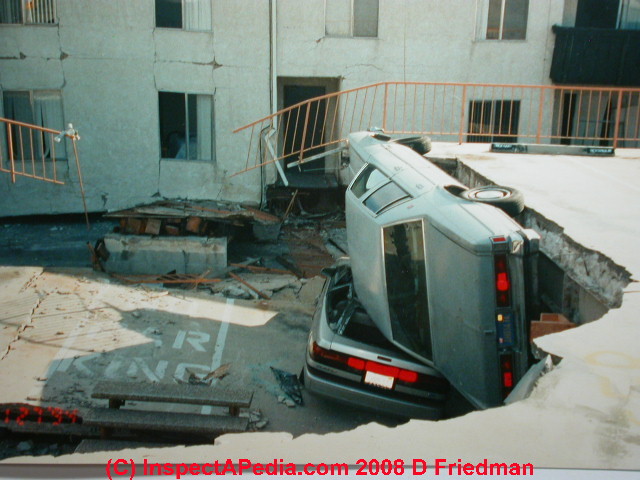
Collapse Accidents and Hazards of Special Risk to Home Inspectors & Home Owners
Masonry structures such as this carriage house in Saugerties, NY, can be very unstable and risk sudden even imminent sudden collapse, depending on just how it is damaged. Broken bond courses in brick are a particular concern
Wood framing and sheathing, especially unsafe roof framing or rotted sheathing
Collapse Hazards for Improperly-Constructed Decks & Stairs

The author inspected this deck and warned of its probable collapse, indicated that it was dangerous, informed the client to "stay off of the deck" until it was repaired.
The author re-inspected the collapsed deck to photograph construction details that led to the structural failure of this component. Litigation was broached.
Interior collapse hazards:
Watch out: See PLASTER, LOOSE FALL HAZARDS for examples of bulged plaster that may be danger signs, including an example of a collapse of an expanded wire lath ceiling that had been improperly installed.
Watch out: often the framing supporting plaster ceilings in homes built before 1900 was sized to be just strong enough to support the weight of the plaster itself. Such ceiling structures were not intended to support the weight of a curious home owner or home inspector.
Building Indoor Air Quality and Pathogenic Hazards for Home Inspectors
Visible mold hazards
Problematic and larger mold reservoirs may be present; risk varies by extent, history, location of leaks, building materials used, mechanical disturbance of moldy materials, other factors.
How to recognize problem molds and cosmetic molds by visual inspection - is it possible? Learn to recognize obviously cosmetic-only mold infections such as BlueStain.
What level of mold exposure is likely to be a risk to home inspectors? More than 30 sq .ft. of highly-airborne-type mold or even small areas of toxic mold if touched to an open cut or an eye.
Mold Inspection / Detection / Testing References:
- https://InspectAPedia.com/sickhouse/Cosmetic_Black_Mold.htm Harmless Black Mold.
- https://InspectAPedia.com/mold/Find_Invisible_Mold.php How to Find Hidden Mold
- https://InspectAPedia.com/mold/Mold_Action_Plan.php Mold Action Guide: What to do about mold
- https://InspectAPedia.com/sickhouse/IAQ_Investigation.php When to hire a professional
- https://InspectAPedia.com/sickhouse/Stains_Not_Mold.php Stuff that is Not Mold or Stuff that is Harmless Mold
- https://InspectAPedia.com/mold/Mold_Test_Method_Validity.php Mold Prevention: a guide
How to Respond to Hostility, Weapons, Threats, Biting Dogs, Flitting Bats, Scratching Cats at Building Inspections
Dealing with violent or threatening building occupants, dogs, spiders, snakes, rats, other pests; weapons, threats, realtors. When and how to leave a threatening environment. How to get the inspection done.
Case histories of Violence at Home Inspections
Note: For reasons that will be apparent, I do not have photographs of these encounters.
- Tenant Threatens Buyer: Tenant informs inspector he is going to beat up and then kill whomever is buying the house (seller is making tenant move out); inspector identifies client as friend/assistant; expressed sympathy, was able to complete the inspection; recapped off premises.
- Tenant Attacks Clients: attacked by hostile tenant, brandishes rifle, uses car to throw gravel; left inspection, informed parties, tenant
removed from premises before re inspection; - Realtor Attacks Client: Client attacked by realtor, (realtor tried to push client's father down stairs in Westchester)
- Realtor Attacks Home Inspector with Car: Bollinger vs. Vermilye, New Paltz NY
- Home Owner Threatens Dog: Home owner threatens inspector (and inspector's dog) with pistol.
Steps to Avoid Trouble From Building Occupants
Assess the level of risk, monitor and change the assessment as needed Maintain professionalism, calmness, do not respond to hostility. As a professional guiding clients through a building:
- Protecting the client is your first responsibility
- Protecting yourself is your second responsibility
Bad Animals: Dealing With Biting, Nipping, Inspector-Chewing Dogs
Ask that dogs be off premises or confined in areas not to be entered during the inspection. Same for other potentially dangerous or hard to control pets. Do not permit owner's pets to escape, be lost, injured.
Bad People: Leaving the Premises Where Occupants Make Threats
Leave the premises if:
- Occupants (or other parties) verbally or physically threaten anyone in the party
- Occupants manifest weapons or other physical threats
- Biting or threatening dog is not controlled
Contact: owner, realtor(s), attorneys, and if appropriate, police;
Do not return to the property without assurance that the potentially dangerous party is not on and will not be on or at the premises
Water Heater Safety Hazards
See
- BLEVE EXPLOSIONS
- BODY OVERHEATING HAZARDS
- RELIEF VALVE LEAKS
- RELIEF VALVE, WATER HEATER
- WATER HEATER SAFETY
Water Tank Safety Hazards
Q&A session to address reporting concerns, priorities of hazards, hazard recognition for Home Inspectors
Some Q&A Safety Topics for Home Inspectors
What is the Right or Obligation of a Licensed Home Inspector to
- report hazardous conditions, and to whom, and when, and in what form
- turn off visibly unsafe heaters, electrical equipment, flooding or burst piping, etc.
- disable unsafe equipment when there is evidence of owner/handyman override of safety controls
The "last man in the building" [OK better, "last person" or "last professional"] is typically held responsible for subsequent catastrophes such as exploding equipment, fires, shocks, collapses. A professional is expected to be able to observe, evaluate, and act appropriately.
Life Safety Codes & Guidelines
- See also the RECOMMENDED ARTICLES and see the complete safety articles guide in the ARTICLE INDEX at the end of this page
- AUSTIN TX MINIMUM LIFE SAFETY GUIDELINES (includes stairway details) [PDF], retrieved 2017/0-4/03, original source: https://www.austintexas.gov/sites/ default/files/files/Planning/Rules/backup15_04.pdf
...
Continue reading at ELDERLY & VETERANS HOME SAFETY or select a topic from the closely-related articles below, or see the complete ARTICLE INDEX.
Or see these
Recommended Articles
- BUILDING CODES re DANGEROUS CONDITIONS
- BUILDING SAFETY HAZARDS GUIDE
- ELDERLY & VETERANS HOME SAFETY
- EMERGENCY EGRESS WINDOWS
- FIRE ESCAPES & FIRE STAIRS
- GARAGE DEFECTS LIST - includes garage safety concerns
- HOARDING HAZARDS
- HOME INSPECTION SAFETY HAZARDS
- MOBILE HOME SAFETY DEFECTS
- SAFETY HAZARDS & INSPECTIONS
- SAFETY HAZARDS GUIDE - home
- SAFETY: ELDERLY & VETERANS HOME SAFETY
- SAFETY, FIRE Safety Checklist, CPSC
- SAFETY for ELECTRICAL INSPECTORS
- SAFETY, HEATING INSPECTION
- SAFETY RECALLS CHIMNEYS VENTS HEATERS
- SAFETY for SEPTIC INSPECTORS
- SECURITY SYSTEMS
Suggested citation for this web page
BUILDING SAFETY HAZARDS GUIDE at InspectApedia.com - online encyclopedia of building & environmental inspection, testing, diagnosis, repair, & problem prevention advice.
Or see this
INDEX to RELATED ARTICLES: ARTICLE INDEX to BUILDING SAFETY
Or use the SEARCH BOX found below to Ask a Question or Search InspectApedia
Ask a Question or Search InspectApedia
Try the search box just below, or if you prefer, post a question or comment in the Comments box below and we will respond promptly.
Search the InspectApedia website
Note: appearance of your Comment below may be delayed: if your comment contains an image, photograph, web link, or text that looks to the software as if it might be a web link, your posting will appear after it has been approved by a moderator. Apologies for the delay.
Only one image can be added per comment but you can post as many comments, and therefore images, as you like.
You will not receive a notification when a response to your question has been posted.
Please bookmark this page to make it easy for you to check back for our response.
Our Comment Box is provided by Countable Web Productions countable.ca
Citations & References
In addition to any citations in the article above, a full list is available on request.
- Your Home Fire Safety Checklist [PDF document], U.S. Consumer Product Safety Commission, Eastern Region, Eastern Regional Center, 201 Varick Street, Room 903 New York, NY 10014-4811, (212) 620-4120, U.S. Consumer Product Safety, - web search 11/19/2010, original source: http://www.cpsc.gov/cpscpub/pubs/556.pdf
- https://InspectAPedia.com/vision/Visual_Perception_Errors.php The Nature of Vision, Inspecting Complex Systems, Why Inspectors Don't See certain defects and miss important omissions
- https://InspectAPedia.com/vision/Sinkholes_Subsidences.php Can X-Ray Vision Warn of Sink Holes? in Florida or elsewhere
- https://InspectAPedia.com/home_inspection/Building_Inspection_Techniques.php Developing your X-Ray Vision - 6th Ed. The Science of Building Inspections - advanced home inspection techniques
- https://InspectAPedia.com/structure/x-ray-ppt_files/frame.htm Developing your X-Ray Vision - 5th Ed.- Powerpoint classroom slides © 2005 Daniel Friedman All Rights Reserved
- Our recommended books about building & mechanical systems design, inspection, problem diagnosis, and repair, and about indoor environment and IAQ testing, diagnosis, and cleanup are at the InspectAPedia Bookstore. Also see our Book Reviews - InspectAPedia.
- Building Pathology, Deterioration, Diagnostics, and Intervention, Samuel Y. Harris, P.E., AIA, Esq., ISBN 0-471-33172-4, John Wiley & Sons, 2001 [General building science-DF] ISBN-10: 0471331724 ISBN-13: 978-0471331728
- Building Pathology: Principles and Practice, David Watt, Wiley-Blackwell; 2 edition (March 7, 2008) ISBN-10: 1405161035 ISBN-13: 978-1405161039
- In addition to citations & references found in this article, see the research citations given at the end of the related articles found at our suggested
CONTINUE READING or RECOMMENDED ARTICLES.
- Carson, Dunlop & Associates Ltd., 120 Carlton Street Suite 407, Toronto ON M5A 4K2. Tel: (416) 964-9415 1-800-268-7070 Email: info@carsondunlop.com. Alan Carson is a past president of ASHI, the American Society of Home Inspectors.
Thanks to Alan Carson and Bob Dunlop, for permission for InspectAPedia to use text excerpts from The HOME REFERENCE BOOK - the Encyclopedia of Homes and to use illustrations from The ILLUSTRATED HOME .
Carson Dunlop Associates provides extensive home inspection education and report writing material. In gratitude we provide links to tsome Carson Dunlop Associates products and services.
 | HOME | ABOUT | ASK a QUESTION | CONTACT | CONTENT USE POLICY | DESCRIPTION | POLICIES | PRIVACY | |
| © 2024 - 1985 Publisher InspectApedia.com - Daniel Friedman | |||||||||