
InspectAPedia® FREE Encyclopedia of Building & Environmental Construction, Diagnosis, Maintenance & Repair |
Question? Just ask us! InspectAPedia
|
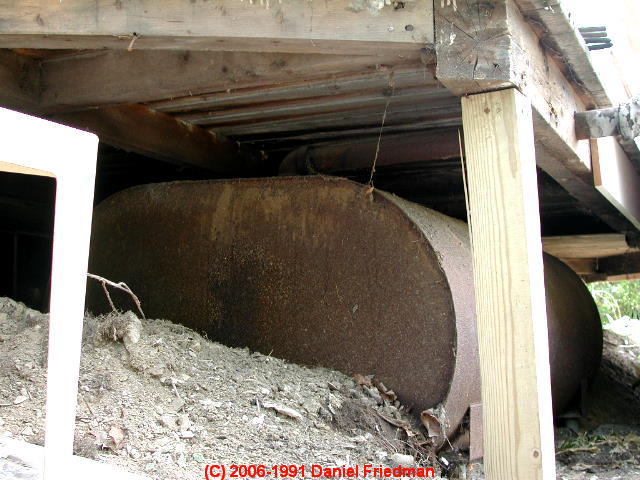 Guide to Heating Oil Fill, Vent, & Oil Burner Feed Piping Defects & Leaks
- POST a QUESTION or COMMENT about leaks or installation problems in heating oil piping for oil-fired heating equipment & water heaters
Causes & locations of heating oil leaks in heating oil piping, fittings, oil filters, oil burners: this oil burner fuel piping article describes defects in heating oil piping, filters, safety valves, and oil tank fill and vent piping.
All of these oil storage tank and piping installation defects can easily be found by visual inspection.
We include considerations of oil pipe leaks out (fuel oil leaks), oil piping leaks in (air in the system), clogged, damaged, noisy, or mis-routed fuel oil piping, and oil fill and vent piping size and location requirements.
We also discuss the need for and location for heating oil or fuel oil filters and safety valves. Beyond the costly problem of leaky oil piping, this document lists other important safety or oil-fired equipment operational defects in home and light commercial heating oil storage and piping systems.
InspectAPedia tolerates no conflicts of interest. We have no relationship with advertisers, products, or services discussed at this website.
- Daniel Friedman, Publisher/Editor/Author - See WHO ARE WE?
Heating Oil Fill, Vent, & Supply Piping Leaks & Defects: How to Find, Fix, or Report Oil Piping Defects by Visual Inspection
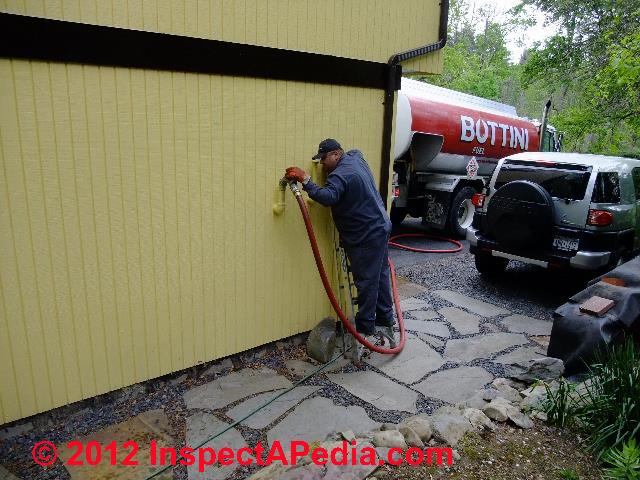 Why is this heating oil delivery operator leaning with his ear next to the vent pipe on this building during a fuel delivery? And why is he standing on a ladder?
These are examples of topics we explain in this article and are discussed further
at OIL TANK FILL / VENT PIPE LEAK REPAIRS.
[Click to enlarge any image]
In addition to explaining and illustrating common defects in heating oil piping at the oil tank and between the oil tank and the oil burner, we also include sample home inspection report language that may assist home owners or home buyers in understanding risks associated with both buried and above ground oil or other fuel storage tanks at their property.
A Maryland study found that more than 80% of petroleum product storage tank leaks occurred in the piping system, not the tank itself, and that leaks were not correlated with age of the storage tank and piping.[3]
Article Contents
- DUAL OIL LINE WRONG VALVES
- MISSING CAP on OIL FILL / VENT
- MISSING OIL SAFETY VALVE OSV
- OIL TANK FILL / VENT TOO SMALL
- OIL TANK FILL / VENT SEPARATED
- OIL TANK FILL TOO HIGH
- OIL FILL / VENT IMPROPER MATERIALS
- OIL TANK VENT MISSING or BLOCKED
- OIL TANK FILL / VENT LEAK WATER
- OIL TANK FILL / VENT NOT SEALED at WALL
- OIL SUPPLY PIPING DEFECTS - between the Oil Tank & the Oil Burner
- OIL SUPPLY PIPING LEAKS - basics
- OIL FILTER LEAKS
- OIL FILTER MISSING
- OIL LINE UNBLOCKING after HURRICANE or FLOOD DAMAGE
- SINGLE OIL LINE PIPED TOO HIGH
- SINGLE OIL LINE on BURIED OIL TANK
Proper oil tank and oil piping inspection report language explains the need for action and indicates where more information can be obtained.
Also see text and oil tank defect photographs
at VISUAL INSPECTION OF OIL STORAGE TANKS.
NOTICE: while example report language is provided here, reproduction of this or any of our web pages or their contents online at other websites or in printed documents for sale is prohibited. Readers are welcome to use the text directly in home inspection reports, with citation of the InspectAPedia website source.
Undersized Heating Oil Fill or Vent Pipes risk oil tank leaks or damage
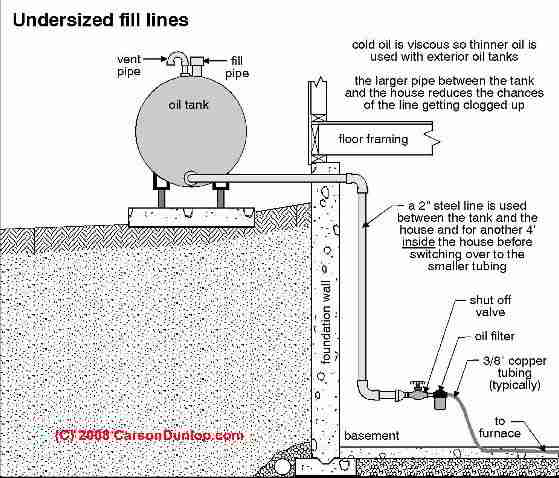
As Carson Dunlop Associates' sketch shows, oil filler or vent piping that is too small can result in too much pressure in the oil tank during filling, resulting in a burst oil tank and serious oil leakage.
Oil tanks are usually filled under pressure (not by gravity like your car). We also do not like to see plastic oil piping used for these applications, out of concern that it may be broken, leading to a serious oil spill.
More about oil tank fill & vent pipes is
at OIL TANK FILL & VENT PIPING INSPECTION CHECKLIST.
And see OIL TANK PRESSURE for a detailed explanation of the pressures that occur during normal oil storage tank filling procedures.
Heating oil storage tank fill & vent pipes too far apart risks over pressurized tank, oil leaks

Carson Dunlop Associates' sketch at left shows typical oil fill and vent piping details for an oil tank installed inside of a building. Usually these pipes are located together and against the building wall.
Sometimes we see that the oil filler pipe for an outdoor buried oil tank will be directly over the tank (and perhaps too close to ground level to keep water out), while the installer may have placed the vent pipe some distance away, against the building wall.
This may have seemed to be a neat job for the installer, but you should know that the oil delivery driver listens to the oil vent pipe to hear when the oil tank has been filled.
Placing the vent line too far from the oil tank fill line is risky.
Heating Oil Fill & Vent Pipes Located Too High on the Wall Make Delivery Difficult & Risk Leaks & Spills
The fill & vent piping for an oil tank should be located at a convenient height above ground that is neither too low (our previous example above) nor too high to permit the oil delivery operator to reach the fill pipe and listen at the vent pipe.
In our photo, the driver from Bottini Fuel (Poughkeepsie NY) is standing on a ladder we left next to a large rock, both placed to permit the operator to both reach the fill pipe and listen closely at the vent pipe to determine when the oil tank (not in view) is filled.
Making it easy for the driver to listen to the fill alarm or vent pipe reduces the chances of seepage, over-filling, or leaks at the oil tank.
At the property shown, renovations lowered the ground level by about 24", making this fill & vent pipe a bit high. This driver told us he has been delivering oil to this property for a decade, so he's quite good natured about stepping up to the piping using the rock or ladder.
But a heating oil delivery person does not carry a ladder on the oil truck, nor is s/he obligated to dig around in the property owner's stuff to find something to stand on. Making the driver perform extra tasks adds time and trouble to a job whose performance is often measured by the oil company in the number of deliveries accomplished in the day.
Improper oil fill or vent piping, missing cap, wrong fittings risk water leaks into outdoor or buried oil tanks
Heating Oil Tank Fill or Vent Pipe Caps Lost or Clogged
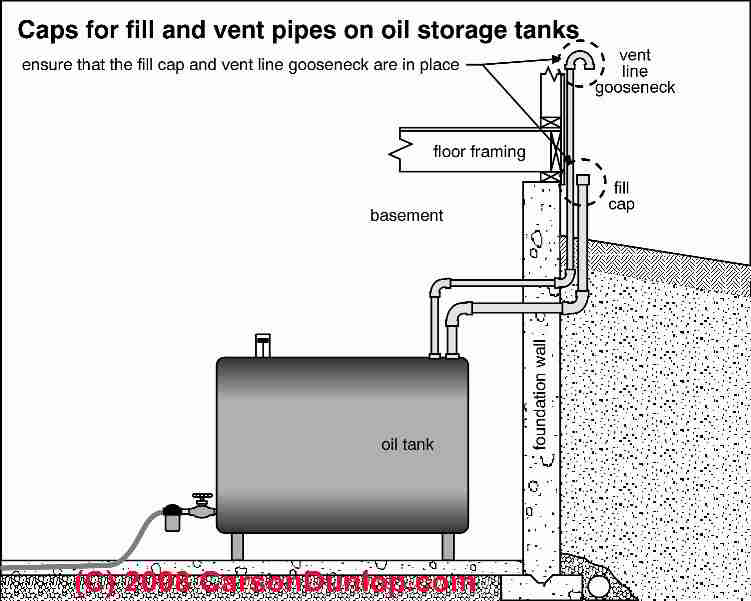
As Carson Dunlop Associates' sketch shows above, and as we show in Arlene Puentes' photo below, you are asking for water in the heating oil tank or insects clogging the fill or vent line (probably the vent line) if the caps have been lost from these pipes.
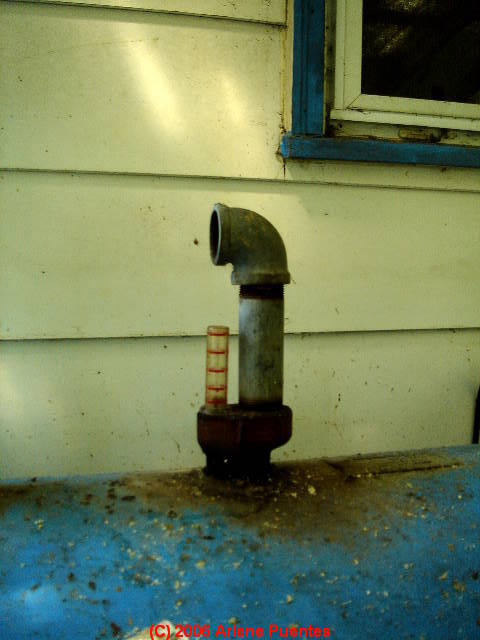
We've been informed of oil tank fill difficulties (perhaps even leading to a burst or oil tank leak) when insects clogged the oil tank vent pipe.
If the screen is lost from your oil tank vent pipe be sure to replace it to keep the wasps and mud-daubers out of this line.
And be sure the screen on the oil tank vent pipe has not been blocked by painting over it - as we explain
at OIL TANK PRESSURE for an explanation. This can cause an oil tank leak during an oil delivery.
No Heating Oil Tank Vent Pipe or Blocked Oil Tank Vent Pipe
Be sure that you can find a proper oil tank vent pipe. On occasion we find that a filler pipe was installed but no vent pipe was run outside. Improper oil tank venting such as no tank vent at all, a too-small oil tank vent, or a vent which is improperly installed, routed, or has become blocked, can cause a catastrophic oil spill in a building or outdoors at a buried tank.
Oil fumes and even heating oil may spill into the building. The tank should be vented to outside to avoid dumping noxious and possibly combustible or obnoxious fumes into the living area.
Outside Exposed Oil Storage Tank Fill or Vent Pipe Admit Water
Check to see if the oil tank fill pipe is in a location where roof drainage may fall directly on or into it. Water in an oil tank can lead to loss of heat and costly related damage from that condition or it can accelerate rust and corrosion from inside the oil tank, leading to oil leaks and a costly environmental cleanup.
The oil tank should be tested for the amount of water in it and if in question, it should be tested for leaks. And protect the fill pipe and vent from water entry.
Details are at OIL TANK WATER CONTAMINATION
Oil Tank Fill or Vent Pipe Not Sealed at Wall - Oil Tank - Caulk pipe entrances
You should caulk the opening where tank supply and vent pipes penetrate the house wall, to prevent pest or water entry at this point. This is an inexpensive item. This repair/maintenance item may be deferred.
Oil Supply Line Piping Defects between oil tank and oil burner
Causes of Leaks in Heating Oil Piping Between the Oil Tank & the Oil Burner
Details listing the various sources of oil piping leaks between the tank and the burner are now
at OIL LINE PIPING LEAK CAUSES.
High-Routed Single Oil Line Problem: single line routed high may lose prime
SERVICE NOTE: if an oil burner's fuel unit is served by a single line from a buried oil tank, or if the oil line is routed from even an indoor heating oil tank up high beneath the ceiling and back down to the oil burner, in some circumstances this installation may tend to lose prime in oil piping system, become air locked, or these events can lead to loss of heat and possible damage to the building from frozen pipes.
This problem occurs commonly if the oil tank is remote and buried (oil burner pumps don't have much lift capacity), or when an indoor tank is very low on oil. You should review this installation detail with your service person.
See our discussion of check valves and
the TIGERLOOP™ deaerator product and also
see OIL TANK PRESSURE for alternatives to conversion of a single line to a two line oil supply piping system.
Single Heating Oil Line on a Buried Oil Storage Tank - Single oil line on buried oil tank risks lost prime, no heat
A single oil line was found coming from tank to oil burner. Recommended practice is use of two pipes, for several reasons: avoiding loss of prime, providing alternate pipe if supply pipe clogs, and reducing the lift load on the pump.
Note: some experts recommend that the fire-safety valve for these systems be installed ONLY on the supply line, with only a simple check valve on the return line. This procedure reduces the risk of burst gasket at the oil pump and spray of heating oil into an existing fire should a valve on the return line close before the valve on the supply line during a fire.
Heating Oil Line Leaks: oil out & air in risks loss of heat & risks a puffback
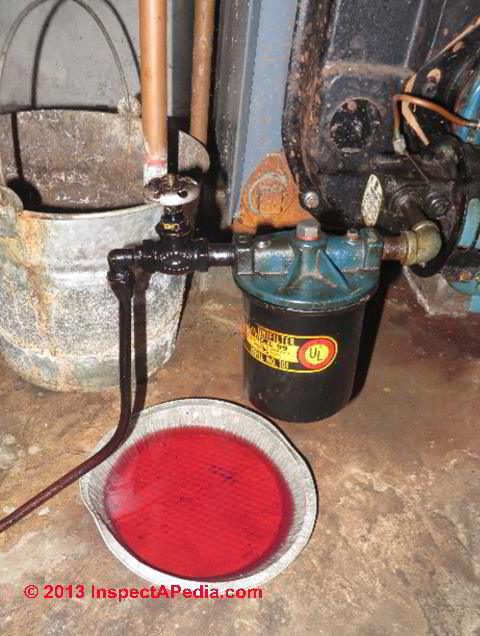 Watch out: leaks in heating oil appliance piping or filters can be much more serious than just a drip spot on the floor. Oil leaks may be hazardous and can lead to improper system operation and even
loss of heat in the building.
Watch out: leaks in heating oil appliance piping or filters can be much more serious than just a drip spot on the floor. Oil leaks may be hazardous and can lead to improper system operation and even
loss of heat in the building.
We discuss the causes & effects of heating oil piping leaks in detail at
Reader Question: How frequently do the copper oil lines leak from corrosion or other factors?
Contractor renovating my basement enclosed the fuel oil line (tank to burner) in the walls.
Just after having carpet laid, I was reinstalling baseboards and my nail gun made a perfect nail hole in the hidden piping. About 2 qts. oil all sprayed out. I shut off tank valve and ran furnace to use up oil in lines. It will be a massive clean-up and I don't want to have this happen again.
How frequently do the copper lines leak from corrosion or other factors? What are the options to prevent a future leak? - Judy 4/23/12
Reply: Frequency of Heating Oil Piping Leaks by Leak Location, Type, Source, Cause
Judy, statistics on oil tank leaks are discussed
While those data focus on and report leaks as oil tank leaks, actually some of the leaks reported under the aegis of "oil tanks" may actually occur in the oil supply and return piping (on a two pipe system for buried tanks) or on the oil supply line from an above-ground oil tank.
But I have not found studies, reports, nor statistics on the leak occurrence rate in just heating oil piping itself.
In my experience, small leaks in the oil piping system are not uncommon. But as leaks in the supply line lead to faulty oil burner operation, ultimately they lead to a diagnosis and repair. (See the previous Q&A about vacuum tests and pressure tests on oil heat piping and on fuel units respectively.)
Oil Piping Leak Report of 0.005 in New England
At OIL TANK LEAK / FAILURE RATES, we include a section on reports of frequency of heating oil piping leaks. You will see that studies found the leakage rate in New England in the U.S. at about five leaks per thousand customers or less, depending on the sub-area in the study.
Oil Tank Leak Report of 40% with 82% due to Oil Piping in Maryland
In a 1986 study, Diane H. Heck found leaks in 40% of petroleum fuel tanks (diesel fuel or kerosene K-1, heating oil, waste oil, and gasoline tanks), (n=240). More accurately she reported a 40% leak occurrence rate in oil storage tank installations, because 82% of those leaks were traced to leaks in oil piping![3]
Because gasoline tanks were included in this study, several factors may lead readers to think that a higher proportion of leaks occurred in gasoline storage tanks than in heating oil or kerosene storage tanks. But as we report
at OIL TANK LEAK / FAILURE CAUSES, that was not the case. Gasoline tanks were responsible for only 26% of all of the leaks found.
Opinion about Probable Percentage of Types of Oil Piping Leaks
My opinion based on field experience repairing heating systems and on field experience as a building inspector of several thousand buildings is that among the leaks that do occur in oil piping systems, they occur in roughly this frequency by type:
- Leaks in oil piping due to a loose, or a poorly made connection or joint - 80% OR MORE
- Leaks in oil piping due to mechanical damage such as being stepped on or bent repeatedly or due to a combination of vibration & contact with an abrasive surface - 15 %
- Leaks in oil piping due to abrasion or corrosion leading to a thinning of and ultimately perforation of the piping wall - 5%
- Leaks due to perforation by a nail or screw during construction - less than 1%.
This is because most often the heating oil piping is exposed along a garage or utility area floor or ceiling and is not buried in walls. Certainly if an oil line were to be installed running hidden inside a wall or floor I'd be nervous about including any fittings whatsoever, as the leak risk is greater at the fittings.
In the OIL TANK PIPING & PIPING DEFECTS article above, in a section
titled DEFECTS FOUND IN HEATING OIL PIPING BETWEEN THE OIL TANK & THE OIL BURNER,
we catalog the types of leaks that occur in oil piping and where they are found. We also describe steps that can be taken to protect oil piping lines from future damage, including a nail puncture such as your oil piping line suffered.
In the Technical Reviewers & References section below, we include additional citations on oil piping leak detection & frequency.
Heating Oil Supply Pipe Leaks in the Heating Oil Line at the Oil Filter
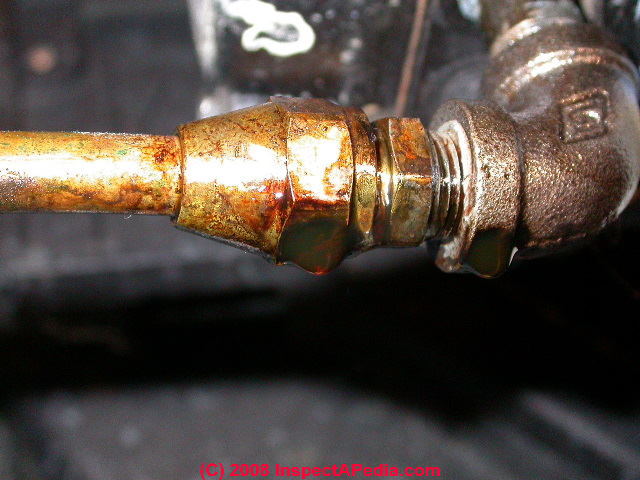
At OIL FILTERS on HEATING EQUIPMENT, we described changing the oil filter as part of oil burner maintenance.
And there we also warn about leaks in piping fittings at the burner, giving a detailed description of exactly why and how leaks occur at the heating oil filter canister assembly. An excerpt is below.
Oil piping leak at the copper piping flare fitting
As we explain earlier in this article, and as we elaborate
at OIL BURNER INSPECTION & REPAIR, oil leaks in the oil piping and filter system can not only spill oil, but can lead to loss of heat, improper oil burner operation and even a puffback.
At left, we illustrate an active oil leak at a flare fitting.
We don't know without further investigation if this leak is because the flare nut is loose or if it's because the copper flare was cracked or improperly made, or finally, if it's because of a notch or scratch on the brass mating surface of the flare.
Try gently tightening the fitting and then clean it thoroughly and check for leaks.
Heating Oil System Filter Omitted - No Oil Filter Installed on Oil Fired Equipment
Details about heating equipment oil filters are found
at OIL FILTERS on HEATING EQUIPMENT. Excerpts are below.
If we do not find a heating oil filter installed on the system this is a defect that risks loss of heat.
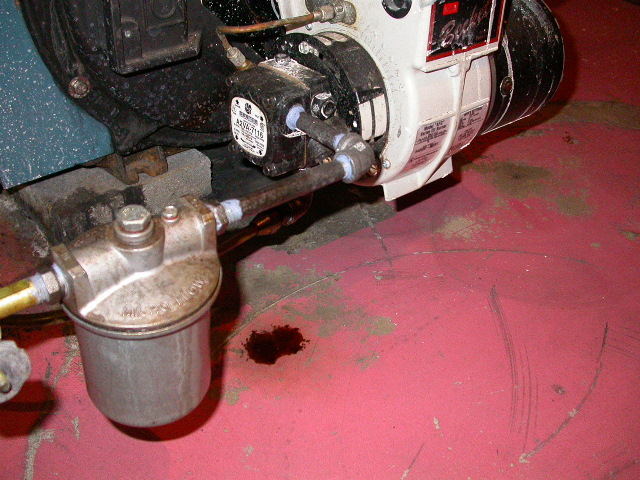
Most modern oil heating equipment will have an oil filter installed, such as the one shown in our photo at left.
Notice that there's a heating oil leak below the connection to the filter outlet? This leak will suck air into the oil burner when it's running, leading to improper and possibly unsafe operation, risking a puffback.
Unless you find or the owner can point out a filter already in place, we recommend installation of one - to be located at or very near the burner and "downstream" of a fire-o-matic safety shutoff valve to permit easy service. Failure to provide adequate filtering may lead to loss of heat and subsequent damage to the building.
Dual Oil Line Piping: - improper installation of oil line shutoff valves
On oil fired heating equipment systems that use an open loop oil piping system or dual oil line piping arrangement (such as used with buried oil tanks and at other installations where the oil burner fuel unit may otherwise lack adequate lift and pumping capacity), the fusible-link type heating oil line shutoff/safety valve should be located only on the oil supply line at the oil burner.
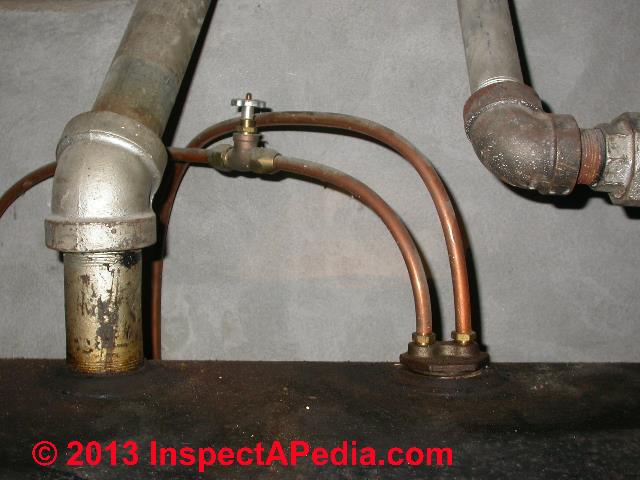
At above left, we illustrate a typical dual oil line piping arrangement exiting at the top of an oil storage tank. Notice incidentally that under-sized tank vent line in the upper right of the photo.
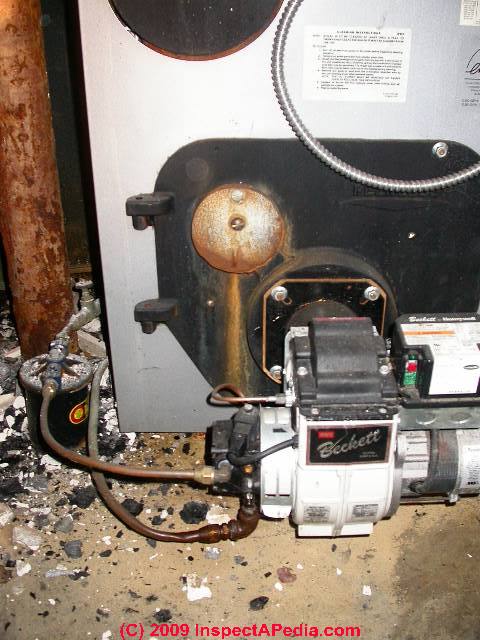
Our dual line oil piping hookup photo above illustrates at least one thing right: there is a fusible link shutoff valve only on the incoming oil line and not on the return line.
We'd like to see a check valve on the return line, and a cleaner site. Heating service techs are accustomed to having to work in cramped dirty locations, but the tighter and nastier the space, the more difficult the job becomes, and the less time anyone wants to spend doing it.
Often the result is "deferred maintenance" - the heating equipment is simply not properly maintained at all.
Do not install a second fusible-link fire safety valve (OSV) shutoff-valve on the return oil line. Use a check valve instead. Details are
OIL LINE SHUTOFF VALVE - missing or improper location
The proper location for the oil line shutoff valve with a fusible link (Fire-o-Matic™ type valves) is just before the oil filter and close to each individual oil burner. Details about oil line valve installation and operation are
at OIL SUPPLY LINE SAFETY VALVES, OSVs.
How to get a water & debris-clogged heating oil line flowing after hurricane & flood damage
An InspectApedia reader asked:
I am having problems restarting the water heater ever since hurricane irene slammed into New Jersey and my basement flooded. We changed the motor and oil filter, but are having problems getting oil to feed through the lines I was wondering if there were suggestions. - Antoinette
Reply: Guide to How to clear or unblock a clogged heating oil line by CO2 blasting, filter changeout, or oil line replacement
Antoinette,
When an oil fired water heater has been flooded, such as by hurricane Irene, there are a number of concerns that need to be addressed. You have taken two obvious steps by changing parts (motor and oil filter) but I can add a few suggestions that might help.
Details about unclogging oil lines are found
at OIL LINE CLOGGING FIX
Oil lines can become blocked with sludge, silt, mud, even water if the lines are open to the flooding environment. Normally an oil line between the oil tank and oil burner, say at a water heater, is always full of fuel oil, and sealed against oil leaks out and air leaks in to the piping system. So dirt or water from outside the system would not easily enter the piping system.
But if the oil tank itself were flooded, you might have water and mud or silt and dirt on the tank bottom - if your oil line feeds from the tank bottom all of that crud would enter the oil line. So a further check of the condition of the oil tank is in order.
A buried oil tank should, like the oil piping, be sealed against outside water entry (though in times of area flooding a partially empty oil tank might float-up and break lines or cause leaks).
An above ground oil tank should be ok IF flood waters never rose high enough to enter the oil tank vent or fill piping.
If your oil tank itself checks out as not contaminated with water and dirt, and provided we are sure that the oil burner assembly was itself entirely replaced and that the oil pump (fuel unit) is working properly, and if you are unable to draw oil from the tank, the usual step employed by the service tech is to use a CO2 gas cartridge and special "gun" assembly that connects to the oil line and attempts to "blow out" an obstruction.
If you are unable to make the line usable following that procedure, and provided we remain convinced that the line is the culprit, I'd have the service company run a new fuel line between the oil tank and the burner.
I'd also be sure the service tech was following proper procedure for bleeding air out of the oil piping during service restoration.
Vacuum Testing Oil Lines Detects Both Blockage & Leaks: Vacuum Standards for Oil Supply Piping
This topic has been relocated to OIL LINE VACUUM & PRESSURE TESTS - How pressure & vacuum gauges are used on heating oil lines to check for leaks or fuel unit troubles.
...
Reader Comments, Questions & Answers About The Article Above
Below you will find questions and answers previously posted on this page at its page bottom reader comment box.
Reader Q&A - also see RECOMMENDED ARTICLES & FAQs
On 2018-10-22 - by (mod) - using non-metallic pipe for oil lines?
Non-metallic piping and pipe fittings used with fuel oil storage must comply with
ASTM D2996
1302.4 Nonmetallic pipe. All nonmetallic pipe shall be listed
and labeled as being acceptable for the intended application for
flammable and combustible liquids. Nonmetallic pipe shall be
installed only outside, underground.
Key to your question is this excerpt:
1302.5 Fittings and valves. Fittings and valves shall be
approved for the piping systems, and shall be compatible with,
or shall be of the same material as, the pipe or tubing
At BUILDING CODE DOWNLOADS you can find copies of codes pertaining to oil storage tanks including the UMC or Mechanical code as adopted by various municipalities.
Here's a useful example
UMC OIL TANK & PIPING CODE [PDF] (2008) example as adopted in the New York City Mechanical Code, retrieved 2015/11/26, original source: www2.iccsafe.org/states/newyorkcity/ Mechanical/PDFs/Chapter%2013_Fuel-Oil%20Piping%20and%20Storage.pdf
On 2018-10-22 by Bob Vinci - 2" MNPT polypropylene plug on a residential oil tank instead of the standard iron plug
Hi,
I am investigating the suitability of using a 2" MNPT polypropylene plug on a residential oil tank instead of the standard iron plug.
It is rated at 150 PSI with a temperature range of -20 to 150F.
This would be used in the top port of an in basement located 250 gallon steel tank. I cannot find any specific regulations limiting its use as to pressure or any other specification. I would appreciate your thoughts on this.
On 2018-03-21 - by (mod) -
Jonathan
I can speculate several causes of the broken cast iron (?) valve:
1. freezing damage including possibly moisture in a fine crack or defect in the original casting.
This is a Dahl valve.
Most Dahl valves are brass or stainless steel but this one looks like cast iron, which would be a surprise. (Am I correct?)
Occasionally cast brass or cast iron valves can contain manufacturing defects that can lead to breakage, moreso in wet freezing conditions or when the fluid passing through the valve is corrosive.
Dahl is a Canadian valve manufacturer:
- dahl Brothers Canada Limited 2600 South Sheridan Way, Mississauga, Ontario Canada L5J 2M4 Tel CDN toll free 800-268-5355 Website: http://www.dahlvalve.com/
So I speculate that your valve may have been located in an area subject to freezing. Let me know if that's possible.
I have also asked the company for an opinion.
2. mechanical stress during original installation
3. less likely: bending or vibration stress - depending on the routing and location of the other piping components and their support
On 2018-03-21 by Jonathan
What do you guys think may have caused this globe stop valve faliure? It was located outdoors connected to a fuel oil tank and failed 4 years after installation
IMAGE LOST by older version of Clark Van Oyen’s useful Comments code - now fixed. Please re-post the image if you can. Sorry. Mod.
On 2017-05-04 by Anonymous
vent leaking
On 2017-03-11 - by (mod) -
Possibly though that'd be quite a bit of over-filling. It's more over-filling than over-pressurizing I suspect. The vent alarm won't completely stop all possible leaks, though indeed when oil level in the tank reaches a sufficient level a rising float turns off the alarm.
On 2017-03-11 by bond
if a heating oil tank is over pressurized (due to over filling), can the oil leak out through the vent line (with a whistle alarm installed) ?
On 2016-11-06 by jim
Is pex tubing okay for house oil from tank to inside house?
Question: changing from 2-line oil delivery piping to single line piping
(Apr 10, 2014) Anonymous said:
cooper piping underground to feed
(Oct 12, 2014) Neft809 said:
I just bought a new oil tank to take out the one that i have underground,and put it above the ground but the old tank has two connections to connect two hoses coming from the heater , how I can put it to work with a single line ? or it needs to be with the two lines ? please and Thanks you
Reply:
Neft
You will need to identify the suction line and connect the new aboveground oil tank to that port on the oil pump.
IMPORTANT
You will have to change the oil pump to internal bypass when changing from 2-line piping to 1-line piping.
As this sounds unfamiliar to you, ask your heating service company for help.
Question: blocked oil feed line
(Jan 9, 2015) Phil - Edmonds Wa said:
It seems like the oil feed line is blocked. The tech tried a pump but was unsuccessful. could a non-tech person use an air compressor to try to clear the line? Thanks.
Reply:
Phil
Take a look at the methods used for clogged oil lines at
...
Continue reading at DUAL OIL TANKS - PIPING or select a topic from the closely-related articles below, or see the complete ARTICLE INDEX.
Or see these
Recommended Articles
- HEATING OIL SLUDGE
- OIL BURNER FUEL UNIT
- OIL STORAGE TANKS - home
- OIL TANK CODES & STANDARDS - home
- OIL TANK GAUGE & VENT ALARM INSTALL / REPLACE
- OIL TANK INSPECTION & TROUBLESHOOTING - home
- OIL TANK PIPING & PIPING DEFECTS - home
- DUAL OIL TANKS - PIPING
- HEAT TAPES on OIL TANK PIPING
- OIL LINE AIR REMOVAL PROCEDURE
- OIL LINE BUZZ & VIBRATION CURE
- OIL LINE CLOGGING FIX
- OIL LINE PIPING LEAK CAUSES
- OIL LINE QUICK STOP VALVES
- OIL LINE VACUUM & PRESSURE TESTS
- OIL SUPPLY & RETURN LINE CONTROLS & VALVES
- OIL SUPPLY & RETURN LINE DE-AERATORS Tigerloop™
- OIL SUPPLY LINE CHECK VALVES
- OIL SUPPLY LINE PIPING LEAKS
- OIL SUPPLY LINE SAFETY VALVES, OSVs
- OIL SUPPLY LINE SAFETY VALVE TURN DIRECTION to OPEN or SHUT
- OIL SUPPLY LINE VACUUM-ACTIVATED OSVs & PRVs
- OIL TANK FILL & VENT PIPING INSPECTION CHECKLIST - home
- OIL TANK FILL & VENT PIPING BENDS & ELBOWS
- OIL TANK FILL & VENT PIPING DEFECTS
- OIL TANK FILL & VENT PIPING MATERIALS
- OIL TANK FILL & VENT PIPING SIZE REQUIREMENTS
- OIL TANK FILL & VENT PIPING OUTDOOR TERMINATION & CLEARANCES
- OIL TANK FILL / VENT PIPE LEAK REPAIRS
- OIL TANK LEAKS & SMELLS - home
- OIL TANK PRESSURE
- OIL or GAS FUELED HEATING EQUIPMENT SHUTOFFS
Suggested citation for this web page
OIL TANK PIPING & PIPING DEFECTS at InspectApedia.com - online encyclopedia of building & environmental inspection, testing, diagnosis, repair, & problem prevention advice.
Or see this
INDEX to RELATED ARTICLES: ARTICLE INDEX to HEATING OIL, OIL BURNERS, OIL FIRED HEATERS, OIL TANKS
Or use the SEARCH BOX found below to Ask a Question or Search InspectApedia
Ask a Question or Search InspectApedia
Try the search box just below, or if you prefer, post a question or comment in the Comments box below and we will respond promptly.
Search the InspectApedia website
Note: appearance of your Comment below may be delayed: if your comment contains an image, photograph, web link, or text that looks to the software as if it might be a web link, your posting will appear after it has been approved by a moderator. Apologies for the delay.
Only one image can be added per comment but you can post as many comments, and therefore images, as you like.
You will not receive a notification when a response to your question has been posted.
Please bookmark this page to make it easy for you to check back for our response.
IF above you see "Comment Form is loading comments..." then COMMENT BOX - countable.ca / bawkbox.com IS NOT WORKING.
In any case you are welcome to send an email directly to us at InspectApedia.com at editor@inspectApedia.com
We'll reply to you directly. Please help us help you by noting, in your email, the URL of the InspectApedia page where you wanted to comment.
Citations & References
In addition to any citations in the article above, a full list is available on request.
- IMC, Chapter 13,
FUEL OIL PIPING & STORAGE, as found in the 2006 INTERNATIONAL MECHANICAL CODE, ICC, International Code Council, 500 New Jersey Avenue, NW, 6th Floor, Washington, DC 20001, Tel: 888-ICC-SAFE (422-7233); Website: iccsafe.org/, Email: webmaster@iccsafe.org, Customer Store (buy publications) 800-786-4452. Also see 2009 International Codes and 2012 International Codes.
This copy is as adapted by Sterling Kansas, retrieved 2018/09/02, original source: https://sterling-kansas.com/DocumentCenter/View/144 - [2] "The application of a continuous leak detection system to pipelines and associated equipment", Sandberg, C.
Raychem Corp., Menlo Park, CA, Holmes, J. ; McCoy, K. ; Koppitsch, H, Industry Applications, IEEE Transactions on, Sep/Oct 1989, Vol. 25 No. 5, pp. 906-909, ISSN : 0093-9994 INSPEC Accession Number: 3582593 Digital Object Identifier : 10.1109/28.41257, Abstract:
An overview of classical leak detection systems is given and the engineering basis of a novel type of detector is examined.
This system is a flexible hydrocarbon-sensing cable that can be installed along pipelines, in double-containment tanks and piping, or in trenches to detect and locate leaks of common industrial hydrocarbon solvents or fuels while ignoring the presence of water.
The simple electrical circuit that locates and detects a leak anywhere along the length of the sensor is also described - [3] "A Case Study of a Large Scale Precision [oil or fuel] Tank Testing Program", Diane H. Heck, Tetra Tech Richardson, Newark, Delaware, web search 4/27/12, original source: http://info.ngwa.org/GWOL/pdf/870143411.PDF, copy on file as /heating/OIl Tanks UST/Tank_Test_Heck_870143411.pdf Abstract:
In September 1986, a precision tank testing program was started to bring a major Maryland utility into compliance with the State of Maryland Oil Spill Control Regulations regarding underground storage tanks. This program involved the testing of over 240 tanks ranging in size from 300 gallons to 1,500 gallons located throughout the entire state of Maryland.
Analyses of the testing results revealed that 40% of the systems tested leaked. Piping leaks caused 82% of the testing failures and tank leaks caused the remaining 18%. Tank systems located in urban areas experienced a 50% testing failure rate, while tank systems located in rural areas experienced only a 25% failure rate.
Leaks in tank systems in urban areas appear to be the result of structural loading and corrosion, affects [effects] absent in rural areas. The age, capacity, and usage of the tanks did not have a role in causing leaks either in the piping or the tank. - Arlene Puentes [Website: www.octoberhome.com ] , an ASHI home inspector in Kingston, NY, contributed the example photograph of an outdoor aboveground oil tank. Ms. Puentes can be contacted at ap@octoberhome.com
- In addition to citations & references found in this article, see the research citations given at the end of the related articles found at our suggested
CONTINUE READING or RECOMMENDED ARTICLES.
- Carson, Dunlop & Associates Ltd., 120 Carlton Street Suite 407, Toronto ON M5A 4K2. Tel: (416) 964-9415 1-800-268-7070 Email: info@carsondunlop.com. Alan Carson is a past president of ASHI, the American Society of Home Inspectors.
Thanks to Alan Carson and Bob Dunlop, for permission for InspectAPedia to use text excerpts from The HOME REFERENCE BOOK - the Encyclopedia of Homes and to use illustrations from The ILLUSTRATED HOME .
Carson Dunlop Associates provides extensive home inspection education and report writing material. In gratitude we provide links to tsome Carson Dunlop Associates products and services.
 | HOME | ABOUT | ASK a QUESTION | CONTACT | CONTENT USE POLICY | DESCRIPTION | POLICIES | PRIVACY | |
| © 2025 - 1985 Publisher InspectApedia.com - Daniel Friedman | |||||||||