 Pressure Control Switch Q&A

- POST a QUESTION or COMMENT about how to adjust or set the Water Pump Pressure Switch - how set the water pump cut in and cut out pressures
More water or well pump pressure control switch FAQs:
Second set of questions and answers on how to adjust the pressure control switch for a water or well pump.
This article series answers commonly-asked questions about how to adjust a well pump or water pump pressure control switch. We provide pump pressure setting advice, procedures & questions & answers about adjusting the pump switch.
InspectAPedia tolerates no conflicts of interest. We have no relationship with advertisers, products, or services discussed at this website.
- Daniel Friedman, Publisher/Editor/Author - See WHO ARE WE?
FAQs on how to set the water pump pressure switch cut-in and cut-out pressures
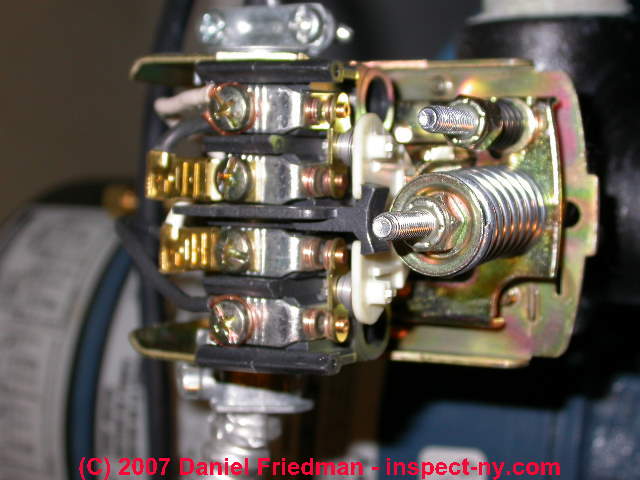
Watch out: SAFETY WARNING OF FATAL SHOCK HAZARD: if you remove the cover of the pump pressure control switch you can get access to the two nuts that adjust the operating pressures of the water pump.
But watch out! There are also live electrical contacts exposed in this area. If you touch them, especially being near water piping, there is a serious risk of death by electrocution.
Watch what you touch, or have a professional plumber or electrician do this job for you.
The individual well pump control switch repair article links below explain exactly how to set the water pump pressure switch, where the adjustments are located (the large and small nut found under the switch cover), which way to turn the nuts to increase or decrease the pump cut-in and cut-out pressures, and other pressure switch troubleshooting and repair procedures
These questions were posted originally
at WATER PRESSURE CONTROL SWITCH ADJUSTMENTS - be sure to see that article if you need to adjust the settings on your pressure control switch for your water pump or well pump.
Also see our index to all water pump control switch FAQs at WATER PUMP PRESSURE SWITCH REPAIR FAQs
Article Index
- PRESSURE GAUGE STICKS
- PRESSURE SWITCH SETTINGS TOO HIGH - water pressure too high, unsafe
- WATER LEAK at PRESSURE SWITCH
- WATER in PRESSURE SWITCH TUBING
- WATER in PRESSURE TANK, HOW MUCH?
...
Water Pressure Switch Set Too High
I increased the pump pressure switch settings - now I think the pump is bad
Last week I increased the cut-in cut-out pressure switch setting on my well.
The system was running at 20-40 and after making the pressure switch adjustment it has been running at 40-60 just as I planned. I checked the cut-in and cut-out over several days after the change and it was working fine.
Today we found that we had zero water pressure. I looked over our system and found there is no water flowing into our pressure tank so no water is being pumped.
I tested for power at the pressure switch and it is getting power but I did not check the voltage. The well pump was here when we bought the house about 10 years ago so the pump is at least 10 years old.
I don't know the specifics of the pump but the control box for the pump states 1 hp, 230 volt, single phase and includes a capacitor and some other blue device.
I assume my increasing the pressure switch seating has lead to a pump failure. Anything else I should test before running out to buy a new pump? - John M 8/34/11
Reply:
John M:
Changing a pump pressure control switch from 20/40 all the way up to 40/60 has an understandable appeal: much higher water pressure, faster flow rate.
But the risk is that you set a cut-off pressure that the pump simply cannot maintain. If that happens the pump might just keep on running - never reaching that 60 psi.
If your pump was a submersible you might not know that the pump is spinning itself to death down in the well. Until it stops working or until the pump overheats and shuts down on thermal overload.
A second possibility is that sometimes when we start pumping water out of a well faster than before we can exceed the well's flow rate (especially if the well is not very deep- doesn't have a big static head). Even if the well later recovers, we can lose prime and lose water pressure, or in some cases run the pump dry and damage it.
Sorry about the bad news, but those are the worries that occur to me from your description.Also take a look at PUMP NEVER STOPS
Followup: to get the pump working I had to replace the pump thermal overload switch
Thanks for the reply Dan,
The pump is working fine now, the following morning after my post I replaced the thermal protection device, turned on the pump and it immediately started pumping and has been running fine since.Just for clarification and as I explained in my original post, the pump is cycling properly (cutting in and out) with the higher pressure setting of 40-60 psi.
I suspect the problem occurred due to my extended continuous use of water while I was working on a landscaping project which had the water running continuously for 8 plus hours. It appears the thermal protection device which is designed to protect the pump from burning out did its job.
Happy to report the pump and well are working great.Reply:
Thanks John M - I will add "replace the thermal protection device" to our list of diagnostic suggestions when a pump motor won't run. Can you send along photos of the parts and pump? Use the CONTACT link found at page top, left, bottom.
Reverse Osmose system installed, need more house pressure - RO works at 39 PSI
Great site! I installed an RO system to replace an old RO that failed because of pressure (new permeate pump booster).
After I did this I wanted to increase house pressure, thought I'll boost the air tank from 30 psi to 50 psi, then I pulled the pressure line on the jet pump to clean. What a nightmare! water everywhere, crud from the sensor, got it all back together, turned it on a start-stop cylcling!
Turned out the water tank pressure was too high without adjusting the pressure switch. After all the helpful info here I just started dropping the tank pressure down to 39 and the problem was solved! Thanks guys, next I might try raising the cut in cut off. - Alan McKee 8/17/11
Reply:
Alan, glad our water pressure articles were helpful. Indeed the pressure tank air charge is not what determines house water pressure - that's controlled by the pressure control switch, as you observed.
I'm having trouble getting the right settings on the pressure control switch
I have just replaced all parts between the well pump and the pipe going into the house, reason was I had a leak and a broken check valve so the system was sucking in air and letting the water reside back down into the well.
My issue now is, that I have a cut in at 38 PSI, and should have a 20 PSI delta, however the Presure Switch does not turn off until 66 PSI. I have adjusted the big nut to get the cut in down to 38, used to be higher, however I an not able to get the pump to turn off at 58 / 60 PSI.
The little nut is released to the point where the spring is almost loose, any suggestions or do I have a "Old" faulty pressure switch and need to replace it?
I have put in new pressure tank and the pump runs approx 3 min from when it kicks in at 38 PSI, to it has put pressure on the systems to 66 PSI, however if we have 2 faucets open at the same time the system struggles to get to 66 PSI - Thomas 9/1/11
Here is a little info I gathered, from what I have read mine system seems like it has some poor adjustments:
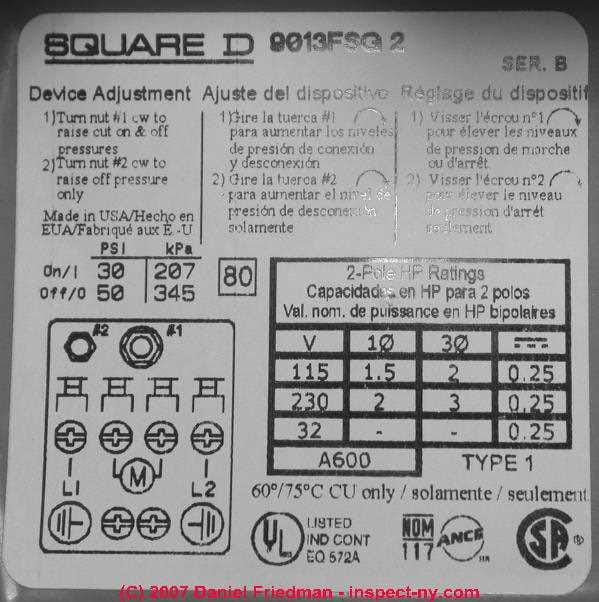
I have a Square D 9013FSQ2 Pressure Switch I checked my cut-in which is 58lbs and cut-out at 69 lbs and i put a tire guage on my pressure tank and it read 70 lbs seems a little crazy. I have a submersible pump at a depth of 120'. I am going to replace the pressure switch since I feel that is my breaker popping problem.
But with these readings I have bad adjustments. it has been like this for almost 11 years now, just dont want future problems. Could someone help me with what all these settings should be and best way to adjust them. I like higher pressure for watering lawn etc. but dont want problems. - David 11/5/11
What are the ranges of 30- 50 psi pressure controls? Can you lower the hightside to 40 psi - (Nov 4, 2014) frankjardin@gmail.com
Reply:
Thomas
I wonder if you carried the adjustment too far. Typically residential switches run 20/40 or 30/50 psi.
Check the labels and instructions that are on your switch to be double sure it works the same way as the models I've described above.
It isn't odd for a pump to run continuously when multiple faucets are open - it's a function of the pump's ability to deliver water (gpm, or pump horsepower) AND the well flow rate.Yes, Frank.
On a typical pressure control switch rated for 30-50 you could lower the cut-out to 40 psi - you might also want to lower the cut-in down closer to 20 so as to minimize short cycling the pump
...
Water Leaks at the Pump Pressure Control Switch Q&A
Water is pouring out at the control panel/ relay switch
We have water pouring out at the contro panel/ relay switch;
I turned off water butnow there's running everywhere. On 2019-02-02 by Candice Copeland
Advice by (mod) - What to do, step by step repairs plus a safety warning
That sounds as if a pipe or tube conducting water pressure to a pressure control switch or the pressure control switch itself is leaking - one or both need replacement; that can be done once water pressure is removed from the system.
Watch out: wet electrical components normally should also be replaced - there are both risks of fatal electric shock and also future corrosion that make the components fail.
- Immediately turn off electrical power to the pump and its controls
- Open one or several outdoor spigots (hose bibbs) to drain water pressure from your system
- Clean up the spilled water
- It may be possible to dry out the pump controls but safest would be to replace the relay switch controls
- Find and fix any loose or broken connectors or tubing that conduct water pressure to the pump control switch
- If there were water leaks at other plumbing connectors, repair those
- With pressure off of the system set the water pressure tank air pre-charge to 2 psi below the pump CUT-IN pressure that's controlled by the pressure switch
- Close open faucets or fixtures that were draining pressure
- Turn the pump electrical power back on
- Check everywhere for leaks
There's a water leak at the pump pressure control switch
I think I have all that adjusted correctly but I have a small water leak at the pressure switch.... I'm assuming there is a gasket in there that needs to be changed? am I right? - Kerry 9.14/11
water is leaking up through the base of the pressure switch. what did I do wrong? - Jerry Jandreau 7/2/12
Reply:
Check the bottom of the switch for plumbing leaks. If there are no leaks at pipe connections I suspect the switch diaphragm is ruptured - replace the switch.
...
Should the pressure sensing tube to the switch contain water?
I am replacing the control switch on my pump. My question is does the small line (1/4") running from the pump to the switch have to be filled with water?
Will an air gap cause pressure reading problems? - John O 9/25/11
Reply:
John O I wondered the same thing - does the small diameter copper or plastic tubing connecting the pressure sensor base of the pressure control switch to the water pump (or pressure tank) need to be filled with water or not? It should not make any difference.
The pressure switch senses pressure by water or air pressing in on a diaphraghm located on the switch bottom.
The diaphraghm doesn't know if it's being pressed-on by air or water. If the water pressure in the tank is, say 30 psi, the air in the line will also be compressed to 30 psi.
...
How much water should be in the pressure tank? Any?
Should there be water in my water pressure tank? - Paul 10/3/11
Reply:
Paul:
If your pressure tank is a type that uses an internal bladder, it may be nearly empty at the bottom of the pumping cycle - that is, at the point that your pump turns on.
If your water pressure tank is a bladdeless steel or fiberglass unit, then normally there will be some water in the tank bottom even at the end of the pumping cycle.Select one of these articles to get the right amount of water and air in your pressure tank:
STEEL WATER TANKS, BLADDERLESS
...
New well pump and tank, but no water is being delivered and the gauge says pressure is not changing.
I have just fitted a new borehole pum and a new pressure vessel. The pump runs then cuts off at 3 bar on the pressure guage. There dosn't appear to be any water in the bladder at all.
The pressure vessel is at just over 2 bar. When I released pressure form the vessel the pressure at the switch dropped as well. Water does flow but there is no water in the tank. How do I set the system so the tank fills. - Nick 3/14/12
Reply:
If the pressure control switch does not respond to changes in water pressure, and assuming the switch and pump have power, check for a debris-clogged pressure control switch. The same problem may be plaguing the stuck pressure gauge
If the pump runs but you get no water then there is a different problem: no well water, well piping leak, etc.
...
Water Hammer Noises When Pump Stops
Will the pressure pump damage the washing machine, water heater etc? in a one story house?
Is it true that Preasure pumps fitted in a house with one floor only spoils the washing machine,water heater etc and presure pumps should not be used for such one floored house. - K Sriram
When checking or adding pressure to bladder style tank should the pressure be set a few pounds below the set on pressure (40-60) switch (38) or should it be set at the higher level around (58) ?
Seems to be a water hammer effect as pump shuts off at (58) - 14 Feb 2015 Doug said:
Reply:
K Sriram
I cannot undertand any reason why a well water pump would damage plumbing in a one story house in some way related to the house height. The pressure operating range - 20-40 psi or 30-50 psi is within the normal operating range of plumbing fixtures and appliances.In other words, No not in any way I can see. Maybe there is some condition someone knows about that we've never come across??
Watch out: other water pressure variations such as that caused by water hammer can indeed damage appliances, piping, controls, valves, etc. Details are
at WATER HAMMER NOISE DIAGNOSE & CURE
Doug, in addition to looking into and addressing the water hammer noise, you want to
...
Water pump short cycles - turns on and off too rapidly - the pressure switch keeps clicking on and off
Moved to SHORT CYCLING WATER PUMP
...
...
Continue reading at WATER PRESSURE CONTROL SWITCH ADJUSTMENTS - topic home, or select a topic from the closely-related articles below, or see the complete ARTICLE INDEX.
Or see these
Recommended Articles
- WATER PRESSURE CONTROL SWITCH ADJUSTMENTS - home for water pump pressure control switch
- WATER PUMP PRESSURE SWITCH DIFFERENTIAL NUT ADJUSTMENT
- WATER PUMP PRESSURE SWITCH RANGE NUT ADJUSTMENT
- WATER PUMP PRESSURE SWITCH SAFETY
- WATER PUMP PRESSURE SWITCH STANDARD (PSI) SETTINGS
- WATER PUMP PRESSURE SWITCH MAXIMUM PRESSURE SETTING
- WATER PUMP PRESSURE SWITCH SETTINGS TOO HIGH
Suggested citation for this web page
WATER PUMP PRESSURE CONTROL ADJUST FAQs-8 at Ins pectApedia.com - online encyclopedia of building & environmental inspection, testing, diagnosis, repair, & problem prevention advice.
INDEX to RELATED ARTICLES: ARTICLE INDEX to WATER SUPPLY, PUMPS TANKS WELLS
Or use the SEARCH BOX found below to Ask a Question or Search InspectApedia
Ask a Question or Search InspectApedia
Share this article:Search the InspectApedia website
Need to make a private comment? Email editor@inspectApedia.com. We welcome email with your website content critique, corrections, suggestions or questions. Email is monitored daily but our workload may prevent an immediate reply. For immediate results, we hope you'll first try asking your question using the search box just above.
Citations & References
In addition to any citations in the article above, a full list is available on request.
- In addition to citations & references found in this article, see the research citations given at the end of the related articles found at our suggested
CONTINUE READING or RECOMMENDED ARTICLES.
- Carson, Dunlop & Associates Ltd., 120 Carlton Street Suite 407, Toronto ON M5A 4K2. Tel: (416) 964-9415 1-800-268-7070 Email: info@carsondunlop.com. Alan Carson is a past president of ASHI, the American Society of Home Inspectors.
Thanks to Alan Carson and Bob Dunlop, for permission for InspectAPedia to use text excerpts from The HOME REFERENCE BOOK - the Encyclopedia of Homes and to use illustrations from The ILLUSTRATED HOME .
Carson Dunlop Associates provides extensive home inspection education and report writing material. In gratitude we provide links to tsome Carson Dunlop Associates products and services.
 |
HOME | ABOUT | ASK a QUESTION | CONTACT | CONTENT USE POLICY | DESCRIPTION | POLICIES | PRIVACY | |
| © 2026 - 1985 Publisher InspectApedia.com - Daniel Friedman | |||||||||