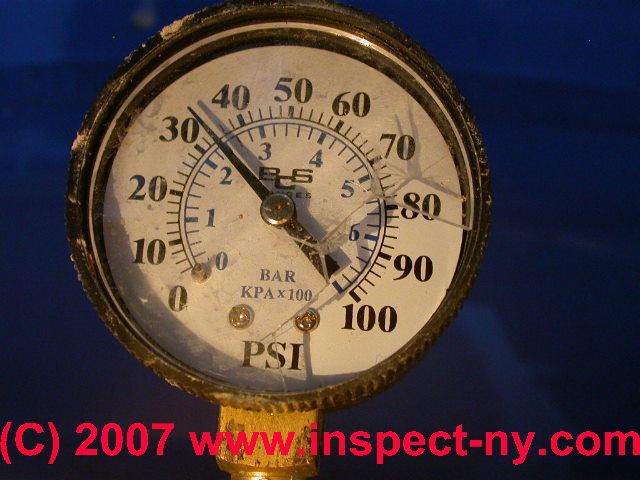
 Maximum Water Pump and Tank Pressure Settings

- POST a QUESTION or COMMENT about Setting the Water Pump Pressure Switch and Improving Water Pressure
Well pump pressure control switch maximum pressure setting:
This article describes how to adjust building water pressure by setting the water pump cut-in and cut-out pressure on the well water pump pressure control switch.
We also point to our article on how to adjust building municipal or community water pressure at a building.
Watch out: You can't just set the pump pressure as arbitrarily high as you want to. The result could be dangerous.
InspectAPedia tolerates no conflicts of interest. We have no relationship with advertisers, products, or services discussed at this website.
- Daniel Friedman, Publisher/Editor/Author - See WHO ARE WE?
How High Can we Set the Water Pressure in My Building?
 What can go wrong with excessive pump pressure control settings:
- Exceeding well pump pressure capability:
Watch out: If you set the CUT-OUT pressure (stop pumping) pressure higher than the water pump is capable of reaching, the pump will just keep running indefinitely until it burns up or blows a fuse or trips a circuit breaker or overheats. - Causing a ruptured water tank internal bladder:
we have had a number of reports of ruptured bladders in water tanks. In normal use the bladder in most water tanks is not stressed at all - the internal water tank bladder simply moves up and down as water enters or leaves the tank - pressure on either side of the bladder (air on one side, water on the other side) remains the same.
If your water tank were a less common model in which air were inside the bladder rather than outside it, excessive air pressure could burst the bladder.
If you set the water pump pressure too high on one of these systems, you might cause the water bladder to rupture inside the tank. In an extreme case you might blow up the water tank itself. Most water tanks are not designed this way. - Blowing up a water pressure tank - serious safety hazard:
if you set water pressure too high, even if the pump is capable of reaching that pressure it may be unsafe. Most water pressure tanks are
designed to operate safely in the water pressure ranges we cite
at PUMP PRESSURE SWITCH STANDARD (PSI) SETTINGS.
If you had the bad luck (or mistake) of using a water tank that has
NO PRESSURE RELIEF VALVE installed, it is possible to cause the tank to rupture or even explode, risking damage to the building or even serious injury or fatality if anyone is nearby. - Causing leaks at fixtures: even if your water tank were rated for high pressure, and even if your water pump is capable of high water pressure, if you run water pressure in a building over 70 or 80 psi you can expect to have recurrent leaks at plumbing fixtures: most water faucets and tub faucets are not designed for high pressure use.
- Also see HOW MUCH AIR TO ADD - How Much Air is needed in the water pressure tank?
What should I do about sudden very high water pressure in my pump and well system?
Our reader asked:
I noticed that my water pressure suddenly seemed awful high and when I checked the gauge it was. I have a 6" drilled well and the shutoff pressure was reading 80# of pressure. I tried adjusting the range nut with little success.
The gap between 'on' and 'off' was way to much. (The switch, a Square-D, indicated a gap of 20-40 ) I think that I have a bad pressure switch. Any thoughts? - J.T.
Reply: Replace the pressure control switch, check and clear debris blockage in the switch mounting piping
A competent onsite inspection by an expert usually finds additional clues that help accurately diagnose a problem.
That said, here are some things to consider based on what you've described so far:
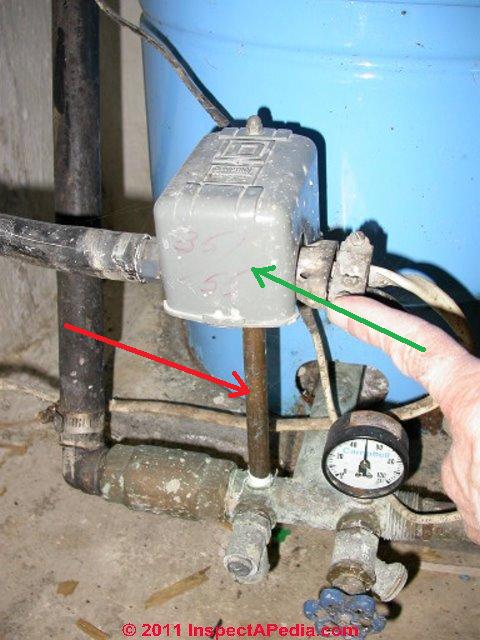
Because you confirmed that the water pressure really is excessive by direct observation, I don't think this is a common gauge error problem and I agree that the problem is most likely with the pressure control switch. In our photo (above-left) the green arrow points to a SquareD pump pressure control switch at its typical installation location.
A well water pump pressure switch might stick in the "on" position due to debris clogging at the pressure sensing orifice, or at the switch mounting tube, or on occasion relay switch points can burn and actually weld together.
Turn Off Unsafe Water Pumps
Watch out: high pressures from a pump that is either pumping to too high a pressure control setting or that does not shut off due to a switch or wiring problem can burst water pipes or a water tank, possibly even leading to injuries, especially if your water pressure tank lacks a pressure relief valve.
I would turn OFF a system pumping to or over 80 psi until the problem is diagnosed and corrected. In our photo (above left) there is indeed a pressure relief valve installed on this pump and tank system. You can see the relief valve attached just below the pressure switch mounting tube (red arrow).
How to Install a New Water Pump Pressure Control Switch
If no one had previously been attempting to adjust the pressure control switch, I'd install a new one. When you install the new switch, either replace or clean out the small-diameter (typically 1/8" or 1/4" ID NPT) pipe nipple that is used to mount the pressure switch to the piping or fitting where it is attached. In our pressure control switch photo (above left) the red arrow points to the mounting tube that we are discussing.
Watch out: As a temporary, emergency "Sunday night" repair, I have filed clean and smooth pitted, burned contact points on a relay switch (with power OFF of course), but because relay switch points are made with a protective plating on the contact point surfaces, when you file or clean burned contact points the switch may still have a short remaining life, and you risk also changing the behavior of the contact relay or even of making the switch unsafe. So it's best to replace the switch promptly.
To replace a water pump pressure control switch the installer will need to turn off electrical power to the system, remove the old switch by disconnecting its wiring and then unscrewing the switch from its mounting tube, and install the new switch in the same position.
It's a good idea to label your switch wires or take some photos as well so that you wire the new switch exactly as the old one was hooked-up.
Watch out: if you do not run enough water to remove water pressure from the pressure tank, when you remove the old pressure switch you'll see water squirting out of the mounting tube.
That's not necessarily so terrible if that "squirt" also cleans debris from the tube. If you drain off water pressure first, the leakage at that point will be trivial. If not, be prepared to get wet as you are screwing the new switch in place, and be prepared to dry everything out before restoring electrical power.
Don't forget to use teflon paste or tape on the threads of the mounting tube so that your new switch won't leak at the mount, but don't blob in so much pipe dope or paste that you risk clogging the switch pressure sensing orifice on the switch bottom.
You should be able to use the new pressure control switch with the factory settings for cut-in and cut-out pressure, especially if you bought one already set to one of the two standards: 20/40 psi or 30/50 psi for Cut-in and Cut-out pressures.
Or see WATER PRESSURE CONTROL SWITCH ADJUSTMENTS if you need to adjust the pressure switch settings.
Check for Sediment Blockage at the Pump Controls
As we discuss at CHECK PRESSURE SENSOR TUBING CLOGGING, often if there is sediment or rust or debris in the water system, that small diameter pipe or even the bottom sensor openings on the pressure control switch can become clogged. The result is that the switch stops properly sensing water pressure.
At that point pressure switch behavior can go either way: the switch may fail to sense a water pressure drop and thus doesn't turn on when needed, or it may fail to sense a water pressure increase and thus does not turn off when needed. Too little water pressure is inconvenient. Too much water pressure can be dangerous.
If/when you are replacing a pump pressure control switch, check the tubing or switch mount as well as the bottom of the old pressure switch for evidence of sediment or mineral deposits or other crud that block the pressure sensing mechanism. Clean or replace blocked switch mounting tubing.
Install a Sediment Filter?
Finally, if indeed your water source is giving up debris, silt, or other sediment particles that can clog the water supply system and its controls, you should consider installing a water filter system as well.
Most water filters I've seen are installed after, rather than ahead of the water pressure tank and controls. But if needed, with a few extra control valves to make filter changeout easy, it should be possible to install filtration ahead of the tank and controls, thus protecting them from sediment as well.
...
Reader Comments, Questions & Answers About The Article Above
Below you will find questions and answers previously posted on this page at its page bottom reader comment box.
Reader Q&A - also see RECOMMENDED ARTICLES & FAQs
Our pump cuts in at 55 and out at 72 psi - what's wrong with it?
Air tank reads 20 pounds. Pump cuts in at 55 and cuts out at 72'ish, according to my pressure gauge. Pump is 1/2 hp. What's wrong? On 2021-06-10 by Charlie
Answer by inspectapedia.com.moderator (mod)
@Charlie,
A 55 psi CUTIN is very high and 72 psi CUT OUT high - you're pushing your luck a bit as at over 70 psi the chances of plumbing leaks increases..
That said, you're not going to get good use of your pressure tank at that 20 psi pre-charge.
Proper pre-charge is 2 psi below the CUT-IN pressure.
see WATER TANK AIR, HOW TO ADD https://inspectapedia.com/water/Water_Tank_Air_Charge.php
Why is it important to set the pressure tank pre-charge 2 psi below the pressure switch CUT-IN pressure?
Why is it important to have the pressure tank pre-charge at 2 psi below the cut in pressure of a pressure switch?. The pressure switch has a lever to protect the pump in case it runs out of water.On 2020-07-28 by Ray z
Answer by (mod) -
@Ray z,
The reason we set the air pre-charge pressure in the water pressure tank to 2 psi below the pump's CUT-IN pressure is to assure that when water is being run in the building (and thus pressure in the tank drops), the pressure in the tank will indeed be sure to fall low enough that the pressure control switch will turn on the pump.
Consider: if the pressure control switch is set to 20/40 that means the pump will turn ON at 20 psi and OFF at 40 psi.
Problem #1 suppose the air precharge in the tank is set to 21 psi. When you run water you'll run out - water will stop, but pressure in the tank may (depending on control locations) keep the pump from ever turning on.
Problem #2: suppose the air pre-charge in the tank is set right at 20 psi. At the end of a water draw-down cycle as you use water pressure drops to 20 psi and hovers there (due to the air precharge) - the pump control switch may begin to chatter causing switch wear and pump damage.
Why does my new pump give less water pressure than the old one?
My preasher tank is only a 30/50 I had to put a pump in the well its 1/2 hp i had a 1 hp before but I was getting 50 pounds now only 40 any ideas On 2021-04-19 by Cory
by (mod) -
@Cory,
I can think of two obvious things to check:
1. the pressure control switch was replaced or re-set to 20/40 - this would probably be the case if your pump gets pressure up to 40 psi and then turns OFF.
2. the pump runs continuously but can't get pressure above 40 psi - so it never reaches its cut-off pressure
In that case read the diagnostic and repair procedure at
WATER PUMP WONT STOP RUNNING - things that can cause a pump to run continuously
How do I set the water pressure lower?
want to lower water pump pressure in water trod pump. too high at 50 On 2020-11-29 by WILTON, JANE
Answer by (mod) -
Sure Jane, glad to help.
See the detailed procedures at
PRESSURE SWITCH NUT ADJUSTMENTS https://inspectapedia.com/water/Pressure_Switch_Nut_Adjust.php
and also
see
PUMP PRESSURE SWITCH STANDARD (PSI) SETTINGS https://inspectapedia.com/water/Pump_Pressure_Switch_Settings.php
Is it ok that my pump cuts on at 40 and off at 50 psi? Why not off at 60 psi?
Just had my pressure tank replaced by pros.
All I have read in manual is for a 40/60 on this system but in practice it is cutting on at 40 and off at 50. All is well, but is this asking too much of the pump?
I use it for my home and probably use 8 gal/day-- great pressure. Wash day cycles more often as my draw down is about 6 gallons. On 2020-08-05 by Suan P
Answer by (mod) -
@Suan P, you're probably fine;
But someone may have set the CUT-OUT pressure down from 60 to 50 because the pump was having trouble reaching that higher 60 psi pressure.
Signs of trouble would be noticing that when you stop running water the pump runs without turning off, or chatters and has trouble turning off when close to 50 psi.
Why is my pump turnign on and off 2 psi below where we set it?
Had my electrician install a new pressure switch. He set the cut in at 30 and the cut out at 50.
This was fine for a day but when I went to check the status of the gauge it now cuts in at 28 and off at 48. Why would it adjust by itself and is it ok to keep the settings as they are? The pressure tank has 30psi printed on the label. On 2018-07-23 by Wilf
by (mod) - How to fix an unwanted drop in the CUT-IN or CUT-OUT pressure ?
Wilf
Thanks for asking.
I SPECULATE that either of these causes could explain that drop in the CUT-IN pressure from what you thought:
1. a pressure control switch for a water system is not a lab-grade precise instrument, the air pressur
2. The air pressure in the pressure tank may not have been where you thought it was when the pressure switch was installed,
Normally we want the tank's air pre-charge to be 2 psi below the pressure switch cut in pressure.
So if the switch - from the factory - is set to cut in at 30 psi the tank's air pre-charge would be set at 28 psi.To do that you need to remove all pressure from the tank, then pre-charge its air to 28 psi. When that's done the pressure switch can be adjusted slightly to CUT IN at 30.
Sometimes the pump pressure switch won't turn the pump on
30.50 switch, works but sometimes contacts in switch don't close to activate PUMP when low pressure reached cut on 30psi. Thus causing continued drop pressure without starting PUMP. I then man. start PUMP, it runs great then few hours later same thing no start.
Seems to be lots water in 300 ft well and high pressure cut out always works after running PUMP for a minute. Any idea,switch and pressure gauge are new.? On 2018-06-01 by Ronald Schuchardt
Answer by (mod) -
Two common causes:
- debris-clogged pressure sensor on the switch (replace the switch)
- switch contains a pump protection circuit that is turning off the control when the well lacks wter
less common
- defective relay itselfSee our complete diagnosis and repair procedure at WATER PUMP WON'T START
Increased pressure switch settings too high, lost all water pressure: check thermal reset
Last week I increased the cut-in cut-out pressure switch setting on my well.
The system was running at 20-40 and after making the pressure switch adjustment it has been running at 40-60 just as I planned. I checked the cut-in and cut-out over several days after the change and it was working fine.
Today we found that we had zero water pressure. I looked over our system and found there is no water flowing into our pressure tank so no water is being pumped. I tested for power at the pressure switch and it is getting power but I did not check the voltage.
The well pump was here when we bought the house about 10 years ago so the pump is at least 10 years old. I don't know the specifics of the pump but the control box for the pump states 1 hp, 230 volt, single phase and includes a capacitor and some other blue device.
I assume my increasing the pressure switch seating has lead to a pump failure. Anything else I should test before running out to buy a new pump? - John M 8/34/11
Reply:
John M:
Changing a pump pressure control switch from 20/40 all the way up to 40/60 has an understandable appeal: much higher water pressure, faster flow rate. But the risk is that you set a cut-off pressure that the pump simply cannot maintain. If that happens the pump might just keep on running - never reaching that 60 psi. If your pump was a submersible you might not know that the pump is spinning itself to death down in the well.
Until it stops working or until the pump overheats and shuts down on thermal overload.
Watch out: even if you reset the thermal overload switch on a pump motor, running it too long may have exceeded its heat capacity and damaged the pump bearings or impeller assembly. So if you reset the pump and water pressure is restored but the pump later begins to run continuously you'll have to lower the cut-out pressure until you've diagnosed the problem and perhaps replaced the damaged parts.
These articles should help:
A second possibility is that sometimes when we start pumping water out of a well faster than before we can exceed the well's flow rate (especially if the well is not very deep- doesn't have a big static head). Even if the well later recovers, we can lose prime and lose water pressure, or in some cases run the pump dry and damage it.
Sorry about the bad news, but those are the worries that occur to me from your description.Followup:
Thanks for the reply Dan,
The pump is working fine now, the following morning after my post I replaced the thermal protection device, turned on the pump and it immediately started pumping and has been running fine since. Just for clarification and as I explained in my original post, the pump is cycling properly (cutting in and out) with the higher presser setting of 40~60 psi.
I suspect the problem occurred due to my extended continuous use of water while I was working on a landscaping project which had the water running continuously for 8 plus hours. It appears the thermal protection device which is designed to protect the pump from burning out did its job.
Happy to report the pump and well are working great.Reply:
Thanks John M - I will add "replace the thermal protection device" to our list of diagnostic suggestions when a pump motor won't run. Can you send along photos of the parts and pump? Use the CONTACT link found at page top, left, bottom.
My water pressure is too low, pump gets hot, trips breaker. Can I increase the pressure setting?
I have very low water pressure, so a neighbor turned it up for me. I couldn't even get Dawn to suds up in my sink! But now the pump runs until it gets hot & throws the breaker switch. Sometimes it keeps clicking on & off.
What can I do to get good pressure, but not burn the pump up? I don't quite get this cut-in & cut-out thing. - Gwen 5/7/11
Reply:
Gwen,
Watch out: do not try setting up the pressure on the pump pressure control switch in this case. Since your pump is tripping the circuit breaker there is a problem to find and fix first: such as a failing pump motor, wiring error, or other unsafe condition.
The pressure control switch sets the water pressure at which your pump turns on and off. Typically these switches are set to turn on at 20 and off at 40 psi or on at 30 and off at 50 psi.
If your neighbor set the pump cut-out pressure too high, your water pump may simply be unable to ever reach the "Cut off" pressure - so the pump will run until it overheats and shuts off by an internal thermal overload switch. Usually these switches reset automatically when the pump cools down.
But running the pump this way is
- DANGEROUS - too much pressure could burst a water pressure tank or other plumbing parts, even injuring someone
- and it can ruin your well pump by burning out the motor
You need help from someone with a bit more expertise, perhaps a real plumber who knows how to adjust the pump pressure control correctly.
Well Pump pressure goes up to 70 psi then immediately falls to 40 psi, many times a minute
when I flush the toilet my well pump cycles on to 70 lbs then right off and drops to 40 lbs and back on to 70 lbs then drops down to 40lbs and back on to 70 lbs it does this 21 or 22 times in a matter of just a couple of minutes then it stays at 40 or 39 lbs. I think it's doing this the whole time the toilet is filling back up? What would cause this?? - Jim Gale 10/17/11
what can be wrong with my well i put a new pressurer swithch the blader tank is good not lossing air but pump cut on and off ever two min what do i have to do to fix the problem - Anon 3/1/12
The pump is new and the pressure tank is old and the pressure switch is new. I run the water the pump clicks on and off every 10 seconds. I can see condensation line above the half way line on the tank. Whats the problem? - Rep 6/5/12
My switch cycles constantly and finally (sticks and holds contact. Is this an air pressure problem in my water tank? - Martin 7/19/12
My well is for outdoor irrigation only and has a very small (maybe 3-5 gallon?) bladder tank and pressure switch set-up.
When I turn on a hose the pump clicks on and then off immediately, just a few seconds then the water pressure from the hose dwindles down and then the pump kicks back on just for a second and right back off so I get a burst of water then the dwindling again & it just keeps going like that.
Isn't the point of the pressure switch & bladder tank to make the pump stay on while water is running, keeping the pressure constant? What adjustment to the pressure switch should I make....increase or decrease the cut-on or cut-off point? - Jen 7/20/12
Reply:
I'm not 100% sure of course, but I don't think it's an air problem.
Short cycling of a water pump describes the pump turning on and off too often when water is running, but not a sticky or misbehaving pressure switch.
Burned switch contacts, a failing switch, a loose connection in the wiring, or a dirt-clogged sensor port on the pressure control switch base or in the tube that conducts water pressure to the switch are more likely at fault.
Martin when you swapped in the new switch, if you left a clogged tube on which the switch mounts or that feeds water pressure to the switch, even the sensor port on the new one could be blocked as well.
I'd also check voltage levels.
And that the pressure tank is not waterlogged.Jen when the pump turns on and then immediately off it's as if there is no air in the pressure tank - so as water is not very compressible, the system reaches cutoff pressure immediately. If the irrigation system draws water fast enough, or if the pressure tank has an air charge, the symptom you describe should not occur.
Take a look at WATER PUMP SHORT CYCLING. I think your water tank may be waterlogged.
How to re-set the pressure control switch to factory specs
How do i reset my Square d 20-40 back to factory setting? my pump stays running longer than usual and the smaller spring is all the way turned out barley any tension on the spring. pump cuts on and off just don't want hurt the bladder. its on a 30 gallon flowtech water tank also i have no way of checking the pressure inside the tank im just going by how the water pump used to run by hearing . (Apr 28, 2014) H20
Reply:
H2 don't feel too bad, we've all done that trick.
See PUMP PRESSURE SWITCH STANDARD (PSI) SETTINGS
Start with a completely empty water pressure tank - let air in at ambient area air pressure, and you'll be close. Or install a gauge if there's a port to do so and set the tank pressure to 2 psi below the cut-in pressure on the switch.
My well water pressure switch is cutting in at 74 PSI and cutting off at 94 PSI and I have 30 PSI in the tank
Good Day, My well water pressure switch is cutting in at 74 PSI and cutting off at 94 PSI and I have 30 PSI in the tank. So my question is this, do I leave the cut in and cutt off alone and increse my tank pressure to 72 PSI or decrease my cut in and cut off to 40/60 and increase my tank pressure to 38 PSI?
Everything seems to be running fine at it's current cut in and cut off but the pressure is a little weak. I am unsure what to do because everything I have read states that the cut off pressure should not exceed 60 PSI. Thanks (Feb 11, 2015) Mark said:
Reply:
Mark, 94 PSI is a very high cut-out pressure and risks leaks or a burst pipe; if something indeed bursts someone nearby could be injured.
At those unusually high water pressures (for a residential building we don't normally run much above 60/40) if you are seeing what you describe as "weak pressure" then I suspect that your gauges are wrong OR there is a blockage that is restricting the flow rate.
Make an independent measurement of water pressure and tell me what it is when the pump has cut out and no water is being run in the building.
See WATER PRESSURE MEASUREMENT in the ARTICLE INDEX
...
Continue reading at PUMP PRESSURE SWITCH STANDARD (PSI) SETTINGS or select a topic from the closely-related articles below, or see the complete ARTICLE INDEX.
Or see these
Recommended Articles
- WATER PRESSURE LOSS DIAGNOSIS & REPAIR
- WATER PUMP INTERMITTENT CYCLING - pump runs occasionally for no reason
- WATER PUMP PRESSURE CONTROL SWITCH - installation, adjustment, troubleshooting & repair of well or water pump control switches.
- WATER PRESSURE CONTROL SWITCH ADJUSTMENTS - how to change the pressure control settings
- WATER PUMP PRESSURE SWITCH NOISES - clicks, hums, buzzes at the pressure control
- WATER PUMP PRESSURE SWITCH REPAIRS - home
- WATER PUMP SHORT CYCLING - pump turns on & off too frequently
- WATER PUMP WONT STOP RUNNING - things that can cause a pump to run continuously
- WATER PRESSURE EFFECT on WATER CONSUMPTION RATE
- WATER SUPPLY PIPE DIAMETER vs FLOW
- WATER TANK AIR, HOW TO ADD
- WATER TANK PRESSURE RELIEF VALVE
- WATER TANK SAFETY
- WELL PIPE LEAKS
Suggested citation for this web page
MAXIMUM PRESSURE SWITCH SETTINGS at InspectApedia.com - online encyclopedia of building & environmental inspection, testing, diagnosis, repair, & problem prevention advice.
Or see this
INDEX to RELATED ARTICLES: ARTICLE INDEX to WATER SUPPLY, PUMPS TANKS WELLS
Or use the SEARCH BOX found below to Ask a Question or Search InspectApedia
Ask a Question or Search InspectApedia
Share this article:Search the InspectApedia website
Need to make a private comment? Email editor@inspectApedia.com. We welcome email with your website content critique, corrections, suggestions or questions. Email is monitored daily but our workload may prevent an immediate reply. For immediate results, we hope you'll first try asking your question using the search box just above.
Citations & References
In addition to any citations in the article above, a full list is available on request.
- Thank you to Jason Gapco at Education Solutions for careful editing and text suggestions, 12/2008
- Thank you to Steven Prior, a reader, for questions leading to our clarification of the function of the large and small pump pressure control switch springs, and for his photograph of the pump switch springs, 3/23/2009
- Thanks to reader Rise for pointing out that turning a nut clockwise means "to the right" or to the "more tight" position in the convention of how most threaded devices work. Nov 2009.
- Thanks to reader Don Travis for discussing water pump adjustment details - July 2010
- Pumptrol™ Pressure Switch Adjustment, Square D, Schneider Electric Corporation, 8001 Knightdale Blvd., Knightdale< NC 27545 1-888-778-2733 - Square D Technical Library, web search 07/24/2010 original source: http://ecatalog.squared.com/techlib/docdetail.cfm?oid=09008926800a93be
- Our recommended books about building & mechanical systems design, inspection, problem diagnosis, and repair, and about indoor environment and IAQ testing, diagnosis, and cleanup are at the InspectAPedia Bookstore. Also see our Book Reviews - InspectAPedia.
- In addition to citations & references found in this article, see the research citations given at the end of the related articles found at our suggested
CONTINUE READING or RECOMMENDED ARTICLES.
- Carson, Dunlop & Associates Ltd., 120 Carlton Street Suite 407, Toronto ON M5A 4K2. Tel: (416) 964-9415 1-800-268-7070 Email: info@carsondunlop.com. Alan Carson is a past president of ASHI, the American Society of Home Inspectors.
Thanks to Alan Carson and Bob Dunlop, for permission for InspectAPedia to use text excerpts from The HOME REFERENCE BOOK - the Encyclopedia of Homes and to use illustrations from The ILLUSTRATED HOME .
Carson Dunlop Associates provides extensive home inspection education and report writing material. In gratitude we provide links to tsome Carson Dunlop Associates products and services.
 |
HOME | ABOUT | ASK a QUESTION | CONTACT | CONTENT USE POLICY | DESCRIPTION | POLICIES | PRIVACY | |
| © 2026 - 1985 Publisher InspectApedia.com - Daniel Friedman | |||||||||