
InspectAPedia® FREE Encyclopedia of Building & Environmental Construction, Diagnosis, Maintenance & Repair |
Question? Just ask us! InspectAPedia
|
 No Heat Diagnosis
for Oil or Gas Fired
Hot Water Heating Boilers
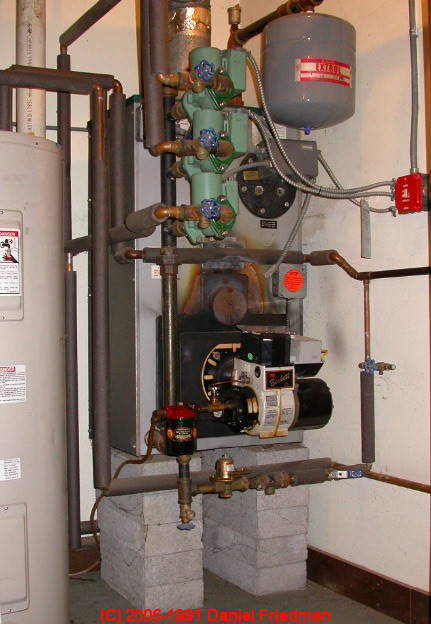
- POST a QUESTION or COMMENT about how to fix a heating boiler that is not working - how to diagnose the loss of heat in a building when the heat source is an oil or gas fired boiler
Heating boiler problem diagnosis and repair guide - no heat or loss of heat calls:
We give a step by step procedure that will let ytou recognize & diagnose no-heat problems with residential heating boilers, including loss of heat, heating boiler noises, leaks, odors, or smoke, and high heating costs.
This article explains the diagnosis and correction of no heat for water or hydronic or hot water or radiator or baseboard hot water heating systems.
We give help in troubleshooting heating systems using the common fuels: heating oil or LP gas (propane) or natural gas.
This article series answers questions about all types of heating systems, advising on troubleshooting, inspection, diagnosis, and repairs. We describe how to inspect, troubleshoot and repair heating and air conditioning systems to inform home owners, buyers, and home inspectors of common heating system defects.
InspectAPedia tolerates no conflicts of interest. We have no relationship with advertisers, products, or services discussed at this website.
How to Diagnose a "no heat" problem: steps the occupant or owner can take before calling repair
 Hot Water Heating System: Once you confirm that your heat is made by hot water (a heating boiler) you might want to review hot water or "hydronic" heating systems
at BOILER COMPONENTS & PARTS
and
at BOILER OPERATING STEPS where we describe the parts and operating sequence of hot water heating systems.
Note: some hybrid or mixed heating systems combine both hot water and hot air to heat a building, such as
water to air systems which use a heating boiler (oil, gas, or electric) to heat water which circulates through (and inside of) a heat exchanger
(that looks like a car radiator) - described
If your heat is by forced warm air, it's not a boiler and you're on the wrong page: instead please
If you don't know whether your heat is provided by a furnace (hot air) or boiler (hot water), or whether your fuel is oil, gas, or electric,
and whether your heat is hot water, steam, or warm air,
see HEATING SYSTEM TYPES.
Types of Defects and Problems with Hot Water Heating Boilers - Hydronic Heating Systems, Loss of Heat, Noises, Leaks
 What sort of defects should you look for when inspecting a heating system?

- LOSS OF HEAT in your BUILDING? - boiler or furnace won't operate,
or system operates but heat is not produced in the living area - we outline a step by step diagnostic procedure for "no heat" conditions just below. - Improper Heating System Function:
NOISES ODORS SOOT, unreliability, inadequate heat distribution - Unsafe conditions on the heating system
- Missing Heating System Components: safety controls, operating aids
- Unreliable heating systems or heating systems at or near the end of their useful life
- Improper Heating System Construction/Installation
- Heating System Damage: leaks, mechanical damage
- Clues of potential other heating system defects:
LEAKS CORROSION STAINS, abnormal temperature
or pressure,
HIGH HEATING BILLS - No domestic hot water for washing and bathing? This is not usually a home heating system problem, but if your hot water is made by a tankless coil and a gas or oil fired heating boiler, the problem could be with the heating boiler itself. If your water heater is not working, find your water heater type
at WATER HEATERS.
How to Diagnose Loss of Heat With Oil-Fired or Gas-Fired Hot Water Heating Systems - hydronic heating system troubleshooting
If the heating boiler oil burner is not turning on at all check the causes listed on this page. We'll take you through photo-illustrated step by step things to do when you have no heat and you need to determine what's wrong. First let's review these simple "no heat" concepts .
NO HEAT: BURNER OFF, SAFETY NOT TRIPPED: - Oil or gas burner has stopped, no safety switch is tripped
1. Is the thermostat calling for heat?
check that the room thermostat setting is at least 5 degrees above the actual room temperature.
See THERMOSTATS.
2. No electrical power:
check that all of the switches that power on the oil or gas burner are in the "on" position. Check heating circuit fuses & circuit breakers, not just the wall switch. We discuss this in detail just below.
3. Is there fuel in the oil tank or LP gas tank?
Check your oil tank or LP gas tank tank gauge.
Out of heating oil?
If the marker in your oil tank gauge reads 1/8 full or less, or is at the bottom or out of sight you are probably out of oil. If your oil tank is buried, and if you do not have an indoor (remote) fuel level gauge, the oil level is checked in the tank by removing the tank filler pipe cap and using a long (clean) stick (or in emergency a clean string and weight) to measure the depth of heating oil in the tank.
Remember that a problem with the oil piping, oil filter, or fuel unit can also cause no oil to be delivered to the oil burner even if plenty of oil is in the tank.
See OIL BURNER FUEL UNIT for some helpful diagnostics
and
also OIL & GAS PIPING.
Out of LP liquid propane gas?
Check the gauge on your propane tank. If the reading is 10% or less you are out of fuel.
If your boiler is fueled by piped-in natural gas from a utility company, check that the company hasn't turned off your gas supply at the gas meter - something that might happen if you didn't pay a gas bill or if the gas company thought your building's gas system was unsafe.
4. Electric motor problem at the burner or blower fan:
Check that an electric motor (for the oil burner, gas burner, or blower assembly) reset switch may have tripped. See our notes above about electric motors, and
See RESET SWITCH, ELECTRIC MOTOR.
5. Aquastat or cad cell control or relay trouble:
if you hear or have ever heard buzzing from any heating system control that includes a relay switch, watch out for a control cover that is in contact with a relay switch in the unit.
If the cover is lightly touching the relay switch the control may simply buzz when the relay is trying to move.
But a too-tight control cover can also prevent a relay from operating, leading to loss of heat. Simply pulling off the cover to let the relay move freely can immediately discover and "fix" this problem.
Details and illustrations including diagnosing buzzing relays are
at HEATING SYSTEM NOISE DIAGNOSIS.
NO HEAT: BURNER HAS TURNED OFF ON SAFETY: Oil or gas burner has stopped, the safety switch is "off" or "tripped"
If you are not sure how to find and check the safety control reset buttons on your heating system, we describe these controls in more detail just a bit further on in this article.
The burner on your heating boiler, furnace, or water heater has shut down, if a red "reset button" has popped up on the burner primary control or on an electric motor that operates the system. This condition is called "Safety Off".
Watch out: Before re-setting the safety switch or button, it's a good idea check the following five common causes of loss of heat leading to a Safety Off condition. Photos and details follow these short paragraphs.
How to press the heating system reset button:
If you do not see anything wrong, you can try re-setting the heating system: press and hold the red reset button down for 3 seconds and release it. If the heating system has electricity it will try to re-start.
Watch out: If the system does not keep running smoothly don't keep pressing the reset button - that could flood the combustion chamber with unburned fuel, causing a dangerous puff-back.
Just press the reset button once. If the heating system starts and runs ok, you still should request a service call, but you can have heat while you're waiting.
1. Heating fuel failures -
out of oil in the oil tank, clogged oil filter, clogged oil nozzle, oil line has been bent, crimped, clogged, clogged oil pump strainer (fuel unit strainer), or inability of the fuel unit to pump oil (broken motor shaft, missing internal bypass plug on a two line oil tank system, an air leak in the oil inlet line, or a leaky foot valve in the oil tank causing loss of oil prime). if the oil tank is outdoors in freezing weather the oil in the tank or in an oil line may have become waxy or jelled.
2. Oil burner motor failure: t
the electric motor that runs the oil burner may itself have gone off on reset. Some causes of electric motor failure: one pipe oil system with the bypass plug installed in the fuel unit (oil pump) causing excessive pressure and stalling the motor; centrifugal motor switch sticking (try banging on the motor once); motor condenser burned out; motor stator or internal windings burned or shorted; motor bearing failure.
Try re-starting the motor -
see RESET SWITCH, ELECTRIC MOTOR
3. Oil burner ignition failure
the oil burner's ignition transformer terminals are loose; the electrodes on the burner nozzle are dirty or not set to the proper gap; the oil is contaminated and is hard to ignite; the ignition transformer has become weak or has burned out (look for tar oozing out of the ignition transformer container); the oil burner nozzle is clogged preventing oil from contacting the ignition spark arc; the ignition electrode(s) are grounded on the air tube of the burner;
4. Faulty heating system control operation
the safety sensor that checks that a good oil burner flame has been established is not working; a stack relay spring or cad cell eye may be dirty with soot; the stack temperature may be too low for the stack relay (boiler is under-fired); the oil burner has been cycling on and off to frequently (a problem with the thermostat).
Tip: Look for loose electrical connections
before deciding that a control or switch has failed, confirm that the system has electrical power, all switches are on, and that a wiring connection has not come loose.
On a recent no-heat call we were embarrassed to learn from Bob, the service tech, that the problem was most likely that somebody (who me?) may have accidentally knocked loose the electrical connector at the oil delay valve (aka "quick stop valve").
The connector may still appear to be in place but may have been pushed slightly back or askew. The result is that on a call for heat the oil burner motor will run but the burner will never ignite. Details about loose connector diagnosis & cures for the quick stop valve or oil delay valve or the PD Timer are
at OIL LINE QUICK STOP VALVES.
Other common loose electrical connections might be at wiring to any heating control or at the oil burner itself.
5. Irregular stack temperatures
in the flue can cause oil burner draft and temperature or control problems. Downdrafts (missing chimney cap), insufficient draft due to chimney problems, or fluctuating oil burner flame may be at fault. Also
see CHIMNEY INSPECTION DIAGNOSIS REPAIR.
-- some of this material is paraphrased from Audel.
Oil Burner Runs - Problems
Oil Burner Operating Problems: Oil or Gas Burner rough, noisy, smoky, smelly
The heating burner operates but not properly.
See OIL BURNER NOISE SMOKE ODORS
Next let's check each cause of no heat in detail; if your system uses warm air heat instead of water or steam, review the check-items just below before going
to HEATING LOSS DIAGNOSIS-FURNACES.
SAFETY WARNING: If a heating system oil burner has been deliberately "shut down" and you don't know when or by whom this step was taken, beware of turning the heating system back on without an inspection and safety check by an expert technician.
- Electrical power to the heating boiler
or oil burner is OFF: check the circuit breaker or fuse supplying power to the unit; check the service switch at the furnace or air handler, and if the system is air conditioning or a heat pump, check the service switch outside at the compressor/condenser unit to be sure it is "on".
Make sure that electrical power is on for all of the heating system components. Check local switches at the boiler, wall mounted boiler switches at the stairwell down to the basement or utility room or in other areas, and check the circuit breakers or fuses in the electrical panel.
Is the heating boiler turned on? Is there electric power to all of the heating system components such as an oil burner at the boiler and power to the circulator pumps?
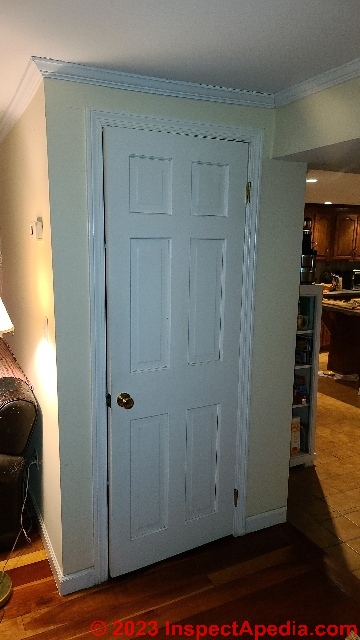
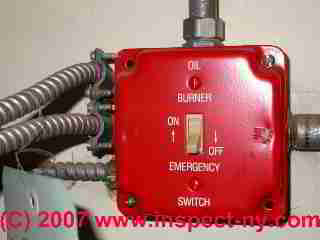
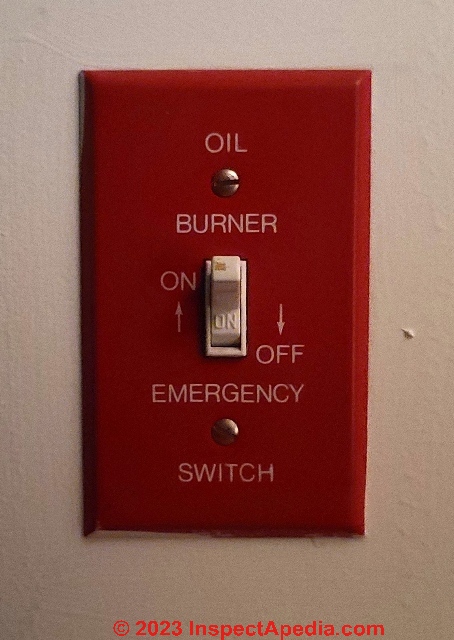
Watch out: as we illustrate above and below, there may be more than one heating boiler or furnace power On-Off switch. Often there is a service switch right at the heater, and another at the top of the basement stairway or elsewhere in the living space.
The upstairs heater on-off switch is there so that in an emergency the building occupants don't have to go down into a basement (or crawl space or other hard-to-access area) to turn off the heat.
The heating system On-Off switch shown here was "hidden" in a closet in an older New York Home. At one time the door shown almost certainly led to a stairway down to a basement under the home - the location of the heating boiler.
Later renovations eliminated the stairs to the basement, leaving only an outdoor basement entry stairs. But the boiler on-off switch remained.
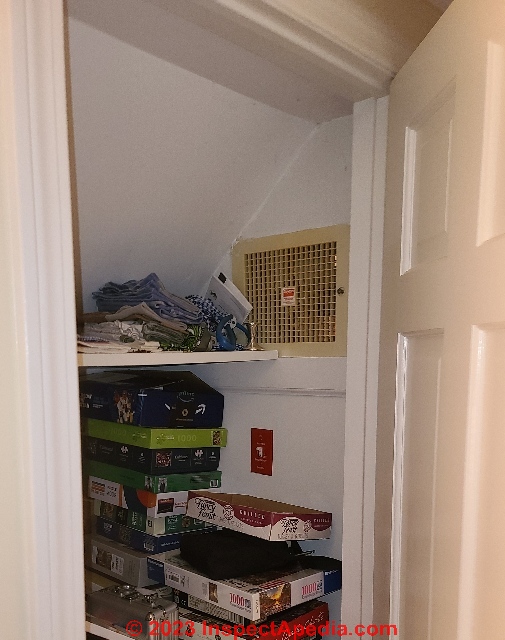
New homeowners didn't know what this red switch did, and one of them, thinking it "did nothing" thought it would be safer to turn the switch to its "OFF" position, so she did so.
Later when the weather turned cold the homeowners discovered that they had no heat, called their service technician for repair, and it was the technician who found this service switch and turned it back to "ON" so that heat could be restored.
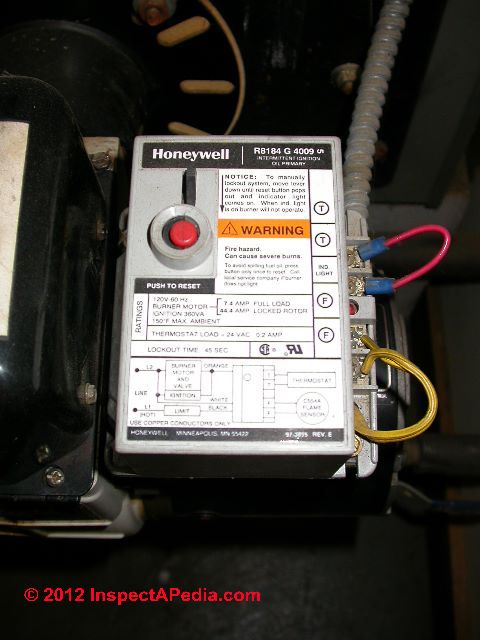
- Oil Burner safety reset switch is OFF or TRIPPED
the heating or air conditioning system may have been turned off on reset - see our "off on reset" and other advice
at CAD CELL RELAY SWITCH (modern equipment).
LP and natural gas fired heating equipment and water heaters also have safety controls including temperature limit controls and gas spillage sensors (see list of reset switches below).
For gas heat, turn off electrical power to the gas fired heater using the service switch. Wait two minutes and turn the electricity back on.
See ELECTRICAL POWER SWITCH FOR HEAT. This will reset most gas heating equipment.
For oil heat: are you sure there is no safety or reset button tripped?
Where are all the heating system reset buttons? If you are looking for the main reset button on heating equipment you'll want to
see:
AQUASTAT CONTROL FUNCTIONS
CAD CELL RELAY SWITCH (hot water boilers and some water heaters),
STACK RELAY SWITCH On older oil fired boilers and furnaces,
FLUE GAS SPILL SWITCH TRIPPING & RESET (gas fired equipment),
and
LOW WATER CUTOFF CONTROLS On steam heating systems.
At ELECTRIC MOTOR OVERLOAD RESET SWITCH we discuss the thermal overload switch and reset button that is found on many electric motors including those operating air conditioning fans, heating system oil burners, and furnace blowers and motors.
A Stack relay switch may be installed on the flue vent connector and may be in the "safety - off" position. To identify and reset this control see STACK RELAY SWITCH. Stack relays are found on older oil fired furnaces and boilers.
- Heating fuel supply - check again:
if it is a gas furnace, is the gas turned on? If your gas is from bottled or LP gas, is the tank empty? If it is an oil fired heating furnace, check the gauge on the oil tank. Are you out of oil?
See OIL TANK GAUGES.
Still no heat? Once you have assured that you have heating fuel and that electrical power is turned on to the heating unit, if you still don't have heat check these controls:
- Thermostat
is in the "off" position or is set to a temperature that does not call for heating (or cooling)
See FAN AUTO ON THERMOSTAT SWITCH for details about what turns the blower fan on and off. - Flue gas spill switch
If your heating boiler is gas-fired (natural gas or "bottled" LP gas), a flue gas spillage switch may have shut the system down after sensing possibly dangerous flue gases (that can contain fatal carbon monoxide).
See FLUE GAS SPILL SWITCH TRIPPING & RESET. This switch will not normally be found on oil fired heating equipment.
- Is there fuel for the boiler ?
check the oil tank gauge
(see OIL TANK GAUGES for tips on how to find, read,and test the oil tank gauge. If the heating boiler is fired by natural or LP gas and not oil, check that no one has shut the gas supply valves.
If the oil tank gauge says there is more than 1/4 of a tank
of oil, you might want to pull the gauge plastic cap and press down on the gauge indicator - check to see if it was stuck indicating oil when the tank is in fact empty.
If you're out of oil or gas
call your oil or gas company and request an emergency delivery. For oil systems, usually the delivery person will also need to enter the building to bleed air from the oil lines in order to get the oil burner operating again. For gas fired heating equipment the driver may want all gas appliances turned off in the building during delivery. - Oil burner motor coupling
another cause of an oil burner starting to run but never igniting at all may be a broken or slipping coupling (or a frozen coupling) between the oil burner motor and the fuel unit. In this case the burner starts in response to a call for heat, but there will be no ignition whatsoever because no oil is being delivered to the nozzle assembly. - Other reasons for no oil flow to the oil burner include:
- an oil safety valve that has been "closed"
(someone turned it the wrong way), - an oil delay valve or quick stop valve that has lost electrical power
- discussed earlier on this page - low oil or no oil in the heating oil tank
(the tank may not be completely empty but oil may be below the oil pickup line if the oil lines are exiting at the top of the tank), - a clogged oil filter or fuel unit strainer.
If the oil filter is clogging the oil burner may re-start after the system has been off for a time, but in minutes after the burner ignites the flame may begin to stumble or even go out as the fuel unit has trouble sucking oil through the filter. An inspection of the oil filter for sludge and crud clogging the filter can diagnose this problem.
While it's out, just replace the filter. - a clogged oil burner nozzle,
- an air leak in the heating oil supply piping,
or a crimp or clog or restriction in the oil piping. - If you recently ran out of oil
and then got a delivery, and if your system uses a single oil line between tank and burner, the line or fuel unit may be air bound and needs to be bled. [8]
- an oil safety valve that has been "closed"
- Is the thermostat calling for heat?
and is the temperature at the thermostat lower than the thermostat setting? - Does the oil burner start but then shut off? Is the system "off on reset"?
if so the red "reset" button will have popped up on the oil burner control (or possibly on an electric motor operating the oil burner) and the system has an operating problem and needs service. It may be possible to re-start an oil burner that has turned itself off by pressing the red reset button ONCE.
If the heating boiler or furnace re-starts and runs acceptably, you can have heat while waiting for the service technician but the system still needs inspection, service, and possibly other repairs before it can operate safely and reliably.
If you push the reset button and the burner does not start and keep running for five minutes or more, DO NOT try again as you may flood the system with oil and make restarting difficult and dangerous. - Is the oil burner motor itself off on reset?
See MOTOR OVERLOAD RESET SWITCH.
Heating Boiler Runs but No Heat is Delivered
- Boilers-Hydronic Heat: Is hot water water circulating?
- Check the hot water circulator:
Test to see if the circulator is operating Feeling the hot water distribution piping (Watch out it should be HOT!).
Feeling the piping can indicate if circulator is running or not -- a quick change in temperature means the circulator works; slow change in temperature may occur if the circulator does not work but hot water is circulating by convection.
See CIRCULATOR PUMPS & RELAYS for articles that help diagnose a circulator pump that won't start or won't stop or is noisy or leaking - Check for a bad zone valve or bad circulator pump relay.
If the building has more than one heating zone it probably uses either multiple circulator pumps, each of which is operated by a circulator relay switch that is in turn operated by a wall thermostat, or it uses multiple zone valves, each of which is operated by a thermostat.
A bad circulator motor or pump, a bad circulator relay (or even a circulator relay cover that is pressed against and jamming the relay switch), or a stuck zone valve (common on some models) will prevent heating water from circulating in that zone while other zones may work fine.
See ZONE VALVES, HEATING for diagnosis of zone valves that don't open or don't close when they should - Check hot water baseboards:
if some baseboards are hot and others cold, are they all on the same heating zone? If not, are all of the thermostats turned up?
If some heating baseboards are hot and others cold and we're sure that they're on the same zone, then the system is probably air-blocked.
See AIR-BOUND HEATING SYSTEMS to diagnose and fix air-blocked heat piping, baseboards, or radiators.
A heating circulator pump is capable of pushing water around in the loop of heating baseboard but is often not capable of overcoming a section of baseboard that contains a large bubble of air.
It's necessary to remove such air blocks. If air blocking has been recurrent a previous owner may have installed air bleeders at strategic points. The bleeder can be opened slightly and carefully, to permit air to escape.
As soon as water starts coming out of an air bleeder valve it can be closed.
Automatic air purge devices are available and are usually installed right at the heating boiler but sometimes additional ones are needed at higher levels in the building. - Check hot water radiators or convectors:
if some radiators or wall convectors are hot and others are cold, and provided that the individual feed valves located at each of these devices is open (turned counterclockwise) the radiator or convector may be air blocked. Usually an individual air bleed valve is located on each of these devices. - Check the Oil Heating Equipment Safety Controls and Switches -
see FIRE SAFETY CONTROLS for photos and details - On gas fired heaters check for flue gas spillage at the heater or for a bad flue gas spillage switch:
If your furnace is gas-fired, a flue gas spillage switch may have shut the system down after sensing possibly dangerous flue gases (that can contain fatal carbon monoxide).
See FLUE GAS SPILL SWITCH TRIPPING & RESET for details. - On oil fired boilers or furnaces check for a bad automatic draft damper switch
If the draft damper does not open in response to a thermostat's call for heat the heating appliance will not start.
How to Diagnose Soot or Noises during Heating System & Oil Burner Operation
For full details of this topic be sure to
see OIL BURNER NOISE SMOKE ODORS.
- Noises during oil burner startup
a "bang" or puffback which blows soot into the room through the barometric damper or through other equipment openings: the oil pump may not be shutting down properly at the end of an oil burn cycle, leaking incompletely burned oil into the combustion chamber.
That oil ignites at startup causing a potentially dangerous puffback. Immediate service and repair are needed. - Soot and black marks
in the living area can sometimes indicate an unsafe or poorly-functioning heating system but these marks can also be normal in some buildings depending on other conditions. Details about soot tracking are
at THERMAL TRACKING.
Watch out: Safety warning about soot: Sooting can occur with both gas fired and oil fired systems.
Soot coming from a gas fired heater is probably indicating a very dangerous condition risking carbon monoxide poisoning. If a gas fired appliance is producing soot, it should be turned off and Immediate service is needed.
See COMBUSTION AIR DEFECTS
and
also SOOT on OIL FIRED HEATING EQUIPMENT
and GAS FIRED WATER HEATERS for safety warnings about soot at heating appliances. - Noises during oil burner startup
a "rumbling" sound (which usually continues all during operation" or a "stumbling" sound in the combustion chamber probably indicates that the system needs inspection and cleaning very soon. Some noise is normal however, but the normal sounds tend to be more smooth and continuous.
See OIL BURNER CHOKING SOUND
See OIL BURNER RUMBLING NOISE - Noises during oil burner shut-down
a stumbling or rumbling after the oil burner motor has stopped, indicate that oil is continuing to leak into the combustion chamber and risks a dangerous puffback - see "Noises during oil burner startup" above. Immediate service is recommended.
See OIL BURNER SOOT & PUFFBACKS - Noises of shrieks or grinding coming from the electric motor or oil pump
On the oil burner mean that immediate service is needed - probably a bearing is failing.
See OIL BURNER SQUEALING HIGH PITCHED SOUNDS - Startup problems:
noises and clues of puff back: if you see flapping at the barometric damper or if you see or hear vibrations in the system, or if you see black soot on or near heating equipment the system may be unsafe and prompt service is needed - Noises from radiators or heating baseboards: clanking pipes
or sharp snapping noises may be heard as a normal consequence of expansion of metals during the heating cycle.
These noises can often be eliminated or reduced by careful routing of piping and by allowing room around heating pipes for expansion, but probably not eliminated in the case of hot water baseboards.
Bubbling or rumbling noises
in hot water heating piping can be caused by air in the heating lines. If the amount of air becomes excessive the system may be unable to circulate hot water and extra steps to bleed unwanted air will be required.
See OIL BURNER GURGLING
Hissing sounds
such as air escaping from radiators or other piping where air bleeder valves are installed are normal but should be brief and uncommon.
If you constantly hear air hissing from radiator bleed valves double check that you understand what kind of heat you have - hissing from bleeder valves on steam heat radiators as heat is coming up in the building is normal.
How to Evaluate Heating Boiler Leaks & Corrosion
For full details of this topic see BOILER LEAKS CORROSION STAINS
When observing evidence of leaks on a heating boiler, keep these points in mind:
- Even serious leaks may never show up as "wet" spots:
A boiler may be leaking but you may see no actual water: during the heating season the boiler may always be hot, causing small leaks on the boiler or on heating piping to simply evaporate.
But such leaks will usually be visually very evident: look for a build-up of corrosion, green or white or other colored mineral salts, or look for rust or water stains on the equipment. - Internal heating boiler leaks:
Some critical boiler leaks may be internal and not visible by simple inspection, such as a leak inside the boiler heat exchanger which may pass water into the combustion chamber. A service technician or a skilled home inspector should be able to spot evidence of these leaks. - Surface rust
light, superficial rusting, is generally repairable. Clean the area and fix the leak when the boiler is next serviced and monitor for any future leaks. - Exfoliation, or thick flaking rust
On any boiler but particularly on a steel heating boiler is very serious, possibly not repairable, and risks loss of the boiler as well as sudden loss of heat in the building. Examples of this problem are
at TANKLESS COILS - Leaks related to temperature or pressure:
Some leaks occur only at peak operating temperature-e-g at relief valve.
On some heating boilers such as some cast-iron units, leaks may occur between boiler sections when the system is cold - on these models some technicians prefer to keep a little heat in the boiler year-round to avoid this problem.
Leaks between boiler sections may be repairable but if left unattended can destroy the equipment.
A Catalog of Common Heating System Leak Points - Where to Watch for Heating System Leaks
- Tankless Coil mounting plate
- see rust stains below and around plate -
see TANKLESS COILS - Pipe fittings
anywhere in the system, including in water supply piping to a boiler, hot water distribution piping, or at face of coil plate - mineral salts and stains may show even a small leak though no water may be visible (it evaporates quickly on hot heating system components) - Leaks around bolt openings
- suspect hidden damage - Leaks between sections of a cast iron boiler
- Leaks at the circulating pump mounting flanges
- Leaks at the boiler temperature/pressure relief valve.
This leak may be very dangerous as corrosion from water passing through the valve may prevent its safe operation in an emergency.
Prompt expert inspection and repair are needed. Watch for leaks below the valve's mouth or discharge pipe (a pipe should extend from the relief valve to a few inches from the floor) or watch for corrosion at the tip of the discharge pipe. Gently feel inside the tip of this pipe to see if it's wet. DO NOT TRY TO TEST or open or operate the relief valve itself.
Watch Out: a leaky relief valve indicates an potentially very dangerous condition; prompt service is needed. - Leaks at air bleeder valves or air vents -
at the boiler or remote where such bleeders are placed on heating piping or baseboards or radiators - Leaks at radiator control valves
or between radiator sections - Leaks at heating baseboards,
at poorly-soldered copper pipe fittings on finned copper baseboard heating systems - Leaks due to frozen and burst piping
or in extreme cases, frozen and burst heating boilers themselves. Freezing pipes produce very distinctive types of damage such as splits or separation at solder joints.
How to Recognize & Diagnose Inadequate Combustion Air for Oil-Fired Heating Systems
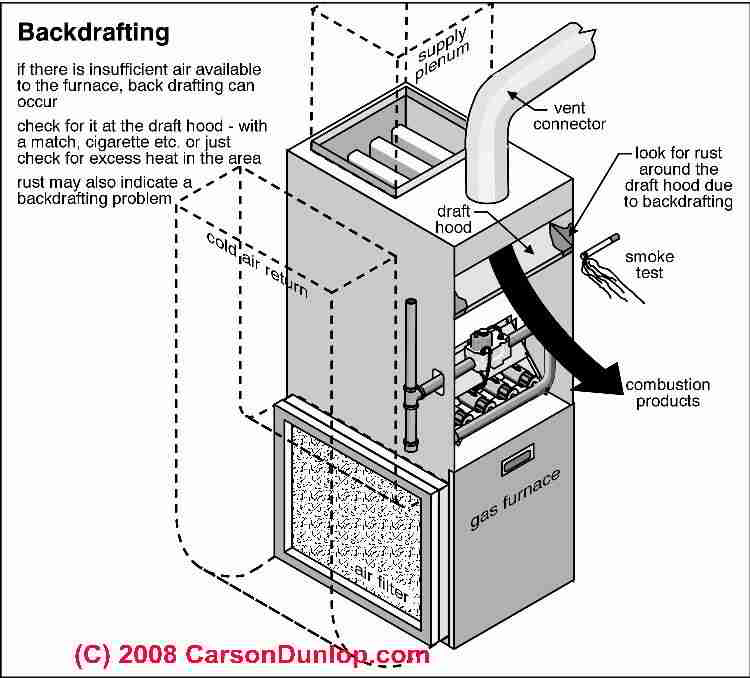
For full details of this topic
Lack of adequate combustion air
can result in improper system operation, sooting, increased heating cost, damage to oil burner components (back pressure heat can destroy an ignition transformer), higher and more frequent heating service costs, loss of heat, noises, smoke, and potentially, the production of carbon monoxide or other flue or combustion gases which escape into the building - potentially dangerous
Watch Out: The sketch shown here, courtesy of Carson Dunlop Associates, explains how dangerous furnace back-drafting can occur when there is insufficient combustion air.
These conditions can not only release flue gases into the occupied space, but they are likely to cause the production of potentially fatal carbon monoxide.
We've seen heating equipment that seemed to work just fine during its adjustment because the service technician was working with the door to the furnace or boiler room open. But when she left the system and closed the furnace room door, suddenly there was insufficient combustion air.
Also see Unsafe Air Conditioning or Heating Duct Openings which describes the risks of reduced combustion air on hot air heating systems when certain return air duct defects are present,
and also see CARBON MONOXIDE - CO
and CHIMNEY INSPECTION DIAGNOSIS REPAIR
A Guide to Heating Equipment Malfunctions & Their Implications
- Noises & soot buildup
can lead to a potentially dangerous puffback which can damage the heating equipment and blow soot and smoke throughout the building. - Leaks on hot water heating systems are never acceptable,
anywhere. Leaking relief valves need immediate attention and repair (Leaking relief valve could be due to water-logged expansion tank, improper control settings (temperature too high), improper automatic water feeder operation (pressure too high), or defective valve (leaky).
True, you only have to report the valve. Did you miss problems at the other components?) Corroded relief valves also need to be test by a service technician and repaired or replaced - Relief Valves:
Do not touch the heating boiler or water heater temperature or pressure relief valve - it may open and fail to shut down.
A relief valve which does not work is dangerous since the system is missing an important safety device. Should an over pressure or over temperature condition develop for other reasons, the boiler could explode. - Corrosion
on heating system parts: Do not pick at corrosion as you may start a catastrophic, un-stoppable leak requiring total system shut-down. Leaks left un repaired can destroy heating equipment. - Tankless coils for making hot water
If there is different water pressure/flow observed in the kitchen in which the hot water pressure is significantly less than cold, even before examining the building's mechanical systems you may speculate that a tankless coil installed may be installed.
What other clues suggest that the local water supply may be hard in minerals and that there may be a risk of clogged piping? When the water supply is high in minerals, the hot water pipes or tankless coils clog up before cold water piping. Is a water softener installed? Is there known "hard" water--have mineral deposits clogged the coil? Are there "cleanout" plumbing fittings on the tankless coil piping?
Does this suggest a history of clogging and acid-flush treatments? A clogged coil can be repaired or replaced. How severe was that rust you observed at the tankless coil mounting plate? Severe rust may mean that the boiler must be replaced.
Examples of Heating System Defects with Important Implications
- Lack of adequate combustion air
can result in improper system operation, sooting, loss of heat, noises, smoke, and potentially, the production of carbon monoxide or other flue or combustion gases which escape into the building - potentially dangerous - Leaky oil at an oil burner ignition transformer
watch for back pressure in combustion chamber--watch out for blocked heating flue or blocked chimney - these would be unsafe, or the heater may be unreliable. An unreliable heater can lead to frozen burst pipes and costly building damage. A blocked chimney could lead to a potentially fatal carbon monoxide hazard. - Unusual interior moisture conditions, noises, smoke, or odors
during heating season--watch for blocked chimney or poor flue vent connections - Equipment recalls
Specific heating system problem brands Repco, Blueray etc.
[Do not confuse Repco™ heating boilers, which had fire chamber and other failures, with other products (REPCO pumps, REPCO controls, REPCO water conditioners, or water treatment that carry the Repco name. Those products are distinct from REPCO heating boilers and are produced/distributed by the R.E. Prescott Company.
Further, we are unaware of any remaining warranty or replacement support for failed or antiquated Repco heating boilers.]
Reader Q&A - also see the FAQs series linked below
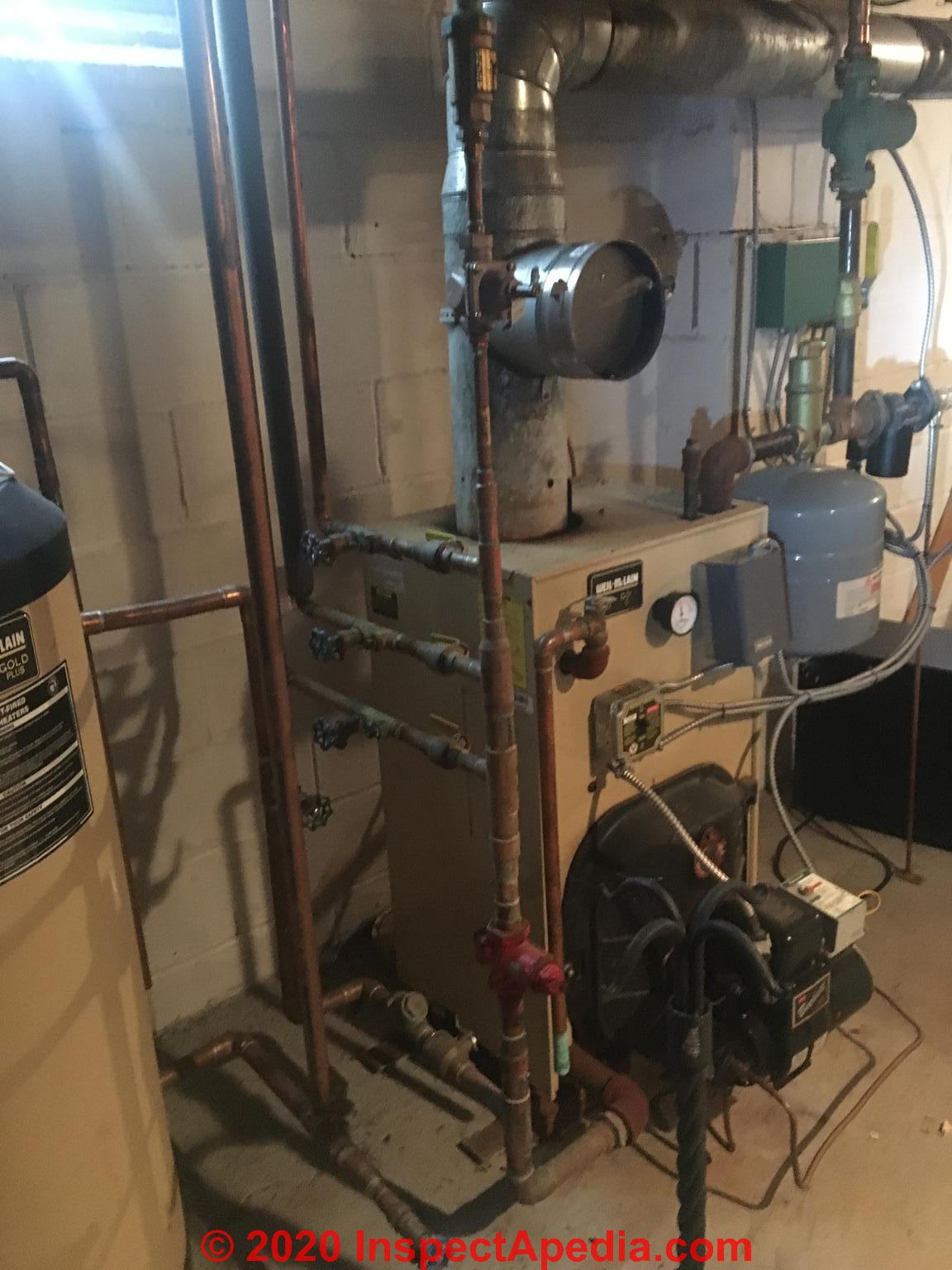
On 2020-09-23 by Tony - heating baseboards don't get hot
I had a Navida Tankless water heater installed for hot water only, the big water tank was removed from my oil burning system for the baseboard heaters,
Now my baseboard heaters are not getting hot, the boiler is at 180 and the hot water seams to be going out back the baseboards are not hot, and the return lines are cold,
Was the hot water tank needed to still run the baseboard heaters ?
On 2020-09-23 - by (mod)
Tony
It's possible that the settings on your aquastat are incorrect.In the ARTICLE INDEX you will see an AQUASTAT SETTINGS article on what the proper settings are.
If your control is set, for example, with the LO too close to or above the HI then the circulator pump won't run and hot water won't be sent to the baseboards.
On 2020-05-14 by JERRY - very smoky oil burner flame
boiler will purge , ignition is immediate after purge ,fires thru trial period very smoky, goes to hard lockout after trial period
Has new nozzle , cleaned boiler, new cad cell , cleaned screen on pump.air settings the same as it has always run
any ideas on what is causing failure
On 2020-05-15 - by (mod) -
Jerry,
That smoky flame tells us the oil burner is out if adjustment and so locking out is normal.
On 2020-02-21 by John - How do I set dial and locking arm on Honeywell L4080B 1212 Aquastat?
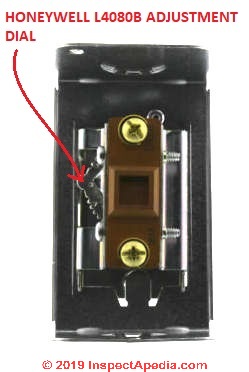 How do I set dial and locking arm on Honeywell L4080B 1212 Aquastat?
This is a Two stage HI B 85/50 Hydrotherm boiler.
Boiler will not go from hi fire to low fire after return water reaches its maximum setting.
Please advise
On 2020-02-21 2 - by (mod) -
Also can you post a photo of your boiler and another of its data tag (one image per comment) ? I don't have a Hydrotherm HI B 85/50 boiler manual nor can I find that exact boiler name.
I'm looking into the question in more-detail John and will report back.
If you don't have it, the manual for your aquastat is at
i HONEYWELL L4080B AQUASTAT MANUAL [PDF]that also covers the HONEYWELL L8080A AQUASTAT MANUAL [PDF]
Honeywell's own website provides no literature for the L4080 / L8080 nor does the company list a replacement, though the L4080 - series and L8080- series aquastats are certainly listed as a available by many supply houses.
Also the Honeywell L7224U might suit.
But to the point of your question, I don't see that the L4080 has within itself specific provision for dual fire-level boilers.
The L4040B aquastat is a simple high limit aquastat controller with a single adjustable set-point using an internal dial inside the aquastat.
On 2020-01-21 by Mike - only 1 of the 2 boiler pipes gets hot
There’s 2 pipes coming out of burner one gets hot the other staying cold and burner runs for a few minutes and shuts off.
On 2020-01-22 - by (mod) -
Mike
Is the boiler's burner shutting off because it's reaching the hi limit, because the thermostat is satisfied, or because of an operating problem?
About the line that doesn't get hot, in the ARTICLE INDEX above see AIRBOUND HEATING SYSTEM for troubleshooting and repairAlso look for a circulator that's not coming on or a valve closed in the heating line.
On 2019-12-19 by jimmy45 - our baseboards get warm but not hot enough and house takes a long time to get up to temperature
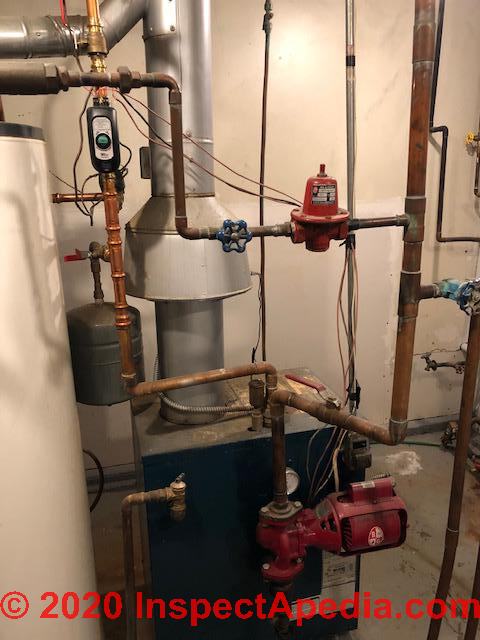 Thank you for taking the time
Our home is a late 60's pre-built with 1150 square feet. We have a Weil-mclain CG 11 hot water boiler, Taco sentry zone valve on the supply side, and I think the issue is with the zone valve.
We use 10% LP on a 500 gal. tank a week. When the thermostat calls, the zone valve closes, the boiler fires, as does the circulator.
The baseboards get warm to the touch, but not 180 degree hot. Once the heat is reached, the boiler stops as does the circulator, and the zone valve opens.
We have our thermo set at 65, it turns out around 63 degrees, and shuts of around 66. It takes close to an hour to raise 3 degrees.
Is this much LP normal?
How has no damage occurred with the circulator running and the zone valve closed?
Thank you for your time
On 2019-12-19 b (mod) - Weil-mclain CG 11 hot water boiler gas usage rate
Jimmy
First: perhaps you mis-typed but you said
The baseboards get warm to the touch, but not 180 degree hot. Once the heat is reached, the boiler stops as does the circulator, and the zone valve opens.
That's not right. The zone valve OPENS to let hot water circulate to the baseboards and CLOSES at the end of a call for heat to that zone.So if your zone valve is really working backwards that would explain why it takes forever to heat your home.
When the zone valve is CLOSED but the boiler and circulator are running, NO hot water circulates through that heating zone - it won't get warm.
Then when the boiler and circulator STOP if the zone valve OPENS then the remaining hot water in the boiler will circulate slowly by convection and your house will slowly get some but not enough heat.
Finally: I can't guess how much LP gas use is normal for your home because the amount of fuel needed and heat output needed to warm a home varies significantly by the home's rate of heat loss (how well a home is insulated, how much air leakage there is, how much glass there is, how much opening and closing of windows and doors occurs, etc).
But there are some sanity checks that one can make.
1. Look at the heating boiler's data tag where you'll see the input BTUh consumption rate of your boiler.
At GAS BTUH, CUBIC FEET & ENERGY we give all of the ways to convert between cubic feet or other measures of LPG and btus. You can thus start by seeing the rate per hour (of "on" time) at which your boiler consumes fuel.
You'll need to watch or measure or count hours-on for your boiler.
2. Have your heating service tech be sure that the boiler is properly tuned and adjusted. If your boiler's HI limit is set to 180degF that does NOT mean that the baseboard pipes will ever see that temperature; there is heat loss enroute;
However your tech might agree to push up the HI to 190 or closer to 200F (not above that or the TPR valve will open); the thermal conductivity of baseboard is exponentially greater at higher temperatures so you'll see a bit more efficient heat transfer into the occupied space.
3. InspectApedia offers a number of articles on cutting heating cost by finding where the waste or leaks are.
Two articles I like are
ENERGY SAVINGS PRIORITIES
and
HEATING COST SAVINGS METHODS
3. There are plenty of additional heat savings articles recommended at those pages I just cited.
...
Continue reading at BOILER OPERATING PROBLEMS or select a topic from the closely-related articles below, or see the complete ARTICLE INDEX.
Or see BOILER REPAIR DIAGNOSTIC FAQs - questions & answers posted originally at this page.
Or see this
Article Series Contents
- BOILERS, HEATING
- BOILER OPERATING PROBLEMS
- HEATING SYSTEM TYPES if you don't know what type of heating system you have
- OIL BURNER INSPECTION & REPAIR
- OIL BURNER NOISE SMOKE ODORS - home
- GAS BURNER FLAME & NOISE DEFECTS
- GAS BURNER SOOT CAUSE & CURE
- GAS BURNER PILOT LIGHT PROCEDURE
- RADIATORS - topic home, for cold radiator or baseboard diagnosis and repair
Suggested citation for this web page
DIAGNOSE & FIX HEATING PROBLEMS-BOILER at InspectApedia.com - online encyclopedia of building & environmental inspection, testing, diagnosis, repair, & problem prevention advice.
Or see this
INDEX to RELATED ARTICLES: ARTICLE INDEX to HEATING BOILERS
Or use the SEARCH BOX found below to Ask a Question or Search InspectApedia
Ask a Question or Search InspectApedia
Try the search box just below, or if you prefer, post a question or comment in the Comments box below and we will respond promptly.
Search the InspectApedia website
Note: appearance of your Comment below may be delayed: if your comment contains an image, photograph, web link, or text that looks to the software as if it might be a web link, your posting will appear after it has been approved by a moderator. Apologies for the delay.
Only one image can be added per comment but you can post as many comments, and therefore images, as you like.
You will not receive a notification when a response to your question has been posted.
Please bookmark this page to make it easy for you to check back for our response.
Our Comment Box is provided by Countable Web Productions countable.ca
Citations & References
In addition to any citations in the article above, a full list is available on request.
- Domestic and Commercial Oil Burners, Charles H. Burkhardt, McGraw Hill Book Company, New York 3rd Ed 1969.
- National Fuel Gas Code (Z223.1) $16.00 and National Fuel Gas Code Handbook (Z223.2) $47.00 American Gas Association (A.G.A.), 1515 Wilson Boulevard, Arlington, VA 22209 also available from National Fire Protection Association, Batterymarch Park, Quincy, MA 02269. Fundamentals of Gas Appliance Venting and Ventilation, 1985, American Gas Association Laboratories, Engineering Services Department. American Gas Association, 1515 Wilson Boulevard, Arlington, VA 22209. Catalog #XHO585. Reprinted 1989.
- The Steam Book, 1984, Training and Education Department, Fluid Handling Division, ITT [probably out of print, possibly available from several home inspection supply companies] Fuel Oil and Oil Heat Magazine, October 1990, offers an update,
- "Residential Hydronic (circulating hot water) Heating Systems", Instructional Technologies Institute, Inc., 145 "D" Grassy Plain St., Bethel, CT 06801 800/227-1663 [home inspection training material] 1987
- "Warm Air Heating Systems". Instructional Technologies Institute, Inc., 145 "D" Grassy Plain St., Bethel, CT 06801 800/227-1663 [home inspection training material] 1987
- Heating, Ventilating, and Air Conditioning Volume I, Heating Fundamentals,
- Boilers, Boiler Conversions, James E. Brumbaugh, ISBN 0-672-23389-4 (v. 1) Volume II, Oil, Gas, and Coal Burners, Controls, Ducts, Piping, Valves, James E. Brumbaugh, ISBN 0-672-23390-7 (v. 2) Volume III, Radiant Heating, Water Heaters, Ventilation, Air Conditioning, Heat Pumps, Air Cleaners, James E. Brumbaugh, ISBN 0-672-23383-5 (v. 3) or ISBN 0-672-23380-0 (set) Special Sales Director, Macmillan Publishing Co., 866 Third Ave., New York, NY 10022. Macmillan Publishing Co., NY
- Installation Guide for Residential Hydronic Heating Systems
- Installation Guide #200, The Hydronics Institute, 35 Russo Place, Berkeley Heights, NJ 07922
- The ABC's of Retention Head Oil Burners, National Association of Oil Heat Service Managers, TM 115, National Old Timers' Association of the Energy Industry, PO Box 168, Mineola, NY 11501. (Excellent tips on spotting problems on oil-fired heating equipment. Booklet.)
- Thanks to Bottini Fuel service manager Ron Thomas for discussing aquastat functions, low limit controls, oil burner short cycling causes, and boiler maintenance, reliability, and service contracts 4/13/2010. Bottini Fuel is a residential and commercial heating oil distributor and oil heat service company in Wappingers Falls, NY and with offices in other New York locations. Bottini Fuel, 2785 W Main St, Wappingers Falls NY, 12590-1576 (845) 297-5580 more contact information for Bottini Fuel
- In addition to citations & references found in this article, see the research citations given at the end of the related articles found at our suggested
CONTINUE READING or RECOMMENDED ARTICLES.
- Carson, Dunlop & Associates Ltd., 120 Carlton Street Suite 407, Toronto ON M5A 4K2. Tel: (416) 964-9415 1-800-268-7070 Email: info@carsondunlop.com. Alan Carson is a past president of ASHI, the American Society of Home Inspectors.
Thanks to Alan Carson and Bob Dunlop, for permission for InspectAPedia to use text excerpts from The HOME REFERENCE BOOK - the Encyclopedia of Homes and to use illustrations from The ILLUSTRATED HOME .
Carson Dunlop Associates provides extensive home inspection education and report writing material. In gratitude we provide links to tsome Carson Dunlop Associates products and services.
 | HOME | ABOUT | ASK a QUESTION | CONTACT | CONTENT USE POLICY | DESCRIPTION | POLICIES | PRIVACY | |
| © 2024 - 1985 Publisher InspectApedia.com - Daniel Friedman | |||||||||