
InspectAPedia® FREE Encyclopedia of Building & Environmental Construction, Diagnosis, Maintenance & Repair |
Question? Just ask us! InspectAPedia
|
 Well Construction & Maintenance
5 Details to Avoid Well Pollution
- POST a QUESTION or COMMENT about how to construct & maintain a water well in order to avoid well contamination
On this page at RECOMMENDED ARTICLES we provide links to the key starting places to find procedures for well construction: how to drill a well or how to dig a "hand dug" well.
Immediately below we include some well construction details to avoid polluted well water.
Proper well construction and continued maintenance are keys to the safety of your water supply. Your state water-well contractor licensing agency, local health department, or local water system professional can provide information on well construction.
The well [well casing head, which in a modern well should be protruding above ground] should be located so rainwater flows away from it. Rainwater can pick up harmful bacteria and chemicals on the land's surface. If this water pools near your well, it can seep into it, potentially causing health problems.
InspectAPedia tolerates no conflicts of interest. We have no relationship with advertisers, products, or services discussed at this website.
Well Construction and Maintenance Details to Help Avoid Well Water Contamination
 1. Proper Surface Runoff Control Around a Well
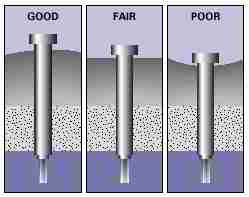
Here we show first, three types of well locations and how surface water drains.
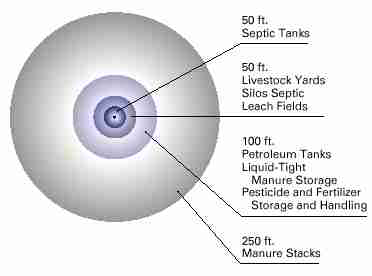
A second illustration (below) lists the distances from the well to guard against possible sources of pollution.
[Click to enlarge any image]
Don't assume that if your well is drilled in a spot with good surface drainage away from the casing top (the "good" example at left n the illustration .
Proper drainage at the surface helps assure that contaminated water won't leak into the well from below ground.
2. Proper Distance from Well Contamination Sources
But that's not the whole story.
Underground features such as buried sloping rock can still direct contaminated water into a well below ground, particularly if there are leaks in the casing or if the contaminated water is reaching the aquifer that feeds the well.
To keep your well safe, you must be sure possible sources of contamination are not close by.
Experts suggest the well separation distances [shown in the illustration above] as a minimum for protection - farther is better.
See details of the recommended water well distances from just about every imaginable possible source of well contamination, found at
3. Provide a Sanitary Seal Cap on the Well
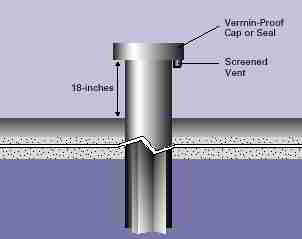 The graphic [at left] shows a good example of an animal-proof cap or seal and the casing of a well.
Protect your own well area from contaminants.
- Be careful about storage and disposal of household and lawn care chemicals and wastes.
- Good farmers and gardeners minimize the use of fertilizers and pesticides.
- Take steps to reduce erosion and prevent surface water runoff.
- Regularly check underground storage tanks that hold home heating oil, diesel, or gasoline.
- Make sure your well is protected from the wastes of livestock, pets, and wildlife.
- An animal or vermin proof cap prevents rodents from entering your well, being trapped and dying.
- Paving around your well will prevent polluted runoff from seeping into your water supply.
4. Well Maintenance Avoids Drinking Contaminated Water
Many homeowners tend to forget the value of good maintenance until problems reach crisis levels. That can be expensive.
You should test your well water for basic contaminants. If none are found, you may begin to increase the frequency of well water testing from annual to a bit less often.
But if contaminants are found you'll need to find and fix the source of contamination if possible, and if not, then you'll need to add well water treatment such as a disinfection system.
It's better to maintain your well, find problems early, and correct them to protect your well's performance.
Keep up-to-date records of well installation and repairs plus pumping and water tests.
Such records can help spot changes and possible problems with your water system.
If you have problems, ask a local expert to check your well construction and maintenance records. He or she can see if your system is okay or needs work.
See details at DRINKING WATER TESTING
and at FAILED WATER TESTS - WHAT TO DO
Also see FLOOD CONTAMINATED WELL RESTORE & PROTECT where we discuss the importance of protecting a well from polluted groundwater, of protecting groundwater from accidental pollution through open wells, and also how to return a well to operation and use after area flooding.
5. Get Well Inspection, Repair, or Construction Help from an Expert
Water-well drillers and pump-well installers are listed in your local phone directory.
The contractor should be bonded and insured. Make certain your ground water contractor is registered or licensed in your state, if required.
If your state does not have a licensing/registration program contact the National Ground Water Association. or the Well Drillers Association - listed below/.They have a voluntary certification program for contractors. (In fact, some states use the Association's exams as their test for licensing.)
- [US] National Ground Water Association NWGA, National Ground Water Association
601 Dempsey Rd.
Westerville, OH 43081 USA, Web: https://www.ngwa.org/ Email: customerservice@ngwa.org Tel: (800) 551-7379 (614) 898-7791
Website excerpts: The National Ground Water Association is a private nonprofit organization representing the professionals involved in the groundwater industry: scientists and engineers, water well drilling contractors and pump installers, and equipment manufacturers and suppliers.
A water well is any test hole or other excavation into the Earth that is drilled, cored, bored, washed, fractured, driven, dug, jetted, or otherwise constructed when intended use of such excavation is for the location, monitoring, dewatering, observation, diversification, artificial recharge, or acquisition of groundwater or for conducting pumping equipment or aquifer tests. It may be open (uncased and unscreened) or a portion may be cased or screened.
The association provides these Best Suggested Water Well Practices
BSPs already published (board-approval date noted in parentheses)
Watch out: while the NWGA documents below are free to members they are remarkably expensive for non members - every one of the NWGA articles below is priced at $150.00 U.S. for non-members! As a no-cost alternative, live links we provide below are to free articles and PDF downloads from other expert sources - Ed.
See WATER TESTS for CONTAMINANTS - home as well as the water contaminant topics below.- Best Suggested Practices for Aquifer Storage and Recovery (7-16-2014)
- Managing a Flowing Water Well (2-20-2010; references updated 9-16-2010)
- Reduce and Mitigate Problematic Concentrations of Methane in Residential Water Well Systems (8-21-2013)
See METHANE GAS SOURCES - Reducing Problematic Concentrations of Arsenic in Residential Water Well Systems (5-19-2016)
See ARSENIC in DRINKING WATER - Reducing Problematic Concentrations of Boron in Residential Water Well Systems (5-15-2019)
- Reducing Problematic Concentrations of Fluoride in Residential Water Well Systems (9-18-2013)
- Reducing Problematic Concentrations of Hydrogen Sulfide in Residential Water Well Systems (8-21-2013
See WATER ODOR DIAGNOSIS - SULPHUR - Reducing Problematic Concentrations of Iron and Manganese in Residential Water Well Systems (9-18-2013)
See WATER FILTERS - SEDIMENT & IRON
See WATER TREATMENT EQUIPMENT CHOICES other water treatment options besides filters. - Reducing Problematic Concentrations of Lead in Residential Water Well Systems (6-15-2016)
See LEAD IN DRINKING WATER, HOW to REDUCE - Reducing Problematic Concentrations of Microorganisms in Residential Water Well Systems (9-18-2013)
See BACTERIA LEVELS in WATER, INTERPRETATION
See COLIFORM STANDARDS for DRINKING WATER
See WELL CHLORINATION SHOCKING PROCEDURE
- Reducing Problematic Concentrations of Nitrates in Residential Water Well Systems (9-18-2013)
See SEPTIC SYSTEM NITROGEN HARM [PDF] - Nitrogen Removal Fact Sheet [PDF] Washington State DOH, Nitrogen Removal Fact Sheet - original source www.doh.wa.gov/Portals/1/Documents/4450/337-142-Nitrogen-Removal-from-OSS-FactSheet.pdf - Reducing Problematic Concentrations of Perchlorate in Residential Water Well Systems (8-21-2013)
- Reducing Problematic Concentrations of Radon in Residential Water Well Systems (9-18-2013)
See RADON IN WATER - Reducing Problematic Concentrations of Strontium in Residential Water Well Systems (9-18-2013)
- Reducing Problematic Concentrations of Uranium in Residential Water Well Systems (3-19-2014)
- Residential Water Well Disinfection Following a Flood Event: Procedures for Water Well System Professionals (5-15-19)
or see our free page: FLOOD CONTAMINATED WELL RESTORE & PROTECT - Residential Well Cleaning (2-18-2015)
See WELL CLEANING PROCEDURES - Water Well Systems for Fire Protection Services for Stand-Alone Housing Units of Four or Fewer (2-19-2014)
- Water Well Systems Inspection (2-17-2016)
See WELLS CISTERNS & SPRINGS - home
- [US] Well Drillers Association - Web: https://www.welldrillers.org/ Email: secretary@welldrillers.org
- Harter, Thomas, WATER WELL DESIGN and CONSTRUCTION [PDF] (2003) University of California, Division of Agriculture and Natural Resources, UC Davis,
There is no cost for mailing or faxing the list to you.
See details at CONSULT LOCAL WELL EXPERTS
---
This text describes types of activities in your area that can create threats to your water supply. It also describes problems to look for and offers maintenance suggestions.
Initial Source: EPA 816-K-02-003 January 2002. Edits, content addition, & web page design
Editing and expansion for clarity have been done by InspectApedia.com.
...
Continue reading at SIX STEPS to WELL WATER SAFETY or select a topic from the closely-related articles below, or see the complete ARTICLE INDEX.
Or see these
Recommended Articles
- CHLORINATION WELL SHOCKING PROCEDURE
- CISTERNS, WATER STORAGE
- DRILLED WELLS, STEEL CASINGS
- DRIVEN POINT WELLS
- FLOOD CONTAMINATED WELL RESTORE & PROTECT
- HAND DUG WELLS - topic home
- HAND DUG WELL PROCEDURE - home
- SIX STEPS to WELL WATER SAFETY
- SPRINGS as WATER SUPPLY
- WATER TREATMENT EQUIPMENT CHOICES
- WATER POLLUTANT SOURCES
- WATER PUMP CAPACITIES TYPES RATES GPM
- WATER PUMP CONTROLS & SWITCHES - home
- WATER QUALITY TESTS, CONTAMINANTS, TREATMENT
- WATER TANK: USES, TROUBLESHOOTING - home
- WATER TESTS for CONTAMINANTS - home
- WATER WELL CONTAMINATION HAZARDS
- WELL CAPS & COVERS
- WELL CASING LEAK REPAIRS
- WELL CLEANING PROCEDURES
- WELL CLEARANCE DISTANCES
- WELL CONSTRUCTION INFORMATION SOURCES
- WELL CONSTRUCTION & MAINTENANCE
- WELL DEPTH, HOW TO MEASURE
- WELL DISINFECTION PROCEDURE, POST FLOODING
- WELL FLOW RATE
- WELL LIFE EXPECTANCY
- WELL LOCATION, HOW TO FIND
- WELL PIPING FOOT VALVES
- WELL PIPING TAIL PIECE
- WELL WATER CONTAMINATION: CAUSES, CURES - home
- WELL WATER PRESSURE DIAGNOSIS - home
- WELLS CISTERNS & SPRINGS - home
Suggested citation for this web page
WELL CONSTRUCTION & MAINTENANCE at InspectApedia.com - online encyclopedia of building & environmental inspection, testing, diagnosis, repair, & problem prevention advice.
Or see this
INDEX to RELATED ARTICLES: ARTICLE INDEX to WATER SUPPLY, PUMPS TANKS WELLS & SPRINGS
Or use the SEARCH BOX found below to Ask a Question or Search InspectApedia
Ask a Question or Search InspectApedia
Questions & answers or comments about how to construct & maintain a water well in order to avoid well contamination.
Try the search box just below, or if you prefer, post a question or comment in the Comments box below and we will respond promptly.
Search the InspectApedia website
Note: appearance of your Comment below may be delayed: if your comment contains an image, photograph, web link, or text that looks to the software as if it might be a web link, your posting will appear after it has been approved by a moderator. Apologies for the delay.
Only one image can be added per comment but you can post as many comments, and therefore images, as you like.
You will not receive a notification when a response to your question has been posted.
Please bookmark this page to make it easy for you to check back for our response.
Our Comment Box is provided by Countable Web Productions countable.ca
Citations & References
In addition to any citations in the article above, a full list is available on request.
- [1] Drinking Water from Household Wells - PDF, U.S. EPA, Original source last retrieved 2/13/2013, original source: http://www.epa.gov/privatewells/pdfs/household_wells.pdf
- Access Water Energy, PO Box 2061, Moorabbin, VIC 3189, Australia, Tel: 1300 797 758, email: sales@accesswater.com.au Website: http://www.accesswater.com.au/
Moorabbin Office: Kingston Trade Centre, 100 Cochranes Rd, Moorabbin, VIC 3189
Australian supplier of: Greywater systems, Solar power to grid packages, Edwards solar systems, Vulcan compact solar systems, water & solar system pumps & controls, and a wide rage of above ground & under ground water storage tanks: concrete, steel, plastic, modular, and bladder storage tanks. - Our recommended books about building & mechanical systems design, inspection, problem diagnosis, and repair, and about indoor environment and IAQ testing, diagnosis, and cleanup are at the InspectAPedia Bookstore. Also see our Book Reviews - InspectAPedia.
- In addition to citations & references found in this article, see the research citations given at the end of the related articles found at our suggested
CONTINUE READING or RECOMMENDED ARTICLES.
- Carson, Dunlop & Associates Ltd., 120 Carlton Street Suite 407, Toronto ON M5A 4K2. Tel: (416) 964-9415 1-800-268-7070 Email: info@carsondunlop.com. Alan Carson is a past president of ASHI, the American Society of Home Inspectors.
Thanks to Alan Carson and Bob Dunlop, for permission for InspectAPedia to use text excerpts from The HOME REFERENCE BOOK - the Encyclopedia of Homes and to use illustrations from The ILLUSTRATED HOME .
Carson Dunlop Associates provides extensive home inspection education and report writing material. In gratitude we provide links to tsome Carson Dunlop Associates products and services.
 | HOME | ABOUT | ASK a QUESTION | CONTACT | CONTENT USE POLICY | DESCRIPTION | POLICIES | PRIVACY | |
| © 2024 - 1985 Publisher InspectApedia.com - Daniel Friedman | |||||||||