
InspectAPedia® FREE Encyclopedia of Building & Environmental Construction, Diagnosis, Maintenance & Repair |
Question? Just ask us! InspectAPedia
|
 Zinsco & GTE-Sylvania-Zinsco Circuit Breakers Failure Mechanisms

- POST a QUESTION or COMMENT about Zinsco & Zinsco-Sylvania electric panels & circuit breakers
How & why do Zinsco breakers or electrical panels fail?
Here we describe & provide photographs of the apparent failure mechanism involved with Zinsco and GTE-Sylvania-Zinsco electrical panels and circuit breakers. We include field photographs of Zinsco equipment failures from a variety of sources.
This article series discusses the electrical, fire, and shock hazards associated with Zinsco electrical components, circuit breakers, electrical panels, including certain Sylvania electrical panels and breakers which are in fact of the same product design and origin.
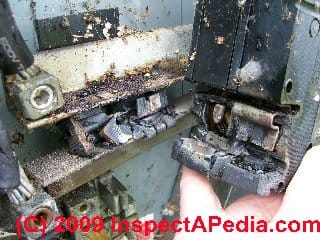
Our page top photo of a burned Zinsco main circuit breaker and burned greased Zinsco electrical panel bus was provided by Washington state electrician J. P. Simmons
InspectAPedia tolerates no conflicts of interest. We have no relationship with advertisers, products, or services discussed at this website.
- Daniel Friedman, Publisher/Editor/Author - See WHO ARE WE?
Failure Mechanisms for Zinsco or Zinsco-Sylvania Electric Panels and Circuit Breakers
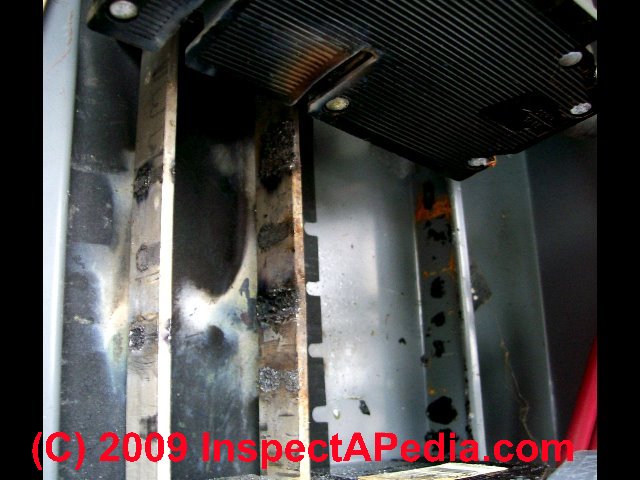 Our photo (left, courtesy of J. P. Simmons) shows the typical Zinsco or Zinsco-Sylvania electrical panel main bus damage from arcing.
- Arcing and/or overheating (see ZINSCO OVERHEAT IR PHOTOS), or a similar failure process occurs at the connection of the circuit breaker to the electrical panel bus damage the bus, the breaker, and the connection, making the electrical contact unreliable and leading to equipment failure.
- Circuit breakers become damaged by arcing or overheating. Damaged circuit breakers are unlikely to perform properly in response to an overcurrent condition.
- Aluminum electrical panel components appear to be an important factor in failures in this equipment
- Moisture exposure appears to be a factor in failures in this equipment.
Types of Zinsco Panel and Circuit Breaker Failures
- Circuit breakers may fail to trip in response to an overcurrent condition. This is a fire and shock risk.
- Circuit breakers may "blow out" the side casing of the device in an electrical "arc explosion"
- Circuit breakers may fail to drop power even when they are switched off [remains to be verified--DF] - that is, the breaker may appear to be switched to the "off" position but internally it may still be conducting power to the circuit.
At OK to USE ZINSCOS? we report on a different viewpoint from a vendor who continues to market this equipment and feels that at its price point in the market this product is reasonable to use, and who opines that when Zinsco equipment fails (burn ups, failures to trip) it is because it was "over-used" at too-demanding an amperage draw. Our view is that it is just under that condition that a circuit breaker should trip off.
Question: modify the GTE-Sylvania Zinsco Panel or just swap it out?
 I am a homeowner with a GTE-Sylvania (Zinsco) electrical panel that has
served me well enough for 30 years. I now have two breakers that do not
supply electricity to the circuit anymore.
I am a homeowner with a GTE-Sylvania (Zinsco) electrical panel that has
served me well enough for 30 years. I now have two breakers that do not
supply electricity to the circuit anymore.
There are plenty of replacement UBI breakers at my local Ace Hardware, but I cannot get the failed breakers out of the panel.
I could replace the aluminum buss bars with copper plated ones (I think), but you have encouraged me to get the whole panel replaced instead. - Anonymous by private email 2018/02/101
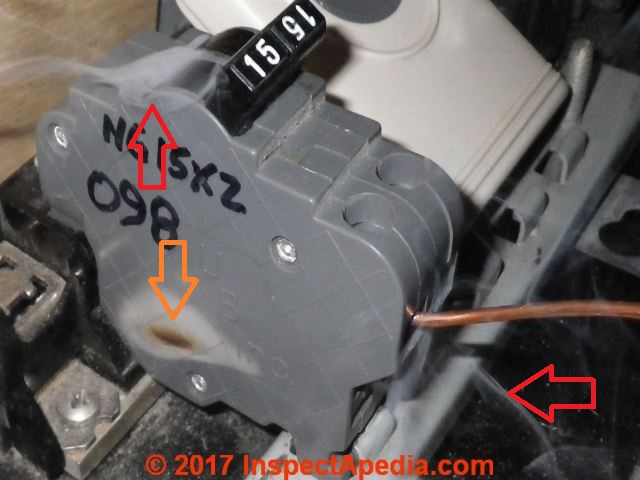
Photo: a replacement UBI circuit breaker showing burn marks and overheating.
Reply: best to replace the panel
Anon: I would replace the electrical panel, just as you've decided to do.
While we'd have been thrilled to find new replacement circuit breakers that eliminated the poor performance of several electrical panel and circuit breaker brands that have performed poorly (and thus in our opinion are UNSAFE) there are compelling arguments to eschew replacing breakers for replacing the entire panel. These include:
- Performance of replacement circuit breakers for these older "problem" electrical panels has been found to be about as unreliable as those being replaced
See UBI FPE CIRCUIT BREAKER TEST RESULTS for test results that were indeed disappointing. - Modifying an electrical panel in a do-it-yourself project such as replacing aluminum bus bars with copper may be unsafe, inexpert, may fail to fully understand and address all of the underlying safety problems, and can give you a future problem with a fire insurance claim should a loss occur.
For example, in some problem electrical panels the underlying issues are found in both the panel bus design and in the circuit breaker performance.
However there are bolt-in complete replacements of panel bus assemblies that can work in some situations.
See FPE REPLACEMENT PANEL where we discuss Eaton Cutler-Hammer replacement panel bus assemblies that fit in some older FPE panel boxes. - Often an older electrical panel is under-sized and a new one of same space may be overloaded from day-one.
Reader Follow-up:
I got the Zinsco panel replaced.
The new panel had to be installed in a different place... previous owner had build a room addition around the old one, so there was no longer 3 ft of clearance in front of it.
The Zinsco panel had been full, so we upgraded to a 200 amp panel, from 125 amp--this increased the cost by less than 10%, which I considered to be trivial. We had to upgrade the grounding.
My electric contractor emptied the old panels and used the housings as junction boxes, to connect the wires leading to the new panel.
We gave the contractor the contents of the Zinsco panel, and the new $60 UBI breaker I had bought and could not install. I hope these do him more good than harm. I have ordered a cover plate to fill the socket where the electric meter used to be.
The new panel is by Siemens. I don't expect to have to replace a breaker for 30 years, and I don't expect to live that long. If we need additional circuits, we can add them. I think the house is safer now, and when it comes time to sell, there will be one less thing to fix. - Anonymous by private email 2018/04/12
...
Reader Comments, Questions & Answers About The Article Above
Below you will find questions and answers previously posted on this page at its page bottom reader comment box.
Reader Q&A - also see RECOMMENDED ARTICLES & FAQs
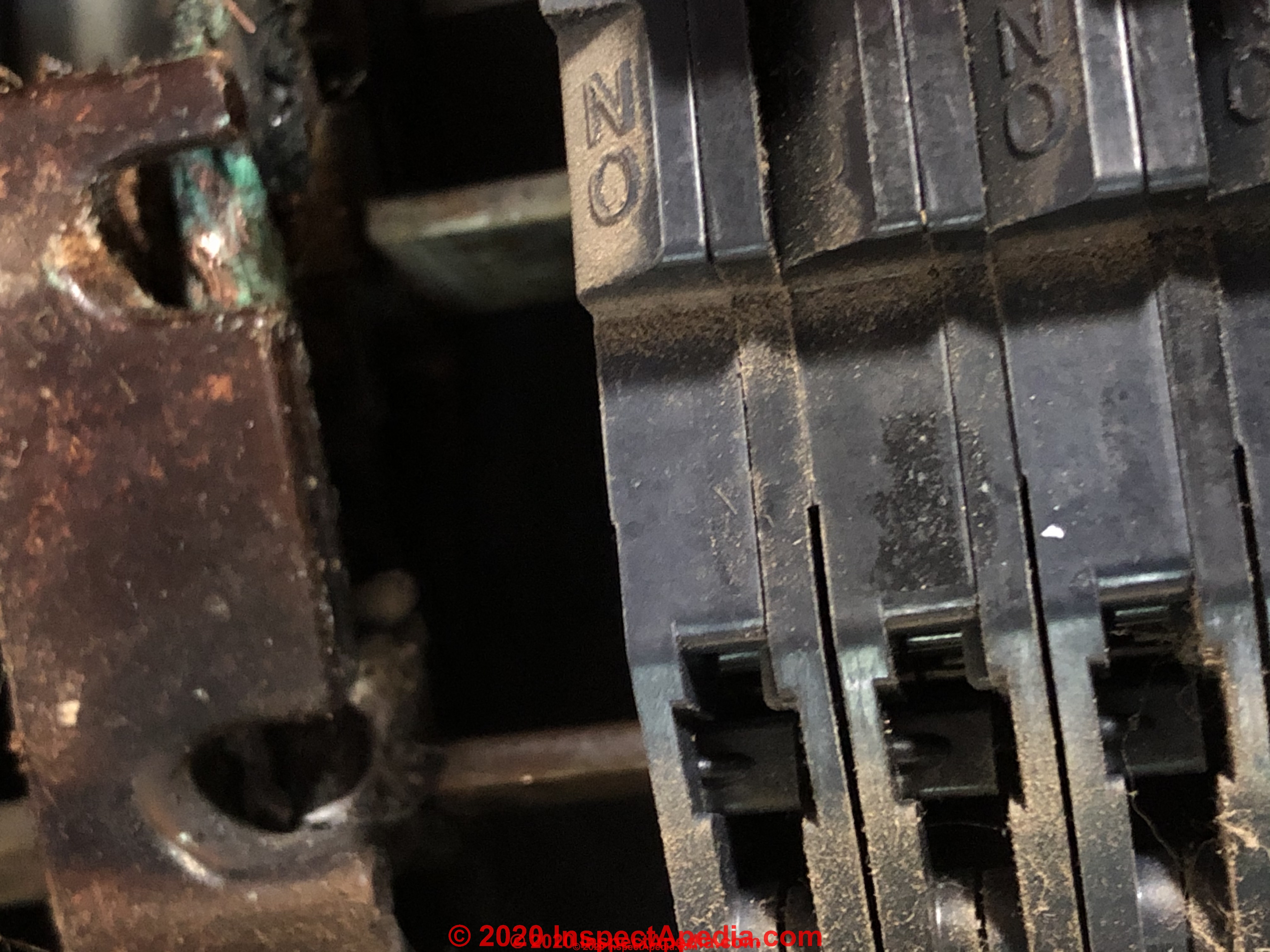
Question: where can I get replacement parts for this damaged Zinsco Electrical Panel? Catalog No. 12-5X(7-14)C 125A Zinsco
I have a panel that a loose wire and it got hot and needs some Zinsco electrical panel parts; are they available?
 ...
... 
If you need more information you can call me at ... - Anonymous by private email 2020/05/12
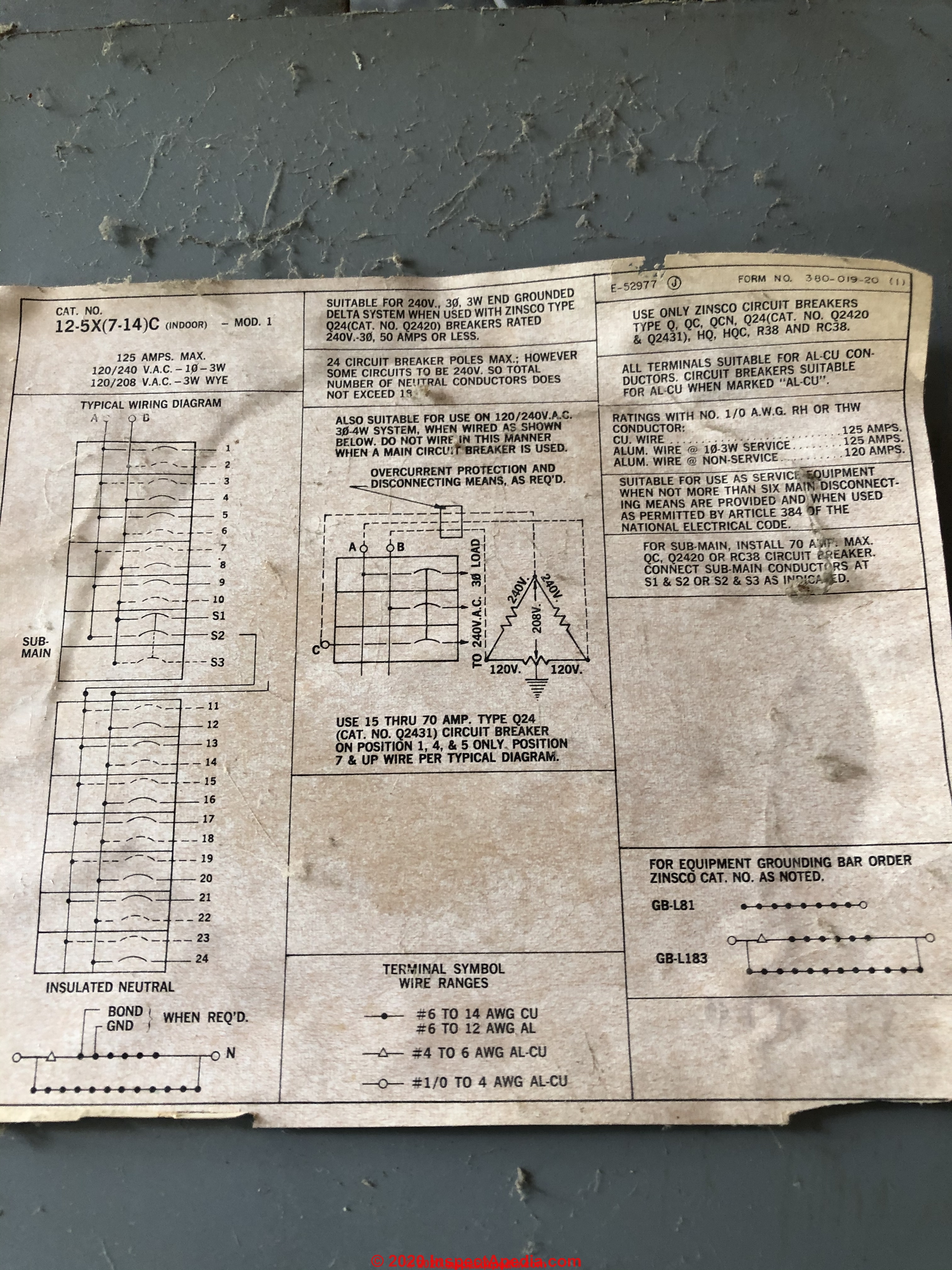
Moderator reply:
You have an unsafe Zinsco electrical panel. It should be replaced, not "fixed".
See details our article series beginning at ZINSCO SYLVANIA ELECTRICAL PANELS and don't hesitate to ask if any of that is unclear.
On 2020-10-23 - by (mod) -
ZINSCO REPLACEMENT PANEL COSTS https://inspectapedia.com/electric/Zinsco_Panel_Replacement_Cost.php
On 2020-10-23 by don dragoo
about how much will it cost to fix or replace one of the true slyvania boxes?
On 2019-06-06 - by (mod) -
I want to add that I don't understand what that meter lock is doing around one of the toggle switches. It certainly isn't effectively locking the breaker in any position but it could make it unsafe by interfering with smooth operation in the event of an overcurrent. If you know who put that on there we are to ask them what they thought they were doing.
On 2019-06-06 - by (mod) -
Yes, Christian, that's a Zinsco circuit breaker in your photo. One can just see the top of the characteristic slots in the breaker side.
If you can look around and safely take some sharp photos of all of the labels you can find on the panel and Breakers those Sharp Images would be very useful. Take great care not to touch any electrical connector or component because you could be shocked or killed.
On 2019-06-06 by Christian Kohler
I wonder if my main panel for our duplex is a Zinsco panel. I know the sub-panel in my unit is the problematic Zinsco, but I'm not sure about the main. It was constructed in 1979. And does has a Sylvania label on it.
IMAGE LOST by older version of Clark Van Oyen’s Comments Box code - now fixed. Please re-post the image if you can. Sorry. Mod.
On 2018-11-10 - by (mod) -
Excellent nice Sharp Photo thank you will be sure to keep it with the article serious. If you want to be credited by actual identity let me know by comment or by private email thanks
On 2018-11-10 by Jake
Melty breaker goodness from a 1981 Sylvania. Feel free to use.
IMAGE LOST by older version of Clark Van Oyen’s Comments Box code - now fixed. Please re-post the image if you can. Sorry. Mod.
On 2016-04-16 - by (mod) -
Shirley, in the live links above at CONTINUE READING you'll find several articles with photos that help Identify a Zinsco - Sylvania panel by the unique breaker colors, markings, appearance, and in addition if your electrician removes a breaker or there are extra breakers not plugged-into the panel the breaker side view is unique as you'll see in the photos.
See these articles whose live links are given on this page
IDENTIFY GTE SYLVANIA-ZINSCO PANELS
IDENTIFY KEARNEY PANELS
IDENTIFY ZINSCO ELECTRICAL PANELS
IDENTIFY ZINSCO SYLVANIA METER BASE
On 2016-04-16 by Leigh Shirley
My contact email address is LHS.Lola@yahoo.com
On 2016-04-16 Leigh Shirley
How can I tell if I have a Zinsco panel? My main panel has no label or manufacturer on it. My sub panel has a Sylvania label, but does not say it is of the Zinsco division. Did Sylvania make only Zinsco?
On 2015-11-23 by (mod) - Electrician's see stuff like your GTE Sylvania Kearney Zinsco failure photos on a weekly bases
Tom:
We would much welcome photos from electricians seeing the failures we describe at InspectApedia.com.
A problem in prompting some manufacturers or authorities to address some safety hazards is that so few field failures are ever reported through any mechanism. An electrician busy earning a living tosses the old failed device and installs a new one and moves-on. A homeowner may be afraid of stigmatizing her home in case of re-sale. Experts I've asked estimate just a very few % of electrical failures are ever reported anywhere. That makes field reports very valuable.
You or others are welcome to use our page bottom CONTACT link to send us failure reports and photos. Contributors can remain anonymous or be named and linked-to as they prefer.
On 2015-11-23 by Tom Walsh
Electrician's see stuff like your photos on a weekly bases
from most manufacturers
...
Continue reading at GTE-SYLVANIA-ZINSCO FAILURE REPORTS or select a topic from the closely-related articles below, or see the complete ARTICLE INDEX.
Or see this
Zinsco Electrical Panel Article Series
- ZINSCO SYLVANIA ELECTRICAL PANELS - home
- GTE-SYLVANIA-ZINSCO FAILURE MECHANISM
- GTE-SYLVANIA-ZINSCO FAILURE REPORTS
- IDENITFY FRANK ADAM ELECTRICAL PANELS
- IDENTIFY GTE SYLVANIA-ZINSCO PANELS
- IDENTIFY KEARNEY PANELS
- IDENTIFY SYLVANIA ELECTRICAL PANELS
- IDENTIFY WALKER ELECTRICAL PANELS
- IDENTIFY ZINSCO ELECTRICAL PANELS
- IDENTIFY ZINSCO SYLVANIA METER BASE
- OK to USE ZINSCOS?
- UBI FPE CIRCUIT BREAKER TEST RESULTS
- ZINSCO CIRCUIT BREAKER INDEPENDENT TESTS
- ZINSCO CIRCUIT BREAKER TEST REPORT
- ZINSCO ELECTRICAL PANEL AGE & HISTORY
- ZINSCO FAILURE PHOTOGRAPHS
- ZINSCO FAILURE REPORTS
- ZINSCO OVERHEAT IR PHOTOS
- ZINSCO FAILURE REPORT PROCEDURE
- ZINSCO REPLACEMENT CIRCUIT BREAKERS
- ZINSCO REPLACEMENT PANELS
- ZINSCO REPLACEMENT PANEL COSTS
- ZINSCO SAFETY PRECAUTIONS
- ZINSCO SUMMARY PAGE for Reproduction
- ZINSCO WARRANTY & CONTACT INFO
Suggested citation for this web page
GTE-SYLVANIA-ZINSCO FAILURE MECHANISM at InspectApedia.com - online encyclopedia of building & environmental inspection, testing, diagnosis, repair, & problem prevention advice.
Or see this
INDEX to RELATED ARTICLES: ARTICLE INDEX to ELECTRICAL INSPECTION & TESTING
Or use the SEARCH BOX found below to Ask a Question or Search InspectApedia
Ask a Question or Search InspectApedia
Try the search box just below, or if you prefer, post a question or comment in the Comments box below and we will respond promptly.
Search the InspectApedia website
Note: appearance of your Comment below may be delayed: if your comment contains an image, photograph, web link, or text that looks to the software as if it might be a web link, your posting will appear after it has been approved by a moderator. Apologies for the delay.
Only one image can be added per comment but you can post as many comments, and therefore images, as you like.
You will not receive a notification when a response to your question has been posted.
Please bookmark this page to make it easy for you to check back for our response.
IF above you see "Comment Form is loading comments..." then COMMENT BOX - countable.ca / bawkbox.com IS NOT WORKING.
In any case you are welcome to send an email directly to us at InspectApedia.com at editor@inspectApedia.com
We'll reply to you directly. Please help us help you by noting, in your email, the URL of the InspectApedia page where you wanted to comment.
Citations & References
In addition to any citations in the article above, a full list is available on request.
- Personal communication, J. Aronstein to D. Friedman, 3/6/2006
- James P. Simmons: Personal communication and photographs used in this article series, J. Simmons to Daniel Friedman, 3/4/2006, 2/19/2008. Photographs contributed to this website by Jim P. Simmons, Mr. Electric, Licensed Master Electrician, 1320 Dayton Street SE, Olympia, WA 98501, 360-705-4225, Fax 360-705-0130 or by email to mrelectricoly@msn.com
- Thanks to Jon Bolton, professional home inspector in central Florida, the INSPECTAGATOR for field photographs of Zinsco electrical panels and circuit breakers, including the no-trip burnup Zinsco photo used in this article. Mr. Bolton can be contacted at 407-678-HOME (4663) or by email jon@inspectagator.com. Mr. Bolton uses infrared imaging equipment in field investigations.
- Thanks to various electricians, home owners, and home inspectors for contributing the Zinsco Sylvania-Zinsco electric panel and circuit breaker field failure reports cited above.
- Thanks to David Osborn, an alert home inspector, for helpful critique regarding the need for Zinsco/Sylvania electrical panel replacement, 4/27/06
- Thanks to Joe Funderburk, Alpha & Omega Home Inspections, Hickory Grove, SC for his photos of a Kearney electrical panel. Mr. Funderburk is a NACHI member and home inspector who can be reached at jfunderburk@aohomeinspection.com or at www.aohomeinspection.com
- Thanks to Texas electrician Jeff Weissman for contribution of photographs of burned Zinsco circuit breakers. 03/06/2007. Mr Weissman can be reached at jeffweissman@gmail.com or by telephone at 713-666-6605
- In addition to citations & references found in this article, see the research citations given at the end of the related articles found at our suggested
CONTINUE READING or RECOMMENDED ARTICLES.
- Carson, Dunlop & Associates Ltd., 120 Carlton Street Suite 407, Toronto ON M5A 4K2. Tel: (416) 964-9415 1-800-268-7070 Email: info@carsondunlop.com. Alan Carson is a past president of ASHI, the American Society of Home Inspectors.
Thanks to Alan Carson and Bob Dunlop, for permission for InspectAPedia to use text excerpts from The HOME REFERENCE BOOK - the Encyclopedia of Homes and to use illustrations from The ILLUSTRATED HOME .
Carson Dunlop Associates provides extensive home inspection education and report writing material. In gratitude we provide links to tsome Carson Dunlop Associates products and services.
 | HOME | ABOUT | ASK a QUESTION | CONTACT | CONTENT USE POLICY | DESCRIPTION | POLICIES | PRIVACY | |
| © 2024 - 1985 Publisher InspectApedia.com - Daniel Friedman | |||||||||