 Walker Electrical Panels
- POST a QUESTION or COMMENT about this article topic
This article describes Walker electrical panels, and the original inventor and business owner Ralph M. Walker.
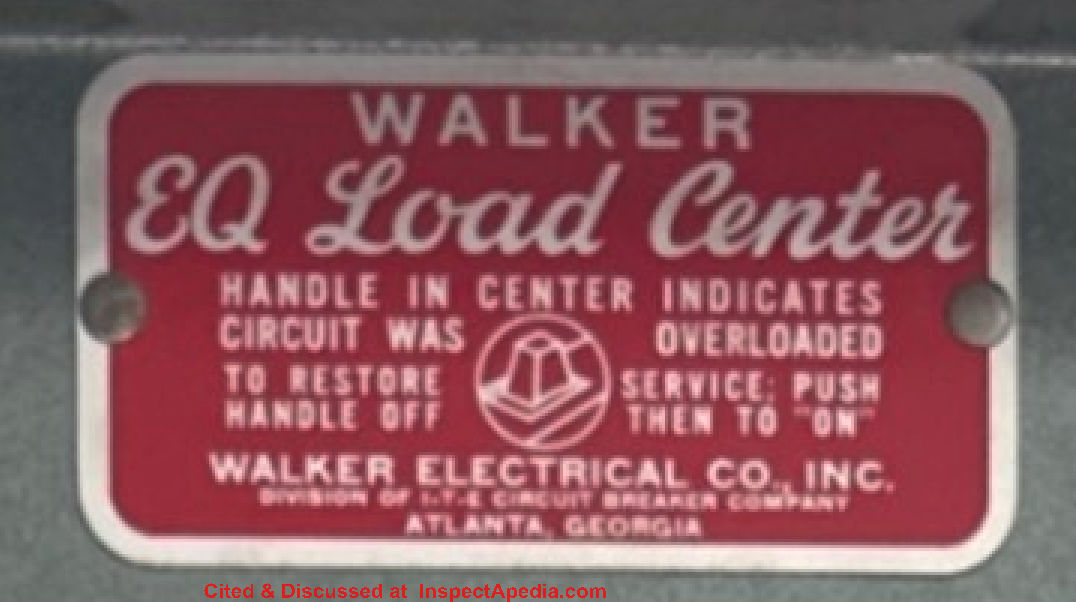
Page top photo: a Walker Electrical panel found in a Georgia home, courtesy of a Georgia licensed electrician and discussed below.
We include patent research and other historical details giving information about the origin, products, and life of the Walker Electrical Company and add safety suggestions for Walker electrical panels.
InspectAPedia tolerates no conflicts of interest. We have no relationship with advertisers, products, or services discussed at this website.
- Daniel Friedman, Publisher/Editor/Author - See WHO ARE WE?
Walker Electrical Panels 1939 - 1965
The Walker Electrical Co. Inc. was a division of I.T.E. Circuit Breaker Company, of Atlanta, Georgia. I.T.E. is also known for their [potentially unsafe] ... Bulldog Pushmatic load centers. - Donald Hester
Watch out: Some but not all Walker electrical panels used Bulldog Pushmatic circuit breakers that are unsafe - the breaker may remain "on" even when switched to the "off" position.
Also, simply because of the age, these and any older electrical panels and the wiring that they protect deserve a careful inspection for safety and adequacy.
Article Contents
- WALKER EQ LOAD CENTER - main fuse, circuit breakers, not Bulldog Pushmatics but internal condition unknown
- WALKER ELECTRICAL PANEL WATER / RUST DAMAGE - replace water damaged electrical equipment
- WALKER ELECTRICAL PANEL HISTORY - dates, patent disclosures, purchase history
...
Walker EQ Load Center w/ Main Fuse
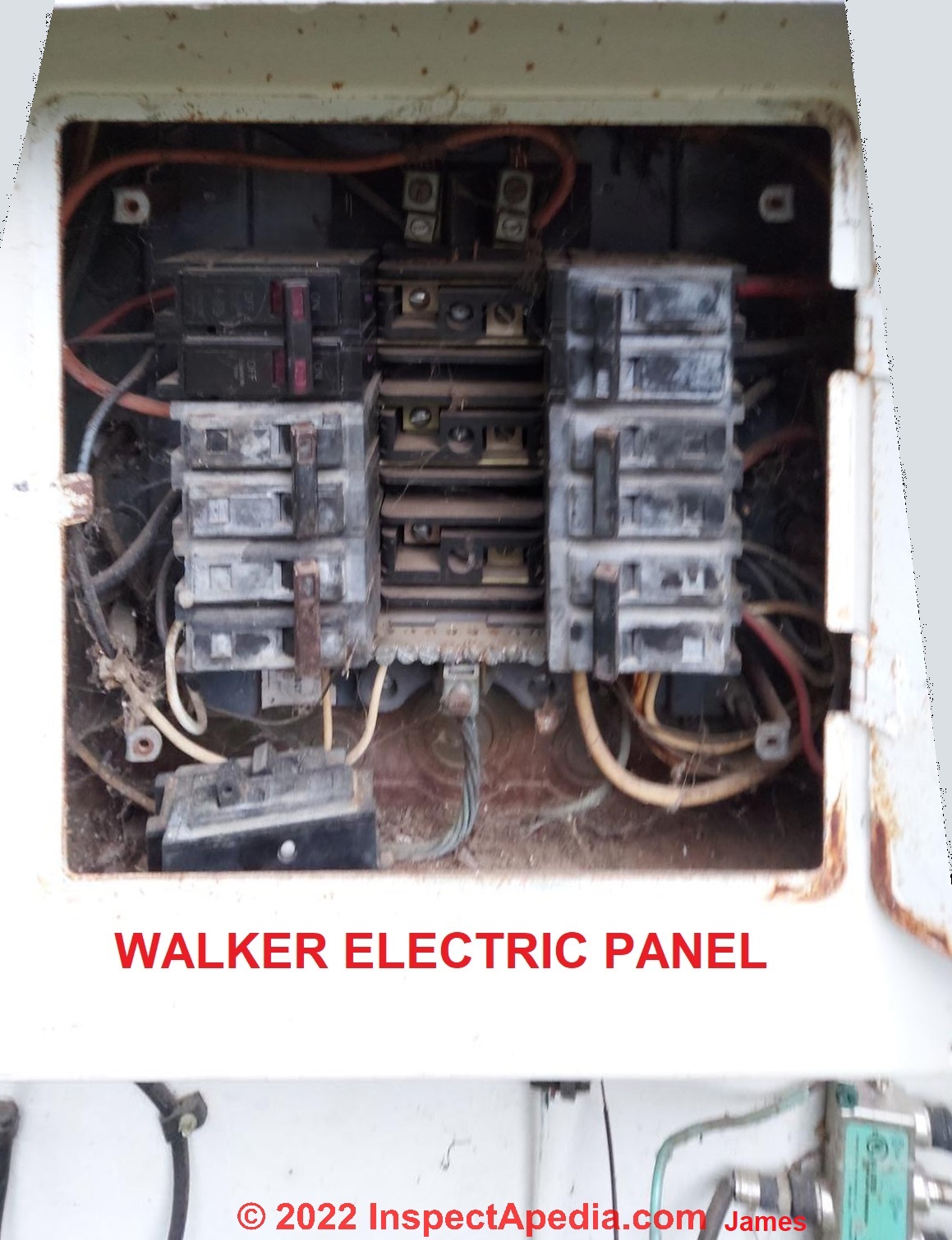 An InspectApedia reader who is a licensed electrician wrote to us about the Walker electrical panel shown here and its label shown at page top.
Notice the label indicating that Walker was an Atlanta, Georgia subsidiary of I.T.E.
Notice also that this Walker electrical panel combines a main fuse pull-out and two banks of circuit breakers, though it does not use the questionable Bulldog Pushmatic circuit breakers found in some Walker load centers.
I'm a Georgia Licensed Electrician (EN000858) and I do two or three major remodels each year and I just about remove all the old wiring and install new NM cable, new devices, add extra circuits in the kitchen, laundry room and bathroom(s) because just changing out the panel in my opinion just doesn't cut it because many of the problems originate at the utilization points (outlets).
To me it is pointless to just change out the panel.
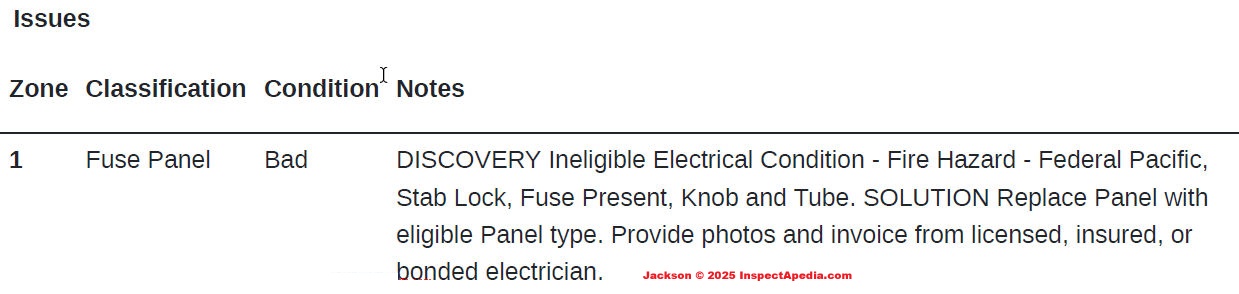
I had a local insurance agent call me stating that one of his customers had their homeowners canceled because of the panel because, as you can read in this snippit of a report on their home [given below - Ed.]
When I read these notes [see FPE & FP IDENTIFICATION, HOW TO - Ed. ] my first reaction was that it obviously wasn't FPE, nor stab-lock, yes the main was a fuse, I have not seen the house so I don't know if it is K&T.
Then as I was thinking about it It may just be standard boilerplate meaning any of the following could apply.
The one thing that was clear was that the solution is to replace the panel.
So the homeowner just thinks he has to change out the panel—Simple! Not a lot of money.
I then began to explain to the agent that there was so much more that I was required to do. Lots of money.
So I am wondering if you have anything on your site that reinforces the importance of removing the old wires, installing new and changing out the devices that I can add to the discussion?
- Anonymous by private email 2025/05/12
[Below is the the report excerpt telling the homeowner they needed to replace this panel but mis-naming it - leaving everyone confused - Ed]
Potential Hazards in the Walker E Q Load Center Panel Shown Above
The FUSE portion of an FPE **Fuse** panel is not inherently unsafe, and in the view of quite a few electricians I've spoken to over the years, many think that fuses are in many respects safer than circuit breakers. Less convenient, but more reliable.
So if an FPE panel found were fuse-only, it would be an error to require its replacement based on its brand.
Watch out: the report snippet does not identify this electrical panel correctly so its advice is at best confusing.
In your photo I see both a main fuse pull-out (at the panel top) and two columns of circuit breakers.
The panel label reads
WalkerEQ Load Center
...
Walker Electrical Co., Inc.,
Division of I.T.E. Circuit Breaker Company
Atlanta Georgia
So this is not an FPE nor Zinsco circuit breaker panel and it looks to me as if someone was re-using a canned report form and didn't proof-read it against what was actually installed.
A reasonable guess is that the circuit breakers shown below that main fuse pull-out are ITE breakers.
ITE also produced "Bulldog / ITE" Pushmatic circuit breakers that can also be unsafe - they can remain "on" internally while in the "off" position - a serious hazard, but the breakers in your photo are NOT the "pushmatic" type so won't sport that hazard.
See BULLDOG PUSHMATIC DESIGN HISTORY and the other articles on Pushmatic we cite at the end of this page.
Bottom line: the report that you quoted was an error - a misidentification of the electrical panel;
We don't know who wrote that report - a home inspector, an insurance agent or someone else. If it was a home inspector or electrical inspector, IMO they didn't meet even the most minimum standard of inspection nor competence.
Or perhaps "speedy-inspector" found K&T wiring somewhere and simply generated a "report" using a too broad and mistaken boilerplate paragraph - we don't know. It can also be a case of some inspector who spends everyone else's time and money to reduce the inspector's own risk.
Watch out: That does not mean that this specific electrical panel is in great or "safe" condition; there could be other evidence of safety concerns, for example, of overheating, mis-wiring, or other hazards visible if the panel cover is removed to inspect its interior - a step required by home inspection standards in most states and by associations such as the American Society of Home Inspectors - ASHI.
Check Wiring & Devices, not Just the Electrical Panel
I agree with your point that it can be dangerous to "just replace the panel" without considering the condition of the rest of the electrical system. But not all "old" electrical wiring needs replacement just based on its age.
Does "Old" Electrical Wiring Need Replacement?
Not necessarily. At OTHER PEOPLE's MONEY you'll see that we try to be thoughtful about how we spend our client's money and to be honest about whose risk we're reducing.
Copper itself does not deteriorate with age - so copper in old wire is as good as in new wire.
Old electrical wiring itself may thus be in good and safe condition (in my experience and opinion - DF)
PROVIDED - the wire insulation is undamaged by wear, heat, water, mechanical damage, etc., and
PROVIDED that the electrical wiring or its insulation has not been damaged by overheating, which as you know almost always occurs at or close to the connector - (most overheating seems to be at connectors or devices).
Even though knob and tube, undamaged, remains "legal" in most jurisdictions, in my opinion its lacking a ground means that wherever someone has "improved" such a circuit they've often added a "fake" grounded receptacle which IMO is unsafe, as are KNOB & TUBE WIRING circuits that have been covered by insulation (it was meant to be cooled by being run in open air except where passing through framing (in ceramic tubes).
When we first started writing on this topic (in the mid 1980's), insurance companies were not so familiar with Zinsco and FPE hazards but beginning, I think, with State Farm Insurance, many insurers became convinced, largely by Dr. Jess Aronstein's research that those panels are a serious latent hazard that ought to be replaced.
See these
- FPE HAZARD ARTICLES, STUDIES - our index to the complete set of FPE panel hazard material including FPE failure reports such as this
- 2017 FPE HAZARD REPORT - 2017
Also take a look at
We will welcome any comments, criticism, or content suggestions that you may have on any of these topics.
...
Water-Damaged Walker Electrical Panel
An InspectApedia reader asked:
Hi can you tell me anything about my Walker electrical panel?
[See photo] - On 2022-08-11 by James
This Q&A were posted originally
Moderator reply: Replace obsolete, rusted, unreliable Electrical Panel
@James,
Looking at your photo alone we can not see 98% of what an onsite inspector would be expected to check, and don't have any of the useful surrounding contextual data: building location, age, history, etc.,
but we can see and warn you about the following:
- Watch out: Rust and corrosion in the electrical panel, risking circuit breakers that jam, don't trip in response to over-current, so increase the risk of a building fire or someone getting shocked
- Six double pole breakers, no single pole breakers, so one would expect to find another electrical panel powering other circuits in the building served
- It looks as if the panel is outdoors but may not be weatherproof
- I think this is a split-bus panel; in addition to its age, rust, corrosion, inability to accept new types of circuit breakers (possibly including AFCI and GFCI), you should also
see SPLIT BUS ELECTRICAL PANEL HAZARDS - I can't see brand or connection bus details that might identify the panel brand and thus tell us if it's a known unsafe product but the corrosion alone is sufficient to call for replacement
Reader follow up:
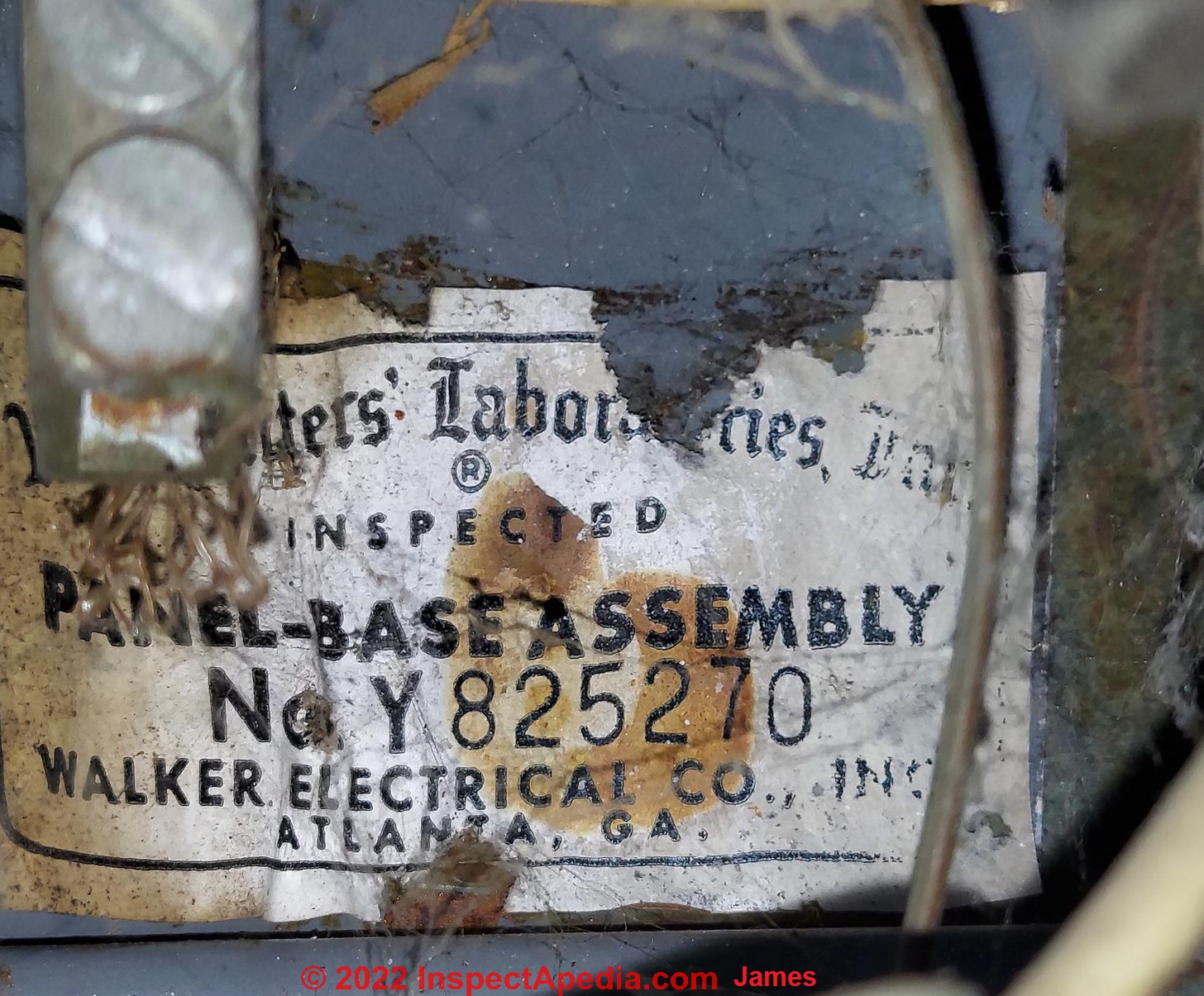
Here is a pic of the tag inside.
...
History of the Walker Electrical Co., Atlanta Georgia
That Walker Electric Company, Atlanta Georgia sticker in James' electrical panel just above tells us that the panel was a product of Walker Electric, a Georgia company founded in 1939 by Ralph Walker (Ralph M. Walker), later bought by I.T.E. (Inverse Time Element Co., a large electrical manufacturer ) before the end of the 1950s.
So James' electrical panel will have been made before the end of the 1960s, possibly a bit earlier.
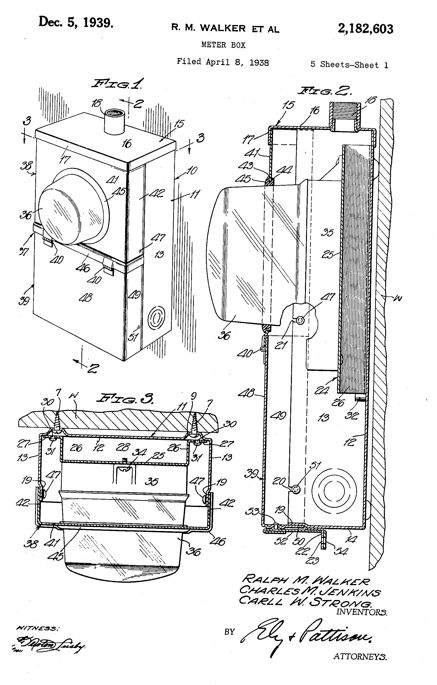
The Walker family name also appears in additional electrical patents we include below.
- Walker, Ralph M., Charles M. Jenkins, and Carll W. Strong. METER BOX [PDF] U.S. Patent 2,182,603, issued December 5, 1939.
[Illustrated above]
Excerpt:
This invention relates to improvements in weather-proof boxes for electric meters.
One of the important features of the invention resides in a weatherproof box for outdoor use in which an electric meter may be locked to prevent unauthorized tampering, and which may be viewed for reading at will by the representative of an electric service company or by the subscriber of the electric service.
This convenience is not broadly new, for in Walker Patent No. 2,007,065, there is shown a lockable weather proof meter box having a window opening in alinement with the dials of the meter, but to properly house the entire meter in the box it was necessary to provide a forwardly projecting extension on the front cover, and accurately mount the meter in the box so that the face of the meter alined with a window opening in the extension.
However, this invention differs from the Walker patent in that it enables the face of the meter to protrude through the front of the box, which eliminates the labor and material costs necessary to form a front extension. - Walker, Ralph M. DESIGN FOR A WEATHERPROOF BOX FOR [PDF] US Patent No. 117,420 filed Sept. 1, 1939
- Walker, Ralph M. WEATHERPROOF BOX FOR ELECTRIC CIRCUIT BREAKERS AND OTHER ELECTRICAL DEVICES [PDF] U.S. Patent 2,250,977, issued July 29, 1941.
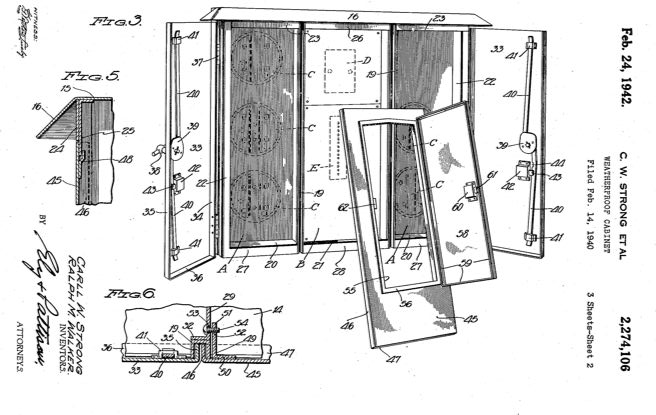
- Strong, Carll W., and Mabel B. Walker. WEATHERPROOF CABINET [PDF] U.S. Patent 2,274,106, issued February 24, 1942. Application filed by Walker Electrical Co.,
[Illustrated just above] - Walker, Mabel B., and George P. Alexander. AUTOMATIC OUTLET BOX MAKING MACHINE [PDF] U.S. Patent 2,331,525, issued October 12, 1943. Assigned to Walker Electrical Co.,
- Walker, Ralph E. FUSE PULLER [PDF] U.S. Patent 2,430,544, issued November 11, 1947. (Ralph E. was from Silverdale WA, perhaps not related to the Walkers above?)
Hester's Notes on the Walker Electric Co.
- Donald Hester, a home inspector in Washington State has written a nice little history of Walker Electric that you can see quoted at the top of this page and illustrated in a bit more detail at
http://www.ncwhomeinspections.com/Walker+Electric+and+Bulldog+Pushmatic
Contact Mr. Hester at http://www.ncwhomeinspections.com/ or at 509-670-9572.
...
Continue reading at BULLDOG PUSHMATIC DESIGN HISTORY or select a topic from the closely-related articles below, or see the complete ARTICLE INDEX.
Or see these
Recommended Articles
- BULLDOG PUSHMATIC DESIGN HISTORY
- BULLDOG PUSHMATIC BREAKER REPLACEMENTS
- BULLDOG PUSHMATIC COMPATABILITY & FAQs
- CIRCUIT BREAKER FAILURE RATES - home
- CIRCUIT BREAKER LOCKS - where we discuss circuit breaker locks for Pushmatic breakers
- CIRCUIT BREAKERS RE-CONDITIONED USED
- ELECTRICAL PANEL AGE
- ELECTRIC PANEL INSPECTION - home
- FPE & FP IDENTIFICATION, HOW TO
- OLD ELECTRICAL WIRING TYPES
- PUSHMATIC - BULLDOG PANELS
- PUSHMATIC BREAKER FAILURE REPORTS
- WESTINGHOUSE v. BULLDOG
Suggested citation for this web page
WALKER ELECTRICAL PANELS at InspectApedia.com - online encyclopedia of building & environmental inspection, testing, diagnosis, repair, & problem prevention advice.
Or see this
INDEX to RELATED ARTICLES: ARTICLE INDEX to ELECTRICAL INSPECTION & TESTING
Or use the SEARCH BOX found below to Ask a Question or Search InspectApedia
Ask a Question or Search InspectApedia
Share this article:Search the InspectApedia website
Need to make a private comment? Email editor@inspectApedia.com. We welcome email with your website content critique, corrections, suggestions or questions. Email is monitored daily but our workload may prevent an immediate reply. For immediate results, we hope you'll first try asking your question using the search box just above.
Citations & References
In addition to any citations in the article above, a full list is available on request.
- In addition to citations & references found in this article, see the research citations given at the end of the related articles found at our suggested
CONTINUE READING or RECOMMENDED ARTICLES.
- Carson, Dunlop & Associates Ltd., 120 Carlton Street Suite 407, Toronto ON M5A 4K2. Tel: (416) 964-9415 1-800-268-7070 Email: info@carsondunlop.com. Alan Carson is a past president of ASHI, the American Society of Home Inspectors.
Thanks to Alan Carson and Bob Dunlop, for permission for InspectAPedia to use text excerpts from The HOME REFERENCE BOOK - the Encyclopedia of Homes and to use illustrations from The ILLUSTRATED HOME .
Carson Dunlop Associates provides extensive home inspection education and report writing material. In gratitude we provide links to tsome Carson Dunlop Associates products and services.
 |
HOME | ABOUT | ASK a QUESTION | CONTACT | CONTENT USE POLICY | DESCRIPTION | POLICIES | PRIVACY | |
| © 2026 - 1985 Publisher InspectApedia.com - Daniel Friedman | |||||||||