
InspectAPedia® FREE Encyclopedia of Building & Environmental Construction, Diagnosis, Maintenance & Repair |
Question? Just ask us! InspectAPedia
|
 Air Conditioning & Heat Pump Compressor/Condenser Unit
Home Page: Inspect, diagnose, repair or
replace the outdoor compressor/condenser unit
- POST a QUESTION or COMMENT about HVAC compressors & condensers: the outdoors condensing unit
Outdoor air conditioner compressor unit inspection, diagnosis & repair guide home page.
This article series discusses the outdoor components of air conditioners and heat pumps and includes links to key articles that discuss in detail the outdoor and indoor components of an air conditioner or heat pump system including the outdoor compressor condenser unit and the indoor air handler, controls and ductwork.
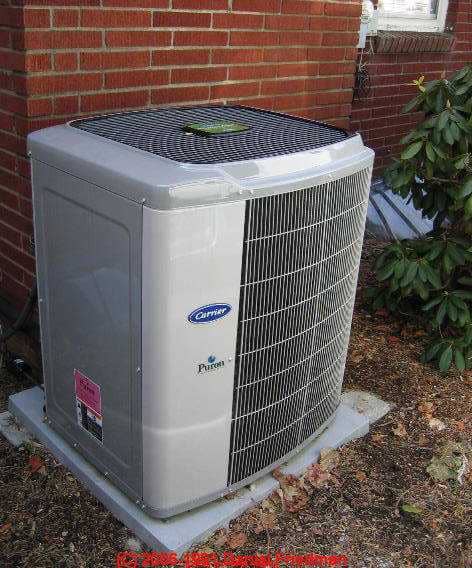
Page top photo: a modern Carrier compressor/condenser unit outside a New York home. Whether or not this unit is too close to the building wall depends on which sides of the unit are intended for air intake.
InspectAPedia tolerates no conflicts of interest. We have no relationship with advertisers, products, or services discussed at this website.
- Daniel Friedman, Publisher/Editor/Author - See WHO ARE WE?
How do Air Conditioning Compressor / Condenser Units Work?
 What is the "Compressor" unit in an air conditioner or heat pump system?
In a nutshell, the air conditioner compressor/condenser/fan unit is the "outdoor" half of an air conditioning or heat pump installation that uses a compressor motor to compress refrigerant gas to high pressure, sending the pressurized gas through cooling coils (condensing coils) where aided by air movement drawn by the condenser unit fan, the gas is returned to a liquid refrigerant state.
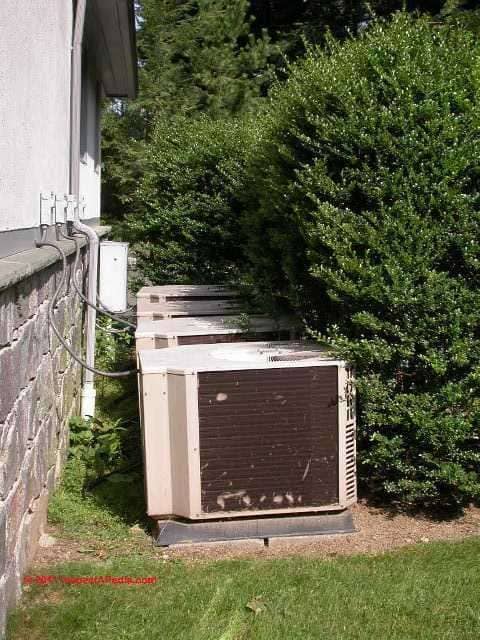
Photo just above: four outdoor A/C condenser units are installed too close together, out of level, and worst, their air flow is blocked by thick shrubbery. The effect of these common mistakes is a shorter condenser unit life and higher operating costs.
Article Contents
- COMPRESSOR / CONDENSER OPERATION - how it works to heat or cool a building
- COMPRESSOR / CONDENSER ENVIRONMENT & SAFETY WARNINGS
- COMPRESSOR / CONDENSER TYPES
- COMPRESSOR / CONDENSER VALVES
- COMPRESSOR / CONDENSER OILS - refrigerant oils, uses, types, problems.
- DIAGNOSTIC PROCEDURES for AIR CONDITIONERS & HEAT PUMPS - links to key diagnostic and repair procedures if your system isn't working properly
The process of compressing and then condensing the refrigerant back from a gas to a liquid also moves heat out of the refrigerant and into outdoor air. We explain this process in detail below.
The outdoor half of a typical air conditioning system (shown above) is a unit containing the refrigerant compressor and condensing coil and a cooling fan.
In our photo the dark colored screened surface covering one side of the condensing coil of the first compressor in this row is easily visible.
The compressor motor itself (image shown below in this article) is not visible unless the covers of this unit are removed.
Also see our RECOMMENDED ARTICLES list at the bottom of this page.
...
How the Air Conditioning Compressor/Condenser Unit Works to Move Heat from Indoors to Outside
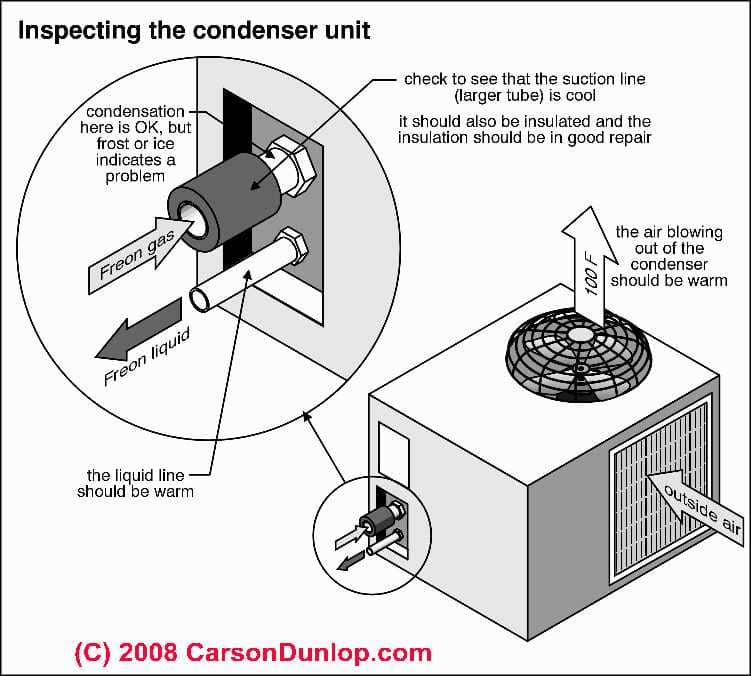 In this article we will sketch and explain the internal parts of an air conditioner compressor motor and the A/C condenser unit such as the compressor, condenser, and key controls.
The A/C Compressor
The air conditioning compressor motor is a pump which draws sensible heat laden refrigerant gas from the building's indoor components (evaporator or "cooling coil" in the indoor air handler) through the larger diameter refrigerant suction line into the compressor where that pump compresses the low pressure refrigerant gas to high pressure and higher temperature.
Raising the coolant (refrigerant) temperature above outdoor ambient temperature causes heat to flow from the coolant (flowing out of the compressor and through the outdoor A/C condenser coil) into outdoor air. (Heat always flows from warmer to cooler substances).
Sensible heat and other terms are defined
at DEFINITION of HEATING, COOLING & INSULATION TERMS
Sketch courtesy of Carson Dunlop Associates, a Toronto home inspection, education & report writing tool company [ carsondunlop.com ].
As we explain
at THERMOSTATIC EXPANSION VALVES,
it is the flow restriction provided by a cap tube or by a TEV in the refrigerant piping system that allows the A/C compressor pump to raise the system pressure and thus increase the temperature at which the coolant changes state.
In other words, the TEV or cap tube allows the compressor to reduce refrigerant pressure on the LOW side of the metering device and raise refrigerant pressure on the HIGH side of the metering device.
Incidentally, A/C compressors can only accept and compress refrigerant in gas form. In fact the refrigerant vapor is superheated to be sure that there is no liquid at the pump - lest the pump be damaged. If liquid refrigerant were to flow into the compressor motor it would most likely cause catastrophic damage.
Even with the covers off, you wont' see much of the actual air conditioner compressor motor: A/C compressor motors in residential and most commercial systems are hermetically sealed motors - that is, the motor is encased in a sealed steel can - all you'll see is a black metal container with metal (usually copper) tubing and some wires running to it.
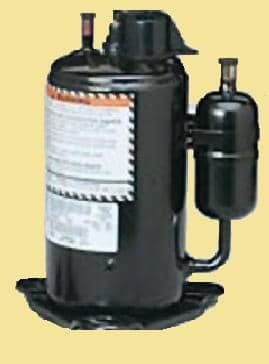 This is the compressor motor. In our illustration of a hermetically-sealed residential compressor motor (above right), the smaller cylinder to the right of the compressor is a filter/dryer built onto this replacement unit.
The A/C Condenser
The high pressure high temperature refrigerant gas leaves the outdoor compressor and enters the outdoor condensing coil where it is cooled to a liquid state by the condensing unit fan that blows outside air across the condensing coil or by immersion of the condensing coil in cooling water in some designs.
The heat produced in these steps is transferred to the outside by a fan which blows outside air across the condensing coil. The liquid refrigerant is then able to return to the indoor components for cooling and dehumidifying the building interior.
Definition of an Air Conditioner or Heat Pump
An air conditioner or heat pump compressor is a basically a motorized pump which moves refrigerant gas from the indoor cooling coil (where it has evaporated to cool indoor air blowing over that coil) to the outdoor compressor/condenser where the gas is compressed and cooled back to a liquid form.
Refrigerant gas moves from the indoor air handler cooling coil to the outdoor compressor via the larger refrigerant "suction line".
Liquid refrigerant returns from the outdoor compressor/condenser to the in-building air handler and evaporator coil.
Evaporating liquid refrigerant inside the indoor cooling coil cools and dehumidifies indoor air.
Condensing refrigerant gas outdoors at the compressor/condenser effectively is moving heat from indoors to the outdoor air.
[During heat pump "heating" cycles the process is reversed, moving "heat" from outdoor air to the indoor coil.]
The diagnosis and repair of various defects in the air conditioning compressor/condenser unit are discussed in detail using the links
provided at the end of this article. Here is more detail about the components of the air conditioner or heat pump compressor/condenser unit:
Heat pumps are described separately and in more detail
at HEAT PUMPS.
...
Air Conditioner or Heat Pump Compressor Unit Safety, Damage, & Environmental Warnings
Using Carrier installation instructions for the Carrier 24ANA unit as an example [2] and quoting:
[Compressor/Condenser] Unit Operation & Safety Hazard
Failure to follow this caution may result in minor personal injury, equipment damage or improper operation. To prevent compressor damage or personal injury, observe the following
- Do not overcharge system with refrigerant.
- Do not operate unit in a vacuum or at negative pressure.
- Do not disable low pressure switch
- Dome temperatures may be hot in scroll and bottom temperatures may be hot in recip.
Environmental Hazard Warnings - Failure to follow this caution may result in environmental damage.
Federal regulations require that you do not vent refrigerant to the atmosphere. Recover during system repair or final unit disposal.
Minimum Air Conditioner Compressor Unit Observations for an Air Conditioner Home Inspection Report
Example home inspection report language for an air conditioning compressor:
- The compressor and fan operated normally.
- The rated cooling capacity, estimated age and general condition of the unit are reported below.
OR - We did not operate this equipment because ... Therefore you should ...
[... explanatory text inserted by inspector]
...
Types of air conditioner or heat pump compressors & compressor designs
Sealed Compressors
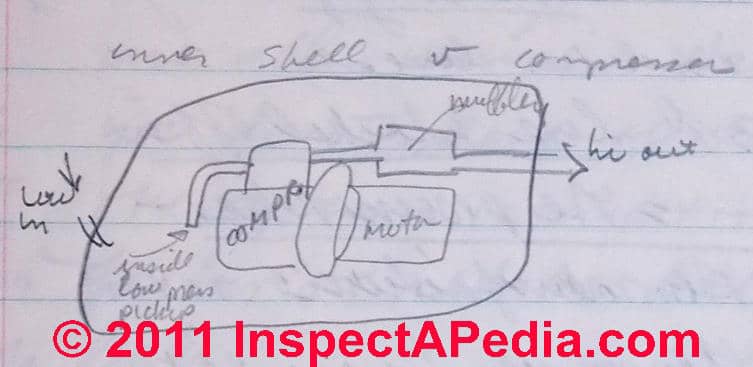
Sealed air conditioning or heat pump compressors enclose both the driving electric motor and the mechanical compressor engine itself within a hermetically sealed "can".
Sealed compressors cannot be opened for repair in the field and are normally replaced entirely when needed.
The diagnosis of a sealed compressor relies on external observations and measurements such as current draws (amps) of the compressor motor and the operating pressures the equipment can achieve.
While a sealed hvac compressor unit can't be field-repaired, the unit can be replaced as an entire system, and in some cases the damaged unit can be traded in for an allowance on the replacement compressor.
What are those three tubes seen welded or soldered to the hermetically sealed HVAC compressor can? There are three tubes you'll find on a typical sealed compressor unit:
- A suction line
(generally larger in diameter - low side line) - receives low pressure refrigerant gas from the cooling coil - A condenser line
(generally smaller in diameter - high side line) - sends high pressure refrigerant gas as compressor output to the condensing coil - A third line, blocked off, not used in the field - the process tube.
This tube is used by the manufacturer of the compressor unit to test and charge the system. - 5-port HVAC or refrigeration compressors
include a low side, high side, and process tube and two more tubes that send oil through an oil cooler or oil cooler condenser.
The oil cooler condenser lines will always be close together and close to the bottom of the unit (to pick up oil to be cooled) - that's how you can identify which of those tubes coming in and out of the sealed compressor are doing which jobs. - Power: You'll also see, of course, a connnection bringing electrical power to the compressor motor
Watch out: if you are carrying a refrigerator or freezer in other than upright position,
that is if you have to place the unit on its side, place it so that the low side (suction side) refrigerant lines are facing "up" so as not to drain oil or liquid refrigerant into a line where it does not belong and where it may block a cap tube.
If you make a mistake and carry the appliance in the wrong position, you would be smart to leave it in the upright or operating position for a few hours before turning it on to avoid forcing a slug of oil into (and blocking)
the CAPILLARY TUBES
often used on home refrigerators or freezers.
Leaving the system upright allows oil that may have leaked into the refrigerant line to drain back into the compressor motor. If you turn on the system too soon the risk is that you push this oil into the cap tube where it may remain or be hard to get out or worse, you may leak oil into the reed valves where they will be damaged when the compressor motor is turned on.
Open type refrigeration compressors
Open type refrigeration compressors are commonly found on automotive air conditioning systems. The motor that drives the actual compressor (the mechanical engine that compresses refrigerant gas) is physically separate from the compressor and is located outside of it.
Typically a motor drives the compressor via a belt and pulley system (cars and some commercial refrigeration systems).
This is why you should run your automobile air conditioner from time to time even out of the cooling season - to lubricate the shaft seal around the compressor motor/pulley - that's a spot where refrigerant may leak out at a dried seal.
Semi-sealed HVAC compressors
Semi-sealed compressors can be disassembled and repaired, as can the open type above.
...
Air Conditioner / Heat Pump Compressor Valves - two common designs
All compressors have a suction and a discharge valve to control refrigerant flow through the unit.
Reed Valve refrigeration compressor motors
Often the valve is a reed design - in which case the bottom reed is the intake valve and a top mounted reed is the discharge reed or valve that discharges out through a noise muffler into the condenser piping and coil.
It is these valves that can be destroyed if liquid refrigerant is sent through the compressor.
Rotary valve refrigeration compressor motors - Frigidaire rotary compressor motors
[Click to enlarge any image]
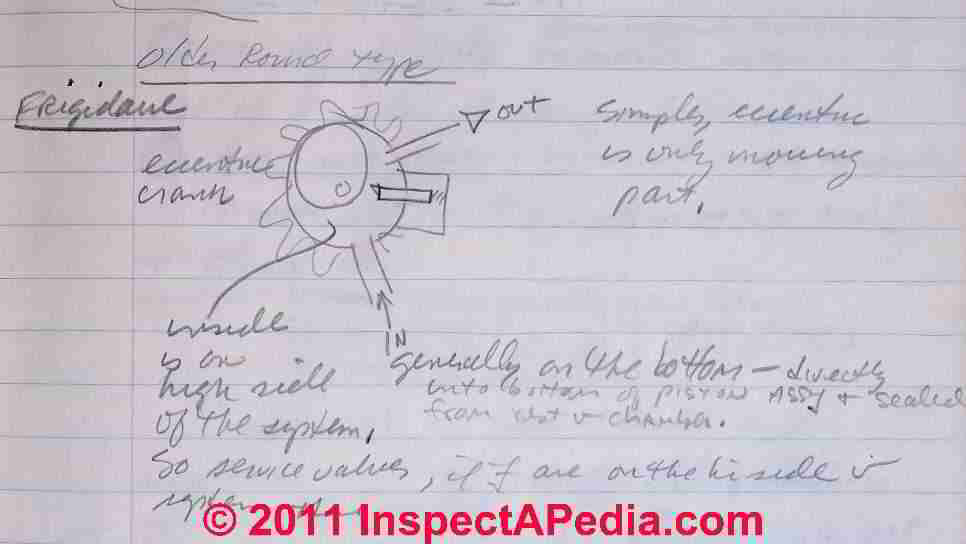
Some other refrigeration compressor valve designs are quite different from these simple reeds, including an old and very successful eccentric crank system: the rotary compressor motor design patented by Frigidaire™ and used in refrigerators for several decades.
This compressor motor design was used in a range of Frigidaire equipment and appliances including refrigerators and some air conditioners.
The durability of the design stems at least in part from its simplicity: a simple eccentric crank (see our sketch at left) is the only moving part in the motor. My illustration above is of course simplified.
On this compressor motor the inlet or suction line is generally found on the bottom of the unit, feeding directly into the bottom of the piston assembly and sealed from the rest of the chamber. The interior of the compressor chamber (sketch note and arrow at left) is on the HIGH side of the system. So service valves, if they are installed at all, are placed on the high side of the system there.
Frigidaire eccentric crank rotary refrigeration compressor motors were remarkably durable and reliable.
After the Dutchess County Boces class I (DF) took on refrigeration motor repair, the next spring during "Spring Cleanup" when people toss out old appliances, we drove around looking for old Frigidair refrigerators that were being tossed out.
Invariably the motor, which was indestructable, still worked. I found one and made it into my working compressor motor that I used when I needed one to service (pull a vacuum) on other HVAC equipment. All I had to do was braze on service valves on to the motor's hig and low refrigerant lines and of course put a plug on its power wire.
I continued to use that salvaged Frigidaire refrigerator compressor as our HVAC service vacuum pump for many years.
...
Air Conditioner / Heat Pump Compressor Motor Refrigerant Oils
Refrigeration compressor motors use 300 viscosity oils when working with refrigerants in the Freon family and 150 viscosity oils when working with other refrigerants.
These are special oils that use a non-wax base such as Texaco Capella oil or oils by Virginia Chemical.
The refrigeration oil lubricates the moving parts of the compressor motor as it receives and compresses refrigerant gases.
Compressor/Condenser HVAC Oil Lubricant Problems
Warnings & Tips about Refrigerant Oils
At REFRIGERANT GASES & PIPING using Puron refrigerant information as a source we warn
We discuss the role of refrigerant oil at TIGHT or SEIZED AC COMPRESSORS and then for the worst case,
at BURNED-OUT HVACR COMPRESSOR we explain that this special oil can be lost due to refrigerant leaks and thus can lead to complete failure of a compressor motor.
Refrigerant oil lubrication loss can be such a costly problem that commercial refrigeration systems often use a separate oil pump to deliver lubricant directly to the compressor motor. Therefore on commercial cooling equipment, an oil pump failure quickly to compressor motor failure.
Aside from lost oil and compressor motor damage, refrigeration oil can travel in the refrigerant lines where it reaches a capillary tube or TEV , clogging it and causing abnormal system pressures that can damage the compressor.
At TYPES of AIR CONDITIONER or HEAT PUMP COMPRESSORS when we warned that carrying a refrigerator or freezer on its side could drain oil out of the compressor motor into the refrigerant lines where it might later become a problem by blocking the capillary tube or might enter reed valves causing valve damage, this is the oil we were talking about.
- Puron refrigerant, as with other HFCs, is only compatible with POE oils.
- POE oils absorb moisture rapidly. Do not expose oil to atmosphere.
- POE oils may cause damage to certain plastics and roofing materials
Other refrigerant oil snafus
Watch out: bubbling sounds heard in the refrigerant piping suction line near the compressor could be refrigerant oil pooling in that location.
This oil pooling is not usually a consequential problem provided the collection of oil does not block passage of refrigerant in the system. In good HVACR design the refrigerant piping slopes back from the evaporator unit (cooling unit or air handler) towards the compressor/condenser unit so that refrigerant oil in the line finds its way back to the compressor motor.
See REFRIGERANT PIPING GURGLING.
REFRIGERANT OIL PROBLEM FAQs are given just below
Question: oil in the capillary tube? - recurrent cap tube clogging
i have replaced my compressor from company and when I started it was giving cool air but the copper pipe out side (large) was not cool enough and after 40 mints its timer light flashes and after 10 more mints its down automatically. it happens again and again I sent back it to company technician is looking into it.
He said oil was in capillary and it needs flushing so he will replace its capilary since after cleaning its not fixed. do u think there is no fault in compressor? or what possibly is the problem.. - Wagar 7/11/12
Reply:
You'll want to check the installation manual to find the control light decoding for your brand and model of cooling equipment. Could be a control or control board problem too. It's just about impossible to flush a cap tube so replacement is normal.
But if there is debris in the system, or excessive oil, the new cap can clog as well; good practice would be to empty the system, pull a vacuum, flush the whole system, install a filter dryer, replace the cap tube, and recharge.
Question: can the condenser get oil logged
Can a condenser become oil logged, how and why? - Dominic 8/22/11
Reply:
Dominic:
A condenser, if you mean the condensing coil, set level, would not be expected itself to become oil clogged, though condensers do sometimes clog from a combination of debris and moisture or oil.
But refrigerant oil moving through the system can clog a refrigerant metering device such as a capillary tube.Dom, it is normal for some refrigerant oil to circulate through the HVAC refrigeration system;
Oil clogging can occur in some installations if the refrigerant piping is not properly routed or due to an improper charge.
The more usual problem is not at the condenser coil but at smaller orifices such as a cap tube or the TEV.
See
...
How to diagnose and fix an air conditioning system that is not working
Are You Troubleshooting an air conditioner or heat pump compressor/condenser unit?
For steps that a building owner or occupant might take before calling a service technician
see DIAGNOSTIC GUIDE A/C or HEAT PUMP
If your air conditioning system won't work, use these easy A/C-heat pump diagnostic guides
Specific A/C or Heat Pump compressor diagnosis & repair procedures listed just below:
- A/C - HEAT PUMP CONTROLS & SWITCHES - identify and find all of the controls to be sure that the problem isn't something trivial
- BURNED-OUT COMPRESSOR
Watch out: before assuming that the compressor motor or the entire HVAC compressor/condenser unit needs replacement, be sure you (or more likely your trained, qualified HVAC repair technician) has checked for simple and lower cost problems such as a bad start/run capacitor, contactor relay switch, control board, or even just a loose wire or similar component. - CAPACITORS for HARD STARTING MOTORS - that may get more life out of a compressor motor
- CLEARANCE DISTANCE, HVAC - what happens if you block air flow around the compressor/condenser unit?
- COMPRESSOR / CONDENSER DIAGNOSTICS
- COMPRESSOR / CONDENSER INSPECTION CHECKLIST - for a simple checklist for the outdoor compressor/condenser unit.
- CONDENSING COIL REPAIR REPLACE - discusses the replacement of the outdoor condensing unit coil
- CONTACTOR RELAY DIAGNOSIS & REPAIR - a bad switch or relay can prevent the outdoor compressor/condenser unit from running
- CONTROL CIRCUIT BOARD, A/C - a bad control board or circuit board in the outdoor compressor/condenser unit or inside in the air handler unit
- CRANKCASE HEATERS - are needed on the outdoor compressor motor in areas subject to cold or freezing weather. A failed heater can cause the compressor to push liquid refrigerant into the motor, ruining it
- DEFECTS LIST - HEAT PUMP - and also DEFECTS LIST - HEAT PUMP SUBSYS - list inspection points for heat pumps
- DIAGNOSTIC GUIDE A/C or HEAT PUMP - suggestions for diagnosing compressor or condenser fan and coil problems that can mean intermittent or totally lost cooling capacity of your system
- ELECTRIC MOTOR DIAGNOSTIC GUIDE - can help diagnose a compressor/condenser fan that's not working or an indoor air handler blower fan that's kaput
- FAN, COMPRESSOR / CONDENSER UNIT - if the fan on the outdoor compressor / condenser unit is not working properly
- HARD STARTING COMPRESSOR MOTORS - diagnostic tips can get a compressor running again or help determine that it needs to be replaced
- AIR CONDITIONING & HEAT PUMP SYSTEMS - home - all diagnostic routines for the whole system
- SPLIT SYSTEM AC / HEAT PUMP REPAIRS
- TICKING NOISE DIAGNOSIS - traced to a condenser problem
- LOST COOLING CAPACITY - our focus is on the case in which the air conditioning system seems to be "running" but not enough cool air, or no cool air at all is being delivered to the occupied space
- OPERATING DEFECTS - we take you through the major air conditioning problem symptoms and how to get the air conditioning system working again
- A/C - HEAT PUMP CONTROLS & SWITCHES - we explain the many electrical switches and controls that control an air conditioner or heat pump system. You'll need to check these if your air conditioner won't start
Sketch of the condenser unit shown above was provided courtesy of Carson Dunlop Associates, a Toronto home inspection, education & report writing company.
List of air conditioning system diagnostic articles:
See our complete list of air conditioning system diagnostic and repair guide articles just below.
Since the failure of an air conditioner to turn on, loss of air conditioner cooling capacity, reduced air conditioning output temperatures, loss of cool air supply, or even loss of air flow entirely can be due to a variety of problems with one or more components of an air conditioner or air conditioning system,
after reviewing the lost air conditioner cooling diagnosis procedures described in this article, be sure to also review the diagnostic procedures at each of the individual air conditioning diagnosis and repair major topics listed just below.
If your air conditioning or heat pump system has lost its cooling capacity or won't start,
or if your air conditioning electrical bill has increased even though the system "on" time has not changed, select one or more of the diagnostic articles listed at
AIR CONDITIONING & HEAT PUMP SYSTEMS - home -
...
Life of an Air Conditioning or Heat Pump Compressor?
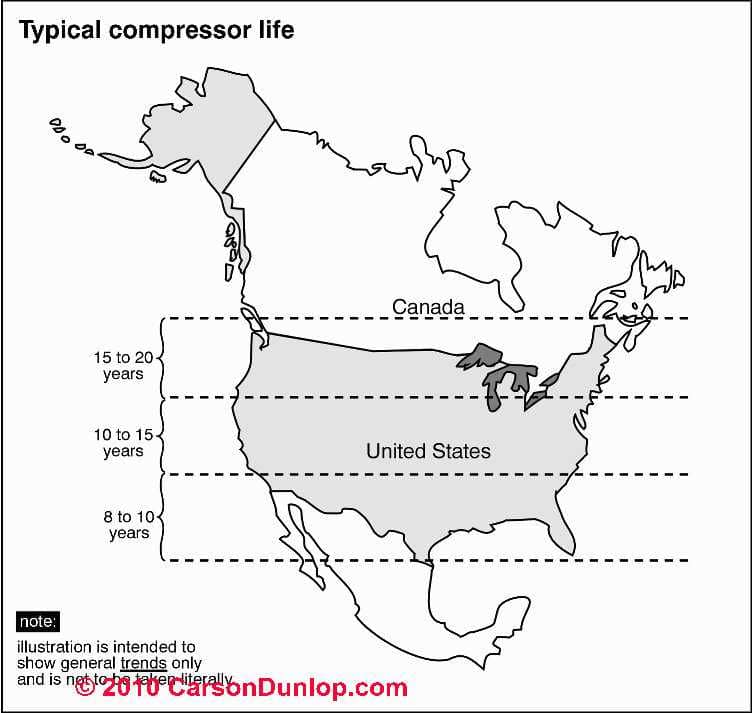
10-20 years, sometimes longer.
Please see complete details at AIR CONDITIONER/ HEAT PUMP LIFE EXPECTANCY - including the factors that impact air conditioner or heat pump life.
Components of the Outdoor Portion of a Central Air Conditioning System
We have moved this discussion to a separate article. Please
see COMPRESSOR / CONDENSER UNIT COMPONENT PARTS
Thank you to our readers for their generous comments
Your page has been helpful with hint on how to fix it yourself. i intend starting a diploma program in Refrigeration and Air conditioning. please I would like to have a pdf copy of the entire air conditioning section for educational/personal improvement purpose; my email is peppyetas@gmail.com thanks alot On 2015-08-17 by princely
Working of referent components is easily understandable . It is really good for beginners . Excellent. - On 2015-04-13 by ANIL KUMAR
it's very useful to me,thank you. - On 2012-07-03 by good
Thanks so much for bringing this excellent , comprehensive and easy to understand article. God bless you - On 2012-06-21 by sibte, shah
This website is awesome ! (July 15, 2012) Sean
...
...
Continue reading at COMPRESSOR / CONDENSER DIAGNOSTICS - step by step diagnosis, or select a topic from the closely-related articles below, or see the complete ARTICLE INDEX.
Or see COMPRESSOR / CONDENSER REPAIR FAQs - posted originally at this article
Or see these
Recommended Articles
- AIR HANDLER / BLOWER UNITS - home
- COMPRESSOR / CONDENSER REPAIR - home
- AIR VELOCITY RATES TYPICAL FPM
- BURNED-OUT COMPRESSOR
- CAPACITORS for HARD STARTING MOTORS
- CHATTERING RELAY CONTROL SWITCHES
- COMPRESSOR BURNED OUT
- COMPRESSOR / CONDENSER COMPONENT PARTS
- COMPRESSOR / CONDENSER DIAGNOSTICS - step by step diagnosis
- COMPRESSOR / CONDENSER INSPECTION CHECKLIST
- COMPRESSOR / CONDENSER INSTALLATION ERRORS
- COMPRESSOR / CONDENSER LEVELING REQUIREMENTS
- COMPRESSOR / CONDENSER NOISES
- COMPRESSOR/CONDENSER SHADE BENEFITS?
- COMPRESSOR DISCONNECT SWITCH
- COMPRESSOR MOTOR INSULATION
- COMPRESSOR MOTOR REPLACEMENT
- COMPRESSOR WON'T STOP
- CONDENSER FAN WON'T START
- CONDENSER FAN WON'T STOP
- CONDENSING COIL REPAIR REPLACE
- CONTACTOR RELAY DIAGNOSIS & REPAIR
- CONTROL CIRCUIT BOARD, A/C
- COPELAND ELECTRICAL HANDBOOK [PDF]
- CRANKCASE HEATERS
- ELECTRIC MOTOR DIAGNOSTIC GUIDE
- FAN, COMPRESSOR / CONDENSER UNIT
- FAN NOISES HVAC
- HARD STARTING COMPRESSOR MOTORS
- HEAT PUMP OUTDOOR UNIT DEFROST CYCLE
- LONG-ON CYCLING AC COMPRESSOR
- MOTOR OVERLOAD RESET SWITCH
- NOISES, HVAC SYSTEM DIAGNOSIS - home
- NOISES, HVAC SOUND DESCRIPTIONS - Index to all noises & sounds
- REFRIGERANT FLOODBACK, LIQUID SLUGGING
- REFRIGERANT LEAK REPAIR
- REFRIGERANT PRESSURE CONTROLS & SWITCHES
- REFRIGERANT PRESSURE READINGS & CHARTS
- SHORT CYCLING AC COMPRESSOR
- TIGHT or SEIZED AC COMPRESSORS
- CONTROLS & SWITCHES on A/C or HEAT PUMP - what and where are all of the controls?
- DIAGNOSTIC GUIDE A/C or HEAT PUMP - First steps to diagnose an air conditioner or heat pump
- AIR CONDITIONER BLOWS WARM AIR
- AIR CONDITIONER WON'T START
- AIR CONDITIONER HEAT PUMP LIFE EXPECTANCY
- BURNED-OUT COMPRESSOR
- CAPACITORS for HARD STARTING MOTORS
- CONDENSER FAN WON'T START
- ELECTRIC MOTOR DIAGNOSTIC GUIDE
- NOISES, HVAC SYSTEM DIAGNOSIS - home
- EDUCATION COURSES A/C / HEAT PUMP
- MANUALS & PARTS GUIDES - HVAC - home
- SPLIT SYSTEM AC / HEAT PUMP REPAIRS - home
Suggested citation for this web page
COMPRESSOR / CONDENSER REPAIR - home at InspectApedia.com - online encyclopedia of building & environmental inspection, testing, diagnosis, repair, & problem prevention advice.
Or see this
INDEX to RELATED ARTICLES: ARTICLE INDEX to AIR CONDITIONING & HEAT PUMPS
Or use the SEARCH BOX found below to Ask a Question or Search InspectApedia
Ask a Question or Search InspectApedia
Try the search box just below, or if you prefer, post a question or comment in the Comments box below and we will respond promptly.
Search the InspectApedia website
Note: appearance of your Comment below may be delayed: if your comment contains an image, photograph, web link, or text that looks to the software as if it might be a web link, your posting will appear after it has been approved by a moderator. Apologies for the delay.
Only one image can be added per comment but you can post as many comments, and therefore images, as you like.
You will not receive a notification when a response to your question has been posted.
Please bookmark this page to make it easy for you to check back for our response.
IF above you see "Comment Form is loading comments..." then COMMENT BOX - countable.ca / bawkbox.com IS NOT WORKING.
In any case you are welcome to send an email directly to us at InspectApedia.com at editor@inspectApedia.com
We'll reply to you directly. Please help us help you by noting, in your email, the URL of the InspectApedia page where you wanted to comment.
Citations & References
In addition to any citations in the article above, a full list is available on request.
- In addition to citations & references found in this article, see the research citations given at the end of the related articles found at our suggested
CONTINUE READING or RECOMMENDED ARTICLES.
- Carson, Dunlop & Associates Ltd., 120 Carlton Street Suite 407, Toronto ON M5A 4K2. Tel: (416) 964-9415 1-800-268-7070 Email: info@carsondunlop.com. Alan Carson is a past president of ASHI, the American Society of Home Inspectors.
Thanks to Alan Carson and Bob Dunlop, for permission for InspectAPedia to use text excerpts from The HOME REFERENCE BOOK - the Encyclopedia of Homes and to use illustrations from The ILLUSTRATED HOME .
Carson Dunlop Associates provides extensive home inspection education and report writing material. In gratitude we provide links to tsome Carson Dunlop Associates products and services.
 | HOME | ABOUT | ASK a QUESTION | CONTACT | CONTENT USE POLICY | DESCRIPTION | POLICIES | PRIVACY | |
| © 2025 - 1985 Publisher InspectApedia.com - Daniel Friedman | |||||||||