
InspectAPedia® FREE Encyclopedia of Building & Environmental Construction, Diagnosis, Maintenance & Repair |
Question? Just ask us! InspectAPedia
|
 Radiant Heat Guide
Strategies for using radiant heat
- POST a QUESTION or COMMENT about radiant heat flooring choices, design, installation, + diagnosis, and repair of problems
Radiant heat uses, designs, options:
This article discusses the basics of radiant heat for auxiliary heating or basic heating in buildings, including strategies for using radiant heat. The article also compares the costs of types of heating system use and we describe hydronic (hot water) radiant heat and electric radiant heat systems.
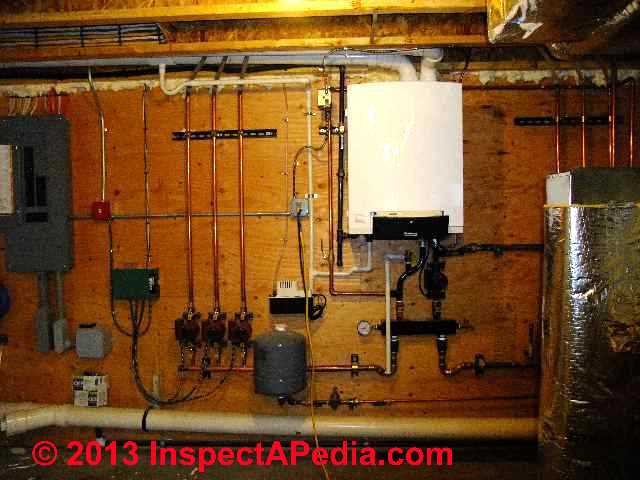
We describe typical installations of both hydronic tubing and electric radiant heat, including thin film electric radiant heat panels below several types of finish flooring. Our page top photo illustrates the heating boiler, circulators & mixing controls for a multi-zone radiant floor heating system installed during reconstruction of a home in Tivoli, NY.
InspectAPedia tolerates no conflicts of interest. We have no relationship with advertisers, products, or services discussed at this website.
Radiant Heat Use in buildings: when, why, how to use radiant heating
 Sketch at page top and accompanying text are reprinted/adapted/excerpted with permission from Solar Age Magazine - editor Steven Bliss.
The sketch explains that the radiant heat effect of a hot surface depends on the angle that the surface forms with the subject. Large surfaces facing and close to the subject provide the most radiant heat.
[Click to enlarge any image]
Key articles on radiant heated floors & radiant heat installation, troubleshooting, repair
- RADIANT HEAT - home
- CARPETING IMPACT on RADIANT HEAT FLOOR
- DRIVEWAY & WALK DE-ICING SYSTEMS
- RADIANT HEAT AIR BOUND
- RADIANT HEAT CONTROLS
- RADIANT HEAT DEFECTS LIST
- RADIANT HEAT DESIGN & INSTALLATION MANUALS
- RADIANT HEAT INSTALLATION
- RADIANT HEAT MISTAKES
- RADIANT HEAT TEMPERATURES
- RADIANT HEAT TEMPERATURE CONTROL / MIXING VALVES
- RADIANT HEAT TEMPERATURE NIGHT SETBACK
- RADIANT SLAB FLOORING CHOICES
- RADIANT SLAB TROUBLESHOOTING
- RADIANT SLAB TUBING & FLUID CHOICES
- RADIANT SLAB TUBING LEAKS
- SLAB INSULATION, RADIANT / PASSIVE SOLAR
- THIN FILM RADIANT HEATING SYSTEMS for Ceilings & Floors
- WOOD FLOOR RADIANT HEAT
- WOOD FLOOR RADIANT HEAT DAMAGE
 "Radiant Heating, how it works, when to use it"
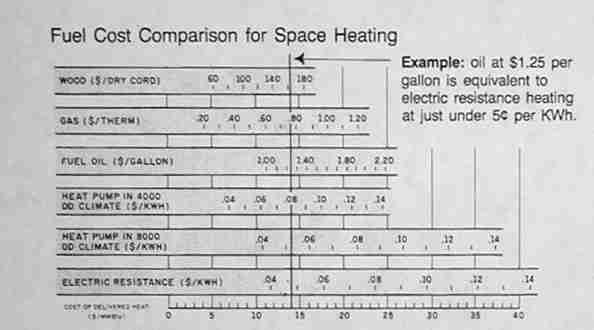
The table (left) included in this radiant heat article provides a typical fuel cost comparison for space heating.
The basics of Radiant Heating Systems
This article explains how radiant heating systems work, it describes the comfort of radiant heating systems, and it provides strategies for using radiant heat in buildings effectively.
The author, Steven Bliss, explains how to use radiant heat most comfortably, citing the ability to heat large areas to relatively low temperatures (rather than providing concentrated heat source), the evenness of radiant heat, and the importance of mass inside the structure to help keep temperatures even and comfortable through the thermostat cycling on and off where radiant heating systems are installed.
The author describes relatively low-cost in-floor radiant heating systems using hot water as well as electric heating elements. In-drywall radiant heat products are also explained and described for ceiling use.
Advantages of radiant heating systems
- The radiant heating system is unobtrusive -
in fact not visible in the occupied space, saving floor space as well - Radiant heating systems are quiet and clean
and require little or no maintenance (depending on the heating source: an oil fired heating boiler supplying a radiant heated building will still require annual maintenance). - Radiant heating systems save energy
compared with comparable convective heating systems where the same fuel is being used to produce btu's of heat. Savings accrue from lower air temperatures as well as the omission of duct or pipe heat losses in the system. - Heating savings from radiant heat systems depends
largely on the amount of thermostat set-back that the occupants find comfortable. Occupants of a radiant-heated building often are equally comfortable (compared with other heating methods) setting back the thermostat 5 degF - about a 20 to 25% savings on heating fuel expense. - Radiant heat "feels special"
or "like being heated by the sun" - (an OPINION difficult to verify objectively).
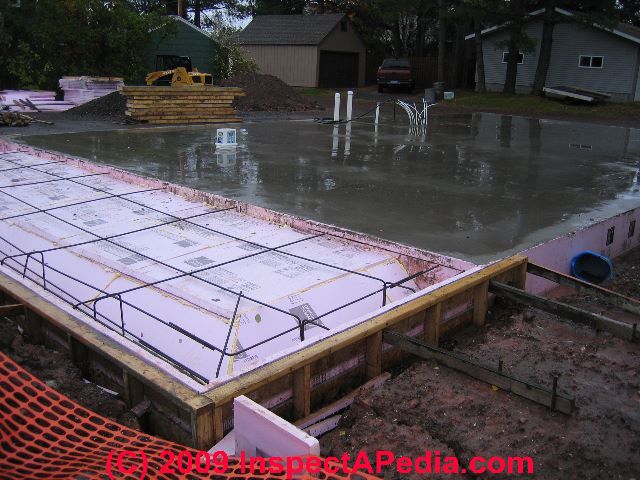
Our photo (above) shows a radiant-heated concrete slab under construction in Two Harbors, MN in 2007.
Disadvantages of electric radiant heat systems
- Electricity can be the most expensive way to provide heat
in some areas of the country. Check with your local utility company as special rates may be available for homes using electric heat.
One of the many foul-ups of the contractor whose radiant heat system was described
at RADIANT HEAT FLOOR MISTAKES was that he failed to install a separate electric meter to provide service to the building where the electric radiant heat system was installed (although the meter was included in the job specs ignored by the contractor),
precluding the owners' ability to take advantage of lower electrical utility rates.
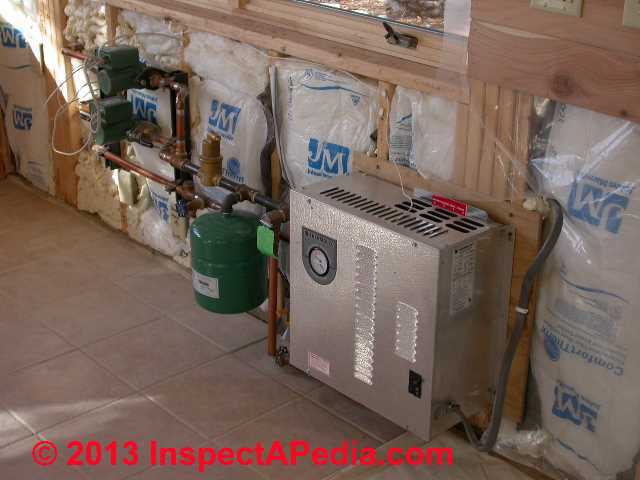
Our photograph (left) shows a really nice looking electric boiler used for the radiant heat system discussed
at RADIANT HEAT FLOOR MISTAKES - unfortunately although the boiler remains installed, the radiant floor heating system is not usable. - Extra ceiling or under-slab insulation
will be needed for ceiling-mounted radiant heating systems. The worst foul-up of the contractor whose radiant heat system was described
at RADIANT HEAT FLOOR MISTAKES was that he buried the in-floor radiant tubing so deep in the floor slab that more heat was transmitted through the under-slab insulation than reached the occupied space - rendering the heating system not usable.
Don't make this mistake.
See SLAB INSULATION, RADIANT / PASSIVE SOLAR for under-slab and slab perimeter insulation specifications.
Floor Damage, Gaps, & Odor Complaints with Radiant Heat Installed under Wood Floors

We (DJF) have investigated a number of complaints of gaps opening between the boards of finished wood flooring and complaints of odors emitted from some types of tubing used in radiant floor heating systems.
Diagnosing gaps in finished wood flooring can be tricky, since these may appear with or without under-floor radiant heating systems installed, especially if the flooring is installed too quickly, without having adjusted its moisture level to that of the building. Installing wood flooring that is at too high a moisture level risks shrinkage and floor gaps as the building dries out.
In some cases that we investigated, flooring gaps appeared after an installer or owner pushed the radiant floor heating system to a temperature higher than recommended by the equipment and tubing manufacturers.
The temperature push was made in an attempt to "cook out" odors emitted from the radiant floor tubing when the heating system was first fired up.
Typical Cost of Radiant Heating Systems
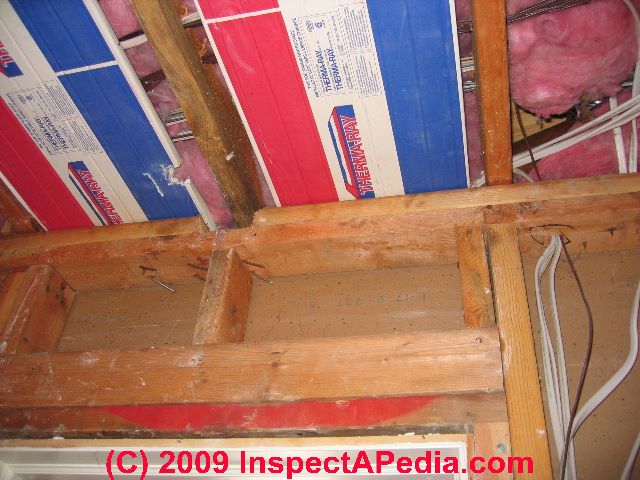
Heating system costs are divided into installation or "first" costs, regular maintenance costs, and operating costs. Our photograph (left) shows two Therma-Ray electric radiant heat panels being installed in the ceiling of a 1960's home in Poughkeepsie, New York.
These panels were replacing previously damaged ceiling components. Be careful about cutting holes in drywall ceilings where electric radiant heating panels have been installed.
- The installation cost for most radiant heating systems is between electric baseboard and conventional air or hydronic (hot water) heating systems.
- Electrical radiant heating systems, if that's how your radiant heating system works, requires the least maintenance - practically none.
- The fuel costs, if your radiant heat system uses electricity, will be higher than oil or gas in most areas of the country.
Here we include solar energy, solar heating, solar hot water, and related building energy efficiency improvement articles reprinted/adapted/excerpted with permission from Solar Age Magazine - editor Steven Bliss.
Thin Film Radiant Heating Systems for Ceilings & Floors - types, where to buy
An alternative to hydronic, tubing-based radiant heating systems that were discussed above, at TYPICAL COST of Radiant Heating Systems we cited electrical radiant heating systems including panels used in ceilings or floors. [See our photo above for an older version of electric heat in gypsum ceiling panels.]
These electric radiant floor heating systems use comparatively thin flexible heating film panels (IHS-CPF) that are wired to a dedicated electrical circuit and of course controlled by a room thermostat. Some radiant heat panel sources include:
- Calorique (West Wareham, MA 800 922-9276), produces thin film radiant heating panel systems used for interior building heating (ceilings or floors), snow melting, de-icing, drum and tank heating, agricultural uses, pet heating systems, and consumer end products.
- (866-786-1806) radiant heating floor panels, .45mm thick, claim to be the thinnest radiant heating panels currently available. CarbonicHeat radiant heating panels are intended for use under ceramic tile.
Radiant heat floor system products are also available for use under Saltillo tile and natural stone flooring as well as below nail-down (or staple-down) wood flooring and engineered wood flooring products. - ComfortTile adhesive-backed fiberglass mesh mats for radiant floor heating [manufacturer and distributor contact information needed - CONTACT us], used under ceramic tile or stone flooring.
- FloorHeat (Lansing MI, 888-265-5455) provides electric radiant heating mats ideal for small floor areas, 12-inch wide electric heating elements for under framed floors, as well as supporting plastic grid modules, heating plates, and PEX tubing for hydronic radiant heating system s. Systems are intended for use under carpeting, hardwood, laminate floors, or parquet flooring.
FloorHeat produces low-voltage radiant heating panels that might fit certain low-voltage alternative energy-designed homes. These panels can also be used in roofing applications and can tolerate being penetrated by roofing nails. - IdealHeat - see WarmRibbon flexible heating film ribbons and panels described below. [manufacturer and distributor contact information needed - CONTACT us],
- In-Slab radiant heat electric cable used in concrete slabs. [manufacturer and distributor contact information needed - CONTACT us],
- Nuheat electric radiant heat systems ( Richmond BC, Canada, 800-778-WARM (9276) ) for use under tile, stone, and laminate flooring, Nuheat Industries provides a cable system that permits custom layouts of heating elements as well as both standard and custom heating mats.
- ThermalMat electric radiant heat panels used under hardwoods, laminates, and engineered wood flooring; [manufacturer and distributor contact information needed - CONTACT us],
- Warm Ribbon Flexible Heating Film panels [manufacturer and distributor contact information needed - CONTACT us], very thin panels, used under a variety of finish floor products. WarmRibbon products include a crystalline ribbon heater that can be used both indoors and outdoors and is intended for carpeted or parquet-flooring finish floors.
Note on Avoiding or Insulating Heat Sources rather than Producing Heat:
Too many of the electric radiant heat flooring searches we made turned up advertising pages where writers collected sources a bit hastily. We include the content below to help readers sort out the products they want (radiant heat flooring materials) from other stuff.
HeatShield panels, (Valley Center, CA 800-750-3978 ) produces heat insulating panels - in case you need to shield from heat rather than to direct heat into a building area. Heatshield Radiant Heat Mats (Amazon.com) are sold in an adhesive-backed form used, for example, in the automotive industry.
Examples of Thin Film Radiant Heat Flooring Installations for Different Flooring Materials
The Calorique company provides radiant floor heating systems in several designs including specifically for use below laminate flooring, carpeting, vinyl tile, linoleum, and ceramic tile floors. Calorique's system uses individual thin film panels connected to a 30-A electrical circuit to provide heat below these types of floor materials. Calorique describes these radiant heat floor installation examples:
Radiant Heat below glued carpet, wood, vinyl, or linoleum floors in dry surroundings
- Finished floor surface: carpeting, wood, vinyl or linoleum (sheet flooring) with adhesive
- Self leveling flooring cement or latex compound at least 1/4"thick
- Thin film heating mats, electrical, wired per the manufacturer's instructions
- Floor surface: concrete slab or wood
Radiant Floor heat below floating type wood, laminate, or parquet flooring in dry surroundings
- Wood, laminate, or parquet finish flooring without use of an adhesive (typically mechanical clips or fasteners)
- Thin film heating mats, electrical, wired per the manufacturer's instructions
- Soft insulation material (see the manufacturer's specifications)
- Floor surface: concrete slab or wood
Radiant Floor heat below ceramic tiles in dry surroundings
- Ceramic tile finished floor surface
- Thin-set / grout / tile adhesive or mastic
- Thin film heating mats, electrical, wired per the manufacturer's instructions
- Hard insulating material (see the manufacturer's specifications)
- Floor surface: concrete slab or wood
Radiant Floor heat under tiles in wet surroundings
- Ceramic tile finished floor surface
- Thin-set / grout / tile adhesive or mastic
- Grounding net - recommended in wet surroundings, a grounding net (for safety) is installed directly above the heating mat
- Thin film heating mats, electrical, wired per the manufacturer's instructions
- Hard insulating material (see the manufacturer's specifications)
- Floor surface: concrete slab or woo
- Thanks to reader Jim O'Dowd for suggesting this resource.
Original article
Links to the original article in PDF form immediately below
- RADIANT HEAT USE Part 1 [PDF] - Radiant Heat: how it works and when to use it.
use your browser's back button to return to this page - RADIANT HEAT USE - part 2 [PDF]
- RADIANT HEAT USE - part 3 [PDF]
CONTACT us to suggest other types or suppliers of radiant heating systems and equipment.
InspectAPedia is an independent publisher of building, environmental, and forensic inspection, diagnosis, and repair information for the public - we have no business nor financial connection with any manufacturer or service provider discussed at our website. We are dedicated to making our information as accurate, complete, useful, and unbiased as possible: we very much welcome critique, questions, or content suggestions for our web articles.
Radiant Heat Installation & Operation & Temperature Guides
These references, studies, guidelines on radiant heat temperatures, heat losses, etc. are found
Reader Comments, Questions & Answers About The Article Above
Below you will find questions and answers previously posted on this page at its page bottom reader comment box.
Reader Q&A - also see RECOMMENDED ARTICLES & FAQs
On 2023-04-17 by InspectApedia Publisher (mod) - repair kit & instructions for fixing damaged electric radiant heat cables or wires
 @Alex,
I was not sufficiently clear in my earlier answer suggesting that you're looking at a wire splice whose connections need to be approved & safe as well.
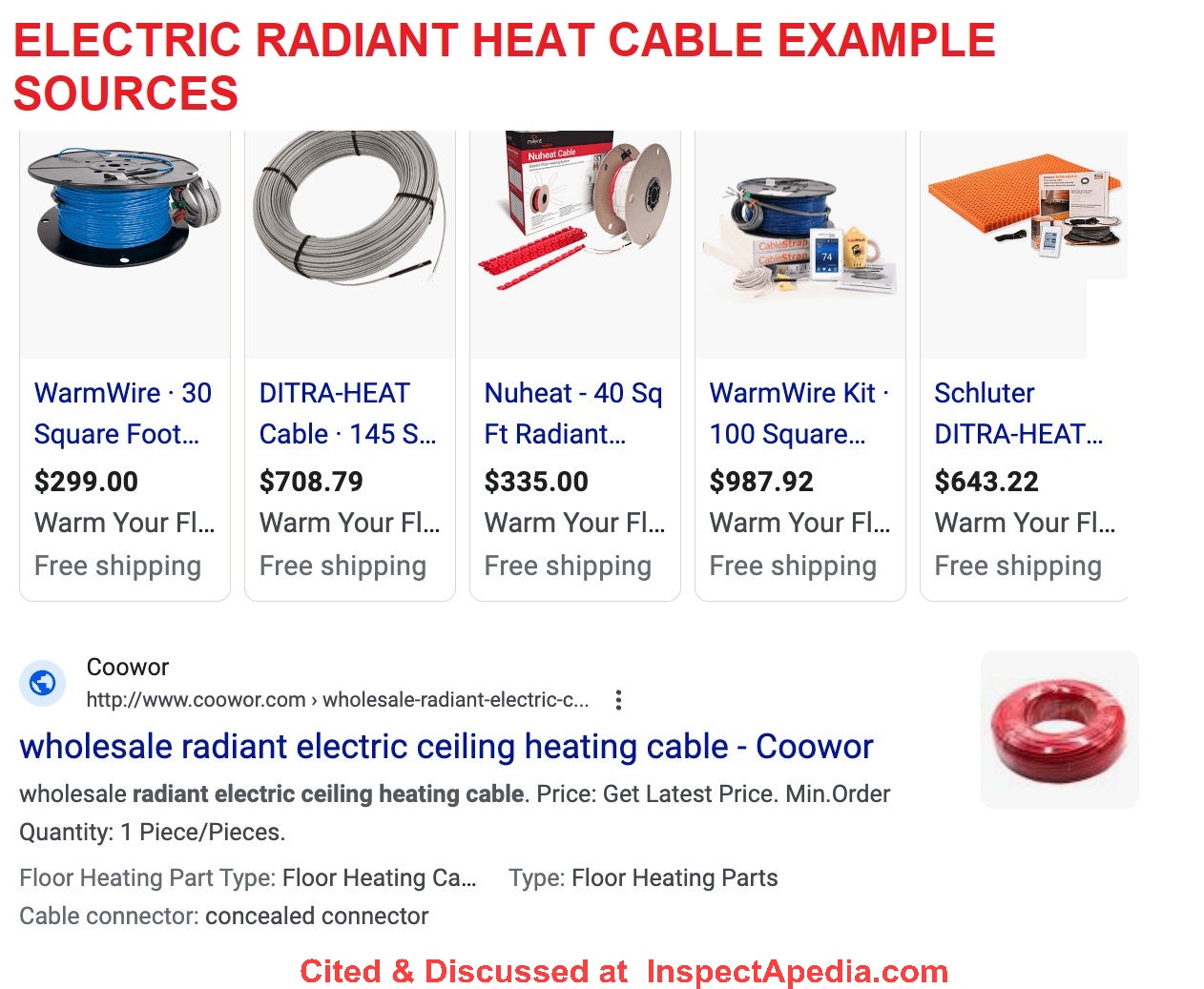
There are literally dozens of manufacturers of electric radiant heat wire manufacturers whose products can be installed in a ceiling or used to repair broken radiant heat wire in a ceiling.
I'll paste screen shots giving an example, simply searching for "electric radiant heat ceiling wire" and of radiant heat electric cable repair kits.
You'll want to contact the manufacturers directly to ask for advice about code-approved and electrical- and fire-safe connections when repairing such wiring.
The concern is that using typical electrical wire connectors may lead to a failure as wire used for radiant electric heating goes through so many temperature cycles and heating variations.
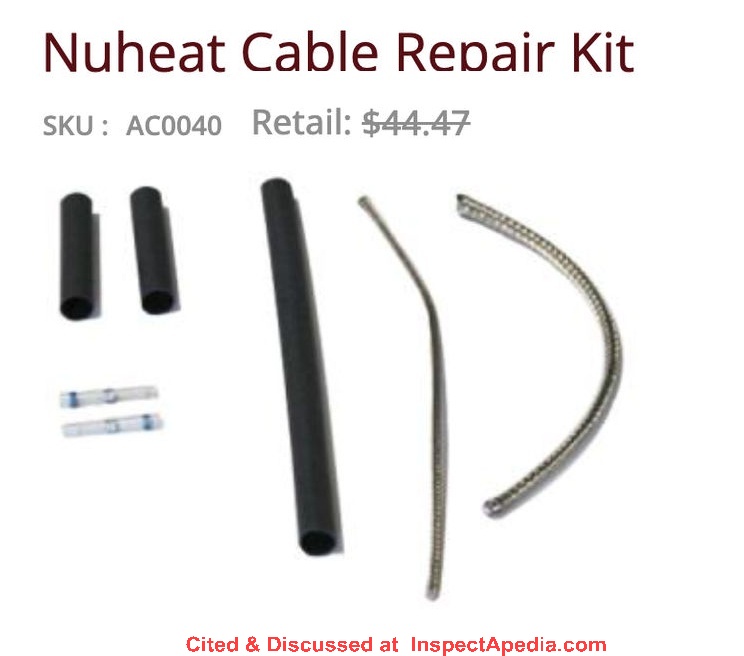
The good news is that electric radiant heat cable manufacturers also make wire or cable connection and repair kits.
For example, NuHeat offers a radiant heat cable repair kit and repair instructions.
I'll post a photo of the repair kit and a link to radiant electric heat repair instructions above.
Below: example of sources of electric wire cable used for electric radiant heat systems.
See these
- NUHEAT RADIANT ELECTRIC HEAT CABLE REPAIR KIT INSTRUCTIONS [PDF] NuHeat Corp., nVent Thermal Management, 3210 – 6900 Graybar Road, Richmond, BC, Canada V6W 0A5 Tel: 1-800-778-9276 (WARM) Web: www.nuheat.com/
- FYI see our articles on radiant heating starting at
RADIANT HEAT - home
On 2023-04-17 by Alex - where do I find repair wire for electric radiant heat in a ceiling?
@InspectApedia Publisher, problem is that I can’t find the heat wire manufacturer. All I have is the picture of that wire & can’t seem to find any other info on it or if I need to solder or use a butt slice to reconnect wire. Any other info that you have would be appreciated. Thanks
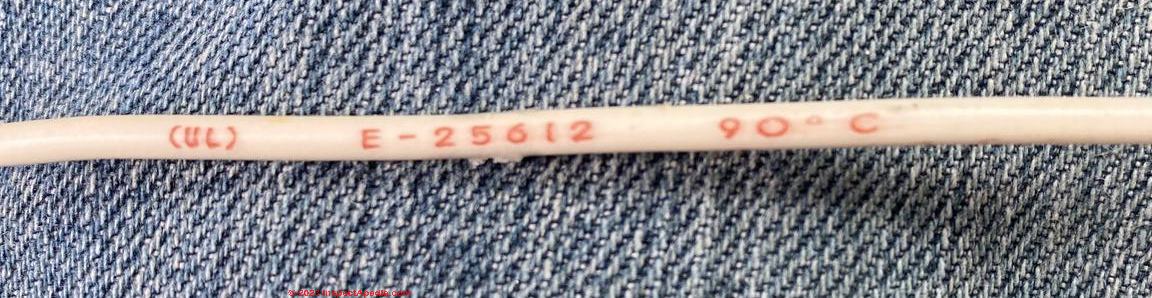
I’m trying to find radiant heat wire that was used in ceilings I heard around the 1960’s. Single conductor with thick insulation. Looks like a size 22awg wire from a home in California. Looking for a replacement wire that I could use to splice into. It is stapled onto drywall then gets mudded to hide in ceiling.
Photo: UL listed electric wire for radiant heat system, identified as (UL) E-25612 90°C
This Q&A were posted originally
at OLD ELECTRICAL WIRING TYPES
On 2017-05-30 - by (mod) - how do we determine if electric radiant heat is working & safe to use?
Diana,
Sounds as if the home inspector took an easy way out. I would think he would have told you if there was a functional or not functional heating Source in the house. Just saying evaluate further is a little vague.
It's possible that the heat is or was electric radiant floor heat but I really can't know from your text. An inspector with a little bit of experience ought to be able to look at the controls and try turning them on to see if the floors get warm.
On 2017-05-30 by Diana
Situation: Currently in escrow on a home built in 1978. Home inspector only recommended further evaluation of the home's radiant heat.
A prior owner installed central A/C and heat. There is no known broiler, pump or any such device visible for the radiant heat, but there are analog knobs on the walls in each room to control it. Not sure if it is operable or safe.
Question: What is the method for determining:
A) Is it safe to operate?
B) Is it electric or hydronic?
C) If installed to a home on a raised foundation if it runs in the floors or the walls?
D) Is it still operating (functional)?
E) What type of professional would service or inspect this system?
On 2016-04-28 - by (mod) - radiant heat "caused" cracks in concrete floor?
Sorry to hear this trouble, Susan, and surprised that radiant heat would cause the floor to crack. Perhaps you first want to get some help with diagnosing the cracking cause: is it in the pattern of the tubing or at stress points or is there foundation settlement, or slab heaving or something else?
About the tubing: take a look at the tubing where it is exposed to view.
Armed with the brand name and tubing model name we can look up the manufacturer's temperature rating. It may be that though 180 was too hot, the tubing may be un-damaged.
Post a photo so that we can see more of what's going on.
On 2016-04-27 by Susan
I have radiant heating in my indoor concrete floor. I understand that my boiler system was installed incorrectly and water temperatures of 180 was running through the tubing ...my concrete floor is severely cracked ... what is the maximum temp of water for the tubing and what concerns should I have with regard to damage to tubing ...life of tubing ...
should it be replace ...please let me know if there are any other concerns I might have
thank you for you time
On 2015-01-22 - by (mod) - do we need the auto or fan setting on the thermostat when using electric radiant heat
Anon
Presuming your heating system is only providing heat the FAN setting should be irrelevant as it ought not be connected to anything.
I'd use AUTO or HEAT if there is a HEAT position.
In the More Reading links above see THERMOSTATS, HEATING / COOLING for articles that include the thermostat switch settings.
On 2015-01-22 by Anonymous
we have radiant heat- do I put it on auto or fan in the winter
On 2014-10-29 by Aimee - poles to support a radiant heat wall unit?
I just moved into a condo with radiant heat ceilings. I want to install 4(four) One inch (1") by one inch poles to support a wall unit system . The poles would be about 13 inches away from the walls and 32 inches apart.
Cabinets fit I between the poles and get bolted to the poles. The walls serve as support since the units are flush with the wall. The system was designed by the architect George Nelson and was sold in the 1970s by Omni.
Please advise as to the safety or danger to the heating ceiling.
Thank you
On 2014-03-16 - by (mod) - ceiling heat stopped working
Anon:
If the ceiling heat in the rooms where you have not heat is on the same circuit and controlled by the same thermostat as in rooms where you do have heat then most likely the radiant circuit for those rooms has been damaged or interrupted. That can happen by someone driving a nail, walking in the attic, or more seriously, by overheating of the system.
On 2014-03-16 by Anonymous
The
ceil heat has stopped working in two rooms of my house... also one of my light fixtures has stopped working also.
Could this be related to the heat not working? I have tested the wires and electricity is getting to the thermostat and the light fixture. What could be my problem?
On 2014-03-10 - by (mod) - radiant heat working in some rooms, not others
Dana,
If you have heat in some rooms but not others, the problem is not likely to be the oil burner itself.
However when a radiant floor heat is off for a time it's possible that a control seized or that a loop has become air-bound. Ask for a service call to determine if a control is not working or if there is another heat problem with just that zone.
Keep us posted.
DF
On 2014-03-08 by Dana
We ran out of oil last friday and the oil company came and restarted the furnace. However we just realized that our rooms with the radiant heat flooring aren't working. What do I need to do?
On 2012-05-07 by Katie - electric radiant heated ceilings.
Hi,
I am buying a condo with electric radiant heated ceilings. The property is currently bank owned so I don't know anything more about the heating than that (other than that each room is independently controlled). From my reading so far I am unclear on whether there are different kinds of electric radiant heat ceilings or if it's all pretty much the same.
I understand that I cannot puncture the ceiling in any way, but would pressure damage it as well? I would like to use a portable dance pole sometimes, which is basically a very big tension rod.
The top does have a 16" diameter dome to spread the pressure over a greater area, but it only contacts the ceiling at the edge where there is a ring of silicone. I worry that the wires might be damaged by being pressed between the pole and the joist, since there has to be enough pressure to withstand lateral forces on the pole.
Would it make a difference if I put it up only when I wanted to use it versus leaving it up most of the time? I was so excited to be moving someplace with enough room to have a pole of my own until I realized just how big of a deal it is to damage these heating systems. I would rather keep using the poles at the gym than cause thousands of dollars in damage to my home (and investment).
On 2011-12-14 - by (mod) - 1960 era All Electric Apartment
1960-era all electric:
1. Type of heating: we cannot know what type of heat your all electric apartment has without more information: there may be (typical) electric baseboard heaters, or there may be radiant in floor or in ceiling, or less likely even an electric boiler powering hot water heat or water to air heat.
Take a look for heat radiating devices, take some sharp photos and send them to us (see the CONTACT link at top, left, bottom of our web pages) and I can comment further.
2. I'll research and reply to this later
3. The first and easiest thing you can do to save on heating cost with electric heating is to manually or automatically set back the temperature at night or when you are out of the apartment.
You may want to install automatic programmable thermostats so that you can set and forget the setbacks,
WATCH OUT: some electric heat systems use a high voltage thermostat that is wall-mounted or may be mounted right on an electric baseboard unit. If your apartment uses that type of heat control, the standard low-voltage programmable thermostat sold at building supply stores won't work.
You do not need to turn OFF a heater when it's not in use as long as the thermostat is keeping the heater off. Off is off, whether the "off" state is specified by the thermostat or by a circuit breaker. The only exception is a very small electricity usage to power thermostats themselves.
3. If your heaters use a finned system to heat air (take a look behind the covers of electric baseboards for example) gently vacuum off dust and trash that may be blocking airflow, and don't block the air entry points at the bottom of baseboard heaters by thick carpeting or anything else.
Take a look at our articles on electric heat, saving on heat energy, etc. beginning with the article titled "ELECTRIC HEAT" found near the top left of this page.
On 2011-12-14 by 1960 era All Electric Apartment
Just moved into an 1960 era "All Electric Apartment" in Southern California. Wondering
1) What type of Electric heating system my unit probably has
2) Is there a general guideline to caculate kWh usage and thus understand usage better (& potential problems)?
2) Any tips on How to save on heater usage?
a) Been told that best to turn heater breakers off when not using (myth or fact)?
3) Any maintenance that would help
a) Like Replace Manual Thermostats with modern LCD Timer Type?
b) Breakers?
I have a two bedroom apartment with 3 Separate Thermostats in all rooms.
...
Continue reading at RADIANT HEAT AIR BOUND or select a topic from the closely-related articles below, or see the complete ARTICLE INDEX.
Or see these
Radiant Heating System Articles
- RADIANT HEAT - home
- CARPETING IMPACT on RADIANT HEAT FLOOR
- DRIVEWAY & WALK DE-ICING SYSTEMS
- RADIANT HEAT AIR BOUND
- RADIANT HEAT CONTROLS
- RADIANT HEAT DEFECTS LIST
- RADIANT HEAT DESIGN & INSTALLATION MANUALS
- RADIANT HEAT INSTALLATION - Dream Home Guide, 1950s
- RADIANT HEAT MISTAKES
- RADIANT HEAT TEMPERATURES
- RADIANT HEAT TEMPERATURE CONTROL / MIXING VALVES
- RADIANT HEAT TEMPERATURE NIGHT SETBACK
- RADIANT SLAB FLOORING CHOICES
- RADIANT SLAB TROUBLESHOOTING
- RADIANT SLAB TUBING & FLUID CHOICES
- RADIANT SLAB TUBING LEAKS
- SLAB INSULATION, RADIANT / PASSIVE SOLAR
- THIN FILM RADIANT HEATING SYSTEMS for Ceilings & Floors
- WOOD FLOOR RADIANT HEAT
- WOOD FLOOR RADIANT HEAT DAMAGE
Suggested citation for this web page
RADIANT HEAT at InspectApedia.com - online encyclopedia of building & environmental inspection, testing, diagnosis, repair, & problem prevention advice.
Or see this
INDEX to RELATED ARTICLES: ARTICLE INDEX to RADIANT HEAT
Or use the SEARCH BOX found below to Ask a Question or Search InspectApedia
Ask a Question or Search InspectApedia
Try the search box just below, or if you prefer, post a question or comment in the Comments box below and we will respond promptly.
Search the InspectApedia website
Note: appearance of your Comment below may be delayed: if your comment contains an image, photograph, web link, or text that looks to the software as if it might be a web link, your posting will appear after it has been approved by a moderator. Apologies for the delay.
Only one image can be added per comment but you can post as many comments, and therefore images, as you like.
You will not receive a notification when a response to your question has been posted.
Please bookmark this page to make it easy for you to check back for our response.
Our Comment Box is provided by Countable Web Productions countable.ca
Citations & References
In addition to any citations in the article above, a full list is available on request.
- Solar Age Magazine was the official publication of the American Solar Energy Society. The contemporary solar energy magazine associated with the Society is Solar Today. "Established in 1954, the nonprofit American Solar Energy Society (ASES) is the nation's leading association of solar professionals & advocates. Our mission is to inspire an era of energy innovation and speed the transition to a sustainable energy economy. We advance education, research and policy. Leading for more than 50 years. ASES leads national efforts to increase the use of solar energy, energy efficiency and other sustainable technologies in the U.S. We publish the award-winning SOLAR TODAY magazine, organize and present the ASES National Solar Conference and lead the ASES National Solar Tour – the largest grassroots solar event in the world."
- Steve Bliss's Building Advisor at buildingadvisor.com helps homeowners & contractors plan & complete successful building & remodeling projects: buying land, site work, building design, cost estimating, materials & components, & project management through complete construction. Email: info@buildingadvisor.com
Steven Bliss served as editorial director and co-publisher of The Journal of Light Construction for 16 years and previously as building technology editor for Progressive Builder and Solar Age magazines. He worked in the building trades as a carpenter and design/build contractor for more than ten years and holds a masters degree from the Harvard Graduate School of Education. Excerpts from his recent book, Best Practices Guide to Residential Construction, Wiley (November 18, 2005) ISBN-10: 0471648361, ISBN-13: 978-0471648369, appear throughout this website, with permission and courtesy of Wiley & Sons. Best Practices Guide is available from the publisher, J. Wiley & Sons, and also at Amazon.com - Azel Technologies controls, temperature gauges & thermostats for radiant heating systems
- i-Link SERIES ZONE CONTROLS (CIRCULATOR PUMP SWITCHING RELAYS ) FOR HYDRONIC / RADIANT FLOOR HEATING SYSTEMS - Quoting: The i-Link series multi-zone circulator pump switching relays simplify wiring for hydronic heating ( radiant floor heating ) systems. With leading edge features and superior product design, i-Link makes installation quick and easy.
- i-Link SERIES ZONE VALVE CONTROLS FOR HYDRONIC / RADIANT FLOOR HEATING SYSTEMS
- UNIVERSAL DIGITAL TEMPERATURE GAUGE: DS-60P - Quoting: The i-Link series Zone Valve Controls simplify the field wiring and yet control up to six zone valves in a multi-zone hydronic radiant heating system. The contractor friendly Printed Circuit Board eliminates the problem caused by incorrect wiring and saves hours of installation time. There would be no more “messy” look of conventional zone valve installations.
- DIGITAL NON-PROGRAMMABLE THERMOSTAT FOR HYDRONIC RADIANT FLOOR HEATING - Quyoting: D-508F digital non-programmable heat only thermostat is designed to control either ambient(air) temperature (A Mode) or floor temperature (F Mode) or a combination of ambient temperature with floor temperature limits(AF Mode). An auxiliary remote sensor is provided to measure slab temperature in order to control the floor temperature(within maximum and minimum limits in AF Mode) in hydronic radiant floor heating system. It can also be used for sensing the outdoor temperature in A Mode.
- DIGITAL PROGRAMMABLE THERMOSTAT FOR HEATING/COOLING & HYDRONIC RADIANT FLOOR HEATING - Quoting: Azel Technologies introduces 500 series electronic programmable thermostat that utilizes the lastest digital technologies for residential and light commercial systems. D-500 is designed for 24 Vac single-stage heating and cooling systems. D-502F is designed to control the floor temperature in Hydronic Radiant Floor Heating Systems. The 500 series can accurately control the temperature within one degree. Reliable permanent memory retains the programmed settings in the event of a power failure. In addition, the large, easy to read LCD display with backlit makes the thermostat easy to operate and simple to program.
- Azeltec, SOLAR DIFFERENTIAL CONTROL: DST-932, P.O. BOX 53138 Thornhill ON L3T 7R9 Canada Tel: 905-223-5567 Email: info@azeltec.com Web: azeltec.com- Quoting: The DST-932 differential temperature controller is designed for the Solar Heating Systems. The DST-932 switches on a pump in order to transfer heat from solar collector to a storage tank. The controller reads the temperatures of the storage tank (T1) and of the collector (T2), when this differential temperature (T2-T1) is higher than a set value (dt), it will switch on the pump. It is possible to limit the maximum temperature of the storage tank and also activate a freeze protection function. By switching to manual mode it allows the test of the heating system by turning the pump ON or OFF. A universal sensor P-01 or P-02(higher temperature range) is supplied with the control. This solid state temperature sensor probe can be extended up to 500 feet.
- Calorique Radiant Heating Floor & Ceiling Systems, Calorique LLC, 2380 Cranberry Highway, West Wareham, MA 02576 USA, Tel: 800 922-9276, produces thin film radiant heating panel systems used for interior building heating (ceilings or floors), snow melting, de-icing, drum and tank heaitng, agricultural uses, pet heating systems, and consumer end products. The company provides radiant floor heating systems in several designs including specifically for use below laminate flooring, carpeting, and tile floors. - Thanks to reader Jim O'Dowd for suggesting this resource.
- FloorHeat 3130 Sovereign Drive, Lansing, MI 48911, 888-265-5455, Email: info@FloorHeatCompany.com) radiant floor heating panels,
- Heatshield Panels, 27354 Valley Center Road, Valley Center, California 92082 USA, 800-750-3978
- Nuheat Industries, 3105 - 6900 Graybar Road, Richmond, BC Canada V6W 0A5, electric radiant heat systems for use under tile, stone, and laminate flooring, Web: nuheat.com Tel: 800-778-WARM (9276) Email: info@nuheat.com
- ASHRAE 25 Heating, Refrigeration, and Air Conditioning engineering standards
- ASHRAE 90.1-2004 User's Manual, instructions for the design of commercial and high-end residential buildings "to ensure their compliance with ANSI/ASHRAE/HESNA Standard 90.1-2004 including the application of principles of effective energy conserving design..."
- CarbonicHeat radiant heat flooring products, Web: carbonicheat.com Tel: 866.786.1806 Email: sales@carbonicheat.com, [no mailing address]
- "Radiant Heating Systems" U.S. DOE
- In addition to citations & references found in this article, see the research citations given at the end of the related articles found at our suggested
CONTINUE READING or RECOMMENDED ARTICLES.
- Carson, Dunlop & Associates Ltd., 120 Carlton Street Suite 407, Toronto ON M5A 4K2. Tel: (416) 964-9415 1-800-268-7070 Email: info@carsondunlop.com. Alan Carson is a past president of ASHI, the American Society of Home Inspectors.
Thanks to Alan Carson and Bob Dunlop, for permission for InspectAPedia to use text excerpts from The HOME REFERENCE BOOK - the Encyclopedia of Homes and to use illustrations from The ILLUSTRATED HOME .
Carson Dunlop Associates provides extensive home inspection education and report writing material. In gratitude we provide links to tsome Carson Dunlop Associates products and services.
 | HOME | ABOUT | ASK a QUESTION | CONTACT | CONTENT USE POLICY | DESCRIPTION | POLICIES | PRIVACY | |
| © 2024 - 1985 Publisher InspectApedia.com - Daniel Friedman | |||||||||