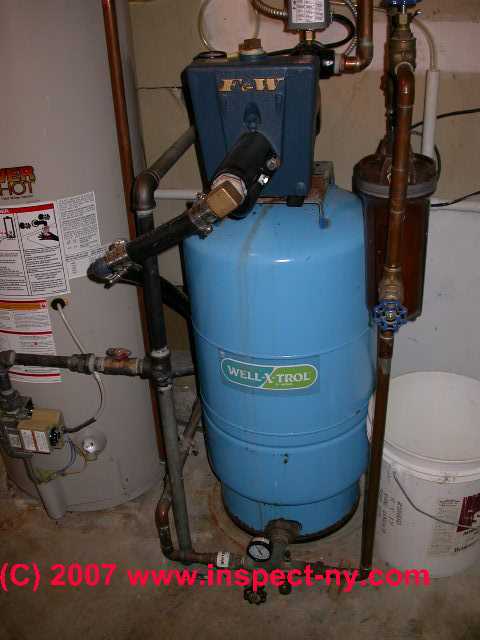
 Intermittent Loss of All Water Pressure
- POST a QUESTION or COMMENT on intermittent loss of building water pressure: troubleshooting, causes, repairs.
Intermittent loss of building water pressure: diagnosis & cure. This article describes questions and answers from and to a homeowner who lost water pressure.
The basics process of diagnosis and the costs of the repair are explained.
This article describes common water pressure-loss problems and their causes, and provides links to more detailed diagnosis and repair articles for each of those situations.
Consumer advice on saving money on well repair costs includes a review of the parts and labor costs of a typical well pump and pressure tank replacement case.
InspectAPedia tolerates no conflicts of interest. We have no relationship with advertisers, products, or services discussed at this website.
- Daniel Friedman, Publisher/Editor/Author - See WHO ARE WE?
How to diagnose loss of water pressure that later improves or returns "on its own"
When you lose water for some time period but later it returns we think immediately of the following possible explanations.
- The well is being pumped "dry"
and you're waiting for the well itself to recover water. With age however, some wells deteriorate and deliver less and less water as their flow rate from the water table into the well diminishes.
This occurs as minerals clog the cracks or passages through which water is entering the well.
A well may be pumped "dry" - and the pump stops delivering water, or the well may be pumped down to a low flow rate - or a low recovery rate, which in some installations may permit the pump to continue to run but it will deliver water only at a reduced rate.
- Low Well Water well pipe tailpieces:
Some wells that are known to have intermittent low water problems may be equipped with a special tailpiece on the water pick-up end of the well pipe precisely to prevent the well pump from becoming damaged when water level in the well drops too low.
The tailpiece permits the in-well water pump to continue to run by recirculating well water within the pump but by halting delivery of water or slowing delivery of water to the building.
See WATER PUMP LIFE EXPECTANCY where we describe these conditions and parts in more detail.
This is a very likely cause of the intermittent loss of water or water pressure symptom. - Well pump motor is overheating:
if a well pump motor is overheating for any reason (low voltage, bad start/run capacitor, damaged motor, damaged pump impeller parts, loss of water in the well, pump running dry) it may be a model that will turn itself off when too hot.
A thermal sensor inside the pump motor housing handles this job.
With the motor off for a cool-down period, the thermal sensor automatically resets and the pump will run again.
Typically the "off" time is 15-20 minutes. If the pump on-off activity is erratic or very long, it could be that the problem is a bad thermal sensor switch.
Note that other electric motors may have a thermal reset switch that is mechanical and "pops out" to show a red "reset button" that must be pushed back in manually. If the motor is still too hot, pushing the button won't work - the button won't stay in.
See details at - Water pump hesitates before starting at end of water tank draw-down cycle -
see PUMP PRESSURE CONTROL SWITCH FINE-TUNE - If the pump runs, water pressure returns, but water pressure drops without explanation when the pump stops,
see WATER PRESSURE FALLS SLOWLY, ERRATIC PUMP - A pump is shutting down on thermal overload
and you're waiting for it to cool down and automatically re-set its overload switch.
If the well pump is visible in the building you can diagnose this condition: - If the pump keeps running and you have no water
there is a problem with the well or well piping or foot valve in the well -- maybe. See contrasting cases after this list.
Or on occasion, the pump could itself be damaged -
its motor is spinning but the pump impeller is broken and the pump is not moving water.
Explanation: If the well pump keeps running and you have no water it is also possible that the pump itself is defective, such as having broken internal parts so that the motor runs but the pump does not move water.
But if the impeller blades in the pump are broken, the pump may spin but no water is moved inside the pump housing - the water supply system would have poor water pressure or it may have no water and never recover.
By contrast with cases where you lose but then recover water pressure in the building are cases where you lose and do not recover water pressure or flow:
You'd have either no water or only very low pump output no matter what conditions in the well.
- Or the pump has lost its prime.
If the water tank is empty the pump may need to be primed.
See WELL PUMP PRIMING GUIDE - If the pump shuts itself off and is hot,
it is off on thermal reset.
See RESET SWITCH, ELECTRIC MOTOR - If the pump is in the well
you can't see these conditions directly but an electrician or plumber can do some diagnosis from the building by noting the amperage draw on the pump circuit.
If inside the well there is a leaky or broken water line rising from the pump,
the pump could run but deliver less or no water to the building. If this defect is present, the system will not recover to normal operation on its own. In may cases the pump will deliver some water pressure but it is poor.
If the well pipes come disconnected completely, the pump may run but no water will be delivered.
- Bad or No water pressure?
See WATER PRESSURE LOSS DIAGNOSIS & REPAIR for a step by step detailed guide to diagnosing and correcting bad water pressure or total loss of water pressure.
Before changing a water pump or control, we need to know why the water pressure or water flow is poor.
Also see our
separate WATER PRESSURE PROBLEM DIAGNOSIS TABLE in summary table form. - Intermittent water pump cycling - when you think the pump is running at odd hours - is discussed
at WATER PUMP INTERMITTENT CYCLING - this means that the water pump comes on for no apparent reason. - Short cycling of a water pump
means that the water pump turns on and off too rapidly or too frequently when water is being run in the building.
See WATER PUMP SHORT CYCLING CAUSES
and WATER TANK REPAIR PROCEDURES - Loss of water pressure means
that the pressure with which water enters a plumbing fixture has become too slow, or is sometimes too slow or weak in water flow rate, or water flow may stop entirely.
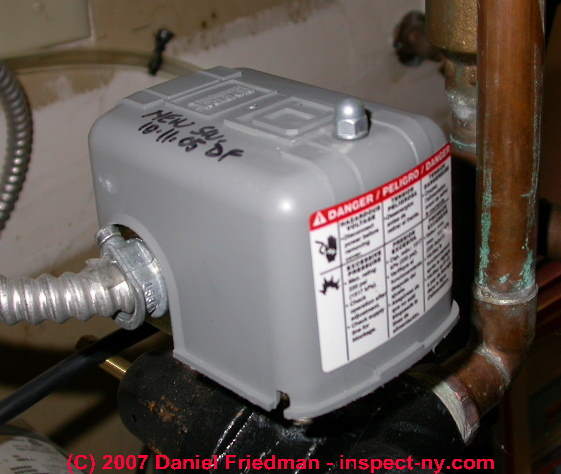
See WATER PRESSURE LOSS DIAGNOSIS & REPAIR - Details on how to repair the water pump pressure control switch are discussed
at WATER PUMP PRESSURE SWITCH REPAIRS - How to boost water pressure in a building by installing a pressure booster pump and pressure tank is discussed in detail
at WATER PRESSURE BOOSTER PUMP
If the building water supply stops and takes minutes to hours to recover, you may have problem with the well flow rate.
But the problem of lost water supply and pressure could be more mechanical: a bad well pump.
The well pump, in turn, could have been damaged or hastened to the end of its life by a bad water pressure tank which has caused well pump short-cycling. Short cycling of the pump motor can burn up the pump relay control.
Readers of this document should also see WATER TANK REPAIR PROCEDURES how to diagnose the need for air, how to add air, stop water pump short cycling to avoid damage - water storage water pressure tank safety.
...
Reader Comments, Questions & Answers About The Article Above
Below you will find questions and answers previously posted on this page at its page bottom reader comment box.
Reader Q&A - also see RECOMMENDED ARTICLES & FAQs
Every few days water stops running in our house
Our house has three floors. Every so often (say, every other week or even every few days), certain things stop working all at once: the water stops working in the downstairs bathroom, but only the COLD water - and along with it, the cold water in the downstairs laundry room.
At the same time, the water supply in the door of the refrigerator on the MAIN level (one floor up) stops working.
At some point later, they all come back on at the same moment and continue working as if nothing ever happened. Completely random timing and an utter mystery .help! Thanks. On 2020-10-21 by Anna
Suggestions by (mod) -
Anna
If your water pressure is provided by a well or water pressure booster pump in your home, take a look at the causes and cures listed above on this page,
and perhaps you'll want to ask your repair person to check or replace the pressure control switch.by Anna - Are pressure booster pumps found if on city water?
Hi, I neglected to say, we're on city water, no well - would we have a water pressure booster pump if we're on city water? Thanks.
by (mod) -
Some buildings do - you would know if your home had a pressure booster system: you'd see a pump or perhaps pump and tank near the point of water entry into the building.
take a look at the causes and cures listed above on this page,by Anna -
Thank you, will ask.
I Lose All water pressure when I run water for a few minutes
I put a new foot valve and check valve on my main line for the pump but still when I run water in house less than 5 minutes I lose total pressure - On 2019-11-13 by Robert
Reply by (mod) -
That sounds to me more like a problem of a well running out of water then a check valve problem.
It's probably where your check valve the symptom would be losing Prime and you'd have no water at the start of the pump on cycle.
What you're describing is having water at the start when you first open a fixture and then running out very quickly.
...
Continue reading at WATER PRESSURE INTERMITTENT LOSS or select a topic from the closely-related articles below, or see the complete ARTICLE INDEX.
Or see WATER PRESSURE STOPS RETURNS FAQs posted originally on this page.
Or see these
Recommended Articles
- WATER PRESSURE GAUGE
- WATER PRESSURE TABLE 1: PUMP WON'T RUN, WON'T STOP, or CYCLES
- WATER PRESSURE LOSS DIAGNOSIS, MUNICIPAL
- NO WATER PRESSURE
- WELL WATER PRESSURE IMPROVEMENT
- WATER PRESSURE BAD at SOME FIXTURES
- WATER PRESSURE INTERMITTENT LOSS - water pressure or flow rate varies too much
- WATER PRESSURE STOPS, RETURNS - water flow stops, then returns
- WATER PRESSURE VARIATION CAUSES
- WATER PUMP CONTROLS & SWITCHES
- WATER PUMP INTERMITTENT CYCLING - pump turns on and off at odd times for no apparent reason
- WATER PUMP SHORT CYCLING - pump turns on and off to frequently or too rapidly
Suggested citation for this web page
WATER PRESSURE STOPS, RETURNS at InspectApedia.com - online encyclopedia of building & environmental inspection, testing, diagnosis, repair, & problem prevention advice.
Or see this
INDEX to RELATED ARTICLES: ARTICLE INDEX to WATER SUPPLY, PUMPS TANKS WELLS
Or use the SEARCH BOX found below to Ask a Question or Search InspectApedia
Ask a Question or Search InspectApedia
Share this article:Questions & answers on intermittent loss of building water pressure: troubleshooting, causes, repairs. .
Search the InspectApedia website
Need to make a private comment? Email editor@inspectApedia.com. We welcome email with your website content critique, corrections, suggestions or questions. Email is monitored daily but our workload may prevent an immediate reply. For immediate results, we hope you'll first try asking your question using the search box just above.
Citations & Reviewers
In addition to any citations in the article above, a full list is available on request.
- Thanks to reader René A Valencourt, CCP, MCTS, IS Dept., CTB, Inc. for technical editing 10 Sept 2009.
-
Flexcon, SMART TANK INSTALLATION INSTRUCTIONS [PDF], Flexcon Industries, 300 Pond St., Randolph MA 02368, www.flexconind.com, Tel: 800-527-0030 - web search 07/24/2010, original source: http://www.flexconind.com/pdf/st_install.pdf
- Grove Electric, Typical Shallow Well One Line Jet Pump Installation [PDF], Grove Electric, G&G Electric & Plumbing, 1900 NE 78th St., Suite 101, Vancouver WA 98665 www.grovelectric.com - web search -7/15/2010 original source: http://www.groverelectric.com/howto/38_Typical%20Jet%20Pump%20Installation.pdf
- Grove Electric, Typical Deep Well Two Line Jet Pump Installation [PDF], Grove Electric, G&G Electric & Plumbing, 1900 NE 78th St., Suite 101, Vancouver WA 98665 www.grovelectric.com - web search -7/15/2010 original source: http://www.groverelectric.com/howto/38_Typical%20Jet%20Pump%20Installation.pdf
- In addition to citations & references found in this article, see the research citations given at the end of the related articles found at our suggested
CONTINUE READING or RECOMMENDED ARTICLES.
- Carson, Dunlop & Associates Ltd., 120 Carlton Street Suite 407, Toronto ON M5A 4K2. Tel: (416) 964-9415 1-800-268-7070 Email: info@carsondunlop.com. Alan Carson is a past president of ASHI, the American Society of Home Inspectors.
Thanks to Alan Carson and Bob Dunlop, for permission for InspectAPedia to use text excerpts from The HOME REFERENCE BOOK - the Encyclopedia of Homes and to use illustrations from The ILLUSTRATED HOME .
Carson Dunlop Associates provides extensive home inspection education and report writing material. In gratitude we provide links to tsome Carson Dunlop Associates products and services.
 |
HOME | ABOUT | ASK a QUESTION | CONTACT | CONTENT USE POLICY | DESCRIPTION | POLICIES | PRIVACY | |
| © 2026 - 1985 Publisher InspectApedia.com - Daniel Friedman | |||||||||