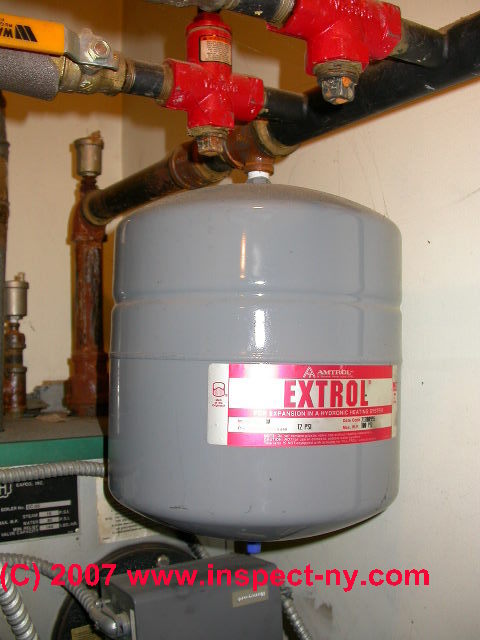
 Amtrol Extrol®, the Fill-Trol® Expansion Tank

- POST a QUESTION or COMMENT about heating system expansion tanks: their function, size, location, maintenance, and need for draining (on some models)
Amtrol / Extrol® internal-bladder heating equipment expansion tank: what is an diaphragm or internal-bladder type expansion tank, how do they work, and how are they installed, adjusted, maintained & repaired?
This article series describes how to identify, inspect, install, repair, or service heating boiler expansion tanks: here we explain the function of expansion tanks on hot water (hydronic) heating systems.
InspectAPedia tolerates no conflicts of interest. We have no relationship with advertisers, products, or services discussed at this website.
- Daniel Friedman, Publisher/Editor/Author - See WHO ARE WE?
Amtrol's Adapted Extrol®, the Fill-Trol® Diaphragm-Type Expansion Tank
Article Contents
- AMTROL FILL-TROL COMPARED with EXTROL - what's the difference & why you care
- AMTROL EXPANSION TANK INSTALLATION POSITION -
- AMTROL EXPANSION TANK PRE-CHARGE PRESSURE
- AMTROL EXPANSION TANK PRESSURE ADJUSTMENT
- WHAT GOES WRONG - Warnings from Amtrol
- AMTROL EXTROL / FILL-TROL EXPANSION TANK SIZING
...
How is Amtrol's Fill-Trol expansion tank different from the Extrol expansion tank?
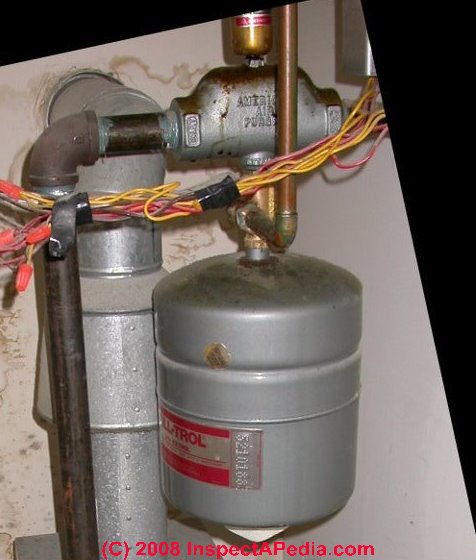
The Amtrol Fill-Trol expansion tank shown at left looks a lot like the simpler Extrol expansion shown at the top of this article, right?
But Amtrol's Fill-Trol expanstion tank got some added features.
I wish we could push those zone valve control wires out of the way, but instead, take a look at the little brass valve pointed to by my yellow "FILL-TROL VALVE" note on this photo. (We'll show this Fill-Trol valve in more detail below in a moment.)
Amtrol has added a specially designed pressure-reducing valve that will automatically feed water into the heating system as needed.
This is Amtrol's adapted Extrol® tank called the Fill-Trol® diaphragm-type expansion tank.
This tank resembles the simpler Extrol® hydronic expansion tanks but adds an automatic valve that eliminates the need for a separate automatic water-feeder or "fill valve" for the heating system boiler.
So in one package we have the expansion tank (below the red arrow) and an automagic water feeder.
The whole assembly has been mounted to a tapping on the under-side of the air scoop and all of this is located above the heating boiler (a gas fired unit in this example).
We've also pointed out the air bleeder valve or air vent mounted atop the air scoop / air purger device.
Hot water leaves the heating boiler (a gas boiler that is barely visible at the bottom of this photo), rises up the vertical pipe, bends to the right to flow through the air purger and past the expansion tank, and onwards through one or more zone valves to heat the building.
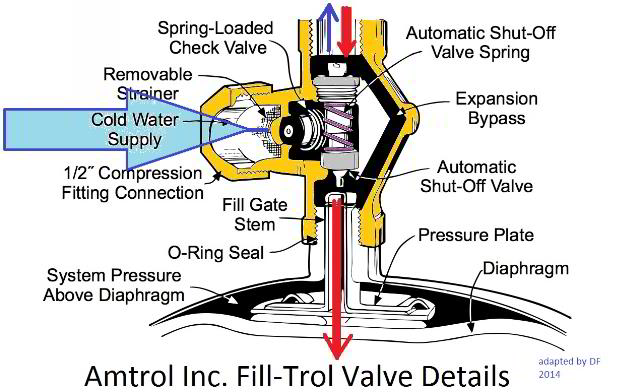
Our sketch shown below, adapted by Daniel Friedman from Amtrol's FillTrol® product literature, illustrates how the FillTrol® valve works to combine an automatic water feed valve for a hydronic heating system with a valve that admits expanding hot water from the system into the expansion tank bladder.
In the case of the Fill-Trol, the valve will put water into the heating system (via its distribution piping) should the pressure fall below 12 psi.
If you go back to look at the photo at the very top of this article you'll see a similar expansion tank, mounted in a similar location, but without this special pressure-reducing water feed valve.
That heating system will need a separate automatic (or manual) water feed valve.
Separately at WATER FEEDER VALVES, HYDRONIC BOILER we explain the function of pressure-reducer/water feed valves on hydronic (hot water) heating boilers in general.
...
Installation of the internal-bladder Amtrol Extrol® expansion tank
Amtrol specifies the expansion tank mounting position in the installation instructions for the Amtrol Extrol Expansion Tank No. 30 (found at the References section of these articles) in text, from which I quote:
Mount tank vertically in downward position only.
Ensure the piping can support the entire weight of the tank when full of water.
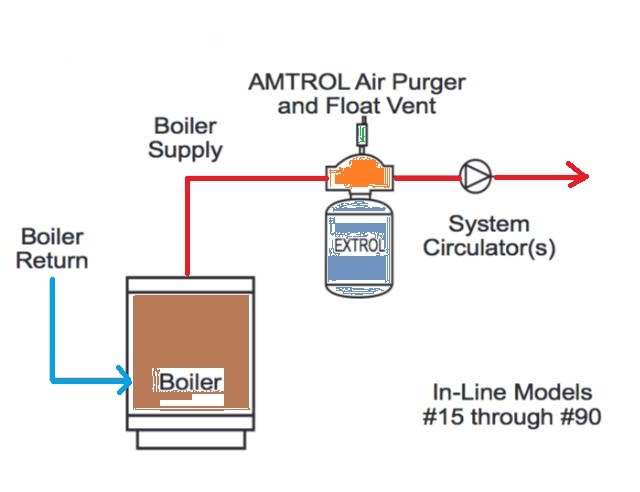
Mounting Position for the Amtrol Extrol® expansion tank
Our reader asked:
I have a system 2000 gas fired furnace that has a Extrol 30 that is mounted sideways instead of hanging down. It has waterlogged for a fourth time in the last 20 years and about four years ago was the last time until now. Does the tank being mounted horizontally instead of vertically have an effect on the life of the bladder?
I don't remember ever having to replace one in any house I lived in until I moved in here. Rick Bouchard globe56@myfairpoint.net 3/25/2014
Reply:
The Amtrol company's installation instructions for the Extrol 30 does not explicitly mention horizontal vs. vertical mounting position for the device, but the installation instructions do include a sketch showing the unit in a vertical position.
The instructions also include this line "Do not place the EXTROL on a dead-end pipe. Air can collect in the EXTROL, causing internal corrosion and possible leakage." Which I take to warn you that *any* installation that might allow air to collect in the device could cause corrosion and leakage. That is, in my opinion, precisely the risk that you might face if your unit is mounted horizontally.
A review of both product brochures and installation literature all show the expansion tank in the positions shown in Amtrol's Extrol sketches adapted above.
You can contact the company directly as well both for warranty claims or to double check the tank mount position. Note that the warranty will not cover damage or failure attributed to improper installation of the device.
- Amtrol Inc., 1400 Division Road, West Warwick, RI 02893, Tel: 401.884.6300 Website: www.amtrol.com
Are an Air vent & purger needed for Amtrol Extrol Tanks?
Does the "Amtrol Extrol Expansion Tank No. 30" need air vent and air purger - Anonymous: 3/3/2014
Answer: Not for the expansion tank, but yes for the hydronic heating system boiler, pipes, radiators, etc.
Anon: for the operation of the Extrol expansion tank itself an air vent and purger are not required, but for proper functioning of the heating system (boiler, pipes, radiators, baseboards) where the Amtrol Extrol Expansion Tank No. 30 is installed, indeed an air purger and vent are needed.
Here is what the company says in the installation instructions for their Extrol expansion tanks:
The EXTROL is installed on the supply-side of the boiler system. Its sealed-in air pre-charge prevents water from entering the tank until the system pressure begins to rise.
As the water temperature rises, water enters the EXTROL. As the system cools, the diaphragm is forced downward. Water is expelled from the EXTROL, back into the heating system.
Although the EXTROL does not have to be installed at the base of an air purger, this installation is recommended to reduce air in the system and provide a compact installation. Some method of air elimination is required to ensure an oxygen-free system. - Extrol® (2014)
See the Extrol installation & operation instructions found at References or Citations at the end of this article.
...
What goes wrong with internal bladder type heating system expansion tanks?
Normally these internal-bladder expansion tanks never need adjustment of their air pressure.
But as we noted near the start of this article, if the internal bladder of the tank ruptures the tank may eventually become waterlogged.
If the expansion tank is a model that includes an air pressure adjustment valve on the tank, you may find that a burst internal tank bladder means you will find water leaking out of the air charge valve, or water will squirt out of the valve if its center pin is depressed.
If the internal bladder type expansion tank such as the Amtrol® Adapted Extrol-R, the Fill-Trol-R Diaphragm-Type Expansion Tank is not a model that can be rebuilt with a new internal bladder, the tank will need to be replaced.
Here are some additional notes warnings quoted from Amtrol Inc.'s installation instructions for the company's Extrol® hydronic diaphragm expansion tanks in-line & SX series. The first 7 notes are of particular interest to the installer.
- The EXTROL must not be placed overhead in the floor joist space.
- When replacing a plain-steel tank, the EXTROL should be relocated per Figure 1. [See our adapted sketch above]
- Do not place the EXTROL on a dead-end pipe. Air can collect in the EXTROL, causing internal corrosion and possible leakage.
- FAILURE TO PROPERLY SEAL VALVE CAP WILL RESULT IN LOSS OF PRECHARGE CAUSING PRODUCT TO FAIL.
- Radiant systems with non-barrier tubing or high oxygen content should use a Radiant EXTROL® expansion tank with a plastic liner. See the EXTROL brochure, or call (401) 535-1216 for sizing assistance.
- Do not hang models SX-30V through SX-160V. They are floor standing models only.
- FOR USE IN CLOSED HYDRONIC SYSTEMS ONLY.
Do not install [the Amtrol Extrol tank described here] on domestic water systems, or in open heating systems. Corrosion and tank failure may result. Use a Therm-X-Trol® for domestic water systems or a Radiant EXTROL® for radiant heating systems where proper air elimination equipment or barrier tubing is not used. - EXPLOSION OR RUPTURE HAZARD.
A relief valve must be installed to prevent pressure in excess of local code requirement or maximum working pressure designated in the Product Manual, whichever is less. Do not expose product to freezing temperatures or temperatures in excess of 240° F.
Do not adjust the pre-charge or re-charge this product except for any adjustments at the time of the initial installation, especially if product is corroded, damaged or with diminished integrity. Adjustments to pre-charge must be done at ambient temperature only.
Failure to properly size the product or follow these instructions may result in excessive strain on the system and may lead to product failure, serious or fatal personal injury, leakage, and/or property damage.
This product, like most products under pressure, may over time corrode, weaken and burst or explode, causing serious or fatal personal injury, leaking or flooding and/ or property damage. To minimize risk, a licensed professional must install and periodically inspect and service the product.
A drip pan connected to an adequate drain must be installed if leaking or flooding could cause property damage.
Do not locate in an area where leaking could cause property damage to the area adjacent to the appliance or to lower floors of the structure.
Amtrol Extrol Models #15 through #90 come with a 5 year warranty. All other EXTROL models come with a 1 year warranty. *
- [Added] See LEAKS into the BOILER CAUSE RELIEF VALVE LEAKS for a discussion of causes of abnormally high boiler water pressure that may show up as apparent expansion tank overpressure trouble.
Failure at the Amtrol Fill-Trol valve allowed boiler to go dry?
Would my amtrol fill-troll supply valve system not functioning properly cause my boiler to go dry. I don't see any signs of any leakage. Where would the water go in the closed system? (Mar 8, 2015) Mike said:
Reply:
Mike,
Almost certainly in a hydronic heating system (hot water heat) if the boiler has gone dry we have a double fault: a leak somewhere AND the water feeder was not replacing lost water (or there was no automatic water feeder, as is the case on some old systems).
So most likely the leak is somewhere not obvious such as in a crawl space or under a slab.
If you have heating pipes running under a slab or for that matter anywhere, if you re-fill the system and fire up the boiler (you'll have to bleed out or remove air to get it working) you might get help finding the leak using IR or thermal scanning to look for the heat of leaking hot boiler-water.
...
Pre-Charge Pressure in Amtrol & Similar Expansion Tanks
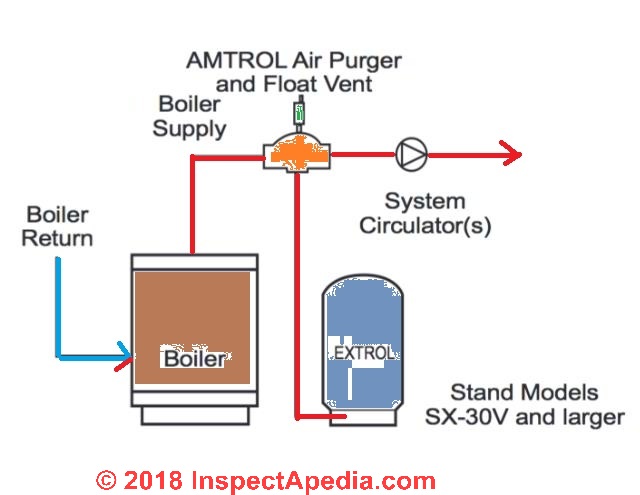
A pre-charged internal-bladder type expansion tank such as the Amtrol Extrol® is installed on the outlet side of the heating boiler between the boiler supply outlet and the heating circulator pump(s) as shown in our adaptations of installation schematics provided by Amtrol.
The internal pressure of the bladder tank is factory set to 12 psi in order to equal the system fill pressure found on a typical residential heating boiler (eg. 12 psi cold on many systems) and should not need further adjustment.
If adjustment is needed, follow the instructions in the IO manual for your expansion tank
- we give links to those at EXPANSION TANK IO MANUALS & SIZING GUIDES and at CITATIONS & REFERENCES found at the end of the this page
...
How do I adjust or set the pressure on an Amtrol Fill-Trol expansion tank
My oil boiler has a Fill-trol model 110 with an automatic valve on it and the system has been turned off for 1 year and I notice that water pressure is 40psi and is popping off at the pressure valve.I can hear water coming from my main water line so I turned it off.
Can I clean the automatic valve because the water is bypassing it. Could the spring be stuck or is the tank not pushing on the valve to shut it off. Thanks (Dec 7, 2014) John said:
Reply: you should not need to change the pressure unless you've got a tall building
John:
Watch out: 40 psi is much too high - I would look for a problem with the pressure-reducer water feeder mechanism. Indeed your model, as described by Amtrol, "The AMTROL FILL-TROL® system consists of a specially adapted EXTROL® pre-pressurized, diaphragm-type expansion tank, and the FILL-TROL, a specially designed, automatic, fill valve."
The problem could be something as trivial as debris on a valve seat. There is a screen in the valve that is intended to be removed for cleaning.
The whole FillTrol valve assembly can be removed for cleaning but depending on what control valves were installed on your heating system you may have to drain part or all of the system to remove the expansion tank and fill valve assembly.
And I would not try such a repair before checking the product's maintenance instructions or asking the company for advice, AND I would not begin such a repair without having a repair kit of parts on hand - typically o-rings, gaskets, etc.
I would give the company's tech support a call at 401-884-6300
The problem could also be a failure at your building water pressure regualtor subjecting the whole building to abnormally high pressure.
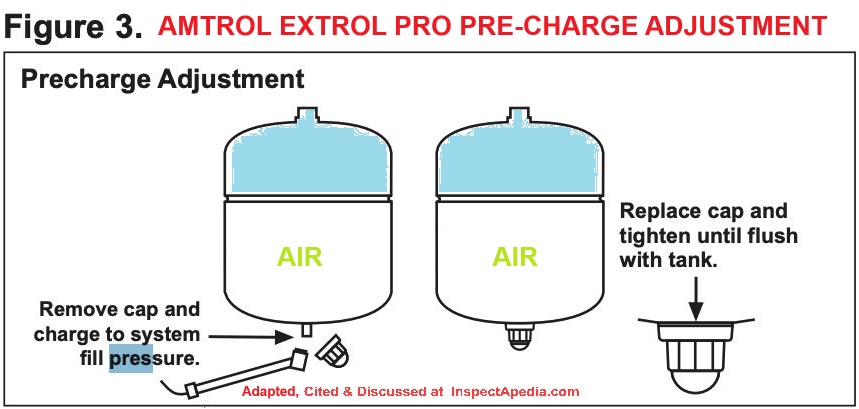
Amtrol Extrol expansion tanks use an internal bladder preset by the factory at 12 psi.
IF your heating boiler serves a taller building and has to run at 15 psi cold, you may need to adjust the tank's pre-charge pressure - follow the instructions found in the manual for your specific tank - or find the manual at EXPANSION TANK IO MANUALS & SIZING GUIDES
Here are the instructions for your
- AMTROL FILL-TROL COMBINATION EXPANSION TANK & AUTO FILL VALVE INSTALLATION & OPERATION INSTRUCTIONS [PDF] (at Amtrol's website) - local backup copy saved as Amtrol-Fill-Trol-Manual.pdf
...
Amtrol Extrol Expansion Tank Model Numbers & Sizing
Expansion Tank Sizing Resources
- Amtrol EXTROL SIZING GUIDE For Pressurization and Expansion Control of Low Temperature Water Systems [PDF] (2019) Amtrol, Worthington Industries, 1400 Division Road, West Warwick, RI USA 02893 T: 800.426.8765 www.amtrol.com - retrieved 2023/08/10, original source: amtrol [dot] com/wp-content/uploads/2019/06/9003-036-03_19-EXTROL-Sizing [dot] pdf
- See a complete set of Amtrol Extrol and Fill-Trol expansion tank IO manuals at
HEATING BOILER EXPANSION TANK IO MANUALS [Web page] - Also find more Amtrol and other expansion tank installation and repair guides
at EXPANSION TANK IO MANUALS & SIZING GUIDES
and
at CITATIONS & REFERENCES found at the end of the this page
Is it ok to replace an Amtrol Extrol #30 with a #15?
Can you replace a model 15 for a model 30 - 2018/02/03 Anonymous
Reply: No, do not substitute a smaller capacity expansion tank on your boiler without consulting the manufacturer's specifications
Anon
The Amtrol Model # 15 is a 2-gallon internal bladder type expansion tank pre-charged to 12 psi.
while
The Amtrol Model #30 is a 4.4 gallon tank of similar specifications but with more capacity to handle more water volume as a hydronic heating system warms up.
If we assume for illustration that your boiler is heating your home through finned copper baseboard,
You would select the Amtrol Extrol Model #15 for boilers with an input BTUH capacity up to 50,000 BTUhwhile
You would select the Amtrol Extrol Model #30 for boilers with an output BTUH capacity of 75,000 BTUh up to 150,000 BTUh
For a larger boiler, such as one with an output BTUH of 175,000 BTUh to 250,00 BTUh you'd need an Amtrol Extrol Model #60
From those examples you can see that you should NOT use a smaller, Amtrol/Extrol #15 to replace an Amtrol/Extrol #30 expansion tank unless the size of your boiler is 50,000 BTUh or smaller.
Watch out: installing a too-small expansion tank that does not have adequate capacity is unsafe because an undersized expansion tank can cause spillage at the temperature/pressure relief valve, and repeated spillage at that valve can ultimately lead to valve seizure and a dangerous condition that even risks a boiler BLEVE (explosion).
See the following Amtrol web page for help with selecting the proper residential or commercial hydronic expansion tank size. You need to specify the heating boiler net OUTPUT in BTUH and the type of heat radiation such as finned baseboard, radiant panels, in-wall unit heaters, or cast iron radiators.
AMTROL HYDRONIC EXPANSION TANK SIZING - live link above on this page, original source amtrol.com/resources-rewards/selection-tools/#hydro-form
...
Continue reading at BOILER DRAIN DAMAGES EXPANSION TANK or select a topic from the closely-related articles below, or see the complete ARTICLE INDEX.
Or see AMTROL EXTROL® FILL-TROL® FAQs - questions & answers postd originally at this page.
Or see these
Recommended Articles
- EXPANSION TANKS, BOILERS - home
- AMTROL's EXTROL®, the FILL-TROL®
- ATTIC & ANTIQUE EXPANSION or HEADER TANKS
- BOILER DRAIN DAMAGES EXPANSION TANK
- EXPANSION TANK AIR VALVE LEAKS
- EXPANSION TANK DIAGNOSIS
- EXPANSION TANK DRAIN & AIR RE-CHARGE
- EXPANSION TANK IO MANUALS & SIZING GUIDES
- EXPANSION TANK LEAK REPAIRS
- EXPANSION TANK PRESSURE ADJUSTMENT
- EXPANSION TANK SIZING GUIDE
- EXPANSION TANK WATERLOGGING CAUSES
- EXPANSION TANK WON'T DRAIN
- FIND the EXPANSION TANK
- HEADER TANKS
- RELIEF VALVE LEAK DUE TO EXPANSION TANK
- TANKLESS COIL INTERNAL LEAKS INTO the BOILER
- THERMAL EXPANSION of HOT WATER
- THERMAL EXPANSION TPR VALVE LEAKS
- WATER PRESSURE TOO HIGH: DANGERS
Suggested citation for this web page
AMTROL's EXTROL®, the FILL-TROL® at InspectApedia.com - online encyclopedia of building & environmental inspection, testing, diagnosis, repair, & problem prevention advice.
Or see this
INDEX to RELATED ARTICLES: ARTICLE INDEX to HEATING BOILERS
Or use the SEARCH BOX found below to Ask a Question or Search InspectApedia
Ask a Question or Search InspectApedia
Share this article:Search the InspectApedia website
Need to make a private comment? Email editor@inspectApedia.com. We welcome email with your website content critique, corrections, suggestions or questions. Email is monitored daily but our workload may prevent an immediate reply. For immediate results, we hope you'll first try asking your question using the search box just above.
Citations & Reviewers
In addition to any citations in the article above, a full list is available on request.
- Amtrol Corporation, Installation & Operation Instructions, Extrol (R) Hydronic Diaphragm Expansion Tanks In-Line & SX-Series [PDF] (06/15), Amtrol Corporation, 1400 Division Road, West Warwick RI 02983, Tel: 401-884-6300, Website: www.amtrol.com, retrieved 2016/05/10, original source http://www.amtrol.com/media/documents/extrol/9015183_06_15_EXTROL_IO.pdf
- Amtrol Corporation, "Extrol® Hydronic Expansion Tanks for Non-Potable Water Installation & Operation Instructions, Models EX-15 through EX90 Models SX-30V through SX-160V", Amtrol corporation
- Amtrol EXTROL PRO EXPANSTION TANK INSTALLATION & OPERATION INSTRUCTIONS [PDF] (at Amtrol) for Models EX-15PRO, EX-30PRO, EX-60PRO, local backup copy saved as Amtrol-Extrol-Pro-Instruction-Manual.pdf
- AMTROL FILL-TROL COMBINATION EXPANSION TANK & AUTO FILL VALVE INSTALLATION & OPERATION INSTRUCTIONS [PDF] (at Amtrol's website) - local backup copy saved as Amtrol-Fill-Trol-Manual.pdf
- [4] B&G / ITT Reducing Valves, Instruction Manual V55999: Reducing Valves Installation, Operation, & Service Instructions [PDF] Bell & Gossett Air Separators and other heating system components, Bell & Gossett, 8200 N. Austin Ave., Morton Grove IL 60053, USA - Tel 847 966-3700 Fax 847 965-8379. Original source www.bellgossett.com/literature/files/610.pdf
- [5] Bell & Gossett Airtrol® System Installation, Operating and Service Instructions [PDF] Bell & Gossett, 8200 N. Austin Ave., Morton Grove IL 60053, USA - Tel 847 966-3700 Fax 847 965-8379. Retrieved 8/9/2012, original source B&G, [copy on file as Airtrol_Installation_Manual.pdf linked in this reference]
- "Residential Hydronic (circulating hot water) Heating Systems", Instructional Technologies Institute, Inc., 145 "D" Grassy Plain St., Bethel, CT 06801 800/227-1663 [home inspection training material] 1987
- Boilers, Boiler Conversions, James E. Brumbaugh, ISBN 0-672-23389-4 (v. 1) Volume II, Oil, Gas, and Coal Burners, Controls, Ducts, Piping, Valves, James E. Brumbaugh, ISBN 0-672-23390-7 (v. 2) Volume III, Radiant Heating, Water Heaters, Ventilation, Air Conditioning, Heat Pumps, Air Cleaners, James E. Brumbaugh, ISBN 0-672-23383-5 (v. 3) or ISBN 0-672-23380-0 (set) Special Sales Director, Macmillan Publishing Co., 866 Third Ave., New York, NY 10022. Macmillan Publishing Co., NY
- Installation Guide #200 for Residential Hydronic Heating Systems, The Hydronics Institute, 35 Russo Place, Berkeley Heights, NJ 07922
- In addition to citations & references found in this article, see the research citations given at the end of the related articles found at our suggested
CONTINUE READING or RECOMMENDED ARTICLES.
- Carson, Dunlop & Associates Ltd., 120 Carlton Street Suite 407, Toronto ON M5A 4K2. Tel: (416) 964-9415 1-800-268-7070 Email: info@carsondunlop.com. Alan Carson is a past president of ASHI, the American Society of Home Inspectors.
Thanks to Alan Carson and Bob Dunlop, for permission for InspectAPedia to use text excerpts from The HOME REFERENCE BOOK - the Encyclopedia of Homes and to use illustrations from The ILLUSTRATED HOME .
Carson Dunlop Associates provides extensive home inspection education and report writing material. In gratitude we provide links to tsome Carson Dunlop Associates products and services.
 |
HOME | ABOUT | ASK a QUESTION | CONTACT | CONTENT USE POLICY | DESCRIPTION | POLICIES | PRIVACY | |
| © 2026 - 1985 Publisher InspectApedia.com - Daniel Friedman | |||||||||