 Main Electrical Panel Disconnect Switch
- POST a QUESTION or COMMENT about the main power switch or main disconnect switch at electrical panels
Main fuse or main circuit breaker in an electrical panel:
This article summarizes inspection of the main electrical switch - the main switch at buildings and also outlines other electrical panel and switch defects that can be found by visual inspection.
We include information about How many main disconnect switches are allowed, other main disconnect switch hazards.
InspectAPedia tolerates no conflicts of interest. We have no relationship with advertisers, products, or services discussed at this website.
- Daniel Friedman, Publisher/Editor/Author - See WHO ARE WE?
Inspecting the Residential Electrical Main Disconnect Panel or "Box" for Defects
 This article and others in the series discusses procedures for safe and effective visual inspection of residential electrical systems including electrical panels and other components, when the inspection is conducted by trained building
inspection professionals, home inspectors, electrical inspectors, and electricians.
This article and others in the series discusses procedures for safe and effective visual inspection of residential electrical systems including electrical panels and other components, when the inspection is conducted by trained building
inspection professionals, home inspectors, electrical inspectors, and electricians.
- Main control center for house
- Integrated or separate service disconnect (main breaker or fuses) - need main disconnect if more than 6 switches
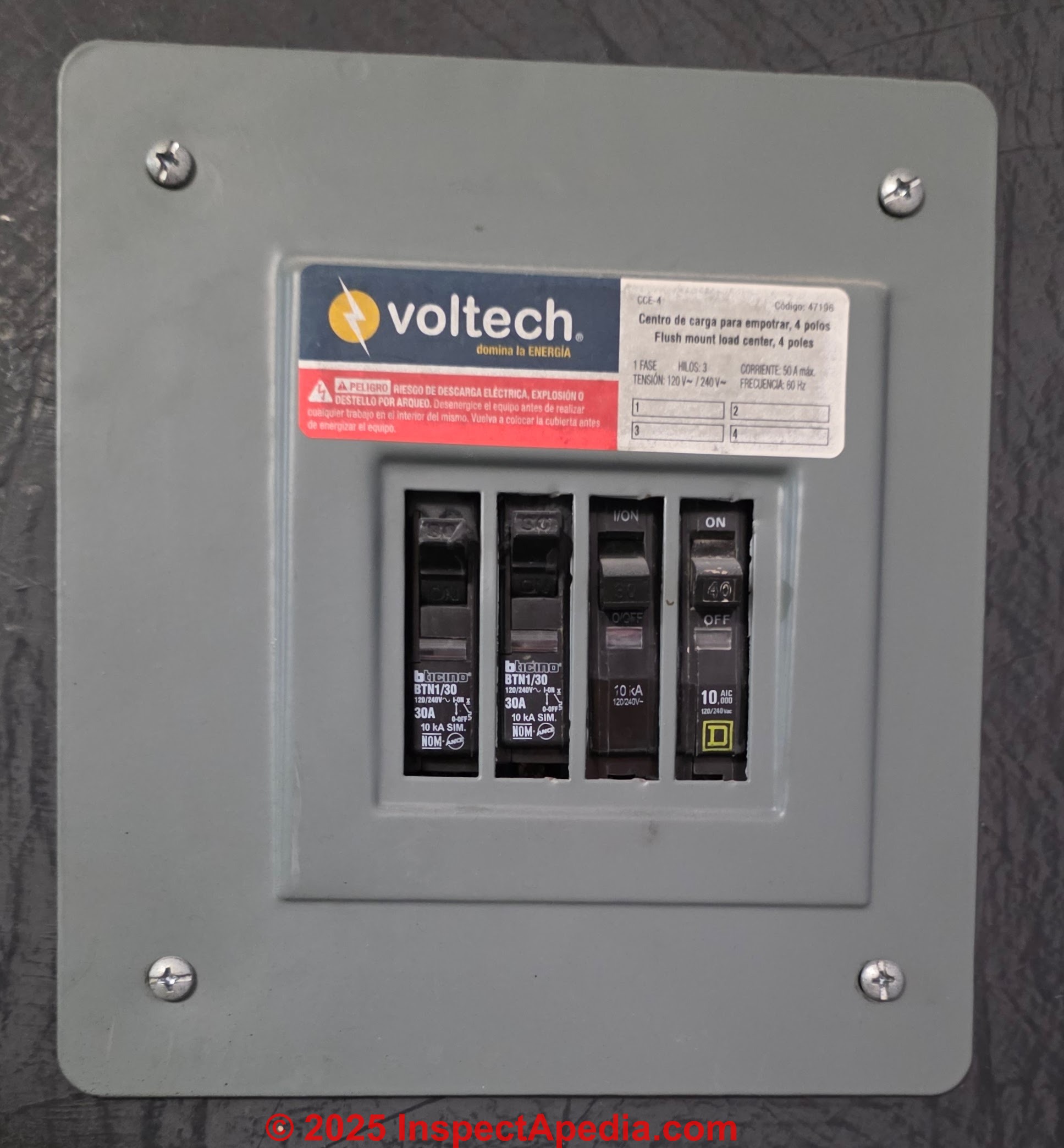
Photo above: a Voltech electrical panel with four circuit breakers meets the "rule of 6" requirement that says that for a small panel like this one no main switch is required. Voltech is an international electrical equipment supplier headquartered in Chennai, India. This panel was photographed in central Mexico.
Electrical Service Box Location Defects
- OK indoors our outside (if weather tight)
- NOT OK bathroom, clothes closet, kitchen cabinets
- Should Be at eye level, easily accessible, with 3 ft. working clearance
Inspecting the Electric Service Panel & Main Disconnect Switch for Condition Defects
The Implications: electrical shock or fire. Look for these electrical panel hazards when inspecting the main circuit breaker:
- Missing Main Disconnect Switch - note that at some installations the main disconnect may be located separately from the main electrical panel, particularly if the main electrical panel is distant from the electric meter (NEC Ref 1).
- More than two main disconnect switches in the main panel are required to turn off the panel (presuming this is a main residential panel hosting more than 6 circuits total - see next bullet.
- No main disconnect switch in electrical panels with six or more breakers. If the "six-breaker" rule is allowed locally, the six switches must be together in the same panel enclosure.
That is, if six or fewer breakers are in the main panel, that panel can be counted as a service disconnect (NEC Ref 2).
We and others believe this requirement originated with fire fighting departments, to assure that no more than six manual operations would be required to turn off electrical power in an emergency.
Note that local jurisdictions and codes may require that a single main switch be provided. - Ed. - Poor access to the electrical panel; panel not secured
- Rust, corrosion in the electrical panel or main disconnect
- Overheating signs in the electrical panel or main disconnect enclosure
- Over fusing or panelboard or electrical panel box rating too small for the service entry wiring or building or circuit load
- Inappropriate. mounting surface for the electrical panel or main disconnect / not secure
- Damaged electrical panel or main disconnect parts
- Wiring condition: Poor electrical panel or main disconnect connections, poor wiring
- Illegal taps at the electrical panel or main disconnect
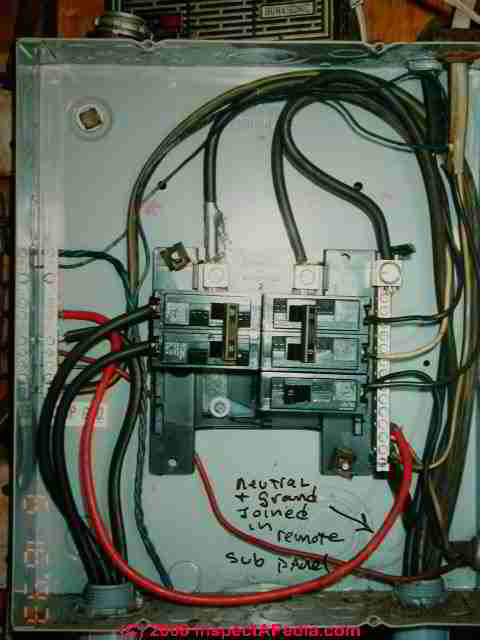
- Neutral wire (grounded conductor) defects such as bonding the neutral and ground in a sub panel
See CASE HISTORY: LOSS of NEUTRAL SHOCKS HOMEOWNER
See ELECTRICAL PANEL FUSED NEUTRAL WIRE HAZARDS - Bypasses: Fused circuits or other circuits that bypass the main panel, bypasses box, fused upstream
- Obsolete or poor-performing electrical panel, breakers, disconnect, equipment or unsafe equipment - examples:
- Water leaks: Exterior, electrical panel or main disconnect not weather tight
- Specific Electrical Panel Product Defects, see additional articles listed at left and below
How Many Main Breakers are Allowed in a Residential Electrical Panel?
 Reader Question:
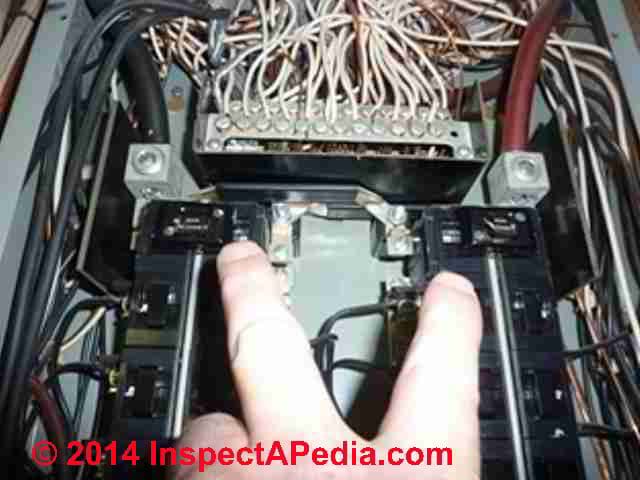
Recently I inspected a ITE Pushmatic main panel box. At the top of each buss line there was a main breaker. What is the current policy regarding this type of main panel box wiring configuration? Is there need for further evaluation by a licensed electrician? - D.B. 1/22/2014
[Click to enlarge any image]
Reply: two main switches or breakers
The short answer is that we are allowed up to two main switches to turn off power in the main electrical panel.
Rule Of Six - 6 breaker panels can skip a main
A sub panel containing 6 circuits or less can omit a separate main breaker and may be switched by the breaker on its input feed circuit.
That situation is called the "rule of six" - meaning that if there are six breakers or less in a panel then that panel does not have to also have a main switch.
But there are other issues with Pushmatics that argue for viewing this equipment with caution. I'm not confident that the advice "have the panel examined by an electrician" is at all an adequate warning, since there are surely electricians living by rigid code interpretation who will deem safe electrical panels known to have safety defects but that have not been subject to a government-ordered recall.
Clear examples are FPE Stab-Lok equipment, and two more possible examples are the Bulldog-Pushmatic panel and also Zinsco panels.
Where we have independent, unbiased testing and field reports of comparatively high levels of field failures, an astute home inspector, electrical inspector, or electrician ought to call out those hazards - even where they may call for a costly panel replacement. (The last man in to touch the equipment will be blamed if/when there is a fire or catastrophe).
Details and an expanded discussion of these hazards can be found
at PUSHMATIC - BULLDOG PANELS.
If I understand your photo, you are pointing (your dangerously close bare fingers made me nervous) to a pair of split-main breakers, an arrangement that lacks a common internal trip or external trip tie. This design would allow one side of the panel to be switched off while leaving the other side "on".
For main disconnects, (using 2002 NEC as an example)
NEC 408.16 Overcurrent Protection.
(A) Lighting and Appliance Branch-Circuit Panelboard Individually Protected.
Each lighting and appliance branch-circuit panelboard shall be individually protected on the supply side by not more than two main circuit breakers or two sets of fuses having a combined rating not greater than that of the panelboard.
Exception No. 1: Individual protection for a lighting and appliance panelboard shall not be required if the panelboard feeder has overcurrent protection not greater than the rating of the panelboard.
[This means that no main is required in the panel if the feeder wires to the panel are protected ahead of the panel itself - that is, in effect there is a separate main breaker ahead of the panel, but there are then separation distance constraints between these switches.]
Your photo shows an electrical panel that uses two main breakers so by my understanding, on this point it would be acceptable. Further, this particular Pushmatic main breaker design is not visually ambiguous - that is, switching off one side of the panel would not make it look as if both are off.
About paired or common trip tie or handle tied circuit breakers:
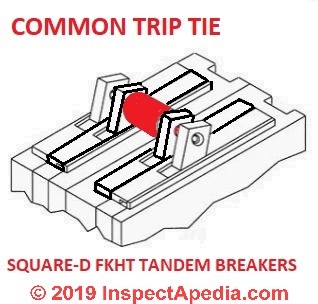 Some experts (http://ecmweb.com) aptly point out that even if a circuit breaker pair could be connected by a common handle (not possible in this Pushmatic case) the level of protection is not the same as that provided by two-pole or double-pole circuit breakers with a common internal trip tie mechanism.
A handle-only connection in some designs may leave one breaker "on" and the other "off" - a dangerous condition because of the chance of fooling the electrician or homeowner into thinking that all electrical power is off when it is not.
Common internal trip ties would be required by NEC 240.20(B) for example on a multiwire branch circuit because that code paragraph requires that "... the circuit breaker shall open all ungrounded conductors of the circuit." Tandem circuit breakers (two breakers powering two circuits fit into a single original breaker slot in a panel) also trip together.
Details are at CIRCUIT BREAKER HANDLE TIES
Separately, NEC also permits a maximum of six disconnects to turn off all power in an electrical panel. We encounter this condition usually in sub-panels or branch panels. If the sub panel contains more than 6 breakers (and is remote from the main switch) it needs to have its own main switch.
NEC 230.71 Maximum Number of Disconnects.
(A) General. The service disconnecting means for each service permitted by 230.2, or for each set of service-entrance conductors permitted by 230.40, Exception Nos. 1, 3, 4, or 5, shall consist of not more than six switches or sets of circuit breakers, or a combination of not more than six switches and sets of circuit breakers, mounted in a single enclosure, in a group of separate enclosures, or in or on a switchboard.
There shall be no more than six sets of disconnects per service grouped in any one location.
For the purpose of this section, disconnecting means used solely for power monitoring equipment, or the control circuit of the ground-fault protection system or power-operable service disconnecting means, installed as part of the listed equipment, shall not be considered a service disconnecting means.
Reader follow-up:
Thank you for your in-depth review and explanation of the issues encountered at this panel box.
[...] and I will revisit these issues with this client. Your comments also prompted me to read other related issues on main panel boxes that were posted on your website. - D.B. 1/24/2014
Reply:
About your finger near that Pushmatic breaker, I know you were smart enough not to electrocute yourself.
As a publisher/editor I have to worry about risks to a casual reader, a careless homeowner, or someone who just lacks respect for electricity. The chance that someone else will fail to understand that they need to be careful when inspecting electrical panels is a worry that leads me take opportunity to point out shock hazards where I can see them.
Even though at home inspections I habitually stood blocking my inspection client from direct access to the electrical panel as I examined that component, I once had a client reach right over my shoulder and stick his finger right into a live fuse socket while asking "What the heck is this!" The results were exciting.
Watch out: at a home inspection training seminar we had an electrician tell newbie home inspectors how to inspect the electrical panel by saying "Well the first thing you wanna do is grab a-holt of each of the entry main wires just above where they come into the main breaker - and give them a good shake!"
I could just imagine that with that fool statement he had probably killed one or two of the fellows in the room, sending 240 volts right through their hearts.
Information in this electrical inspection article series was presented by Daniel Friedman - InspectApedia.com, and discussed by the Hudson Valley chapter of the American Society of Home Inspectors - HVASHI Seminar 12 Sept 2002, Updated April 2006, April 2009, January 2014, July 2017, March 2019
...
Reader Comments, Questions & Answers About The Article Above
Below you will find questions and answers previously posted on this page at its page bottom reader comment box.
Reader Q&A - also see RECOMMENDED ARTICLES & FAQs
Why would I lose power on one leg of my electrical panel after someone changed the main disconnect?
I would like to know why I would have lost one leg of 220 after the maintenance guy changed out the 3 wire disconnect next to the meter the 3 wires go underground and come up under my home out of the ground as 4 wires where could they have changed over.
Maybe there is a short there as I have 229 at disconnect and 120 one only one if the hot lines coming into the house On 2020-11-10 by John mjnks -
Reply by (mod) -
John
It's a perfectly fair question - why did I lose power on one leg of an electrical system - but not one that we can reliably answer from a brief text message as there are lots of possiblities.
Watch out: The more-important point is that the electrical system might be not just missing power but unsafe, depending on just why power was dropped.
A poor connection in a meter box can drop power but an example of a different cause is a cut wire or a post driven through a buried wire - a condition that is dangerous, risking fatal electric shock.
Get your electrician to examine the system and do tell me what she found.by John
The main 200 amp breaker is on the north side of my house. The panel is on the south side. It has more than six circuits. Does it require a master breaker as well?
Reply by (mod) -
@John, yes either in the panel or next to it
Does the rule of 6 electrical disconnects apply to condominiums and high rise buildings?
Does the six disconnects apply to condos and high rises also? On 2020-09-25 by Daniel E Griffin
Answer by (mod) - Yes
Yes
Can I install drywall to cover the main shutoff switch if I provide an access door?
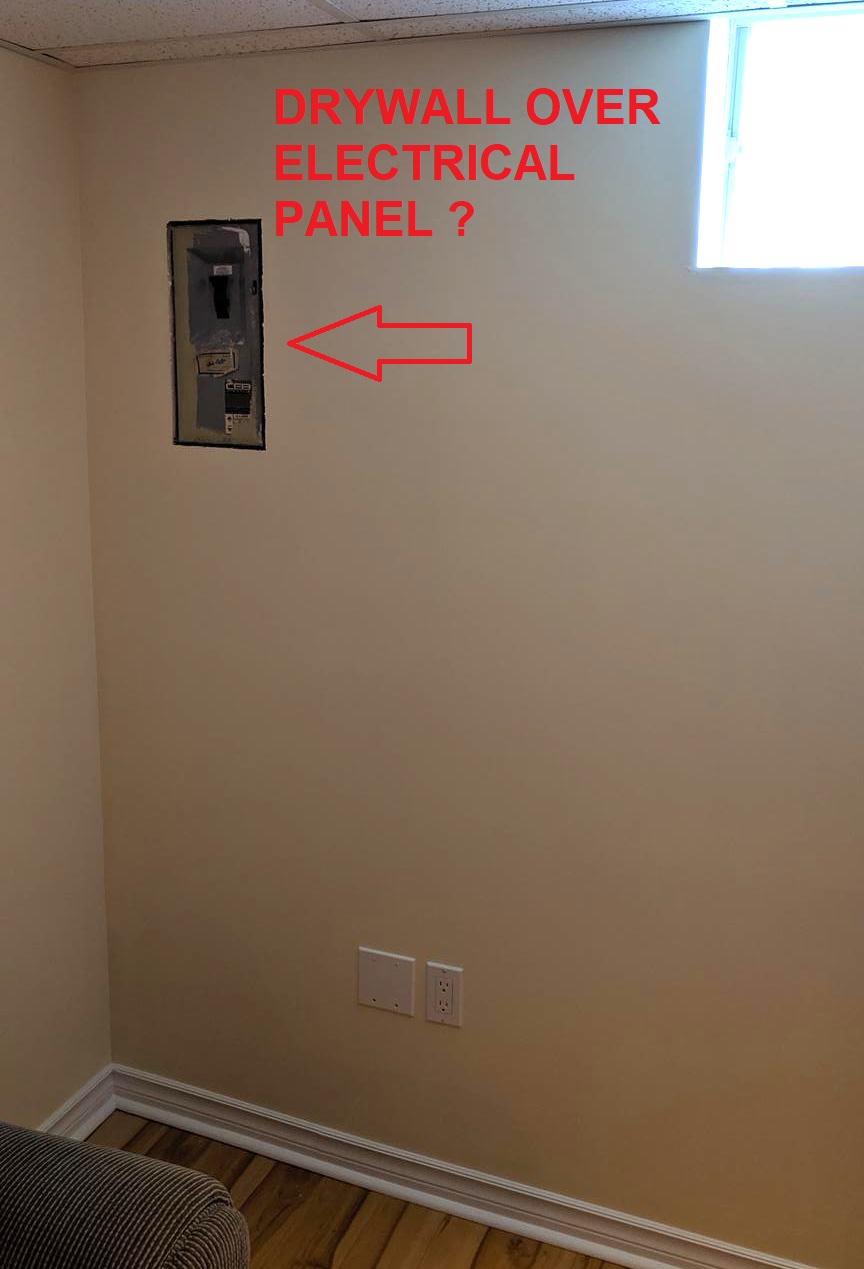 Am I able to drywall over the main service shutoff as long as I install a door to access the switch?
I'd like to install a direct vent gas fireplace in my basement corner.
The main shut off unfortunately is also located in the corner.
Once the framing and drywall is complete, the shut off would be covered.
I was thinking of installing an access door, then putting a paint over it. Is there any codes/guidelines for accessibility? Thanks! On 2020-08-17 1 by Joe
Answer by (mod) - keep elecrical panel location obvious and access easy
Joe
You can of course add a level of drywall over the ecisting wall, but you will need to leave working space to remove the panel cover.
And if you are going to build an exterior access cover or door it needs to be obvious that it's the electrical panel. Otherwise in an fire or shock emergency someone may not be able to find the main disconnect switch.
Watch out: do not cover the electrical panel in a way that makes its location hidden or in any way not-obvious, as in the event of an emergency any building occupant needs to be able to find the panel and to reach it to turn off the main or other switches.
Also, for the same reason, review the required safe access and clearance distances to the panel before thinking about installing a gas fireplace in that same corner.
Discuss the question with your building inspector too.
OK to place a main electrical disconnect below the electric meter on a pole?
Can a 200amp main disconnect be placed directly below the meter on a meter pole? On 2020-07-03 by Robin
Answer by (mod) -
Sure, Robin,
The main disconnect for a 200 A service can be located outside at an electric meter or pole, using, of course, a proper weatherproof box.
However if the electrical panel indoors has more than 6 circuits installed, it, too, requires a main shutoff switch.
How many disconnects are allowed on a residential home to turn off
How many disconnects are allowed on a residential home to turn off On 2019-03-25 by Anonymous
Anser by (mod) - six
A common rule of thumb is 6 breakers max to be switched off to cut all power to a home; more than 6 you need a separate main switch.
In a typical main panel, up to 2 main switches are allowed as main disconnect for the panel.
...
Continue reading at MAIN DISCONNECT AMPACITY or select a topic from the closely-related articles below, or see the complete ARTICLE INDEX.
Or see MAIN ELECTRICAL DISCONNECT FAQs - questions & answers about the main electrical disconnect switch(es) posted originally on this page
Or see these
Recommended Article
- ELECTRICAL INSPECTOR SAFETY PROCEDURES important basic safety procedures, clothing, and equipment for home inspectors and electrical inspectors.
- ELECTRICITY TURN ON AFTER BREAKER TRIP
- Step 5. RESTORE UTILITIES AFTER FLOODING
Suggested citation for this web page
MAIN ELECTRICAL DISCONNECT at InspectApedia.com - online encyclopedia of building & environmental inspection, testing, diagnosis, repair, & problem prevention advice.
Or see this
INDEX to RELATED ARTICLES: ARTICLE INDEX to ELECTRICAL INSPECTION & TESTING
Or use the SEARCH BOX found below to Ask a Question or Search InspectApedia
Ask a Question or Search InspectApedia
Share this article:Ask a Question or Search the InspectApedia website using the box just below.
Need to make a private comment? Email editor@inspectApedia.com. We welcome email with your website content critique, corrections, suggestions or questions. Email is monitored daily but our workload may prevent an immediate reply. For immediate results, we hope you'll first try asking your question using the search box just above.
Citations & Reviewers
In addition to any citations in the article above, a full list is available on request.
- U.S. National Electrical Code, NEC Reference (1): [QUOTING 2008 NEC]
National Electric Code is Article 225 Part II.
225.31 Disconnecting Means. Means shall be provided for disconnecting all ungrounded conductors that supply or pass through the building or structure.
225.32 Location. The disconnecting means shall be installed either inside or outside of the building or structure served or where the conductors pass through the building or structure. The disconnecting means shall be at a readily accessible location nearest the point of entrance of the conductors. For the purposes of this section, the
requirements in 230.6 shall be utilized.
VI. Service Equipment - Disconnecting Means
230.70 General. Means shall be provided to disconnect all conductors in a building or other structure from the service entrance conductors.
(A) Location. The· service disconnecting means shall be installed in accordance with 230.70(A)(l), (A)(2), and (A)(3).
(1) Readily Accessible Location. The service disconnecting means shall be installed at a readily accessible location either outside of a building or structure or inside nearest the point of entrance of the service conductors.
(2) Bathrooms. Service disconnecting means shall not be installed in bathrooms.
(3) Remote Control. Where a remote control device(s) is used to actuate the service disconnecting means, the service disconnecting means shall be located in accordance with 230.70(A)(1).
(D) Marking. Each service disconnect shall be permanently marked to identify it as a service disconnect.
(C) Suitable for Use. Each service disconnecting means shall be suitable for the prevailing conditions. Service
equipment installed in hazardous (classified) locations shall comply with the requirements of Articles 500 through 517 - U.S. National Electrical Code NEC Reference (2): Requirement for main circuit breaker if more than six switches in the panel: See
NEC Section 230-71.
Article 225: A readily accessible disconnect is required at the remote building, located either outside or nearest the point of entrance inside [225-8]. There shall be no more than six disconnects mounted in a single enclosure, or up to six separate enclosures [230-71].
The disconnects must be grouped and each disconnect must be marked to indicate the load served [110-22 and 230-72]. - 1993 NEC (Quoting from Orlando Florida Code of Ordinances, web search 01/18/2011, original source: http://search.municode.com/html/13349/level3/TITIICICO_
CH22ELCO_ARTIIINAELCOAM.html#TITIICICO_CH22ELCO_ ARTIIINAELCOAM_S22.49SE230-71NAELCOAM
Section 230-71 of the National Electrical Code of 1993 is amended to read as follows:
(a) No building shall have more than six (6) operations of the hand for a main disconnecting means.
(b) Commercial buildings. The 100A or over service disconnecting means shall comply with Article 230 of the National Electrical Code and shall be installed on the outside of the building as near the point of entrance of service wires as possible considering the type of building and accessibility in case of fire or other reason for opening the service switch and disconnecting the building.
Upon special application to the inspecting authority, before any work is started, approval may be granted for the meter and/or service disconnecting means to be installed inside the building if accessible and available for meter reading, servicing and disconnecting in case of emergencies.
(c) On commercial or residential buildings, if the service disconnecting means is not readily apparent on the exterior of the building, it shall be properly indicated by a reasonable sign constructed of permanent materials with no less than one and one-half (1½) inches high letters designating its exact location.
The sign shall be located on the exterior of the building at the service doorway. If the service disconnecting means is located at a point that is not accessible and available for meter reading, servicing, and disconnecting in case of emergencies, there shall be a shunt trip switch installed and so noted as above.
(d) Where a property comprises more than one building under single management or in multiple occupancy buildings, a separate switch at service entrance equipment for each building must be installed (it may be a toggle switch) to disconnect the "House Lighting" circuits.
This switch may be locked. It shall have an indicating sign at or on the switch. - Outside electrical service feeder wires: see Article 225, not Article 230 (Service conductors).
- In addition to citations & references found in this article, see the research citations given at the end of the related articles found at our suggested
CONTINUE READING or RECOMMENDED ARTICLES.
- Carson, Dunlop & Associates Ltd., 120 Carlton Street Suite 407, Toronto ON M5A 4K2. Tel: (416) 964-9415 1-800-268-7070 Email: info@carsondunlop.com. Alan Carson is a past president of ASHI, the American Society of Home Inspectors.
Thanks to Alan Carson and Bob Dunlop, for permission for InspectAPedia to use text excerpts from The HOME REFERENCE BOOK - the Encyclopedia of Homes and to use illustrations from The ILLUSTRATED HOME .
Carson Dunlop Associates provides extensive home inspection education and report writing material. In gratitude we provide links to tsome Carson Dunlop Associates products and services.
 |
HOME | ABOUT | ASK a QUESTION | CONTACT | CONTENT USE POLICY | DESCRIPTION | POLICIES | PRIVACY | |
| © 2026 - 1985 Publisher InspectApedia.com - Daniel Friedman | |||||||||