
InspectAPedia® FREE Encyclopedia of Building & Environmental Construction, Diagnosis, Maintenance & Repair |
Question? Just ask us! InspectAPedia
|
 Roof Flashing Defects List
& Home Inspection Education
- POST a QUESTION or COMMENT about troubleshooting roof flashing leaks
Roof flashing leak troubleshooting: this article lists significant roof flashing defects, definitions, and home inspection education topics.
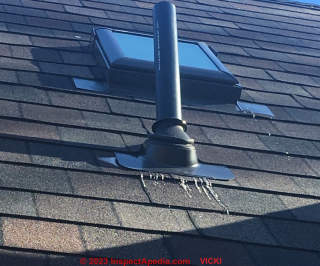
Page top photo: in freezing weather we might spot evidence of flashing leaks at a roof as water accumulates as ice and becomes more-visible. Photo courtesy of InspectAPedia.com reader Vicki, discussed below on this page.
InspectAPedia tolerates no conflicts of interest. We have no relationship with advertisers, products, or services discussed at this website.
- Daniel Friedman, Publisher/Editor/Author - See WHO ARE WE?
Home Inspection Education Curriculum - Roof Flashing
1.2 Steep Roof Flashing Defects
1.2.1 Knowledge Base
1. Describe the function of steep roof flashings.
2. List five common flashing materials used on steep roofing.
3. Describe the installation and repair techniques for the following flashings: valley, chimney, pipes or stacks, roof/wall intersections, sloped roofs meeting flat roofs, skylights, eaves, rakes, hips, and ridges.
4. Define the following terms: open valleys, closed valleys, upstands(Never heard of this term) JDG, cutting the points, closed cut (half woven) valley, fully woven valley, saddle or cricket, step flashing, counter flashing, pan (trough) flashing.
5. Identify the codes or standards which apply to steep roof flashings in your area.
1.2.2 Inspection Skills for Roof Flashing Inspection
1. Describe the inspection procedure for steep roof flashings.
2. Identify the following common flashing defects listed on the next page.
3. Describe the implication of each defect.
4. Identify safety issues for the inspector and occupant of the home (fall hazard and electric shock).
5. Communicate findings to client verbally and in writing, recommending corrective action where needed.
Roof & Wall FLASHING DEFECTS List
Eaves Flashing & Roof Edge / Drip Edge Flashing, Typical Defects List
• Drip Edge Behind gutter
• Loose
• Above eave protection
Roof, Wall-Above, Flashings
• Missing
• Not continuous
VALLEY FLASHINGS, Typical Defects
• Above eave protection
• Above underlayment
• Closed cut valleys not trimmed 2 inches back
• Closed valleys with wrong material
• Doesn’t widen at bottom ??
• Fasteners exposed
• Metal pieces too long
• Missing
• Windows used as a skylight • Rot
• No upstand ?? edge break?
• Points not cut • Wrong application
• Rust
• Shingles not sealed to metal
• Too short
• Torn, patched • Loose, damaged, patched, open seams
• Wood joints break into valley
• Wrong, incomplete flashings
SKYLIGHTS & Skylight Flashing, Typical Defects
• Damage, patched
• Leak
• Rot
• Skylight or soarium poorly secured to roof
• Wrong, incomplete flashings
• Cracked, broken glazing
• Curb – low, missing
ROOF/SIDEWALL FLASHINGS, Typical Defects
• Not let into mortar joints
• Overlap inadequate
• No step or counter flashings
• Rust
• Siding not cut back
• Step flashings not set into shingles properly
• Too short or narrow
• Damaged, loose, open seams, patched
• Missing
• Nailed through shingles
• Not let into mortar joints
• Open at top
• Rust
CHIMNEY FLASHINGS, Typical Defects
• Pan missing, inappropriate
• Cap flashing too short
• Cricket missing, loose, damaged
• Damaged, loose, open seams, patched
• Missing base or cap flashings
• Missing top, bottom, side flashings
• Not let into mortar joints JDG Very rarely done today
• Overlap inadequate on base or cap flashings
• Rust
• Side base flashings not set into shingles properly
• Side base flashings too short
Plumbing Vent PIPE / STACK FLASHINGS
• Open at top
• Rust
• Damaged
• Exposed, missing fasteners
• In a valley
• Missing
• Rust
• Top of flashing exposed or bottom buried
• Vertically misaligned
• Wrong material or wrong size
HIP AND RIDGE FLASHINGS DRIP EDGE FLASHINGS, Typical Defects
• Coming apart
• Exposed fasteners not sealed
• Excessive exposure
• Loose, misaligned, missing
• Overlaps not alternated (wood)
• Poor fastening
• Rust • Rust
• Too short
Low Slope Roof Flashing Defects, Typical Defects
• Caulking, sealant dried out or cracked
• Clamps or termination bars loose
• Counter flashings not let into masonry
• Damaged, loose, bent
• Drain or scuppers missing, clogged, ineffective
• Fasteners loose, rust, missing
• Incompatible materials
• Leaks
• Membrane stretched
• Missing, too short
• Old, worn out
• Open at seams or ends
• Patched
• Ponding on wall flashings (horizontal parts)
• Pitch pockets not filled
• Rust
• Sagging or slipping (base flashings)
• Skylight curb missing or too short
• Skylight not well secured
Watch out: these home & building inspection checklists do not list all possible defects for the systems discussed, and not all home or building inspectors will examine all of the items listed here. CONTACT us to suggest corrections or additions to articles at this website.
...
Reader Comments, Questions & Answers About The Article Above
Below you will find questions and answers previously posted on this page at its page bottom reader comment box.
Reader Q&A - also see RECOMMENDED ARTICLES & FAQs
On 2020-09-10 by danjoefriedman (mod) - reader asks about winter evidence of leaks at roof flashing at vent piping & skylight
Re-posting from private email: water drips under plumbing vent visible in winter; why?
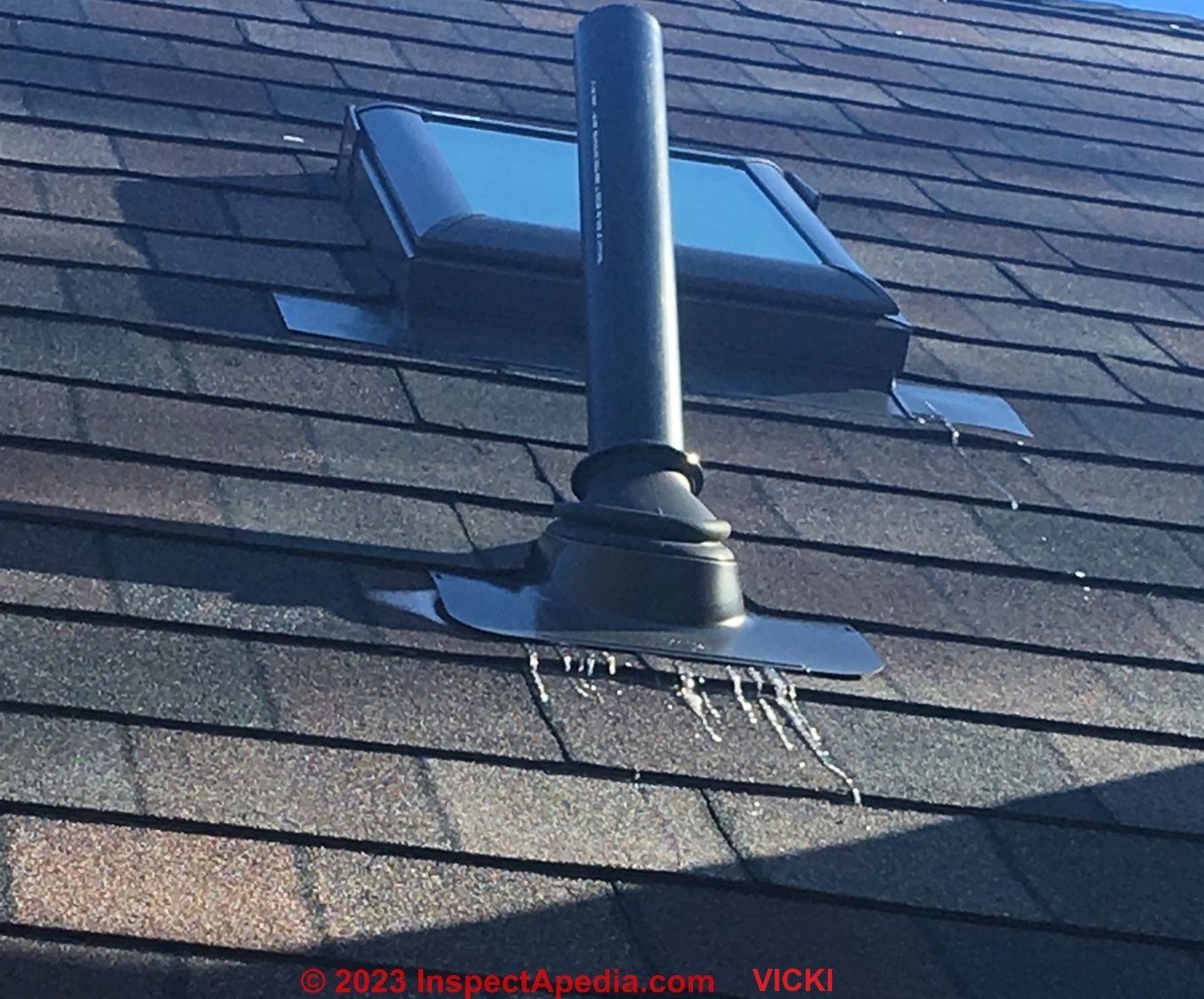
During the winter I noticed on newly installed roof, that water was dripping from underneath vent stack pipe flashing at the bottom.
What would cause this to happen? Is this normal?
I am enclosing a picture, in which there are iced water drips. It is definitely coming from underneath the flashing, cause I saw water drop leaking from underneath the flashing.
Also, at the top of my roof at the ridge caps, it also has water drops that looks like it is coming from underneath the shingle. Is that normal? The ridge caps are not completely sealed down yet. - Anonymous 2020/08/19
Moderator reply:
Thanks for the interesting photo and question, Anon
I would first inspect the roof cavity/attic with care to see if there's not inadequate venting or a moisture problem that's causing condensation that's leaknig out along with air at various penetrations,
not just the vent stack but at the skylight flashing above that point too
If this is a cathedral ceiling, I'm worried that there may be a moisture accumulation problem in the roof space - risking mold or damage.
On 2020-01-29 by danjoefriedman (mod)
phoenix az roofing said:
Very educational content about home inspection
On 2018-03-05 by danjoefriedman (mod)
Most likely flashing was not properly installed
On 2018-03-04 by colsome Logan
on split level house after siding was installed whee front of house protrudes there is a leak in the joint area. why
...
Continue reading at ARTICLE INDEX to BUILDING FLASHING or select a topic from the closely-related articles below, or see the complete ARTICLE INDEX.
Or see these
Recommended Articles
- ARTICLE INDEX to BUILDING ROOFING
- BUILDING DEFECTS LISTS - home
- DEFECT CLUSTERS
- DRIP EDGE FLASHING for ROOFS - home
- ROOF DRIP EDGE DIMENSIONS & SIZES - you are on this page
- ROOF DRIP EDGE COLOR CHOICES
- ROOF DRIP EDGE PLACEMENT / LOCATION
- ROOF DRIP EDGE INSTALLATION on NEW or RE-ROOF JOBS
- ROOF DRIP EDGE INSTALLATION INSTRUCTIONS & CODES
- ROOF DRIP EDGE INSTALLATION MISTAKES
- ROOF DRIP EDGE ALTERNATIVE: FASCIA WRAP?
- ROOF FLASHING DEFECTS LIST
- ROOF FRAMING TIES & BEAMS
- ROOFING INSPECTION & REPAIR - home
- FLASHING, ASPHALT SHINGLE VALLEYS
- FLASHING, CHIMNEY Mistakes & Leaks
- FLASHING, CLAY TILE ROOFS
- FLASHING MEMBRANES PEEL & STICK
- FLASHING for METAL ROOFS
- FLASHING ROOF WALL DETAILS
- FLASHING ROOF-WALL SNAFU
- FLASHING SIDING DETAILS
- FLASHING WALL DETAILS
- FLASHING WINDOW DETAILS
- ROOF STEEP SLOPE DEFECTS LIST
Suggested citation for this web page
ROOF FLASHING DEFECTS LIST at InspectApedia.com - online encyclopedia of building & environmental inspection, testing, diagnosis, repair, & problem prevention advice.
Or see this
INDEX to RELATED ARTICLES: ARTICLE INDEX to BUILDING & HOME INSPECTION
Or use the SEARCH BOX found below to Ask a Question or Search InspectApedia
Ask a Question or Search InspectApedia
Questions & answers or comments about troubleshooting roof flashing leaks.
Try the search box just below, or if you prefer, post a question or comment in the Comments box below and we will respond promptly.
Search the InspectApedia website
Note: appearance of your Comment below may be delayed: if your comment contains an image, photograph, web link, or text that looks to the software as if it might be a web link, your posting will appear after it has been approved by a moderator. Apologies for the delay.
Only one image can be added per comment but you can post as many comments, and therefore images, as you like.
You will not receive a notification when a response to your question has been posted.
Please bookmark this page to make it easy for you to check back for our response.
IF above you see "Comment Form is loading comments..." then COMMENT BOX - countable.ca / bawkbox.com IS NOT WORKING.
In any case you are welcome to send an email directly to us at InspectApedia.com at editor@inspectApedia.com
We'll reply to you directly. Please help us help you by noting, in your email, the URL of the InspectApedia page where you wanted to comment.
Citations & References
In addition to any citations in the article above, a full list is available on request.
- John Cranor [Website: /www.house-whisperer.com ] is an ASHI member and a home inspector (The House Whisperer) is located in Glen Allen, VA 23060. He is also a contributor to InspectApedia.com in several technical areas such as plumbing and appliances (dryer vents). Contact Mr. Cranor at 804-873-8534 or by Email: johncranor@verizon.net
- Mark Cramer Inspection Services Mark Cramer, Tampa Florida, Mr. Cramer is a past president of ASHI, the American Society of Home Inspectors and is a Florida home inspector and home inspection educator. Contact Mark Cramer at: 727-595-4211 mark@BestTampaInspector.com 11/06
- Roger Hankey is principal of Hankey and Brown Inspections, Winter Park, CO. Mr. Hankey is a past chairman of the ASHI Standards Committee and served in other ASHI chapter and national leadership roles. Mr. Hankey is a National Radon Proficiency Program certified measurement professional and a Level II infrared thermographer. Contact Roger Hankey at: 970-393-6604 - rogerhankey47@gmail.com . Website: www.HankeyandBrown.com Mr. Hankey is a frequent contributor to InspectAPedia.com.
- Arlene Puentes [Website: www.octoberhome.com ] , an ASHI member and a licensed home inspector in Kingston, NY, and has served on ASHI national committees as well as HVASHI Chapter President. Ms. Puentes can be contacted at ap@octoberhome.com
- In addition to citations & references found in this article, see the research citations given at the end of the related articles found at our suggested
CONTINUE READING or RECOMMENDED ARTICLES.
- Carson, Dunlop & Associates Ltd., 120 Carlton Street Suite 407, Toronto ON M5A 4K2. Tel: (416) 964-9415 1-800-268-7070 Email: info@carsondunlop.com. Alan Carson is a past president of ASHI, the American Society of Home Inspectors.
Thanks to Alan Carson and Bob Dunlop, for permission for InspectAPedia to use text excerpts from The HOME REFERENCE BOOK - the Encyclopedia of Homes and to use illustrations from The ILLUSTRATED HOME .
Carson Dunlop Associates provides extensive home inspection education and report writing material. In gratitude we provide links to tsome Carson Dunlop Associates products and services.
 | HOME | ABOUT | ASK a QUESTION | CONTACT | CONTENT USE POLICY | DESCRIPTION | POLICIES | PRIVACY | |
| © 2024 - 1985 Publisher InspectApedia.com - Daniel Friedman | |||||||||