
InspectAPedia® FREE Encyclopedia of Building & Environmental Construction, Diagnosis, Maintenance & Repair |
Question? Just ask us! InspectAPedia
|
 Warm Air Furnace Heating Systems Guide
Furnace inspection, troubleshooting, & repairs
- POST a QUESTION or COMMENT about how to buy, install, maintain, and fix warm air heating furnaces, ductwork, and controls
Warm air furnace installation, troubleshooting, repair guide:
This article series answers just about any question about forced air or warm air furnace central heating system troubleshooting, inspection, diagnosis, and repairs in residential buildings and homes.
We explain how furnaces work, what controls and settings are used, what goes wrong, and how to fix it.
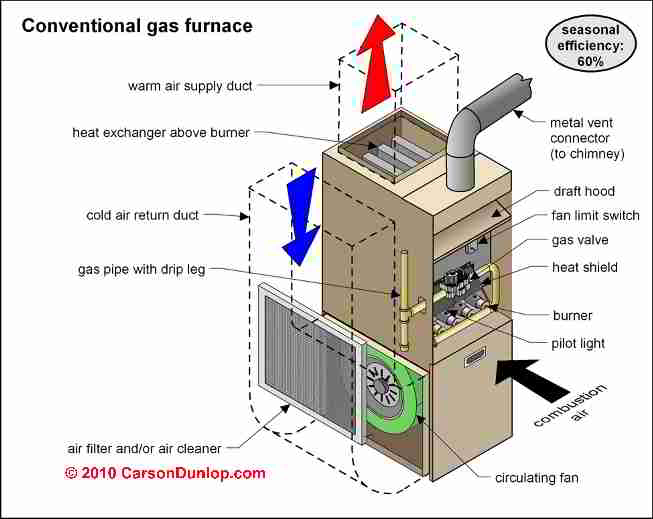
This page is the starting point for our series of heating furnace diagnosis and repair articles. Sketch at page top courtesy of Carson Dunlop Associates, a Toronto home inspection, education & report writing tool company [ carsondunlop.com ].
InspectAPedia tolerates no conflicts of interest. We have no relationship with advertisers, products, or services discussed at this website.
- Daniel Friedman, Publisher/Editor/Author - See WHO ARE WE?
Warm Air Furnace Inspection, Diagnosis & Repair - where to start?
 If you have no heat,
see HEATING LOSS DIAGNOSIS-FURNACES.
Article Contents
- WHAT KIND of HEAT DO I HAVE - boiler or furnace or something else?
- HOW TO RECOGNIZE a FURNACE: warm air heat uses supply & return air ducts & registers
- DIFFERENCE BETWEEN FORCED WARM AIR & GRAVITY FURNACE
- GRAVITY (OCTOPUS) FURNACES
- FORCED WARM AIR FURNACE (most homes use this)
- HOW DOES a FORCED WARM AIR FURNACE WORK?
- ACCEPTABLE NOISE LEVELS for HVAC SYSTEMS
- DETERMINE AGE of a FURNACE
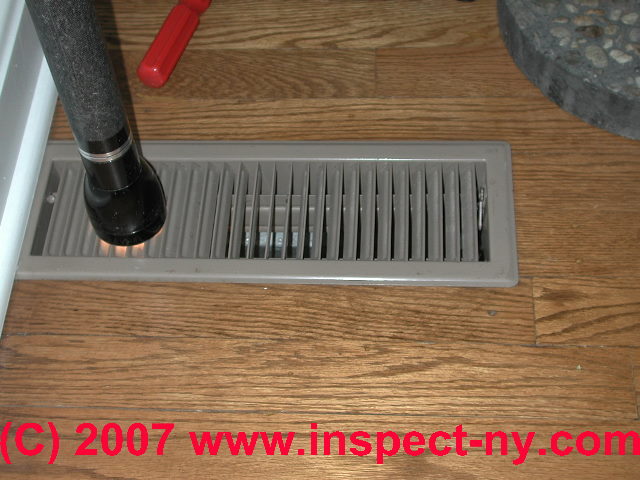
Photo above: our flashlight is atop and shining into a floor register that delivers forced warm air into this room. If you see air registers your heat is being delivered by warm air, not hot water baseboards and not electric baseboards and not a radiant heated floor.
...
What Kind of Heat Do I Have?
First make sure you understand what type of heating system is installed
If you don't know what kind of heat your building uses, we explain how to figure out the answer in more detail
These photos will help you determine what kind of home heating system you have.
Here we're showing heating equipment just as you'll see it in your home, with all of the access covers and panels in place.
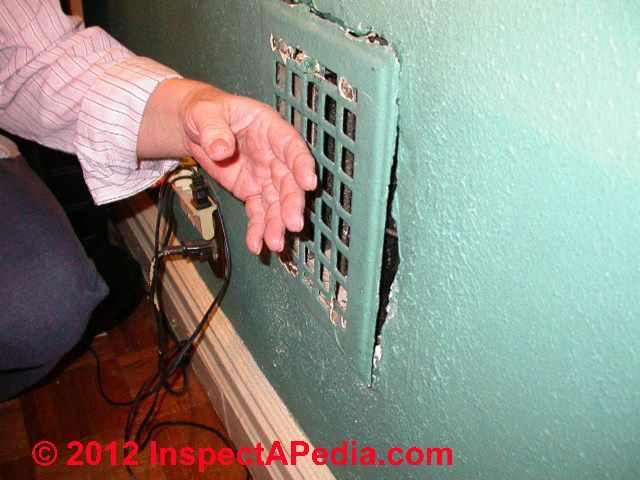
Above: if you feel warm air blowing into a room through a register, or perhaps flowing out of a room into a return air inlet like the one by my hand, your building uses warm air heat.
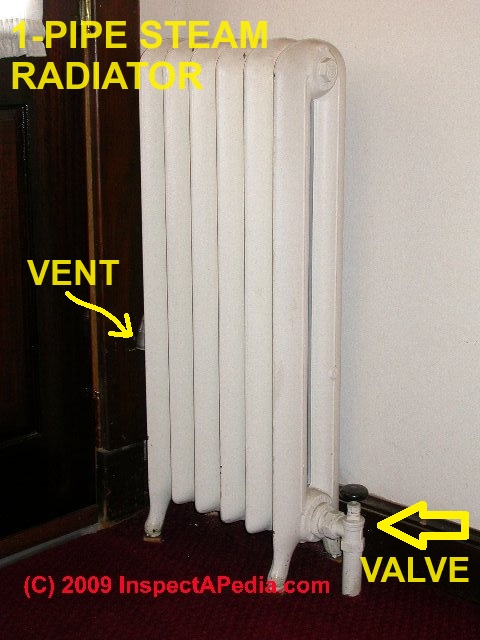
If you see heating RADIATORS for ROOM HEAT (photo above) your heat is by hot water - BOILERS, HEATING or by steam heat - STEAM HEATING SYSTEMS.
If you see heating BASEBOARDS (photo below) your heat may be by hot water or else by electric baseboards - ELECTRIC HEAT.
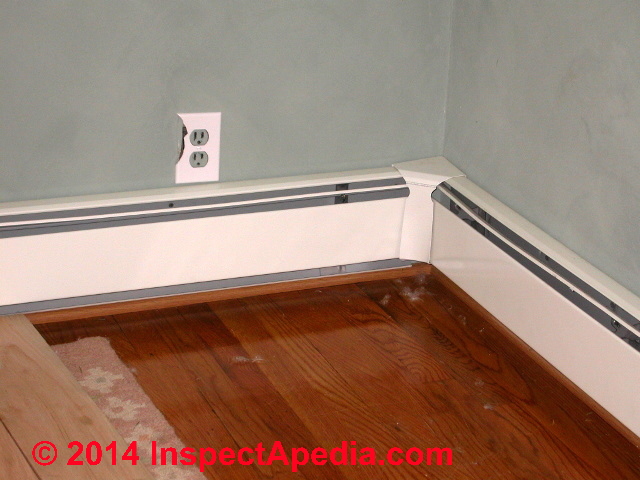
If you don't see any sort of heat radiating device your heat may be by RADIANT HEAT in floors or ceilings.
Articles at this website such as those listed at HVAC SYSTEM TYPES offer lots more detail including photos of individual heating system controls and components along with explanatory text.
...
How To Tell That Yours is a Warm Air Heating System, a Furnace
If the heat in your building is provided by warm air that flows out of floor registers (above left), a wall air supply register (above) or a ceiling air supply register (photo below) and on into the occupied space, then the air which warms the living space is probably being delivered through large or small diameter ducts, registers, air filters, and a furnace blower.

The heated air is being heated by a gas, oil, or electric furnace, or perhaps by a heat pump or a geo-thermal system then your heat is provided by a warm air furnace (sketch at page top, for example)
Cooler air (hopefully also from the same occupied space) flows back to the furnace through one or more air returns and ducts into the furnace return air plenum from which it enters the furnace itself to be re-heated.
Some older warm air systems (illustrated below) are less sophisticated and may have no ductwork at all, and worse, may heat cold air from the basement and send it one-way into the occupied spaces of the home.
...
What's the Difference Between Forced Hot Air Heat and Gravity Hot Air Heat?
Your heating furnace may located in a basement, in a crawl space, in an attic, or even in an outdoor utility closet or an attached garage. In all cases, some heating equipment (oil, gas, coal, wood, geothermal, electric, solar) is used to transfer heat to air that is then delivered to the occupied space of the building.
Illustration of Simple Gravity Furnaces using a Floor Register (Ductless Warm Air)
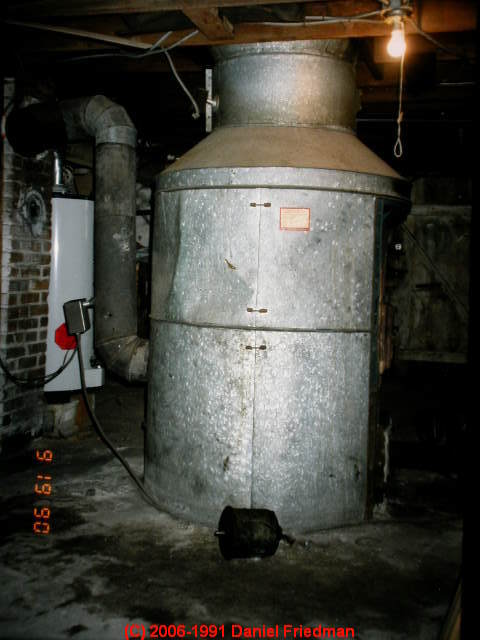
Older hot air heating systems were comprised of a furnace that heated air, sometimes just air from the basement.
The warm air rose into the upper areas of the building by convection (warm air, which is less heavy than cold air) rises, displacing colder, more dense air in the building). You can see one of these old under-floor convection furnaces in our photos at left.
Popularly called a "gravity furnace" (cold air falls by gravity, and warm air defies gravity by rising), you will see only two "pipes" or ducts on the unit.
A flue gas exhaust flue (the smaller diameter steel "pipe" that exits near the bottom left of the gravity furnace and connects to a brick chimney in our photo - and that larger diameter round duct at the top center of the gravity furnace.
That large round warm air supply plenum or duct delivered warm air into the building through a large floor grate in the first floor above. Our arrows show the direction of air flow through this gravity furnace.
In this photo we can't see the cool air intake but almost certainly it's at the bottom of the unit and is in this horribly inefficient unit, is taking cold wet basement air and heating it up before sending it upstairs.
We do see a little of this furnace's repair history - that abandoned motor on the floor in the bottom center tells us that an oil burner was installed and had to have a motor replacement.
Warm air rose from this gravity furnace upwards from the first floor grate into the rest of the building also by convection (or "gravity") flowing up a stairwell, or upstairs through registers cut in the first floor ceilings.
How to Spy on your Parents Through the Gravity Heat Registers
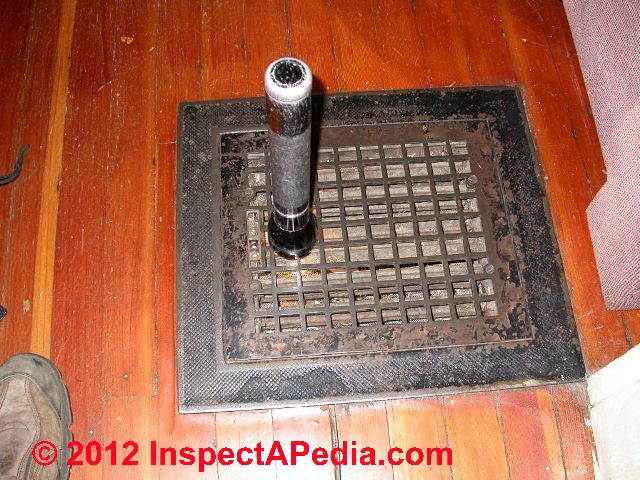
We know that the air register at left is a warm air supply register because it has those moveable louvers that would be absent on a cool air return register cover.
But now let's be honest - we don't know for sure if the air register at left is connected to ductwork or if it's just letting warm air rise by "gravity" (we say "convection") from a floor below.
It's easy to figure out however. Just open the louvers and look through the grating. If you find yourself looking into a duct, typically full of trash and debris in an older home, it's connected to ductwork.
If you find that your can see right into a room below, this is a simple gravity or convection register.
When the author (DF) was a boy, we used to spy on our parents and their friends by peering down at them through a register like this after we had been sent upstairs to bed.
They were not up to much besides drinking, talking about stuff we couldn't understand, and playing canasta.
...
Gravity & Octopus Furnaces
Octopus furnaces (illustrated below) added warm air ducts that conducted air directly to different areas of the building.
You can see at below left why the heater was called an "octopus" furnace. It may not have always had the eight arms of an octopus but it sure looks like one, with those ducts waving all around.

Below you can also see the stack relay (black rectangular control) on the exhaust flue of this octopus furnace.
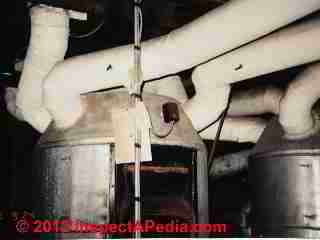
At in both of the above photos and enlarged at above right we illustrate that white paper-like duct wrap that was just about always an asbestos paper material. On the octopus furnace at above right you can also see a rectangular heating control switch near the top of the furnace.
Those black Tee-shaped controls visible on the ducts themselves are manual duct dampers that allowed the occupants to balance warm air flow among different areas of the building.
How to Spot an Invisible Octopus Furnace
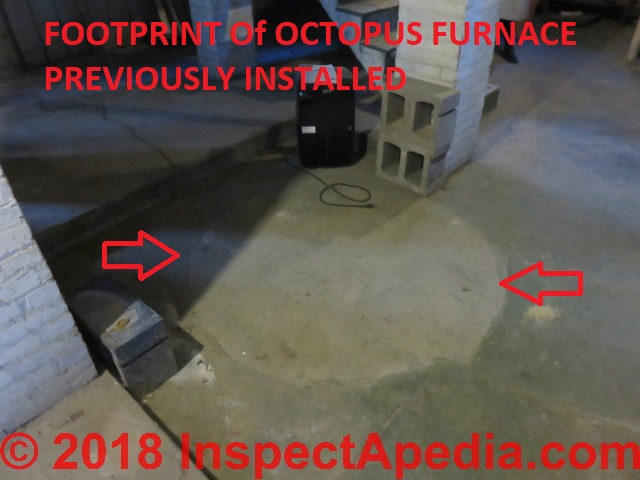
The round footprint of lighter-coloured concrete on the basement floor of this Poughkeepsie New York home tells us that most-likely there was previously a round octopus furnace installed in the home.
At the time of our inspection the home had been heated for decades by a steam boiler and the octopus furnace was long gone.
The combination of the estimated age of the home (about 100 years old), its location, and history of heating in the North Eastern U.S. support this opinion - now principally of just historic interest.
...
Modern Forced Warm Air Furnaces
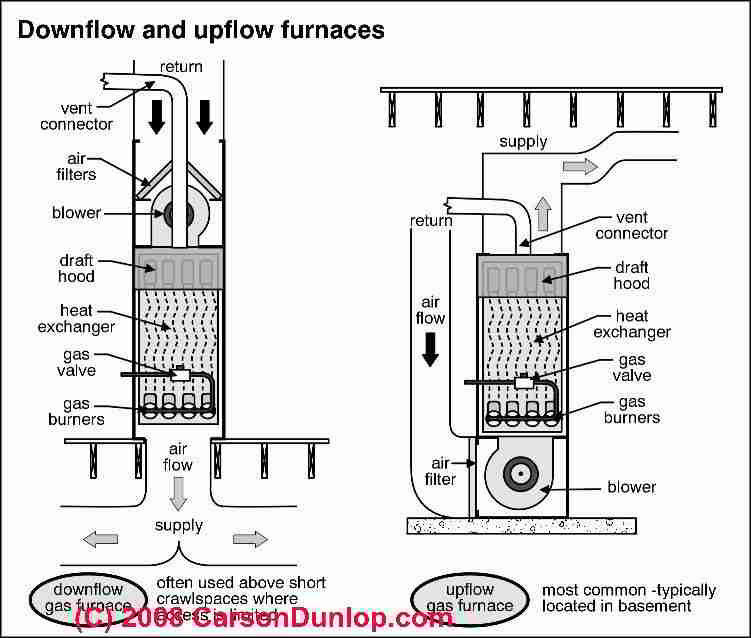
Modern warm air furnaces classed as central heating include a heat source (oil burner, gas burner, electricity, solar,etc.), a blower assembly, a cool return air plenum, a warm air supply plenum, and connections to supply and return ducts that bring cool air from the occupied space, pass it through the air handler, and move it as warmed air back into the building.
Depending on their physical position a furnace may be an upright unit or a horizontal unit suited for low basements or crawl space installation.
Heating system air flow direction determines whether we call the vertical air handler an upflow unit (cool air enters at the bottom) or a downflow unit (cool air enters at the top of the unit).
Our upflow/downflow furnace illustration at left was provided courtesy of Carson Dunlop Associates, a Toronto home inspection, education & report writing tool company [ carsondunlop.com ].
Below at left is an up-flow high efficiency gas fired furnace that we installed.
Air enters that silver plenum at the base of the unit and flows upwards through an air filter, blower assembly, heat exchanger and supply plenum into supply ductwork. Our arrows indicate the direction of air movement through the upflow furnace.
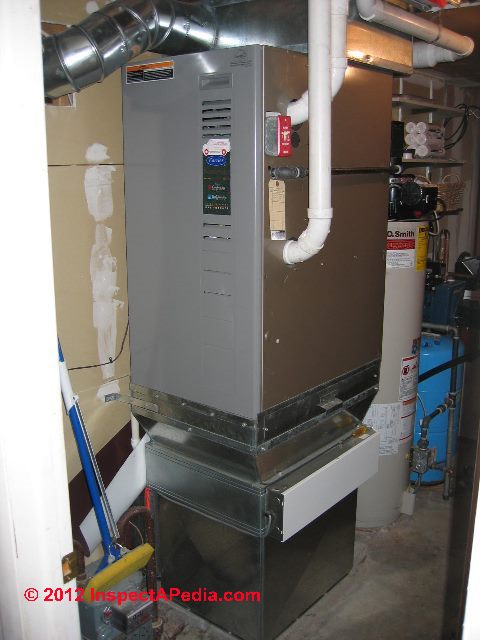
Below is a horizontal furnace.
We guess that return air is entering at the right end of the unit because those flex ducts are larger than the smaller flex duct headed up from a (not visible) connection to the supply plenum at the left end of the unit.

A look inside through the blower compartment access door on the other side of this unit would answer the question.
See FURNACE CONTROLS & SWITCHES and
for details about how furnaces work and their controls,
see FURNACE OPERATION DETAILS.
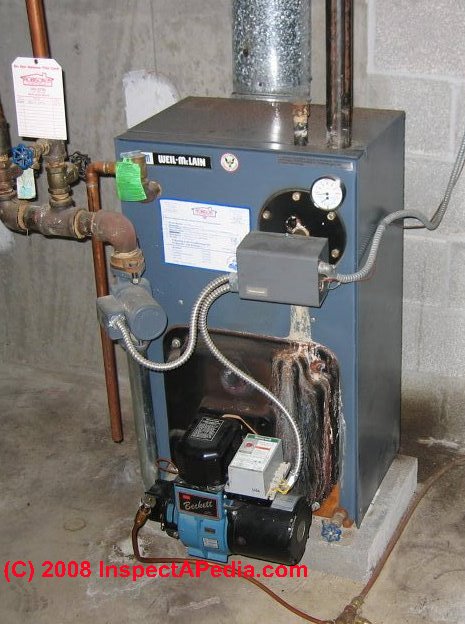
Are you sure it's a furnace and not a boiler like the one above?
A furnace is not a boiler, and vice versa.
A boiler should not be called a furnace, or your heating technician will know she or he can charge you extra because you have no idea what is going on, and what they do will seem more mysterious (and expensive) than ever.
Except for one trouble making company who messed everyone up by making a hot water heating boiler and calling it an "Iron Furnace". Oh well. Boilers heat water and furnaces heat air. Usually.
Do you see ductwork, or water pipes?
If the heat in your building is provided by warm or hot metal radiators, heating baseboards containing finned copper tubing, or wall convectors that look like a radiator but contain finned copper tubing, or if heat is provided by flexible rubber, plastic, or metal tubing run in building floors or ceilings, then the warm or hot water circulating in those devices is probably being delivered by piping circulating water heated by a heating boiler, or possibly by a steam boiler or a heat pump or geo-thermal system.
See BOILERS, HEATING and RADIANT HEAT FLOOR MISTAKES.
If your heating radiators have valves which hiss and let air escape as heat is coming on your heat is probably being delivered in pipes which circulate steam from the steam boiler up through radiators in the occupied space.
See STEAM HEATING SYSTEMS .
...
How does a Warm Air Heating Furnace work?
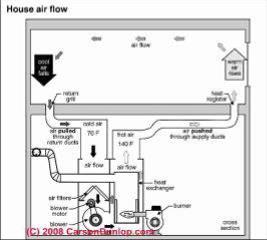
The Building Thermostat senses temperature, turns on the furnace burner. The oil or gas burner will continue to run (usually) until the call for heat is satisfied at the thermostat.
Heat exchanger: Hot combustion gases produced by the oil or gas burner circulate inside of the furnace's metal heat exchanger causing it to get hot.
The furnace blower inside the furnace blower compartment draws returning cool air from the living area and blows it across the outside of the heat exchanger, sending the now-warmed air onwards into the occupied space.
Air ducts connect and permit movement of cool air from occupied space through furnace and deliver warm air back to occupied space.
Sketch courtesy of Carson Dunlop Associates, a Toronto home inspection, education & report writing tool company [ carsondunlop.com ].
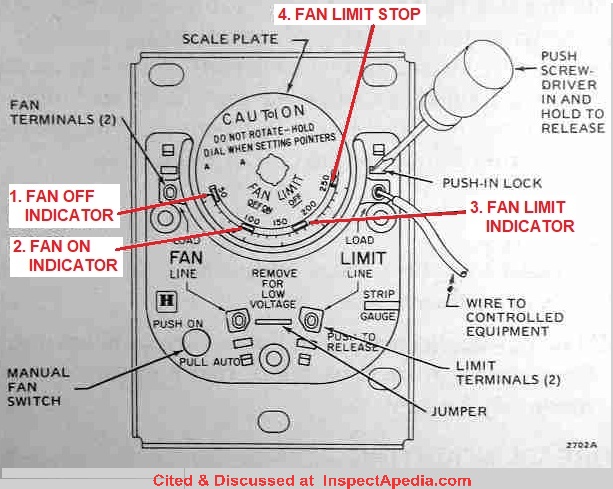
Combination Fan & Limit Control: This control turns the furnace blower on and off at the proper times.
Details of just how a warm air heating system works and how its controls function as well as how these components are inspected, tested, set, or re-set are provided
...
What are Acceptable noise levels from HVAC systems?
An InspectApedia reader asked:
Our brand new (Carrier Infinity variable speed, installed 2017) furnace, located in the garage closet, & intake air vent makes a lot of noise (up to 86 decibels) heard inside our house.
Where can I find references to acceptable noise from HVAC systems INSIDE the residence? I live in Los Angeles. I’ve researched & was only able to find ordinances for outside noise penetrating inside & construction noise ordinances, nothing in standards of noise from HVAC equipment inside the home.
Also looking for HVAC consultants who can come & evaluate the location & installation issues. Our HVAC Contractor refuses to cooperate.
Plz help. TIA - On 2019-02-17 by Lana
Reply by (mod): Typical furnace noise range is 40-60 decibels
Typically a furnace will produce noise or sound in the 40-60 decibel range, but just what noise level you hear depends on where you're making the measurement and where the equipment is located as well as many conditions in the building itself that may transport or transmit noises through the structure - or block it.
Watch out: an important question to ask is whether or not the HVAC noise that you're heating indicates that the equipmenty is not operating properly.
And you'll see from my list below that there is quite a long list of possible "abnormal" noise sources from HVAC equipment.
So just reporting a noise level as too high or bothersome without some diagnosis is not going to get us far enough.
Indirectly HVAC noise diagnosis answers your question since an abnormal noise is also unacceptable as it means there's a problem with the equipment.
See these HVAC noise diagnosis articles:
- HVAC SYSTEM NOISE DIAGNOSIS - home
- AIR HANDLER / BLOWER NOISES
- CHATTERING RELAYS, HVAC EQUIPMENT
- COMPRESSOR CONDENSER NOISES
- DUCT SYSTEM NOISES
- DUCT VIBRATION DAMPENERS
- ELECTRIC MOTOR NOISE DIAGNOSIS
- FAN NOISES, HVAC
- HVAC SOUND DESCRIPTIONS
- HVAC NOISE-1 BANG BUZZ VIBRATE - banging, bearings, buzzing
- HVAC NOISE-2 CHATTER CHIRP CLANK FAN GROAN - chatter, chirp, clank, clunk, cyclical sounds, fan noise, groan, growl, gurgle
- HVAC NOISE-3 HISS HOWL HUFF HUM - hiss, howl, huff, hum, groan, woo wuu wuff
- HVAC NOISE-4 POP, RATTLE, ROAR, RUMBLE - loud start, pop, rattle, rumble, water, silence
- HVAC NOISE-5 SCREAM SING TRUMPET WHINE WUWU - scream, sing, squeal, trumpet, wawa, wowo, water gurgle, whine, whistle, wuwu
- NOISES, HVAC SOUND RECORDINGS
- REFRIGERANT PIPING GURGLING
After that, I don't think you'll find a noise standard that is confined just to "HVAC systems" but we do offer a lot of help with your concern.
See
...
How do I find out how old my furnace is?
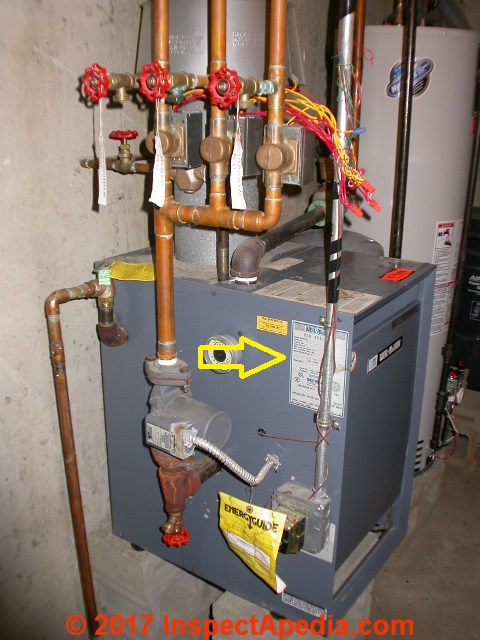
To find out how old your furnace is,
Check the furnace brand and model, find the data tag, and if there is no manufacture date on the data tag, find the serial number on the data tag.
The manufacture date is usually encoded in the furnace serial number.
But exactly how the manufacture date is encoded in the furnace serial number is at least brand-dependent.
For that reason, once you know at least your furnace brand (manufacturer) and have found its serial number, you can look up the furnace age decoding guide for your particular heater at
AGE of HEATERS, BOILERS, FURNACES
where we give several documents that decode those serial numbers.
In that article we also give links to Furnace and Boiler manuals, age decoders, and contact information sorted alphabetically by manufacturer.
For example suppose your furnace is made by American Standard
in the article I gave you'd find this link
MANUALS & PARTS GUIDES - HVAC Brands A-E - & Master Index to All Brand Names, HVAC manuals, wiring diagrams, installation and repair guides -
and at that page you'd scroll down through the alphabetically-organized list of manufacturers (or using your browser's search feature to search our page for AMERICAN STANDARD)
Until you find find this link:
AMERICAN STANDARD boilers & furnaces
and clicking on that link
you'd find all the information we have on that brand, including an
American Standard HVAC Data Tag Age Decoder
...
...
Continue reading at FURNACE CONTROLS & SWITCHES or select a topic from the closely-related articles below, or see the complete ARTICLE INDEX.
Or see FURNACE HEATING FAQs - questions & answers about furnace inspection & repair posted originally on this page
Or see these
Recommended Articles
- BOILER / FURNACE AGE GUESSER
- HEATING FURNACE INSPECTION GUIDE
- HEATING LOSS DIAGNOSIS-FURNACES - If you have no heat
- NO HEAT - FURNACE
- FURNACE OPERATION DETAILS
Suggested citation for this web page
FURNACES, HEATING at InspectApedia.com - online encyclopedia of building & environmental inspection, testing, diagnosis, repair, & problem prevention advice.
Or see this
INDEX to RELATED ARTICLES: ARTICLE INDEX to HEATING FURNACES
Or use the SEARCH BOX found below to Ask a Question or Search InspectApedia
Ask a Question or Search InspectApedia
Try the search box just below, or if you prefer, post a question or comment in the Comments box below and we will respond promptly.
Search the InspectApedia website
Note: appearance of your Comment below may be delayed: if your comment contains an image, photograph, web link, or text that looks to the software as if it might be a web link, your posting will appear after it has been approved by a moderator. Apologies for the delay.
Only one image can be added per comment but you can post as many comments, and therefore images, as you like.
You will not receive a notification when a response to your question has been posted.
Please bookmark this page to make it easy for you to check back for our response.
IF above you see "Comment Form is loading comments..." then COMMENT BOX - countable.ca / bawkbox.com IS NOT WORKING.
In any case you are welcome to send an email directly to us at InspectApedia.com at editor@inspectApedia.com
We'll reply to you directly. Please help us help you by noting, in your email, the URL of the InspectApedia page where you wanted to comment.
Citations & References
In addition to any citations in the article above, a full list is available on request.
- Mark Cramer Inspection Services Mark Cramer, Tampa Florida, Mr. Cramer is a past president of ASHI, the American Society of Home Inspectors and is a Florida home inspector and home inspection educator. Mr. Cramer serves on the ASHI Home Inspection Standards. Contact Mark Cramer at: 727-595-4211 mark@BestTampaInspector.com
- John Cranor [Website: /www.house-whisperer.com ] is an ASHI member and a home inspector (The House Whisperer) is located in Glen Allen, VA 23060. He is also a contributor to InspectApedia.com in several technical areas such as plumbing and appliances (dryer vents). Contact Mr. Cranor at 804-873-8534 or by Email: johncranor@verizon.net
- Domestic and Commercial Oil Burners, Charles H. Burkhardt, McGraw Hill Book Company, New York 3rd Ed 1969.
- National Fuel Gas Code (Z223.1) $16.00 and National Fuel Gas Code Handbook (Z223.2) $47.00 American Gas Association (A.G.A.), 1515 Wilson Boulevard, Arlington, VA 22209 also available from National Fire Protection Association, Batterymarch Park, Quincy, MA 02269. Fundamentals of Gas Appliance Venting and Ventilation, 1985, American Gas Association Laboratories, Engineering Services Department. American Gas Association, 1515 Wilson Boulevard, Arlington, VA 22209. Catalog #XHO585. Reprinted 1989.
- "Warm Air Heating Systems". Instructional Technologies Institute, Inc., 145 "D" Grassy Plain St., Bethel, CT 06801 800/227-1663 [home inspection training material] 1987
- The ABC's of Retention Head Oil Burners, National Association of Oil Heat Service Managers, TM 115, National Old Timers' Association of the Energy Industry, PO Box 168, Mineola, NY 11501.
- In addition to citations & references found in this article, see the research citations given at the end of the related articles found at our suggested
CONTINUE READING or RECOMMENDED ARTICLES.
- Carson, Dunlop & Associates Ltd., 120 Carlton Street Suite 407, Toronto ON M5A 4K2. Tel: (416) 964-9415 1-800-268-7070 Email: info@carsondunlop.com. Alan Carson is a past president of ASHI, the American Society of Home Inspectors.
Thanks to Alan Carson and Bob Dunlop, for permission for InspectAPedia to use text excerpts from The HOME REFERENCE BOOK - the Encyclopedia of Homes and to use illustrations from The ILLUSTRATED HOME .
Carson Dunlop Associates provides extensive home inspection education and report writing material. In gratitude we provide links to tsome Carson Dunlop Associates products and services.
 | HOME | ABOUT | ASK a QUESTION | CONTACT | CONTENT USE POLICY | DESCRIPTION | POLICIES | PRIVACY | |
| © 2025 - 1985 Publisher InspectApedia.com - Daniel Friedman | |||||||||