
InspectAPedia® FREE Encyclopedia of Building & Environmental Construction, Diagnosis, Maintenance & Repair |
Question? Just ask us! InspectAPedia
|
 Fireplace Inserts & Zero-Clearance Fireplaces
Antique coal burning & modern wood-burning fireplaces & inserts
- POST a QUESTION or COMMENT about fireplace inserts & zero clearance fireplace installation, operation, inspection, maintenance, & repair
Fireplace inserts:
This article describes the antique and modern fireplace inserts used for wood, coal, or pellet fuel heating.
We discuss fireplace inserts and zero-clearance fireplaces, both antique and modern, and their hazards and inspection limitations.
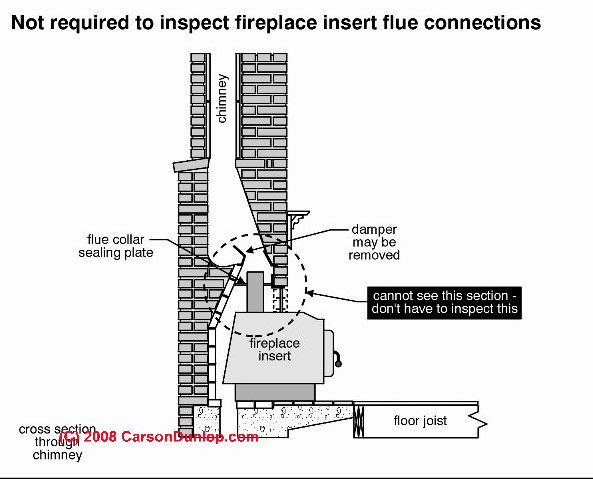
The page top sketch, provided courtesy of Toronto home inspection firm Carson Dunlop Associates illustrates limitations on the visual inspection of fireplace inserts. It does not show proper fireplace insert installation details.
InspectAPedia tolerates no conflicts of interest. We have no relationship with advertisers, products, or services discussed at this website.
- Daniel Friedman, Publisher/Editor/Author - See WHO ARE WE?
Antique Fireplace Inserts - Coal-Burning
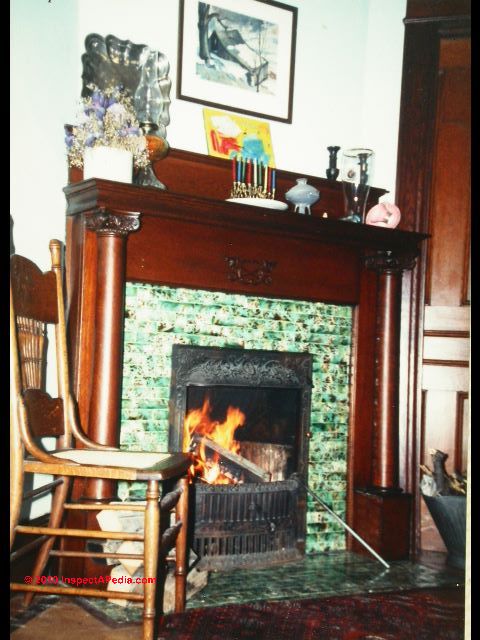
Below we provide photographs of the exploration of the condition of a cast-iron "fireplace" or fireplace grate that was originally intended for burning large chunks of coal, probably soft coal. This installation was found in a home built in Poughkeepsie NY ca 1900 and restored by the author.
Watch out: Because a fireplace insert blocks direct access to the chimney flue from inside a building, the condition of an inaccessible flue is often unknown, and possibly dangerous fire or carbon monoxide hazards could be present.
Expert inspection and cleaning are appropriate as at least an annual safety check.
Our page top sketch of a typical fireplace insert is provided courtesy of Carson Dunlop Associates & Associates.
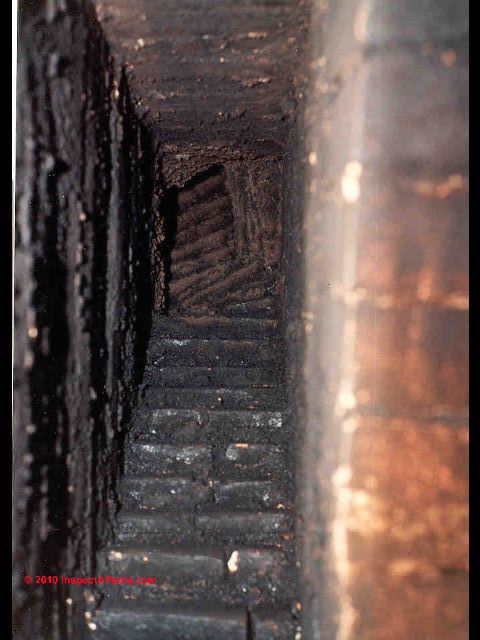
Working carefully so as not to damage the ceramic tile fireplace facade and hearth, we removed and disassembled this antique coal burning fireplace insert (burning wood in our photo) to inspect the condition and construction of the chimney flue (above right).
The flue was un-damaged, needed cleaning, and was also a bit small for any expanded fuel use in this installation.
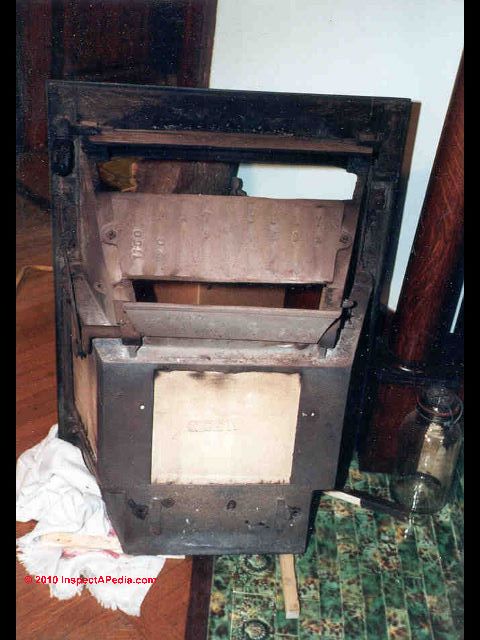
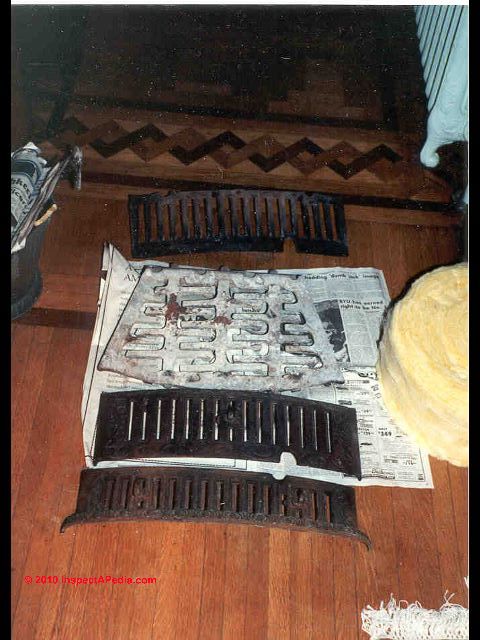
Our fireplace photos above show the back and top of this coal burning insert (above left) and the grate assembly (above right).
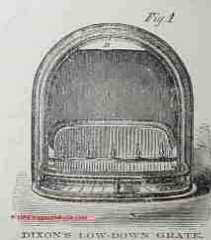
At below left we show the solid (8" or more) masonry firebox and the opening into a basement ash pit below this fireplace. Our reproduction of an antique fireplace grate insert (below right) was a Dixon's Low-Down Grate.
Low fireplace grates were intended for use over an ash pit opening.

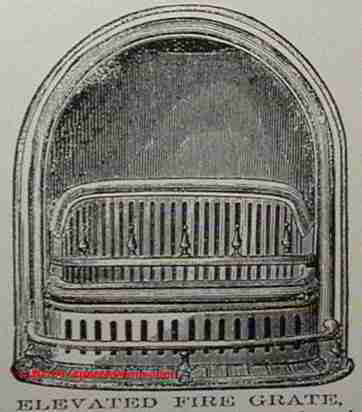
For upper floor rooms where no ash pit connection was possible, Dixon sold an Elevated Fire Grate [Image]
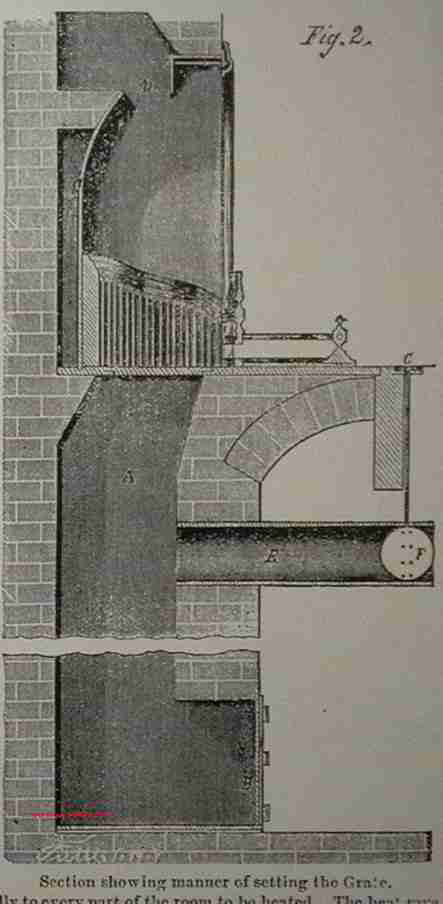
The installation of low cast iron fire grates over an ash pit was made as shown in this sketch. [Image]
Dixon's design intended to draw combustion air for the fire from the basement (cellar) or from outside, not from the room being heated - a design considered proper practice in modern homes and required by code in some areas.
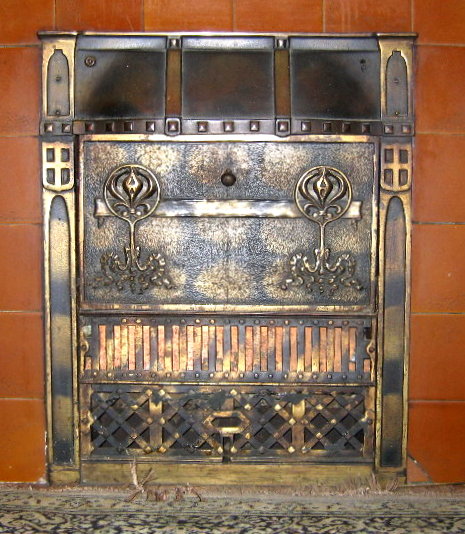
Here is another beautiful antique fireplace opening cover/grate [Image] observed in Minneapolis and contributed by Roger Hankey.
Watch out: some older homes used a shared flue among fireplaces and heating appliances on different floors - a practice that is considered unsafe and is prohibited today.
Modern Fireplace Inserts for Burning Wood, Coal, Pellet Fuel
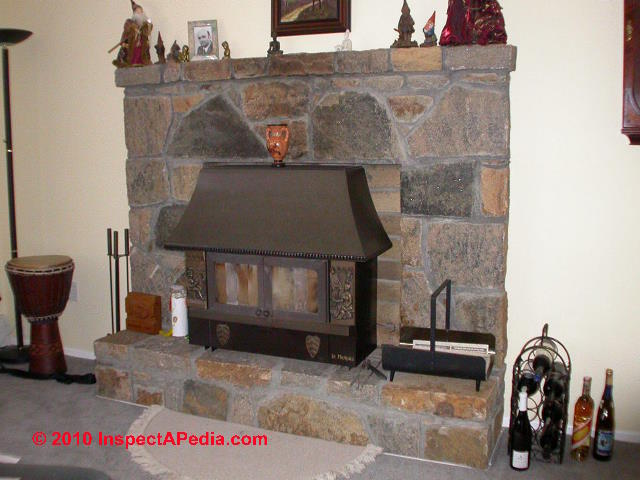
A modern fireplace insert for burning wood is shown at left. You can see why inspecting the chimney from inside is impossible without removing the appliance.
This installation is particularly interesting.
If you click to enlarge the photo you can see light colored bricks at the right of the fireplace insert: the installer appears to have bricked the original fireplace opening to better fit the new insert.
Watch out: adding a fireplace insert that moves the fire doors closer to the edge of the hearth reduces fire clearance (for heat or if the doors are open, sparks and coals) between the appliance opening and nearby combustibles or flooring.
The owners have placed a "fireproof rug" in front of this unit - that semi-circular carpet observed on the floor. Is this adequate?
Be sure to consult your local fire inspector when installing or converting a fireplace or fuel burning appliance.
Unsafe Fireplace Inserts
By "fireplace insert" we refer to a wood or coal-burning stove designed to be inserted into an existing masonry fireplace opening.
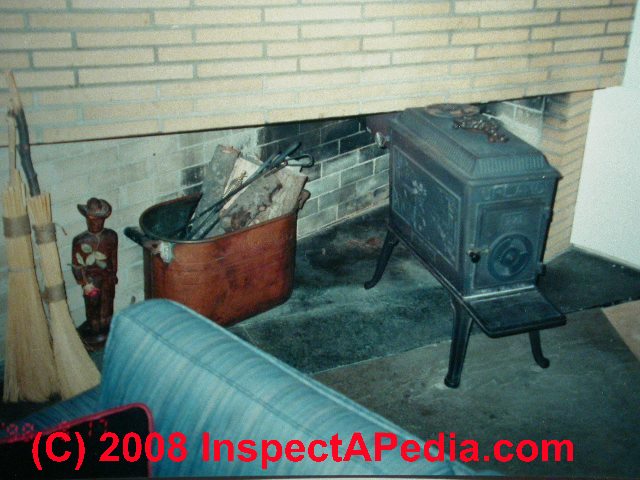
The wood-stove installed in the fireplace at left may work in such a location, but it was not designed as an "insert" - and does not fit the opening of this odd fireplace. In fact not much would fit in this angled firebox.
Placing the feet of the woodstove past the hearth and onto a rug, as well as less than 3' from combustibles, are further fire hazards - this is an unsafe installation.
Zero-clearance Fireplaces
Details about this topic are now at FIREPLACE INSPECTION PRE-FAB - separate article. Excerpts are below
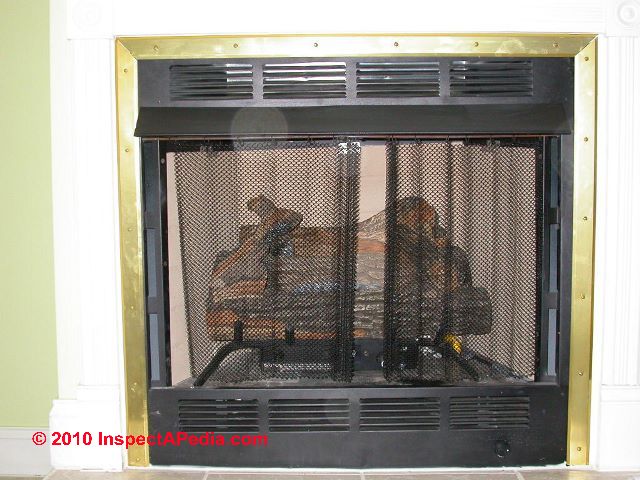
Do not confuse a fireplace insert woodstove or coalstove with a "zero-clearance" fireplace such as the unit shown here.
Zero-clearance fireplaces are typically steel constructed fireplaces to burn wood or perhaps other fuels such as LP or natural gas in modern homes, usually connected to a metal chimney.
Our photo (left) shows a zero-clearance gas fireplace. Other zero clearance fireplaces burn wood or perhaps other fuels.
The clearance to combustibles is not "zero" but one or more inches, depending on the materials, construction, and manufacturers' instructions.
Watch out: we have found a few zero-clearance fireplaces improperly installed too close to combustibles.
The installer did not understand the purpose of steel clearance-assuring projections welded to the zero-clearance fireplace, and s/he had hammered them flat to "shoe-horn" the zero clearance fireplace into a too-small wood-framed rough opening.
The result was a serious building fire hazard and a building code violation as well.
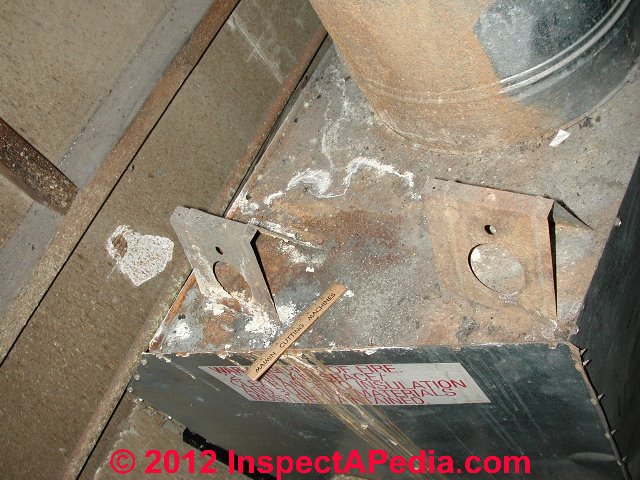 Our photo of a zero-clearance fireplace from inside the framed opening (left) shows the clearance guards intact next to our ruler.
But inspection showed chimney leaks onto this unit - evidenced by the rust and white stains that can ultimately damage the flue (at upper right) and the fireplace unit, making it unsafe.
Inspecting the Chimney where a Fireplace Insert for Wood or Coal is Installed
In fact it is just about impossible to see the condition of these components and their connections unless the insert is removed or inspected from above using a chimney inspection camera system.
If a woodstove/free-standing fireplace like this were to be used it would probably require at least three feet of clearance from combustibles.
Local codes and fire regulations need to be consulted, and in most jurisdictions, a building permit and safety inspection are required for the installation of a woodstove or similar device.
Abandoning or Removing a Fireplace Insert?
Often when a fireplace insert has been installed, the original fireplace damper has been modified (cut to pass the flue vent connector) or simply removed entirely. If you are discontinuing a fireplace insert, you may need to repair or replace the fireplace damper, or perhaps install a chimney-top damper instead.
Factory-Built or Pre-Fab Fireplace Inspection Checklist
Common Factory-Built Fireplace Defects, Problems, Unsafe Conditions |
||
|---|---|---|
| Item # | Fireplace, Hearth, or Chimney Defect, Concern, Hazard | Comment / More Detail |
Building ID & Location: __________________________________________ Date & Time: _________________________________________________ Inspector: ____________________________________________________ © Copyright 2023 - 1985 InspectApedia.com, All Rights Reserved. Author Daniel Friedman. |
||
| 1 | Chimney & Fireplace Installation: all parts of a factory-built fireplace or chimney must be installed according to instructions provided by the manufacturer and no parts can be damaged to an extent that would impair the function of that part. |
FIREPLACE INSERTS INSTALL, INSPECT, REPAIR FIREPLACE INSPECTIONS |
| 2 | Chimney & Fireplace Labels: all parts of a factory-built fireplace or chimney system (except in some jursidictions locally-made covers) must bear labels identifying the parts as listed for use with the fireplace model installed in the building. Examples of labeling issues and even counterfeit labels are at CHIMNEY SHROUD, Decorative |
CHIMNEY INSPECTION CHECKLIST |
| 3 | Fireplace air circulators: any louvers, slots or other openings intended to allow air to circulate to and around the fire-box must be clear of obstructions and should not be damaged or have leaks into or out of other building areas or components. |
|
| 4 | Factory-built fireplace spacers or supports must be in place and not bent, crushed, or damaged. There should be no combustibles that intrude into the fireplace area past the fire clearance distances indicated by the spacers or by the manufacturer's installation instructions. |
|
| 5 | Floor fire protection: if the fireplace has been installed over a combustible floor a non-combustible safety strip (or other manufacturer specified fire safety and heat protection system) must have been placed underneath the unit and on the floor beneath the hearth extension and the fireplace |
|
| 6 | Fireplace hearth extension fire protection: the hearth extension must be made of non-combustible materials and of the thickness, depth, and width specified by local building codes & in compliance with the fireplace manufacturer's specifications, OR the hearth extension must be a listed accessory intended for use with the model fireplace installed. |
|
| 7 | Building insulation installed near the fireplace must be non-combustible and un-faced (e.g. un-faced fiberglass rather than kraft-faced or foil-faced). Where cellulose building insulation is installed it must be shielded and protected from heat that risks combustion, as specified by instructions of the insulation manufacturer and in compliance with local building codes. |
|
| 8 | Fireplace mounting: the fireplace must be supported and secured or fastened tot he structure or blocked so as to prevent shifting or movement or settlement from its installed position, as specified by the manufacturer. |
|
| 9 | Mantel, hearth face, other fireplace trim: trim materials at or near the face of the fireplace must comply with both fireplace manufacturer's instructions and local building codes with regard to choice of materials, fire clearance spacing, and fastening methods so as to avoid placing combustible materials too close to a heat source; trim, doors, etc. must be installed without air leaks or gaps as per manufacturer's instructions. |
|
| 10 | Fireplace modifications: the factory-built fireplace cannot be modified except as permitted by the manufacturer. This includes respecting spacers, trim, mounting locations, and accessories or fire doors. |
|
| 11 | Fireplace inserts into existing fireplaces or into framed openings may not be installed unless the insert is listed and building-code approved and of course installed according to the manufacturer's instructions. This includes add-on home-heating systems or hydronic systems tying into building heating equipment. |
|
| 12 | Fireplace chimney & Chimney connections: the chimney should be inspected for proper construction, safe operating condition, etc. as appropriate for the type of chimney materials and construction (masonry, factory-built, etc). |
CHIMNEY INSPECTION CAMERA |
Notes to the Table Above
The fireplace owners manual and operating instructions should be provided and should be placed where readily accessible to building occupants.
The fireplace identifying tags such as serial number and model number and UL listing or other listing certifications and labels provided by the manufacturer should be intact and left in place as originally installed by the manufacturer.
Additional fireplace safety inspection details are provided at
- FIREPLACES & HEARTHS
- FIREPLACE INSPECTION PRE-FAB
- FIREPLACE INSERTS INSTALL, INSPECT, REPAIR
- FIREPLACE INSPECTIONS
Inspection checklist warning: No checklist is ever a complete guide to building inspection or diagnosis since no checklist can contain every possible hazard or every clue that suggests a problem.
Therefore do not rely on this or any checklist to assure that your inspection of a chimney is complete. Instead, use this list to suggest additional topics that you otherwise may have omitted from your inspection.
The more detailed chimney inspection and repair articles at the links at Related Links and the citations below below suggest further, more-detailed chimney inspection points and procedures.
Fireplace Insert Manuals
- Also see this separate collection for gas-fueled fireplace inserts:
GAS FIREPLACE / GAS LOG MANUALS - Ambiance, Outlander-i19 FIREPLACE INSERT WOODSTOVE INSTALLATION & OPERATION MANUAL [PDF] (2020) Wolf Steel Lt., 24 Napoleon Rd., Barrie ON L4M 0GB Canada / 103 Miller Drive, crittenden KY 41030 USA, Tel: 866-820-8686 Web: www.https//ambiencefireplaces.com
- FIREPLACE MODELS SG36 - SE36 & SB42 INSTALLATION & OPERATION INSTRUCTIONS [PDF] (2009) Security Chimneys International, 2125 Monterey St., Laval, Quebec, Canada H7L 3T6 Tel.: (450) 973-9999
- HEAT & GLO FIREPLACE INSTALLATION MANUAL Northstar-BK, GT, NT [PDF] (2019) (Obsolete - "retired") Woodburning Fireplace Insert Installation, Heat & Glo is a brand of Hearth & Home Technologies, 1915 West Saunders Street, Mt. Pleasant, Iowa 52641 USA Web: www.heatnglo.com
- HEATILATOR EL32-EL46 FIREPLACE INSTALLATION MANUAL [PDF] Heatilator EL36/EL42 4044-188 Installation Manual Rev Q 10/20, retrieved 2021/05/18 original source https://downloads.hearthnhome.com/installManuals/4044_188.pdf

- Oliver McLeod chimneys & woodstoves or fireplaces: history and information is
at METAL CHIMNEY INSTALLATION MANUALS - Security Chimneys FIREPLACE MODELS SB36 - SE36 SB42 Installation and Operating Instructions [PDF] Thomas Industries Inc., 4360 Brownsboro Road, Suite 300, P.O. Box 35120 Louisville, Kentucky 40232 U.S.A. Tel: (502) 893-4600
Web site: www.thomasind.com
excerpt: The chimney models HT6103+ and HT6000+ of Oliver MacLeod, division of Security Chimneys International Ltd are respectively equivalent to models ASHT+ and S-2100+. - Security Chimneys International
- Security Chimneys SB SE FIREPLACE INSERT MANUAL Models SB36-SE36-SB42 [PDF] Security Chimneys International Ltd. 2125 Monterey St., Laval, Quebec, Canada, H7L 3T6 Tel: (450) 973-9999
Excerpt: Always check your local building codes. The installation must comply with their regulations. - Security Chimneys HE43 FIREPLACE INSERT INSTALLATION & OPERATION INSTRUCTIONS [PDF] (2010) Models HE43-2, HE43N-2, HE43BN-2, Security Chimneys International Ltd. - contact information cited above.
- Warnock Hersey CBS-41 FACTORY BUILT FIREPLACE SYSTEM MANUAL [PDF] (1998) Heat-N-Glo Fireplaces, Hearth & Home Technologies,
1915 West Saunders Street, Mt. Pleasant, Iowa 52641 USA Web:
www.heatnglo.com
Note: The manual front page states that "This appliance has been retired. Service parts pages within have been removed. For replacement parts, please refer to the individual service partss listed on the brand websites"
Watch out: This fireplace requires Heat-N-Glo, Equus, Sercurity, oir Oliver-MacLeod components designed for this system. - Warnock Hersey SECURITY FIREPLACE INSERT MANUAL Model SECURE HE43-1 [PDF] (2002) Security Chimneys International Ltd. 2125 Monterey St., Laval, Quebec, Canada, H7L 3T6 Tel: (450) 973-9999
Excerpt:
The Secure HE43-1 is designed to work best when fueled with seasoned cordwood. Hardwoods are preferred to softwoods since the energy content of wood is relative to its density. Hardwoods will result in a longer burning fire and less frequent refueling.
A moisture content of 15% to 20% (seasoned) is preferred. Excessively wet wood will be difficult to burn and will result in lower efficiency and increased creosoting.
Do not burn scrap or garbage, treated wood or wood such as driftwood from the ocean which has been exposed to salt or other chemicals. Salt or chemicals can corrode the firebox and chimney.
Do not abuse the unit by burning large amounts of paper, cardboard, Christmas tree branches or building construction materials such as pressed wood, plywood or lumber. Intense firing with these may overheat the fireplace, causing damage to the unit, a fire, or even possibly igniting a chimney fire, if the chimney is creosoted.

- [3] Wood Heating Alliance, BUILDING INSPECTOR'S CHECKLIST FOR FACTORY BUILT FIREPLACES [PDF]
Editor's note: the Wood Heating Alliance traemark was filed in 1989 and was cancelled as of July 23, 1996. - See additional fireplace, fireplace insert & chimney safety articles at the page Citations & References
Reader comment: fireplace flue insertion distance
12/27/2014 Anonymous said:
I thought fireplace insert flues at a minimum must extend to the first tile in the chimney.
The diagram shown here [at the top of this page] does not reflect this.
Reply:
Anon,
Quite so. If you are referring to the page top sketch, that drawing does not claim to describe a proper stove insert installation; rather it illustrates areas that are not accessible for visual inspection during a home inspection. Thanks for pointing out that the sketch might confuse someone.
A fireplace insert vertical flue vent connector should indeed pass into the first vertical flue tile, subject to further installation specifications provided by the individual fireplace insert manufacturer.
Any flue vent connector that connects horizontaly into a masonry chimney flue needs to be flush with the masonry flue interior. Extending an inch past that point is probably ok but extending too far into the flue horizontally is improper and is likely to block draft.
See INACCESSIBLE CONNECTIONS FIREPLACE, WOODSTOVE for details.
Question: fire clearances for a fireplace mantle shelf
(Sept 30, 2011) Glenn said:
I have a gas insert and want too build a mantel with a shelve 10-12 inches wide, how high above the insert must the bottom of shelve be.
Reply:
Glenn the required fire safety clearances are specified in the installatino manual for your gas insert fireplace and will vary among manufacturers. If you give us the brand and model I'll help you find the clearance details.
Question: Our house has 8 fireplaces, house built in 1897.
(Nov 13, 2012) Richard said:
Our house has 8 fireplaces, house built in 1897.
We were told they are "coal burning" fireplaces, all masonry, and wanted to know if we should use the cast iron covers, which have a round hole in the top 3/4 part and a "damper" at the bottom. We tried it and it makes the fireplace act like a furnace, but is it safe? Thanks
Question: how to get information about a Superior Model CF-3860 fireplace insert, provided from Superior, The Fireplace Company, Fullerton, California
(Feb 2, 2015) L. Flannery said:
Hello
A Superior Model CF-3860 fireplace insert, provided from Superior, The Fireplace Company, Fullerton, California was put in my new home built in 1985 in Edmonton, Alberta Canada. It has been little used and is in excellent shape.
Because of our lack of use, I want to install a gas fireplace insert and I am trying to find out whether there are inserts which can be installed into this model without removing it.
The Alberta Fireplace Installation guide says:
"Fireplace inserts must be installed according to their respective listing requirements. Inserts must not be installed in factory-built fireplaces unless the listing specifically allows the combination."
Are there gas inserts which are compatible with this factory-built fireplace? Alternatively, can you direct me to where I can get this question answered.
Reply:
L.F.
I'm doubtful but can't offer a specific gas heating product for the fireplace insert you cite. I'd start by giving the company a call to see what they themselves recommend for their product line.
Contact the Superior Fireplace Company,
4325 Artesia Ave., Fullerton, CA 92833 USA
Tel: (800) 731-8101
Email : E-mail this company
Web Site : www.superiorfireplace.com
...
Continue reading at FIRE CLEARANCES, WOOD COAL & PELLET STOVES or select a topic from the closely-related articles below, or see the complete ARTICLE INDEX.
Or see these
Recommended Articles
- CHIMNEY FIRE ACTION / PREVENTION
- CHIMNEY FLUE INSPECTION CAMERA
- CHIMNEY DRAFT & PERFORMANCE
- CHIMNEY RE-LINING CHOICES
- CHIMNEY REPAIR METHODS
- CLASS A CHIMNEYS, MetalBestos™
- FIRE CLEARANCES INDOORS
- FIRE CLEARANCES, MASONRY CHIMNEYS
- FIRE CLEARANCES, METAL CHIMNEYS
- FIREPLACES & HEARTHS - home
- FIREPLACE INSERTS INSTALL, INSPECT, REPAIR - home
- GAS FIREPLACES & GAS LOGS - home
- GAS FIREPLACE / GAS LOG MANUALS
- METAL CHIMNEYS & FLUES - home
- METAL CHIMNEY INSTALLATION MANUALS
- PELLET STOVE CLEARANCE DISTANCES
- PYROLYSIS EXPLAINED
- WOOD STOVE OPERATION & SAFETY - home
- WOOD STOVE MANUALS
Suggested citation for this web page
FIREPLACE INSERTS INSTALL, INSPECT, REPAIR at InspectApedia.com - online encyclopedia of building & environmental inspection, testing, diagnosis, repair, & problem prevention advice.
Or see this
INDEX to RELATED ARTICLES: ARTICLE INDEX to CHIMNEYS & FLUES
Or use the SEARCH BOX found below to Ask a Question or Search InspectApedia
Ask a Question or Search InspectApedia
Try the search box just below, or if you prefer, post a question or comment in the Comments box below and we will respond promptly.
Search the InspectApedia website
Note: appearance of your Comment below may be delayed: if your comment contains an image, photograph, web link, or text that looks to the software as if it might be a web link, your posting will appear after it has been approved by a moderator. Apologies for the delay.
Only one image can be added per comment but you can post as many comments, and therefore images, as you like.
You will not receive a notification when a response to your question has been posted.
Please bookmark this page to make it easy for you to check back for our response.
IF above you see " Comment Form is loading comments..." then COMMENT BOX - countable.ca / bawkbox.com IS NOT WORKING.
In any case you are welcome to send an email directly to us at InspectApedia.com at editor@inspectApedia.com
We'll reply to you directly. Please help us help you by noting, in your email, the URL of the InspectApedia page where you wanted to comment.
Citations & References
In addition to any citations in the article above, a full list is available on request.
- [4] Baird, David J., C.B.O., "Factory-built Chimney Chase Fires: A case for More Detailed Inspection", Building Standards, March-April 1991, pp. 14-17.
- [16] Chimney Inspection Checklist, Carson Dunlop, Associates, Toronto, Ontario
- [18] "Chimneys and Vents," Mark J. Reinmiller, P.E., ASHI Technical Journal, Vol. 1 No. 2 July 1991 p. 34-38.
- [19] "Chimney Inspection Procedures & Codes," Donald V. Cohen was to be published in the first volume of the 1994 ASHI Technical Journal by D. Friedman, then editor/publisher of that publication.
The production of the ASHI Technical Journal and future editions was cancelled by ASHI President Patrick Porzio.
Some of the content of Mr. Cohen's original submission has been included in this more complete chimney inspection article
CHIMNEY INSPECTION DIAGNOSIS REPAIR
Copies of earlier editions of the ASHI Technical Journal are available from ASHI, the American Society of Home Inspectors. - [5] Purdie, Roger K., CHIMNEY FIRE SAFETY BULLETIN [PDF] Vista Fire Protection District, 2001, report of house fire related to the home's metal chimney. Contains advice for chimney * fire safety & sketches of approved and not-code-approved metal chimney tops, caps & crowns. [PDF]
- [12] Fire Inspector Guidebook, [BOOK] A Correlation of Fire Safety Requirements Contained in the 1987 BOCA National Codes, (newer edition available), Building Officials and Code Administrators International, Inc. (BOCA), Country Club HIlls, IL 60478 312-799-2300 4th ed.
Note: this document is reissued every four years. Be sure to obtain the latest edition. - [15] "Top Ten Chimney (and related) Problems Encountered by One Chimney Sweep," Hudson Valley ASHI education seminar, 3 January 2000, contributed by Bob Hansen, ASHI
- [20] "Chimney Inspection Procedures & Codes," Donald V. Cohen, draft, was to be published in the first volume of the 1994 ASHI Technical Journal by D. Friedman
- [25] Chimney Inspection Checklist, Carson Dunlop, Associates, Toronto, Ontario
- [26] Chimney & Stack Inspection Guidelines, American Society of Civil Engineers, 2003
- American Gas Association - New Vent Sizing Tables
- Brick Institute of America - Flashing Chimneys
Brick Institute of America - Proper Chimney Crowns
Brick Institute of America - Moisture Resistance of Brick - [8] BOCA Fire Inspector Guidebook, A Correlation of Fire Safety Requirements Contained in the 1987 BOCA National Codes, (newer edition available), Building Officials and Code Administrators International, Inc. (BOCA), Country Club HIlls, IL 60478 312-799-2300 4th ed. Note: this document is reissued every four years. Be sure to obtain the latest edition.
- Chimney Safety Institute of America - Chimney Fires: Causes, Effects, Evaluation
- Costello, Martine, & Josh Kovner, "Rooftop View Turns to Darkness," New Haven Register, 12 May 1992 p. 11: Catherine Murphy was sunning on a building roof when a chimney collapsed; she fell into and was trapped inside the chimney until rescued by emergency workers.
- GAMA - Gas Appliance Manufacturers' Association has prepared venting tables for Category I draft hood equipped central furnaces as well as fan-assisted combustion system central furnaces.
- [9] International Association of Fireplace and Chimney Inspectors, Inc., IAFCI, 5325 N Commerce Ave Ste 5 Moorpark, CA 93021, Website: http://www.membersiafci.org/
- Murphy, Bill & Hansen, Bob, "Top Ten Chimney (and related) Problems Encountered by One Chimney Sweep," Hudson Valley ASHI education seminar, 3 January 2000, contributed by Bob Hansen, ASHI
- [7] National Chimney Sweeps Guild, NCSG, 2155 Commercial Drive, Plainfield, IN 46168, Tel: 317) 837-1500, Website: http://www.ncsg.org/ , Email: mmcsweeney@ncsg.org
- [8] National Fireplace Institute - NFI, Website: nficertified.org/ Quoting from the associations website:
The National Fireplace Institute® is the professional certification division of the Hearth, Patio & Barbecue Education Foundation (HPBEF), a 501(c)3 non-profit educational organization for the hearth industry. - NFPA 211 - Standards for Chimneys & Fireplaces, NFPA 211: [book at Amazon] Standard for Chimneys, Fireplaces, Vents, and Solid Fuel-Burning Appliances, 2006 Edition (older editions and standards are found at the same bookstore)
- Natural Gas Weekly Update: http://tonto.eia.doe.gov/oog/info/ngw/ngupdate.asp Official Energy Statistics from the U.S. Government
- New York 1984 Uniform Fire Prevention and Building Code, Article 10, Heating, Ventilating, and Air Conditioning Requirements
- New York 1979 Uniform Fire Prevention & Building Code, The "requirement" for 8" of solid masonry OR for use of a flue liner was listed in the One and Two Family Dwelling Code for New York, in 1979, in Chapter 9, Chimneys and Fireplaces, New York 1979 Building and Fire Prevention Code:
- NFPA #211-3.1 - Specific to chimneys, fireplaces, vents and solid fuel burning appliances.
- NFPA # 54-7.1 - Specific to venting of equipment with fan-assisted combustion systems.
- NFPA 211 - 3-1.10 - Relining guide for chimneys
- NFPA 211 - 3-2 - Construction of Masonry Chimneys
- NFPA 211 - 3-3 - Termination Height for chimneys
- NFPA 211 - 3-4 - Clearance from Combustible Material
- NFPA 54 - 7-1 - Venting of Equipment into chimneys
- Reinmiller, Mark J., P.E., "Chimneys and Vents," Mark J. Reinmiller, P.E., ASHI Technical Journal, Vol. 1 No. 2 July 1991 p. 34-38.
- Uniform Mechanical Code - UMC 1991, Sec 913 (a.) Masonry Chimneys, refers to Chapters 23, 29, and 37 of the Building Code.
- In addition to citations & references found in this article, see the research citations given at the end of the related articles found at our suggested
CONTINUE READING or RECOMMENDED ARTICLES.
- Carson, Dunlop & Associates Ltd., 120 Carlton Street Suite 407, Toronto ON M5A 4K2. Tel: (416) 964-9415 1-800-268-7070 Email: info@carsondunlop.com. Alan Carson is a past president of ASHI, the American Society of Home Inspectors.
Thanks to Alan Carson and Bob Dunlop, for permission for InspectAPedia to use text excerpts from The HOME REFERENCE BOOK - the Encyclopedia of Homes and to use illustrations from The ILLUSTRATED HOME .
Carson Dunlop Associates provides extensive home inspection education and report writing material. In gratitude we provide links to tsome Carson Dunlop Associates products and services.
 |
HOME | ABOUT | ASK a QUESTION | CONTACT | CONTENT USE POLICY | DESCRIPTION | POLICIES | PRIVACY | |
| © 2024 - 1985 Publisher InspectApedia.com - Daniel Friedman | |||||||||