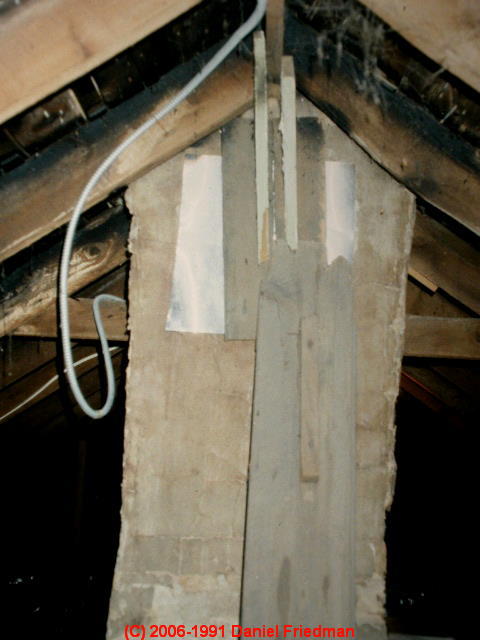
 Indoor Chimney Inspection Checklist

- POST a QUESTION or COMMENT about procedures for the inspection of chimneys for unsafe conditions, damage, or structural problems.
How to inspect chimneys for safety or structural damage issues - a checklist:
This article provides a Detailed Chimney Inspection Checklist for use when inspecting a building chimney from inside a building.
InspectAPedia tolerates no conflicts of interest. We have no relationship with advertisers, products, or services discussed at this website.
- Daniel Friedman, Publisher/Editor/Author - See WHO ARE WE?
Detailed Indoors Chimney Inspection Checklist
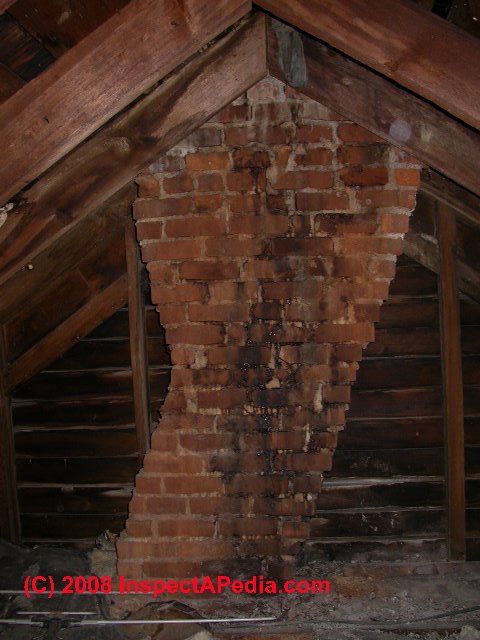
Inside Chimney Defect Observations
Here is a chimney inspection checklist built from multiple contributors. Contact Us if you have corrections or additions for this chimney inspection checklist.
Watch out: no checklist can be complete, and you should never rely only on a checklist to perform a building inspection.
A checklist is useful to help avoid forgetting certain key steps, but it is always possible that other defects are present that are not on your checklist. Readers of this outdoor chimney inspection checklist should be sure to review the illustrated chimney defect and inspection procedures at CHIMNEY INSPECTION INDOORS.
These articles on chimneys and chimney safety provide detailed suggestions describing how to perform a thorough visual inspection of chimneys for safety and other defects. Chimney inspection methods and chimney repair methods are also discussed.
We list these observations in a order (not the only possible order) that might be followed by a visual inspection beginning outdoors and continuing indoors throughout the building, basement to attic, and including appliances or devices that vent through a chimney.
Responsibility of an Home Inspectors Regarding Chimney Inspections
The ASHI Standards and most other home inspection standards (CREIA TAREI FABI etc) require reporting on the exterior condition of a chimney, the cap, the flue, the roof flashings and the vent connectors from the appliances.
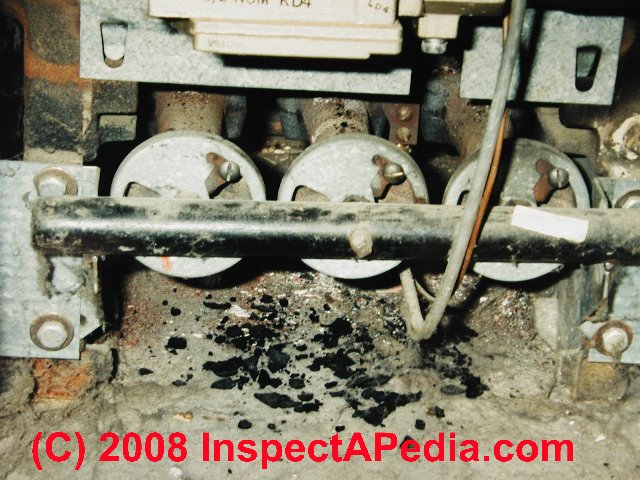
Some indoor clues (photo at left) might indicate such serious safety hazards (blocked flue, carbon monoxide poisoning) as to deserve immediate professional attention and appropriate warnings to building occupants.
This basic visual inspection can be expanded to provide a more complete understanding of the components with concurrent recommendations to the client for the necessary repairs.
The chimney inspectionlinks listed at the ARTICLE INDEX the bottom of this article provide an encyclopedia of chimney functional and safety defects.
A starting-point indoor check list for a chimney inspection includes the following items:
| Chimney Inspection Checklist - Indoor Observations | |||
|---|---|---|---|
| Item # | 34 Indoor Inspection Points for Chimney Concerns or Defects© Copyright 2017 InspectApedia.com, All Rights Reserved. Author Daniel Friedman. |
Location on Building | Comments |
Building ID & Location: __________________________________________ Date & Time: _________________________________________________ Inspector: ____________________________________________________ |
|||
| 1 | Exterior chimney surface materials examined indoors for signs of leaks, cracks, damage, improperly sealed openings. | CHIMNEY CRACK DETECTION & DIAGNOSIS CHIMNEY COLLAPSE RISKS, REPAIRS |
|
| 2 | Chimney Cap & top seal - if missing, leaky, or damaged, you may have spotted this from outside; inside you may see leak stains and brown or black bleed-through marks on the chimney, or bubbled, damaged plaster or drywall covering the chimney | ||
| 3 | Attic observation: Chimney construction on excessive angle (more than 30 deg) (typically viewed inside an attic) | ||
| 4 | Chimney cleanout not provided | CHIMNEY CLEANOUT DOORS | |
| 5 | Chimney cleanout door missing, ajar, not closed, not openable | ||
| 6 | Chimney cleanout door close to combustibles | ||
| 7 | Chimney flue - view is normally limited unless using professional chimscan type equipment, but views into the chimney from barometric dampers, draft regulators, or cleanouts can indicate chimney damage (such as pieces of chimney liner) or blockage (debris). Look for evidence of shared flues among appliances on different floors or breaks or holes between adjacent flues |
SHARED CHIMNEY & FLUE HAZARDS | |
| 8 | Roof Flashings & leaks around chimneys (very common): inspect inside for leak stains may on chimney sides or on ceilings or even interior walls near an outside wall chimney; also look for leak stains inside fireplaces & in or on heating appliances or their flue vent connectors | ||
| 9 | Chimney materials in attic with careful attention to movement, cracks, leaks, stains, gas and fire hazards | ||
| 10 | Chimney materials & condition in basement with careful attention to movement, cracks, leaks, gas and fire hazards | ||
| 11 | Chimney not continuous through roof (metal flues, fire-rated roof passage thimble) | ||
| 12 | Chimney passages through intermediate building floors: leak stains, indications of prior and improperly sealed chimney openings, fire clearance issues - abandoned vent closures such as where a woodstove or coal stove was previously connected to the flue | ||
| 13 | Multiple appliances vented into single flue: too many, inadequate draft, back-drafting, CO hazards, operating defects | ||
| 14 | Chimney flue vent connectors to heating appliances: rust, holes, leaks |
FLUE VENT CONNECTORS, HEATING EQUIPMENT | |
| 15 | Chimney flue vent connector has improper slope (wrong direction) | METAL CHIMNEY SLOPE LIMITS | |
| 16 | Chimney flue vent connector is too long | ||
| 17 | Chimney flue vent connector enters a dead end flue | ||
| 18 | Flue vent connector not sealed at point of entry into chimney | ||
| 19 | Flue vent connector or thimble extending too far into chimney interior (disassembly or inspection through draft regulator may be required) | ||
| 20 | Clearance to combustibles especially at flue vent connectors and with metal chimneys |
||
| 21 | Chimney flue conditions: mirror view inside flue when possible, via openings listed above | ||
| 22 | Dead end flue, high risk of blockage | ||
| 23 | Inspect heating systems for evidence of inadequate combustion air such as soot on or around gas-fired equipment (photo above) WARNING: this is a very dangerous sign and merits immediate attention to avoid potentially fatal carbon monoxide poisoning. |
||
| 24 | Combustible clearances inadequate - between metal or other flues and nearby combustibles; | ||
| 25 | Fire stopping missing or inadequate (often not visible) | ||
| 26 | Metal flue not rated for application - wrong flue type | ||
| 27 | Metal flue sections loose | ||
| 28 | Metal flue sections connected in wrong order (water leaks) | ||
| 29 | Transite (cement asbestos chimneys & flues | TRANSITE PIPE CHIMNEYS & FLUES | |
| 30 | Evidence of abandoned chimneys, incomplete removal, collapse hazards, even hazards of attempted re-use | ||
| 31 | Three-sided chimneys: draft & performance issues | Three-Sided Chimneys: Problems | |
| 32 | Chimney & Fireplace Labels: all parts of a factory-built fireplace or chimney system (except in some jursidictions locally-made covers) must bear labels identifying the parts as listed for use with the fireplace model installed in the building. Examples of labeling issues and even counterfeit labels are cited at right. | CHIMNEY SHROUD, Decorative | |
| 33 | Chimney & Fireplace Installation: all parts of a factory-built chimney must be installed according to instructions provided by the manufacturer and no parts can be damaged to an extent that would impair the function of that part. | ||
| 34 |
Additional fireplace safety inspection details are provided at right |
||
| Notes: | |||
Appropriate repairs are recommended based upon the items presented in this article series. T
he inspector has to be very careful about how he/she states the reason for the recommendation since home inspectors are seldom code authorities or trades people and do not want to open the door to a liability action if an improper or delayed repair is made. But failure to state a reason for a needed repair risks that the building owner, occupant, buyer may fail to recognize an unsafe condition.
...
Continue reading at CHIMNEY SHROUDS or select a topic from the closely-related articles below, or see the complete ARTICLE INDEX.
Or see these
Recommended Articles
- CHIMNEY INSPECTION DIAGNOSIS REPAIR - home
- CHIMNEY FLUE INSPECTION CAMERA
- CHIMNEY INSPECTION CHECKLIST
- CHIMNEY INSPECTION, FLUE INTERIOR
- CHIMNEY INSPECTION from GROUND
- CHIMNEY INSPECTION INDOORS
- CHIMNEY INSPECTION OUTDOORS
- CHIMNEY INSPECTION at ROOFTOP
- CHIMNEY TOP MASONRY DAMAGE
- INACCESSIBLE CONNECTIONS FIREPLACE, WOODSTOVE
- UNLINED FLUE INSPECTIONS
Suggested citation for this web page
CHIMNEY INSPECTION INDOORS at InspectApedia.com - online encyclopedia of building & environmental inspection, testing, diagnosis, repair, & problem prevention advice.
Or see this
INDEX to RELATED ARTICLES: ARTICLE INDEX to CHIMNEYS & FLUES
Or use the SEARCH BOX found below to Ask a Question or Search InspectApedia
Ask a Question or Search InspectApedia
Share this article:Questions & answers or comments about procedures for the inspection of chimneys for unsafe conditions, damage, or structural problems. .
Search the InspectApedia website
Need to make a private comment? Email editor@inspectApedia.com. We welcome email with your website content critique, corrections, suggestions or questions. Email is monitored daily but our workload may prevent an immediate reply. For immediate results, we hope you'll first try asking your question using the search box just above.
Citations & References
In addition to any citations in the article above, a full list is available on request.
- NFPA 211: Standard for Chimneys, Fireplaces, Vents, and Solid Fuel-Burning Appliances, (2024) at the NFPA Bookstore, (Older NFPA editions and standards are found at the same bookstore)
- NFPA #211-3.1 1988 - Specific to chimneys, fireplaces, vents and solid fuel burning appliances.
- NFPA # 54-7.1 1992 - Specific to venting of equipment with fan-assisted combustion systems.
- GAMA, VENTING TABLES, CATGORY I CENTRAL FURNACES [PDF] (1990 & 2000) Gas Appliance Manufacturers' Association,, includes also fan-assisted combustion system central furnaces.
SPECIAL METAL-FAB UPDATE AS OF MARCH 2000 The venting tables within this booklet have now been included in the National Fuel Gas Code (NFPA 54/ANSI Z223.1-1999). That code may also be used to size venting systems for drafthood equipped central furnaces or for fan-assisted combustion system central furnaces.
This booklet contains new venting tables designed specifically for use with Category I central furnaces.
These tables are unique, in that, industry wide venting tables now exist for fan-assisted combustion system central furnaces. Venting tables for these types of appliances are not contained in the National Fuel Gas Code (NFPA 54/ANSI Z223.1-1988).
All requirements contained in this booklet apply to both Category I drafthood equipped central furnaces as well as fan-assisted combustion system central furnaces. At no time should a venting system for a listed Category II, III, or IV central furnace be sized with these tables.
The National Fuel Gas Code (NFPA 54/ANSI Z223.1-1988) may also be used to size venting systems for drafthood equipped central furnaces.
However, at this time, the National Fuel Gas Code does not include alternate sizing methods for fan-assisted combustion systems.
Therefore, until engineering data is developed to allow alternate sizing methods for Category I fanassisted central furnaces, the enclosed venting tables must be used for fan-assisted combustion system central furnaces.
These tables apply to venting single appliances and common venting multiple appliances in both metal and masonry chimneys. - National Fuel Gas Code, an American National Standard, 4th ed. 1988 (newer edition is available) Secretariats, American Gas Association (AGA), 1515 Wilson Blvd., Arlington VA22209, and National Fire Protection Association (NFPA), Batterymarch Park, Quincy MA 02269. ANSI Z223.1-1988 - NFPA 54-1988. WARNING: be sure to check clearances and other safety guidelines in the latest edition of these standards.
- ICC, Fire Inspector Guide Based on the 2021 International Fire Code [ICC Digital Subscription] International Code Council
- Uniform Mechanical Code - UMC 1991, Sec 913 (a.) Masonry Chimneys, refers to Chapters 23, 29, and 37 of the Building Code.
- New York 1984 Uniform Fire Prevention and Building Code, Article 10, Heating, Ventilating, and Air Conditioning Requirements
- New York 1979 Uniform Fire Prevention & Building Code, The "requirement" for 8" of solid masonry OR for use of a flue liner was listed in the One and Two Family Dwelling Code for New York, in 1979, in Chapter 9, Chimneys and Fireplaces, New York 1979 Building and Fire Prevention Code:
- "Top Ten Chimney (and related) Problems Encountered by One Chimney Sweep," Hudson Valley ASHI education seminar, 3 January 2000, contributed by Bob Hansen, ASHI
- Chimney Inspection Checklist, Carson Dunlop, Associates, Toronto, Ontario
- Costello, Martine & Josh Kovner, "Rooftop View Turns to Darkness," New Haven Register, 12 May 1992 p. 11:
Excerpt:
Catherine Murphy was sunning on a building roof when a chimney collapsed; she fell into and was trapped inside the chimney until rescued by emergency workers. - "Chimneys and Vents," Mark J. Reinmiller, P.E., ASHI Technical Journal, Vol. 1 No. 2 July 1991 p. 34-38.
- "Chimney Inspection Procedures & Codes," Donald V. Cohen was to be published in the first volume of the 1994 ASHI Technical Journal by D. Friedman, then editor/publisher of that publication, but the production of the ASHI Technical Journal was cancelled by ASHI President Patrick Porzio.
Some of the content of Mr. Cohen's original submission has been included in this more complete chimney inspection article:
CHIMNEY INSPECTION DIAGNOSIS REPAIR - Natural Gas Weekly Update: http://tonto.eia.doe.gov/oog/info/ngw/ngupdate.asp Official Energy Statistics from the U.S. Government
- US Energy Administration: Electrical Energy Costs http://www.eia.doe.gov/fuelelectric.html
- Ceramic Roofware, Hans Van Lemmen, Shire Library, 2008, ISBN-13: 978-0747805694 - Brick chimneys, chimney-pots and roof and ridge tiles have been a feature of the roofs of a wide range of buildings since the late Middle Ages. In the first instance this ceramic roofware was functional - to make the roof weatherproof and to provide an outlet for smoke - but it could also be very decorative. The practical and ornamental aspects of ceramic roofware can still be seen throughout Britain, particularly on buildings of the Victorian and Edwardian periods. Not only do these often have ornate chimneys and roof tiles but they may also feature ornamental sculptures or highly decorative gable ends. This book charts the history of ceramic roofware from the Middle Ages to the present day, highlighting both practical and decorative applications, and giving information about manufacturers and on the styles and techniques of production and decoration. Hans van Lemmen is an established author on the history of tiles and has lectured on the subject in Britain and elsewhere. He is founder member and presently publications editor of the British Tiles and Architectural Ceramics Society.
- Chimney Inspection Checklist, Carson Dunlop, Associates, Toronto, Ontario
- Chimney & Stack Inspection Guidelines, American Society of Civil Engineers, 2003 - These guidelines address the inspection of chimneys and stacks. Each guideline assists owners in determining what level of inspection is appropriate to a particular chimney and provides common criteria so that all parties involved have a clear understanding of the scope of the inspection and the end product required. Each chimney or stack is a unique structure, subject to both aggressive operating and natural environments, and degradation over time. Such degradation may be managed via a prudent inspection program followed by maintenance work on any equipment or structure determined to be in need of attention. Sample inspection report specifications, sample field inspection data forms, and an example of a developed plan of a concrete chimney are included in the guidelines. This book provides a valuable guidance tool for chimney and stack inspections and also offers a set of references for these particular inspections.
- Fireplaces, a Practical Design Guide, Jane Gitlin
- Fireplaces, Friend or Foe, Robert D. Mayo
- NFPA 211: Standard for Chimneys, Fireplaces, Vents, and Solid Fuel-Burning Appliances, (2024) at the NFPA Bookstore, (Older NFPA editions and standards are found at the same bookstore)
- Principles of Home Inspection: Chimneys & Wood Heating, in (Principles of Home Inspection), Carson Dunlop, Associates, Toronto, Ontario
- U.S. vs. Canadian Unlined Masonry Chimney Flue Requirements & Case Study
- NFPA 211 - 3-1.10 - Relining guide for chimneys
- NFPA 211 - 3-2 - Construction of Masonry Chimneys
- NFPA 211 - 3-3 - Termination Height for chimneys
- NFPA 211 - 3-4 - Clearance from Combustible Material
- NFPA 54 - 7-1 - Venting of Equipment into chimneys
- Brick Institute of America - Flashing Chimneys
Brick Institute of America - Proper Chimney Crowns
Brick Institute of America - Moisture Resistance of Brick - American Gas Association - New Vent Sizing Tables
- Chimney Safety Institute of America - Chimney Fires: Causes, Effects, Evaluation
- National Chimney Sweep Guild [Website] 1255 SW Prairie Trail Pkwy Ankeny, Iowa 50023 USA, Tel: +1 (317) 837-1500 Email: office@ncsg.org NCSG certifies chimney sweep (cleaning) professionals.
- In addition to citations & references found in this article, see the research citations given at the end of the related articles found at our suggested
CONTINUE READING or RECOMMENDED ARTICLES.
- Carson, Dunlop & Associates Ltd., 120 Carlton Street Suite 407, Toronto ON M5A 4K2. Tel: (416) 964-9415 1-800-268-7070 Email: info@carsondunlop.com. Alan Carson is a past president of ASHI, the American Society of Home Inspectors.
Thanks to Alan Carson and Bob Dunlop, for permission for InspectAPedia to use text excerpts from The HOME REFERENCE BOOK - the Encyclopedia of Homes and to use illustrations from The ILLUSTRATED HOME .
Carson Dunlop Associates provides extensive home inspection education and report writing material. In gratitude we provide links to tsome Carson Dunlop Associates products and services.
 |
HOME | ABOUT | ASK a QUESTION | CONTACT | CONTENT USE POLICY | DESCRIPTION | POLICIES | PRIVACY | |
| © 2026 - 1985 Publisher InspectApedia.com - Daniel Friedman | |||||||||