
InspectAPedia® FREE Encyclopedia of Building & Environmental Construction, Diagnosis, Maintenance & Repair |
Question? Just ask us! InspectAPedia
|
 Frost & Ice Foundation Damage
Frost or Ice Lensing Heaves Up vs. Frozen Soil Horzontal Pressures
- POST a QUESTION or COMMENT about frost heave vs. frozen soil lensing damage and pressures and their effects on footings, foundations & posts or piers
Foundation damage due to frost heaves or ice lensing:
Here we explain the difference between the vertical lift of frost heaves and ice lensing (or frost lenses) and we include details of the construction of a frost-lens-proof structural pier, and we provide data on the amount of soil pressure and expansion exerted by water and freezing.
This article series explains of the the causes of foundation cracks, buckling, or collapse in areas of freezing weather, clay soils, or wet soils.
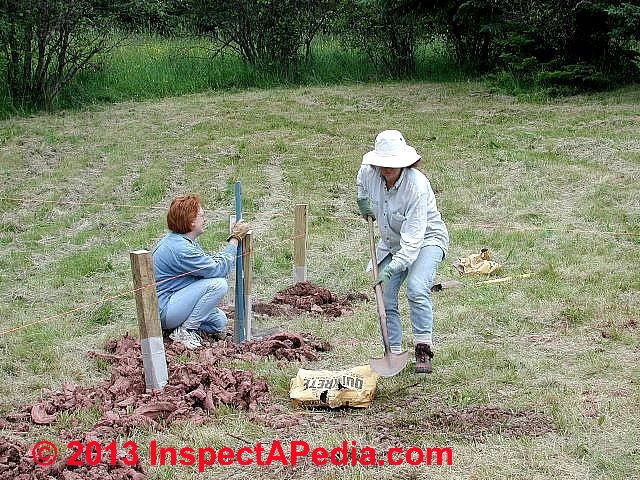
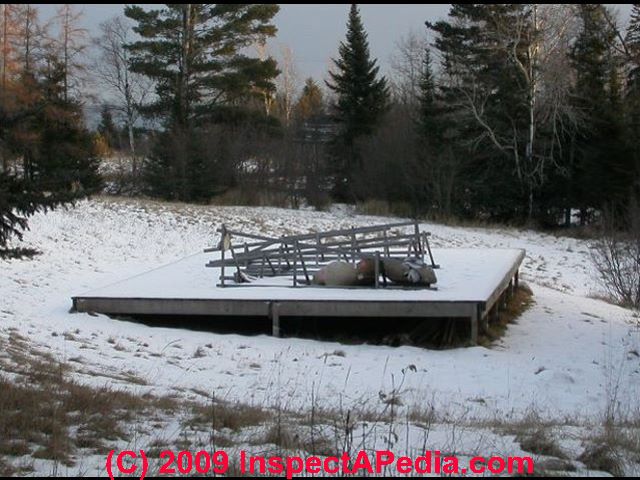
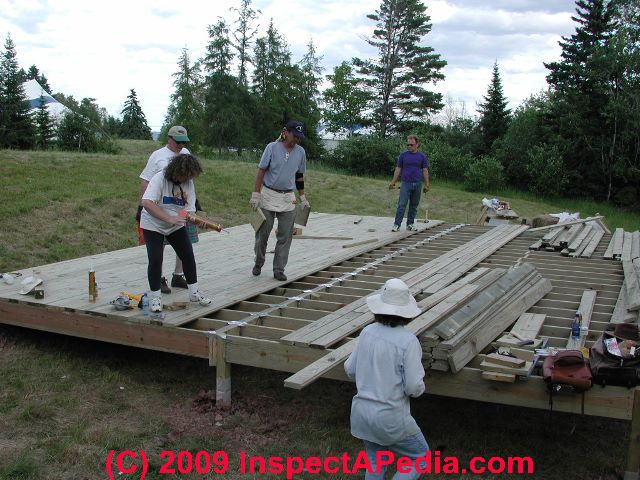
Photo (above) shows a crew constructing a structural pier (in clay soils) that successfully resists ice lens lifting in Two Harbors, Minnesota. Notice that we're wrapping these posts in several layers of 6 mil poly sheeting. The finishded outdoor stage is shown just below with a light winter snow cover.
InspectAPedia tolerates no conflicts of interest. We have no relationship with advertisers, products, or services discussed at this website.
- Daniel Friedman, Publisher/Editor/Author - See WHO ARE WE?
Frost Heaves Compared with Frozen Soil Impacts on Foundations
 Found here: Details of an ice-lens-proof structural pier construction in Minnesota.
Can foundation insulation cause cracked, bulged, or buckled foundation walls?
What is the difference between ice lensing and freezing earth pressure? How much pressure is exerted by wet, freezing soil? How do we prevent foundation damage - key steps.
Some of the information in this article is reprinted/adapted/excerpted with permission from Solar Age Magazine - editor Steven Bliss.
Article Contents
- FOUNDATION DAMAGE by ICE LENSING
- FROST-LENS-PUSH-PROOF STRUCTURAL PIER
- WET, FROZEN SOIL EXPANSION DATA
There are two distinct problems associated with frozen ground and its effects on building foundations: frost heaving and pressures from frozen soils.
Ice Lens Formation & Damage to Foundations
Frost heaving is what makes roads buckle during the winter in many northern states and provinces.
It is caused by small plates of ice called ice lenses that form a foot or more below the surface. Ice lenses draw water from surrounding soil by capillary action, typically growing up to 1/4 inch to 2 inches in thickness and up to several feet across.
Often frost lenses form in multiple layers, adding to the total soil movement in an upwards direction. Ice lenses form in porous silts and also in clays that can support capillary action.
They need extreme cold, combined with a subsurface water source - that water might come from ground water, surface runoff, or even roof runoff around a building.
Roads and sidewalks are good candidates for frost heaves because melted snow provides a good water source as well, and frost can penetrate deeply into the soil because roads and sidewalks are cleared of their insulating snow cover.
Where the direction of heat loss is upwards to grade, ice lenses form horizontally. In these cases, ice lenses push mostly upward, not laterally. Theoretically, a frost heave could lift a building foundation wall or a pier if the soil above the ice lens were frozen to and adhered to the foundation wall or pier surface.
Healy has seen concrete piers for highway sign posts lifted as much as an inch per year by frost heaving, but he has never seen frost do structural damage to foundations.
Where the direction of heat loss is horizontal, as through a retaining wall or the wall of a frozen basement, ice lenses could form in the vertical plane and push laterally.
Constructing a Frost-Lens-Push-Proof Stage for Summerblue Arts Camp in Two Harbors, Minnesota
 Indeed frost lenses or ice lenses can lift a building foundation by adhesion to the foundation sides, especially at a a building corner.
We (DJF) observed this condition at a 1960's home in Poughkeepsie, NY, where a building corner was lifted each winter by freezing wet ground.
Even though the wall's footings were below the frost level, ice lensing against the top few feet of the buried portion of the foundation wall was causing an annual movement problem that cracked the masonry blocks in a stair-step pattern at the building corner, and cracked the drywall in the bedroom above.
The owner dug at the problem corner, found a ground water source, a spring, and cured by installing drainage to remove the water problem.
Soil frozen against a foundation wall or a pier, or ice lenses where there is a lot of ground water, can also pinch and lift piers and posts.
When Lon Church, director of Summer Blue Arts Camp - in Two Harbors, Minnesota, decided in 2001 to construct an outdoor stage platform that would be exposed to both clay soils and very cold weather, we wrapped the platform's piers in several layers of 6-mil polyethylene plastic to reduce the ice grip around each pier, thereby reducing the ability of ice lenses in the freezing soil to lift the piers supporting the stage.
In our deck construction photos (see the center post in both photos above) you can see that we brought the poly well above ground level during construction.
Above you can see the plastic wrap being installed around posts during pier installation in 2001. (The "© 2009" on this photo is from when it was published online. The picture was taken and first © in 2001.)
We discuss this deck post installation job
In our "Summerblue Arts Camp" winter 2009 photo below you can see the same piers, still protected by plastic though the plastic isn't quite visible.
Eight years after construction (in 2009), and after a number of very cold Minnesota winters, we had seen no frost movement in the piers for this outdoor stage. -- DJF.
In the 2009 photo above the front or audience side of the stage is to the left.
We describe the deck board installation for this stage
at DECK FLOOR INSTALLATION TIPS where we show the jig used to force deck boards into position.
More than sixteen years after the original construction, Inspecting this Two Harbors MN Summerblue arts camp stage in October 2017, we found that the posts as originally constructed by the author (Daniel Friedman), the property owner, Lon Church and his crew, had remained in place and the deck surface had remained almost perfectly flat.
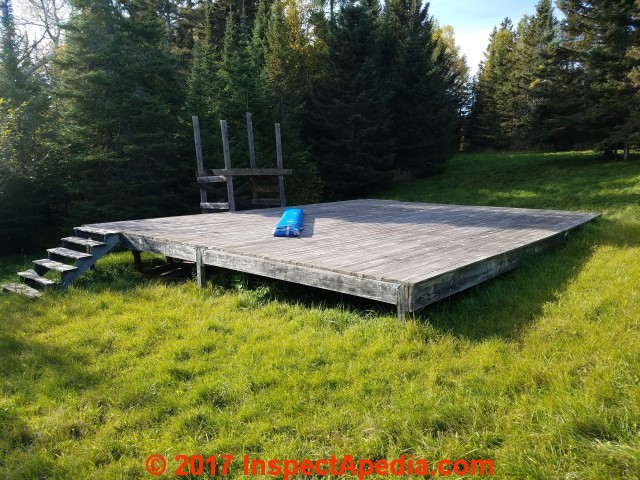
In the photo above (October 2017) you'll note that the stage was constructed with a deliberate but slight slope from back to front, placing the lower edge of the stage closest to the audience - at the right side of the image.
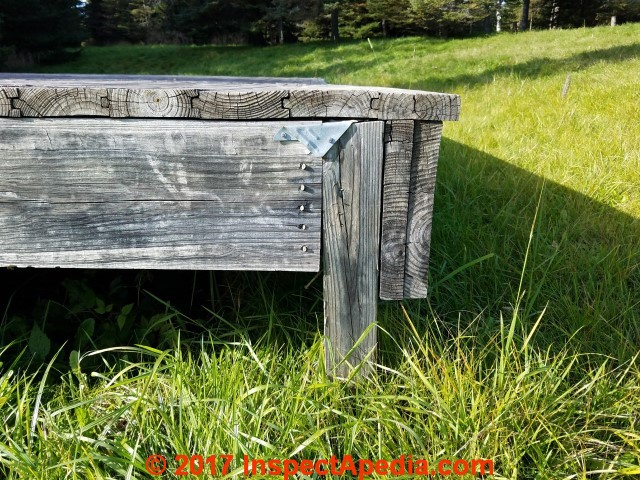
Above: one of the corner posts of the Summerblue stage.
You cannot see the plastic with which we wrapped these posts in 2001, as it remains buried in the clay soil.
But the absence of frost heaving at the stage suggests that these posts have performed well. Below our photo shows the stage in use.
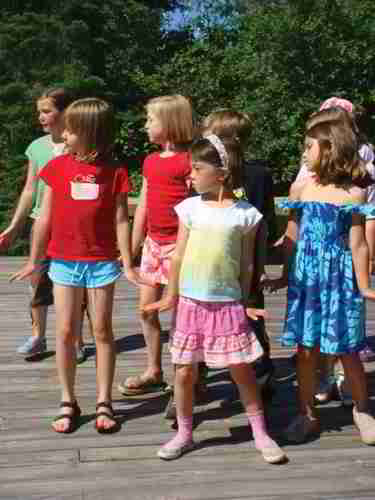
The installation and long term performance of this outdoor performing arts stage floor are described in articles listed at the end of this page.
How Much Does Wet, Frozen Soil Expand to Cause Pressure & Damage to Foundations?
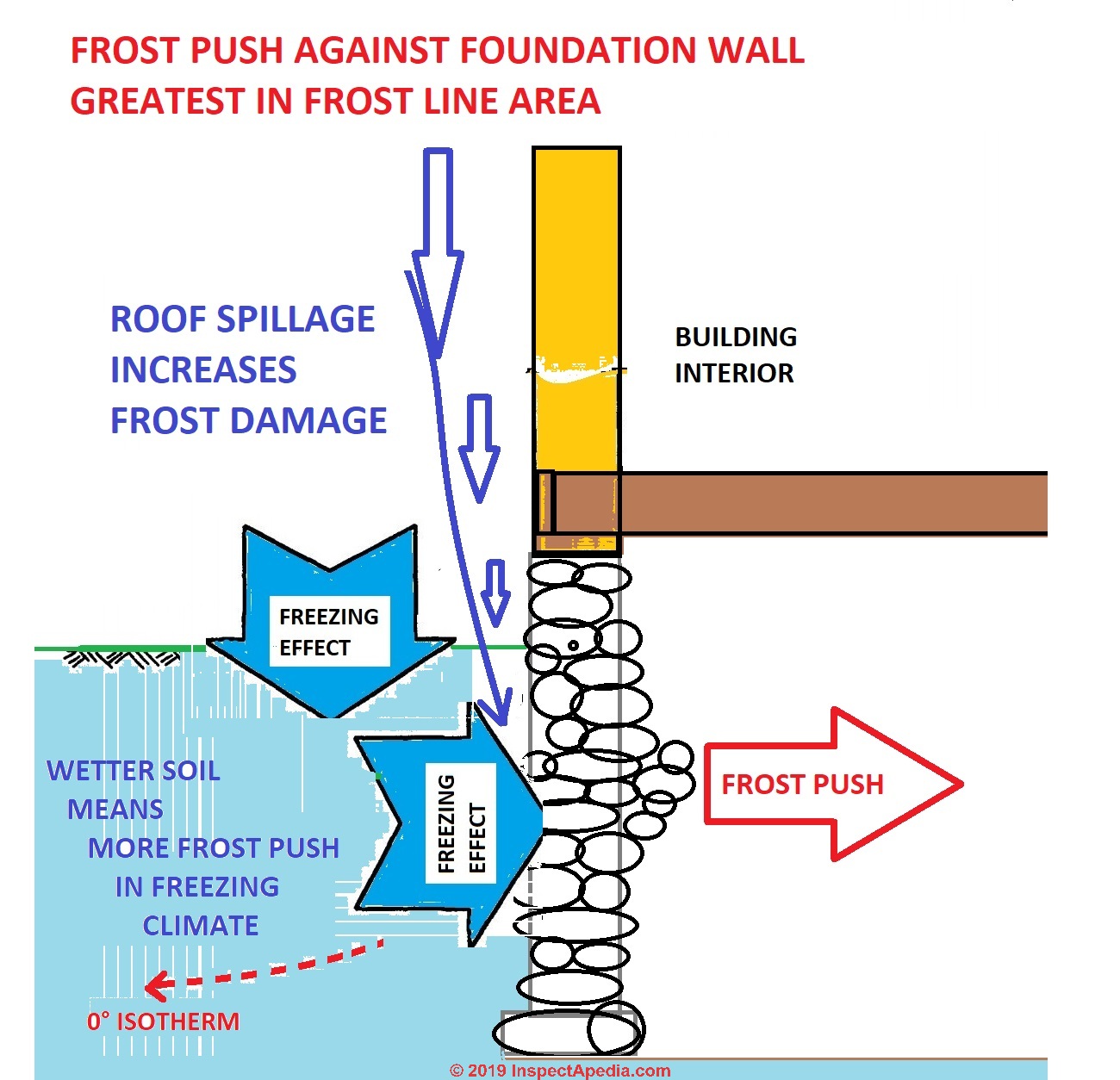
Soil that expands due to freezing is a separate problem from frost heaves or frost lensing.
The necessary ingredients are water-saturated (often clay-containing) soil and continuous freezing temperatures.
Water-saturated soils, where clay is involved, can hold up to two-thirds water by volume, and water expands by 8 percent when it freezes.
So the total volume of soil can expand by as much as 5 percent during freezing conditions.
Unlike ice lenses, this freezing soil expansion exerts force in all directions.
The force exerted by freezing soil against a foundation wall, according to Heley, could be enough to crack the un reinforced walls in Duluth, and we confirm that this phenomenon can occur even further south, to the limits of areas of freezing soils.
At STONE FOUNDATION DEFECTS where we show frost-damaged stone foundation walls we include research on the force exerted by frost-push on foundation walls.
Separtely at FOUNDATION FAILURE by INSULATION we discuss both causes of and claims about preventing foundation damage from frost and ice by using insulation.
Our photo below shows excavation and a new foundation under a home that suffered a catastrophic foundation collapse.
The foundation wall in the right of this photo collapsed inwards into the garage, due to pressure from water-soaked earth that was caused, in turn, by surface runoff from a hill that sloped directly towards the home's rear wall. -- DJF
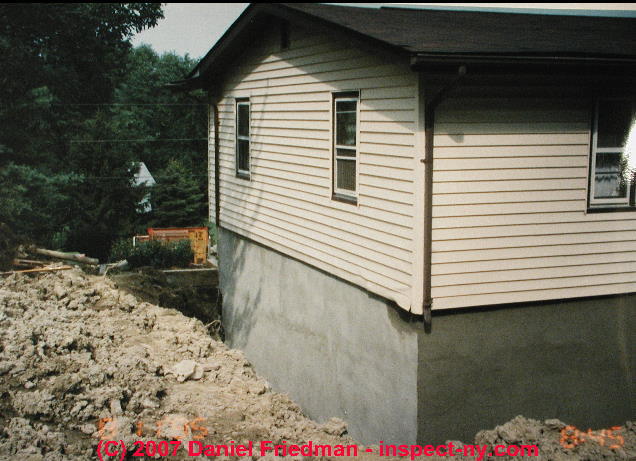
Even if the foundation wall does not cave in, the expanding mass of freezing soil may make a mess of exterior insulation or waterproofing coatings, as was reported in Fargo ND.
As the soil expands, it may drag the exterior insulation or waterproofing foundation membrane with it. For this reason, some builders drape a loose layer of polyethylene plastic over their waterproofing or exterior insulation to act as a slip joint, such as we described for the outdoor stage piers.
Others, like Heley, put foundation insulation on the interior.
Watch out: see FOUNDATION FAILURE by INSULATION - insulation causing foundation buckling or damage
...
Reader Comments, Questions & Answers About The Article Above
Below you will find questions and answers previously posted on this page at its page bottom reader comment box.
Reader Q&A - also see RECOMMENDED ARTICLES & FAQs
Question: can I use flat insulating board angled away from a foundation to prevent ice lensing?
 I was watching a show several years ago that showed a flat insulated board that was laid on an angle away from the foundation to prevent water/ice forming around the foundations in Vermont.
I have been wondering ever since what that material was and if it worked. It was placed at the frost line on a downward slope. Any ideas? - M.M. 8/26/20134
Reply: maybe
1. Buried foam insulation to avoid frost damage?I have some experience with trying to get water away from buildings and with using insulation to avoid several problems:
- frost push, foundation cracking, movement
- frost lensing, foundation is lifted by heaving soils
(Ice Lenses, Frost Heaves vs. Frozen Soil Pressure) - foundation leakage
Along with Steve Bliss we've published some relevant notes on an old debate about whether or not foundation insulation might even cause rather than avoid foundation damage -
see BUCKLED FOUNDATIONS due to INSULATION?
In my experience & OPINION, using solid closed cell foam insulation alone to try to get water away from buildings is ineffective or not cost effective or both; Considering that most foundations are built in a larger-sized excavated hole, backfill around the foundation is less firmly packed than other virgin soil at the same site.A result is that even if soil slopes away from the foundation, water spilling close to it or running close to it from in-slope grade tends to soak down through the soil where there is risk of frost and leak damage to the structure.
A sloped foam insulating pad is not water-tight unless abutting seams are sealed and even then may be too narrow a drain-pad around the building unless extended far enough away to deliver water to the surface at a location where it continues to drain away from the structure, or to deliver water to a buried drainage system well away from the building and continuing to daylight or to a storm drain.So I'm doubtful that a foam insulation apron alone keeps water from running beneath itself and thus towards the structure.
What's left then: well the foam may slow or reduce the freezing of soils close to the building, while still admitting water.2. Foam aprons for frost damage prevention?
I have not inspected a structure with a foam apron at or close to grade, sloping away, that prevented frost or water damage;
3. Geotextile surrounds as part of building waterproofing & ice damage prevention:
I have inspected, and also helped design and install geotextile installations that waterproofed around a building foundation; we used this approach at a metal-roofed converted barn home in Newbugh NY because the owner simply could not keep gutters on the building.
Key was getting roof spillage away from the foundation by a combination of a buried geotextile combination of plastic and fabric matting that sloped at least 10 ft. from the structure, in some locations more, and terminating where water was then drained off of the property;
We backfilled and seeded or sodded over the geotextile installation, maintaining the desired drainage contour; close to the building walls we installed a band of gravel to reduce rain splash-up onto the building walls along the roof drip-line.
...
Continue reading at FOUNDATION FAILURES in CLAY SOIL or select a topic from the closely-related articles below, or see the complete ARTICLE INDEX.
Or see these
Recommended Articles
- BASEMENT HEAT LOSS for a detailed discussion of insulating building foundations.
- BULGED vs. LEANING FOUNDATIONS
- FOUNDATION CRACK DICTIONARY for a discussion of the diagnosis of specific crack patterns in masonry
- FOUNDATION DAMAGE & REPAIR GUIDE - home
- FOUNDATION DAMAGE by ICE LENSING
- FOUNDATION DAMAGE SEVERITY
- FOUNDATION FAILURES in CLAY SOIL
- FOUNDATION FAILURE by INSULATION - insulation causing foundation buckling or damage
- FOUNDATION FAILURES by MOVEMENT TYPE - home
- FROST HEAVES, FOUNDATION, SLAB
- HORIZONTAL MOVEMENT IN FOUNDATIONS
- INSULATION LOCATION - WHERE TO PUT IT - home & separate article series
- POLYSTYRENE FOAM INSULATION for a guide to using this material in below-grade foundation insulation applications.
- SOIL PROPERTIES & BUILDING FAILURES
- STONE FOUNDATION DEFECTS
- STRUCTURAL COLLAPSE HAZARDS
- VERTICAL MOVEMENT IN FOUNDATIONS
Stage / Deck Construction Article Series
- BATTER BOARDS LAYOUT METHOD
- DECK BOARD GAPS & SPACING
- DECK CONSTRUCTION BEST PRACTICES
- DECK FLOOR LAYOUT
- DECK FLOOR INSTALLATION
- DECK FLOOR INSTALLATION TIPS
- DECK JOIST LAYOUT
- DECK JOIST INSTALLATION
- DECK LAYOUT
- SQUARE PLUMB & LEVEL A STRUCTURE
- DECK POST CONSTRUCTION
- FOUNDATION DAMAGE by ICE LENSING includes a review of the long term performance of this outdoor stage structure
Suggested citation for this web page
FOUNDATION DAMAGE by ICE LENSING at InspectApedia.com - online encyclopedia of building & environmental inspection, testing, diagnosis, repair, & problem prevention advice.
Or see this
INDEX to RELATED ARTICLES: ARTICLE INDEX to BUILDING INSULATION
Or use the SEARCH BOX found below to Ask a Question or Search InspectApedia
Ask a Question or Search InspectApedia
Try the search box just below, or if you prefer, post a question or comment in the Comments box below and we will respond promptly.
Search the InspectApedia website
Note: appearance of your Comment below may be delayed: if your comment contains an image, photograph, web link, or text that looks to the software as if it might be a web link, your posting will appear after it has been approved by a moderator. Apologies for the delay.
Only one image can be added per comment but you can post as many comments, and therefore images, as you like.
You will not receive a notification when a response to your question has been posted.
Please bookmark this page to make it easy for you to check back for our response.
IF above you see "Comment Form is loading comments..." then COMMENT BOX - countable.ca / bawkbox.com IS NOT WORKING.
In any case you are welcome to send an email directly to us at InspectApedia.com at editor@inspectApedia.com
We'll reply to you directly. Please help us help you by noting, in your email, the URL of the InspectApedia page where you wanted to comment.
Citations & References
In addition to any citations in the article above, a full list is available on request.
- Solar Age Magazine was the official publication of the American Solar Energy Society. The contemporary solar energy magazine associated with the Society is Solar Today. "Established in 1954, the nonprofit American Solar Energy Society (ASES) is the nation's leading association of solar professionals & advocates. Our mission is to inspire an era of energy innovation and speed the transition to a sustainable energy economy. We advance education, research and policy. Leading for more than 50 years. ASES leads national efforts to increase the use of solar energy, energy efficiency and other sustainable technologies in the U.S. We publish the award-winning SOLAR TODAY magazine, organize and present the ASES National Solar Conference and lead the ASES National Solar Tour – the largest grassroots solar event in the world."
- Steve Bliss's Building Advisor at buildingadvisor.com helps homeowners & contractors plan & complete successful building & remodeling projects: buying land, site work, building design, cost estimating, materials & components, & project management through complete construction. Email: info@buildingadvisor.com
Steven Bliss served as editorial director and co-publisher of The Journal of Light Construction for 16 years and previously as building technology editor for Progressive Builder and Solar Age magazines. He worked in the building trades as a carpenter and design/build contractor for more than ten years and holds a masters degree from the Harvard Graduate School of Education. Excerpts from his recent book, Best Practices Guide to Residential Construction, Wiley (November 18, 2005) ISBN-10: 0471648361, ISBN-13: 978-0471648369, appear throughout this website, with permission and courtesy of Wiley & Sons. Best Practices Guide is available from the publisher, J. Wiley & Sons, and also at Amazon.com - Summerblue Arts Camp., Two Harbors MN, Lon Church, Director, c/o: Two Harbors High School 405 4Th Avenue, Two Harbors, Minnesota 55616, United States Email: lon_church@yahoo.com
- In addition to citations & references found in this article, see the research citations given at the end of the related articles found at our suggested
CONTINUE READING or RECOMMENDED ARTICLES.
- Carson, Dunlop & Associates Ltd., 120 Carlton Street Suite 407, Toronto ON M5A 4K2. Tel: (416) 964-9415 1-800-268-7070 Email: info@carsondunlop.com. Alan Carson is a past president of ASHI, the American Society of Home Inspectors.
Thanks to Alan Carson and Bob Dunlop, for permission for InspectAPedia to use text excerpts from The HOME REFERENCE BOOK - the Encyclopedia of Homes and to use illustrations from The ILLUSTRATED HOME .
Carson Dunlop Associates provides extensive home inspection education and report writing material. In gratitude we provide links to tsome Carson Dunlop Associates products and services.
 | HOME | ABOUT | ASK a QUESTION | CONTACT | CONTENT USE POLICY | DESCRIPTION | POLICIES | PRIVACY | |
| © 2025 - 1985 Publisher InspectApedia.com - Daniel Friedman | |||||||||