 Water Tank Air Pressure Adjustment Q&A
Index
Water Tank Air Pressure Adjustment Q&A
Index
- POST a QUESTION or COMMENT about setting the air precharge pressure in internal-bladder type water pressure tanks
Index to all water pressure tank air pressure or bladder pressure adjustment questions and answers.
This article series describes how to determine the proper air pressure setting in a bladder-type well tank, when, and how to actually change the air pressure in the water tank.
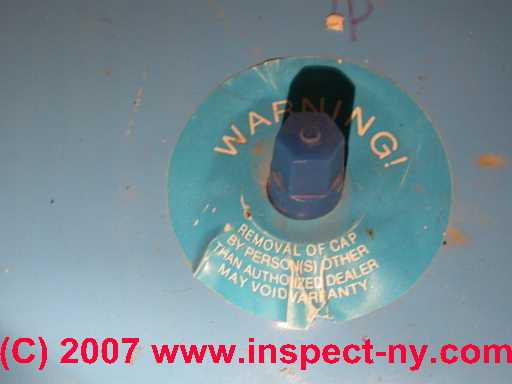
The page top photo shows a typical air valve found on a bladder type water pressure tank.
InspectAPedia tolerates no conflicts of interest. We have no relationship with advertisers, products, or services discussed at this website.
- Daniel Friedman, Publisher/Editor/Author - See WHO ARE WE?
Air Pressure Setting for a Bladder-Type Well Tank - Q&A
These questions and answers about how to set the air pre-charge pressure in a water pressure tank were posted originally
at WATER TANK AIR PRESSURE ADJUSTMENT - be sure to review that procedure.
Watch out: for very high water pressure readings in your system. If the water pressure is over 70 or 80 psi your system there can be a risk of burst water pipiong or a burst water pressure tank.
Such an event can both flood the building and can injure anyone nearby. Check the maximum water pressure you're using against the maximum water pressure rating for the pressure tank itself.
That's why your water supply system should have a WATER TANK PRESSURE RELIEF VALVE (separate article).
Also see WATER TANK INSTALL, DIAGNOSE, REPAIR FAQs INDEX - our index to all questions & answers about diagnosing and fixing water pressure tank problems.
Article Index
- ADD AIR to a BURIED WATER PRESSURE TANK - ideas on how
- ADD AIR to a WATER TANK - OTHER METHODS - what if there's no air valve?
- ADJUST the AIR CHARGE if you CHANGE the PUMP CONTROL SWITCH CUT-IN PRESSURE
- AIR CHARGE LEAK / LOSS in BLADDER TANKS
- AIR CHARGE TOO LOW in PRESSURE TANK
- AIR CHARGE TOO HIGH in PRESSURE TANK - how to let air out
- AIR LEAKS OUT of the PRESSURE TANK - signs of air leaks
- AIR PRE-CHARGE PRESSURE CORRECT?
- AIR PRESSURE CREEPS UP in BLADDER TANK - and now pump won't turn on (pressure never falls down to the the low CUT-IN pressure)
- AIR PRESSURE SETTING in a NEW WATER TANK - when do I add air and water to the bladder type water tank?
- AIR PRESSURE IS ZERO in BLADDER TYPE PRESSURE TANK
- AIR VOLUME CONTROL DIAGNOSTIC FAQs
- BLADDER TYPE PRESSURE TANK SHOWS ZERO AIR PRESSURE
- CAN'T GET AIR INTO THE PRESSURE TANK
- CAUSE of ABNORMALLY HIGH WATER PRESSURE - at the water tank
- DOES WATER TANK SIZE AFFECT THE AIR PRESSURE SETTING?
- DRAIN a WATER TANK WITHOUT a DRAIN VALVE - to get an air charge into the tank
- DRAW DOWN WATER QUANTITY TOO SMALL - fix at the pressure control switch, pump runs too soon
- ELIMINATE THE WATER PRESSURE TANK COMPLETELY?
- HOW MUCH AIR SHOULD BE IN THE WATER PRESSURE TANK?
- INCONSISTENT PRESSURE SWITCH OPERATION vs AIR CHARGE PRESSURE
- INCREASE WATER PRESSURE by INCREASING WATER TANK AIR PRESSURE?
- INCREASE WATER TANK PRESSURE TO GET WATER TO HIGHER FLOORS?
- IS THE AIR PRE-CHARGE PRESSURE CORRECT?
- PUMP RUNS WHEN WE'RE NOT USING WATER: IS IT AN AIR CHARGE ISSUE?
- PUMP TURNS ON IMMEDIATELY WHEN WE RUN WATER - no air charge in the tank
- TANK AIR & WATER PRESSURE READING ACCURACY - measuring at the water tank air valve compared with measuring at the water tank pressure gauge
- TANK PRESSURE GOES ABOVE the AIR PRE-CHARGE - what are normal operating pressures for a bladder type water pressure tank?
- WATER LEAKS OUT AT THE AIR VALVE - water comes out at the Schrader Valve
- WATER TANK AIR LEAK INDICATIONS - signs of air leaks at the tank or at its air valve
- WATER TANK AIR LEAKS OUT - air charge gets lost
- WATER TANK AIR VALVE REPAIR or REPLACEMENT FAQs - if the air valve is leaky or damaged
- WATER WON'T GO IN - EMPTY WATER TANK DIAGNOSIS - water won't go into the water tank, stuck bladder?
- WRONG WATER TANK AIR CHARGE CAUSES LOSS of PUMP PRIME?
...
What's the Proper Air Charge for a Water Tank?
How much pressure should be in the bladder tank for my water system?
 I would like to know how much pressure should be in bladder tank? 2016/04/18 myra
What should normal setting be on pump switch and comparative pressure in the water tank bladder? 2016/04/19 ray JetPump1Line028DJFs.jpg
Reply:
Sure Myra,
WATER TANK AIR PRESSURE ADJUSTMENT states
Set the air pressure in the empty water tank to 2 psi below the well pump pressure switch cut-in pressure.
For example, if your well pump pressure control switch is set to "CUT-IN" (start pumping water from the well) at 40 psi, then set the pressure tank to (40 - 2) = 38 psi.
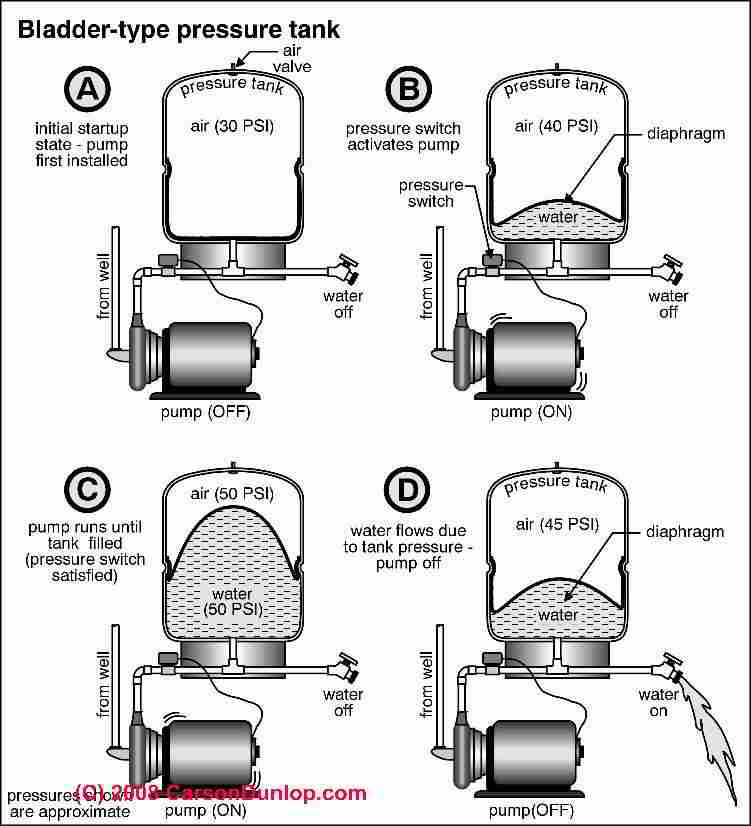
Our example, adapted and edited from Carson Dunlop's original (used with permission thanks to Al Carson), shows that we set the empty water pressure tank air pre-charge to 38 psi when a 40/60 pressure control switch is used.
Ray,
On most (not all) bladder type water pressure tanks, the "bladder" is a rubber container in the tank that holds water (not air) and the air is in the steel tank above the bladder.
WATER TANK AIR PRESSURE ADJUSTMENT tells us
- Set the air pressure in the empty water tank to 2 psi below the well pump pressure switch cut-in pressure.
- Bleed air pressure out of the water tank, or add air pressure into the water tank, until the tank pressure.
- For example, if your well pump pressure control switch is set to CUT-IN (start pumping water from the well) at 30 psi, then set the pressure tank air precharge (when the tank is empty) to (30 - 2) = 28 psi.
How much air can I put into the pressure tank and what does it mean to say set the pressure to 2 psi blow the pump start-up pressure?
How much air can be put in tank and what's it mean when it says be certain the air pressure in tank is 2 psi below pump start up pressure? On 2017-11-15 by Ed Wilson
by (mod) - how to add the right amount air to the water pressure tank: 2 psi below the switch CUT-IN pressure
Ed
By "how much air" we don't really mean a specific volume of air; rather it's the air pressure that you shoud be setting in an empty water pressure tank, regardless of the actual tank's physical size or volume.
We can see the pressure in the tank at the water pressure gauge if one is mounted right on the pressure tank, or we can measure the air pressure in the tank using a simple tire pressure gauge.
Photo: I'm holding a little digital tire pressure gauge onto the Shrader air valve on a water pressure tank.
For a bladderless water tank, turn off the pump, drain all pressure from the system, empty the tank - so it will be at atmosphereic pressure (14.6 psi if you're at sea level and that will read zero on the water pressure gauge)
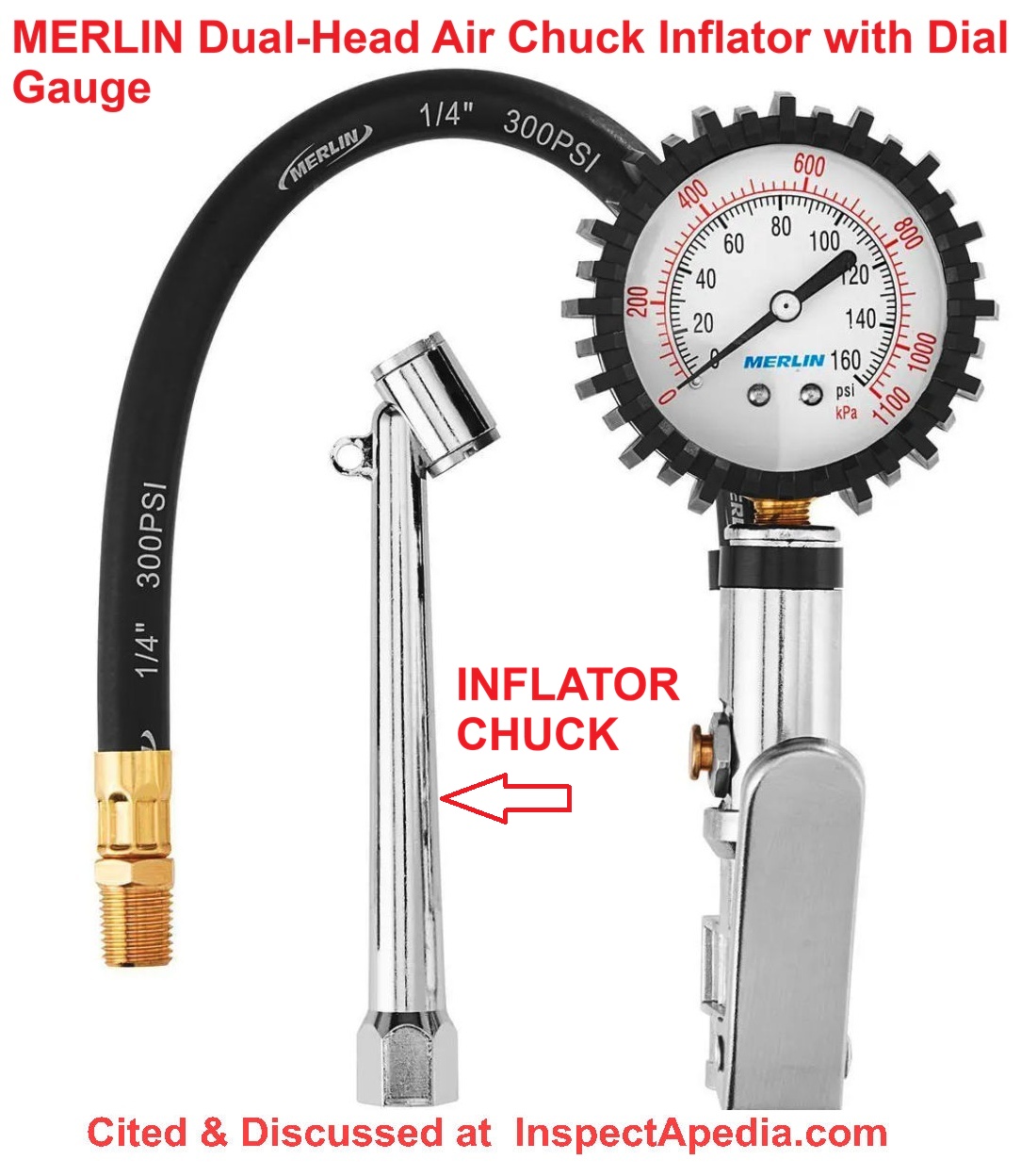
For a tank uthat uses an internal bladder, with pressure drained from the system, the tank's air precharge pressure is set to 2 psi below the CUT IN pressure on the pump pressure control switch.We add air by using a bicycle tire pump or a container of compressed air or a small utility air pump that includes an air hose and air chuck.
A typical well pump pressure control switch, out of the box, will be called a 20/40 psi switch
That means that the switch is adjusted at the factory to turn the pump ON when the water system pressure falls to 20 psi) and the pump will keep running until the switch senses that water pressure has increased up to 40 psi.
Other pressure control switches run at a higher pressure range like 30/50, turning the pump on at 30 and off at 50 psi. And pretty much all of these switches can be adjusted to set the switch pressures higher or lower.
Watch out, though: if you set the CUT-OUT pressure too high the pump may be unable to reach that pressure (due to pump design limits) and the pump will simply run continuously - risking damaging the pump.
Watch out, also to never set the water pressure so high that it's dangerous or risks leaks. A CUT-OUT pressure over 70 psi is in my opinion unsafe, risking plumbing leaks. At very high pressures there's also a risk of a burst pressure tank that can injure or kill someone nearby (that happened to a plumber in New Paltz, New York - he was killed) or can burst a pipe and flood the building.
So if your water pump turns on when the pressure falls to 20 psi, then the tank's air pre charge will be set to 18 psi.If your pressure switch Cuts in at 30 PSI then set the air recharge to 28 PSI.
Details are at WATER TANK AIR PRESSURE ADJUSTMENT
Below: a Merlin air chuck and pressure gauge and inflator kit that sells for $15. U.S. (air pressure source not included).
What's the relationship between water pressure tank air pre-charge pressure setting and the pressure control switch settings
I don't understand the relationship of the pressure tank setting ex. 20psi. & the control switch 30/50 psi. What is pressure is the control reading to cut in or out?
The pressure tank? Will the pressure in the house be controlled only by the tank setting & it should be constant pressure whether the pump. S running or not? Thanks. Harry (June 7, 2015) Harry
Reply: the air pre-charge must always be a bit below the pressure control CUT-IN pressure. We use 2 psi.
Harry: a 30/50 psi pressure control switch turns the pump on when pressure in the system - sensed by the switch - falls to or below 30 psi and turns the pump off when pressure reaches 50 psi.
Typically we set the air pre-charge in the pressure tank to 2 psi below the cut-in pressure setting.
That air pre-charge pushes water out of the pressure tank when you open a tap so that the pump doesn't have to cycle on immediately (as it would without the air because water is not very compressible: water pressure would fall immediately whenever you opened any tap).
Once the pressure falls to the CUT-IN pressure the pump turns on and runs until it reaches the CUT-OFF pressure.
When you stop using water and the pump adds water until the tank pressure reaches 50 psi and the pumps stops, both the air and the water are sitting at 50 psi.
Watch out: if you set the water tank air pressure too close to or above the CUT-IN pressure then you'll have no water and the pump won't turn on.
Tell me why the air pressure goes up in the water tank after the pump runs
I have model V60 Gould water tank. Water psi 40/60 air pre-charge pressure has been set at 38 psi.
After pump runs the air pressure goes up two 55 psi. Why? (Apr 12, 2016) Dale Martin
Reply: here's the probable cause: a malfunctioning pressure gauge
Dale:
Remember that the air pressure AND the water pressure in the same individual water tank will always be the same. They are both in the same container so they will both be at the same pressure.
For a pressure control switch set at 40/60 the pump should turn ON at 40 psi (or below) and should turn OFF at 60 psi. The gauges and switch are not lab grade absolutely precise but the pressure gauge should be reading close to those numbers.
So if you really mean that AFTER THE PUMP STOPS the tank pressure reading at the pressure gauge continues to increase, I can guess that the pressure gauge may be partly debris clogged, causing it to delay in reading actual pressure. - Daniel
...
Water Tank Size vs Air Charge Pressure
Does the water tank size affect the air pre-charge pressure setting?
What should the standard air pressure be in a 20 gallon water holding tank? On 2021-11-25 by David
by Inspectapedia Com Moderator - no
@David,
Pressure is not determined by the pressure tank, but rather by your pressure control switch that turns your pump on and off.
From the factory typical residential water pump pressure control switches turn on at 20 or 30 PSI and turn off at 40 or 50 psi.
When installing a new water pressure tank or adjusting an existing one, the tank's pressure, with the water pump turned off and no water pressure in the system, is set to 2 PSI below the pressure control switch cut in pressure, for example 18 PSI or 28 PSI.
...
Inconsistent or Inaccurate Pressure Control Switch Operation
How can changing the air-pressure of the tank pre-charge change the pressure setting of the cut-in switch.
We've just had a new pressure tank installed at our off-grid home and have encountered some puzzling behavior.
Our well pump is run by a gasoline-powered generator that we only use when we need to pump water from our deep well. The original system was installed in 1989 and, when the old pressure tank stopped working, we purchased a new Water Worker 62 gallon bladder tank (HT62B).
The system is set up for 60/40psi operation and with the old tank we could draw water all the way until the tank was empty before refilling it, if we chose to do so.
We hired a licensed plumber with experience in deep well systems to install the new tank. The new tank was supposed to have a pre-charge pressure of 38psi.
All went normally with the first tank filling. The water pressure gauge rose steadily from zero to 58psi, at which point the cut-out switch disconnected power to the pump.
As the well system had not been used in some time, I wanted to run a few tanks of water through it before collecting a sample for the county health department. While draining the tank through the drain faucet located near the base of the tank, I watched the pressure gauge needle move slowly downward, as it should.
The first anomaly occurred when the gauge reached 37psi. At this point, there was a "click," the water flow abruptly stopped, and the pressure gauge needle dropped instantly to zero. (I presume the "click" was the cut-in switch operating but, as there was no power to the system, the pump did not engage.)
Upon closing the drain valve I encountered the second anomaly; the pressure gauge needle began rising slowly, and finally stopped at 37psi.
the drain valve produced a small amount of water and the pressure gauge needle dropped quickly to zero.
In the course of draining the tank, I recovered about 16-1/2 gallons of water.
I was able to confirm that the tank was empty by pressing lightly on it with my fingertips near the top, which caused it to easily rock slightly.
I had read that the pre-charge air pressure should be 2psi lower than the cut-in pressure switch setting, so I checked the pre-charge pressure with a digital tire pressure gauge. The reading was 39psi.
Thinking the high pre-charge pressure might be the source of the odd behavior, I let air out of the tank until I had the pressure at 35psi, 2psi below the cut-in pressure of 37psi. I then opened and closed the drain valve to reset the water pressure gauge to zero and started the pump to refill the tank.
The third anomaly occurred as soon as the pump started when the pressure gauge needle jumped from zero to somewhere in the 30s-psi range.
From that point on, the gauge needle rose slowly and steadily to 58psi, at which point the cut-out switched turned the pump off.
The fourth anomaly happened when I was again draining the tank (with the electrical power off). This time, water kept coming out of the tank as the pressure gauge needle passed the 37psi mark. I recovered about 20-1/2 gallons before the cut-in switch clicked at 32psi, the water flow stopped, and the pressure gauge needle dropped to zero.
Thinking that if the cut-in pressure setting changed, that the cut-out setting might also have done so, I refilled the tank. The cut-out occurred at 58psi, the same as before.
At this point, I am completely confused, as I don't see how changing the air-pressure of the tank pre-charge can change the pressure setting of the cut-in switch. I don't want to make any more changes to the system settings until I either understand what I need to do to get this tank working correctly, or if I need to hire a professional to come sort out the problem.
Any advice will be much appreciated. On 2021-09-23
by Tom
Explanation by Inspectapedia Com Moderator - correcting the pressure tank air pre-charge to set it to 2 psi below the pressure switch CUT-IN pressure won't change the pressure switch settings
@Tom,
Changing, or we should say correcting the pressure tank air pre-charge to set it to 2 psi below the pressure switch CUT-IN pressure won't change the pressure switch settings but it will change (and correct) how the pump operates provided you set the pressure correctly in the first place.It sounds as if you've not got things operating correctly, though I may have gotten confused reading through your posting.
An example mistake:
setting the air pre-charge in the water tank when the tank already has water in it. If you did that the pre-charge pressure is inaccurate; we don't know what the pressure was when you started nor where in the pump on/off or water drawdown cycle you were.
Another questionable practice:
setting your water tank controls so that the tank is fully empty before you turn on the pump might be OK but I'm unclear on just what pressure settings you were using.
With the tank air pressure re-charge set to 35psi, 2psi below the CUT-IN pressure of 37psi. the pump should turn ON at 37 psi and should turn OFF at your CUT-OFF pressure setting of a 60 psi.
A small error in pressure switch accuracy is normal:
Remember that the pressure switch is not a lab-grade precise control; so it may be a 1-4 psi "off" of the settings you tried to achieve. There is also some variation in pressure readings as the pressure may surge when the pump first turns on, and it may drop slightly when the pump turns off.
The rest of the behaviour you describe sounds normal. E.g. the pressure continues to drop if you drain the tank when the pump is turned off.by Tom
@inspectapedia.com.moderator,
Thanks for your reply. What appears to me to remain a problem is that, with the pre-charge pressure set to 35psi, the cut-in pressure has changed from 37psi to 32psi.Other than that, the pressure dropping as the tank is drained is normal until the new cut-in point of 32psi is reached, at which point the pressure drops instantly to zero. What I would like to know is if this behavior is normal for this type of tank or, if it is not, is there any danger in operating it this way?
Thanks.by Inspectapedia Com Moderator
@Tom,
I would like to be helpful but I really don't understand this situation as it has been described.
If a water pressure tank is PROPERLY re-charged to 35 PSI, you will never see 32 psi on the pressure gauge for the tank.Watch out: I suspect that you are not setting the air pre-charge properly in the first place - that would make pump and switch behaviour different from what you expected.
When it's completely empty of water the tank would be sitting at 35 PSI, the air pre-charge level.
And while it's possible to adjust the pressure control switch to change the cut in, cut out, or to shift the entire range up and down, if you haven't touched the pressure control switch and all you've done is change the pressure tank air pre-charge, then you are not changing the control switch settings.
Generally where people get in trouble is when they set the pressure tank air pre-charge to a higher pressure than the pressure control switch cut in setting.
In that case since their system pressure never will fall to the cut in level the pressure control switch will simply never turn on the pump.
You might want to comment about where and how you are measuring the pressures you report.
It's possible you were measuring in different places, or that your pressure control switch is too far from the water pressure tank itself.
Keep in mind also that this is not lab great equipment - it's not precise.by Tom
@inspectapedia.com.moderator,
Again, thanks for the reply. I understand what you are saying about how the tank should operate. Nevertheless, my system behaves just as I have described and I do not understand how that is possible.The air pre-charge pressure is measured at the air valve on the top of the tank using a digital tire pressure gauge. The water pressures are measured by a standard dial-type pressure gauge mounted on the water pipe about six inches from the outlet at the bottom of the tank.
I understand that, with a pre-charge pressure of 35psi, the water line pressure gauge should not read less than 35psi. However, my gauge drops all the way to zero when the tank is empty, with the pump cut-in switch tripping at 32psi.
Before I reduced the pre-charge pressure from 39psi to 35psi, the pump cut in switch was tripping at 37psi.
Moreover, the water pressure gauge is new. (Perhaps it is defective?) In any case, I am concerned that something is seriously wrong with this system and have no idea how to set it right.
Thanks.by Inspectapedia Com Moderator
@Tom,
When you are measuring air pressure at two different locations on the equipment using different measurement devices it would be no surprise that your measurements with different.Small differences could simply be the responsiveness of the pressure gauge. I find that even measuring at the same point with the same device, depending on how carefully I put the pressure gauge onto the Schrader valve, I may get different readings: for example if I leak out a bit of air at each reading.
by Tom
@inspectapedia.com.moderator,
I am measuring the air pressure at only one location with one device; the air valve at the top of the tank using a digital tire pressure gauge. The other measurement is the water pressure in the outlet pipe at the bottom of the tank and is measured with the water pressure gauge attached to the pipe.It is the water pressure that drops to zero when the tank is empty. The pre-charge air pressure remains at 35psi. I hope this clarifies the situation.
Thanks.by Inspectapedia Com Moderator
@Tom,
If I understand you correctly, I make your description as two pressure measurements, made at different locations
You said
"I am measuring the air pressure at only one location with one device; the air valve at the top of the tank using a digital tire pressure gauge. "
[I make this as measurement #1 at location #1 with device #1]
"The other measurement is the water pressure in the outlet pipe at the bottom of the tank and is measured with the water pressure gauge attached to the pipe. "
[Measurement #2 - presumably with a gauge mounted into a tee on the supply pipe]
It is the water pressure that drops to zero when the tank is empty. The pre-charge air pressure remains at 35psi. I hope this clarifies the situation.
If a tank is pre-charged to 35 psi and the pump is left OFF and you run water, water pressure in the system will fall to zero and the pressure in the tank, now measuring the air charge, will show 35 psi.
If the pump is turned ON and if your water pressure drops below the pressure control switch CUT-IN pressure (something hopefully above 35 psi, like 37) then the switch isn't turning on when it should - and is mis-adjusted or debris clogged, or defective.by Tom - Since the cut-in switch is turning on at 32psi when the air pre-charge pressure is 35psi, I take it that the problem is with the switch.
@inspectapedia.com.moderator,
Thank you! Since the cut-in switch is turning on at 32psi when the air pre-charge pressure is 35psi, I take it that the problem is with the switch.
All the best.by Inspectapedia Com Moderator - If the pressure control switch is inconsistent there's a problem
@Tom,
More likely your gauge is inaccurate or the switch pressure sensor is inaccurate.My OPINION is that if the pump pressure control switch performance is consistent then you'd simply adjust either the switch or the air precharge pressure to suit your needs.
But if the pump pressure control switch is inconsistent in when it turns the pump on or off, there's either a pressure switch sensor port or tube clog problem or the switch is defective and should be replaced.
...
Increase Water Pressure (Flow Rate) By Adjusting Water Tank Air Pressure?
We had bad water pressure so we increased the air pressure in the water tank - how much will that help?
We do not have good pressure coming out of any of our faucets.My husband checked pressure on bladder and it was 33 psi so he added 2 so it is now 35psi.
It is recommended to be set at 38psi. How much of a difference will that 3 pounds make in terms of the pressure we get? On 2020-09-10 by Tammy
by (mod) - That won't help: you need to increase the pressure control switch CUT-IN pressure and then you can increase the tank pressure to 2 psi below that
Tammy
The pressure tank air pre-charge does not determine the water pressure at your faucets itself; rather that's done by your water pump.The water flow rate or "pressure" that you see at an open faucet depends on
- The power of your pump
- Possibly on the flow rate of your well if a flow rate limiter is installed as may be found on low-flow-rate wells - to protect the pump
- Possibly on the diameter and length and number of elbows in your water suppply piping that constrict or impede the flow rate.
The water tank air pressure pre-charge should be set to 2 psi below the water pump CUT-IN pressure.
So if you want higher water pressure in the home you can
Adjust the CUT-IN pressure and CUT-OUT pressure up so long as you don't set the CUT-OUT to a higher pressure than your pump can achieve.
Watch out: Don't set the CUT-OUT pressure higher than 60 psi - we don't want a leak or burst pipe problem.
Then set the water pressure tank air pre-charge, when the tank is empty, to 2 psi below your CUT-IN setting on the pressure switch.
To adjust the pressure control switch itselfsee WATER PRESSURE CONTROL SWITCH ADJUSTMENTS
and to find the instructions for your specific switchsee WATER PUMP SWITCH INSTALLATION MANUALS
Watch out: Keep in mind that the "water pressure" that you see at a sink faucet is what I call "water flow rate" in gallons per minute or liters per minute, and a poor flow rate at faucets may be due not to the absolute "pressure" you set in the system but rather to clogged pipes that restrict water flow.
See details at CLOGGED WATER SUPPLY PIPES, REPAIR
...
Using a Bicycle Pump to Put Air into a Water Pressure Tank
How long will it take to use a bicycle pump to pressureize a water tank to 18 psi?
 Water tank read no pressure. How long does it take to hand pump 18 psi in it. On 2019-01-29 by Pat
by (mod) -
Pat:
Thanks for asking a great question that I generalize as follows:
How long will it take me to get 18 psi of air pressure into my water pressure tank if there was no air to start with and if I use a good quality bicycle pump?
About 15 minutes of pumping time to get 18 psi of air into a 30 gallon water tank that contains no air to start with - more or less, as I will explain.
The true answer ... as Mark Cramer says ... depends.
It depends on
- the size of the pressure tank
- how much water is in the tank and at what starting pressure
- the size, capacity, and pumping volume - per stroke - or pumping rate of your hand pump
- shown above, a Blackburn floor pump or bicycle pump sold by Eastern Mountain Sports and others (ems.com).
- how fast you operate the hand pump and how long you can keep it up without pause
Here's a data point: a standard "floor pump" for bicycle tires, that is a pump that stands upright on the floor, that you stand on, with a T-handle can pump about 300 cc's per stroke - and can pump to 160 psi.
If the ENDING volume of air in a 30 gallon water tank will occupy half of the tank's total volume at 18 psi, that's a 15 gallon space filled with air, that's about 57 liters of air. That's 56000 ccs of air.
If your pump pushes out 300 cc's per full stroke, the number of strokes (S) required is
56,000/300 = 187 strokes.
If you pump like mad and can manage one pump stroke every 5 seconds that;s
187 x 5 = 933 seconds or 15 minutes of pumping, assuming you are starting with zero air in the tank.
...
Water Tank Air Pre-Charge Pressure Too Low Q&A
What happens if water tank pre-charge setting is too low?
I've read all the posts here, understand that the recommended setting for air pressure in the pressure tank is 2 psi below the cut-in setting on the pressure switch. What if our tank setting is lower than the recommended 2 psi below? Ours is currently 34 psi; cut-in set at 40.
We've started having problems with the automatic safety shutoff on the pressure switch turning off the pump until it's re-primed by hand with the lever on the switch.
Seems to be related to activation of the backwash filter system, which demands 8 gal/min in the first cycle. Have tested for water system leaks & tank waterlogging, which seem fine.
The suggestion from the guy who put in the filter system was to change to a pressure switch without the automatic shutoff.
I'd like to understand the relationship between the tank pressure & the pressure switch cut-in.
Also, any suggestions on the pump shut-off problem (happens intermittently, not every time) would be appreciated. (July 11, 2014) Tina
Reply by (mod) - water pump short cycling, damaged pump or pump switch, too much variation in building water pressure
Tina,
Setting the pre-charge pressure in the water tank to more than 2 psi below the cut-in pressure reduces the draw-down water volume, making the pump run or cycle on and off more often than needed.
We call that pump "short-cycling"
Rapid on-off cycling of a water pump can overheat the motor or cause burning of the pressure control switch contacts, leading to shorter life of those components.
Here's the relationship between tank pressure and pressure switch:
The water tank should have an air pressure "pre-charge" set to 2 psi below the pressure control switch CUT-IN pressure. To be accurate, that adjustment must be made when the pump is turned OFF and all water pressure has been drained from the system.
For example, if your pump switch is a 30/50 switch that turns the pump ON at 30 psi and OFF at 50 psi, then the tankair charge should be 2 psi below the ON pressure or in this case, 28 psi.
When a pressure switch is not reliably turning the pump on and off when it should I figure it may be debris-clogged and I swap in a new one.
The automatic shutoff is a nice safety feature that can help avoid damaging the pump or burning up the switch. Swapping to a switch that doesn't have the feature unfortunately is just avoiding finding and fixing the trouble.
See WATER PUMP PROTECTION SWITCH
The tank pressure is the same as the water pressure in the plumbing system. A pressure control switch is connected to the water piping, usually near the pressure tank, via a small tube or mounting tube for the switch itself. Water pressure in that tube presses a diaphraghm inside the pressure switch that operates its on-off relays.
Tina said
Thanks for your response. I forgot to mention that we've already replaced the pressure switch, no debris in the tube either.
I agree that the automatic shutoff is a valuable feature, & it makes me crazy that the new switch didn't fix our problem.
I didn't understand why our 34 psi tank setting would reduce the draw-down water volume; it seems like less pressure would allow a larger volume of water in the tank.If I interpret your explanation of the pressure control switch correctly, then the cut-in command (to turn on) is sent by that switch to the pump, independent of the air pressure charge set for the tank. Is that true?
Thanks for your help.Moderator Reply:
Tina
Keep in mind that the switch just sees pressure - it doesn't know if it's air pressure or water pressure pressing on its membrane.
The air acts as a spring to push water out of the tank until the pressure drops to the cut in point. Without the air, water not being Rey compressible the pump will short cycle on and off rapidly ipuntil it retires with a pumpache
You may be right.
I figure optimum is 2 psi below the cut in pressure. That's close to the cut in pressure but below it so we won't send air out through the system and ...
A too high Pre charge (say 44 just to avoid a chattering control) which would push out all of the water but still remain above the switch cut in pressure, thus keeping the pump from ever coming on.I'm claiming that the optimum charge thus gives the greatest drawdown volume.
Btw, if the cutout is too close to the pump's maximum capability you may see cut out trouble and thus see the switch shut down.
If we drop the Pre charge below that the "air spring" in the tank is weakened.
The pump is still going to cut in at 40 as you set it. But with a weaker air charge less water was pushed out (in gallons per minute) during the draw down cycle.
...
What's the order of tasks when setting the water tank air pressure: turn on the pump first or add air first?
Should I increase the cut in pressure on my jet pump first or should I add air pressure to the tank first - the pump is not at the original pressure - presently cutting in at 25 p.s.i. On 2018-10-27 by Anonymous
Answer by (mod) - here's the exact seqence of steps
Watch out: be sure that you set the tank pressure with the pump turned off and all water pressure relieved from the system.
- Start by turning off the pump and removing all pressure from the water tank;
- Then set the air pre-charge pressure in the tank to 2 psi below the CUT IN pressure to which the pump pressure control switch is set
Example: if your pressure control switch turns on your water pump at 30 psi, you would set the water tank's air pre-charge to 28 psi. - Then turn on the pump again.
The pump should run until the pressure in the system is at the pressure switch CUT-OUT pressure setting.
Bottom line:
Typically factory settings on a residential well and pump and tank system will be 20/40 or 30/40 psi CUT-IN / CUT-OUT pressures though some switches may be adjusted to a different range by the installer or owner.Our article WATER TANK AIR PRESSURE ADJUSTMENT gives more details about this procedure. Key is setting the air pressure in the water pressure tank (bladder type or also bladderless tanks) at
2 PSI BELOW THE PRESSURE CONTROL SWITCH CUT-IN PRESSURE
I think I got air rather than water into the tank bladder; how do I fix it?
In the process of trying to adjust cut-in/cut-off pressures, I ended up letting a bunch of air out of the tank (intentionally due to brain fart). So, I found this site (lots of great info here!) and went through the Well Tank Air Pressure Adjustment Procedure.
After getting things somewhat back to normal, I've noticed that the system now behaves poorly in one respect: The contents of the tank are consumed more quickly (pump cycles more often, and I can see that the pressure drops more quickly by the height of the water coming out of the sprinklers).
Could this be caused by air having been introduced into the water bladder (resulting in less water in the bladder)? If so, is there a way to remove that air, or do I just need to wait for it to be absorbed into the water over time?
I did accidentally start to fill the bladder before opening the supply valve after having shut off the supply valve to drain the tank. Maybe that partially filled the bladder with air?
Do I just need to empty the bladder again and start over? Would that force the air out (if that's the problem)? I've got a Flexicon Industries Challenger APC266 tank. On 2022-06-08 by Mark R
by InspectApedia-911 (mod) - on most bladder tanks air is in the tank top and water is inside a bladder at tank bottom
@Mark R,
Thanks for a helpful though challenging question.Bottom line: to set the right air pre-charge in the pressure tank turn off the pump, remove pressure from the system by draining water, then put in the right air charge - 2 psi below the CUT-IN pressure.
Details:
If your tank is one that uses an internal bladder, and if you set the air charge properly, the air would not be in the same bladder as is contained the water in the tank. The air valve on a bladder-type water tank connects to the space above the bladder.
But if you didn't quite do the air re-charge properly you could find the short-cycling problem you describe.
Before setting the air pre-charge in the pressure tank you must
1. turn off the pump
2. drain all pressure from the system
3. drain the water tank of water
4. then set the tank air-charge pressure to 2 psi below the pump's CUT-IN pressure.
5. Turn the pump back on.
Otherwise, as your description suggests, you can end up with too little air volume at the right pressure in the tank.by Mark R
Thanks for the quick response! In addition to the steps you provided, I did these steps:
1.5- shut off the supply to the pump (from a 2500 gallon storage tank)
6- opened the supply to the pump from the storage tank (I think this should have been 4.5)
My concern is that I may have introduced air into the water bladder via the pump while the supply to the pump was shut off between steps 5 and 6).
Perhaps that limited the volume of water that can go into the bladder.
by InspectApedia (mod) - may need to drain the water tank completely
@Mark R,
For the concern that you described, try draining the pressure tank completely.
That means that you turn off water and pump and open and drain near the tank bottom and add water run out until there's nothing else coming out of your tank.
At that point your tank bladder should be close to completely empty.
Air pressure above the bladder will collapse it.
Then set the air charge pressure.by Mark R
@InspectApedia , I went through the process again (taking care to open the supply before turning the pump back on), and it's behaving very much like it had before I messed it up. Thanks!
by InspectApedia-911 (mod) - Well Tank Air Pressure Adjustment Procedure
@Mark R,
Glad to hear that it's working now and thanks for the feedback, that will help others.
...
How do I empty a Water Pressure Tank?
How do you empty tank under house so you can remove it ? On 2018-09-28 by Marty
Answer by (mod) - Here are the steps to get water and pressure out of a water pressure tank
Marty:
- Turn off power to the water pump or well pump;
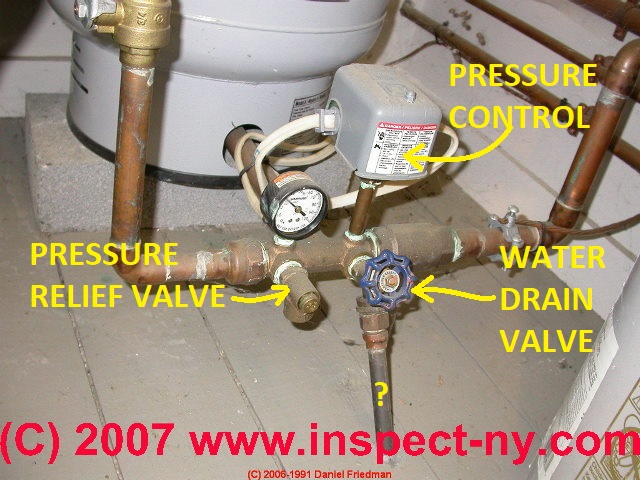
- Connect a garden hose to the tank drain and run that outside. In my photo you can see a black garden hose that has been attached to the water tank drain valve.
Alternatively some water tanks may have a drain that's close enough to a working floor drain that you can let the water out to that disposal point.- Open the tank drain valve - indicated in the photo as WATER DRAIN VALVE
- In the building, open one or several faucets nearby to let air flow into the system as water drains out of the tank.
- When water stops draining at the valve the tank is as empty as it's going to get.
...
What will the water pressure be when my water tank is full?
What is the full tank pressure for a 50/30 pressure On 2017-02-28 by Glen
by (mod) - when the pump stops the pressure will be the CUT-OUT pressure
Glen:
If you are using a 30/50 cut-in/cut-out pressure control switch then when the pump turns off the tank pressure will be close to 50 psi. It may drop slightly below that when the pump stops, depending on the pump's technical properties and depending on the rest of the plumbing system to which the tank feeds.
Keep in mind that as soon as you begin running water the pressure in the water system (tank, pipes, etc) will fall.
When water pressure falls to the pump CUT-IN pressure (30 psi in this example), the pump should turn on.
Can I change the water tank pressure and pump pressure control to a higher number safely?
I have a 44 gallon pressure tank with default 40/60 setting with air @ 38psi, the tank has a max rating of 125psi.
Can this be adjusted to 55/75 with 53 psi air without issue? Would this create a total pressure higher than 125psi, or would the 75psi include the air pressure?
The plumbing would be able to handle the higher pressure if adjusted. On 2022-09-09 by Joe K
by InspectApedia-911 (mod) - safe water tank air pre-charge pressure limits
@Joe K,
You're fine setting the water pressure tank pre-charge to 53 and the pressure control to 55/77 - 75 psi is well below the maximum tank pressure allowed (that you report is 125 psi)
BUT
Watch out: if you set the pressure higher than the pump itself is able to achieve, OR if at the higher pressure you run water so fast in the building that your gpm usage rate skyrockets and you run the well dry - you'll have to back off to the old lower range.by Joe K
@InspectApedia-911, Thanks for the fast reply! Right now the well is rated at 50gpm and the pump is 1.5hp/20gpm, so I hope it will work this way for a while. Thanks again, your website is amazing.
...
The air valve (Schrader valve) on the watet tank is leaking air when I take off the cap - is this normal?
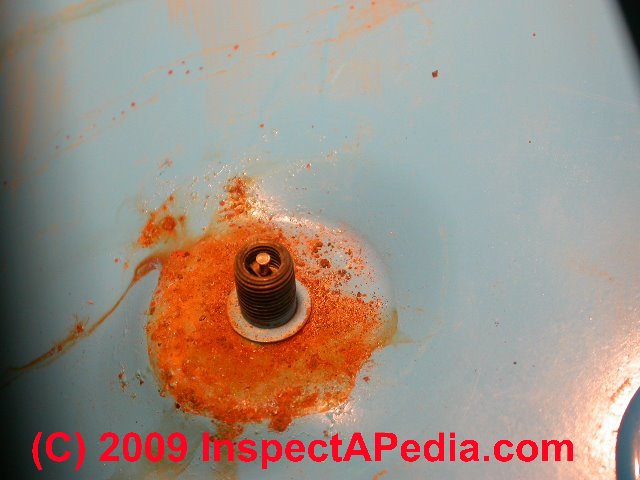 After we removed and replaced the water tank air valve air is leaking out
Just shocked well , after flood. Air presure valve was removed ,reinstalled.valve leeks air without airvalve cap. Is this normal? John
Moderator Reply: No. tighten or replace the valve stem core.
No, John. We shouldn't see water (nor air) leaking from the air valve.
Stop by your auto parts store, pick up a tire valve replacement tool - you'll need this to un screw the actual valve core from the stem. Try removing, cleaning, and replacing the existing valve core, or just install a new one.
Watch out: on some well systems, particularly those using a submersible pump and an in-well snifter valve, the above-ground snifter valve core spring is a softer one than is used in car tires since it needs to open and close at a lower pressure range.If the auto type replacement core gives trouble later (such as inadequate control of the air volume in a pressure tank that does not use an internal bladder) then a different core could be needed.
If your pressure tank is one that uses an internal bladder, a standard automotive valve core will work fine.
Watch out: if WATER is leaking out of the air valve on a tank that uses an internal bladder, then the bladder is leaking.For other readers: if your air bleeder valve is installed on hot water heating system pipes or at the boiler, see AIR BLEEDER VALVES on HOT WATER HEATING SYSTEMS - home
and also AIR BLEED VALVE LEAK REPAIR FAQs for heating systems - also see
...
...
Continue reading at WATER TANK AIR PRESSURE ADJUSTMENT - topic home, or select a topic from the closely-related articles below, or see the complete ARTICLE INDEX.
Or see these
Recommended Articles
- AIR DISCHARGE at FAUCETS, FIXTURES
- EJECTORS in WELLS
- NO WATER PRESSURE if you have no water at all.
- SNIFTER & DRAIN BACK VALVES
- WATER TANK AIR ADD AT AIR VALVE
- WATER TANK AIR ADD BY DRAINING
- WATER TANK AIR HOW TO ADD
- WATER TANK AIR HOW MUCH TO ADD
- WATER TANK AIR HOW OFTEN TO ADD
- WATER TANK AIR INLET VALVE
- WATER TANK AIR PRESSURE ADJUSTMENT
- WATER TANK AIR VALVE REPAIRS
- WATER TANK AIR VOLUME CONTROLS
- WATER TANK BLADDERS & CAPTIVE AIR
- WATER TANK MANUALS
Suggested citation for this web page
WATER TANK AIR PRESSURE ADJUSTMENT FAQs at InspectApedia.com - online encyclopedia of building & environmental inspection, testing, diagnosis, repair, & problem prevention advice.
Or see this
INDEX to RELATED ARTICLES: ARTICLE INDEX to WATER SUPPLY, PUMPS TANKS WELLS & SPRINGS
Or use the SEARCH BOX found below to Ask a Question or Search InspectApedia
Ask a Question or Search InspectApedia
Share this article:Search the InspectApedia website
Need to make a private comment? Email editor@inspectApedia.com. We welcome email with your website content critique, corrections, suggestions or questions. Email is monitored daily but our workload may prevent an immediate reply. For immediate results, we hope you'll first try asking your question using the search box just above.
Citations & References
In addition to any citations in the article above, a full list is available on request.
- In addition to citations & references found in this article, see the research citations given at the end of the related articles found at our suggested
CONTINUE READING or RECOMMENDED ARTICLES.
- Carson, Dunlop & Associates Ltd., 120 Carlton Street Suite 407, Toronto ON M5A 4K2. Tel: (416) 964-9415 1-800-268-7070 Email: info@carsondunlop.com. Alan Carson is a past president of ASHI, the American Society of Home Inspectors.
Thanks to Alan Carson and Bob Dunlop, for permission for InspectAPedia to use text excerpts from The HOME REFERENCE BOOK - the Encyclopedia of Homes and to use illustrations from The ILLUSTRATED HOME .
Carson Dunlop Associates provides extensive home inspection education and report writing material. In gratitude we provide links to tsome Carson Dunlop Associates products and services.
 |
HOME | ABOUT | ASK a QUESTION | CONTACT | CONTENT USE POLICY | DESCRIPTION | POLICIES | PRIVACY | |
| © 2026 - 1985 Publisher InspectApedia.com - Daniel Friedman | |||||||||