Water Tank Bladder Pressure Q&A #4Internal bladder type water pressure tank diagnostic questions & answers:
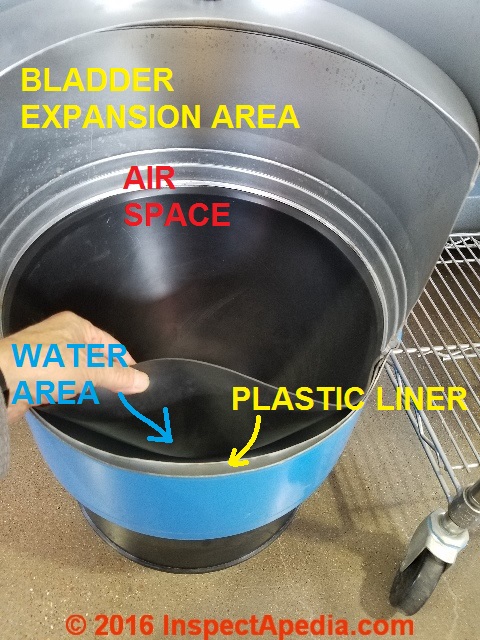
These questions & answers help diagnos & fix problems traced to the internal bladder used in water pressure tanks.
This article series describes the diagnosis and repair of internal bladder type water pressure tanks: how they work, what goes wrong, how to fix it.
InspectAPedia tolerates no conflicts of interest. We have no relationship with advertisers, products, or services discussed at this website.
- Daniel Friedman, Publisher/Editor/Author - See WHO ARE WE?
These questions and answers about diagnosing problems in water pressure tanks were posted originally
at WATER TANK DIAGNOSIS & REPAIR - home. Be sure to see that article.
Or see our index to all water tank bladder questions & answers at WATER TANK BLADDER DIAGNOSTIC FAQs
...
Hi, just to say this is a great website very helpful, read many things on it over the years.
My issue is that my taps and toilets have been spluttering for a couple of weeks now and it coincides since we dropped the well pump 10 inches due to a dry spell we had and the depletion in the well water. The system had run dry for a day so there was no water at all in the pipes in the house.
Now the pump is working fine but the pressure at the taps and toilets (worse upstairs) is very spluttery and quite loud.
The pump reaches the correct pressure (5bar) then cuts out as it should but the gauge on the controller drops slowly to around 2 bar without any faucets open.
I have checked the expansion vessel we have and the schrader valve is giving me zero reading. No water or air hisses out when i put a pin on the valve head. I knock the bottom of the tank and it sounds tinny which i believe it should do.
So confused as to what the issue is and whether its the membrane inside burst? Sharder valve faulty? The lowering of the pump requiring me to decrease the pressure relief valve? On 2018-11-01 by Andy Brumby
Advice by (mod) - that's probably not the best fix
Thank you for the nice comment, Andy. We work hard to provide researched, un-biased information so I'm really grateful when a reader finds it useful.
Sputtering taps usually means that there is air getting into the water supply system.
That can happen due to very low water in a well, and indeed using less water by lower water pressure might let you run water longer before the air problem shows up, but your observation that the pressure drops back down when no water is running in the building suggests that there could be a leak in well piping above the water level in the well. That will let water out as well as letting air into the system so that the next time the pump runs air appears at faucets (as it's over-charging the pressure tank with air).
If the leak were just air at a bad Schrader valve I don't think you'd see pressure falling in the system.
Just what that valve will do when you depress the valve pin depends on where it's located in the system (on the tank or on the piping, for example).
If the valve is on a bladder tank pressing the pin will release air unless the bladder has burst and the tank is waterlogged.
If the valve is on a bladderless tank pressing the pin will release air unless the tank is completely waterlogged.
If the valve is on well or water piping near the tank (usually at its bottom level) pressing the valve pin may simply release water.
If pressing the valve does nothing then the valve is plugged or the system is at zero pressure.
See the diagnosis and repair advice at AIR DISCHARGE at FAUCETS, FIXTURESWatch out: if your well and pump and tank previously used a snifter and drain-back system, an old drain back valve on the well piping in the well can also cause excessive air to be added to the pressure tank and to sputter or discharge at faucets.
We explain that problem at SNIFTER VALVE MALFUNCTION
Followup by Andy - will flushing the system fix this?
Thanks for the speedy reply. I understand it could well be a leak in a joint etc in the well line so i will check this tomorrow thank you.
However tonight, as soon as the pump had shut off from its cycle and filled the system, i shut off the isolation valve which is located after the pressure tank (ours is the internal bladder/membrane type) and the pressure gauge on the controller stayed level and didnt slowly decrease like it has been.
Once i opened up the isolation valve it slowly dropped from 5.5bar down to 2 bar where it then sits before a tap is turned on. We have a pressure reducing valve further up the line which does seem to be 'hissing' whilst the gauge drops from 5.5 bar to 2bar.
Will still check line tomorrow in well but should I try flushing the system dry and then refilling it with all the taps open to see if there is any air elsewhere within the system? Its just strange this has only happened since the well ran dry a few weeks back.
More advice by (mod) - signs of a running toilet - don't flush the system "dry"
If the valve that you closed is between the pressure tank and pump and the building itself, and if on closing that the pressure didn't fall, that would tell us the leak is in the building (such as a running toilet)
If the isolation valve that you closed is between the pump and the well, the it's the opposite conclusion.
I wouldn't "flush the system dry" (if this is an above-ground pump like a jet pump) unless you have a good water source for re-priming.
I am getting switch chatter and when I check the pressure on the tank the pressure is way higher than the shut-off pressure on my switch. There is plenty of air in the tank. As soon as I remove some of the air the pump goes to working correctly again.
2 weeks later I have the exact same problem and once again have to remove air to get it to work correctly. is there any reason why I would be getting excess air in the tank other than somebody putting it in there on purpose On 2019-01-17 by Morgan
by (mod) - sources of excessive air in the water pressure tank
Morgan
Please check out the air sources atAIR DISCHARGE AT FIXTURES
As one of those sources may explain the problem you describe
Let me know how that works for you or ask additional questions as you need
If You have lots of head pressure from a gravity feed system do I need a Pre charged tank? (July 2, 2014) Dan Tipping s
Reply:
Dan
The air reservoir in a water pressure tank is there to smooth the on-off cycling of the pump that will otherwise short-cycle, causing damage to the equipment. If your home feeds entirely by gravity and doesn't use a pump there'd be no role for a pressure tank.
(July 3, 2014) Dan Tipping said:
Thanks, I was thinking the same. There is a pump that pumps the well water up a big hill to a tank. The tank then feeds the cabin. I recently had a leak in the pre charged tank and this got me wondering why it was even there. I think I will get rid of it... Thanks,
DanReply:
Usually people don't install equipment without a reason, buut a pressure tank on the building side of the water supply tank on a gravity system = I dunno why it's there.
...
[We're in process of editing the Q&A below - Ed.]
My well has always been shut down when I leave my cabin.
When restarted it would pump all the air out of the system and work fine. Now for the last six months when I start it up the pump starts, runs for a minute removing the air then stops.
After a minute or two starts pumping again, it does this 6 or 7 times befor I get water .It seams like when all the air is out water starts flowing and the pump runs fine. When I leave and drain it again,the nest time I start it up it does the same thing. I changed the pressure valve and checked the pressur in the bladder .(Dec 4, 2014) Anonymous
Reply: running a pump dry can lead to pump failure
Anon
Most water pumps don't fare well when running "dry" as the pump impeller and impeller bearings can overheat or be warped or damaged.
When you used your pump to remove air from the water system it was running dry each time. It's possible that that has ultimately led to a bearing failure, motor overheating, and thus the pump is shutting off on thermal reset?
WR-60r well rite diaphram water tank leaks water from the bottom. Can this be repaired (Dec 31, 2014) Anonymous
Reply: Unless the leak is at a repairable plumbing connection, replace the tanki
Temporary patches using a screw and neoprene washer or epoxy are just that: temporary and usually not long-term reliable.
Your Well-Rite 60-R is a 20 gallon water pressure tank from Flexcon, sold widely at plumbing suppliers and building suppy stores.
It uses an internal bladder that is not considered economically replaceable so even if the leak is at the tank bottom bladder access port or even if the leak is traced to a bladder failure, repair still isn't recommended.
I'd replace the tank unless the leak is at a threaded plumbing fitting that can be re-made. A matching WR-50R water tank retails (in 2026) for $500 to $650. - Daniel
(Feb 7, 2015) Anonymous said:
1 got a 20 gallon bladder tank and the well company put it 6 ft under ground is it a good place for a bladder tank? T hey had to dig it up once and it cost me then. What can I do to make them put it under my crawl space?
(Feb 7, 2015) avi said:
i have a bladder style tank and I think the water is frozen at the bottom of it during 3 sub zero temps and high wind the window next to the tank is broken and the plastic covering hole fell away and extremely cold air blew in and on tank in basement.i had frozen pipes so I placed kero heater in basement to thaw .
before this had water but then slowly went down in pressure and then nothing.ive had no water for 2 days pipes seem warm the tank feels like water is in it but feels like its solid air comes out of air valve at top of tank when depressed.but when you hit the pipe coming out of tank sounds hollow
.and the pumptrol switch contacts are closed like its calling for water but nothing happens when I open the valve before the water pressure gage water comes out but no water comes out of house faucets .can some one help please thanks for your time and input
Reply:
Avi
I agree that your system is probably frozen. Search InspectApedia for "DeWinterizing" to see step by step procedrues.
If by "underground" you mean that the pressure tank is in a well pit, that is a common practice to protect the equipment from frost.
If you mean that a conventional internal bladder pressure tank was actually buried, that sounds odd - I'd want to know the tank brand and model and then to check with the manufacturer on where it can be installed.
(Feb 8, 2015) Richard said:
Hi I live in Ontario, Canada and I've experiencing a strange situation over the last two years, what happens is that during the colder parts of winter February, March I loose water pressure on my bladder tank.
The pressure builds up again once I toggle the pressure switch, we are using a submersible pump about 30feet down a cast well 4ft underground lines into house the thru pressure tank into house.
As I said this only happens during winter month and thru out the summer I have no problem as I’m even able to top up swimming pool without it cutting out. Any insight as to why this happens would be appreciated.
Reply:
Richard,
In most areas, including Ontario, the water table drops in summer, not winter. So I suspect more that something is freezing; if your well can't send up water because the pitless adapter or well piping are not below the frost line and so are freezing that could be the trouble. Where are the controls - the pressure switch?
(Feb 11, 2015) Richard said:
Thanks for your reply here are the details the water supply Line and wiring is 4 to 5 foot below grade the foot valve and submersible pump is 30ft down a cast wall well and the controls and bladder tank are in my basement corner where the supply line and power come in/out.Reply:
Richard when I had this problem in New York it was because in very cold weather, especially when there was not much snow cover (for insulation) shallow water lines were freezing.
IN Ontario your frost line depth is nearly six feet (1.8 metres in Ottowa) though I've read some sources putting it up higher at 5 ft - it depends on where you live of cousre, and over in Windsor is just about 1 metre (3.3 ft) (usually).
I'm guessing first in the frost direction because of the cold-weather relationship.
There could be of course another explanation, even (rarely) wet wiring that pushes apart a wet twist-on connector that is freezing.
(Feb 12, 2015) Richard Jones said:
Hi and thanks for replying again I was wondering about frost levels myself we change from a shallow well to a deep well setup in 2011 and the problem 1st appeared last year 2014, but the weather here in central Ontario was cold last year and we have had some good cold snaps this year also. I was wondering if the ground water was freezing and not getting into the well ?
But this week I’m going to check the pressure switch and make sure the orifice is not blocked and also replace gauge plus look into a solid state sensing device that monitors motor load and incoming power to automatically shut off the pump.
We have adapted the routine of not running two items at once to reduce load on the water supply but last night when running a bath for the grandkids we lost the pressure three times, as for pulling the pump that will have to wait to spring to look at connections as its too darn cold and the snow is covering the location.
Reply:
I'd check for debris-clogging of the pressure switch sensing tube or crud in the sensor port at the switch bottom; typically we just replace a suspect switch in that case.
If the switch were outside certainly it could freeze.
(Feb 14, 2015) Richard Jones said:
I came home to zero water tonight so started checking things a little deeper here’s what I did.
1 checked voltage had 240vac across terminal on pressure switch
2 checked the pump wiring main blk-yell wires had 4.7ohms, start red-yell had 18.2ohms, checked all wires to ground nothing shorted.
3 replaced pump control box (didn’t have means to test start capacitor)
4 checked amp draw had 5.2amps
Everything says pump is good and running but not building pressure next on list to check will be check valve to make sure it hasn’t failed and replace as a precaution, replacing the low water cutoff switch to be sure it’s not that also (doubt it is faulty). If after this I guess I’m going to have to dig 3ft of snow off well cover and gain access to well and start checking there.
(Feb 15, 2015) Richard Jones said:
Good news we now have water changed everything in the house that could be changed and still didn’t have any water (pump was working according to clamp on meter), so off the local big boys toys store and purchased myself a fish tape.Put fish tape down the line found a blockage 3 ft. from entry point to the house, phone local rental store see if they had a steamer they did but it was out, so did some internet reading and came across a product called “Liqui-fire” which says its safe for supply water.
Then had to make a longer pipe adapter to put on supply line and filled it with Liqui-fire which local hardware had, left it overnight and checked at 7am this morning joy of joy blockage was gone.
Put everything back together and had problems filling system as the water sounded like it was spurting, I had to hold low pressure cut off switch on manually for 10 mins till I got 30psi and it then very slowly built up to 50psi.
So recon I still need to access the well check depth and adjust pump height according to what I find but that can wait for spring. So a big thank you for walking me thru and you suggestions I appreciate your help in my dilemma.
Reply:
Good work Richard. Indeed years ago I had a similar problem during very cold weather.
The local well plumber came out, opened the well piping, and uses his home-made hot water pump to circulate hot water into the open pipe end until he could melt his way through. Outdoor well piping freeze problems are of course worse in very cold weather without snow cover.
(Feb 18, 2015) JimP said: What makes the water pressure drops when the well pump is off?
Reply:
Jim
If the psi just drops a pound or three I think it's cessation of head pressure from the running pump.
If pressure drops and continues to fall there's either water running somewhere or there's a leak.
I have a 20 gal wellxtrol with a 30-50 psi squareD pumptrol switch with pressure reading that are unusual. The pressure switch needed replacing because contacts were sticking. I put in a new pressure gauge and measured before I replaced the switch: tank pressure 18 psi, cut in 42 psi, cut out 67 psi.
The system seems to work fine. It's 25 years old. I replaced the switch with the same, and adjusted it to 38 psi cutin, 64 psi cut out. Do I need to increase the tank pressure to 36 psi? Should I be using a 30-50 psi switch when running 38-64 psi cutin-cutout? - D Harry 10/28/11
Reply:
D Hurry:
First, if your present pressure control switch is handling your (somewhat high) setting of 38/64 psi cut-in/cut-out you don't need to change the switch.
In the article above we list the factory air pre-charge settings for models of Well-x-Trol water pressure tanks.
Please read the WARNINGS about messing with tank air pre-charge in the article above.Then you can set your pre-charge pressure (with all water drained out of the tank) to 2 psi below the cut-in pressure on your pressure switch, or as you suggested, for a 38 psi cut-in, you'd set the air charge to 36 psi.
That 4 psi difference, however, is not very significant. Leaving the tank at factory pressure and setting the pressure control switch to a higher cut-in/cut-out pressure means that the volume of water you can draw from the tank before the pump turns on is a bit reduced.
i need to know what the ptoblem might be if there is water dripping from the water gauge where the floast is on the water tank - Robin 11/27/11
Reply:
Robin it sounds as if your gauge mount is leaking or the gauge itself has failed internally and is leaking from the gauge assembly. It should be possible to purchase a new part and using pipe dope, teflon tape, or teflon pipe sealant, replace the part and seal the leak.
You'll need to turn off the pump, drain pressure from the system (you don't need to fully drain the system) to install the new part.
how long should it take to have well water pressure back after bleeding and reseting? - Matt 12/30/11
Reply: one pump "on" cycle
Matt:
For a typical residential water pressure tank, after restoring a lost air charge in the water tank bladder or making a tank pressure adjustment, the well water pressure should return within less than a minute after the well pump has begun to run.If no water is running in the building but the pump has turned on and is re-filling and re-pressurizing the water pressure tank, the total pump run time will typically be 1-4 minutes from pump turn-on until the pressure in the tank reaches the cut-off level, depending on tank size and water system delivery rate.
I have a Well-X Trol (size to be verified tonight)pressure tank.
If water is being utilized at one fixture, pressure seems to be non-existant at any others.
My pump cuts-in/out at 30# & 50# on the nose, with no aparent short cycling.
After reading this (incredibly informative) page, can anyone verify my assumption that I need to verify my factory set pressure? (disable pump, drain, check pressure, add if needed) - Scott J 1/9/2012
Reply: no, no.
Scott J,
We need to distinguish between water pressure and flow rate or quantity.
Static water pressure when no water is running shows us the system maximum water pressure possible after the pump has cut off at the "cut out" pressure set by the pressure control switch.
Active water "pressure" and flow rate: if you have normal water pressure in the system at one fixture but inadequate or very little pressure as soon as a second fixture is turned on, that suggests that there is a water delivery problem - often traced to clogged piping or a control valve that is partly closed somewhere.
The pressure in your water pressure tank determines the length of the draw down cycle - how long water can run before the pump has to turn on. It is the pressure control switch and pump and well capacity that determine the system functioning water pressure and flow rate.
So from your complaint, I may be mistaken but I don't quite see how changing the pre-charge pressure in your water tank would help. I'd leave it alone. Instead, see
WATER PRESSURE & FLOW MEASUREMENT - for how to measure what your system is doing
and see
WATER PRESSURE LOSS DIAGNOSIS & REPAIR (article links listed at the ARTICLE INDEX the bottom of this article ) to further diagnose the trouble.
...
Continue reading at WATER TANK BLADDER PRESSURE ADJUSTMENT or select a topic from the closely-related articles below, or see the complete ARTICLE INDEX.
Or see these
WATER TANK BLADDER DIAGNOSTIC FAQs-4 at InspectApedia.com - online encyclopedia of building & environmental inspection, testing, diagnosis, repair, & problem prevention advice.
Or see this
Or use the SEARCH BOX found below to Ask a Question or Search InspectApedia
Try the search box just below, or if you prefer, post a question or comment in the Comments box below and we will respond promptly.
Search the InspectApedia website
Note: appearance of your Comment below may be delayed: if your comment contains an image, photograph, web link, or text that looks to the software as if it might be a web link, your posting will appear after it has been approved by a moderator. Apologies for the delay.
Only one image can be added per comment but you can post as many comments, and therefore images, as you like.
You will not receive a notification when a response to your question has been posted.
Please bookmark this page to make it easy for you to check back for our response.
IF above you see "Comment Form is loading comments..." then COMMENT BOX - countable.ca / bawkbox.com IS NOT WORKING.
In any case you are welcome to send an email directly to us at InspectApedia.com at editor@inspectApedia.com
We'll reply to you directly. Please help us help you by noting, in your email, the URL of the InspectApedia page where you wanted to comment.
In addition to any citations in the article above, a full list is available on request.