 Water Pump Controls Switch Pressure Differential Gap FAQs

- POST a QUESTION or COMMENT how to troubleshoot problems with water pump controls
Well Pump & Water Pump Control & Switch Questions & Answers:
Q&A about how to identify, use, fix or replace the various controls & switches used on well pump & water pump systems & equipment.
This article series describes and identifies the switches, controls, and safety devices used on water tanks and water pumps such as the pump pressure control switch, pump motor relays, water tank relief valve, water tank pressure gauge, water tank air volume control, and water tank air valve.
InspectAPedia tolerates no conflicts of interest. We have no relationship with advertisers, products, or services discussed at this website.
- Daniel Friedman, Publisher/Editor/Author - See WHO ARE WE?
Water Pump & Water Tank Control, Switches, & Attachment FAQs
These questions & answers about water pump controls were posted originally
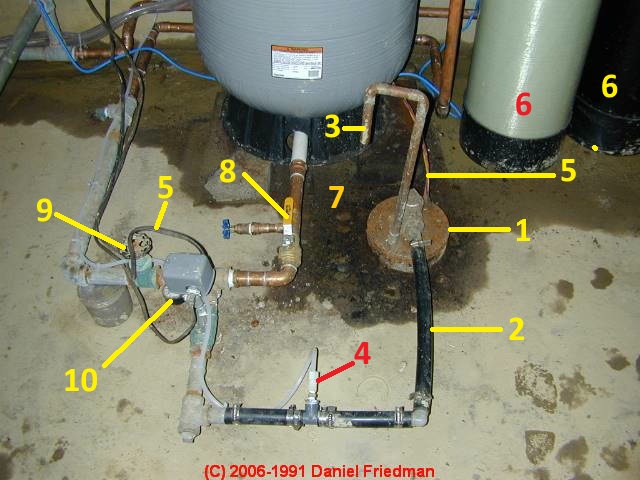
at WATER PUMP CONTROLS & SWITCHES - if you're not sure you can identify the controls and switches for your well pump or water pump, start there.
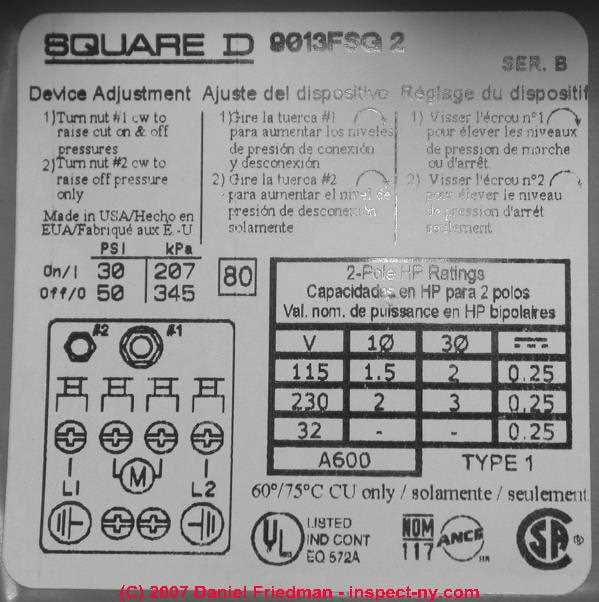
If you need to adjust or repair the pump pressure control switch, see WATER PUMP PRESSURE CONTROL
Also see our index to all water pump control switch FAQs at WATER PUMP PRESSURE SWITCH REPAIR FAQs
Article Index
- PRESSURE DIFFERENTIAL vs PRESSURE RANGE CHANGE EFFECTS Q&A
- PRESSURE DIFFERENTIAL, MINIMUM ALLOWED - between CUT-IN and CUT-OUT
...
 Effects of Increasing the Difference Beween Cut-In & Cut-out Pressures
versus
Effects of Higher or Lower Pressure Range at a Water Tank Q&A
Can I increase the differential between cut-in and cut-out on the pump pressure control?
I have a 20 a Gallon water pressure tank with a submersible centrifugal water pump in frin the lake at my cottage.
I have my pressure switch set at 40-70psi (30 differential)
Is there any harm having a 30psi differential.?
I have my bladder set properly at 38 psi. On 2020-09-03 by Tim
by (mod) - increasing the pump control differential is OK; here's the effect
Tim
There's no harm in using a larger differential gap as you described as long as your pump has no trouble reaching that cut off pressure.
The effect will also be of course, that you will notice a greater water pressure drop or flow rate reduction at your fixtures before the pump comes on. If that's not a bother than you're fine.by Tim
Great thanks for your advice!
I was just worried it would make my bladder crap [fail] on my pressure tank faster.
by (mod) - get a longer draw-down cycle by increasing the pressure range & what that does to the tank bladder
You can increase the draw-down by widening the water pressure differential between CUT-IN and CUT-OUT water pressure, but there's a limit which is the volume of your water pressure tank bladder.
Your pressure tank is rated to give you a 20 gallon draw-down volume.
You can get 20 gallons out at any of a range of pressure settings.
But when you operate at a higher pressure range - as you are doing with a 40-70 pressure control switch setting, that 20 gallons is going to be delivered at a higher pressure, which means that it is given to users faster, which means that the pump will cycle on sooner than if you operated at a lower pressure range such as 30-60 psi or 20-50 psi.
But as long as the air pre-charge in your pressure tank is set safely 2 psi below your CUT-IN pressure the system will work normally.
As long as your tank pressures don't exceed the manufacturer's permitted range you won't be harming the tank bladder.
...
Minimum Differential Between Pump CUT-IN & Pump CUT-OUT?
Can I set a Narrow Pressure Switch Differential of 10 psi?
I have a Goulds 1/2 hp J5 deep well pump with a 20 gal pressure tank. I am operating with a differential of 14 psi (20 / 34 CUT-IN / CUT-OUT).
Due to well limitations, the maximum pressure generated by the pump is 38 psi (pump runs forever if the cut-out pressure is raised above 38).
At this setting, the small nut is completely loosened.
I would like to operate at 24/34, but if I increase the cut-in pressure to 24 (large nut), then the cut-out pressure is also increased, and the pump runs forever (small nut still completely loose).
It seems that I am limited by the Goulds pressure control switch (which is attached to the pump and monitors the pressure by a plastic tube from the pump housing).
Any solution to this? It is a fairly new pump, so simply replacing the Goulds pressure conrol switch does not guarantee a solution, since the specs of the Goulds switch apparently do not allow one to operate with a cut-in/out differential of 10 psi. - Antony 9/14/12
Reply: don't set the pump switch Differential to a too-small number
Anthony
You're right that the "range nut"see WATER PUMP WONT STOP RUNNING
shifts the whole water pressure cut-in/cut-out range up or down, while the "differential nut" widens or narrows the cut-in to cut-out pressure gap.
I SPECULATE that Goulds and other water pump pressure control manufacturers don't allow the range width to be less than 10 psi because you'd find that when running water in the building the pump would be cycling on and off too rapidly.
You'd be better off to leave the range so that the cut-in is at 20 psi, and then you can set the cut-out up to 34 psi.Or call Goulds and ask if they have a switch that will operate with a narrow CUT-IN/CUT-OUT differential value.
...
Continue reading at WATER PUMP CONTROLS & SWITCHES or select a topic from the closely-related articles below, or see the complete ARTICLE INDEX.
Or see these
Water Pump Control & Switch Articles
- WATER PUMP CONTROLS & SWITCHES - home
- WATER PUMP CONTROL STATUS INDICATORS
- WATER PUMP ELECTRICAL SWITCHES
- WATER PUMP PRESSURE CONTROL ADJUSTMENT
- WATER PUMP PRESSURE CONTROL SWITCH
- WATER PUMP VARIABLE FREQUENCY / VARIABLE SPEED DRIVE (VFDs)
- WATER PUMP SWITCH INSTALLATION MANUALS
- WATER PUMP & TANK I&O & REPAIR MANUALS
- WATER PUMP PROTECTION SWITCH
- WATER PUMP RELAY SWITCH
- WATER PUMP REPAIR GUIDE - home
Suggested citation for this web page
WATER PUMP CONTROL SWITCH PRESSURE DIFFERENTIAL FAQs at InspectApedia.com - online encyclopedia of building & environmental inspection, testing, diagnosis, repair, & problem prevention advice.
Or see this
INDEX to RELATED ARTICLES: ARTICLE INDEX to WATER SUPPLY, PUMPS TANKS WELLS
Or use the SEARCH BOX found below to Ask a Question or Search InspectApedia
Ask a Question or Search InspectApedia
Share this article:Search the InspectApedia website
Need to make a private comment? Email editor@inspectApedia.com. We welcome email with your website content critique, corrections, suggestions or questions. Email is monitored daily but our workload may prevent an immediate reply. For immediate results, we hope you'll first try asking your question using the search box just above.
Citations & References
In addition to any citations in the article above, a full list is available on request.
- In addition to citations & references found in this article, see the research citations given at the end of the related articles found at our suggested
CONTINUE READING or RECOMMENDED ARTICLES.
- Carson, Dunlop & Associates Ltd., 120 Carlton Street Suite 407, Toronto ON M5A 4K2. Tel: (416) 964-9415 1-800-268-7070 Email: info@carsondunlop.com. Alan Carson is a past president of ASHI, the American Society of Home Inspectors.
Thanks to Alan Carson and Bob Dunlop, for permission for InspectAPedia to use text excerpts from The HOME REFERENCE BOOK - the Encyclopedia of Homes and to use illustrations from The ILLUSTRATED HOME .
Carson Dunlop Associates provides extensive home inspection education and report writing material. In gratitude we provide links to tsome Carson Dunlop Associates products and services.
 |
HOME | ABOUT | ASK a QUESTION | CONTACT | CONTENT USE POLICY | DESCRIPTION | POLICIES | PRIVACY | |
| © 2026 - 1985 Publisher InspectApedia.com - Daniel Friedman | |||||||||