 Heating Boiler Expansion Tank Q&A

- POST a QUESTION or COMMENT about heating system expansion tanks: their function, size, location, maintenance, and need for draining (on some models)
Hot water heating system expansion tank / compression tank installation, troubleshooting, repair questions & answers. :
This article series explains how to identify, inspect, install, repair, or service heating boiler expansion tanks: here we explain the function of expansion tanks on hot water (hydronic) heating systems.
InspectAPedia tolerates no conflicts of interest. We have no relationship with advertisers, products, or services discussed at this website.
- Daniel Friedman, Publisher/Editor/Author - See WHO ARE WE?
Heating Boiler Expansion Tank FAQs
 These questions & answers about expansion tanks used on heating boilers were posted originally
at EXPANSION TANKS, BOILERS - topic home - be sure to see the explanation and boiler expansion tank installation, diagnostic and repair advice given there.
Below is our index to questions & answers about heating boiler expansion tank installation, draining, adding air, repairing or installation.
Article Index
- AIR PURGER NEEDED on EXPANSION TANKS?
- AIR VENT LEAKS - don't replace the expansion tank for the wrong reason
- EXPANSION TANK AIR PRESSURE - pre-charge vs at atmospheric pressure?
- EXPANSION TANK BLADDER FAILURE
- EXPANSION TANK DRAIN PROCEDURE
- EXPANSION TANK LEAKS
- EXPANSION TANK LOCATION
- EXPANSION TANK MOUNT POSITION - can an Extrol be mounted horizontally?
- EXPANSION TANK NEEDED ?
- EXPANSION TANK NOISES - at the tank or elsewhere in the heating system
- EXPANSION TANK NOT WORKING - won't accept water
- EXPANSION TANK NORMAL WATER LEVEL
- EXPANSION TANK ODORS
- EXPANSION TANK PRESSURE
- EXPANSION TANK REPAIR or REPLACEMENT
- EXPANSION TANK SERVICE VALVE
- EXPANSION TANK SIZE
- RELIEF VALVE LEAK FIXED by NEW EXPANSION TANK & RELIEF VALVE
- WATERLOGGED EXPANSION TANK INDICATORS
...
Boiler Expansion Tank Drain FAQs
Tip: see the procedures at EXPANSION TANK DRAIN & AIR RE-CHARGE.
Where do I find the expansion tank drain?
I'm trying to bleed drain the expansion tank the only valve I see that has a hose thread is in front and doesn't seem to be near the expansion tank . On 2018-07-28 by roncas
by (mod) - which valve drains the expansion tank
Roncas
If the drain valve you see is on the boiler itself that's not going to drain the expansion tank.
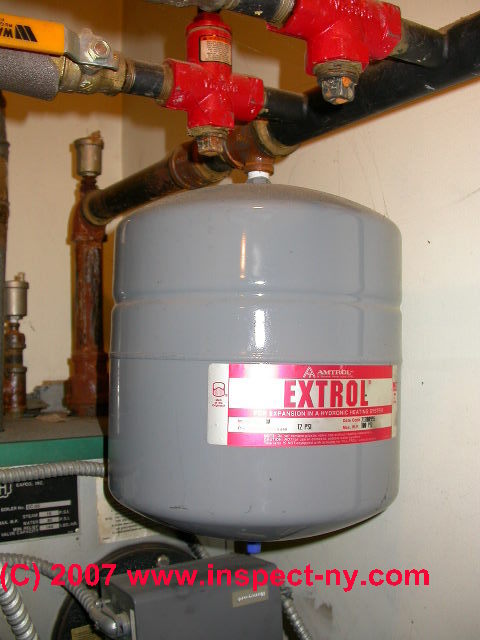
Keep in mind that not all expansion tanks are designed to be drained.If your expansion tank looks like the one at the top of this page, it uses an internal bladder and it does not need to be drained and cannot be drained.
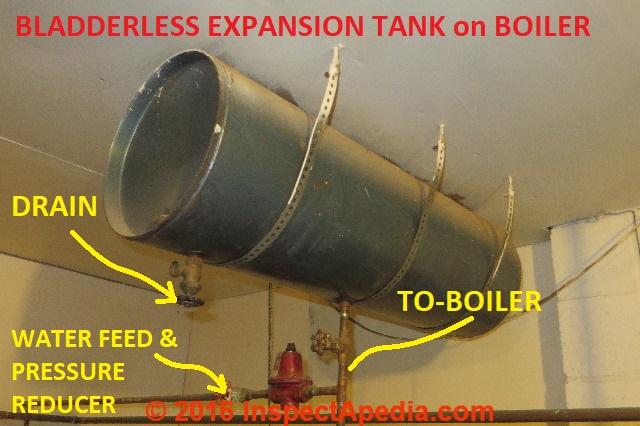
If your boiler uses an older style bladderless expansion tank like the one shown just above, there is usually a tank drain valve mounted near one end - yellow arrow marked DRAIN in my photo. This might be a special valve designed to allow air to enter the expansion tank while water is being drained out.
See details at EXPANSION TANK DRAIN & AIR RE-CHARGE.
How do you Drain a Bladderless Expansion Tank?
How do you drain a bladderless expansion tank in a hydronic oil heat system that has no pressure regulator valve or expansion tank isolation valve?
It does have the newer air bleed drain valve installed on the bottom of the tank.
Thanks, - 2012-12-04 by Dale Binsberger -
Reply by (mod) -
The service valve between boiler and tank is closed and the expansion tank drain valve is connected to a hose to drain it into a bucket or floor drain, then the drain valve is opened.
You may need to be patient to allow air to enter the tank as water dribbles out, or to use some tricks to speed the process that I explain
in detail at EXPANSION TANK DRAIN & AIR RE-CHARGE.
Confusion about how to drain an expansion tank and what boiler pressures should be found
I drained exp.tank and shut valve and bleeder valve. I noticed the entire system was low. I brought system up to proper pressure and bled all radiators. Then I opened the valve to the expansion tank. When water entered tank the pressure for the heating system dropped.
Do I now add more water to system or will pressure come back when water is heated .? Thank you - Lee Davidson - Filling entire system 10/8/12
Sirs, drained the exp. tank with tank supply valve closed. Closed drain valve and bleeder valve.
Entire system pressure was low so brought it up and bled whole house system. Bleeding drops pressure so brought up then i opened tank supply valve this makes pressure drop but i think it will come back when water is heated. Right or wrong? - Lee Davidson 10/8/12
Reply: you might need to add some water to the boiler after draining the expansion tank.
Lee, I agree with your procedure except the last step.
On opening the expansion tank connection between the tank and the boiler, I would expect the boiler pressure drop briefly as water feeds into the expansion tank to bring it (and its air) up to the standard heating system cold pressure, eg. 12 psi presuming that the boiler is cold.
But unless your system lacks an automatic water feed valve, the automatic water feeder would be expected to add the necessary makeup water. Or doesn't your system gave one?
Or finally, if at a low pressure heat makes it to the highest radiator or baseboard you are provably OK.Lee, about your second question:
Watch out: Wrong. It is a mistake to set the water pressure in a hot water heating system to an abnormally high level, and further, you shouldn't need to.Presuming that your equipment has a water feed/pressure reducing valve in place, that valve will automatically feed water to the system up to the usual COLD water starting pressure.
Typically that's around 12 psi, though it may be higher for some taller buildings.
Expecting the problem to be fixed when the water is hot is also an error. It's the cold starting pressure that we attend.Watch out: some readers have been confused about the bladderless expansion tank drain procedure: one has to close the water feed valve into the tank (from the boiler) before opening the tank drain.
Otherwise we are not draining the water out of the tank to let air in, we're just running water through the heating system: from the building water supply, through the water feed valve, through the boiler, and up and out through the expansion tank drain - accomplishing nothing.
How to Eliminate Periodic Expansion Tank Drain-Down Requirement
Hi. I seem to be having an issue once or twice a year that the expansion tank needs emptied, i.e. pressure goes above 30.
Is there something I can do to stop this? Thanks. Sandy. sweisber@pitt.edu - Sandy 11/12/12
Reply:
Sandy,
Sure. You can eliminate the need for periodic draining the heating boiler expansion tank by replacing it with an internal bladder type tank like the Extrol shown at the top of thus article.
...
Expansion Tank Service Valve FAQs
Tip: see the expansion tank service valve and how it is used
at EXPANSION TANK DRAIN & AIR RE-CHARGE.
Expansion tank valve is closed
I'm having trouble pushing water into my third floor radiators. I noticed that the pressure is pretty high and that the valve between the expansion tank and boiler is shut off.
Should this valve be open? Is it safe to open it? Should I turn the furnace off first and let it cool down? On 2012-11-29 by Josh
Reply by (mod) - the service valve is normally open and the drain valve normally closed
Yes, Josh, the service valve between the expansion tank and the boiler is normally open so that as the boiler heats-up and there is thermal expansion in the system, that pressure can be pushed up into the expansion tank where it compresses the tank's air charge.
Watch out: If the service valve is closed there is no working expansion tank on your boiler and as the boiler heats up the pressure may cause inappropriate leaks at the pressure relief valve. That's an unsafe condition.
In my photo above you can see the expansion tank service valve labeled SERVICE VALVE.
But if you are referring to the expansion tank drain valve, that valve is use only when the tank is to be drained, and is otherwise kept closed.
In my photo above you can see the expansion tank drain valve is at the left end of the tank and is labled DRAIN.
...
Boiler Expansion Tank Noise FAQs
Tip: see our heating system noise identification and troubleshooting advice beginning
at HEATING SYSTEM NOISE DIAGNOSIS
Boiling water noises in the boiler expansion tank
My expansion tank makes a boiling water noise. What causes it? On 2018-02-2 6 by Grace
The water in my heating expansion tank is gurgling and the pressure gauge continually fluctuates, how I can I stop this? (Oct 28, 2014) Kevin Parry
by (mod) - common sources of noise at a heating boiler expansion tank
Grace & Kevin:
Normally the expansion tank on a hot water heating system is silent.
There are several heating system noises that might show up at an expansion tank including
- Rattling from inadequate support - older type bladderless ceiling-mounted tanks with loose strapping
- Thermal expansion, clanks and thunks as temperatures change
- Water hammer noises that happen to be amplified by the expansion tank, when a zone valve opens or closes or a circulator starts or stops.
- Nearby heating pipe gurgling sounds or "banging noises" due to air in the system (air purge valves are not working or there is an air-leak into the system). These noises may be near to but not actually inside the expansion tank
- Nearby banging sounds traced to sediment build-up (mineral deposits, rust, debris) and on occasion partial clogging in the boiler itself or circulator or zone valve or piping. As above, these noises may be near to but not actually inside the expansion tank
- Actual boiling water (This would be extremely unlikely to occur in the expansion tank itself).
Watch out: at a residential hydronic (hot water) heating boiler you should never observe actual boiling water; that's because the boiler temperature is normally at or below 200°F.And over that temperature I'd expect the boiler's pressure/temperature relief valve to open and spill hot water. So if your heating boiler is actually boiling water, that is abnormal and unsafe.
Check the aquastat settings on your boiler's primary control and compare those with the proper settings described
at AQUASTAT HI LO DIFF SETTINGS
Also check the boiler temperature gauge. It should show a pressure at or under 30 psi and a temperature under 200°F.
So if your boiler is truly boiling and the TPR valve is not opening your system is doubly unsafe: it's too hot AND a safety device is not working. I would turn such a system OFF and call for repair.
Boiling water is of course normal in a steam boiler.
- boiler water pressure is normally between about 12 psi when the boiler is cold and under 30 psi when the boiler is hot. Abnormally low boiler starting pressure might encourage boiling water - an abnormal condition and not one I've encountered.
See HEATING SYSTEM NOISE DIAGNOSIS - https://inspectapedia.com/heat/Heating_Noise_Diagnosis.php for our complete catalog of noises traced to heating equipment.
Also see EXPANSION TANK LEAK REPAIRS at https://inspectapedia.com/heat/Expansion_Tank_Leak_Repairs.php
Expansion tank is making a Hissing Noise
My expansion tank is hissing load what do I do? On 2018-04-20 by Paul
Reply by (mod) -
It sounds to me as if there's a leak where there should not be one.
I hope you turned off the boiler and called your heating Service Company for prompt repair.
Look around for water on the floor near your boiler and then look up to see if there is actually a water leak.
A different possibility is that you have an internal bladder type expansion tank like the one at the top of this page. That tank would only hiss if its air valve were leaking. a
Finally, the hissing may not be coming from your expansion tank but from water heating in your boiler itself.
Take a closer look and listen and let me know what you see and hear. - Daniel Friedman
Banging pipes vs new Amtrol Extrol® expansion tank
I have a fairly new Amtrol expansion tank (~2 years old). Lately we are getting banging in the pipes when the heat is circulated.
I know I probably have to bleed the system, but the valves that are on the unit are the handle-less type that have to be turned with a wrench to open, and they take a while to seal again once closed.
Will loosening the valve at the top of the expansion tank a little more allow the trapped air to escape eventually - or will I have to bleed the lines manually with a hose and bucket?
I have loosened it a bit and I can hear air escaping occasionally and I am hoping this will eventually bleed the heating system.
Also, I cannot find any other leaks in the system to allow air in. All help is appreciated. (Jan 11, 2013) Rick
Moderator Reply: not necessary to bleed a captive-air bladder type expansion tank
Rick, it should not be necessary ever to bleed a captive-air type expansion tank such as the Extrol® unit and I'm not sure how a waterlogged expansion tank would cause banging pipes in a hot water heating system.
Instead please take a look at our banging pipes diagnostic article:
See BANGING HEATING PIPES RADIATORS (more often a concern on steam heating systems) or if your heating system is only a hydronic unit (hot water heat only)
seeHEATING SYSTEM NOISE DIAGNOSIS where we comment:
Bubbling or rumbling heating system noises in hot water heating piping can be caused by air in the heating lines. If the amount of air becomes excessive the heating system may be unable to circulate hot water and extra steps to bleed unwanted air will be required.
...
Relief Valve Leak: Replaced both Relief Valve & Expansion Tank
Tip: a waterlogged expansion tank or a bladder-type expansion tank with a leaky bladder that becomes waterlogged can lead to water discharge at the boiler pressure / relief valve.
See details RELIEF VALVE LEAK DUE TO EXPANSION TANK
And see maintenance or repair detasils for that problem at EXPANSION TANK DRAIN & AIR RE-CHARGE
Also see RELIEF VALVE LEAKS where we catalog other reasons for such a leak.
Why would TPR valve fail during boiler service? Service company replaced reief valve AND expansion tank
I had my oil burner annual service in October.
The boiler had been operating earlier that day as the weather had already become cold. It was operating fine prior to service. When the service people were packing up I went into the basement to check in.
I was noticed a small pool of water on the floor, maybe 12 inches in diameter or a little larger. When I looked over at it one of the technicians said that they had just noticed it too and they had no idea why it was there.
They said they double checked everything and could find no reason other than maybe the pressure relief valve had just let out a little water after their boiler service.
They thought I shouldn't be concerned and that they didn't believe it would continue to leak.
They acknowledged that it had not been leaking before they began their work and so they really didn't think there was any problem.
They left and the leak got worse and worse over the next several days. I had to call them back to the house as it was really letting out a lot of water.
I was at work when they came back to the house and I just received a bill that says they replaced the pressure relief valve as well as the expansion tank due to expansion tank failure.
My question is this - Why would this suddenly fail at the end of their servicing my boiler.
We had absolutely no leakage or other issues until then. Could they have made some mistake that caused this to happen?
It seems far too much of a coincidence that it would just suddenly fail at their visit and they hadn't noted any issues at all when servicing the boiler. - On 2018-02-15 by Sandra
by (mod) - How your service tech kept you safe by replacing the leaky pressure relief valve and why the expansion tank might have needed replacement
Sandra
Stating that "... the pressure relief valve had just let out a little water after their boiler service" is reasonable and acceptable **IF** that water was released because someone tested the valve by lifting its test lever.But after that test, water should not continue coming out of the relief valve.
Watch out: if a service technician tested the pressure relief valve or "flushed" it by lifting its test lever, that was a proper service procedure and in fact is protecting you from a
dangerous BLEVE EXPLOSION.
It is not unusual for a seldom tested or never tested relief valve, when finally tested, to refuse to close fully and to drip or leak. If that's what happened, the best and safest procedure in my OPINION is to replace the relief valve. It's not a costly part and it's keeping you safe. Don't blame the service tech.
It's correct that aside from a leaky pressure relief valve, a waterlogged expansion tank can cause the relief valve to drip when the boiler heats up.
So it's possible that your heating service company thought it was safer and for you less costly than a third service call, to replace "everything in doubt".
Here are some details about whether or not the expansion tank might be replaced in response to a relief valve leak:
A waterlogged expansion tank like the one I show above would cause the relief valve to leak but the tank itself would not normally need to be replaced unless the tank itself is leaking.
The maintenance procedure for the expansion tank shown above is explained in detail at EXPANSION TANK DRAIN & AIR RE-CHARGE
In contrast, a waterlogged expansion tank like the one I show below would need to be replaced.
That's because this tank (an Extrol model in my photo) uses a bladder to keep its air charge separate from water entering the tank, and the air charge won't be lost unless there is a leak in the bladder or a leak at the air pressure adjustment valve (that you can't see in the photo) on the tank.
So if this type of tank fails, yes it should be replaced.
If you see water dripping at the relief valve again, I suspect the cause may be a different common snafu:
The boiler's aquastat is set to too high a temperature - say over 200°F. - explained at AQUASTAT HI LO DIFF SETTINGS
There are other causes of TPR valve leaks and boiler leaks, all cataloged
at RELIEF VALVE LEAKS where we catalog all of the reasons for such a leak.
When an expansion tank and / or relief valve have just been replaced, if there is still boiler water leaking out of the system there is a problem to be diagnosed and fixed - possibly one that was not apparent to the original service technicians in the first place.
Now that your relief valve has been replaced, you should no longer see leaks at your heating boiler. If you do, let me know and call your service manager again. - Daniel F.
...
Signs of a Waterlogged Expansion Tank FAQs
Tip: see the procedures at EXPANSION TANK DRAIN & AIR RE-CHARGE.
How to Tell if the Expansion Tank is Waterlogged
clh10@msn.com have a 4gal honeywell expansion tank w/butyl membrane above my boiler/furnace.
I was told to tap on it to give me an indication as to whether or not it needs to be replaced.
When i tap on top half i get a ping, tapping on bottom half gives me a solid thud. Is this normal? On 2017-03-02 by cliff
by (mod) - should water be in the expansion tank?
It's normal for there to be water in the bladder in the lower portion of the tank. That ought to give a different sound when tapping there.
A hollow tank gives more of a "ring" sound and a water-filled tank gives more of a "thud" sound when tapped.
Watch out: don't bang on the expansion tank with much force or you may cause a plumbing leak.
The "Safety valve" on my boiler pops off each time the boiler runs - what's wrong? What's the cost of a new expansion tank?
The safety valve is popping off each time boiler kicks on, what is wrong?
Is $300 an average price for an expansion tank? On 2021-02-09 by ERNEST CUPP
by (mod) - safety valve is poping off each time boiler kicks on
Ernest
Watch out: a leaking relief valve is unsafe.
Before replacing an expansion tank let's be sure the problem is the tank and not high pressure, high temperature, water hammer, or other causes of a leaky TPR valve. Please see our article series onAnd you will see a catalog of the common causes of that problem.
And if your expansion tank is an older one that doesn't use an internal bladder the tank may simply need to be drained.
Also see RELIEF VALVE LEAK DUE TO EXPANSION TANKTo replace an old bladderless expansion tank most installers would go to a modern Extrol type tank that in fact uses an internal bladder.
Those cost around $60. U.S. + labor.
Boiler pressure keeps going too high and spilling the relief valve
My boiler pressure keeps going too high and leaking through the pressure relief valve.
I changed pressure relief valve and water feeder and bled the heater lines.
Still nothing. Can it be the expansion tank - Josh said:
Reply: what to check if the problem isn't the relief valve itself
Yes if the expansion tank is waterlogged then when the boiler heats up the relief valve will discharge hot water.
See those details at HOW & WHY BOILER EXPANSION TANKS GET WATER LOGGED
It's easy enough to check an older bladderless expansion tank for being waterlogged as it'll be nearly full of water and very heavy. Or you could simply try draining it, as we explain
at at EXPANSION TANK DRAIN & AIR RE-CHARGE.
If your expansion tank is a newer type such as the Amtrol Extrol that uses an internal bladder, it can still become waterlogged if the bladder develops a leak or ruptures. Often we'll detect that by fiding water released at the tank's air charge valve.
Check also for
a defective water pressure reducer/feeder or wrong water feeder pressure settings
abnormal water pressure at the building side
OR - boiler temperature set too high, as we detail
at AQUASTAT HI LO DIFF SETTINGS
OR - here's a cool one: your boiler could have a tankless coil that's leaking house hot water INTO the boiler.
We explain that problem at TANKLESS COIL INTERNAL LEAKS INTO the BOILER
Let me know. Daniel Friedman
Comment - Draining an old bladderless expansion tank solved relief valve leak
Thank you for this informative information. Many articles just mention the expansion tank with bladders but I have an old bladderless system and I was not sure if I should let the water out
The over pressure valve was periodically going off. Thanks again, I believe you solved my problem. - John OHare 11/16/2011
Reply: not necessary to replace bladderless expansion tank if you service it regularly
Thanks for the nice comment, John. We work hard to make InspectAPedia information accurate, complete, and unbiased and are thrilled when a reader reports that our data has been helpful. Indeed, there are still lots of buildings around whose heating systems use an older type of steel bladderless expansion tank - a component that needs periodic attention to keep the heating system working safely.
An bladderless expansion tank that loses its air charge not only causes the relief valve to spill, it is a more subtle safety hazard - as a spilling relief valve may eventually clog up from mineral deposits and crud, then stop opening, risking a BLEVE or boiler explosion. Sp if you see water on the floor under a relief valve it is something that should never be ignored.
Just how often we need to drain the water out of a bladderless heating boiler expansion tank varies from one installation to another; some need attention twice a year while I've worked on other systems that ran OK for three years or more before the expansion tank became waterlogged.
If your bladderless tank doesn't need attention too often, say not more than once a year, there is no reason it can't continue in service.
Will a water-logged expansion tank prevent boiler from turning on?
Can a waterlogged expansion tank cause an oil boiler to not kick on? 2/27/2014 Trish
Reply: No
In short, no, normally a waterlogged expansion tank doesn't keep a boiler from turning on, but there could be these exceptions:
The principal effect of a waterlogged expansion tank would be spilling at the temperature-pressure relief valve.
Residential hydronic heating boilers (hot water heat) usually are rated for a maximum of 30 psi - the TP valve will open at that pressure and spill water.
I suppose if a boiler lost water and didn't include an automatic water feeder, a low-water cutoff safety switch on such a boiler in that circumstance would shut down the boiler.
Some heating systems might include a pressure control sensor switch that would shut down the boiler if its pressure became abnormally high - a condition that follows a waterlogged expansion tank, but that's not a control I've seen on a residential heating boiler.
...
Boiler Expansion Tank Not Working FAQs
My steel bladderless boiler expansion tank won't let water in
I have an old large bladderless steel traditional heating system expansion tank that seems to not allow water to enter.
The lower pipe going to the tank gets hot, but the upper part of the tank stays cool. I replaced temperature/pressure relief valve and it leaks water.
The boiler now makes a strange noise but still works. Ideas please. On 2021-02-03 by jack perry
by (mod) - old bladderless expansion tank won't let water enter
Jack
In normal use the expansion tank on a hot water heating system is never full - so the bottom of the tank gets hot but the upper tank, wher there should be air, stays cooler.
If the tank becomes waterlogged - loses its air charge - then we'll see dripping or discharge at the boiler temperature/pressure relief valve.
The tank might be waterlogged without being 100% full of water - this could be your case.
Watch out: So if your boiler TPR valve drips and the boiler temperature and pressure are at normal levels, you want to turn off the boiler, isolate the expansion tank and then drain all of the water out of it.
In the ARTICLE INDEX are more articles on diagnosing RELIEF VALVE LEAKSby jack perry
Thank you for the response. The tank sounds completely empty when tapped and never gets warm.
by (mod) - signs that no water is entering the expansion tank: what to try next
Okay so that's a helpful additional to town. It does sound as if water is not entering your tank.
You might try opening the tank drain anyway to see if by some odd circumstance it has become over pressurized with air at too high a pressure.
If that doesn't change the situation then I think we're back to your original surmise, that there is either a valve closed between tank and boiler or a section of piping or the tank inlet itself is blocked.
In That case I might simply replace it with a modern internal bladder type extrol tank
by jack perry
Thank you. This helped me.
Expansion tank on pellet stove not working
I have a pellet burner with an expansion tank but it is not working.
Can this cause the temperature to rise too high and cut out the burner? - On 2020-01-15 by Michael devlin
Reply by (mod) -
Watch out: You'll want to review this question with the pellet stove manufacturer, Michael as there are life-safety implications (though subtle ones) if an expansion tank doesn't work (recurrent relief valve leaks, clogging, BLEVE EXPLOSIONS).
That worrying aside, the absence of an expansion tank would not in any direct way affect the temperature rise in the boiler.
The expansion tank's job (discussed in detail above on this page) is to absorb the initial pressure increase in a closed hot water heating system so as to avoid dumping the TPR valve.
...
Normal Water Level in a Boiler Expansion Tank
Tip: see the procedures at EXPANSION TANK DRAIN & AIR RE-CHARGE.
If you see RELIEF VALVE LEAKS check the boiler temperature & pressure and if those are normal, check for a waterlogged expansion tank.
Why does my expansion tank always hold some water?
Why is my expansion tank retaining water ? On 2020-03-07 by Indi
by (mod) - that's normal, as we explain:
Indi
It's normal for the expansion tank on a hydronic or hot water heating system to contain some water.Typically that take will be about half filled. If the tank becomes completely filled then it can't do its job, the relief valve on the boiler may leak, and and the expansion tank then needs to be drained.
If you consider the way those tanks are operated and maintained we start with an empty tank at atmospheric pressure and then we feed it from the boiler which is going to be between 12 and 30 psi, so the air that was at atmospheric pressure in the tank is going to be compressed and some water from the heating system will enter the tank.
...
Expansion Tank Mounting Position FAQs
Boiler expansion tank Extrol 30 is mounted horizontal - is that OK?
I have a system 2000 gas fired furnace that has a Extrol 30 that is mounted sideways instead of hanging down. It has waterlogged for a fourth time in the last 20 years and about four years ago was the last time until now.
Does the tank being mounted horizontally instead of vertically have an effect on the life of the bladder? I don't remember ever having to replace one in any house I lived in until I moved in here. Rick Bouchard globe56@myfairpoint.net On 2014-03-26 by Anonymous
by (mod) - horizontal vs. vertical mounting position of bladder type expansion tanks
Anon,
The Amtrol company's installation instructions for the Extrol 30 does not mention horizontal vs. vertical mounting position for the device, but the installation instructions do include a sketch showing the unit in a vertical position.The instructions also include this line "Do not place the EXTROL on a dead-end pipe.
Air can collect in the EXTROL, causing internal corrosion and possible leakage."
Which I take to warn you that *any* installation that might allow air to collect in the device could cause corrosion and leakage.
Watch out: That is, in my opinion, precisely the risk that you might face if your unit is mounted horizontally.
...
Is an Air Purge Valve Needed at an Extrol Expansion Tank?
Did "Amtrol Extrol Expansion Tank No. 30" need air vent and air purger ? On 2014-03-03 by Anonymous
by (mod) - No for the operation of the Extrol expansion tank itself an air vent and purger are not required but yes air bleeders are needed on the system
Anon: for the operation of the Extrol expansion tank itself an air vent and purger are not required, but for proper functioning of the heating system where the Amtrol Extrol Expansion Tank No. 30 is installed, indeed an air purger and vent are needed.
Here is what the company says in the installation instructions for their Extrol expansion tanks:
The EXTROL is installed on the supply-side of the boiler system. Its sealed-in air pre-charge prevents water from entering the tank until the system pressure begins to rise.
As the water temperature rises, water enters the EXTROL.
As the system cools, the diaphragm is forced downward. Water is expelled from the EXTROL, back into the heating system.
Although the EXTROL does not have to be installed at the base of an air purger, this installation is recommended to reduce air in the system and provide a compact installation.Some method of air elimination is required to ensure an oxygen-free system.
Water-logged Amtrol Extrol Expansion Tank No. 30 - vs tank mounting position?
Hi I find your site very helpful.
I have an Amtrol Extrol Expansion Tank No. 30 (with disphram inside). The pressure inside the system was under 12 psi before I pumped it back up to over 15 PSI (18 PSI). The tank has a tendency to loose its air over time, especially after many days of cold weather (minus 15 Fareiheit).
The tank was installed in 2007 and is mounted with the water inflow into the tank at the bottom and the air valve on the top.
The maintenance guy mentioned that this type of tank could be mounted upside down and that does not matter but on the Amtrol web site, they always show the Extrol tank with the water intake at the top and the air valve at the bottom.
Could mounting an Extrol tank upside down reduce the life of the tank or reduce the capability of the tank to keep the pressure under 30 psi when the heating system works at its maximum temperature? (Jan 29, 2013) claude st-pierre
Reply:
Claude, Amtrol does specify tank mounting position in the installation instructions for the Amtrol Extrol Expansion Tank No. 30 (found at the References section of this article) in text, from which I quote:
Mount tank vertically in downward position only. Ensure the piping can support the entire weight of the tank when full of water.
and in illustration shows it suspended below the air scoop/air vent on the supply side of the boiler. The company provides these notes:
1. Although the EXTROL does not have to be installed at the base of an air purger, this installation is recommended to reduce air in the system and provide a compact installation. Some method of air elimination is required to ensure an oxygen-free system.
2. The EXTROL must not be placed overhead in the floor joist space. When replacing a plain-steel tank, the EXTROL should be relocated per Figure 1. [see our schematic drawings in the article above]
3. Do not place the EXTROL on a dead-end pipe. Air can collect in the EXTROL, causing internal corrosion and possible leakage.
4. Radiant systems with non-barrier tubing or high oxygen content should use a Radiant EXTROL ® expansion tank with a plastic liner. See the EXTROL brochure, or call (401) 535-1216 for sizing assistance.
* Models #15 through #90 come with a 5 year warranty. All other EXTROL models come with a 1 year warranty. See reverse side for warranty information.
* Do not hang models SX-30V through SX-160V. They are floor standing models only
You state "The tank was installed in 2007 and is mounted with the water inflow into the tank at the bottom and the air valve on the top." which leaves me a little uncertain.
There is only one water connection on the Extrol expansion tank and one air valve fitting. The air valve is used to adjust the initial tank pressure to match the boiler cold or fill pressure at the time of installation.
I think that the reason you see the tank mounted with it water entry port at the top is that it is being connected to the bottom of a typical air purging device whose tapping for that purpose is on the under-side of the air purger. Follow Amtrol's instructions.
See AIR SCOOPS PURGERS SEPARATORS
If your expansion tank is water logged and it's an Extrol unit it needs to be replaced as most likely the bladder has burst.
...
Expansion Tank Pressure FAQs
Extrol expansion tank reads zero psi
My Extrol expansion tank pressure is reading zero. Cannot get hot water from the basement to top floor. Is the expansion tank defective? Could it be a valve?
Thank you for your help. On 2013-01-25 by john spinosa
by (mod) - there's a leak or a failed Extrol expansion tank
We don't normally see a pressure gauge on an expansion tank. But if you're measuring pressure at the air valve on your Extrol tank, from the factory it'd typically be about 12 psi.
So provided you are measuring air at the Extrol tank reliably, either the air valve on your tank leaks (and its valve might be replaced) or the bladder has ruptured, the air has been absorbed into the water or the bladder is blocking the air valve - in which case you need a new expansion tank.
If I let the air out of my expansion tank can I just put more back in?
What happens if I let the air out the tank on my heating system.
Can I just pump the tank up with air again On 2018-10-28 by Alex Nagy
by (mod) - Yes, but you should not be letting air out
Alex
There are two distinct types of expansion tanks on hydronic heating systems.
1. Tanks that use an internal bladder such as made by Amtrol/Extrol.
Those might have a slight pressure adjustment at time of installation but otherwise these tanks should not need service such as "adding air".But IF you mistakenly released the air pressure pre-charge in this type of tank, yes with the boiler cold you would restore its original charge - usually around 12 to 15 psi. Check the IO manual for your specific expansion tank!
If you don't have the manual, download it at BOILER EXPANSION TANK INSTALLATION & OPERATION MANUALS
2. Tanks that do not use an internal bladder.
Those may become waterlogged over the course of a heating season or two.
At annual service the tech drains the water from the expansion tank, allowing air to enter it at atmospheric pressure - extra air is NOT pumped into the tank.
When a type 2 expansion tank (also referred to as boiler compression tank) has been drained and is air-filled, and when its isolation valve is then opened, the heating system's water, contained in the boiler and piping, enter the tank under the normal pressure of the heating system.Typically, depending on a few variables like building height and heating system temperature, the pressure will be somewhere between 12 psi and just under 30 psi.
Watch out: Do not pump extra air into that expansion tank - nor is there a fitting permitting you to do so.
Boiler Pressure drops & I hear Air in the System
3 zone system I bring the pressure up to 12#s in a few days it drops to 7#s and I can hear air in the system.
How could air get in the system when it has pressure and where is the water going. I don't see any leaks. On 2013-01-25 by john spinosa
by (mod) - look for a leak
John,
It's normal for boiler pressure to vary between about 12 psi cold and somewhere under 30 psi when the boiler is hot.
If your boiler pressure was set to 12 psi when the boiler was cold and later when the boiler is cold again you see pressure down at 7 psi then it sounds as if there is a leak somewhere in your hot water heating system.
I'd look for either water anywhere in the system - at the boiler, at radiators or baseboards, at air bleeder valves, along pipes, etc., or for a leak at the boiler itself that might show up as a mineral salts build-up (as the water evaporates when the boiler is hot.)
Old atmospheric (non-bladder type) expansion tank is waterlogged. Should I pre-charge it after draining?
Carsten
I have a an old non-blatter type expansion tank that is waterlogged. I am going to drain it this weekend following your description.
I have been giving the entry and drain valves high penetration WD-40 for the last 2 days to avoid valve stem problems.
Now the question.
Is it worthwhile to charge the expansion tank with approx 20 psig air pressure from a small compressor before closing the drain valve and opening the connection valve from the boiler..good idea or bad idea ?
Reply: No. Drain the tank, fill it with air at atmospheric pressure, then close the drain and open the service valve.
Carsten
I wouldn't bother to try pre-charging the tank just to help it drain, but I would open a tapping or fitting that lets air into the tank and system to speed the drain-down.
The atmospheric expansion tank shown just above your question includes a special drain valve that is designed to also make it easier for air to enter the tank while its accumulated water is being drained.
See EXPANSION TANK DRAIN & AIR RE-CHARGE for the procedure to drain and re-charge an atmospheric expansion tank on a heating boiler.
Boiler System pressure does not fall when I empty the expansion tank
While the boiler was at 130F I turned off the incoming water supply and emptied the bladderless expansion tank again. Pressure did not drop. Closed the expansion tank drain. With water supply still off, ran the boiler through one cycle.
Temp at 200F and pressure still at 30 psi and minimal water dripped from PR valve. Opened expansion tank drain valve and emptied tank again. Pressure still at 30 psi.
Drained all three zones and boiler. No water coming in and no water in the system. Pressure reads 28 psi. Could it be as simple as a faulty pressure gauge at this point? If so, would the new gauge have to be installed with the system empty? Any other suggestions?
Added information to last post 4 hours ago...Boiler is turned off with water supply off. Left boiler drain valve, zone drain valves and expansion tank drain valve open since last post. Pressure gauge has dropped to 20 psi. Is it possible that there is an air lock in the system that is slowly releasing? Or something else?
Update post from last post 12 hours ago... With the boiler still off, all valves open and system empty the pressure gauge indicates 12 psi now. ? (Nov 25, 2014) Robert
Reply:
If the boiler is cool and pressure is stable at 12 psi that's normal. If pressure drops there's a leak out; if pressure increases there's a leak into the boiler or a bad water feeder or pressure reducer. Some more subtle relationships between system pressure and the compression tank (expansion tank) are discussed
at EXPANSION TANK WATERLOGGING EXPLAINED, most of which are more likely to occur with a compression tank that uses an internal bladder - which yours does not.
Utica Starfire boiler pressure readings very high
I am a little concerned.I have decided to check out my gauges on my Utica Starfire Boiler, I was shocked to find the pressure reading was pinned. Could this be correct? The relief valve isn't leaking nor do I see any other leaks.
I have fairly high water pressure in the house, is it bypassing and going to the boiler? The expansion tank sounds full on the top side and hollow on the bottom, as I have read is normal. Any thoughts? (Jan 24, 2015) Les B said:
Reply:
Les
If the boiler pressure were "pinned" at a number over say 30 psi, and if that were actually the pressure in the boiler, you'd figure that the temperature/pressure relief valve would be spilling.
But indeed you don't want a water logged expansion tank.
Watch out: if the pressure is confirmed to really be over 30 psi and your TPR valve is NOT spilling then the system is very dangerous and should be turned off immediately - from a safe remote emergency-off switch.
Solve our expansion tank pressure or pressure or gauge problems
This may or not be a problem. Please tell me what you think. Thanks for your help.
Expansion tank set at 14psi same as the 14psi auto feeder. Cold fill when boiler is at 80F shows 14psi on the pressure gauge.
Pressure verified with separate test gauge. Start boiler and pressure increases to 20 psi at 180F.
When boiler cools back down to 80F overnight the pressure does not return to 14psi. It stays at 19/20psi. I've dropped pressure to 0 psi and cold filling several times and it is always the same outcome. (Sept 8, 2014) Don F.
Reply:
Don
I suspect that the pressure gauge itself may be sticking. Check that first (tap gently to see if it will move, or replace it).
Alternatively, you could have leaks INTO the boiler if a tankless coil is installed. \
Reader follow-up:
Well, the separate pressure gauge when when connected verifies the installed pressure/temp gauge as accurate. If the indirect water heater has a coil leak... Why does the pressure stop at 20? Until I can understand that I can't move forward. For now the 20psi is holding very steady.
Reply:
OK so we like the gauge.
Your question is on point; the stopping pressure would depend on the house side water pressure.
Try this:
Shut OFF completely the boiler water feed - the valve should be ahead of the boiler and pressure reducer / water feeder.
With the boiler OFF and cold and sitting over night, if the pressure doesn't change then we would suspect the water feeder.
Reader follow-up:
Been there done that in 2 different ways... Way 1--- Boiler cold 80F and pressure reduced to 0psi.
Then turn on boiler street valve which feeds auto reducer feeder.
Pressure now goes to 14psi and stays there. So many hours latter (like 18 hours) I turn on the boiler and as it gets hotter the pressure gradually increases from 14psi to 20 psi at 180F.
Then when all is quiet and the boiler is idle overnight for 12 or more hours the boiler is around 80F the pressure is still 19/20psi.
I can repeat this procedure with the street feed valve turned off after filling from the pressure reducer fill valve. But the outcome is the same. Street pressure here is 70psi.
Reply:
Don
If even sitting idle the boiler is still hot (e.g. if it's keeping some heat in the boiler for a tankless coil) then it pressure would stay up in the range you describe.
But if you turned off power to the boiler over night, we can be sure the boiler ought to be "cold" or at least room tempreature, the next morning. And we'd expect to see lower pressures, though possibly slightly above the 12 psi cold if cold water from the street side were really cold on original insertion.
Reader follow-up:
Only heating indirect heater this time of year. I just took some pressure off. Brought it back down to 12psi. I had to let 2 quarts of water before the pressure reduced to 12. I'm thinking coil leak again :(
Reply:
Yeah. If you shut off water supply INTO the indirect-fired water heater tank AND drain pressure off of the tank - if you can stand having no hot water for a time - you can repeat these tests to confirm that water source leaking into the boiler. :-{
...
Expansion Tank Bladder Failures: Leak or Rupture FAQs
Ruptured bladder in Amtrol AX-240V expansion tank - what are possible temporary repairs?
Existing heating system has an Amtrol AX-240V expansion tank. Discovered it has ruptured bladder. New tank is three weeks away. What if anything can I do to operate boilers until I can replace tank (Sept 24, 2016) Dan
Reply:
You may need to add an expansion tank elsewhere on the system. It should be possible to pipe a conventional or alternative expansion tank right on the existing piping as long as it's sized correctly.
Watch out: without an expansion tank the increase in system pressure from just normal operation can cause the relief valve to spill.
If this happens the siguation can become dangerous, as mineral deposits and crud at the relief valve, brought by the spillage or discharge, can ultimately cause the valve to stop opening at high pressure - and that in turn can lead to a dangerous BLEVE explosion. Search InspectApedia.com for BLEVE EXPLOSION to read more.
You might also try lowering the HI limit on the boiler aquastat.
Can expansion tank bladder fragments enter the hot water lines
Can the bladder in a expansion tank deteriorate and work it way into the hot water lines? On 2012-12-20 by Steve
by (mod) - Unlikely
In my OPINION, that's very unlikely, Steve as when an expansion tank bladder fails it's usually a pinhole or a tear, not a bladder disintegrated into tiny fragments.
...
...
Continue reading at EXPANSION TANKS, BOILERS - topic home, or select a topic from the closely-related articles below, or see the complete ARTICLE INDEX.
Or see these
Recommended Articles
- EXPANSION TANKS, BOILERS - home
- AMTROL's EXTROL®, the FILL-TROL®
- ATTIC & ANTIQUE EXPANSION or HEADER TANKS
- BOILER DRAIN DAMAGES EXPANSION TANK
- EXPANSION TANK AIR VALVE LEAKS
- EXPANSION TANK DIAGNOSIS
- EXPANSION TANK DRAIN & AIR RE-CHARGE
- EXPANSION TANK IO MANUALS & SIZING GUIDES
- EXPANSION TANK LEAK REPAIRS
- EXPANSION TANK PRESSURE ADJUSTMENT
- EXPANSION TANK SIZING GUIDE
- EXPANSION TANK WATERLOGGING CAUSES
- EXPANSION TANK WON'T DRAIN
- FIND the EXPANSION TANK
- HEADER TANKS
- RELIEF VALVE LEAK DUE TO EXPANSION TANK
- TANKLESS COIL INTERNAL LEAKS INTO the BOILER
- THERMAL EXPANSION of HOT WATER
- THERMAL EXPANSION TPR VALVE LEAKS
- WATER PRESSURE TOO HIGH: DANGERS
Suggested citation for this web page
EXPANSION TANKS, BOILER FAQs at InspectApedia.com - online encyclopedia of building & environmental inspection, testing, diagnosis, repair, & problem prevention advice.
Or see this
INDEX to RELATED ARTICLES: ARTICLE INDEX to HEATING BOILERS
Or use the SEARCH BOX found below to Ask a Question or Search InspectApedia
Ask a Question or Search InspectApedia
Share this article:Search the InspectApedia website
Need to make a private comment? Email editor@inspectApedia.com. We welcome email with your website content critique, corrections, suggestions or questions. Email is monitored daily but our workload may prevent an immediate reply. For immediate results, we hope you'll first try asking your question using the search box just above.
Citations & References
In addition to any citations in the article above, a full list is available on request.
- In addition to citations & references found in this article, see the research citations given at the end of the related articles found at our suggested
CONTINUE READING or RECOMMENDED ARTICLES.
- Carson, Dunlop & Associates Ltd., 120 Carlton Street Suite 407, Toronto ON M5A 4K2. Tel: (416) 964-9415 1-800-268-7070 Email: info@carsondunlop.com. Alan Carson is a past president of ASHI, the American Society of Home Inspectors.
Thanks to Alan Carson and Bob Dunlop, for permission for InspectAPedia to use text excerpts from The HOME REFERENCE BOOK - the Encyclopedia of Homes and to use illustrations from The ILLUSTRATED HOME .
Carson Dunlop Associates provides extensive home inspection education and report writing material. In gratitude we provide links to tsome Carson Dunlop Associates products and services.
 |
HOME | ABOUT | ASK a QUESTION | CONTACT | CONTENT USE POLICY | DESCRIPTION | POLICIES | PRIVACY | |
| © 2026 - 1985 Publisher InspectApedia.com - Daniel Friedman | |||||||||