
InspectAPedia® FREE Encyclopedia of Building & Environmental Construction, Diagnosis, Maintenance & Repair |
Question? Just ask us! InspectAPedia
|
 How to Add Air to a Water Pressure Tank
- POST a QUESTION or COMMENT on the procedures for adding air to a water pressure tank using one of three easy methods - how to stop well pump short cycling.
Water pressure tank air pre-charge:
This article describes how to add air to a building water pressure tank and it reviews the function and repair of water tank air volume controls or snifter valves in a building water supply system where a private well is the water source.
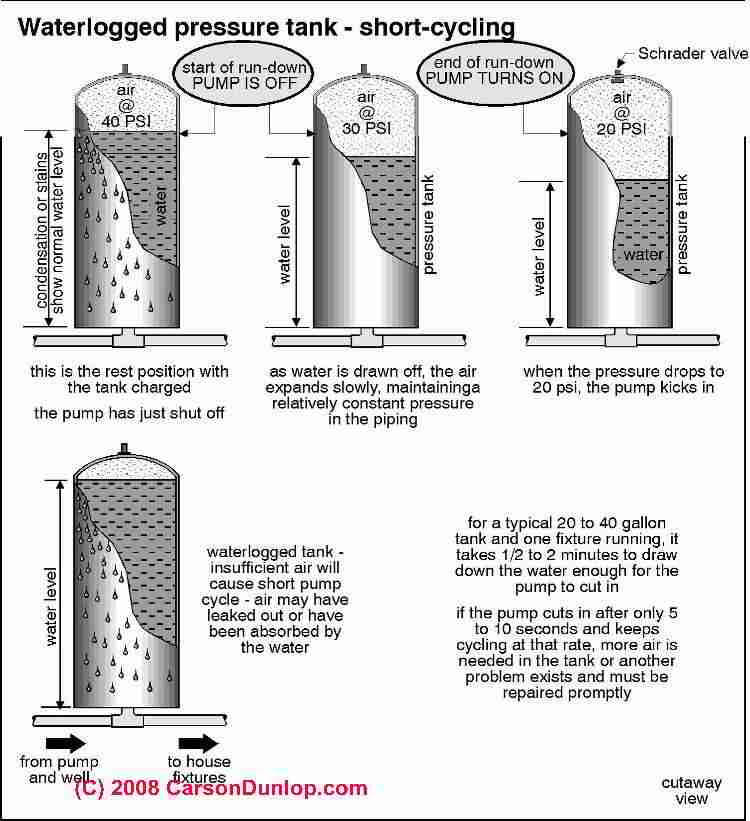
Quite often a short-cycling well pump problem can be traced to loss of the air charge in the water pressure tank.
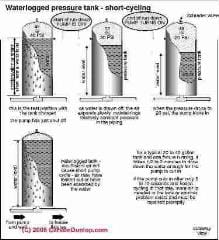
This article describes three alternative methods for fixing that problem. The illustration at page top is courtesy of Carson Dunlop Associates, Inc. in Toronto.
InspectAPedia tolerates no conflicts of interest. We have no relationship with advertisers, products, or services discussed at this website.
How to Add Air to a Water Pressure Tank
 There are fancier methods than those described below but here are three simple methods for fixing a waterlogged water pressure tank, of which the second two work well for easy replacement of air lost from a water storage or pressure tank.
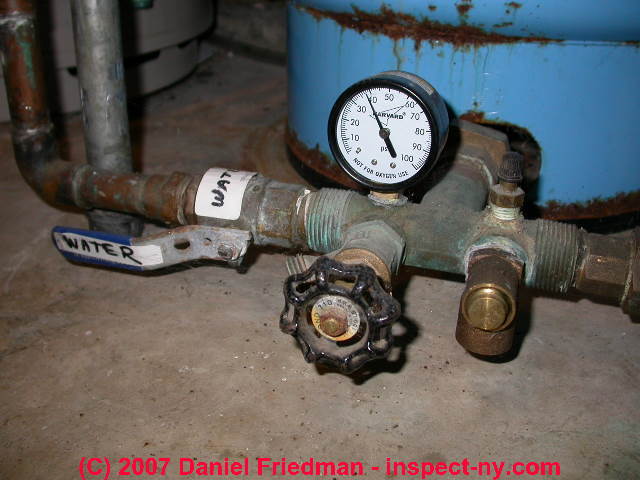
Photo: red arrow points out the air valve found at the tank tee located at the bottomof a water pressure tank. This valve, found at different locations on other tank systems, permits an independent check of system pressure and for tanks that do not use an internal bladder, a valve in this location might be used to manually add air to the tank.
[Click to enlarge any image]
- Use or repair the water tank air volume control, if one is installed - details about different types of air volume controls (jet pumps) and snifter valves (submersible well pumps) are
at WATER TANK AIR VOLUME CONTROLS - Use the water tank air inlet valve or tire valve or "schrader valve" to pump air into the tank - details are
at WATER TANK AIR ADD AT AIR VALVE - Drain the water tank using a garden hose and allow air to enter the tank - details are
at WATER TANK AIR ADD BY DRAINING
Other water tank problems such as air leaks, water leaks, or a damaged or burst air bladder, or pressure control switch problems can also make a water system behave improperly. See the links listed
at the ARTICLE INDEX the bottom of this article or start
at WATER TANK REPAIRS for these.
Below we provide a short summary of these methods for adding air to a water tank, and we provide links to in-depth detailed procedures.
1: AIR VOLUME CONTROLS - Method 1: air-volume controls on water tanks
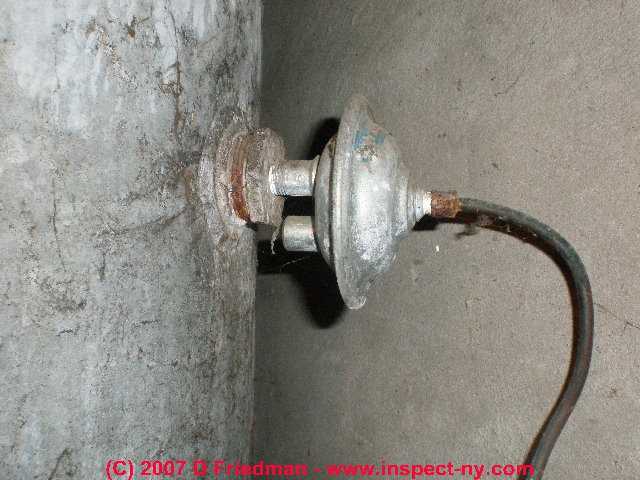
An "automatic" air volume control (AVC) device (on jet pump well systems) or a snifter valve (on submersible pump well systems) may be installed on the water pressure tank if it's an older, bladderless steel tank.
[Click to enlarge any image]
The AVC or snifter valve is intended to automatically put a little bit of replacement air into the tank from time to time as water pressure cycles up and down, that is, each time that the water pump runs.
This device on older water systems often stops working.
One choice is to get the air volume control working again by cleaning and fixing any leaks - details are
at WATER TANK AIR ADD AT AIR VALVE.
Another choice is to remove the air volume control and plug its fittings if it is leaking, and use one of the other water tank air charge methods described in these articles.
If your water tank air charge is being lost too rapidly, your water tank may have an air leak that can be fixed. Or you may need to replace the tank.
2: Use the water tank air inlet valve or tire valve or "schrader valve" to pump air into the tank
An air valve may be found on the water tank, on piping near the tank or water pump, or at the water tank outlet tee as shown in our photo at left.
Using a bicycle pump one can add air to the water tank.
Step by step details for adding air to a water pressure tank by using the air inlet valve are found
at WATER TANK AIR ADD AT AIR VALVE and
Water tank air valves are also described
at WATER TANK AIR INLET VALVE.
...
3: Drain the water tank using a garden hose and allow air to enter the tank
A simple method for recharging the air in a water pressure tank is to turn off the pump, attach a garden hose to the tank drain, open the hose, drain the tank completely, and then let the pump re-fill the tank.
Opening a nearby faucet or valve will speed the drain process and may help let air into the water tank.
Details are
at WATER TANK AIR ADD BY DRAINING
Other water tank problems such as air leaks, water leaks, or a damaged or burst air bladder, or pressure control switch problems can also make a water system behave improperly.
See the links listed at the ARTICLE INDEX the bottom of this article or start
at WATER TANK REPAIRS for these.
More about how we get air into the water pressure tank to avoid well pump short cycling
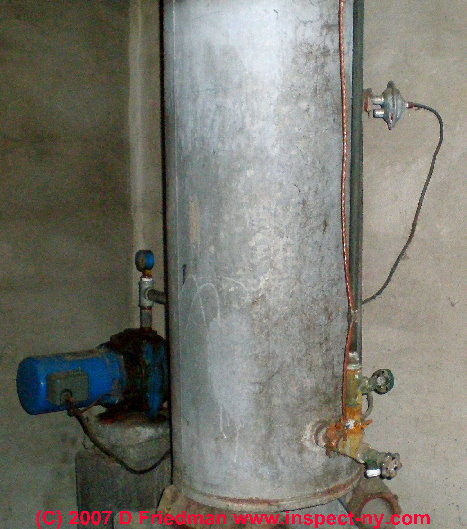
Air volume controls are found normally only on older type bladderless steel water tanks (photo at left) and not on bladder type captive air water tanks. Therefore the procedures describe here are intended for conventional non-bladder type water pressure tanks such as the water tank shown in our photo (left).
We explain these valves and how they work, are repaired, replaced, or abandoned, in our
article:
AIR VOLUME CONTROLS, WATER TANK
If your well tank is a "captive air" or bladder type pressure tank such as the Well-X-Trol™ series s
ee WATER TANK BLADDER PRESSURE ADJUSTMENT.
Bladderless water pressure tanks and their types, installation, and repair or adjustment are described
and
at WATER TANK CAPTIVE AIR vs TRADITIONAL WellMate
Bladder type or captive-air water pressure tanks and their repairs are described
at WATER TANK BLADDERS & CAPTIVE AIR
and at WATER TANKS HOW THEY WORK.
Reader Comments, Questions & Answers About The Article Above
Below you will find questions and answers previously posted on this page at its page bottom reader comment box.
Reader Q&A - also see RECOMMENDED ARTICLES & FAQs
Question: how do I add air to the pressure tank?
I need to add water to my water tank. I know you have to drain the tank before adding air, but the manual doesn't say if you add the air with the water valve open or closed. Any help would be appreciated. - Greg Weber 8/3/11
Opps, sorry. I need to add air to my tank, not water. Sorry.
Reply:
John M: replies to Greg W:
I'm no expert but I usually leave my water valve open, this lets the portion of the tank which holds water equalize with surrounding atmospheric pressure. If you close the water valve then pressure will build in that sealed space.
Greg,
If you are adding air to a water pressure tank (by which I infer you are not using the 'total-tank-drain-out' method, and if your tank uses an internal bladder, the water is kept physically separate from the air and it won't matter a bit whether or not your tank drain is open or not.
You are basically pumping air into the air chamber of the tank that is separate from the water (in many but not all bladder type water tanks the water is in the bladder and the air is around it).
If your water pressure tank does not use an internal bladder and you add air to the tank with its drain (or some nearby plumbing fixture open), your incoming air pressure will push more water out of the tank. Now two things can happen, depending on how much air you put in.
If you stop putting in air before all water is pushed out of the tank and the tank pressure is below the pump cut-in pressure your water pump will come on and repressurize the system normally.
If you keep putting air into a bladderless tank and the water pump is left turned off, eventually you'll push all of the water out of the tank and air will start coming out of your tank drain or nearby faucets. That won't hurt anything, provided you don't lose pump prime.
You'll have charged the tank by emptying it of water completely, the equivalent of our 'total-tank-drain-out' procedure. When you close the tank drain or faucet and turn your pump back on the pump will return water to the tank and pressurize the air in the tank at the same time. If your water tank has excess air that will pass out through plumbing fixtures until the system stabilizes. - DF
Complete procedures for adding air to the water tank are
Water Pump Turns on Immediately When we Run Water
Question: Goulds jet pump 3/4 hp, pump always comes on right away when water runs
i have a JRS7 Goulds jet pump 3/4 hp, recently i have been encountering a problem which i cant seem to rectify. my pump is set that immediately when any tap is opened it will come on and cut off when closed.
it will run for the period while the water is being used but, the pressure however drops sometimes while in use to 0 psi on the guage resulting in the pump cutting off immediately and no water is being delivered.
i have changed the pressure switch and am still experiencing the problem. the thing no matter what i try while it is off it will not come back on until it feels like it then the guage will build back up to 45 psi and it will run for a while and then do the same again. please help - Shawn White 7/23/11
Reply:
Shawn, if a pump always comes on immediately when you open a faucet and shuts off when you close the faucet, your water pressure tank is water logged - it's lost its air charge.
See the article titled WATER TANK AIR, HOW TO ADD (links at the ARTICLE INDEX the bottom of this article )
You might also have a problem of sediment clogging at the pressure sensing switch and gauge both - even if you replaced the switch if its mounting tube were clogged the problem would continue.
Question: pump turns on as soon as spigot opened
(June 13, 2014) Anonymous said:
My pump comes on as soon as the water is opened and continues going on and off until the water is closed. What is the problem and how can I correct it
Reply:
Anon,
Before changing the pressure control switch setting I'd look at either having run the well out of water (pump can't send up enough water to reach the cut off pressure)
or the pump impeller is damaged (pump can't develop enough pressure to reach shutoff)
other explanations include well piping leaks or a damaged pressure control switch
Question: water pressure goes down to next to nothing
(May 2, 2015) carl mcevers said:
water pressure goes down to next to nothing after a few seconds of turning it on
Reply:
Sounds as if there is a waterlogged pressure tank and a slow-flow or low capacity pump. Clogged or very small diameter piping combined with low water pressure can have this effect as well.
Question: water pressure falls immediately from 60 down to 40 and pump cycles on and off
(June 24, 2014) Anonymous said:
My pressure is set at 60 to 40, When you turn the water on it drops from 60 to 40 immediately and will continue to turn on and off until the water valve is turned off. The pump basiclly want shut off until you stop using water
Anon when pressure drops immediately on opening a tap I expect that there is little or no air charge in the pressure tank.
Take a look at
...
Continue reading at AIR INLET VALVES or select a topic from the closely-related articles below, or see the complete ARTICLE INDEX.
Or see WATER TANK AIR, HOW TO ADD FAQs - questions and answers posted originally on this page
r see these
Articles on Adding Air to the Water Pressure Tank
- AIR VOLUME CONTROLS, WATER TANK
- SNIFTER & DRAIN BACK VALVES - may explain water tank air loss
- WATER PUMP & TANK I&O & REPAIR MANUALS - installation, operation & repair guides for all brands
- WATER TANK AIR, HOW TO ADD
- AIR DISCHARGE at FAUCETS, FIXTURES
- SNIFTER & DRAIN BACK VALVES
- WATER TANK AIR VOLUME CONTROLS
- WATER TANK AIR ADD AT AIR VALVE
- WATER TANK AIR ADD BY DRAINING
- WATER TANK AIR HOW MUCH TO ADD
- WATER TANK AIR HOW OFTEN TO ADD
- WATER TANK AIR INLET VALVE
- WATER TANK AIR LOSS SIGNS
- WATER TANK BLADDERS & CAPTIVE AIR
Suggested citation for this web page
WATER TANK AIR, HOW TO ADD at InspectApedia.com - online encyclopedia of building & environmental inspection, testing, diagnosis, repair, & problem prevention advice.
Or see this
INDEX to RELATED ARTICLES: ARTICLE INDEX to WATER SUPPLY, PUMPS TANKS WELLS
Or use the SEARCH BOX found below to Ask a Question or Search InspectApedia
Ask a Question or Search InspectApedia
Try the search box just below, or if you prefer, post a question or comment in the Comments box below and we will respond promptly.
Search the InspectApedia website
Note: appearance of your Comment below may be delayed: if your comment contains an image, photograph, web link, or text that looks to the software as if it might be a web link, your posting will appear after it has been approved by a moderator. Apologies for the delay.
Only one image can be added per comment but you can post as many comments, and therefore images, as you like.
You will not receive a notification when a response to your question has been posted.
Please bookmark this page to make it easy for you to check back for our response.
Our Comment Box is provided by Countable Web Productions countable.ca
Citations & References
In addition to any citations in the article above, a full list is available on request.
- Ben Langston, generously contributed the photographs of round disk-type air volume controls used at the top of this article.
- Alan Carson, Carson Dunlop, Associates, Toronto, has permitted our use of the well and water pump system used at the top of this and some other pages at our website.
- In addition to citations & references found in this article, see the research citations given at the end of the related articles found at our suggested
CONTINUE READING or RECOMMENDED ARTICLES.
- Carson, Dunlop & Associates Ltd., 120 Carlton Street Suite 407, Toronto ON M5A 4K2. Tel: (416) 964-9415 1-800-268-7070 Email: info@carsondunlop.com. Alan Carson is a past president of ASHI, the American Society of Home Inspectors.
Thanks to Alan Carson and Bob Dunlop, for permission for InspectAPedia to use text excerpts from The HOME REFERENCE BOOK - the Encyclopedia of Homes and to use illustrations from The ILLUSTRATED HOME .
Carson Dunlop Associates provides extensive home inspection education and report writing material. In gratitude we provide links to tsome Carson Dunlop Associates products and services.
 | HOME | ABOUT | ASK a QUESTION | CONTACT | CONTENT USE POLICY | DESCRIPTION | POLICIES | PRIVACY | |
| © 2024 - 1985 Publisher InspectApedia.com - Daniel Friedman | |||||||||