
InspectAPedia® FREE Encyclopedia of Building & Environmental Construction, Diagnosis, Maintenance & Repair |
Question? Just ask us! InspectAPedia
|
 Guide to Wood Floor Types, Damage, Diagnosis, Repair
- POST a QUESTION or COMMENT about the diagnosis & repair of wood floors
This article explains types of damage that occurs on various types of wood flooring in buildings.
We illustrate buckling wood floors and comment on how they happen; we illustrate cupping of wood flooring and point out the diagnostic value of noticing which way the cup is shaped.
We explain what to do about gaps between interior floor boards, and we also address deterioration and problems with outside wood decks and porch floors, and we also describe repair approaches for various wood floor damage.
InspectAPedia tolerates no conflicts of interest. We have no relationship with advertisers, products, or services discussed at this website.
- Daniel Friedman, Publisher/Editor/Author - See WHO ARE WE?
A Photo Catalog of Damage to Wood Floors
 Repair approaches for damaged wood floors
- WOOD FLOOR AGE TYPES HISTORY
- WOOD FLOOR DAMAGE REPAIR
- BOARD CUPPING CAUSES
- BUCKLED WOOD FLOORING
- CUPPED WOOD FLOOR BOARDS
- FLOOR DAMAGE DIAGNOSIS
- FLOOR, WOOD MOISTURE
- GAPS BETWEEN FLOOR BOARDS
- GAPS in RADIANT HEATED WOOD FLOORS
- INSECT DAMAGE to WOOD FLOORS
- LAMINATE FLOOR DAMAGE REPAIR
- LAMINATE WOOD FLOOR
- LOOSE NOISY FLOOR REPAIR
- MOLD DAMAGED WOOD FLOORING
- PET STAINED WOOD FLOORS
- PET STAINS & MARKS in BUILDING
- SCRATCHED WOOD FLOORING
- SQUEAKY FLOOR BOARD
- WOOD FLOOR BOARD REPLACEMENT
- WOOD FLOOR REFINISHING SAFETY
Buckled wood flooring due to leaks or high moisture
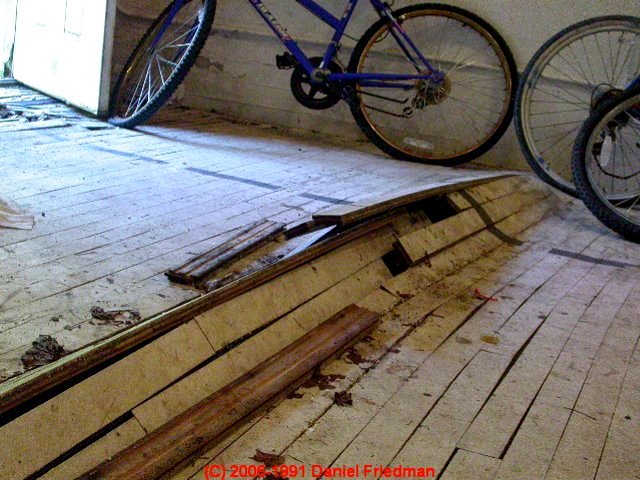
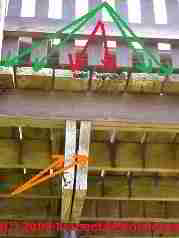
Our photo at page top shows cupped wooden strip flooring and an easy way to detect this condition..
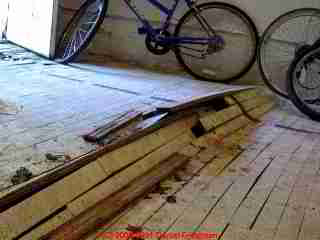
This 1940's wood floor buckled severely because of wet conditions in a gymnasium after the roof leaked.
But even if a building is not subjected to flooding or wet floors, if the wood floor was installed without adequate clearance around its perimeter buckling can occur when moisture increases in the building.
And as we discuss at FLOOR, WOOD MOISTURE, a successful wood floor installation requires that the wood flooring be acclimatized and at proper moisture level in the building before it is installed.
Very large wood floors (such as in this gym) may need an inch or even more of side clearance at the building walls - a detail accomplished by building out floor/wall baseboard trim if necessary, or in the case of newer products, by the combination of clearance gaps and a floating floor design.
Cupped Wood Flooring - Causes & Cures

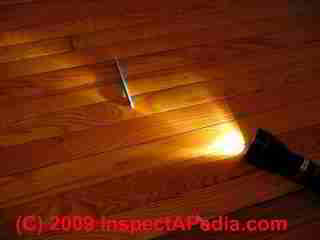
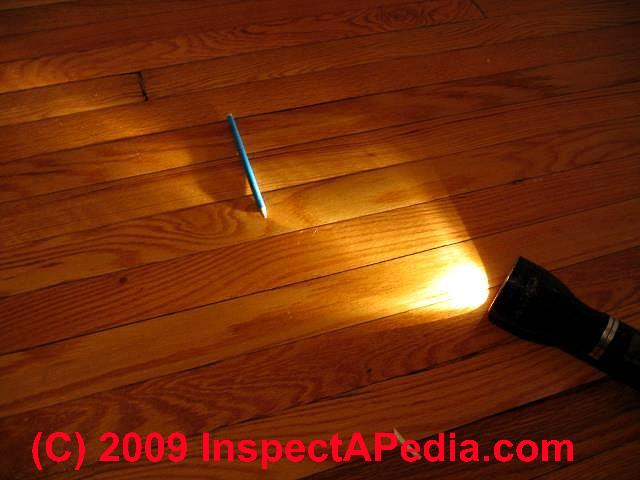
Compare our photo concave (curved down) cupped wooden floorboards with the convex (curved up) cupped floor boards in the photo at the top of this page.
At left you can easily see the concave cupping of the floor at left by looking at our flashlight beam across boards in the upper portion of the photo.
(The center of concave cupping is down and edges of concave-cupped floor boards are raised - think of "cave" as "caving in" if you want to remember this distinction.)
Diagnosing why a wooden floor has become cupped is an important step in correcting the problem, since we need to identify and correct the moisture source.
There are exceptions, but in general a board swells on its side that is most moist.
So on an interior floor like the one shown at left, the fact that the center of the floorboards is cupped "down" we infer that it is the down-side of these boards that is more moist than the finish side facing the room.
We find this condition in homes with finished wood flooring installed over a damp or wet basement or crawl space.
To protect wood floors over crawl spaces from moisture damage see
- NAHB, ICC & ICC Evaluation Service, FLOORS ABOVE CRAWL SPACES: Reducing the Risk of Moisture Accumulation with Wood Floor Assemblies for Residential Buildings in Hot-Humid Climates [PDF], (2014) retrieved 2018/03/17, original source: https://www.homeinnovation.com/~/ media/Files/Reports/ TechNotes-Floors-above-Crawl-Spaces-June-2014.pdf
At our page top photo the finish floor boards seem to be cupped "up" - suggesting that this floor has been wet from above.
If the floor board cupping is minor and hard to see, you might decide to just address the moisture problem and leave the floor alone.
It won't recover, but it the floor should not get worse. How would we repair a badly cupped wooden floor?
Sanding the floor flat is an option unless the boards have not only cupped but come loose from the subfloor. In that case floor replacement may be necessary.
Cause of Outdoor Deck Board & Stair Tread Cupping & Shelling - Bark Side Down Advice for Decks & Steps
Indoors we find that floor boards tend to cup so that the concave side of the board is towards the floor's more dry side, and the convex side of the cupped or curved boards tend to be facing the floor's more wet side.
Apparently when a wooden board has uneven moisture content across its thickness it will tend to expand more on its more wet side, causing that side to "arch" or become convex.
You might think that outdoors where despite temporary wetting from rain, deck boards and wood step boards open to air on both sides ultimately have a uniform moisture content across the board's thickness.
But because the upper board surface is exposed to sun and in some cases more wind or air movement, the under-side of boards may have a higher moisture content. In some installations, significantly higher.
For an explanation of wood board cupping and which side of deck, ramp, and exterior stair boards should face "up".
See BARK SIDE UP on DECKS & STEPS.
Cupped ramp boards (or deck and platform boards) with the "cup" facing up will hold water and form algae or ice more quickly than boards that drain properly, increasing the risk of a slip, trip, or fall hazard. Upwards-cupped boards sometimes rot faster too .
Look at the end-grain of any deck, ramp, or wooden walkway board and notice the curved lines that mark the winter wood layers of the tree from which the board was cut. If these lines arch "upwards" when the board is placed, most boards will also be curved upwards (convex) and will drain better.
But before nailing a deck or ramp board in place, look at the board surface itself - sometimes the boards don't follow these "cupping rules", or the bark side of the board may be badly damaged - so when building a wood structure you may have a reason to place a few walking-surface boards "upside down".
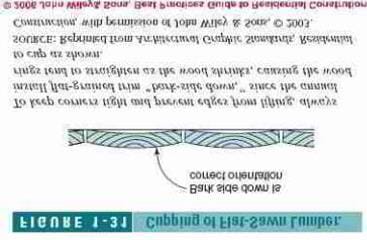
(Sketch adapted from (flipped over) an original provided courtesy S. Bliss, Best Practices in Residential Construction.)
When building a deck we like to look at the end grain of the wood and install deck boards with the "bark side" up so that cupped boards won't form puddle-collecting dips on our deck.
But look at your actual individual boards or stair treads when you are building an outdoor structure. If we are installing a deck board that is already rather cupped, we install it with the convex or "outward curve" side facing up for best drainage.
- See BOARD CUPPING CAUSES
- Also see DECK & PORCH CONSTRUCTION.
Watch out for shelling, board wear, trip hazard:
Watch out: On wooden decks and stair treads a defect "shelling" can occur with the bark side down method.
Shelling is a term used by some builders to refer to the loss of portions of a board surface as late wood growth (the outer surface of the tree and thus the "bark side" of the board) separates from early wood growth (the inner portion of the tree or the tree-center side of the board).
Shelling is reported to occur more often in lumber made from Douglas Fir and Southern Pine. When building an outdoor deck wooden stair tread, it is a good idea to avoid using boards with questionable, likely to separate, portions of their upper surface.
Shelling may be less of a problem with wood trim that is to be placed vertically and kept painted or sealed. We discuss shelling further
at SHELLING DAMAGE TO WALKING SURFACES ON WOOD DECKS & STAIRS.
Gaps Between Wood Floor Boards & in Parquet Flooring: Cause & Cure
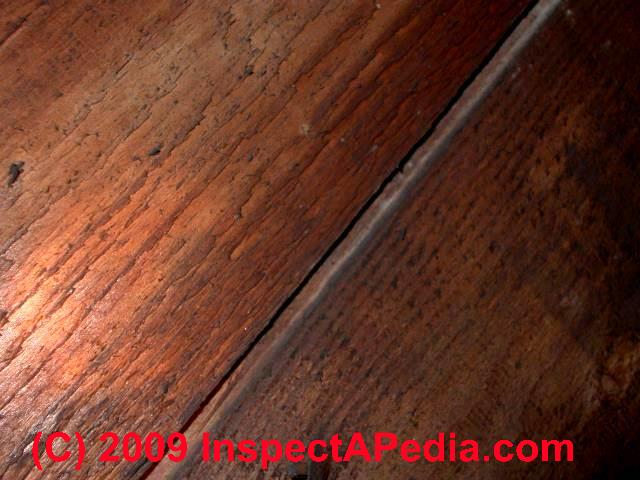
Gaps between wood floorboards may occur for several reasons, but the common underlying cause is a moisture problem.
Installing wood flooring before it has had an opportunity to acclimate to the indoor moisture level of its new home often means that too-moist flooring was nailed in place, later shrinking as building heat further dries the wood.
The gap between the flooring shown at left is viewed from the under-side of the floor of an older building. This is a ship-lap joint whose boards have separated about 3/16".
Softer woods such as pine tend to swell more than hardwoods such as maple or birch when exposed to moisture, to crush more-easily when the swollen boards push against one another or against a wall, and then to shrink more as the floor board dries out - all conspiring to leave gaps between floor boards that can, depending on wood species and moisture / drying cycle history, range from hairline or less than 1/16" in width to perhaps as much as 3/8".
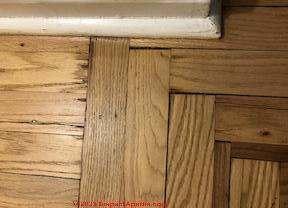
Gaps between wooden floors in other patterns can also appear such as between sections of a wood parquet floor, as shown in our photo below.
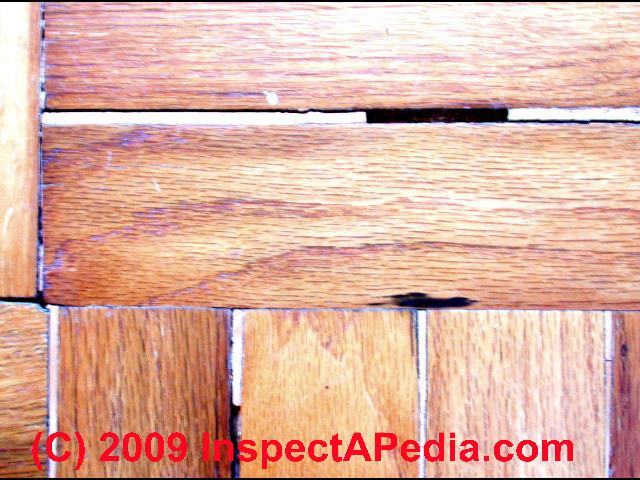
More about parquet flooring history, damage, repair, is
at PARQUET WOOD / VINYL FLOORING
Watch out: Do not rush to fill in gaps like this in wooden floors. Particularly in the case of wideboard flooring the width of individual boards increases and decreases seasonally as building indoor moisture levels increase (typically in the summer) or decrease (typically in winter).
If you fill the gap between floor boards in the dry (wide gap) season, when the building moisture increases and boards swell the swelling floor boards will push against the gap filling material, actually crushing the edges of the floor board.
Then when the building dries out again a new gap will appear.
Or in extreme cases the floor may buckle in damp weather. In either case, it's better to just vacuum out the dust and debris and leave these wideboard floor gaps alone.
At WOOD FLOOR TYPES where we illustrate a restored and re-finished wide-board floor in an 1860's home, if you click and enlarge the photo you'll see that we left the flooring gaps open. In fact during restoration we sometimes have to pick out putty or other stupid crack fillers that someone has applied earlier.
At FLOOR, WOOD MOISTURE we describe problems caused by moisture uptake and subsequent swelling, then shrinkage that leads to gaps between floor boards.
Gaps and shrinkage damage to wood floors installed over radiant floor heating systems
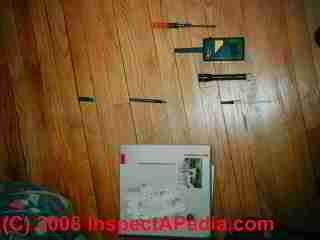
A common complaint we've investigated is shrinkage gaps in wood flooring installed over radiant heat tubing. Photo below: Heatway Entran tubing installed below the floor shown above and subject of a new owner's odor complaints.
This synthetic rubber tubing was found offgassing VOCs, principally forms of hexane, at low levels, below a plausible health hazard, but thought to explain the odor issue in the home. (Rosinski to Hayes, per Lupowitz, 4/18/1995 on file)
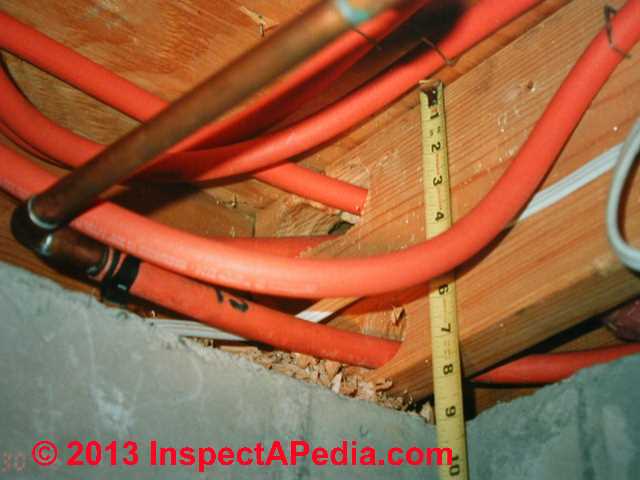
The underlying cause of wood flooring shrinkage gaps for new floors may be flooring that was too moist at installation, or even for an older wood floor, operating the heat at a higher than recommended temperature.
In the gapped wood floor over radiant tubing shown here, the owner, attempting to eliminate a smell associated with the radiant heat tubing, ran the heating system at high temperature, perhaps contributing to this floor gap problem.
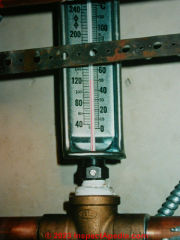
At the time of our inspection in 1995 the radiant heat floor system was running at about 120 degF.
- FLOOR, WOOD RADIANT HEAT - guide to installing wood floors over radiant heat system
- FORMALDEHYDE in LAMINATE FLOORING
Insect Damaged Wood Floors: Termites, Carpenter Ants, Old House Borer, Other
On 2021-04-16 by (mod) - identify this wood flooring & diagnose cause of damage
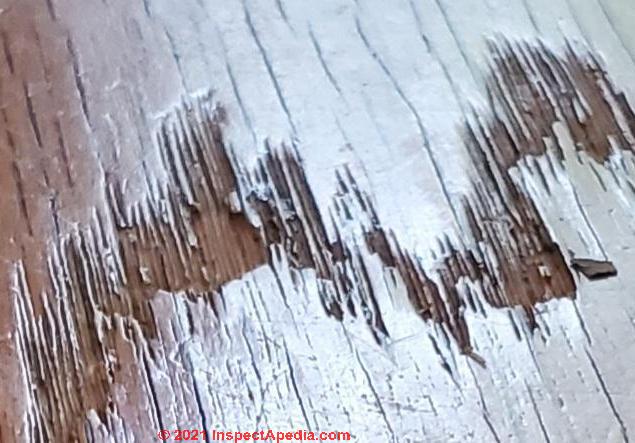
@colleen maki, your photos look like oak to me, not teak.
Enlarging the area of damage (as I've done above) shows loss of material between wood fibres in such narrow lines that it does not look like insect damage, but I'd want to confirm that by closer inspection including inspection of the areas below as I discussed earlier.
In your earlier photo I see V-grooved edges of the floor boards, telling us that this was a factory pre-finished wood floor product.
I *speculate* that the floor has lost surface material that was probably soft and simply protected by the original finish at the time of manufacture.
If it were insect damage (detailed photos and data still not available for comment) I would expect to find more-obvious tunnels and either frass (carpenter ants) or mud/dirt and mud-tubes (termites) or tiny bore holes (old house borer);
I would not expect to see the damage in regular but spaced patterns on the floor keyed to a specific grain pattern (other than the attack of summer wood).
Below is an image of wood destroying insect damage to an old wood floor, just beginning to appear at the floor's finished surface. By the time we inspected and found the damage probed by my awl, termites had already done extensive damage to the floor shown below.
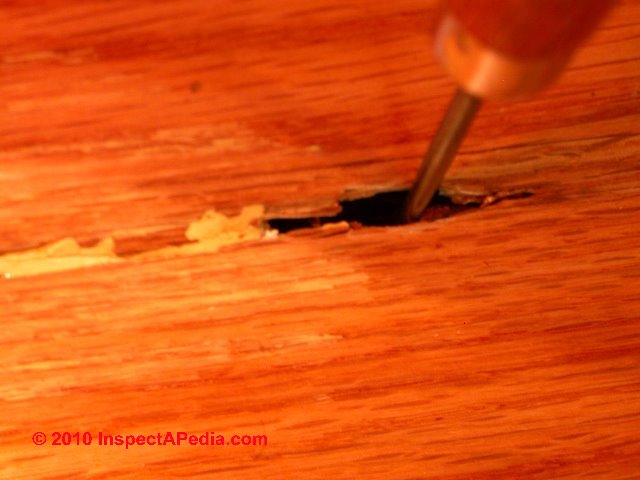
Below my second photo shows characteristic "mud" from termites, retrieved from my exploration of the area of damage.

Details of this floor damage example (termites) are
Your flooring photos and more examples of types of wood floors and help identifying wood species in flooring are
at WOOD FLOOR AGE TYPES HISTORY
On 2021-04-16 by colleen maki
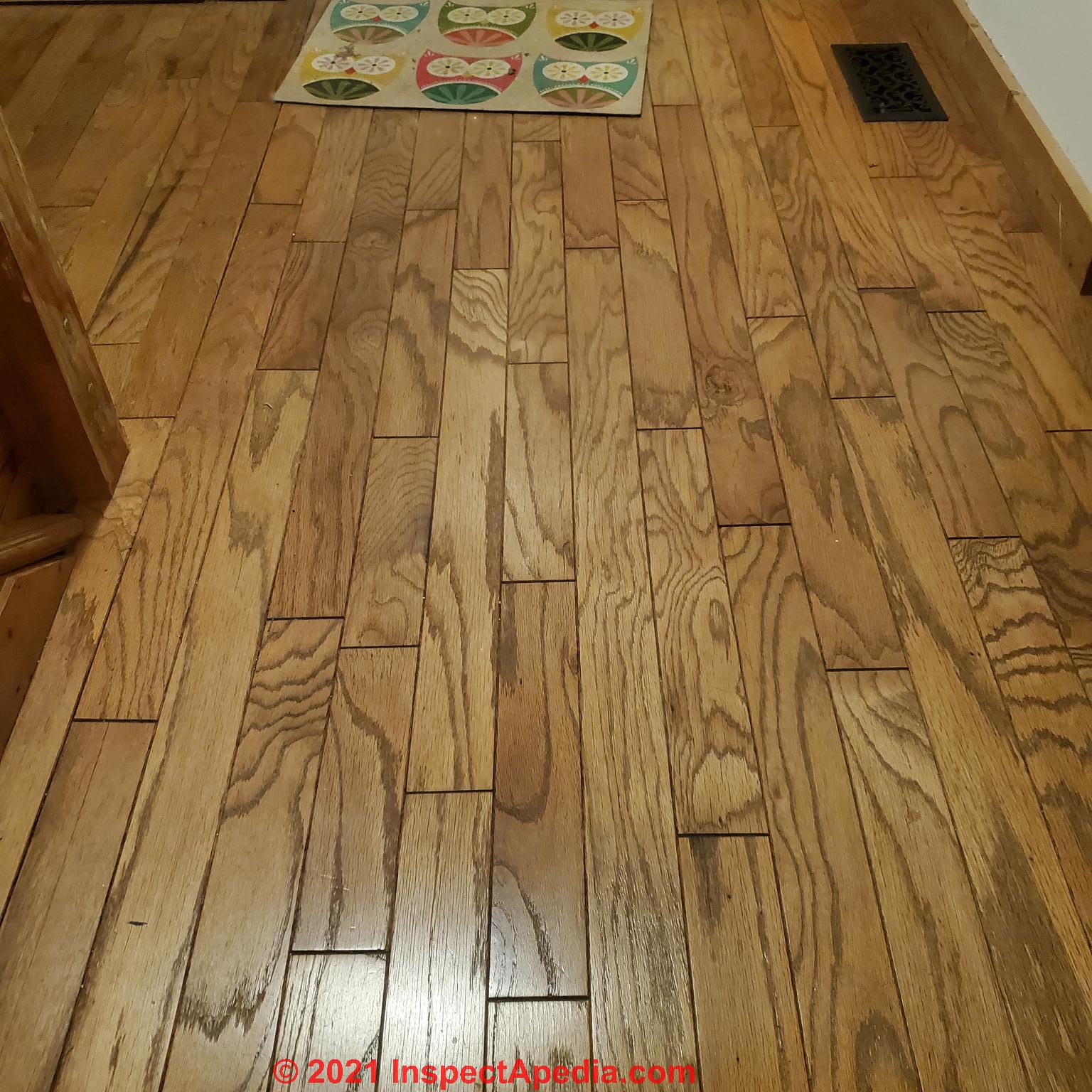
second photo of entry flooring [shown above]
Thank you for your quick response. We were told the wood is teak, although it's been 31 years since we built the house & my memory is fuzzy. There has never been an standing water or leaks to this floor, it is my entry hallway and the front door is on a covered front porch.
I have termite inspection annually and there has never been any evidence of termites. I have never seen any other indication of insect infestation. The house is over a full basement, about 15 years ago I installed a dehumidifier down there.
The wear is occuring in almost all of the darker grain of the wood, including the sides of the flooring where people don't walk. I will post another comment with a second photo. Thank you for your assistance -
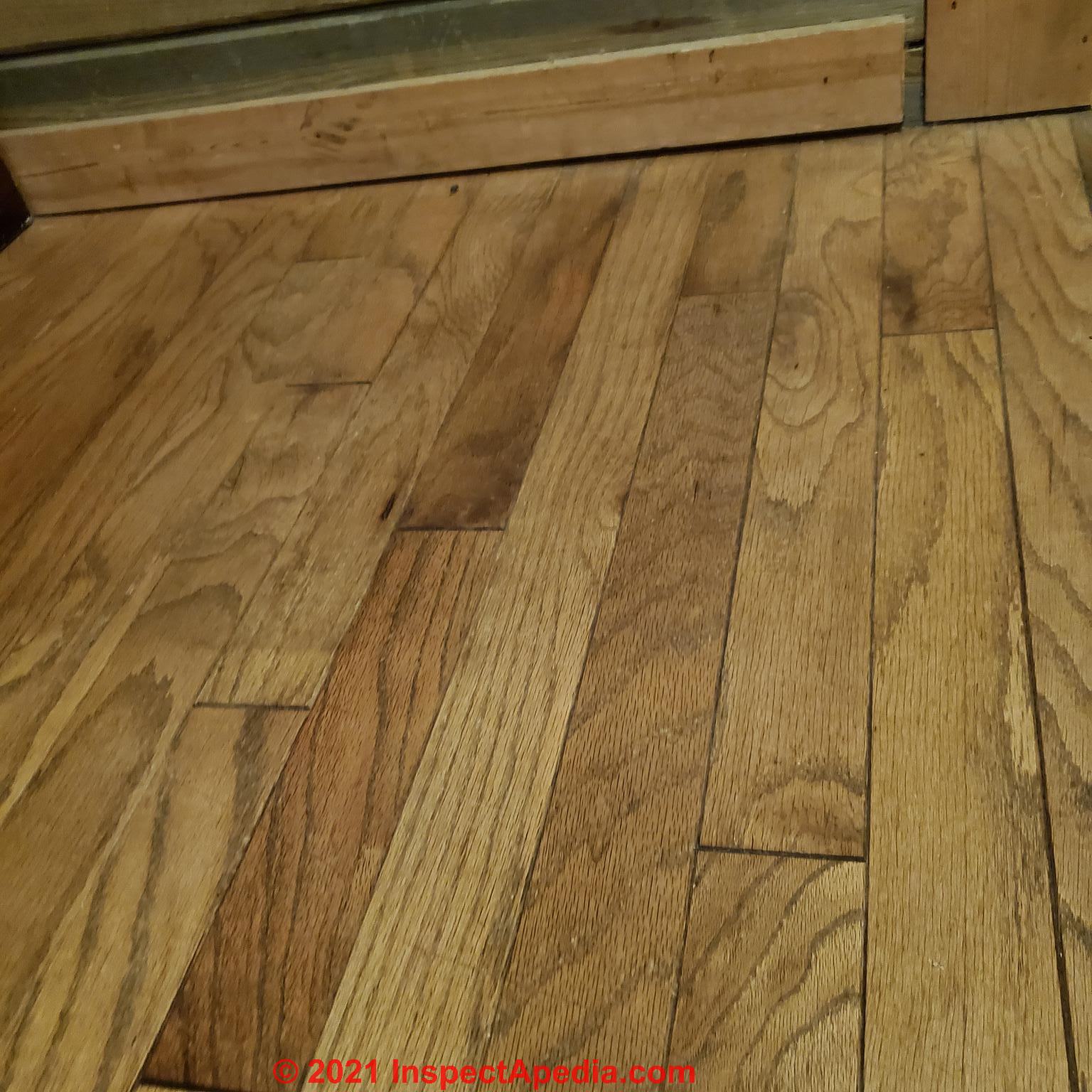
On 2021-04-15 by (mod) - cause of loss of wood/surface of 30 year old floor
@colleen maki,
That's a pretty unusual flooring wear pattern; particularly because its wavy pattern might be perfectly harmless wear showing up as loss of soft summer-wood in flat-sawn floor boards.
Do we know the wood species?
Can you post another photo or two (one per comment) showing the wood grain pattern and thus to help identify the wood?
I would look very closely into the open grains of worn-wood to see if you can spot fine sawdust (insect frass) or mud (indicating termites).
Can you tell me what's below this floor? Is it on a concrete slab or is there a crawl space or basement from which the area below can be inspected.
I'm interested in spotting the history of leaks, water entry, and possibly insect attack.
On 2021-04-15 by colleen maki - why is the surface of this wood floor wearing away?
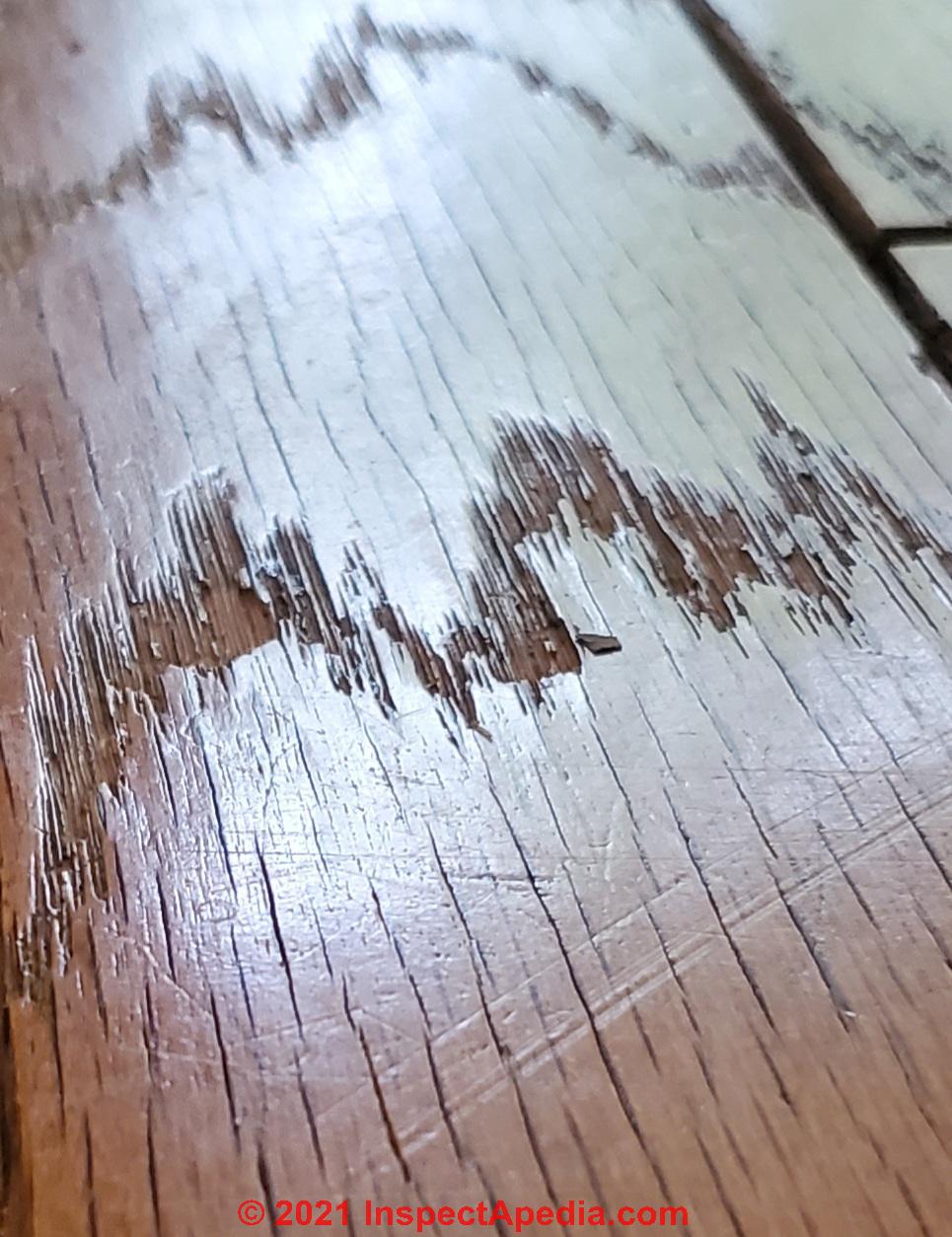
30 year old wood flooring ( we were told teak ), the darker wood grain is wearing away. Any ideas what might cause this? It has never been refinished, is not mopped with water. Approximately once a year ( sometimes less often) I have applied Old English lemon oil to restore moisture & shine. From everything I could read, it is supposed to be safe for wood floors. Here is a close up-
This Q&A and the one just below were posted originallyat WOOD FLOOR DAMAGE DIAGNOSIS FAQs
On 2019-05-28 by (mod) - tiny holes in various places in two wood floors they were refinished 8 yrs. ago. I found sawdust
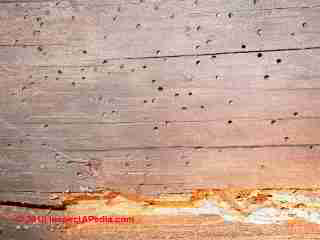 That does sound like a wood destroying insect - termites, powder post beetles, or less likely, carpenter ants whose frass is more coarse.
Normally I suggest sellers wait to see what a buyer and their inspectors care about before spending money that otherwise might be wasted.
But for an unambiguous condition that's a common issue and that's easily solved it may make more sense to go ahead and deal with this bug question now.
Photo: an example of old house borer or powder post beetle damage in wood.
[Click to enlarge any image]
While any home buyer would be expected to have an insect damage inspection - as that's usually required by mortgagors - and thus any buyer would be expected to find the same bug evidence as you've already noticed, if you wait until then to address the problem you're introducing anxiety and delay that's avoidable.
You should go ahead right now and have the home inspected by a licensed pest control officer or "exterminator" to identify the presence of a problem - that then gets treated, or to give a clean bill of health.
In either event you'll end up with a home for sale that has already addressed what otherwise would become a stumbling block along the way to closing sale.
See details at POWDER POST BEETLES
and at COMPARE TERMITE DAMAGE to POWDER POST BEETLE
On 2019-05-21 by Barbara Allen
I have tiny holes in various places in two wood floors they were refinished 8 yrs. ago. I found a teepee if sawdust(?) once. I had it inspected and was told there were no termite activity. The holes do not go through the wood. But it leaves a non-stained hole, so I know it’s new.
I have seen no bugs. No dust on the window sills. (I was asked that question). I want to sell my home. What do I do or disclose? Thank you.
Barbara Allen
Loose or Squeaky Floorboard Diagnosis & Repair Suggestions
Reader Question: 3/23/2014 Nick Ellicott City said:
The floors I need help with have loose boards, gap at the top step tread and the house doesn't have air conditioning.
The floors were laid in 1939. Would subflooring have been laid this long ago and is that why there are loose boards and is very squeaky in places? No pet stains, no dark spots should I sand or just fill with sawdust slurry and oil.
[Click to enlarge any image] Shown at left, an older wood floor in Rockefeller Hall, Vassar College - DF.
Reply: use sawdust to fill wood floor gaps?
Nick I'm unclear on what we're discussing here, so can only make some guesses.
By 1939 many homes had wood floors installed over wood subfloor - the way to find out is to examine both sides of the floor, but one can also often infer or guess or discover the floor structure just from the top surface by noticing the floor type (wideboard vs. newer solid oak or pine narrow board flooring) and by probing gaps between floor boards to see if a subfloor is encountered.
The 19th century wideboard pine floor shown below was installed directly to joists.
About using sawdust to fill wood floor gaps
I would not fill gaps in wood flooring with sawdust and oil nor anything else, both because I'm uncertain about odor and fire safety issues from the mixture you describe and because gaps in wood floors vary in width seasonally as temperatures and moisture change.
Filling gaps between wood floor boards invites later buckling or causes further compression of the edges of boards when they next expand.
You can see that's what's been happening with the putty-filled wood floor gaps in photo at left.
See GAPS BETWEEN FLOOR BOARDS for details.
Follow-Up:
Thanks. I will examine the underneath and see if there is subflooring. They are very squeaky in some places.
Can I nail down the squeaky areas? I saw the sawdust on a Youtube video. This is my first DIY project, do you suggest hand sanding? I also saw cleaning the floors with vinegar. The finished stain color is ideal. I don't want to do too much and ruin them. Your thoughts.
Reply: How to repair a squeaky wood floor
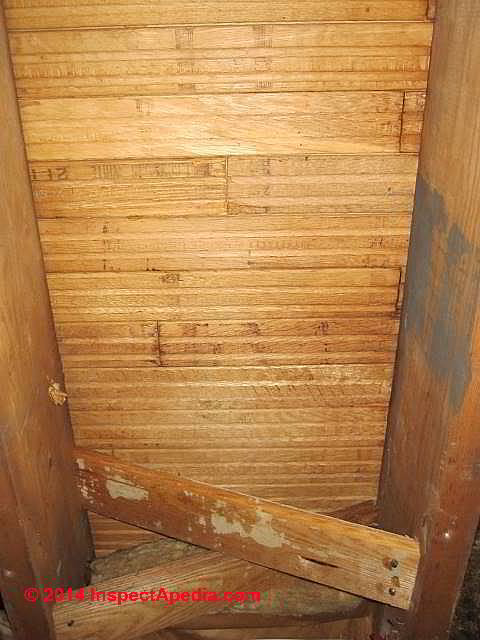
Squeaky wood floors are caused by movement in one or more boards that rub together as you walk over them or as building temperatures and moisture level change.
Ideally we repair loose wood flooring by screwing up or nailing-up from beneath the floor, through the subflooring or best on an angle through the floor joists, through the subfloor (if present) and into the bottom of the finish flooring above.
Nick, at LOOSE NOISY FLOOR REPAIR I've collected a complete set of steps for repairing loose or noisy wood flooring working from above or from below depending on the situation.
Sanding old wood floors: advice
About hand sanding versus power sanding, the answer is, as Mark Cramer says, ... it depends.
On a hardwood floor with plenty of wood thickness and deep damage we might use a power sander along with an edger.
On an antique (often soft-wood) floor like the one shown at left we use a combination of sharp hand scrapers and hand sanding. In my opinion sanding an antique or historic floor dead flat produces a weird and inappropriate finish.
In general using the least destructive, least invasive method is best.
Mold & Other Stains or Mold Damaged Wood Floors
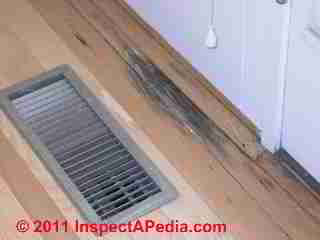
See MOLD CLEANUP - WOOD FLOORING where we describe removing mold from wood flooring surfaces.
Cleaning mold from wood framing, or wood building sheathing and similar wood surfaces is discussed
at MOLD CLEANUP - WOOD FRAMING & PLYWOOD.
Readers should also see the general advice
at MOLD CLEANUP GUIDE- HOW TO GET RID OF MOLD
Also see HIDDEN MOLD in FLOOR / SUB-FLOOR.
Also see TRAPPED MOLD BETWEEN WOOD SURFACES for a discussion of the immobility of mold between wood framing and other surfaces,
and see MOLD GROWTH on SURFACES for an index of what mold genera/species are frequently found on various building surfaces and materials.
Mold, Rot, & Odors in a Water-Damaged / Mold-Damaged Wood Floor
Question: do leaks, water damage & wood floor stains mean we have a significant hidden mold problem? Landlord says we need to move out.
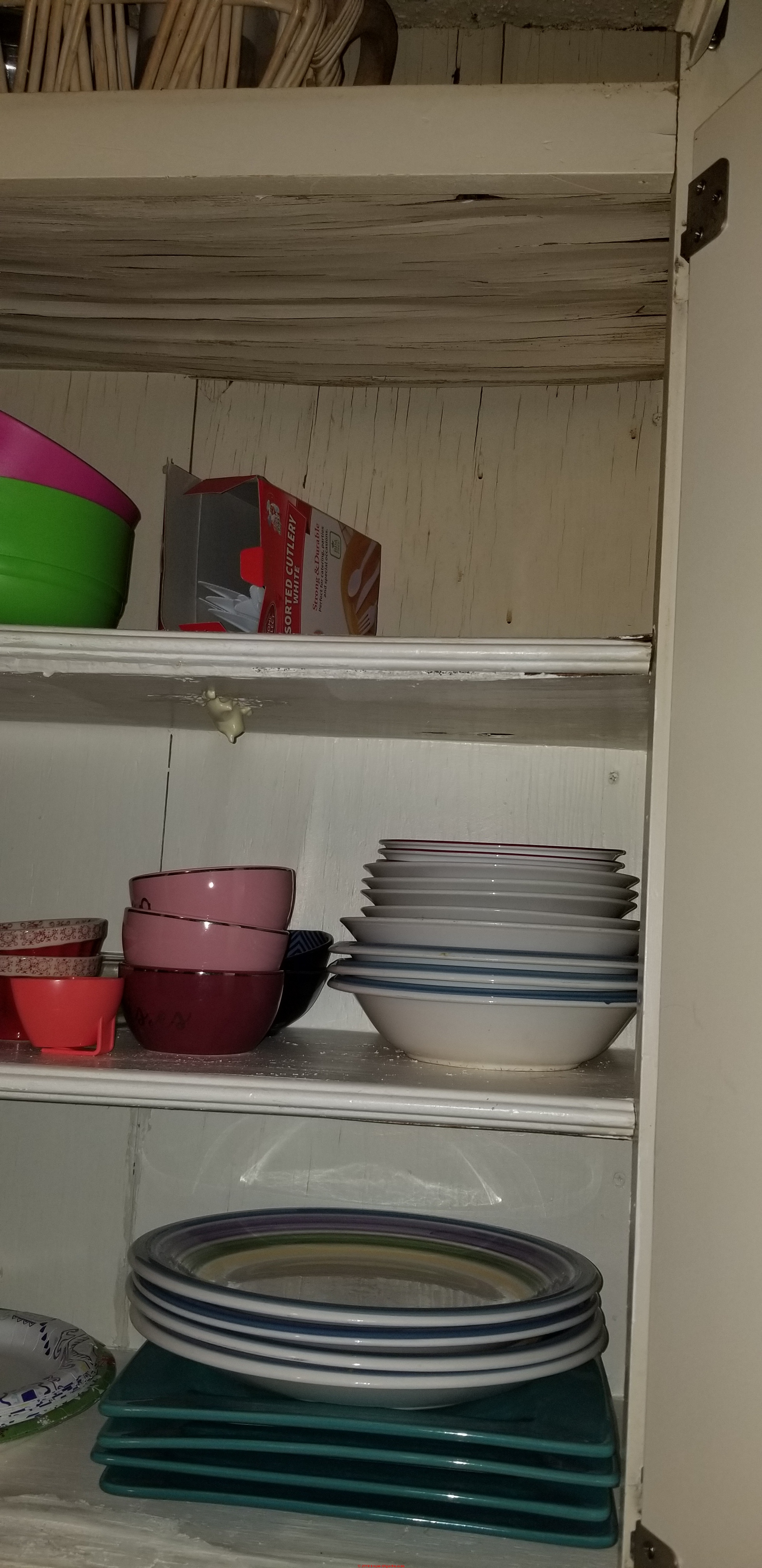 I wasn't really sure if I should post this on one of the advice pages due to the length of our story but feel free to if you think it might help someone else in our situation.
June of last year my fiancé found a house for rent through someone she worked with and we decided to go for it due to the large yard because we have multiple pets.
Bear in mind we live in Arkansas, the magical land of nonexistent tenant rights. Upon moving in we both started noticing seemingly random symptoms (skin issues, headaches, sinus problems, fatigue, etc.)
When we moved in we were informed of a home in one of the kitchen cabinets that was "caused by rain" but didn't think much of it.
We also had a problem with roaches around the fridge and found a sizeable hole behind the refrigerator which I've attached a photo as well.
Obviously the symptoms only increased in severity and only after an exhaustive online search did I attribute our symptoms to fungal infection. Prescription medication seemed to help at first but it all came back once we ceased the medication.
So in September I stumbled across Inspectapedia and finally made the connection that mold had to be the cause for our problems.
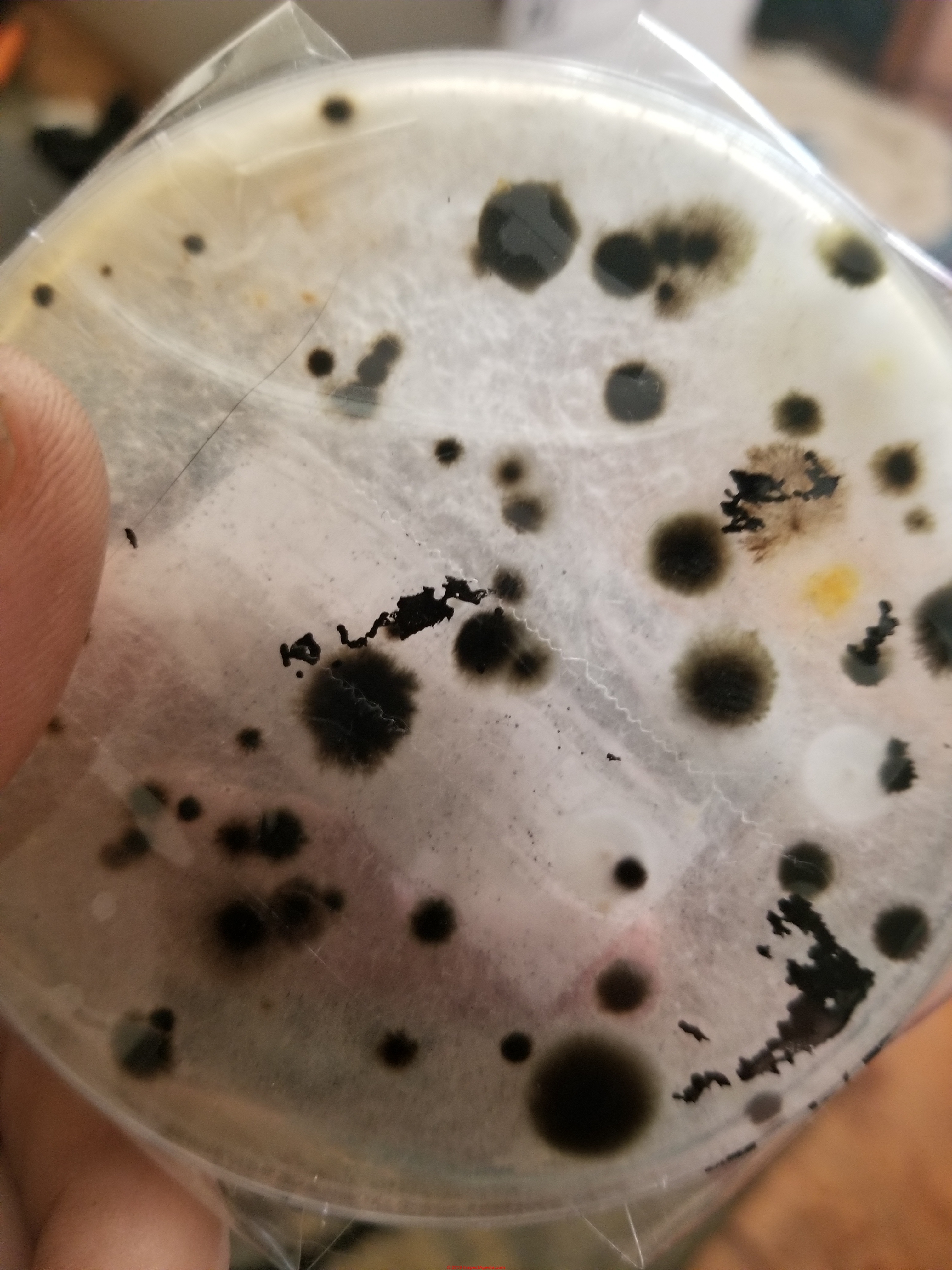
We got a mold test and the results were shocking to say the least. I've attached a picture of the results about the first test and the second test the second time we let sit on the living-room table for the allotted hour and then sealed it exactly is the instructions directed.
When we brought this to our landlords attention they didn't seem all that shocked by the information in fact they seemed like they might have already known about it and didn't show up until November to attempt any repair to the house.
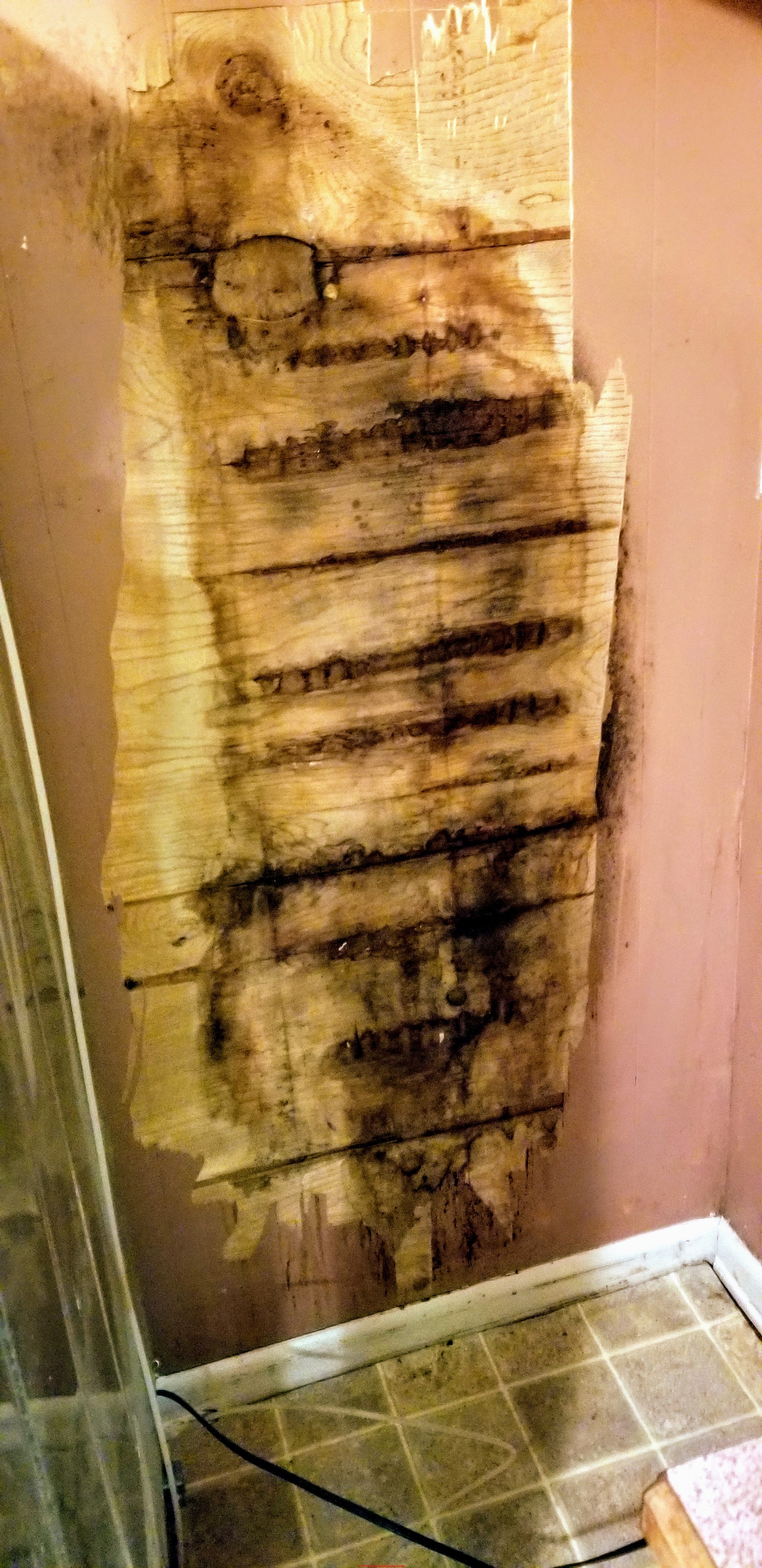
One night I got the bright idea to look at our crawlspace just to see and I've attached a video of what I found.
They showed up pretty quickly after receiving the video and supposedly pumped out the water and fixed the problem according to them. When I confronted them about what was to be done about the existing mold they replied with this text message:
"Take this months rent and find somewhere else to live ASAP, Since it is causing physical symptoms. To get rid of the mold 100%, we will have to gut the house and no one needs to be living there. We will take your deposit and prorate this months rent for however long it takes you to move."
This is two weeks before Christmas by the way. So we paid our rent because there aren't really a whole lot of places to move to at the moment we've been looking trust me.
We even had a mold remediation expert come in and evaluate the house and said we'd have to move out and they will have to gut the house which is interesting because that's what they said before we even had the expert come in to look at it. We're at our wits end and don't know what to do stop any advice would be greatly appreciated.
My main question I guess is with hardwood floors, is discoloration a bad sign?
I only got a few pictures of the house we're currently looking at. There's a basement which is uncommon in this area and also much more space than we expected however I'm timid about the fact that a lot of it's been painted.
Covering something up kind of painted I think. But here are a few pictures. The state of the floors are what concern me.
- Anonymous by private email 2020/02/04
Reply: your landlord is probably right
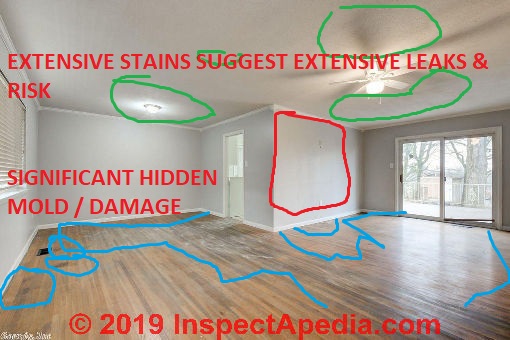
Your story and photos are all a "bad sign" based on the limited information we have at hand, C.H.
- Your landlord says they need to do a gut renovation and repair of the home and that you need to move out
- Your onsite environmental expert said there is significant mold hazard and that you need to move out
- Your photos suggest a history of leaks from above in building walls, and a paint-over without proper removal of moldy materials that may be present in ceilings, walls, floors
- Your medical complaints need to be considered and advised upon by your doctor but certainly sound as if they could be related to a building mold contamination hazard
- You should stop dragging your feet
- You may need to clean your own possessions in the process of moving them into a new location
Among your first batch of photos is one of a dish cabinet with badly water-damaged plywood shelving suggesting a history of building leaks from above.
Watch out: the very fact that the damage has been left in place, perhaps painted-over, is a suggestion that any repair work for prior leaks did not address all of the building cavities that have been wet. Wet building insulation or wall cavity side of drywall can present a significant but hidden mold contamination reservoir that can make building occupants sick.
[Click to enlarge any image]
In understanding the significance of stains on a floor we want to make a reasonable guess at the stain cause and thus at the implications for hidden damage, rot, mold, etc. in the building as well as the adequacy of prior repair work.
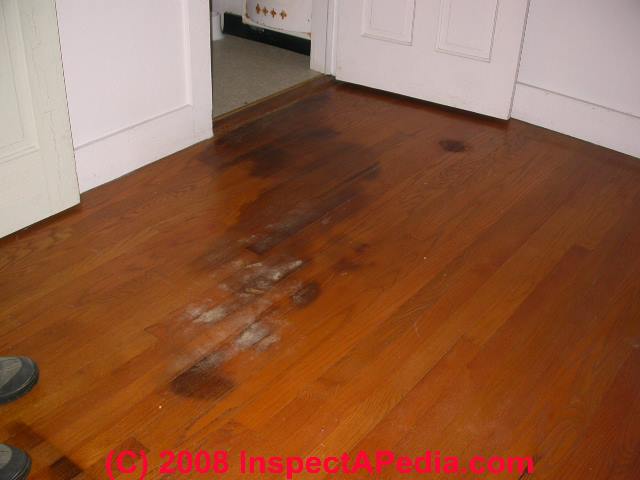
I can't see a thing in your kitchen floor photo but your first wood floor [annotated above] photos shows dark areas that are distinctly in a pattern originating at a doorway - possibly that's foot traffic or a possible prior leak in the kitchen if that's the doorway involved.
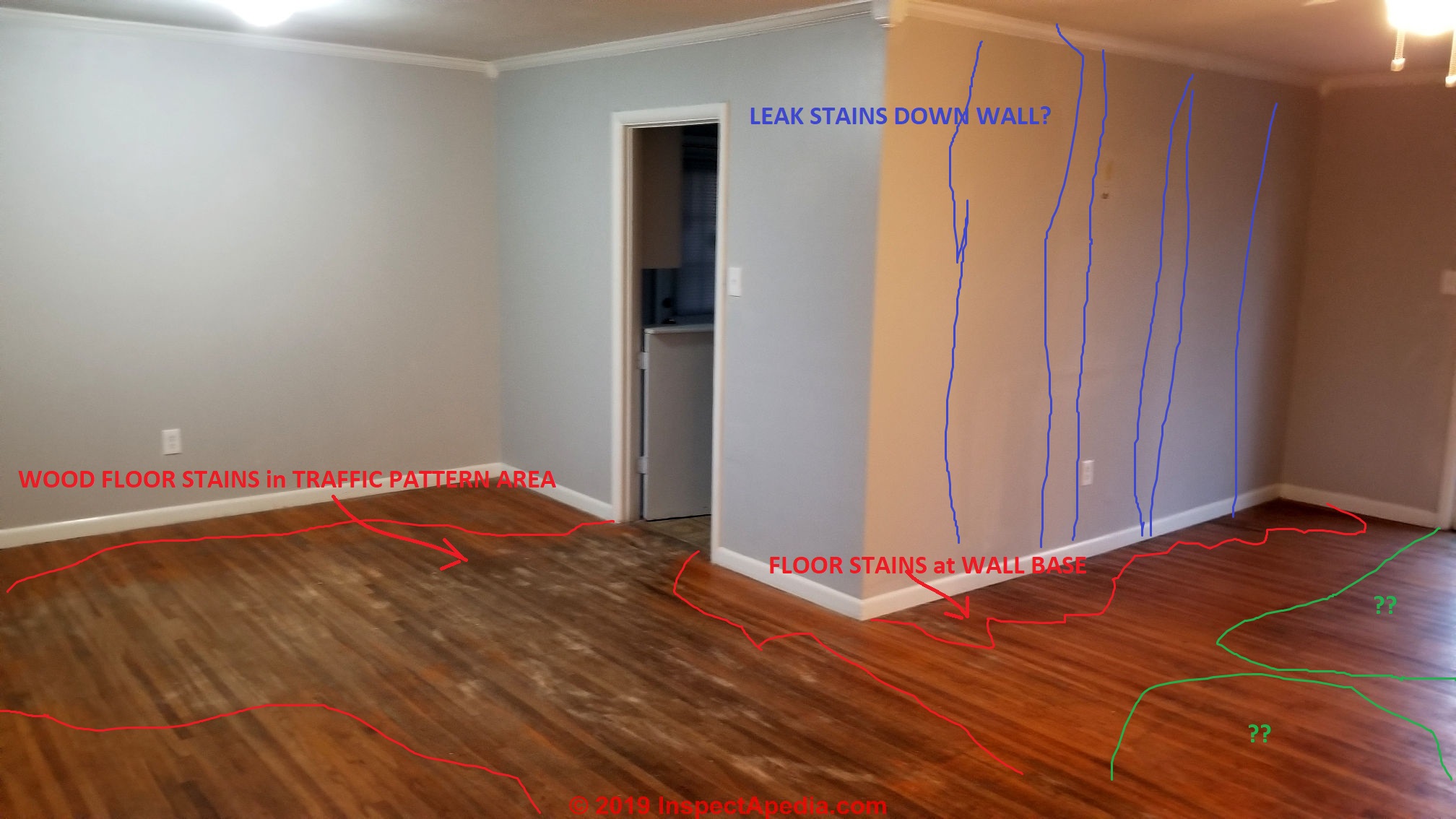
A companion strain to the right and "around the corner" from doorway No. 1 appears to emanate out of the wall. That's a further hint that there could have been prior leaks in the hidden "doorway" room or else from above.
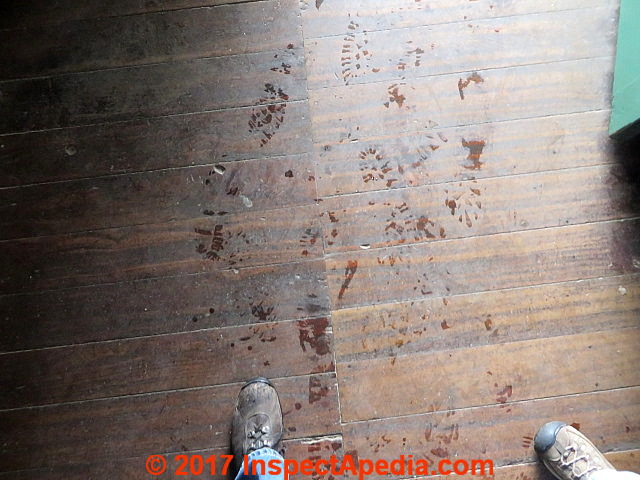
Other wood floor photos also show dark stains in traffic areas that could have been from leaks or, less likely by the pattern, animal urine. Were there previously pets in this home?
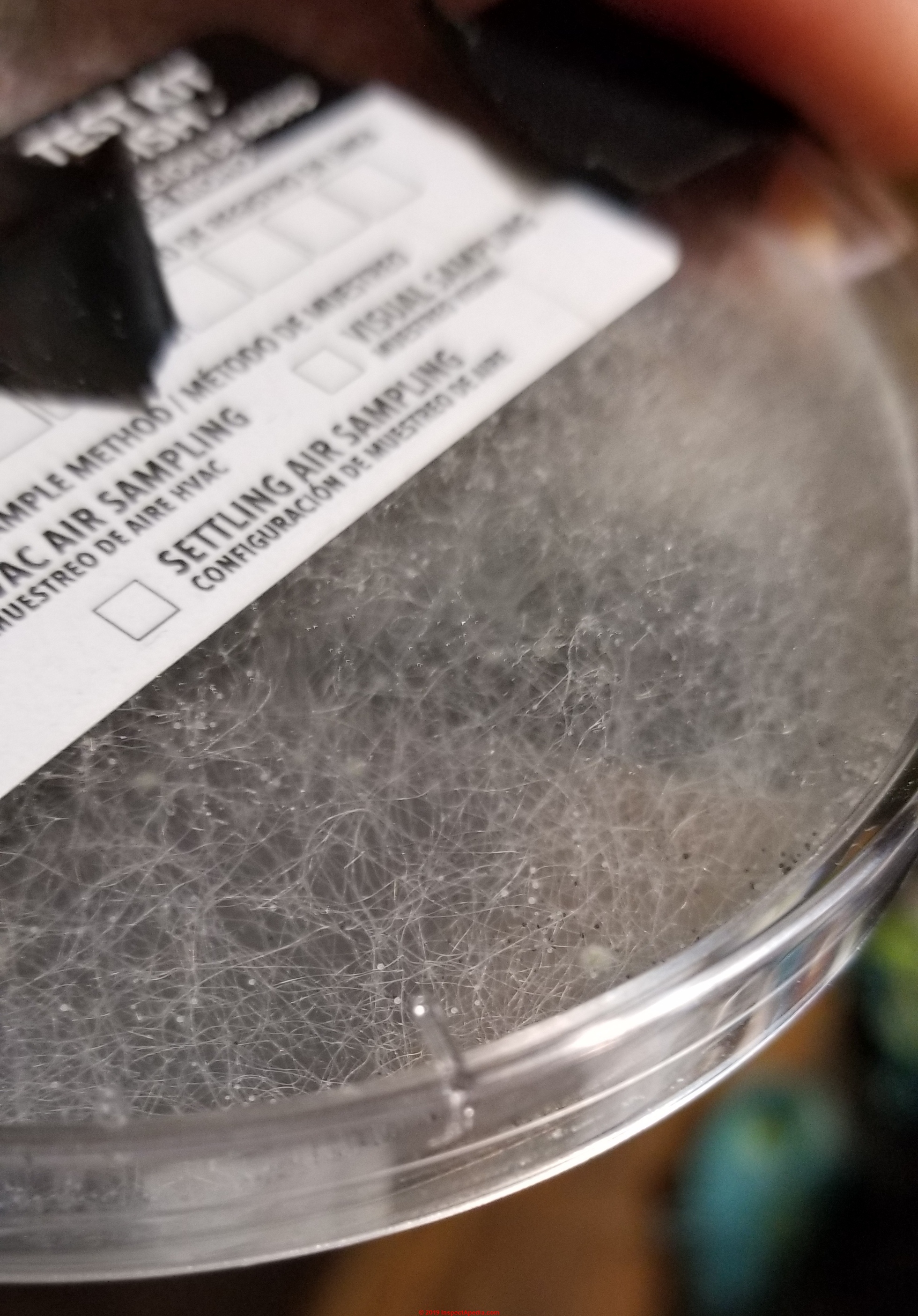 If there is no visible mold then an expert onsite inspection + building history (of leaks, moisture traps, renovations, repairs) can decide when and where more-invasive inspection for hidden mold reservoirs is justified.
Watch out: however. Though you didn't give details, relying on a "mold test" alone to screen a building for hidden mold is fundamentally unreliable, not diagnostic, not accurate, and can completely miss problems (false negative results) ; even if such a test suggests that a mold contamination issue is present the molds detected are quite possibly not the problem molds in the building, nor does the test alone give a clue of what to do next.
From the photos it appears to me that there are significant mold reservoirs in this biding and that someone simply cleaned and painted before re-renting.
Before tackling a moldy or mold-suspect wood floor take a look at
- FLOOR & SUBFLOOR MOLD, HIDDEN
- MOLD CLEANUP - WOOD FLOORING
- MOLD CLEANUP - WOOD FRAMING & PLYWOOD
- MOLD / ENVIRONMENTAL EXPERT, HIRE ? - when to hire an expert
Reader Question: how to diagnose a maple syrup smell in room with damaged wood flooring
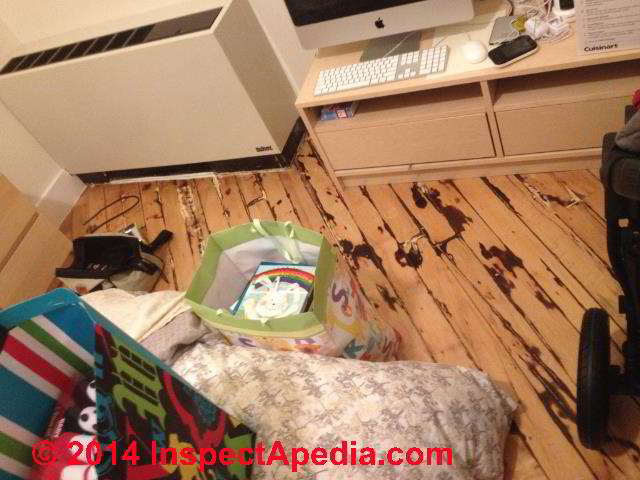
The owner of a building wants to know why this room smells from maple syrup, the odor is stronger when humidity is high, the wood is maple wood and those blotches seen is not understood, it’s a 100 year old building.
If you can’t make the connection with the information provided what testing do you recommend? - H.G., New York City, 3/20/2014
Reply: sources of sweet maple syrup odors indoors vs. mold damaged floor
I have not come across mold that smells like maple syrup, though consumption of fenugreek as well as other sources have been associated with that odor in buildings. Sweet odors have also been traced to bedbug infestations or cockroach infestations (NYC DOH).
Bees making a colony in a building wall can also be a source of waxy pungent odors. And a few readers have even described sewer gases as "sweet".
If the building is framed with cavity walls (not solid masonry) and more if occupants have noticed bees in the area I'd look for a bees nest independent of the apparent rot and fungal decay marks on the floor. Some insecticides or other chemicals applied indoors (perhaps a DIY attempt at mold "treatment") also give off sweet pungent smells.
Indoor building mold contamination itself is not generally described as making sweet odor but there is indeed such a huge range of mold genera species that no one should assert the presence or absence of a particular odor as mold-related just based on "opinion".
There is even a fungus that produces MVOCs that smell like dirty socks.
The stains on the floor look to me like a mix of wood rot and fungal damage that may have been sanded (without repair) and even re-finished.
I add that without an onsite inspection or a physical sample of the light yellow material seen in the flooring gaps I can't say if the material is fungal remains or wood filler (perhaps used to fill in worse rot areas).
It's no surprise that a 100 year old building may have had heating system leaks or other leaks into the floor cavity and floor rot (wood rot is itself a fungal and bacterial action). It's not unheard-of to come across a floor that was re-finished by sanding over rot, filling a few bad spots with wood putty, and coating the new floor.
A close visual inspection that shows that these discolorations were sanded flush and coated-over would argue convincingly for this history.
The pattern of the light yellow material is very strongly suggestive of having filled gaps and areas of rot or other damage with a wood filler product that was then sanded. It is not laid-out in a typical fungal growth pattern.
The pattern of the dark stains could be rot left in place, or other damage at which the surface was concave and not sanded off during floor re-finishing.
I speculate that this is a water-damaged, rotted floor that was sanded and re-finished without pulling up damaged flooring and without cleaning the area below.
Pet Stains on wood floors
Pet urine stains on wood floors - pet stains can ruin wood flooring. Stains are deep enough into the wood that almost no amount of sanding will remove them.
We have had some wood floor stain removal success by careful, by-hand bleaching combined with sanding, followed by careful blending of hand-mixed wood stain products to return the color of the wood floor section to that of its neighbors.
Nail & moisture stains on wood floors
Where small black stains developed in a wood floor in a 1920's bungalow that we restored (our lab and office) we had great success by combining sanding with spot bleach using a Q-tip to lighten the black spots where in prior years moisture had caused bleed and corrosion staining around those fasteners.
Any exposed nails were set into the flooring before sanding. After sanding we sat with a Q-tip and a damp cloth, dabbing and bleaching black spots, wiping and washing off the bleach when the stain was light enough - thus avoiding over-bleaching the floor.
We mixed wood stain products to bring the color of the stained-bleached spots back to the surrounding flooring.
See PET STAINS & MARKS in BUILDING for details including on removing stains from flooring left in place.
Replace Damaged Wood Floor Boards
 Details about how to cut out and replace damaged wood floor boards or damaged engineered wood flooring sections are now found
at REPLACE DAMAGED WOOD FLOOR BOARDS - how to cut out and replace badly-damaged wood or engineered wood floor boards
[Click to enlarge any image]
It is always smart to use the least-invasive, least-destructive repair or renovation method you can. Floor boards that have been stained, gouged, scratched can often be repaired in place.
Also see WOOD FLOOR ENGINEERED, REPAIRS
Also see LAMINATE FLOOR DAMAGE REPAIR
Also see LAMINATE PLASTIC FLOOR
Surface Scratch Repair on Hardwood Flooring
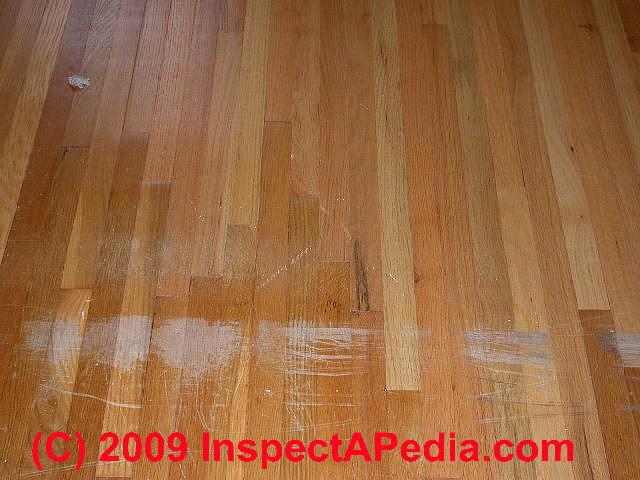
Here is a long strip solid oak wood floor that's shows ugly but fairly superficial scratches. To make this 1970's strip oak wood floor look perfect, sanding and re-finishing may be necessary.
But an alternative to try first is thorough cleaning, perhaps buffing with steel wool, followed by application of a sealant and finish coating.
Often superficial scratches in a wood floor disappear from view when the scratched finish coating is restored.
It's usually a better practice to repair a floor with the least aggressive means possible, preserving the material for a longer life.
At WOOD FLOOR ENGINEERED, REPAIRS we include research, procedures, and products to repair gouged and scratched hardwood and engineered wood floors.
Diagnose & Repair Water or Solvent Stains on Laminate Flooring
Several of the types of flooring damage discussed above, beginning
at BUCKLED WOOD FLOORING due to leaks or high moisture, describe water or moisture damage to floors.
Stains, gaps, buckling, warping and mold are all water-related or moisture-related problems in flooring systems.
At LAMINATE FLOOR DAMAGE REPAIR we add another flooring damage example provided by a reader who included photos of what appears to be a water or solvent-damaged laminated flooring product, probably plastic, not wood.
...
Reader Comments, Questions & Answers About The Article Above
Below you will find questions and answers previously posted on this page at its page bottom reader comment box.
Reader Q&A - also see RECOMMENDED ARTICLES & FAQs
On 2024-01-07 by InspectApedia Publisher - information on moisture expansion rates by wood species
@S.G.,
You may have read
WOOD FLOOR MOISTURE
where we summarize this topic.
I'll find out information on moisture expansion rates by wood species and add a reference here.
As we noted, wood species and moisture changes are key,but so are installation, finish coating etc
Frankly in a new home I'd not expect to see any noticeable gaps opening up in a finished maple floor unless there were a moisture question.
Were these prefinished boards or was the floor nailed down gen sanded and coated?
also see
WET, DEFINITION OF https://inspectapedia.com/interiors/Definition-of-Wet-Building-Materials.php
where we describe critical moisture levels for various building materials
WOOD FLOOR AGE TYPES HISTORY https://inspectapedia.com/interiors/Wood_Floor_Types.php
where we compare the properties of different wood flooring including vulnerability to moisture/heat expansion/shrinkage
On 2024-01-07 by S.G.
@InspectApedia Publisher, ok, fair. Any opinions on maple when it comes to moisture, and/or 2 1/4" wide boards (which aren't especially large)?
On 2024-01-06 by InspectApedia Publisher - the wider the board, and the higher its initial moisture level, the more shrinkage you'll see
@S.G.,
The wider the board, and the higher its initial moisture level, the more shrinkage you'll see - the wider the gap. Wood species is also a factor, and temperature (slightly) as well.
It's not, IMO, a question of too big. It's why and what to expect later.
I suspect either a high building moisture level before winter or the flooring moisture level may have been a bit high when installed - sometimes seen if it was installed in a hurry without time to acclimate to the building before nailing.
On 2024-01-06 by S.G.
 Hey, back again from a couple other subforums here. (Thank you so much for this site, by the way. It's been a lifesaver.)
On the topic of gaps between wood floor boards: How big is too big?
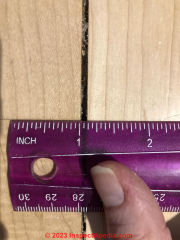
We're coming up on our first true winter in our house and, in the totally normal way it does in that season, some floorboard gaps are getting wider. In most cases, the gaps go all the way across the floor, in the direction the boards 'travel'. We're noticing it more on the second floor than the first. The biggest gap we saw is about 1/8"; see photo. The boards are maple, 2 1/4" wide.
Part of why we ask is because we still have our eye on a possible -- yes, we don't even know if it's actual yet -- hydrostatic issue in the basement, and we haven't had a chance to have out a pro because of the pandemic.
We first found out about the possible issue when we had a polyurea coating installed on our basement floor, and in a handful of spots liquid seeped up THROUGH the coating, something the installer had never seen and the manufacturer said they only saw due to hydrostatic pressure or a worse issue less relevant here.
Since then, the more eagle-eyed person in the household has noticed places the floors sag or rise, maybe walls that seem a degree or two off of vertical, and maybe even a subtle tilt to the overall house.
It's nearly impossible for a house to be truly 100% level, especially one 84 years old like ours is, but we're mostly double-checking with more experienced folks to ask if this kind of gappage seems totally normal, or is also seen as slow progression in an ongoing problem. (We've tried to ask our inspector, but they've been not especially responsive.)
We may eventually shell out for a residential structural inspection by a structural engineer for peace of mind, but we're curious if you have any weigh-in here.
On 2023-07-29 by InspectApedia Publisher - insect damage to the wood flooring
@Rachel,
That looks as if there's insect damage to the wood flooring and where the insect damage is close to the surface of the boards within upper layer is breaking through perhaps from foot traffic above. Absolutely if you see any signs of fine sawdust or mud tubes then there's an active insect infestation.
In any event further investigation would be appropriate including some careful probing and an inspection of the floor from below for insect activity not just in the flooring but in the supporting framing.
On 2023-07-29 by Rachel
We have areas on our old wooden floor the are very slowly appearing to get larger. We have not noticed any sandwood, nor multi tiny holes as typically seen in wood borers.
Is this something we should be worried about and actioning quickly given the very slow change we have been noticing on particular areas of the home? These areas are quick far apart.
On 2022-12-27 by InspectApedia Publisher - gaps in parquet flooring can be rather common
@mgever,
The gaps I see in that parquet flooring are in my experience rather common, especially in a floor as old as yours. I'd like to look more-closely but clicking to see an enlarged, higher resolution copy of your image gives a photo that's just too small to see detail.
So I can't say whether I think this is old damage that simply wasn't noticed previously (we often think something we didn't notice before is "new") or whether there's evidence of water damage or some other problem.
If you are 100% certain that this is a change in the condition of the floor, we ought to be able to trace the change to a building event, usually water-related.
Also diagnostic: where are you seeing these differences: in one spot, in many spots, and what potential water or heat or movement sources are nearby?
Perhaps you can try making a higher-resolution photo so that we could take a closer-look.
On 2022-12-27 by mgever
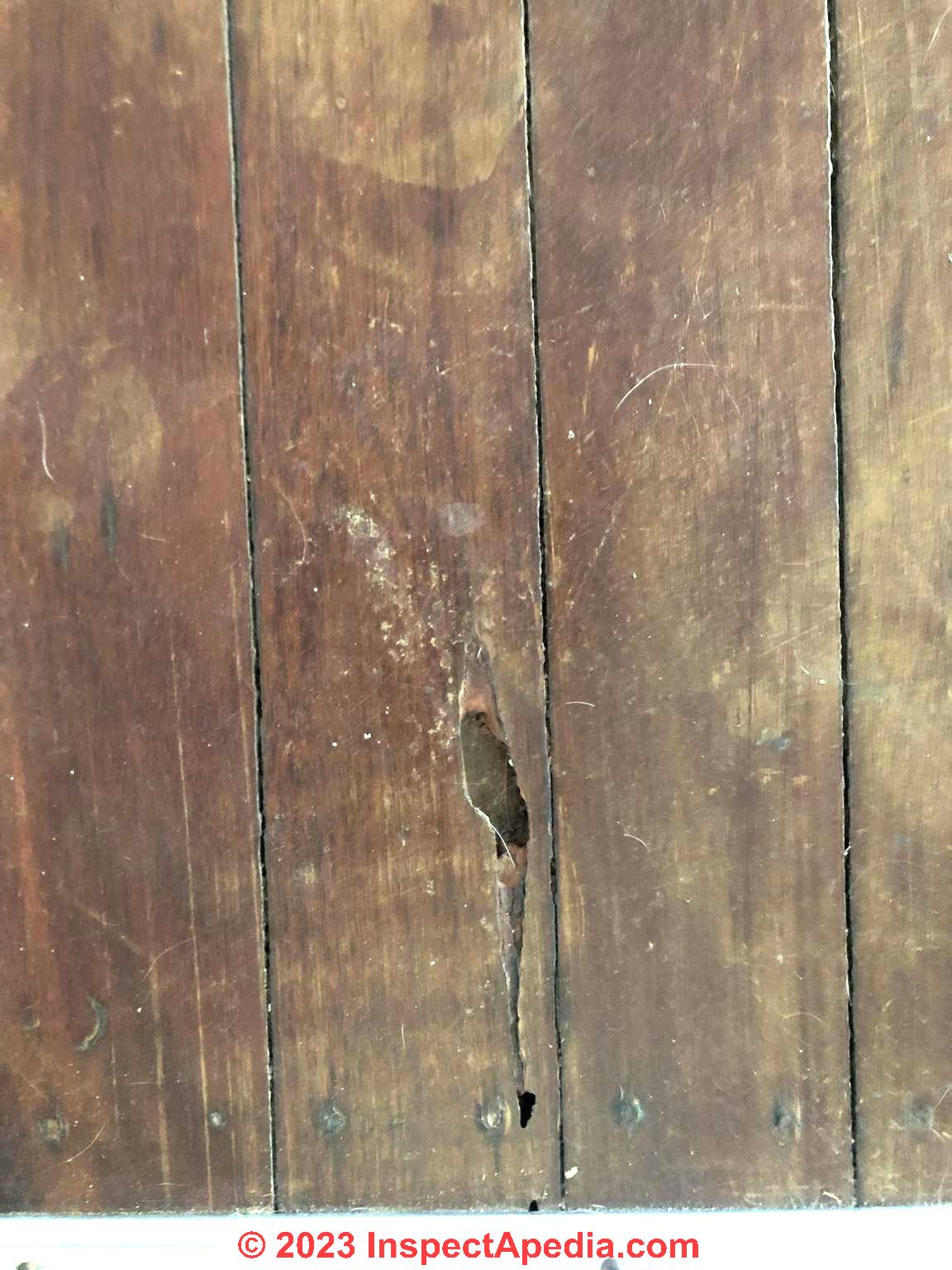
The wood floor boards developed wide cracks, dark areas, and uneven surfaces within one year, and I do not know why. The building was built in 1939. The floors were almost flawless in 2013, when I moved in.
But in the fall of 2020, the cracks appeared and grew wider, a few boards split, and further damage appeared. The problem worsened noticeably afterward. What would cause this to happen?
On 2022-09-14 by InspectApedia (Editor)
Flooreeta whose advertisement link is disallowed by our policy, said:
If you’re looking for ways to protect your hardwood floors from scratches and dents, you might consider using something under your bed. There are a number of different options, from area rugs to furniture “coasters” too thick pads. It really depends on the type of flooring and furniture in your room. flooreeta [dot] com
We welcome content criticism, suggestions, corrections, and are then happy to cite content contributors including their contact information.
On 2022-04-11 by Inspectapedia Com Moderator
@Tien,
Please keep in mind that when all we have is a bit of text in a single photo no opinion reform or advise we offer can possibly be complete and is likely to miss important information that will be obvious to any expert who actually comes on to the site.
However I can tell you that you won't be able to repair water damage working only from the ceiling below as it appears that water also ran into the wall cavity.
On 2022-04-11 by Tien
@Inspectapedia Com Moderator,
It’s also damage my floor because the part of floor is uneven and is sagging about 1/2-1 inches near the bathroom door in the master bedroom. Do you think it is easy fix?
Are you going to take the whole floor or part of the floor to fixed or are they going to take apart the downstairs ceiling and work from there?
Thank you.
On 2022-04-09 by Inspectapedia Com Moderator - source and extent of damage will determine time frame of repair
@Tien,
That added information is helpful but incomplete.
I don't understand whether the leak was from a toilet drain, in which case the wax ring seal may need to be replaced, or whether it was from the water supply to the toilet flush tank.
Leaking clean water into a building cavity is less hazardous than sewage water.
If there was a leak into building wall, ceiling or floor cavities it would be a mistake to leave those unattended and simply wait for them to dry.
The risk is developing a significant mold contamination issue that later becomes more costly to remedy.
So it's worth a bit of careful investigation, perhaps even cutting one or two small test openings to inspect the wall or ceiling cavity.
Most-likely you're going to need to have wet drywall and insulation removed, the cavities cleaned, dried, and then the building restored.
How long that will take depends on how long it takes you to get a contractor to do the work.
On 2022-04-08 by Tien
@Inspectapedia Com Moderator,
Thank you for your reply. The leak appear to be from the toilet and the cause the the pipe wasn’t tighten. I got specialist come to look at it in 2 days. It been leak for 2 1/2 days from upstairs toilet to 2 of the guest bathroom downstairs and also some in the hallway.
Do you think it’s badly damaged? And usually how long it’s going to take for the restoration?
Thank you so much for answering my questions.
On 2022-04-06 by Inspectapedia Com Moderator - toilet leak leads to wall and floor damage
@Tien,
You need an on-site inspector, perhaps a skilled home inspector or siding contractor to find the source of that leak outside above or alongside your window(s). - No repair will be effective before the leak is fixed.
And then you'll want to check the wall cavity for hidden mold.
Keep me posted - let me see photos (one per comment) of what else you find.
On 2022-04-06 by Tien
Water leak damage for 3 days while on vacation
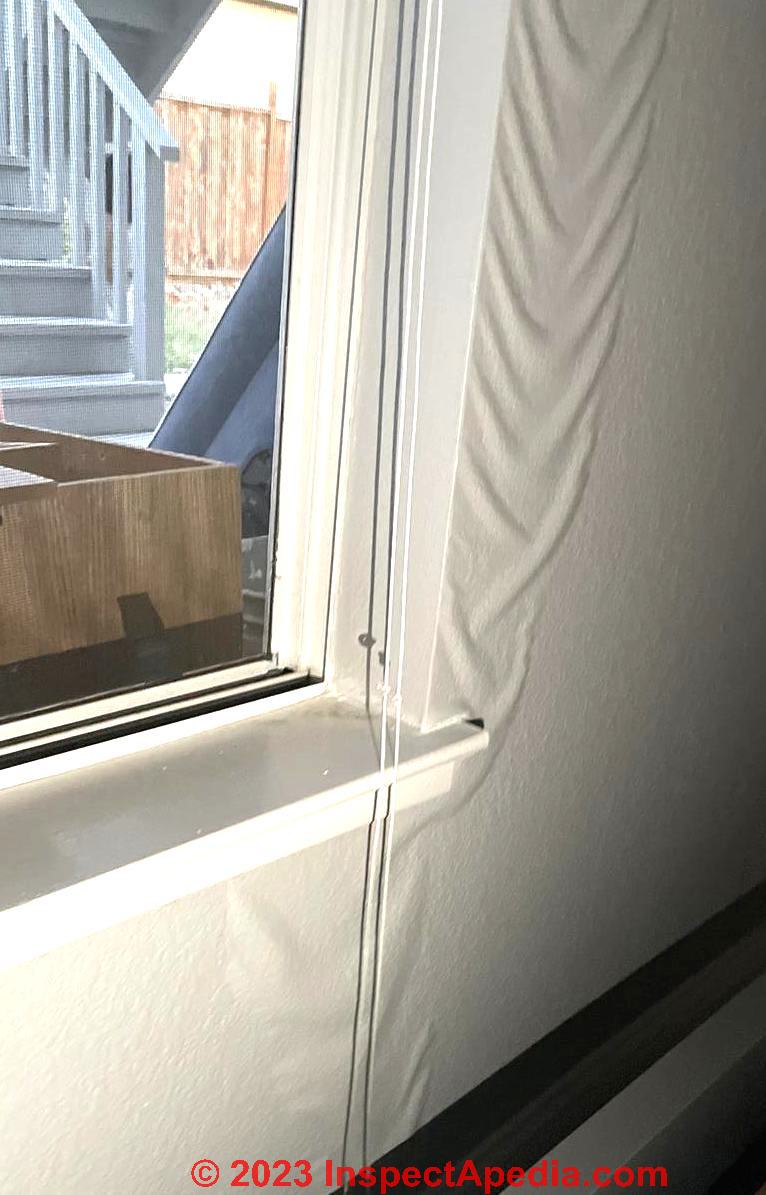
On 2022-02-06 by Inspectapedia Com Moderator - oversanding seems to have caused floor damage
@Anonymous,
Can you post some photos? From just your note I can't guess at the condition of the floor nor the nature or cause of any gaps or cracks or holes.
Normally sanding floorboards won't itself "cause" such damage.
Post as many sharp hi res photos as you like, 1 image per comment. So we can take a look.
On 2022-02-06 by Anonymous
Our Oakwood floors of 36 yrs had scratches from our dogs. They were beautiful and tight, however, we had someone come in and sanded all the floors in the Livingroom, Kitchen, Dinning room, bathroom, and 2 hallways.
He sanded all the floors for 3 hours, 4 times, 4 days. That's 8 hours. We believe that it was way to much sanding to be done and it made the floors very weak and unstable. We now have over 100 large spaces throughout all 4 rooms 1/16 to 1 inch spaces in all floors.
This guy left an abundance of holes in our floors. They were from a nickel to a half a dollar size. He destroyed our walls, kitchen cabinets, stove, refrigerator, floors and all walls from the floor to ceiling had so much dust it destroyed our new heating and air conditioner, he destroyed the base boards and moldings etc.
The floors are so week now, we believe they are from over sanding. Does this happen with over sanding to the floors with the large spaces and the floors being unstable from over sanding?
We believe we will have to have all the wooden oak floors replaced. It is a complete disaster. We would appreciate your advise and suggestions Please?
On 2021-12-09 by Inspectapedia Com Moderator
@Steve,
In order to understand the question and the problem and to even think about whether a cure is needed and how it would be done we would need to see the floor and to know more about the conditions to which it has been exposed. Try posting a photo showing the trouble. Use the ad image button.
On 2021-12-09 by Steve
Installed new engineered flooring a couple few months ago, covered with paper after install to protect.. looked great. Looked great after paper removed. Owner cow says it’s fuzzy and some of the.factory patch is loose. Very strange. Hard to believe it’s the flooring or install.
On 2021-06-02 by inspectapedia.com.moderator
@Cameron Gabrel,
You can use a color-matched wood-filler or even a glued-in strip of matching flooring but
Watch out: first find out how much insect damage there is and whether or not there's an active infestation that needs treatment.
On 2021-06-0 by Cameron Gabrel
What could cause this shredding of the oak? I pulled the shredded oak out of a small crack in the top of the piece of wood.i opened it up so I could clean it out. What should I fill it with? Flexible call comes to mind.
Thank you!
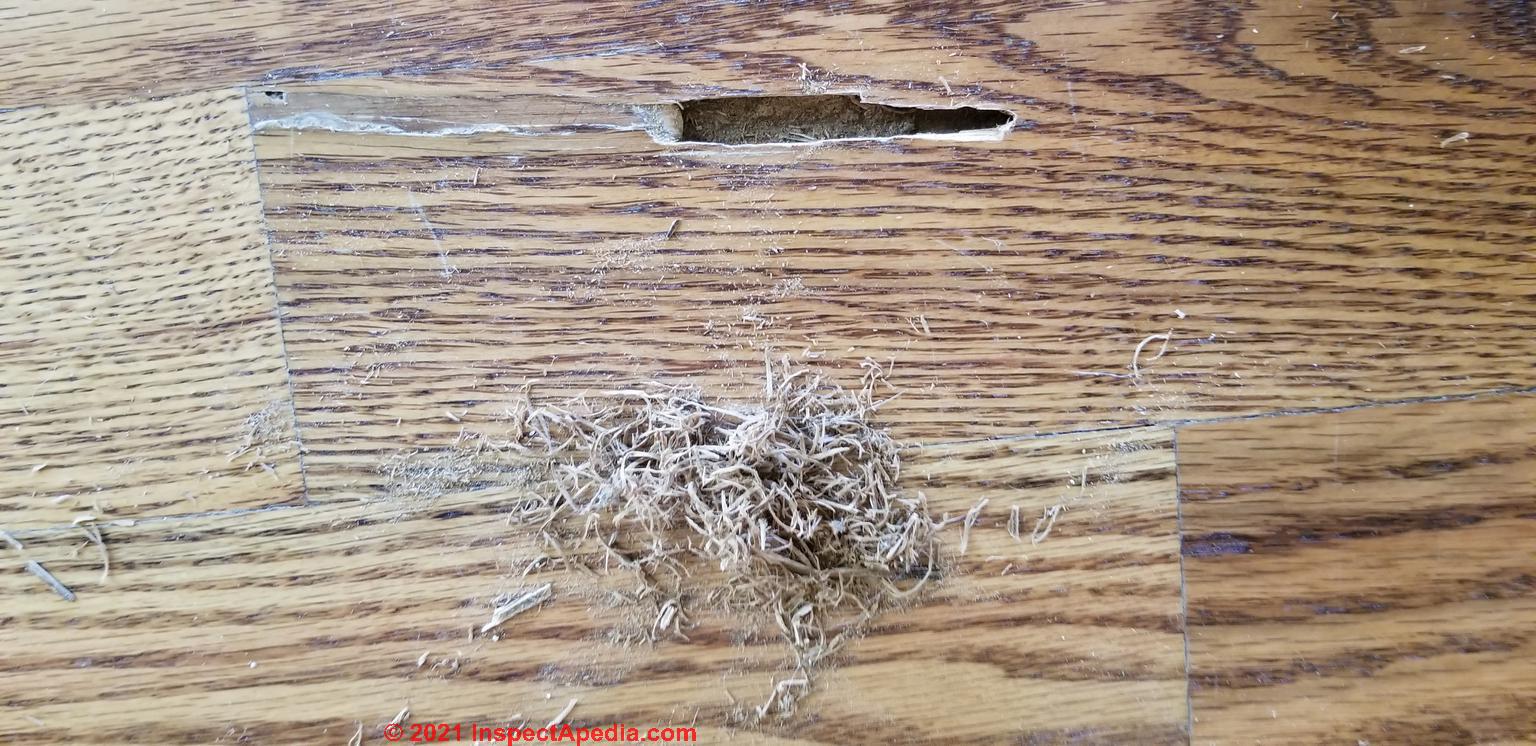
On 2021-04-23 by (mod) - identify animal scratch damage to wood surfaces or flooring
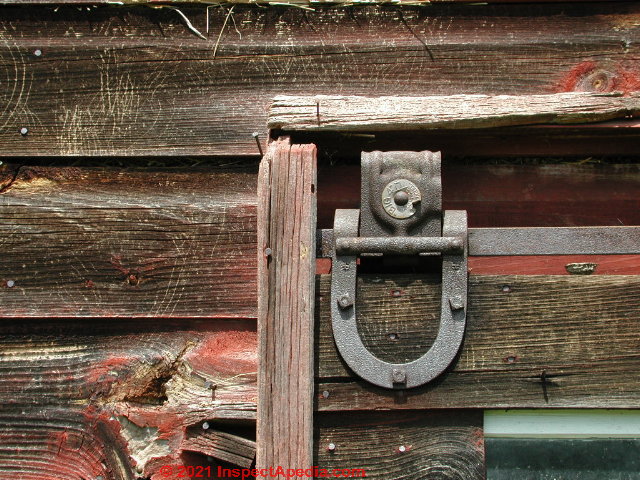 @Elizabeth Villalobos,
I'm not sure if we're seeing marks or scratches made to the floor after it was installed, or on the wood when it was finished in the first place (E.g. for reclaimed wood )
When evaluating damage to a laminate type floor it is very important to know what material we're working with:
- engineered wood laminate
vs
- plastic laminate
for example, is an important distinction because the different materials respond very differently to different events, spills, traffic, stresses.
Also it's perhaps a bit too speculative for any on to diagnose "an uneven" feeling in the floor without knowing
- what the flooring product is
- therefore how it was supposed to have been installed
- how the floor was actually installed: adhered, nailed, floating, clipped
- over any intermediate layers such as rosin paper
- over what surface it was installed and what was the condition of that surface
- how that surface was prepared
- and to what events has the floor been subjected: leaks, water entry, spills, heavy traffic, building movement, pets, etc.
I worry that you'll think I'm being difficult, but frankly any "EXPERT" "diagnosis" and "recommended cure" for damage to your floor would be very speculative, perhaps not even useful, unless a lot more is known about it.
Can you take a look and more photos (perhaps shining a light along the floor surface) you can post one photo per comment but as many comments as needed;
I'd like to know the size, location, traffic pattern, age and type of flooring, and when these were first noticed;
building history: of pets, renovations, etc. is also helpful.
I would like to see some sharper photos of that I could in large it for a clear review but in your initial image I see what looks like scratches, possibly even from an animal.
You'll see some similar scratches at RACCOONS in the ATTIC
See more examples of animal scratch damage to building surfaces at
ANIMAL STAINS & MARKS in BUILDINGS
and larger-diameter ones (e.g. dogs) at ANIMAL DAMAGE to BUILDINGS - home
At the page top EXPERTS directory, find and discuss your concerns with some home inspectors to find one who's experienced and thoughtful about floor damage.
Above is an example of animal scratches, probably a raccoon, on a building exterior. (Of course I'm not claiming you've got raccoons in your living room.)
More diagnosis and repair advice is at
LAMINATE PLASTIC FLOOR
and at
WOOD FLOOR ENGINEERED, REPAIRS
On 2021-04-23 by Elizabeth Villalobos
Laminate flooring installed but boards have unusual marks discoloration on boards.
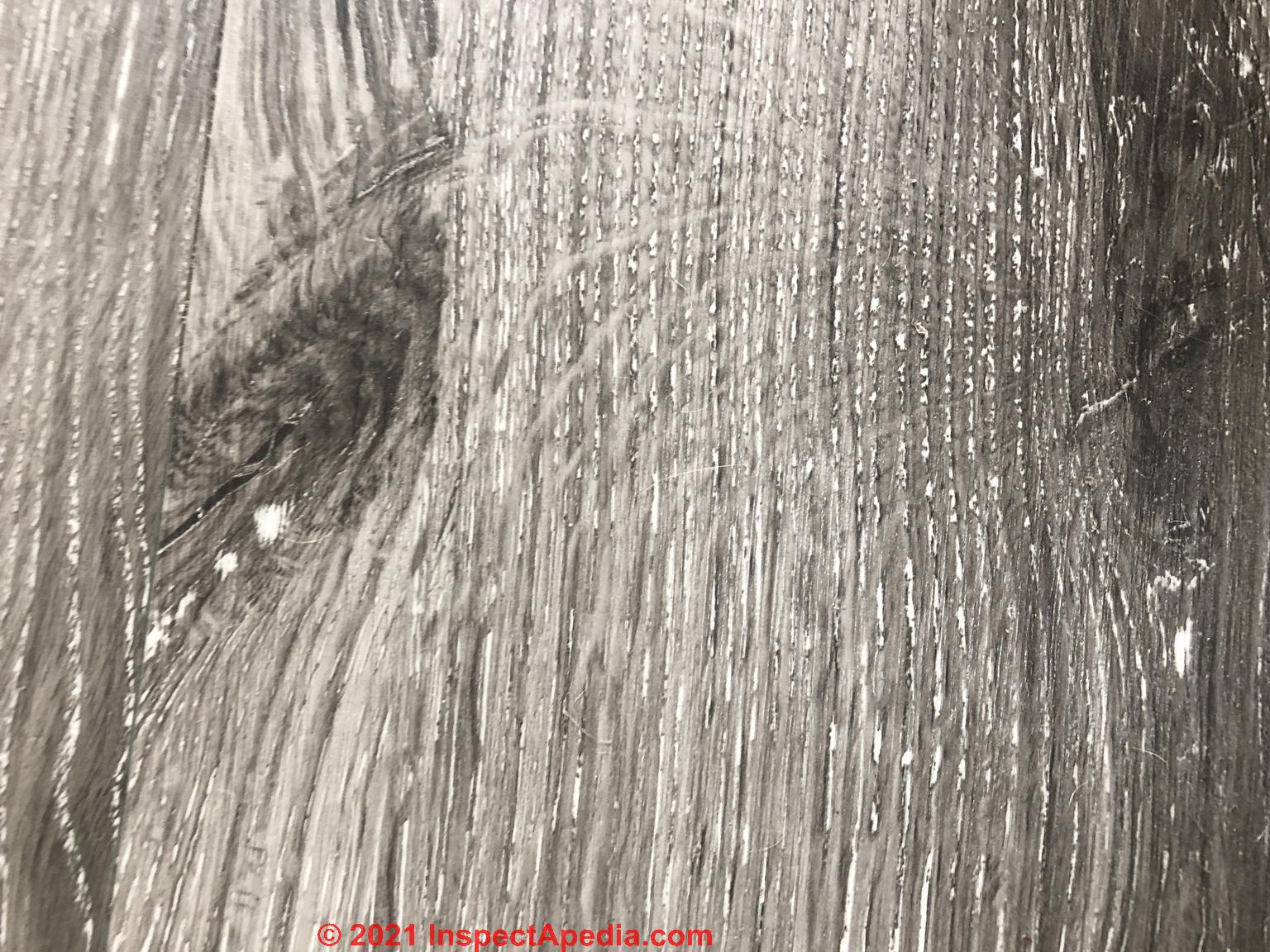
Also when walking on flooring it’s feels very uneven. Is there a company who can inspect and create a report on the findings
Continuing further:
In a private email to us you stated
Due to a house fire the house needed new flooring. Laminate is chosen. The boards look discolored with unusual marks.
Also when you step on floor it feels uneven and unstable . Is there a certified inspection company in whittier that could inspect and create a report of what is wrong and recommends how to correct the problems if they find them ?
Watch out: if a building has suffered a fire there could be quite a few other sources of flooring trouble depending on again another set of questions and facts:
- extent and location of fire damage
- condition of the building when repairs were made
for example, if a water-tight laminated floor was put down over wet or damp subfloor I'd expect future flooring problems with warping, movement, possibly even effects on the floor finish (and also a risk of hidden mold contamination)
On 2020-11-01 by (mod) - remove white stains from laminate flooring?
Anne:
1. first determine if the stain is on the wood surface or if it's moisture related and is underneath the finish coating- make a very close inspection, using good light and a magnifying glass.
2. review the history and details of the installation. Was a glue used, or was a finish coating applied, or was there a spill or what?
If the white staining is water damage it may not be possible to simply clean it off of the floor surface, and in the case of plastic laminate flooring, the only cure may be to replace that section.
Don't try more aggressive solvents as you may damage the floor finish.
I always try removing a dried-on spill (if that's what it is) using the least-aggressive cleaner first, in small quantity, in an unobtrusive test area first.
Safe floor stain removers to try
- Water - but don't leave water on a wood floor
- Goo-Gone
- Odorless paint thinner
are usually pretty safe.
On 2020-11-01 by Anne
I just installed a dark hardwood flooring.
The person that Installed left white stain all over not sure if it is glue from the wood that glue the flooring or from the tape he was using to hold it.I have used solvent but it did not fixed. What is your advice?
On 2020-09-21 by (mod)
Chris:
I'm not a structural engineer but anybody is permitted to consult standard framing tables for wood frame construction.
While old houses and unseen construction are likely to vary from standard and might be less strong, to permit any useful response we'll make an assumption that your first floor framing is in perfect condition and framed to modern framing standards.
Standard first floor residential floor framing is designed to support 30 to 40 pounds per square foot.
Your "parallel to joist" shelving in your sketch has a footprint of
1.29 x 6 ft. = 7.77 sq.ft.
1,025 lbs / 7.77sqft = 132.25 pounds per square foot, that's more than three times the anticipated live load on the floor.
That analysis takes into account that some part of the load under the record shelf is transferred to nearby joists through bracing (if any is present) and by the sub-flooring and flooring.
I would not put such a heavy over-load across the existing floor. I would double or triple the joist below the shelf to form a beam that I'd support by concrete-filled Lally columns that rest on solid masonry block piers.
I have inspected homes that sported huge record collections that actually sagged the floor structure and that in a few cases ripped framing away from the rim joist or even broke a joist.
On 2020-09-21 by Chris
I have a 3-unit rental building that was built in 1895. Frame house, 7’ concrete foundation & basement. Old but solid. A tenant wants to move in with 3 - 6’H x 6’W x 15.5”D record shelves. We did the math and it’s roughly 1,025lbs. for each shelving unit when it’s filled.
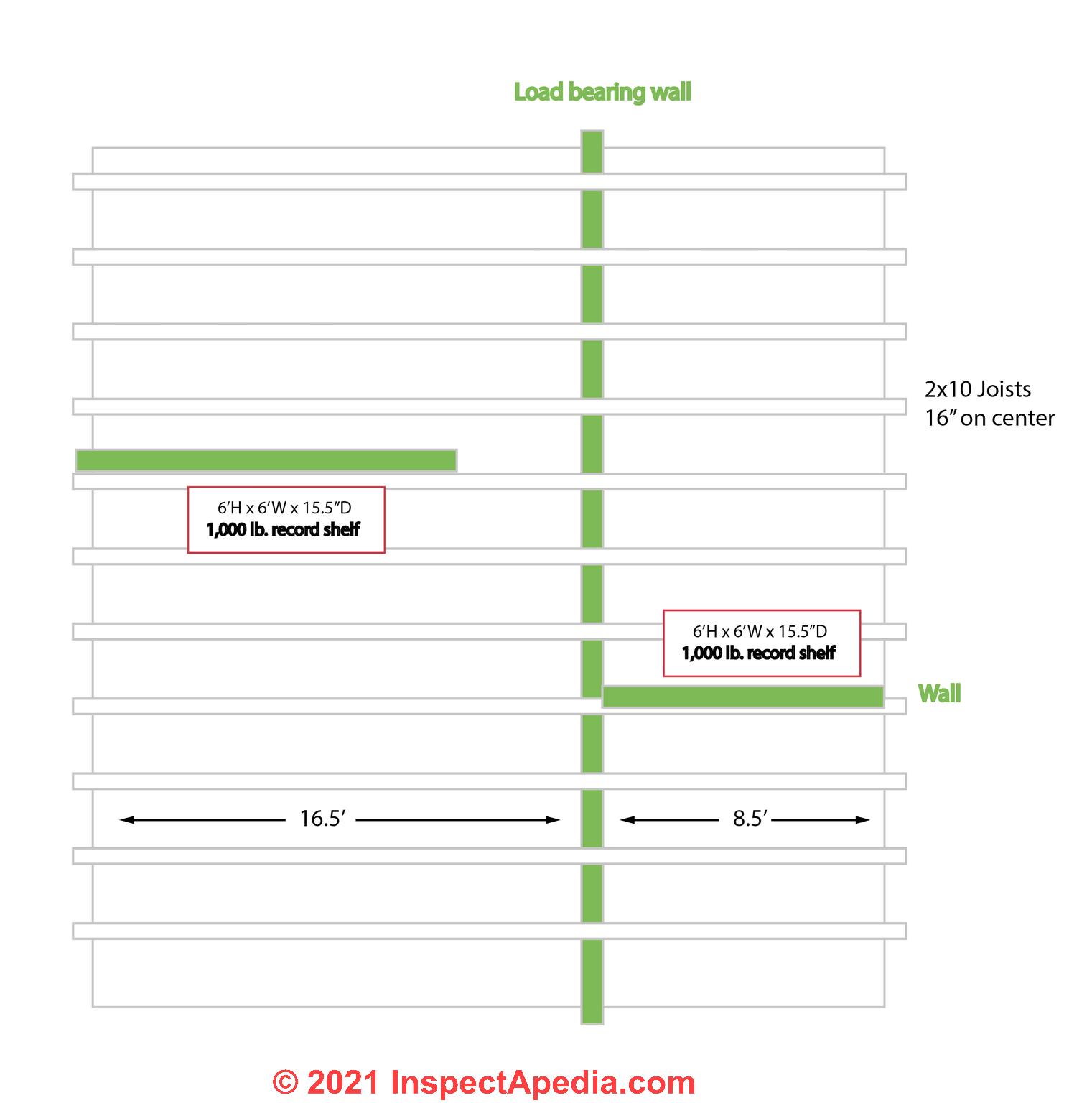
They would be on the first floor (basement underneath them). He’s putting one against the outer wall, perpendicular to the joists. So it would sit on top of at least 4 joists, not as worried about that one.
The ones I’m worried about, he wants to have them sit on walls that are parallel to the joists. One would sit on just a single joist. The other would just barely sit on 2 joists.
So 2 questions:
Can one 2x10 joist hold 1,025lbs. in just a 6’ x 15” span?
And, would 2, 2x10 joists be sufficient for that weight?
On 2020-07-13 v by JJ - raising a floor level
 Thank you, that was just an example to illustrate, my home is white oak hardwood over a tongue and groove subfloor, open basement underneath.
I live at the edge of woods with a creek, so mice andinsects are a never ending battle.
On 2020-07-03 v - by (mod) - options for raising a floor level
JJ
I agree that inaccessible spaces under floors can become a host to rot, mold, insects, etc. but nevertheless it's not out of the question; It looks from your photo as if you're already framing a floor over something - a slab?
Options (not that I recommend all of these) include
- raising the slab with a concrete pour
- filling the cavity with closed cell foam insulation spray
- accepting the cavity but taking great care outside to keep water away from the building, and using treated (rot resistant) but clean (not already moldy) lumber and moisture resistant materials for the floor construction
On 2020-07-03 by JJ
I have a small 1960 ranch with basement and a one step down sunken living/dining room 16x22.
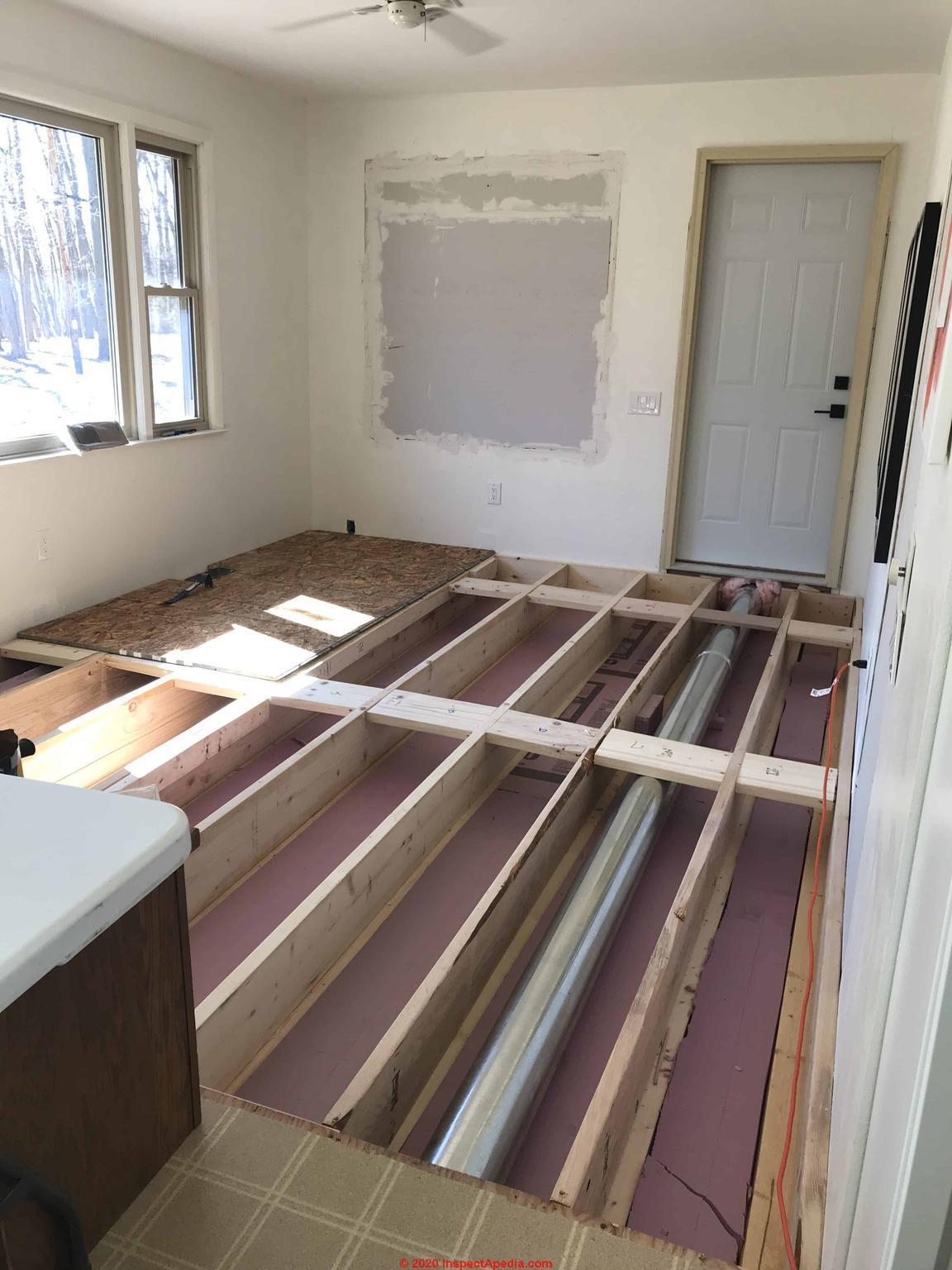
This is a tripping hazard and prevents opening up the floor plan to the entry and kitchen. I see a lot of examples online where new joists and flooring is built on top of the old as in this photo.
Seems the space between the old and new flooring would invite mold, pests and preclude repairs. What is the right way to raise a floor?
On 2020-05-24 - by (mod) - hollow-sounding in corner floor and become blackish
 Uma
Uma
Start by inspecting the framing and subfloor below the area of complaint.
We need to know what's happening: is there a framing issue, subfloor issue, or are there signs of leaks?
What are the country and city of location?
What is the age of the home?
On 2020-05-24 by Umakant
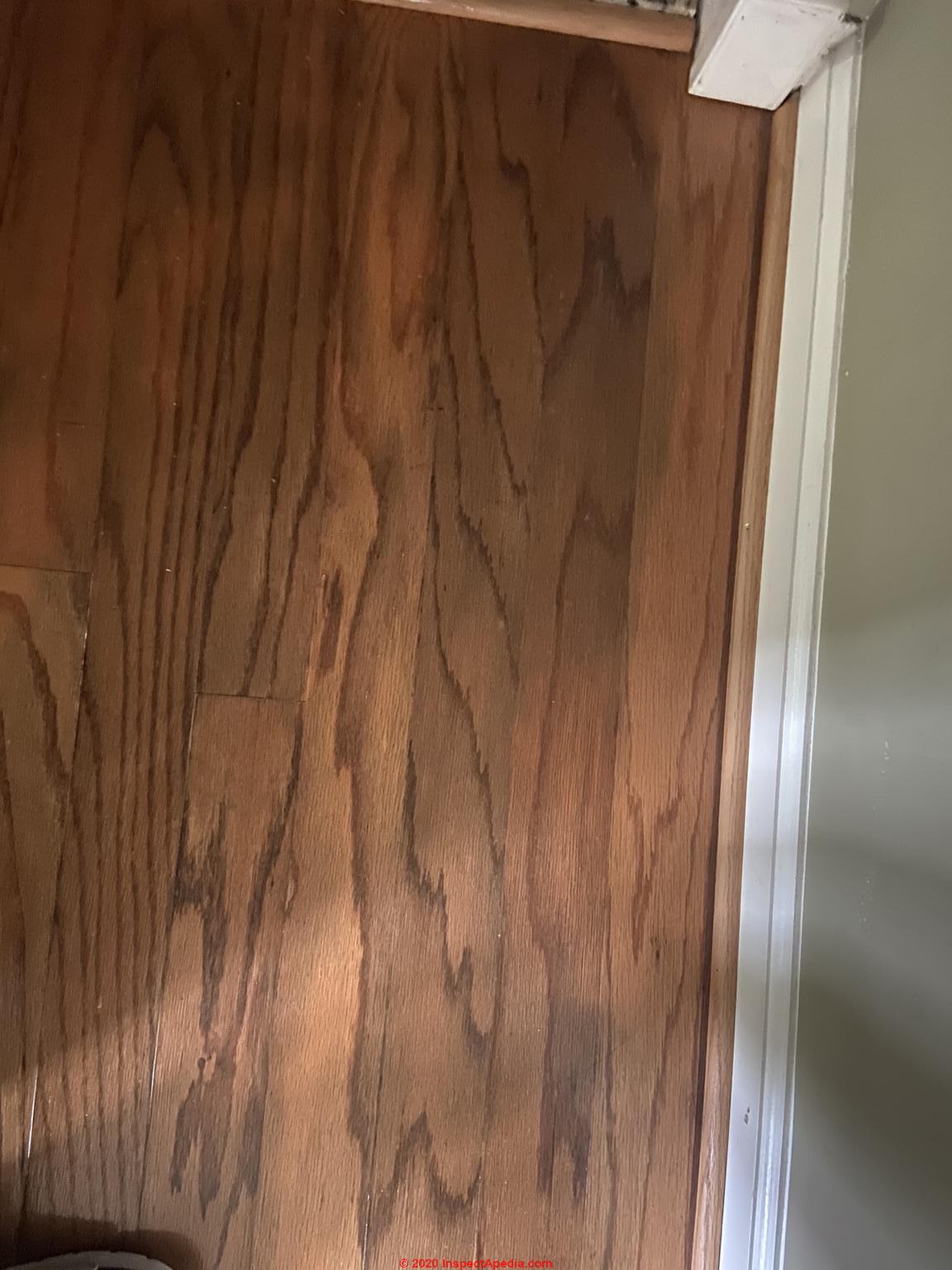
hollow-sounding in corner floor and become blackish at the top. No change in surface finish except change in color.
What will be reason?
How to rectify it.
On 2020-03-27 - by (mod) - white stains on wood floor
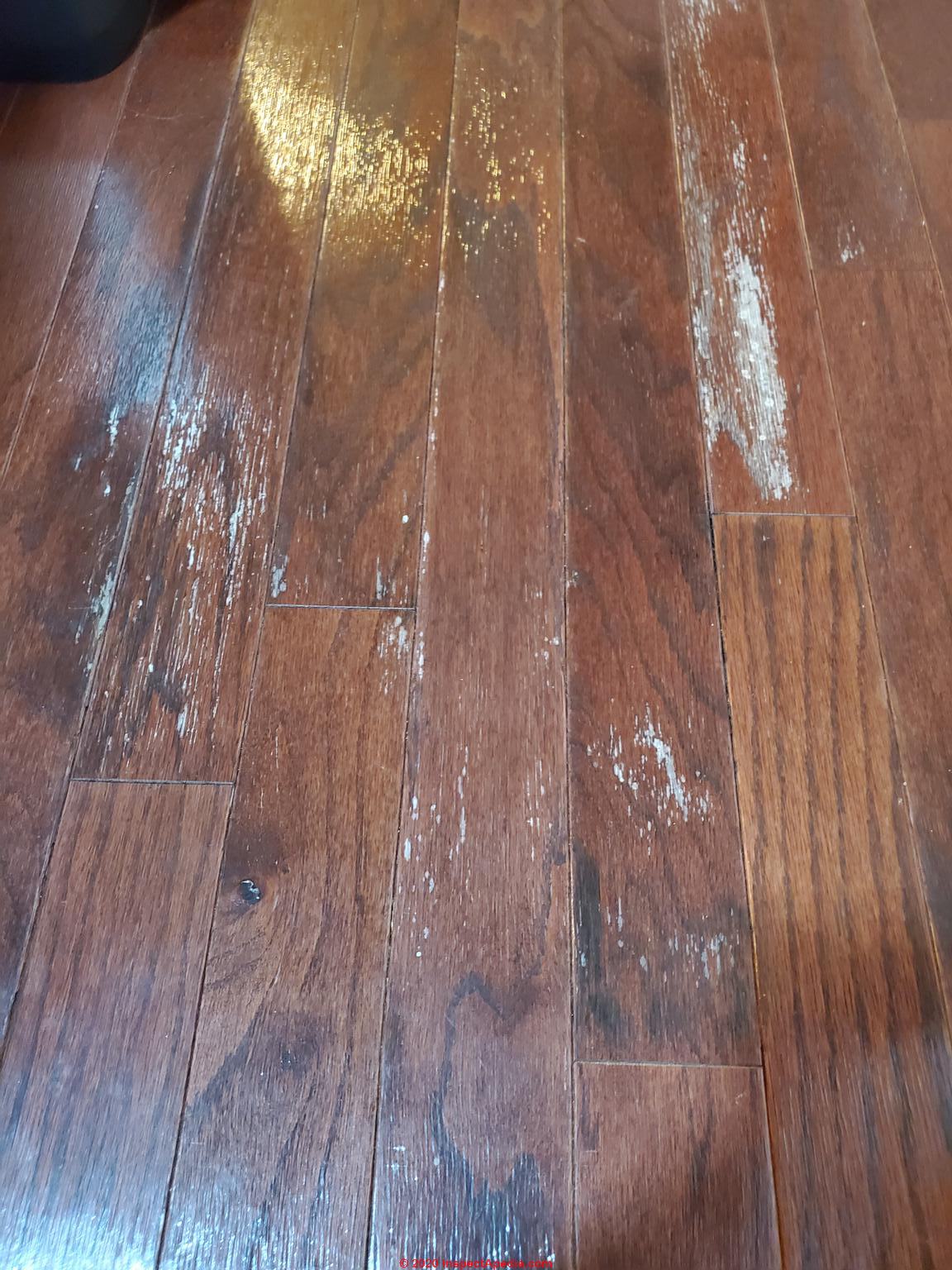 Looks as if the floor has been wet, plus you may have bit of mold under the finish coat,
but water can cause whitening below clear floor finishes even in the absence of mold .
Try letting it dry for a bit and let me know if the white stains diminish.
Inspect the floor from below
to find the moisture or leak source and
to look for hidden water, mold, rot damage.
On 2020-03-27 by Joe
I'm trying to figure out what the white stains are on my flooring.
On 2020-01-26 - by (mod) - repair loose hardwood floor boards from below or from above
Russell
Tips for repairing loose hardwood floor boards from below or from above
While there are some "repair from above" options for loose finished wood flooring they're a bear to implement compared with the easiest approach from below.
If you have access to the floor from below then we can investigate the condition of the floor there and if there's not a bigger problem such as rot or insect damage to framing, usually we can add a block of support and a couple of up-driven screws (don't send them all the way through the finished floor surface) to stabilize the floor.
From above there are a couple of uglier options:
- carefully with an curved-blade sharp X-acto knife cut up but don't remove a pair of spots near the end of each floor board;
- drill 1 1/8" diameter hole through the floor board but not through the subfloor below.
- as the boards only move down, that is they're not otherwise loose and moving up, you can then inject polhyurethane glue to solidify, expand, and fill and stabilize the boards; When the glue is set (maybe 24 hours) you carefully glue down the "chip" you cut loose, to cover the injection holes.
On 2020-01-26 by Russell
I want to refinish my hard wood floor in my very old home. I have two boards in the living room that when I step on the end of them they go down about one quarter inch
On 2019-02-04 - by (mod) -
I wouldn't attempt to repair the floor before fixing the cause of the leaks and condensation in the air conditioning ductwork overhead.
When that's done you ought to be able to clean the surface and the Warren area with the same type of finish material it was on the original floor.
Choose a semi-gloss or gloss depending on what the original finish was.
Spray Feathering the edges you can make the repair disappear completely.
On 2019-02-03 by Pam Moore
Water has dripped from my ceiling a/c vents onto my refinished wood floors. Over time it has worn away the floor finish in a small area (the size of the overhead vent). The wood is exposed but not damaged. How should I proceed to re-finish this small area?
On 2018-10-17 - by (mod) -
Ginger,
In the absence of more information I can but speculate that there is damage below your floor, perhaps from water entry. If the floor had been directly on felt or similar underlayment atop the concrete the damage would be to the flooring itself; if the flooring was laid on furring strips or "nailers" there may be a 3/4" air space below the flooring and water may have entered there.
I suspect that there's little lost in pulling up some floor in the most-damaged area to inspection the conditions and to begin tracking down the cause.
I'd like to see photos of the conditions; use the Add Image button to add a photo to a comment.
On 2018-10-17 by Ginger
after five years engineered hard wood floor has started to buckle up terribly in large area of floor it is laid over cement b
slab floor.If you walk on it you can feel it sink in. Help
...
Continue reading at FLOOR DAMAGE DIAGNOSIS or select a topic from the closely-related articles below, or see the complete ARTICLE INDEX.
Or see WOOD FLOOR DAMAGE DIAGNOSIS FAQs - questions & answers about this article
Or see these
Recommended Articles
- ANIMAL STAINS & MARKS in BUILDINGS
- DECK BOARD GAPS & SPACING
- FLOOR DAMAGE DIAGNOSIS
- OAK FLOORING NOMA CATALOG 1950 [PDF]
- WOOD FLOOR AGE TYPES HISTORY - identify types of wood flooring, density, other properties
- WOOD FLOOR DAMAGE REPAIR
- WOOD FLOOR ENGINEERED & SOLID
- WOOD FLOOR ENGINEERED, REPAIRS
- WOOD FLOOR FINISHES
- WOOD FLOOR REFINISHING SAFETY
- WOOD FLOOR INSTALLATION
- WOOD FLOOR MOISTURE - wood flooring moisture sensitivity, expansion & shrinkage
- WOOD FLOOR, PARQUET
- WOOD FLOOR RADIANT HEAT
- WOOD FLOOR SOLID STRIP, PLANK
Suggested citation for this web page
WOOD FLOOR DAMAGE REPAIR at InspectApedia.com - online encyclopedia of building & environmental inspection, testing, diagnosis, repair, & problem prevention advice.
Or see this
INDEX to RELATED ARTICLES: ARTICLE INDEX to BUILDING INTERIORS
Or use the SEARCH BOX found below to Ask a Question or Search InspectApedia
Ask a Question or Search InspectApedia
Try the search box just below, or if you prefer, post a question or comment in the Comments box below and we will respond promptly.
Search the InspectApedia website
Note: appearance of your Comment below may be delayed: if your comment contains an image, photograph, web link, or text that looks to the software as if it might be a web link, your posting will appear after it has been approved by a moderator. Apologies for the delay.
Only one image can be added per comment but you can post as many comments, and therefore images, as you like.
You will not receive a notification when a response to your question has been posted.
Please bookmark this page to make it easy for you to check back for our response.
IF above you see "Comment Form is loading comments..." then COMMENT BOX - countable.ca / bawkbox.com IS NOT WORKING.
In any case you are welcome to send an email directly to us at InspectApedia.com at editor@inspectApedia.com
We'll reply to you directly. Please help us help you by noting, in your email, the URL of the InspectApedia page where you wanted to comment.
Citations & References
In addition to any citations in the article above, a full list is available on request.
- American Plywood Association, APA, "Portland Manufacturing Company, No. 1, a series of monographs on the history of plywood manufacturing",Plywood Pioneers Association, 31 March, 1967, www.apawood.org
- Best Practices Guide to Residential Construction, by Steven Bliss. John Wiley & Sons, 2006. ISBN-10: 0471648361, ISBN-13: 978-0471648369, Hardcover: 320 pages, available from Amazon.com and also Wiley.com. See our book review of this publication.
- Building Research Council, BRC, nee Small Homes Council, SHC, School of Architecture, University of Illinois at Urbana-Champaign, brc.arch.uiuc.edu. "The Small Homes Council
- Pergo AB, division of Perstorp AB, is a Swedish manufacturer or modern laminate flooring products. Information about the U.S. company can be found at http://www.pergo.com where we obtained historical data used in our discussion of the age of flooring materials in buildings.
- Simpson, W.T., ed., "Dry Kiln Opeator's Manual", Agriculture Handbook 188, USDA Forest Service
- Simpson, William, TenWolde, Anton, "Physical Properties and Moisture Relations of Wood", [PDF] from U.S. FPL, Forest Products Laboratory, Wood Handbook - Wood as an engineering material", 1999, Gen. Tech. Rep. FPL-GTR-113, Madison WI, U.S. Department of Agriculture (USDA) Forest Service, FPL. - retrieved 12/20/2014, original source: http://www.woodweb.com/Resources/wood_eng_handbook/Ch03.pdf
- Skaar, C., Wood Water RElations, 1988, Springer-Verlag, New York 1988
- Stamm, A.J., Loughborough W.K., Thermodynamics of the swelling of wood, Journal of Physical Chemistry 1935, 39(1):121
- ASTM F 1637, Standard Practice for Safe Walking Surfaces, (Similar to the above standards)
- ASHRAE resource on dew point and wall condensation - see the ASHRAE Fundamentals Handbook, available in many libraries.
- Best Practices Guide to Residential Construction, by Steven Bliss. John Wiley & Sons, 2006. ISBN-10: 0471648361, ISBN-13: 978-0471648369, Hardcover: 320 pages, available from Amazon.com and also Wiley.com. See our book review of this publication.
- In addition to citations & references found in this article, see the research citations given at the end of the related articles found at our suggested
CONTINUE READING or RECOMMENDED ARTICLES.
- Carson, Dunlop & Associates Ltd., 120 Carlton Street Suite 407, Toronto ON M5A 4K2. Tel: (416) 964-9415 1-800-268-7070 Email: info@carsondunlop.com. Alan Carson is a past president of ASHI, the American Society of Home Inspectors.
Thanks to Alan Carson and Bob Dunlop, for permission for InspectAPedia to use text excerpts from The HOME REFERENCE BOOK - the Encyclopedia of Homes and to use illustrations from The ILLUSTRATED HOME .
Carson Dunlop Associates provides extensive home inspection education and report writing material. In gratitude we provide links to tsome Carson Dunlop Associates products and services.
 | HOME | ABOUT | ASK a QUESTION | CONTACT | CONTENT USE POLICY | DESCRIPTION | POLICIES | PRIVACY | |
| © 2025 - 1985 Publisher InspectApedia.com - Daniel Friedman | |||||||||